Posted on 1 Comment

Learning American History Through Picture Books (PART 2)

It’s official! History is my favorite subject to teach to my kids thanks to our experience of learning American History through picture books. It’s funny – growing up, history was my worst and least favorite subject. I’m so thankful for the opportunity to grow my education alongside my children.

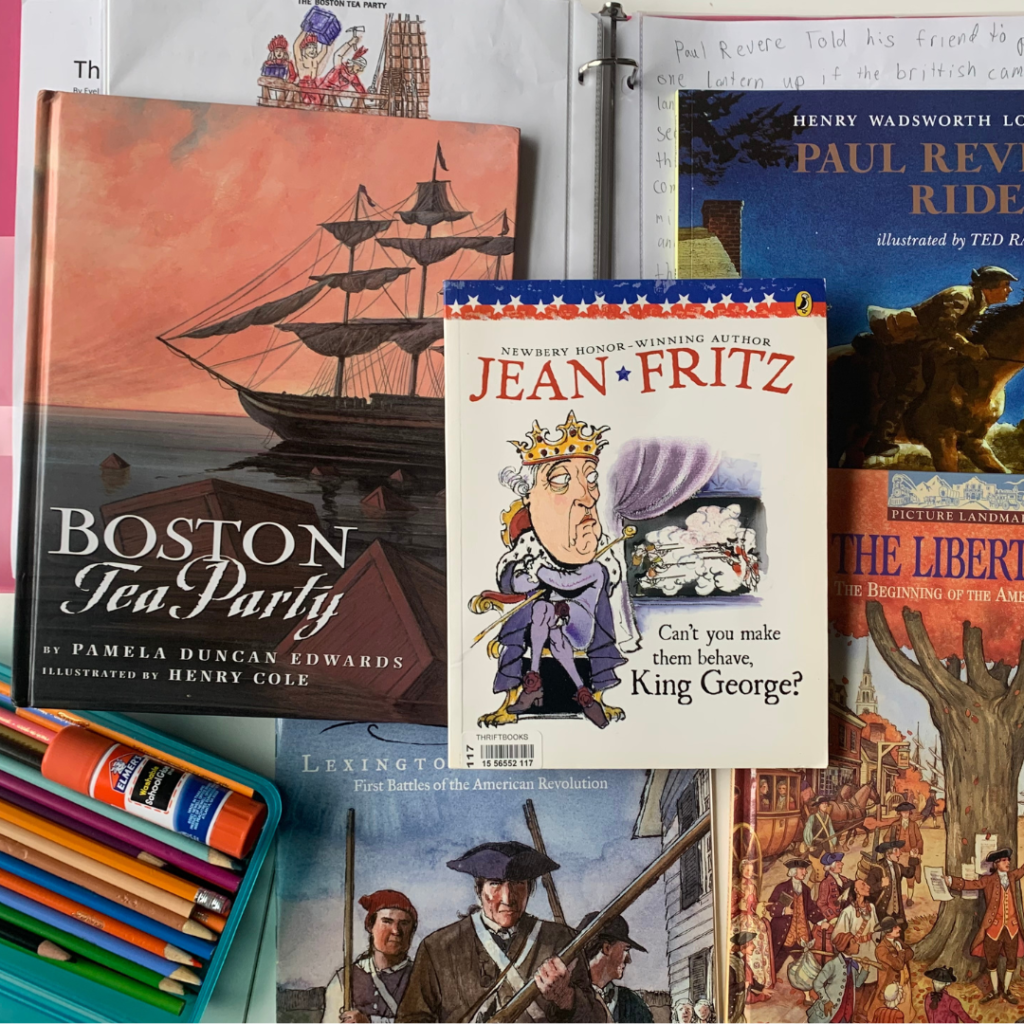
In this post I will be sharing a little bit about our newest American History unit that relies solely on picture books. No textbooks. No worksheets. No extra supply list. This unit relies on beautiful, engaging stories. If you haven’t checked out the first part of this history series, click HERE.

This post contains affiliate links. If you follow one of my links I earn a small commission at no extra cost to you. Thank you for supporting my blog!

American History through Picture Books

If you are new to this series, I’d like to give you a brief overview of what this history series is all about. It all started with my desire to add more great literature to our homeschool. The thought of a history textbook bored me and I thought to myself, surely I can learn about these concepts through something a lot more engaging for my young children.

This is PART 2 of a series I plan to continue working on through the timeline of American History. (So, there are more units to come!)

Part 1 starts with explorers and goes through the Treaty of Paris. (1000 – 1783) Part 2 begins with the Constitution and goes through the end of the Civil War (1787-1865). Part 3 (coming soon!) will start from the end of the Civil War and continue on from there.

I complete all of these units first with my children in order to test out these books and make sure to share our experiences with you. I feel that this will provide you with a more meaningful and complete unit. Part 3 will be completed by my family in the fall of 2024 and I will publish it around Christmas so that it is ready for Jan 2025.

An Explanation of How We Got Here

So for a while I was putting together these thematic history units that were so much fun! (See one of our favorites here.) We read great books, made crafts, and tried new recipes. I loved it! However, I started approaching a new season in my homeschool where none of my little-bitty ones were napping. Finding the time to fit in the “extra” activities became very difficult.

I was also putting my energy in other parts of our homeschool. I spent a lot of time researching and learning about reading and math curricula in order to help my kids thrive. We ran into a few bumps that year that caused some struggle with learning, and my focus was all about helping my kids do their best.

I needed to simplify!

So I changed my goals! I was no longer going to just grab a bunch of books on a topic and search Pinterest for hours looking for crafts and activities. I wanted to research, plan better, and choose beautiful, living books to work through our timeline of history. I thought that for just a short season, we will just focus on reading the picture books and we could try the extra things once we found a good rhythm. The thing is, we fell in love with the simple method of just reading books together!

Reading through picture books in history makes the events come to life. Instead of reading a small section in a textbook, you’re thrown into this beautiful world with so many great details that you can’t help but listen with intent. The stories pull you in and make you want to know more! I can’t express to you how much I have learned through this process. I also wish I could describe how this simple task of reading a book has brought so much joy to all of us as we study history.

An Overview to the Unit

In this unit, you will receive a checklist of picture books to read to your children. The picture books follow a timeline and they are listed for you exactly as you need to read them. You don’t have to choose from a variety of books. Everything is picked for you.

With a checklist like this, it will be easy to put these books on hold at the library. That was a goal of mine. I wanted this to be simple for anyone to gather the books. I believe I purchased three books in this unit because my library didn’t have them. One of the books was because I forgot to put it on hold and Amazon was quicker. So, I maybe spent a total of $15 for the entire unit of picture books! That’s a steal.

Reading and Narration

In this history unit, I will guide you on how to practice narration with these picture books. I teach you how to do it and provide the guiding prompts and discussion questions that you may need. I have an entire section devoted to helping you be successful with the narration of these picture books. If you are completely new to the practice of narration, you will be guided every step of the way!

About a year and a half ago I learned about narration. It intrigued me so much because it seemed so simple and effective. We started practicing it, and I spent time learning more about it. This eventually led to written narration in our home which has completely changed my daughter’s attitude about writing. She loves it! It took time to develop, but narration has been the easiest and most effective form of assessment in our home.

I’d love to suggest one of my favorite books about this topic: “Know and Tell” by Karen Glass. In this book she breaks down the process for each age and teaches you how to transition from oral narration to written narration. It is an incredible resource that really gave me the confidence to keep using narration in our homeschool.

If you’re not into reading an entire book about it yet, check out this website that can answer lots of questions you may have about narration.

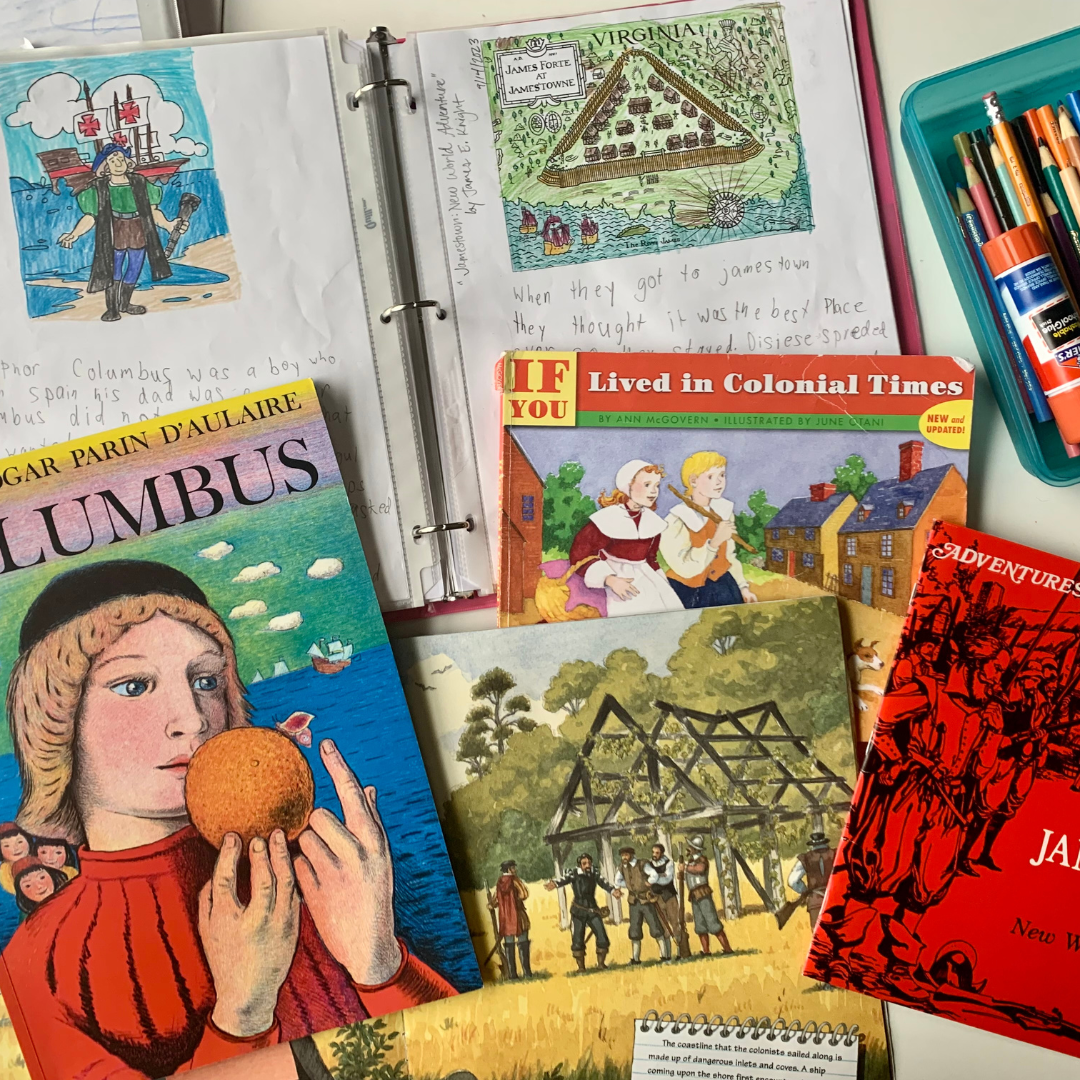
I only share all of this because the unit is that simple: Reading + Narration. No worksheets, no extra supplies, no crafts. These are wonderful things that you are welcome to add, but I wanted the extras to be an option for you. I wanted families to experience the joy of Simply Learning Together.

Picture This

Your ready to start your school day. So you gather on the couch and grab an incredible book about the Erie Canal. You hand your wiggly ones a coloring sheet (already linked for you) so that they can keep hands busy while listening.

You read through this living book together and at the end you talk about it and share your thoughts and ideas. (Discussion questions provided)

That’s it! History lesson done.

Here’s another scenario…It’s been a busy day. You were out of the house at your extracurricular things or homeschool meet-ups. Your school schedule is lighter that day because it’s tough to fit it all in when you are out of the house. You get to the end of the night and as your kids wind down for bed, you grab a beautiful picture book about the Gold Rush and read it to them.

History lesson done.

I’m serious. It’s that simple. Here’s the kicker – you will learn SO MUCH, and you and your kids will actually REMEMBER what you learn because these books are that good! My kids recall the events in the books that we read all the time. This shows me that they learned from it! And I personally know more about American History than I ever did learning about it in school.

Does this simplicity sound like it might be a good fit for you? OR…if you don’t like it that simple and you enjoy adding the extra (which I did at one point! So, I understand that too!) How does it sound to have a complete list of picture books to guide you through the timeline of American History?

Some of Our Favorite Books

There are so many good books to choose from. I wanted to ask my kids what their favorite books were too, and we are sharing them with you here. The funny thing is we all picked the same one! So, I’ll share that one and a couple more of their favorites.

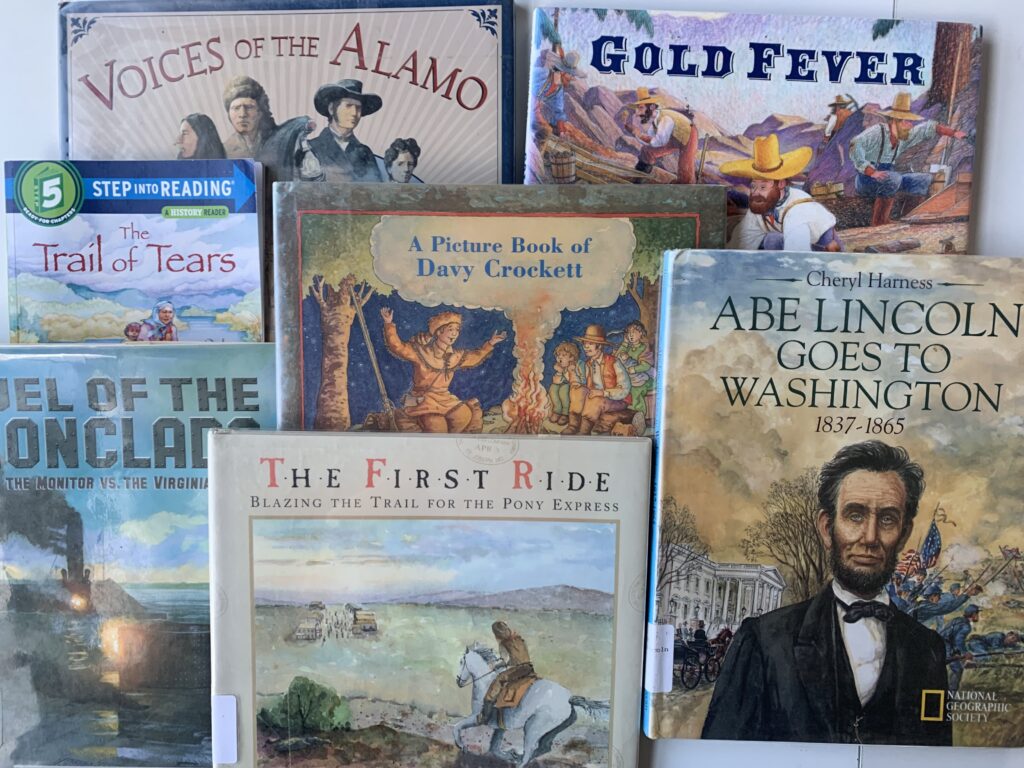
Our favorite was called “The Duel of the Ironclads”. I think it stood out to me because it surprised me so much. I almost didn’t add it to the list, and then we read it. Wow! It was so engaging and interesting. Then, we watched a short re-enactment of the actual event on YouTube. It was incredible! (I do show a handful of YouTube videos to help make connections – all of these are listed in the unit for you)

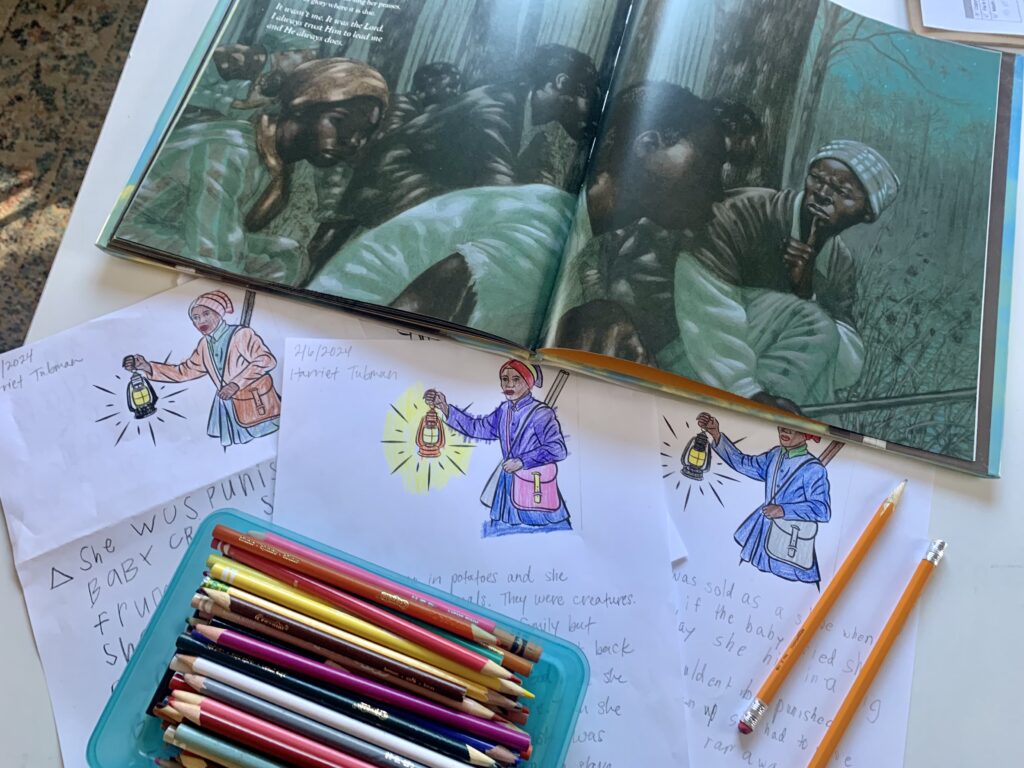
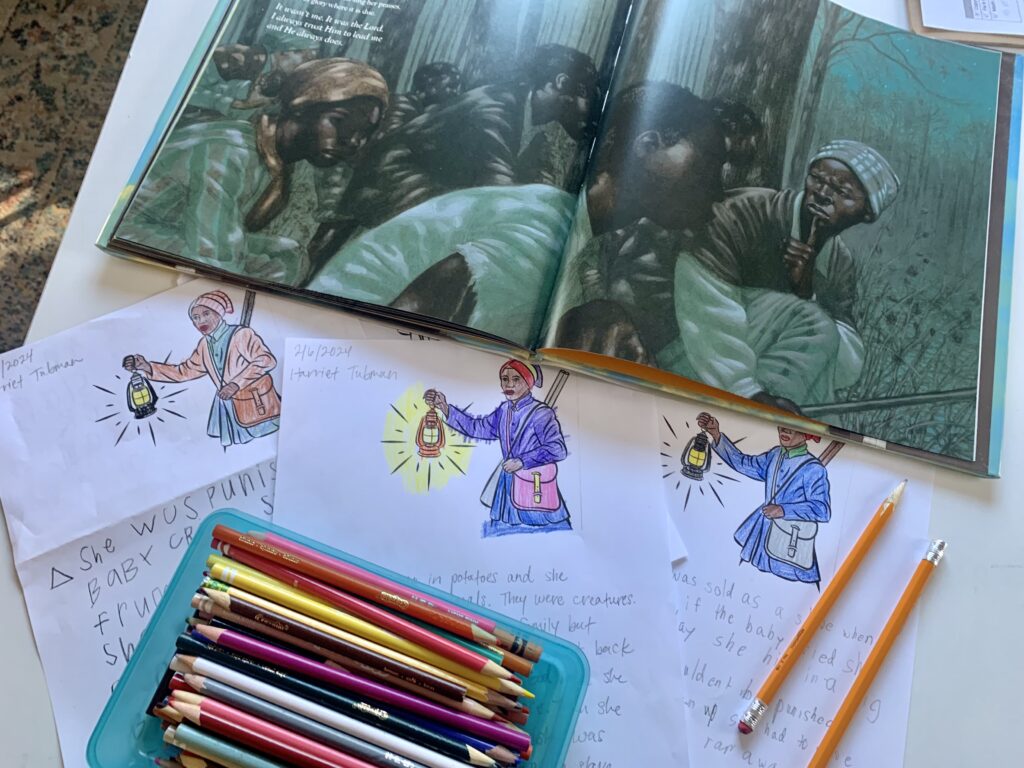
My oldest daughter loved reading about Harriet Tubman. We read “Moses: When Harriet Tubman Led Her People to Freedom” and it was wonderful. We followed it with a Torchlighter’s episode and my kids enjoyed it so much.

Another one of my kid’s favorites was “If You Were a Kid in the Civil War…”. It’s a really simple book but there’s something about it that’s so relatable. I remember reading it to them. This child was right there next to me, completely engaged the entire time.

DOWNLOAD AMERICAN HISTORY PART 2

Helpful Links

PICTURE BOOKS LINK: ALL of the History books we read for American History Part 1 AND American History Part 2 are linked in my Amazon storefront.

COLORING PAGES LINK: The coloring pages we used for our written narrations are linked through my Pinterest account.

Video Links

All of the YouTube videos that are listed in this unit are linked below:

More Info

Want to see the first American History Unit? You can see the entire book list for free on my blog post. You can also see a look through of the curriculum HERE.

American History through Picture Books – Complete Curriculum

I am so excited that this history curriculum is now complete. This has been a project I have been so passionate about over the last couple of years, and I am thrilled to share it all with you. You can now get ALL of the units to this curriculum which makes it a COMPLETE American History curriculum spanning from the explorers in 1000AD all the way through modern times (2000s).

Unit 1 – Explorers through the Treaty of Paris (1000-1783)

Unit 2 – Constitution through Civil War (1787-1865)

Unit 3 – Reconstruction through World War II (1865-1945)

Unit 4 – Post World War II through Current Times (1945-2003)

You can also purchase all of the units as a bundle for a discounted price.

NEW Science Through Picture Books

We had so much fun learning history through these amazing picture books. I knew Science had to follow suit. Read more about it HERE.

Looking for more literature-based curriculum?

For the last few years, my children and I have created a novel-based language arts program that is family-style and enriched with great literature each week. I’m so excited to share a NEW guides with you on how we do this in our home. If you’re tired of an all-in-one language arts workbook or if you’re itching for a great novel to read aloud to your kids, you’ve got to try this method! Check out the link below.

Novel Guides

You can watch multiple videos about this method of Language Arts on my YouTube Channel HERE

Posted on 12 Comments

Learning American History through Picture Books

Learning American History through picture books sounded so great to me, and I was determined to make it happen this year. Now that we’ve done it, I am so pleased with the way it turned out and how much we loved it!

I was never a good history student growing up. Textbooks felt boring and not relatable. The information didn’t stick with me, and I didn’t enjoy it. Boy, did that change once I started teaching it to my own kids in our homeschool! It’s become one of my favorite subjects.

There’s something about a good picture book that just grabs you in to the story. Reading them together with my kids is engaging and memorable. With American History as our focus for the year, I was itching to focus more on picture books and LESS on a textbook.

I worked really hard to put this list together for my kids (ages 9, 7, 4, and 3). To be clear this list covers Viking explorers through the Treaty of Paris (1783). I know for a fact that there may be some gaps as we can not cover Every. Single. Detail…but can a textbook? No matter what curriculum you use, the information is going to be delivered in a unique way.

This was our unique way of learning history this year, and we learned so much. Most importantly, we had fun doing it. It never felt like school. My hope in sharing this list with you is that it can provide that same feeling for you and your family. I pray it allows you to enjoy simply learning history together with your kids.

This post contains affiliate links. If you follow one of my links I earn a small commission at no extra cost to you. Thank you for supporting my blog!

Want to Make it Even Easier?

I have created a complete curriculum of these books, based on the way we completed them in our own home. It includes all of the details of how we read them and what activities or videos we completed alongside them. If you would rather take the planning out and follow a step-by-step guide to completing this, than this is the curriculum for you!

See a complete look-through of this curriculum on my YouTube channel HERE.

It will break down a schedule for you, explain all the details of narration and writing, provide discussion questions, and it contains the links to all of the resources I mention below. You can check it out HERE.

Prepping for the List

Before I jump into the list, I want to share how I came up with it. This took some time and studying on my part, but it was worth it.

TruthQuest history is where I started. This was recommended to me by another homeschooling mom, and it’s basically a gigantic book list. Now, when I say gigantic, I mean GIGANTIC. It’s overwhelming without a doubt. Want a book on George Washington? The book provides 31! And that’s just one person in American History.

Now, times that by each person and event and you can see how this becomes an extremely extensive list. The reason I bring it up though is because it’s a fantastic resource if you’re looking for more book ideas about history. The author has multiple units from ancient history to modern times.

After a little reading and studying on my own, I was able to come up with a list of books that would allow us to work through American History with picture books. I’ve learned in the past that quality is better than quantity, so I have chosen spectacular books to help us do this. I can’t wait to share this list with you!

Narrations

I am normally the crafty type, but for some reason I am just not in a crafting season right now. Maybe it’s the work load of my two bigger ones. Or maybe it’s because of the two little ones that need my time and attention as well. If you check out some of my other units I’ve shared about, you can see that I love a good craft at times.

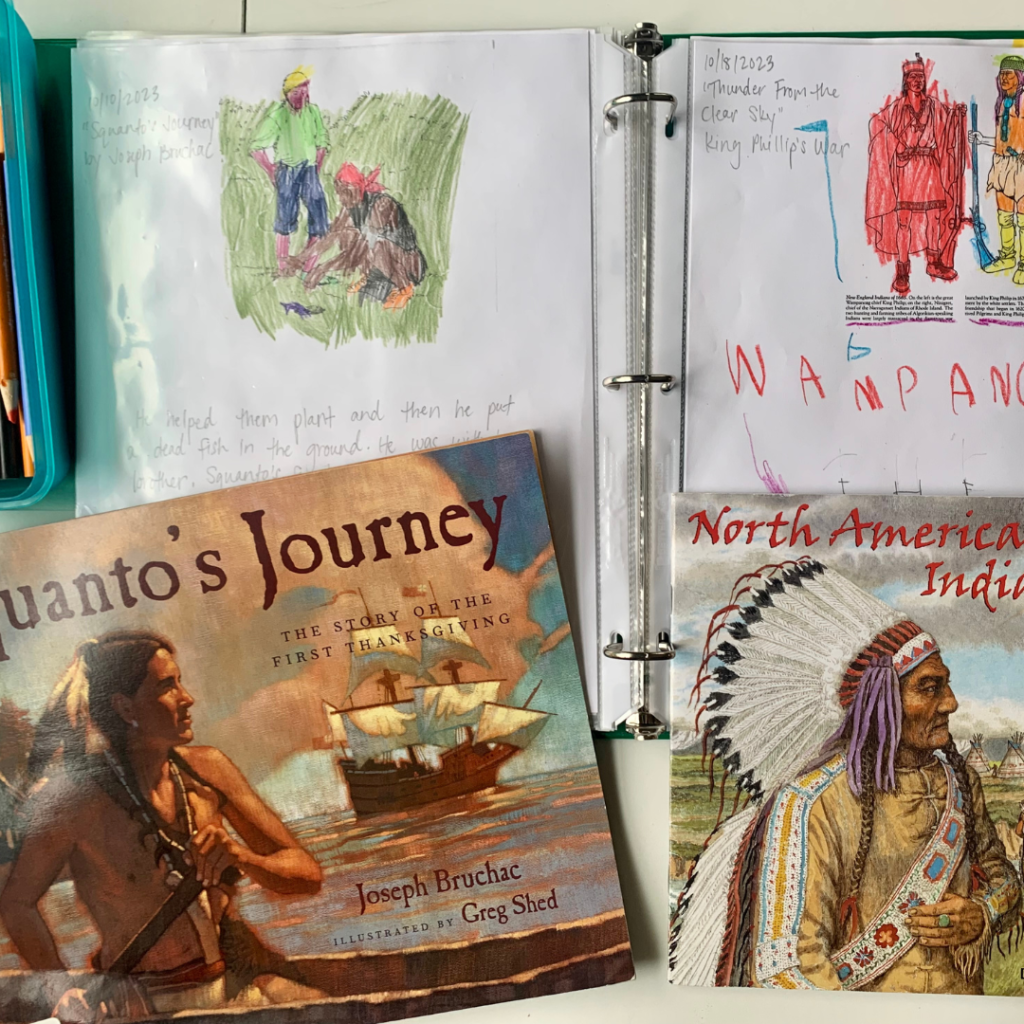
As much as I love them, that wasn’t my goal in this unit. I wanted to keep it so, so simple. Our “assessment” or “learning products” came in the form of narration instead of a craft. Since narration uses my children’s actual words/thoughts I have actually come to really value them. What a treasure to see their sweet minds at work. I usually toss crafts…these I want to hang on to forever!

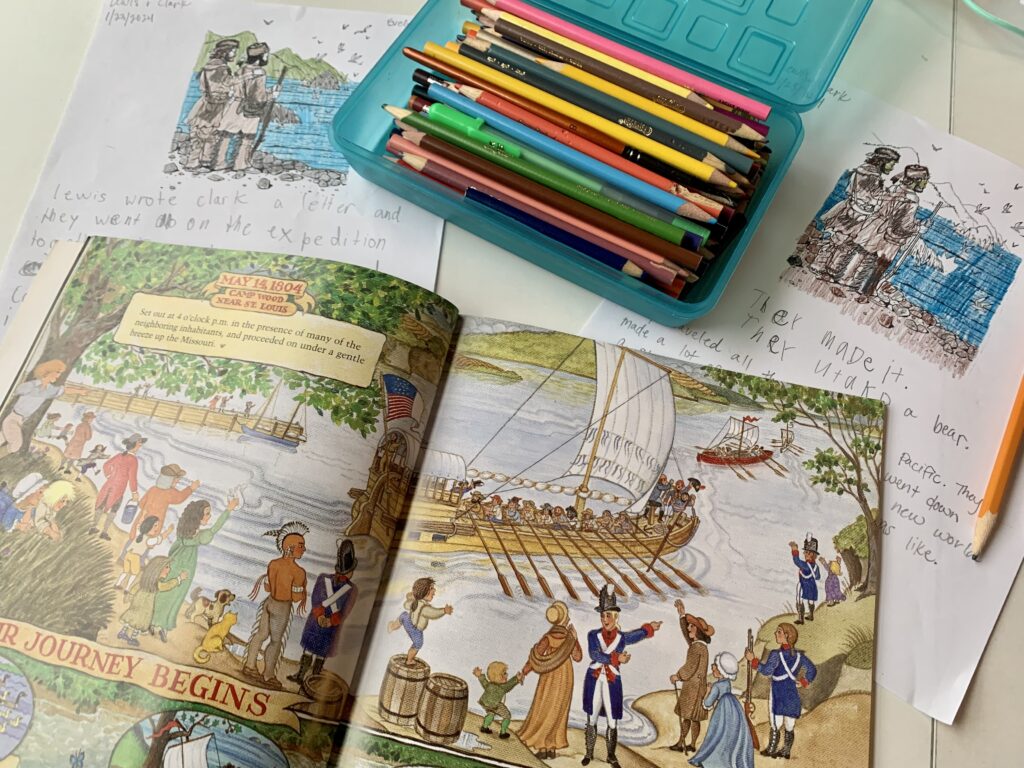
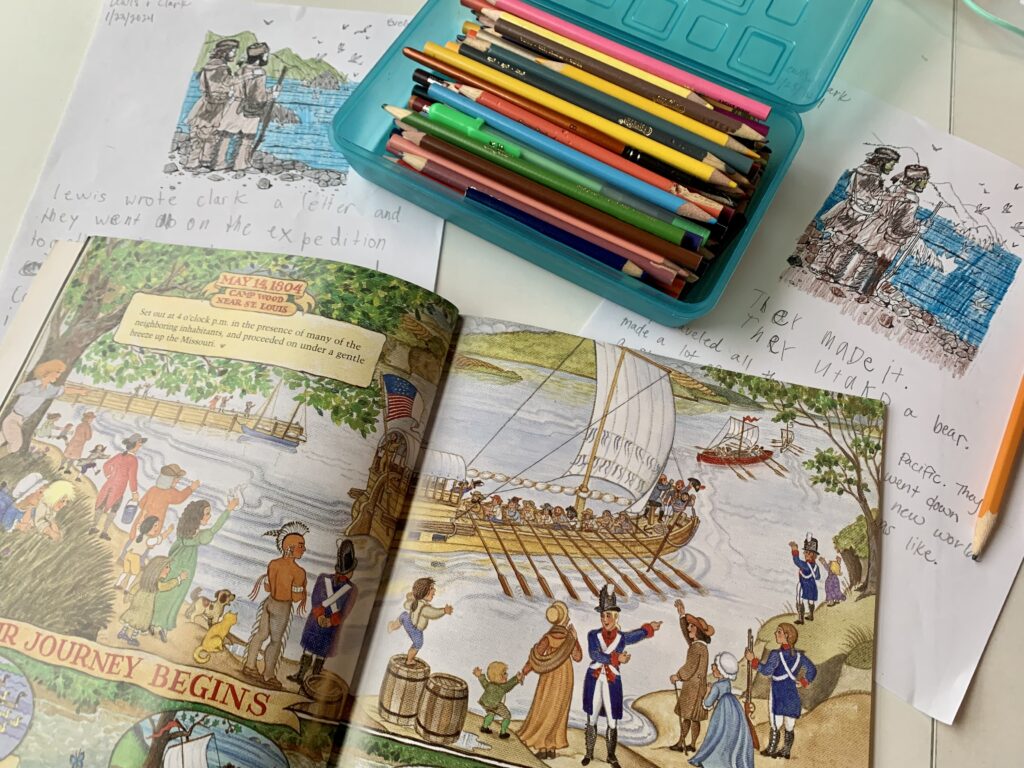
I kept this really simple. My goal was one per week, but some weeks we did two. Add in a simple coloring page for them to work on while I read and it served two purposes – keeping their hands busy AND a page for me to record their narrations. (I share exactly how I did this in my unit)

If you’re not familiar with narration, it’s basically telling back what you just read. We do this each time we read, but some books we record our narrations. My oldest (9) writes her own. My 7yo verbally narrates and I write it for her. Every once in a while my 4 year old will tell me something, and I melt at her cute little sentences about the book!

This was such an easy way to “measure” their learning and it was FUN! I also love going back and reading what they wrote. It’s interesting to see how my 9 year old’s writing has changed, and I notice my 7yo improving in the way she verbally narrates as well. It’s just amazing to see all they remember.

Videos

There were definitely times I couldn’t find a book about what I needed. When this happened, I usually shared a short video with the kids on the topic. This made it easy to have a discussion as needed and move on to the next thing. I will list videos we watched in my list below.

Picture Book List

It is so exciting for me to share this list with you. I hope you and your family enjoy these books together! You can find all of the books linked HERE. I will also link them individually for you for convenience, especially because a couple of them can’t be found on Amazon.

Some of these books are lengthy. Many of them we read half one day and finished it the next. I have little ones, so I totally get the need to cut read aloud time short. It’s hard to keep them quiet and still! Take your time. Enjoy the books for however long you need. Almost every book we were able to read in 1-2 days.

At this point in our timeline, there are so many different people you could touch on in history…Abigail Adams, Thomas Jefferson, John Hancock, etc. We could read for days and days! I chose a select few before finishing out our unit before Christmas. Here’s what I went with:

WOW! It is exciting to reach the end of this list and share! Of course I missed things. I am human, but I doubt you can find a textbook that covers every single detail either. The point is to experience the joy of learning all of this. By using picture books, that joy comes effortlessly, and the events and people are memorable in story form. I hope you feel that same way!

Do you want to see how we lined all of these books up and turned it into a history unit? I have it detailed and explained in my unit that you can find HERE.

Videos List

The following videos helped us fill in some gaps between books:

  • “How did Europeans immigrate to the Americas?” by History on Maps  (Video Length – 11:52) This is a great video to touch on the fact that there were multiple explorers besides Columbus.
  •  “John Smith | PBS World Explorers” by Gerry Dincher  (Video Length – 4:44) A couple books on the list briefly mention John Smith. This is a short video giving more details of his life.
  • “13 American Colonies” by Kids Academy  (Video Length – 4:16) This video explains how the New World became the 13 Colonies.
  • “Crispus Attucks and the Boston Massacre” by The History Channel (Video Length – 6:08) You will read about the Boston Massacre in one of the books, but this video looks into the life of Crispus Attucks, one of the first men killed during the events of the American Revolution.
  • “Treaty of Paris 1783 | Daily Bellringer” by The Daily Bellringer (Video Length – 5:01) A peace treaty is mentioned in the couple of books that we read, but this video will go into detail about what it is and what it meant.

Coloring Pages

I have also linked the coloring pages we used for our narrations on a Pinterest board titled “American History Coloring Pages”. There are lots of options online, but be sure to check out the board for a few to start with.

I would love to hear from you if this list is helpful! Be sure to check out the unit I put together that schedules all of these books and videos together. (Click here to view)

Have you read any of these books? Do you have a favorite on this list? Any you never heard of? Share with me in the comments and connect with me on social media. You can find me on Instagram and YouTube.

Helpful Links

American History Curriculum

Picture Book Links

Coloring Pages

Individual videos linked above.

American History through Picture Books – Complete Curriculum

I am so excited that this history curriculum is now complete. This has been a project I have been so passionate about over the last couple of years, and I am thrilled to share it all with you. You can now get ALL of the units to this curriculum which makes it a COMPLETE American History curriculum spanning from the explorers in 1000AD all the way through modern times (2000s).

Unit 1 – Explorers through the Treaty of Paris (1000-1783)

Unit 2 – Constitution through Civil War (1787-1865)

Unit 3 – Reconstruction through World War II (1865-1945)

Unit 4 – Post World War II through Current Times (1945-2003)

You can also purchase all of the units as a bundle for a discounted price.

NEW Science Through Picture Books

We had so much fun learning history through these amazing picture books. I knew Science had to follow suit. Read more about it HERE.

Looking for more literature-based curriculum?

For the last few years, my children and I have created a novel-based language arts program that is family-style and enriched with great literature each week. I’m so excited to share a NEW guide with you on how we do this in our home. If you’re tired of an all-in-one language arts workbook or if you’re itching for a great novel to read aloud to your kids, you’ve got to try this method! Below are two of the newest guides available now:

James and the Giant Peach

The Secret Garden

You can watch multiple videos about this method of Language Arts on my YouTube Channel HERE

Posted on Leave a comment

No-Sweat, Simple Composer Study – Beethoven

One afternoon, my girls and I were enjoying a snack around the table when I decided to play classical music. This is not something I normally do. With four young children, the day fills quickly, and subjects like music tend to be pushed aside. (I’m sad to admit it.) However, I decided to try it, because I had just finished listening to a book that really encouraged me. (Modern Miss Mason by Leah Boden)

Turns out the music quit playing and I didn’t even realize. (oops!) No one could hear it. When I finally remembered it was on, I quickly grabbed my phone to figure out what was going on. I turned it up and saw the name of the song. It was a song by Beethoven.

My oldest daughter has an ear for music so I decided to “quiz” her on the spot, just for fun. “Do you know who this is?” I asked her. She looked at me like the answer was obvious and responded, “Yeah…it’s Beethoven!”

I couldn’t believe it! I didn’t even know that, but how cool! I asked her how she knew, and she just said that it just “sounded like him”. Well, this got us thinking…what does he sound like?

A quick YouTube search, and we were immersed in the world of Beethoven!

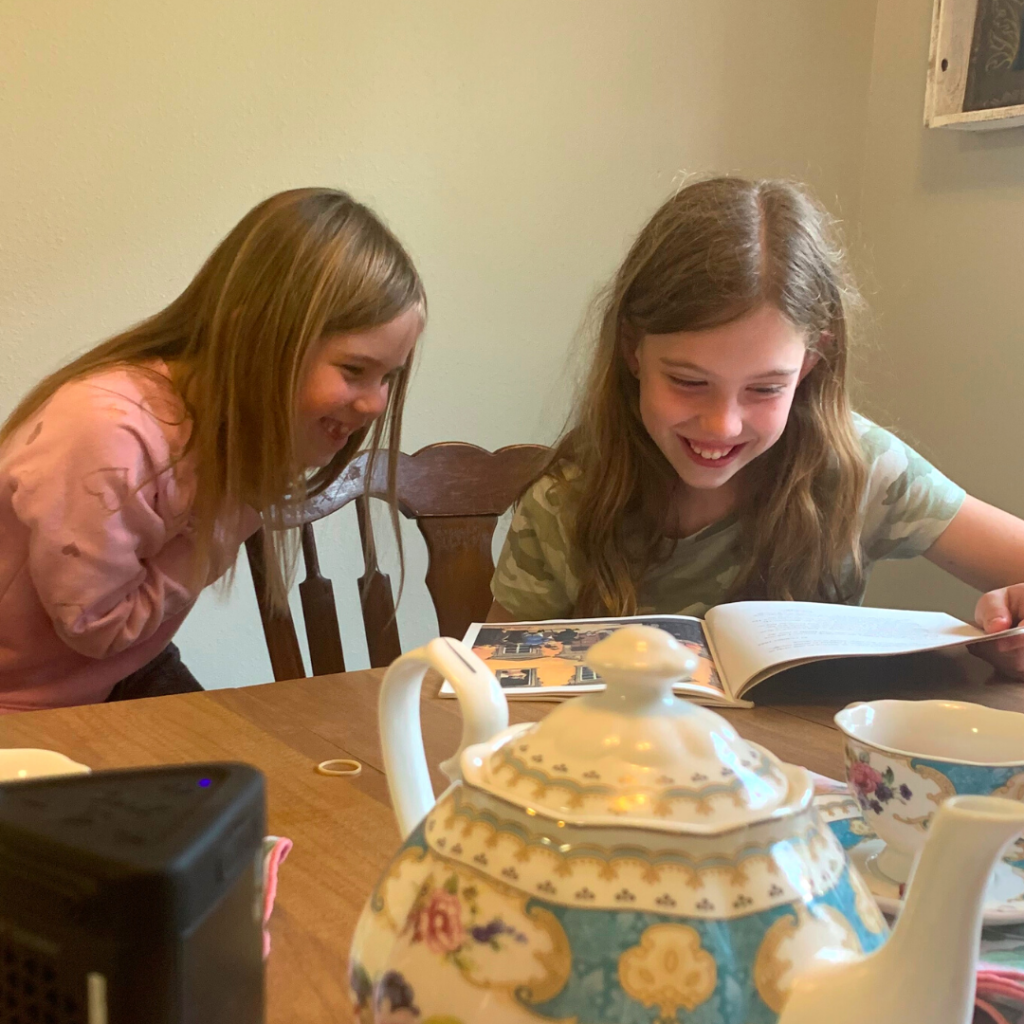
At the end of this afternoon snack, I had this boost of confidence – I can do this! I can add this in without sweat. It was so easy to sit back and chit chat about a song over a snack. Of course, in homeschool mama fashion, I laid out a plan in my head to figure out how to make this work with consistency. The following is what I came up with and some tips on how to make it work.

This post contains affiliate links. If you follow one of my links I earn a small commission at no extra cost to you. Thank you for supporting my blog!

Choose your Composer

This sort of fell in our lap, but there’s a couple ways you could do this. If you’re studying a specific time period, you could look to see if a composer lived during that time. It would be a great way to link your subjects.

The other option would be to just pick something you’re familiar with or something that sounds interesting to you. For our first one, Beethoven was such a great fit, because it’s a well-known composer and I also knew the name well. So, it was fun to learn so much about it!

Lastly, you could pick at random from a good list of composers! Check out this website from Simply Charlotte Mason for a list of suggested composers to study.

Snack and Drink

Little ones always seem to listen better when they’re eating. So, you may want to pick a time of day where a snack fits in.

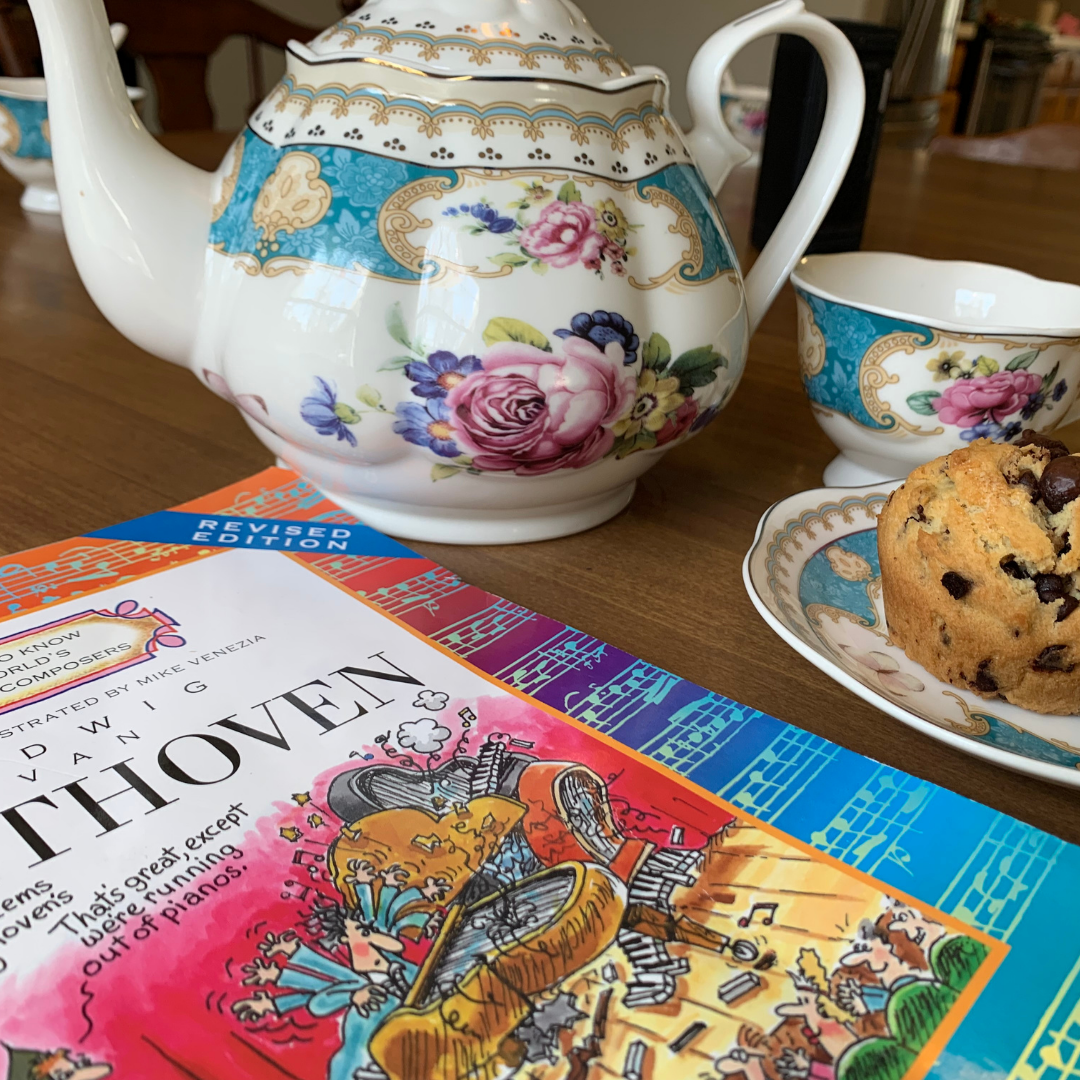
I chose the afternoon after our quiet time, but I have heard of people that do studies like this at breakfast or during a mid-morning snack. Now, a drink is not necessary, but my girls love a tea party. So, it’s turned into a little routine.

We have a cute tea set that one of the girls got for Christmas one year, but other than that our “tea party” is not fancy! Our snack has been as simple as apple slices to something more intense, like homemade muffins. Always pick what feels easy for you.

You want this time to be relaxing and enjoyable. Nobody has fun when they’re running around like crazy. Choose simplicity!

I’ll be honest, the first week we did it, I did kind of feel like a crazy person. Balancing everyone’s tea, and the honey, and the mixing, and the temperature adjusting – it was a little nuts. However, the more we’ve done it, the easier it gets.

I wonder if I should share some of my tricks with you?? If you’re interested in tea, I’ll let you know what we do to make it flow better. First, I prepare while my kids are still in quiet time. I boil the water and steep the tea.

Next, I get the snack ready and at the table (usually I just put it on a paper towel!) I set out enough tea cups for everyone, and I actually put two ice cubes in each cup. This helps cool the tea quickly so no one burns their mouth.

I also give each girl a little spoon (that came with the set). When it’s time to add the honey, the kids know the rule – fill the spoon and mix. No more 😉

Just as a side note – I treat myself to a snack and drink too. I could drink tea with the kids, and sometimes I do, but I usually like to make myself a yummy iced coffee! It’s such an afternoon treat.

beethoven books

Books

To keep it simple, I decided to look for books I could find at my library/local used bookstore. I put books on hold, and picked them up as they were ready. Since this study took about 7 weeks, I wasn’t in a rush to get them all at once.

My goal was to try to read one book a week. Sometimes we did this in just one sitting. Some books, we split up into two different times. I basically just read until I feel like I’ve lost their attention. (This is usually around 15-20 minutes, sometimes even shorter if my two-year-old is awake)

The books we got were great, and we learned so much! I’m going to list them here for you and I’ll put them in order of how much we enjoyed them. The first is the one we enjoyed the most!

You’ll notice I didn’t have a book for every week. There was a week or two when I was waiting on a book so we just looked up some information about a song on the internet. It was a quick way to learn a little bit about the song/musician, even without a book.

Music

If you do a Google search for “Ludwig Van Beethoven Compositions” you’ll get a big list. I chose a small handful to look at over a 7 week period. I will list those below.

I really don’t think it matters what order you listen to the songs. You could do it chronologically, but that would take a little research. I chose the songs based on the ones I recognized first. Then, I chose ones that were brought up in a book we read or that came up on an internet search.

For each song, I used a YouTube video to play the music. There are a couple different ways I would integrate the music into our homeschool.

First, I would try to play it while I prepared our afternoon tea. When we started reading, I would turn it down. When we finished our book, I’d play the music again and this time we would listen very closely. We might point out if it’s soft or loud. I might ask what instrument they could hear.

Sometimes we would even pretend we were playing and move our body according to the feel of the music. It sounds silly, but Beethoven’s music is very up and down. One minute it’s quiet and playful and the next it’s loud and aggressive. We had fun acting this out on a pretend instrument.

Lastly, I would try to play it a little bit throughout the week. I wasn’t always good about this, but I did try. Sometimes I could just play it in the house or I might play it while we were picking up.

Playing the Music on the Piano

Every once in a while my kids will do a piano lesson on Hoffman Academy. One afternoon, my oldest realized that there was a teaching video for “Fur Elise”, one of Beethoven’s compositions.

So, instead of doing the normal Hoffman Academy lessons, she has been working on “Fur Elise” for a couple weeks. I thought it would be such a great way to experience the music, and it now had so much more meaning.

Easy Break-Down

Let’s break this down to visualize an easy-to-do checklist. Sometimes seeing it like this really shows off the simplicity, and that’s my hope here. A composer study can be this simple and still be so beneficial!

  • Prepare Snack and Drink
  • Gather around the table
  • Read a book about the composer aloud
  • Listen to a song by the composer
  • Discuss the book, the music, the instruments

That’s it! No worksheets, no extra activities, just fun conversation and good food around the table. Doesn’t that sound wonderful?

Simple, Fun, and Memorable

“Hey, Mom, what’s Beethoven’s favorite fruit?” This was a joke my daughter read in a magazine and shared with me one night. Of course, after listening and learning about him for so long I was determined to get this joke. “Moonlight Banana,” I said. “SO CLOSE!” She responded. And then she sang the answer, “Ba-na-na-naaaaaa”

Did you hear it? It’s from his Fifth Symphony. How cool that we can recognize that together. A silly joke suddenly has so much meaning.

It’s such a beautiful part of homeschool. I knew very little about Beethoven, and now my children and I can all share in our learning together. I used to think that a composer study was just one-more-thing to add to our day. How in the world was I supposed to get it done?

However, with this approach, not only was it simple, but it became one of the most relaxing parts of our day. I so much enjoyed pausing are afternoon to connect over music, food, and a good book about a GREAT musician.

Posted on 4 Comments

Knights and Castles – Middle Ages Mini Unit

coat of arms

We are beginning to study the middle ages in our homeschool, and I’ve decided to make it into a bunch of different mini-units. Our first one will focus on knights and castles.

Read further for all the books we read as well as the activities we did, but come back soon and check out our other middle ages units as well. I will be posting them on the blog as we complete them!

This post contains affiliate links. If you follow one of my links I earn a small commission at no extra cost to you. Thank you for supporting my blog!

the door in the wall

Read Aloud Novel

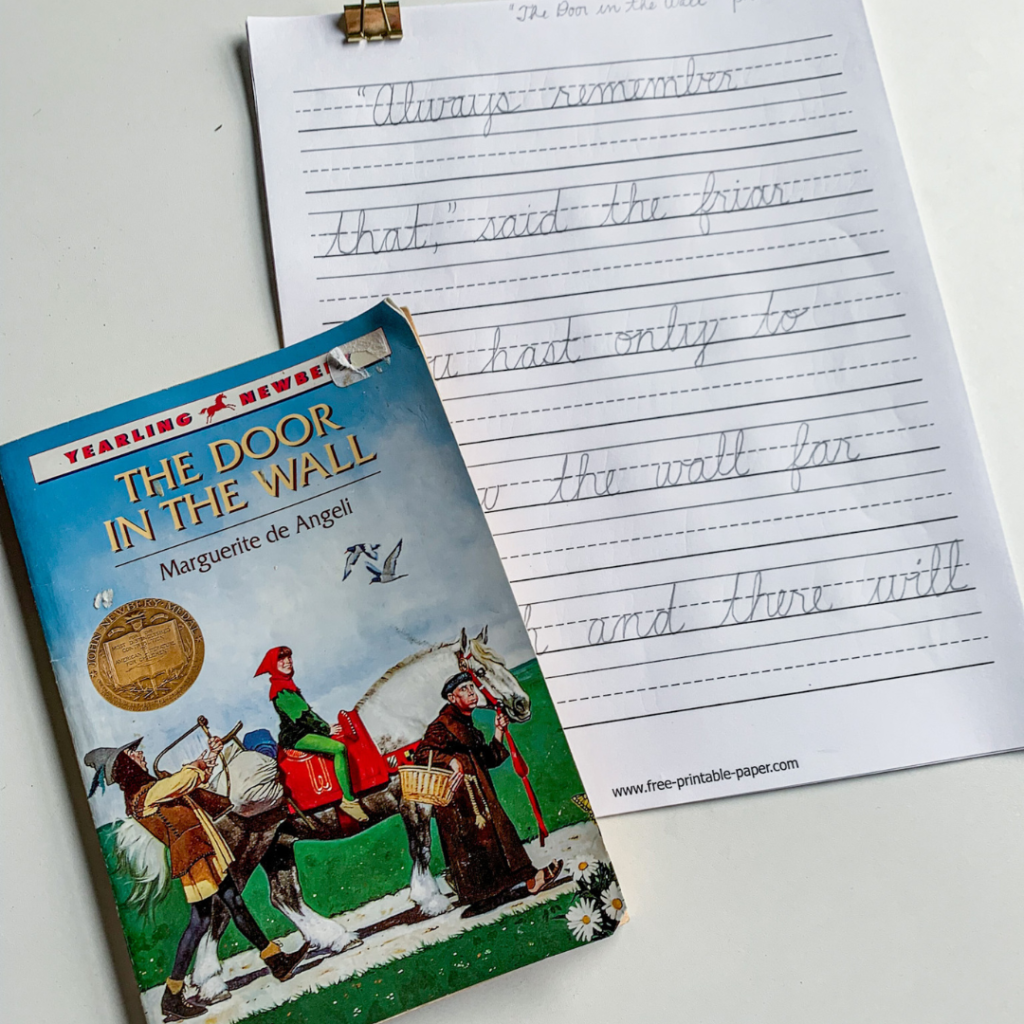
“The Door in the Wall” by Marguerite de Angeli takes place in the middle ages. It follows the story of a young boy who is destined to become a page but is suddenly ill and unable to fulfill his duty. A monk comes to his aid and encourages him to learn new things and work on becoming stronger. His hard work will soon pay off as he will play an important role in protecting the castle.

This book came highly recommended (from many other homeschool mamas online) as a historical fiction novel to read while studying the middle ages. The language can be tricky to understand, and by reading it aloud, I was able to explain what many different things meant. (I also learned some things myself!)

The book is 121 pages and contains 10 chapters, most of which we were able to read in one sitting. The last two chapters were much longer and took us a couple of days to get through.

I also love the message and theme that surrounded the story. Hard work and perseverance can really pay off. When one opportunity ends, another one might come along. You may think about a modern day phrase, “When one door closes, another opens”. All of these ideas brought on great discussion with my kids.

We all enjoyed this book so much. Although we used it to study history, we also used it for my oldest daughter’s language arts lessons. (Read about that here)

More Books

I love using the library as our main source for books, and for this unit, I even visited a local used bookstore. That may get dangerous in the future. I could’ve bought so much! I found tons of good reads and I’ll share the best ones here. You can also check out my YouTube video where I share a peak inside of the books as well.

coat of arms

Coat of Arms

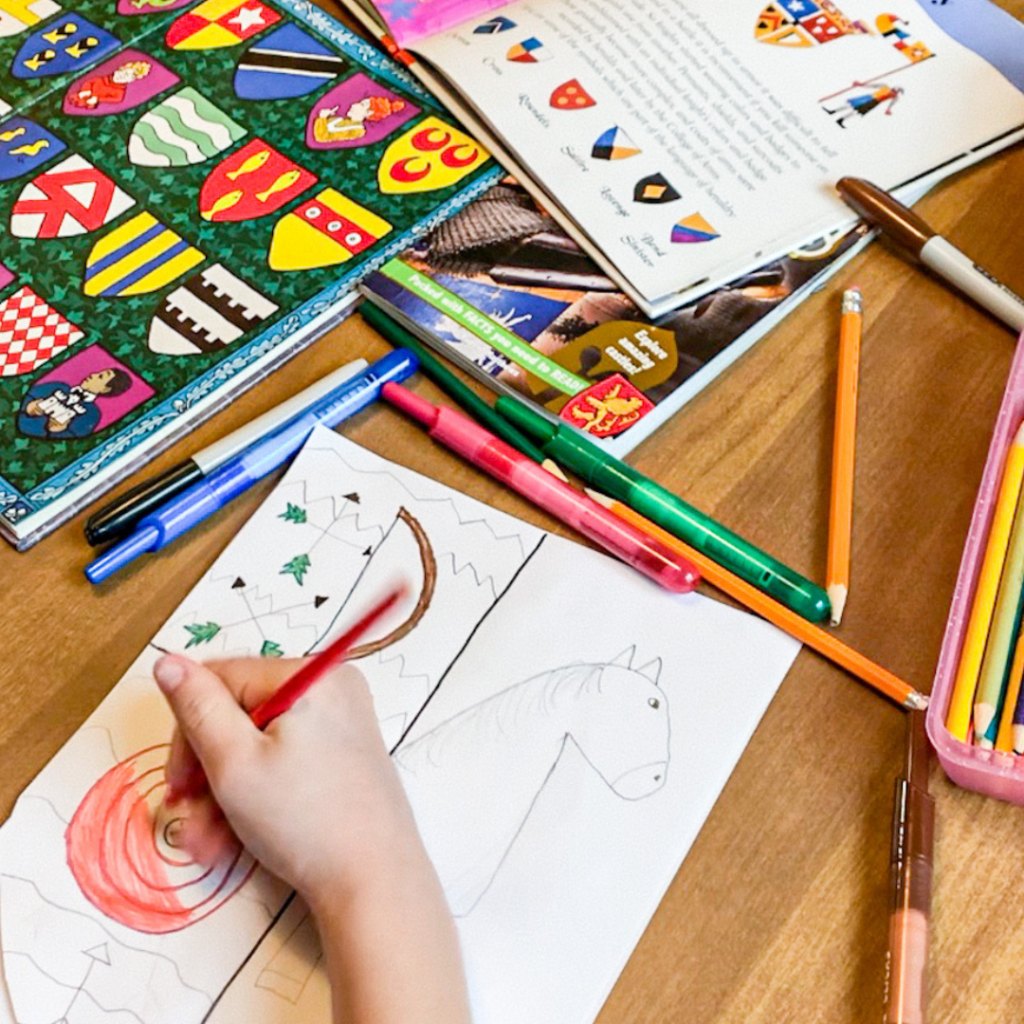
Almost every book we read about knights talked about a coat of arms. Knights would decorate their shields in a way to represent who they were. This was a fun activity to express who we are and decorate our own pretend shields.

You could definitely cut cardboard and paint if you wanted to go all out. We just used white paper! I cut the papers into a shape of a shield and I offered a couple of options. Decorate the whole shield or divide it into 2-4 pieces and add different designs to each piece. They each did something different, but I loved seeing what they chose to add to their shield.

I had them tell me about their designs and what it meant to them so I could write it on the back. It’s a great piece of art for their portfolios.

cardboard castles

Create Castle and Drawbridge

This activity and the two following activities were completed after reading portions of “Castle” by David Macaulay. This book seemed a little intimidating to me because it’s quite long, but it was highly recommended. It turned out to be absolutely wonderful and we learned so much! It did take about 3 days to get through it all.

We created a castle using a cardboard box from our pantry. This blog post breaks down the entire process. Since I have younger ones, I did a little bit of prep to help the activity run smoother. By the time we were ready to start, I already had the boxes shaped.

I had my two oldest each decorate their own castle. I will admit that once it was time to create the drawbridge, I could only help one at a time. If you had older kids, it may be fun to hand them the supplies and say – how can you make this work?

With my two (ages 6 and 8), we talked about it as we went, and I had to do a lot of the work so that the drawbridge would do what it was supposed to. Even still, they loved the finished product and immediately got their Barbies out to start acting out a castle attack. It was pretty cute to watch, and such a fun way to assess what they’ve been learning – through play! I love it!

Castle Drawing and Narration

Before we read our Castle story one morning, I found a video that taught my girls how to draw a castle. Now, we love Art for Kids Hub, but their castle drawing could only be watched if you pay for a subscription on their website.

So, we did something crazy and decided to just draw the Ice Castle from their YouTube channel. I encouraged my girls to decorate it like the castles we have been reading about. My oldest did just that and kept the snow. My other two girls just went full blown Frozen and kept the ice castle.

Either way, it was still fun and I decided to use their pictures as a visual for their narration of what we read that morning. I wrote something for my two oldest girls and kept it in our yearly portfolio. I love how it turned out.

Build-A-Castle Rotation

Just one more day of reading this book (“Castle”), and I wanted something fun to finish it off. We have a few open-ended toys at our house, so I chose four different bins full of blocks to get us started.

I set out four blankets for our morning time and put a bin on each blanket. We had Magnatiles, Mega Blocks , Duplo Legos, and wooden blocks. I told each of my kids that I would set a timer for five minutes and they’d have to build a castle out of that specific toy.

At the end of the timer, no matter if they finished or not, they would rotate to the next blanket and build another castle. They thought this was the coolest. It really broke up the time well! They made all kinds of castles and it was the perfect way to finish off the book while keeping hands busy and ears listening. It was also neat to see their creativity and became a beautiful way to assess their understanding!

Still on My Wishlist

I always like to have a few ideas in my head of what I want to do for our unit studies. I’ll usually make a board on Pinterest (See my middle ages board). The thing is, I don’t always get to every single one. That’s because they are mostly enrichment! And if it adds more stress to complete it, then I put it off for another time.

I love homeschooling with this philosophy because I don’t feel pressured to check a bunch of things off. We still learn so much through our readings! The next couple of activities are ones I wanted to do but didn’t quite get to during our unit. However, they’re too cute not to share! I’ll be saving them for a rainy day, but I hope they might inspire you if you’re studying the middle ages!

Sir Cumference

The Sir Cumference series is so much fun. They are picture books based in the medieval times that teach math concepts through stories.

We found ours at the library. I checked out four of them and we simply read them together before bedtime for a few nights in a row. My kids loved them!

Although we didn’t do an activity to go along with it. I kept thinking how fun it would be to do a simple graphing idea with some candy or cookies, just like in the “Roundabout Battle” story. Check out this candy bar graph for an idea of what I mean. You can also see this photo of an M&M pie chart for another type of graph the book used.

These are such simple ways to bring the book to life and experience the graph in our own hands instead of just the story.

Armor of God

One of the books that we read had a Christian message, and it was called “The Brave Young Knight”. The book was great alone, but I had this idea to do a little armor of God study to go along with it.

You can find the armor of God in the bible in Ephesians 6:10-20. Once we read about it in scripture, I wanted to create a fun, easy knight using aluminum foil shapes. This link will give you a better idea of what I’m talking about.

As we review the armor of God, I hoped to cut the different pieces of the armor out of the foil, glue it on construction paper and label it. I just feel like this could be such a fun way to link our study of knights to what we learn in scripture. It’s also a great visual to help us memorize the verses.

Movies/Shows

We have a family movie night on the weekends, and I love when I can match it up to what we are learning. During this unit, we watched a couple of movies that were related to knights and castles.

First, was The Sword in the Stone. This is an old Disney film that follows the adventures of a young boy who wants to be a knight. It is very magical, but it does take place in the time period. Since I have kids ages 2-8, it was a great one that we could all enjoy.

Another weekend, we let the bigger kids watch A Knight’s Tale. Now, this one is rated PG-13 and it took a little editing on our part.

First, we had to talk with the kids about the language. We also had to be prepared to skip a love scene in the film. The only other thing was one of the first scenes. You see a man’s butt and there’s also a visual of someone hanging in the background. Beyond those few parts, the rest of the film was fantastic!

I highly suggest you read through the Common Sense Media page, and as always, choose what you think is best for your family. Everyone has a preference for movies, and as parents we get the privilege to choose what is shown in our home. In my opinion, it was worth the watch, even though we skipped a small bit. The film portrays that time period so well. You can really see the different classes of people as well as things like jousting and coats of arms, all of which we discussed together the weeks before.

More Unit Studies

Come back soon for more unit studies related to the middle ages. If you liked looking through these ideas or if you try one at home, I’d love to hear about it in the comments!

We’ve been doing unit studies like this all year and I have most of them on the blog. I’ll link some of them below if you’d like check them out!

Ancient Egypt

Weather

Space

Ancient China

Vikings

Thanksgiving

Posted on 6 Comments

The Door in the Wall – A Charlotte Mason Inspired Novel Unit – The Middle Ages

The Door in the Wall

The Door in the Wall is a novel that takes place in the middle ages. This Charlotte Mason inspired novel unit will connect both history and language arts. The living book will provide passages that allow your child to study grammar, spelling, and vocabulary while practicing the skills for copy work, narration, writing, and dictation.

I talk a little more about this method of language arts in this post. It has given us so much freedom in our studies and I have enjoyed very much linking multiple subjects (history and language arts) to one book. Because of this, I almost feel like I have less on my plate, which I think can be helpful for any parent out there!

This novel was a part of our middle ages history unit study, which I will also link for you (COMING SOON). In that post you can see many different activities we did as we studied the time period, but they could also be great activities as a tag-along to this book! We are currently studying the middle ages now as I write this, breaking it into little mini units that I will post as we complete them.

This post contains affiliate links. If you follow one of my links I earn a small commission at no extra cost to you. Thank you for supporting my blog!

The Door in the Wall

“The Door in the Wall” by Marguerite de Angeli takes place in the middle ages. It follows the story of a young boy who is destined to become a page but is suddenly ill and unable to fulfill his duty. A monk comes to his aid and encourages him to learn new things and work on becoming stronger. His hard work will soon pay off as he will play an important role in protecting the castle.

This book came highly recommended (from many other homeschool mamas online) as a historical fiction novel to read while studying the middle ages. Our family used it as a read aloud which worked out great. The language can be tricky to understand and by reading it aloud, I was able to explain what many different things meant. (I also learned some things myself!)

The book is 121 pages and contains 10 chapters, most of which we were able to read in one sitting. The last two chapters were much longer and took us a couple of days to get through.

We all enjoyed this book so much. It was wonderful to read a book that took place in the time period we were studying for history. I also love the message and theme that surrounded the story. Hard work and perseverance can really pay off. When one opportunity ends, another one might come along. You may think about a modern day phrase, “When one door closes, another opens”. All of these ideas brought on great discussion with my kids.

Chapter Summaries and Discussion Questions

I wanted to include chapter summaries and discussion questions in this post for a couple reasons. First, I think it’s helpful to know more about what is in a book before reading it with your kids. When I have more information about a book I can come up with different activities or topics I may want to learn about with the kids as we read through it.

Second, someone reading this might want to assign this book as a silent reading option for their child. I feel like these summaries and questions may help guide you in assessing how that silent reading is going.

I did not include answers to the questions. Most of them are meant to start a discussion and can have a lot of different answers. I hope that if you are practicing narration with your kids that these questions might allow you to challenge your kiddos in what they tell you about the book.

SPOILER ALERT – If you read these summaries, some of the events in the story will be spoiled. Unfortunately, I couldn’t avoid that, but I do hope that even still you find it helpful.

Chapter One

SUMMARY: Robin, a son of a noble family, has reached the age where he is ready to be sent away to learn about becoming a knight. Right before he is supposed to leave he becomes ill. A wandering friar hears of Robin’s condition and travels to help him.

How do you think it feels to leave your parents at such a young age?

What is the plague?

What do you think Brother Luke means by a door in the wall?

Chapter Two

SUMMARY: Robin arrives at St. Mark’s where he is cared for by Brother Luke. He is learning new skills while getting accustomed to his new living space.

What was it like at St. Mark’s?

What kind of things does Brother Luke do to help Robin? What skills does he teach him?

Why do you think Robin got upset with the boy that called him Crookshanks?

Chapter Three

SUMMARY: Robin works hard on his whittling project and learns a helpful lesson about patience. He makes a plan with Brother Luke to learn many different subjects with the help of other monks.

What does Robin learn while learning to whittle?

What kind of things does Brother Luke want to teach Robin?

What do we learn about Robin and his illness after reading the letter to his father?

Chapter Four

SUMMARY: Brother Luke takes Robin fishing where he sees a group of boys playing. He experiences different emotions as he yearns to be well, but he also gets the idea of making himself something to help him walk.

How did Robin feel when he saw the boys swimming?

How does Brother Luke plan to help make Robin stronger?

How do you think crutches could be a door in the wall?

Chapter Five

SUMMARY: Robin receives a reply from his father and makes plans to travel to Shropshire. Robin, Brother Luke, and John-go-in-the-Wynd travel together by foot. The journey is not easy and a fork in the road causes a delay.

What did Robin’s father say in his letter?

How does the fork in the road affect their journey?

What kind of attitude does Robin have on the trip?

Chapter Six

SUMMARY: Robin, Brother Luke, and John continue traveling and stop at a place to sleep. Unfortunately, they are forced to leave because of two evil men and must quickly find a new place to rest.

How did Brother Luke feel about staying at the White Hart?

What did Robin overhear the two men talking about while he was supposed to be sleeping?

Chapter Seven

SUMMARY: Robin, Brother Luke, and John pause their journey for Robin to experience a fair. After a quick stay at an old cottage in the woods, they reach their destination. Robin meets Sir Peter and begins his duties as a page.

How does Robin feel about meeting Sir Peter?

What kind of things will Robin do for Sir Peter?

Chapter Eight

SUMMARY: Robin gets stronger and stronger as the days pass. A thick fog threatens the castle and they are attacked.

Robin has learned many new subjects and skills since he became ill. What are they?

Why is the fog putting the castle in danger?

What do the people inside the castle do while they are under attack?

Chapter Nine

SUMMARY: The people in the castle are running out of supplies while they are under attack. Someone must sneak out to get help. Robin volunteers and heads to John’s Mother’s cottage. John sends a message to get help for the castle.

Why do the people in the castle need help?

Why does Robin think he can be the one to get help?

What was Robin’s journey like?

What is John’s plan for getting back into the castle?

Chapter Ten

SUMMARY: Sir Hugh arrives to help defeat the Welsh. Robin is a hero! However, he still desires to see his family. Soon enough, he sees them and makes plans to travel back home to be with them.

How did Robin play such an important role in this defeat?

Who arrives at the castle on Christmas Eve?

What kind of blessing and reward did Robin receive from the king?

Where will Robin go to live now?

Unit Schedule

The following is a brief outline of what I hope to accomplish each day of this unit with my child. For more details on each piece, be sure to read my explanation post.

In this post I will share the passages we studied and how we broke them down each day in case you’d like to try the same sort of method.

For a VERY brief overview of how our time is used for language arts – I read aloud the novel to all of my kids, usually in the evening before bed. For daily grammar practice, my daughter uses Fix it Grammar. I love that it can be done independently and takes about 5 minutes to complete. Copy work is also completed independently (5 minutes). I set a timer for our actual language arts lesson for 20 minutes.

When you read through the lists for each day, think of it as a checklist. As you can see in the way we split our time, this is getting accomplished all throughout the day at different times. It’s spaced out in a way that works for us.

DAY 1

  • Read novel and narrate [whole family]
  • Grammar Workbook [independent work]
  • Copy work – complete 2-3 lines of selected passage from novel [independent work]
  • Study passage – focus on grammar [language arts lesson with parent]

DAY 2

  • Read novel and narrate [whole family]
  • Grammar Workbook [independent work]
  • Copy work – complete 2-3 lines of selected passage from novel [independent work]
  • Study passage – focus on spelling and vocabulary [language arts lesson with parent]

DAY 3

  • Read novel and narrate [whole family]
  • Grammar Workbook [independent work]
  • Copy work – complete 2-3 lines of selected passage from novel [independent work]
  • Written Narration [language arts lesson with parent]
  • **Option – review passage/spelling words if necessary

DAY 4

  • Read novel and narrate [whole family.]
  • Grammar Workbook [independent work]
  • Copy work – complete 2-3 lines of selected passage from novel [independent work]
  • Dictation [language arts lesson with parent]

DAY 5 (OPTION)

  • Read novel and narrate [whole family]
  • Silent Reading (15-20 minutes) [independent work]
  • Narration [language arts lesson with parent, about 5 minutes]

Passage Selection – Week One

I selected two passages to use for our copy work because it took us two weeks to read the book. Each week, we studied one passage during our language arts lesson time. I will share with you how we study these passages throughout the week.

Now, if you wanted to simplify this even more, you could only focus on what connects to your grammar workbook. Point out what you’ve studied so far, and that’s it. That way it’s consistent between the two. However, I enjoy looking a little deeper than that. There are times when I don’t really know why a comma is there, and I just look it up online right there with her. That’s what it’s all about – learning together!

The following is our passage for week one:

“Always remember that,” said the friar. “Thou has only to follow the wall far enough and there will be a door in it.”(The Door in the Wall, Chapter One, Marguerite de Angeli)

An important thing to keep in mind here is I am not trying to have her reach mastery with these discussions we have about the passages. The mastery will come from her grammar workbook practice. However, I do want her to observe the grammar usage in a way that is meaningful to her, through our family novel. Our lesson is more of an opportunity to have a conversation about why this passage is written the way it is.

I picked this passage because it’s the first time the book mentions the door in the wall. I felt it would be an important part of the story, and it really was. By studying this passage, it allowed my daughter to really think about what the door in the wall means.

On the first day of our schedule, we focus on grammar and punctuation. The following is what we discussed for this passage:

  • Capitalization and end marks
  • Quotation rules
  • The comma after “that” goes at the end of the quote, before the actual quotation mark.
  • “Thou hast” is another way of saying “You have to…”
  • For the word “there” we made sure to discuss why it was spelled that way.

As we study these topics we might practice different examples on the board or practice them orally, if possible. This might seem brief, but as you discuss each one with your child and provide alternate examples or even just look for more examples in the book, the time will go quickly.

Spelling and Vocabulary

For our second day of lessons, we are still using the same passage. This time we focus on spelling and vocabulary. I first ask my daughter if she knows what certain words mean based on the context. If we need to, we look them up in the dictionary.

The vocabulary words we looked at for this passage: friar, and we reviewed “thou hast”

For spelling, I quiz her with many of the words from the passage and see which ones are mastered and which ones need practice. I have her write them on a board. You can make this list based on your child’s needs, but our list looked something like this: always, remember, friar, thou, hast, only, follow, enough, there, door.

Any word spelled incorrectly we practice a few times. I will also try to quiz her the following day as well to see if she can remember the word(s) she missed.

Passage Selection – Week Two

Week two follows the exact same schedule, just with a different passage. So for this section, I will list the passage as well as what we studied to go along with it.

“They knelt in the woods, as if it had been a cathedral, as indeed it looked to be. For the trees, bare of leaves, arched overhead in the very same way that the groined arches of stone swept up high overhead in the Gothic churches.” (The Door in the Wall, Chapter Seven, Marguerite de Angeli)

I loved the image that this passage created, and I liked that it mentioned Gothic churches, something we plan to look at while we study the middle ages. Once we started looking at it together, I regretted my choice because the commas in the first sentence were difficult for me to explain (or even understand myself). BUT! We kept on…this is a learning experience for the both of us and my goal is not mastery here, but instead it’s exposure with meaning.

The following is what we discussed for this passage:

  • Capitalization and end marks
  • The commas in the first sentence – This was the confusing part I mentioned. Based on my research, those commas are there because “as” is a subordinate conjunction. Now, I am no expert, but this is what we went with! Honestly, I’m not stressing about it. I’m 35 and have to google it so I feel like this is one I can let slide. 😉
  • The commas around “bare of leaves” are there because the clause is not essential to the sentence.

Later in the week, I realized I could have also looked at similes. I believe the first sentence contains one. So, if that is something you are interested in, it’s another option. We will save similes for another day.

Spelling and Vocabulary

On the second day of our week we look at spelling and vocabulary from the passage. The spelling words we practiced were as follows: knelt, cathedral, indeed, looked, bare, leaves, arched, overhead, groined, swept, Gothic, churches

The vocabulary words we studied were cathedral, bare, arched, groined, and Gothic. Don’t forget to use context clues first, and then try the dictionary.

Optional Activity – Connecting the Grammar Book to the Passage

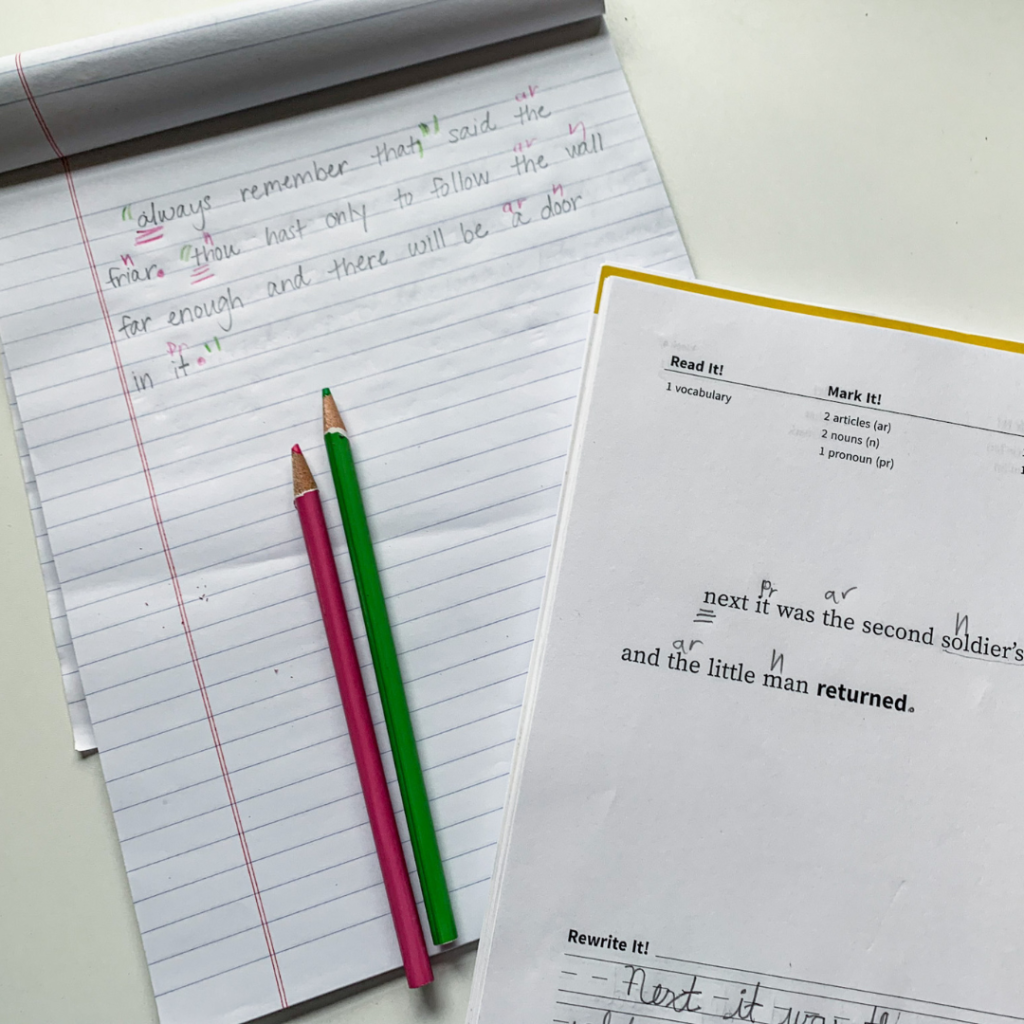
Our spelling and vocabulary lesson goes pretty quick, so I like to use this day to connect her grammar book to our passage. She is using Fix it Grammar and marks up a sentence each day with certain symbols and letters. I write out the passage from our book for her on a piece of paper with no capitalization or punctuation and have her practice editing the sentence using the same marks she has learned from her Fix it Grammar. You can see a preview of this in the image above.

Honestly, you could do this with any grammar workbook. If you are practicing adjectives, find the adjectives. If you’re underlining the subject once and the verb twice, do the same here. See if you can combine your grammar book with your novel one day – It makes the workbook feel relevant!

Final Thoughts

If you want to check out another novel we have done before, click here. We are studying the middle ages for the rest of our school year, so our next couple of novels will most likely fall in that category.

Do you use a similar method to this? Does it help to share all of this info? Let me know if you feel like this is something you might like to see more of!

NEW Novel Guides Available!

For the last few years, my children and I have used this novel-based language arts program that is family-style and enriched with great literature each week. I’m so excited to share a NEW guide with you on how we do this in our home. If you’re tired of an all-in-one language arts workbook or if you’re itching for a great novel to read aloud to your kids, you’ve got to try this method! Below are two of the newest guides available now:

James and the Giant Peach

The Secret Garden

You can watch multiple videos about this method of Language Arts on my YouTube Channel HERE

More Learning with BOOKS

I love using literature in our homeschool. Although this method of language arts is newer to us, we have used books to learn in our homeschool since the beginning. I will link that below for you if you would like to check it out:

The Secret Garden

Mrs. Piggle Wiggle

The Boxcar Children

The Courage of Sarah Noble

Caddie Woodlawn

The Adventures of Reddy Fox

Posted on Leave a comment

A Simple Approach to Learning the Calendar in our Homeschool

As a new month arrives, it’s a reminder for me to practice using the calendar with my kids in our homeschool.

When we first started homeschooling, I thought it was necessary to have daily calendar practice. So, of course, I bought the cutest set I could find for a good deal, made precious binders, and encouraged my children each morning to complete it. The set included things like tracing days of the week, filling in the numbers for the calendar, and recording the temperature and weather.

Well, the truth is – it got really boring after a while, and it just felt like busy work. So over time we’ve made some adjustments, and I’ll be sharing our super simple approach to learning the calendar. The best part – it works!

This post contains affiliate links. If you follow one of my links I earn a small commission at no extra cost to you. Thank you for supporting my blog!

Daily Calendar

I don’t think there’s anything wrong with practicing the calendar daily. I know there are children that truly enjoy working in a notebook or something similar and filling out their pages each day.

In our home, I soon realized, that learning the calendar comes quite naturally, and a daily calendar wasn’t needed for us. So, we got rid of the daily practice and to keep it simple, I use each new month to practice calendar skills.

New Month = Calendar Time

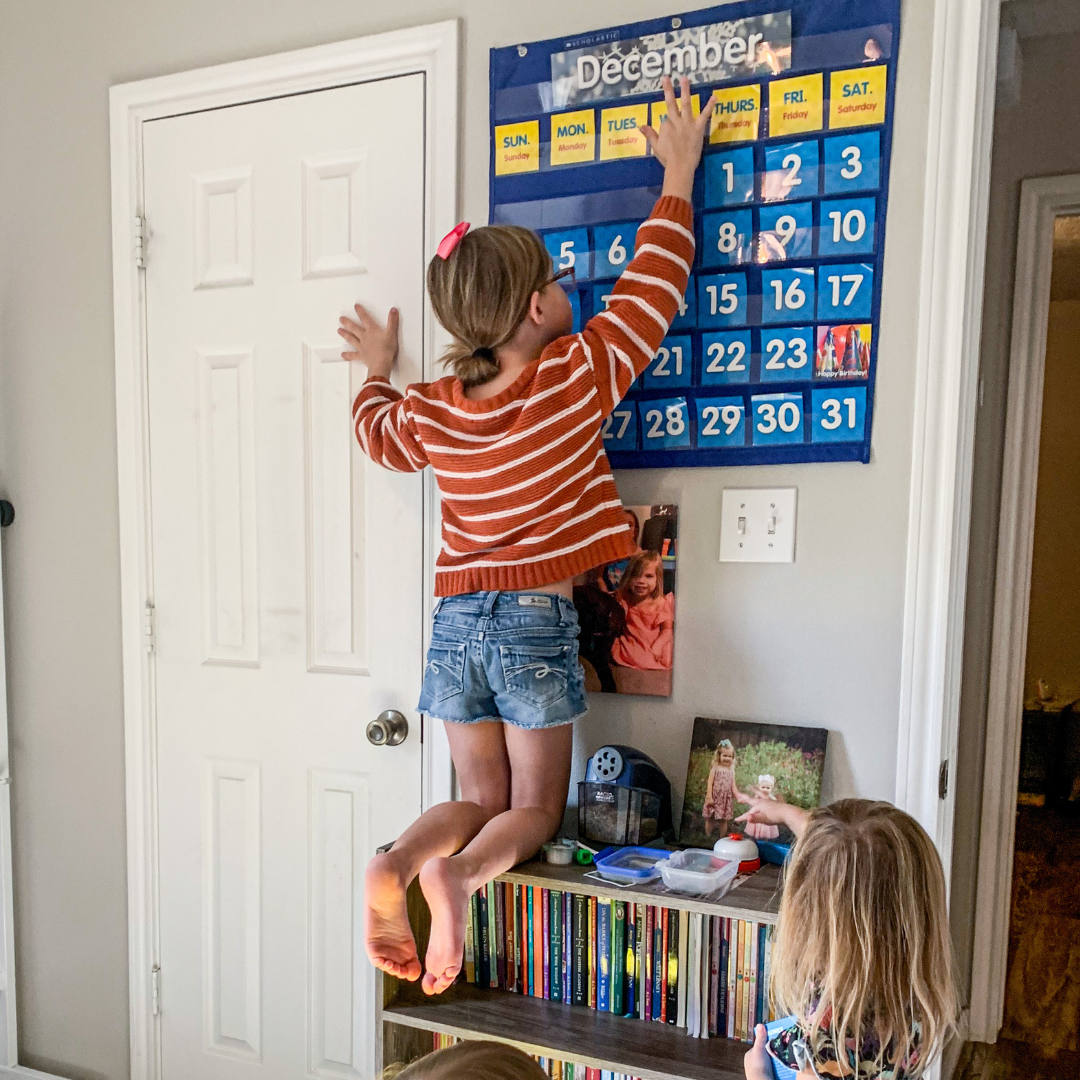
We have a calendar in our school room to display the month. This is a great visual that we can refer to often. Each month I have to change out the little cards so that it displays the correct order of days and month.

When I do this, I gather the kids and we practice a few simple things to get acclimated with the calendar. So this means we practice about 12 times in the year (as long as I remember each month!) That’s it! Easy peasy.

Months of the Year

You’re about to see that we love using songs to memorize. We sing a months of the year song a few times in a row to start memorizing the names of the months. All of my kids participate, including my two year old. He tries to follow along with us – it’s adorable!

Sometimes I like to write the names of the months on the board so that my child that is learning to read can start practicing to recognize the months in print. Next month I’m thinking I’ll have my oldest write the months out for us. Then, I can see how she spells the months – great practice!

If I feel like we need to mix it up we can sing loud and soft or fast and slow. The link I shared with you for the song actually repeats the song about 3 times. So, even just listening to it one time through works!

Days of the Week

Once we finish the months, we move on to the days of the week. This is when my childhood Barney episodes come into play. The song we sing is one I remember from my own childhood! It’s still in my head – proof that songs stick! (Be sure to check out the link to that song for a trip back to the late 80s, early 90s)

I have my kids take turns pointing to the days on the big calendar as we sing them. Everyone likes a turn doing this, so we end up singing it 3-4 times. It’s also fun with a silly pointer, which we have used in the past.

Calendar Questions

Finally, I’ll ask questions about the calendar that are relevant to us and the kids will take turns answering. Below are some questions I might ask:

  • Today is Tuesday. What is tomorrow? What was yesterday?
  • We have a field trip on the second Friday of the month. What day is that?
  • What day of the week is the 15th?
  • What day is Stella’s birthday on?
  • We meet with Adventure Club on Fridays. How many times will we go this month?

It Works and It’s Fun!

We have been doing this for a little over two years now, and I can see how it has worked with my littlest ones. For example, my current four year old has the songs memorized! So she knows her days of the week and months of the year already just by singing along with us each month.

My older two have known the songs for a while, so each month I challenge them with the calendar questions. It really doesn’t take much effort because I just ask questions about our own calendar.

The rest of the calendar practice comes up naturally in conversation. If the days of the week get brought up, we can sing the song quick to answer a question. For example, a question I get all the time is “Mom, how many days until my gymnastics class?” This is the perfect opportunity to put our songs to use!

This is something that has worked well for our family, and it’s been so nice not to have to worry about a sheet to fill out or print out. Every family will be different. It might be helpful to have your children sit and work on something like a calendar each day. If that’s true for you, I encourage you to keep on with it! I only share our experiences as a way to share ideas – I hope it can be helpful or inspiring to you!

What’s your favorite way to learn the calendar? Do you do something similar or do you prefer daily calendar work? I’m curious what other songs might be sung in your homes!

Posted on 1 Comment

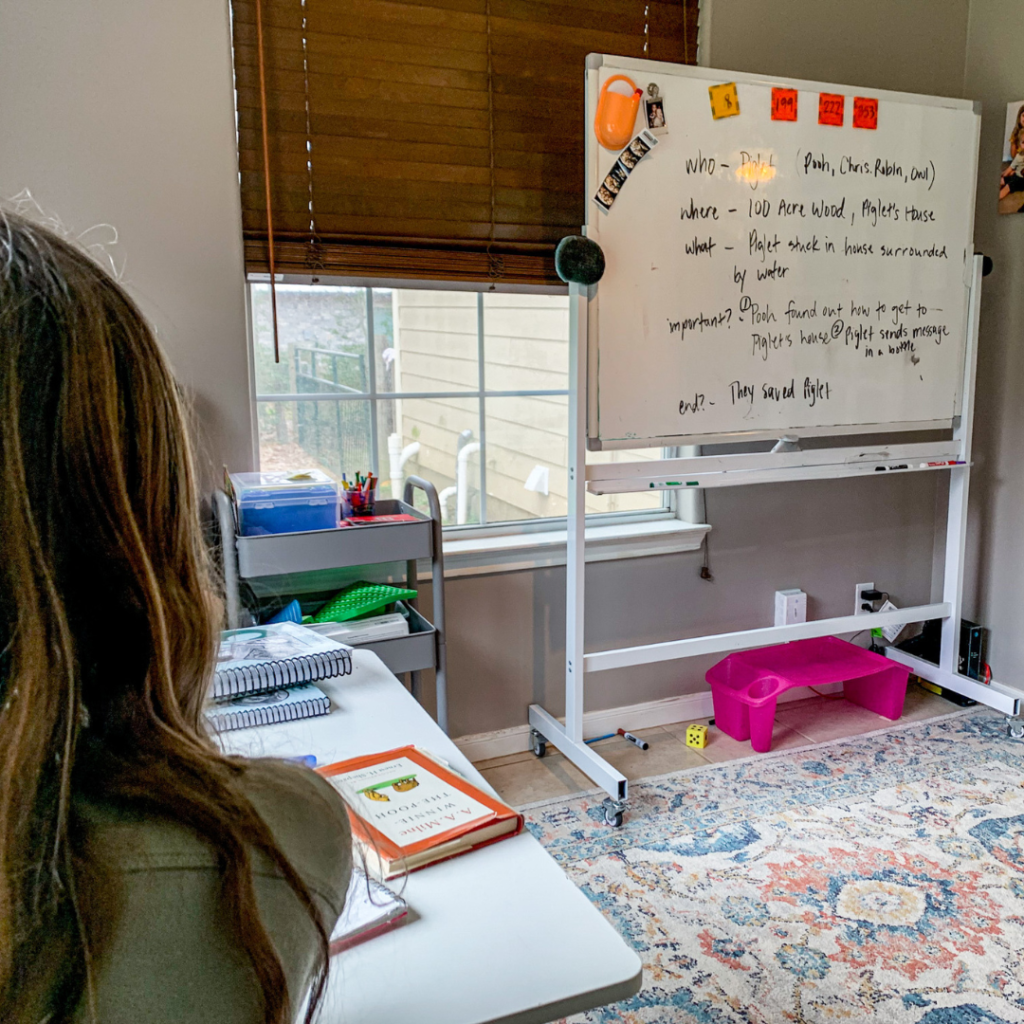
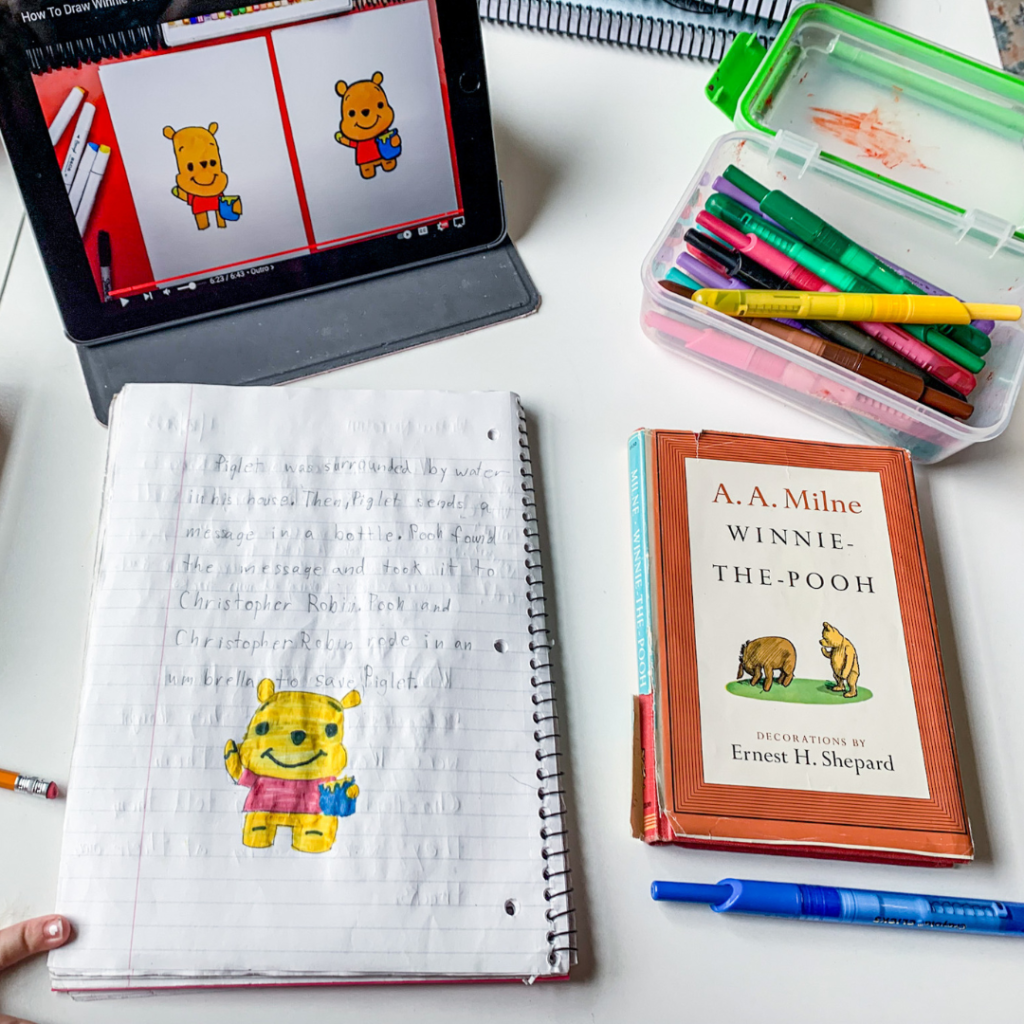
Winnie the Pooh Novel Unit – Homeschool Language Arts

winnie the pooh novel unit

This Winnie-the-Pooh novel unit has really brightened up our language arts. The way it is set up has given us a sense of freedom and fun in our homeschool routine.

This method of language arts is new to us, but we love it so much. I actually break down the entire process in another blog post that I will link here. I highly suggest you read through that first as it will help the rest of this post make more sense.

In this post, my goal will be to give you specifics about our studies and schedules for this particular book, Winnie-the-Pooh.

This post contains affiliate links. If you follow one of my links I earn a small commission at no extra cost to you. Thank you for supporting my blog!

Winnie-the-Pooh

When I first heard that this was a great family read aloud, I ignored it. I thought it was going to be baby-ish and that my kids wouldn’t be interested. However, I was gifted the series from my husband’s grandmother and needed a good, living book to try this new method of novel unit out. Since we had it on our shelf, I went for it.

WOW! Was I wrong! This book was one of the most adorable books we’ve read together. We giggled in every chapter and didn’t want it to end. It’s the sweetest, and it made this unit all the more special!

The goal in reading this book was to try to get through a chapter a day. There are 10 chapters total, so we were able to finish the book in two weeks. I didn’t always read a whole chapter in one sitting. Sometimes I broke it up and read some at night and the rest in the morning. I have a couple little ones and longer chapters are harder to sit through. Breaking it up helped some days!

Unit Schedule

The following is a brief outline of what I hope to accomplish each day with my child. For more details on each piece, be sure to read my explanation post.

In this post, I am going to focus on Winnie-the-Pooh and will share the passages we studied and how we broke them down each day in case you’d like to try the same sort of method.

For a VERY brief overview – We read aloud as a family at different times in the day. For daily grammar, my daughter uses Fix it Grammar. I love that it can be done independently and takes about 5 minutes to complete. Copy work is also completed independently (5 minutes). I set a timer for our actual language arts lesson for 20 minutes.

DAY 1

  • Read novel and narrate [whole family]
  • Grammar Workbook [independent work]
  • Copy work – complete 2-3 lines of selected passage from novel [independent work]
  • Study passage – focus on grammar [language arts lesson with parent]

DAY 2

  • Read novel and narrate [whole family]
  • Grammar Workbook [independent work]
  • Copy work – complete 2-3 lines of selected passage from novel [independent work]
  • Study passage – focus on spelling and vocabulary [language arts lesson with parent]

DAY 3

  • Read novel and narrate [whole family]
  • Grammar Workbook [independent work]
  • Copy work – complete 2-3 lines of selected passage from novel [independent work]
  • Written Narration [language arts lesson with parent]
  • **Option – review passage/spelling words if necessary

DAY 4

  • Read novel and narrate [whole family.]
  • Grammar Workbook [independent work]
  • Copy work – complete 2-3 lines of selected passage from novel [independent work]
  • Dictation [language arts lesson with parent]

DAY 5 (OPTION)

  • Read novel and narrate [whole family]
  • Silent Reading (15-20 minutes) [independent work]
  • Narration [language arts lesson with parent, about 5 minutes]

Passage Selection – Week One

I selected two passages to use for our copy work because it took us two weeks to read the book. Each week, we studied one passage during our language arts lesson time. Next, I will share with you how we study these passages throughout the week.

“He was getting rather tired by this time, so that is why he sang a Complaining Song. He was nearly there now, and if he just stood on that branch…Crack!” (Winnie-the-Pooh, A.A.Milne)

On the first day of our schedule, we focus on grammar and punctuation. The following is what we discussed for this passage:

  • Capitalize the first letter in a sentence and choose the correct end mark.
  • A comma and a conjunction can join two sentences together. (Conjunction Junction, what’s your function? — Are you singing yet?)
  • Complaining Song is capitalized by the author – Why? It’s possible he wanted to make it more official or to make it a title of a song. (Poetic License/Author’s Choice)
  • The “…” is called an ellipses. It encourages the reader to pause.
  • “Crack!” is italicized for emphasis, an exclamation point adds volume in this case. For fun, we also discussed what onomatopoeia was.

As we study these topics we might practice different examples on the board or practice them orally, if possible. This might seem brief, but as you discuss each one with your child and provide alternate examples or even just look for more examples in the book, the time will go quickly.

Spelling and Vocabulary

For our second day of lessons, we are still using the same passage. This time we focus on spelling and vocabulary. I first ask my daughter if she knows what certain words mean based on the context. If we need to, we look them up in the dictionary.

The vocabulary words we looked at for this passage: rather, nearly, complaining

For spelling, I quiz her with many of the words from the passage and see which ones are mastered and which ones need practice. I have her write them on a board. You can make this list based on your child’s needs, but our list looked something like this: getting, rather, tired, why, complaining, nearly, there, stood, branch, crack

Any word spelled incorrectly we practice a few times. I will also try to quiz her the following day as well to see if she can remember the word(s) she missed.

Passage Selection – Week 2

Week two follows the exact same schedule, just with a different passage. So for this section, I will list the passage as well as what we studied to go along with it.

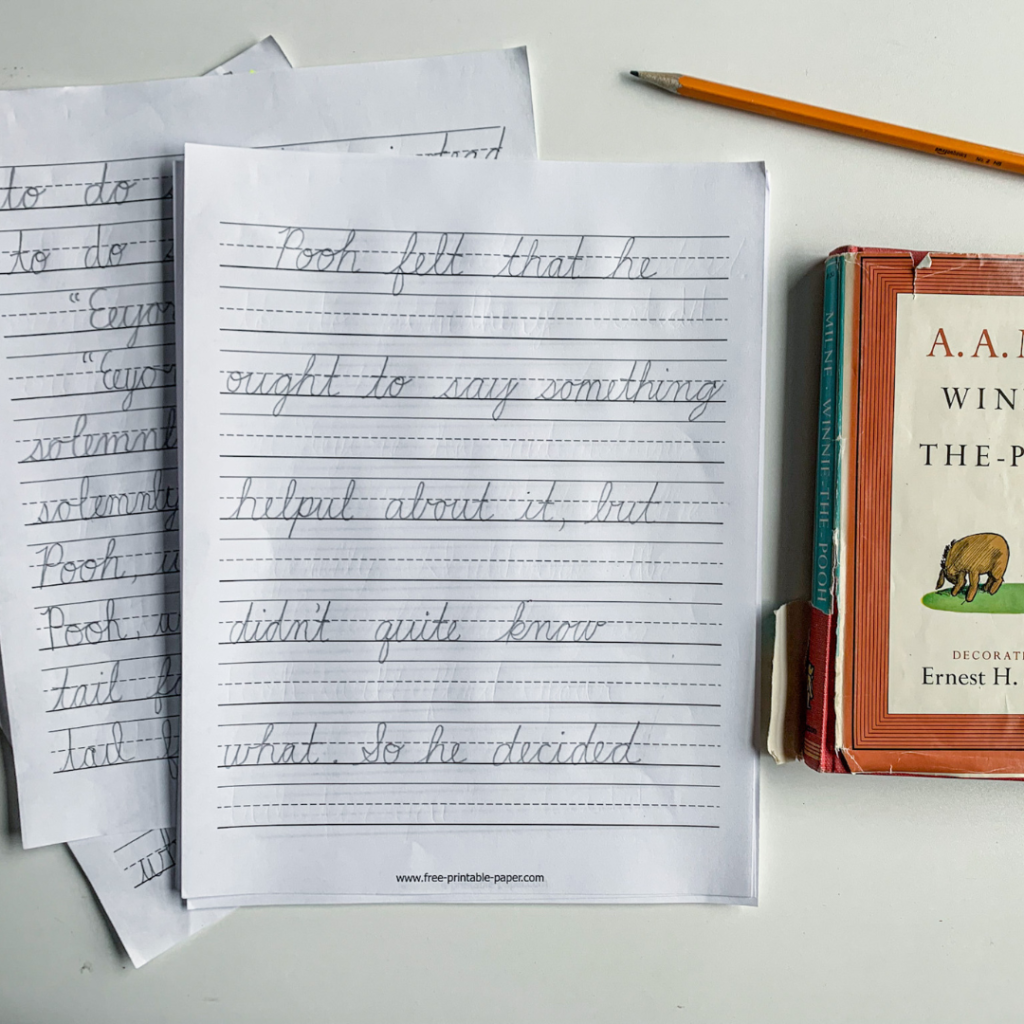
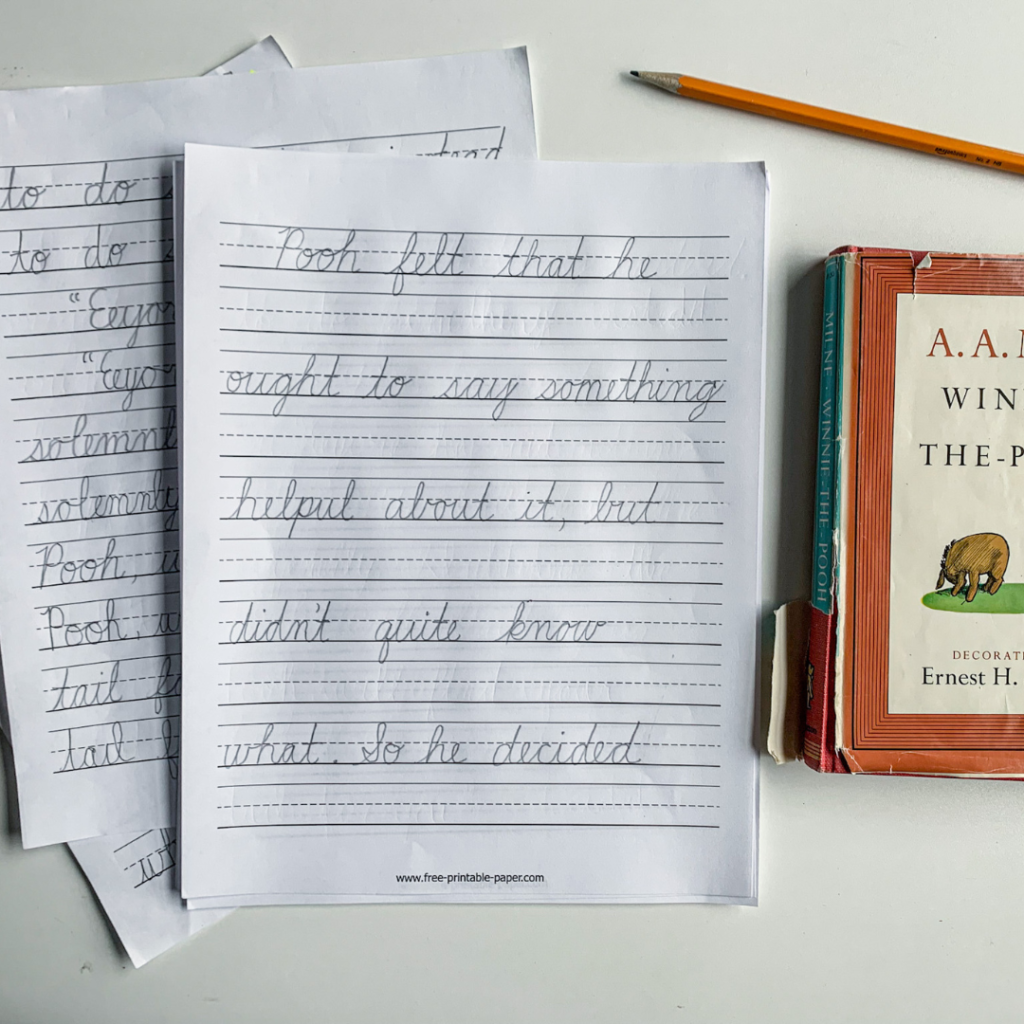
“Pooh felt that he ought to say something helpful about it, but didn’t quite know what. So he decided to do something helpful instead.

“Eeyore,” he said solemnly, “I, Winnie-the-Pooh, will find your tail for you.” (Winnie-the-Pooh, A.A. Milne)

On the first day we discussed the following:

  • Capitalize the first letter in a sentence and choose the correct end mark.
  • Didn’t is a contraction – did not. We practiced writing other contractions.
  • A new speaker starts a new paragraph, indent.
  • A comma is placed after “Eeyore” to separate the quote, but we also discussed direct address.
  • Always capitalize “I”.
  • Winnie-the-Pooh is surrounded by commas because it is information that is not essential to the sentence.
  • Quotes go around what the character is saying.

Now, if you wanted to simplify this even more, you could only focus on what connects to your grammar workbook. Point out what you’ve studied so far, and that’s it. That way it’s consistent between the two. However, I enjoy looking a little deeper than that. There are times when I don’t really know why a comma is there, and I just look it up online right there with her. That’s what it’s all about – learning together!

vocabulary photo

Spelling and Vocabulary

On the second day of our week we look at spelling and vocabulary from the passage. The spelling words we practiced were as follows: ought, something, helpful, about, didn’t, quite, know, decided, instead, solemnly, tail.

The vocabulary words we studied were “ought” and “solemnly”. Don’t forget to use context clues first, and then try the dictionary.

optional grammar activity

Optional Grammar Activity

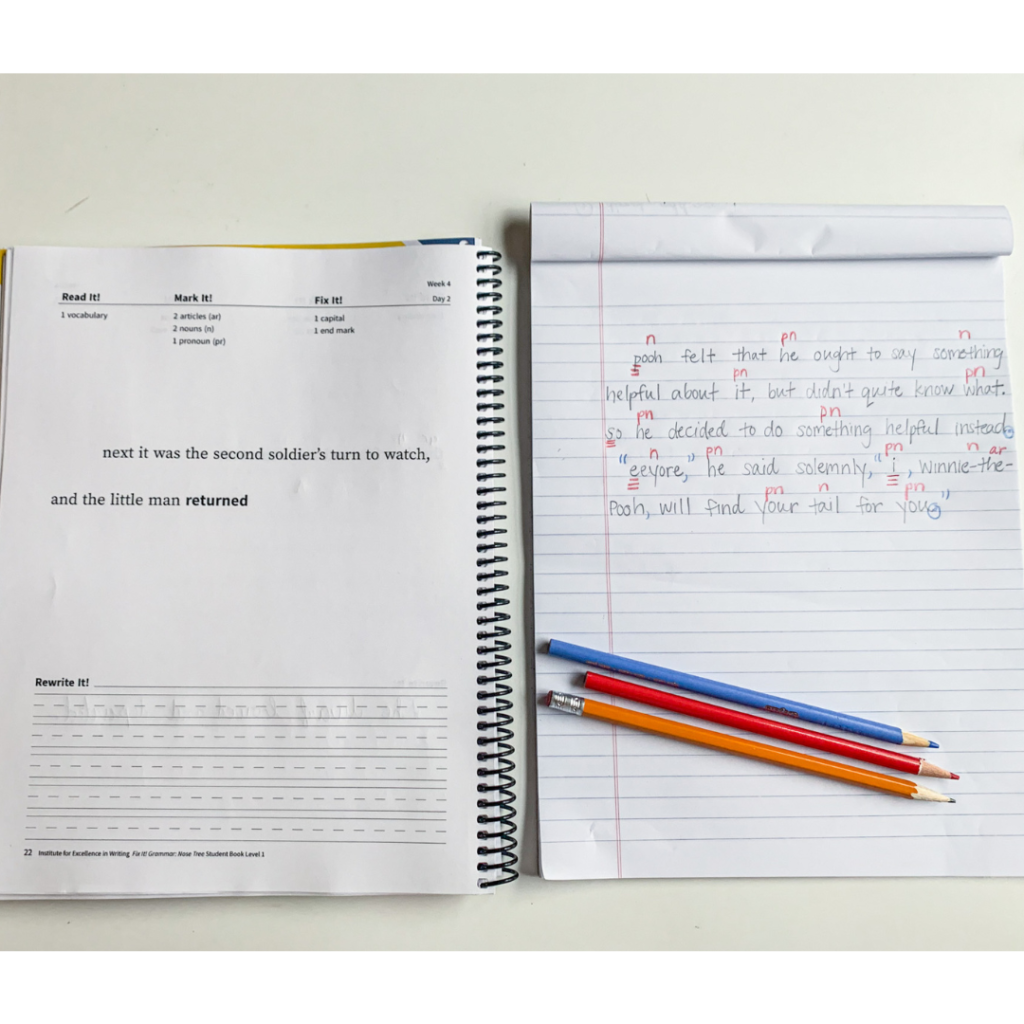
Usually on our spelling and vocabulary day we have extra time. I like to switch out her Fix it Grammar page with a little something different. We use the exact same methods she is practicing in her workbook but we apply it to our passage instead.

Here’s an example. In her Fix it Grammar book she is currently marking words that need to be capitalized, end marks, nouns, articles, and pronouns. So, I wrote the sentence on the board and had her do the same thing to our passage. It worked out great! I’ve snapped a picture (above) of an example for you to see.

Honestly, you could do this with any grammar workbook. If you are practicing adjectives, find the adjectives. If you’re underlining the subject once and the verb twice, do the same here. See if you can combine your grammar book with your novel one day – It makes the workbook feel relevant!

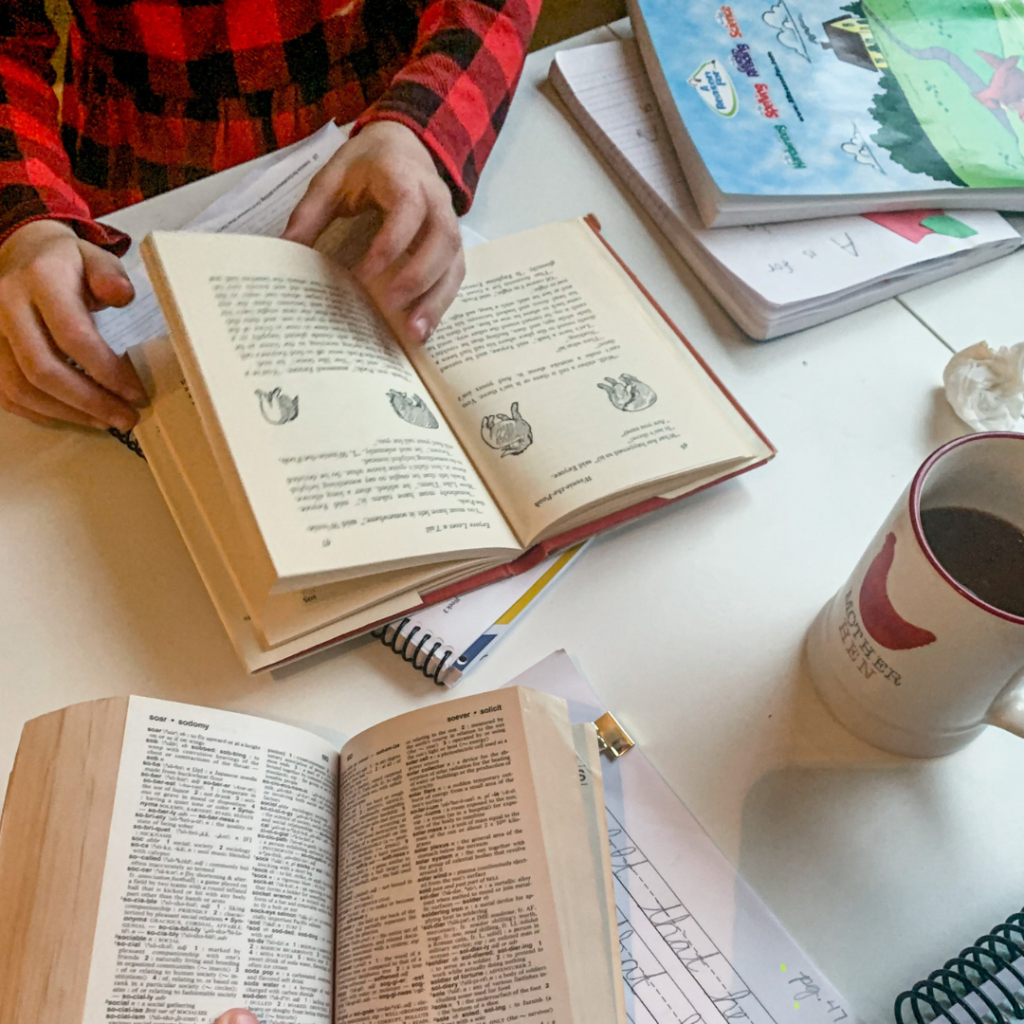
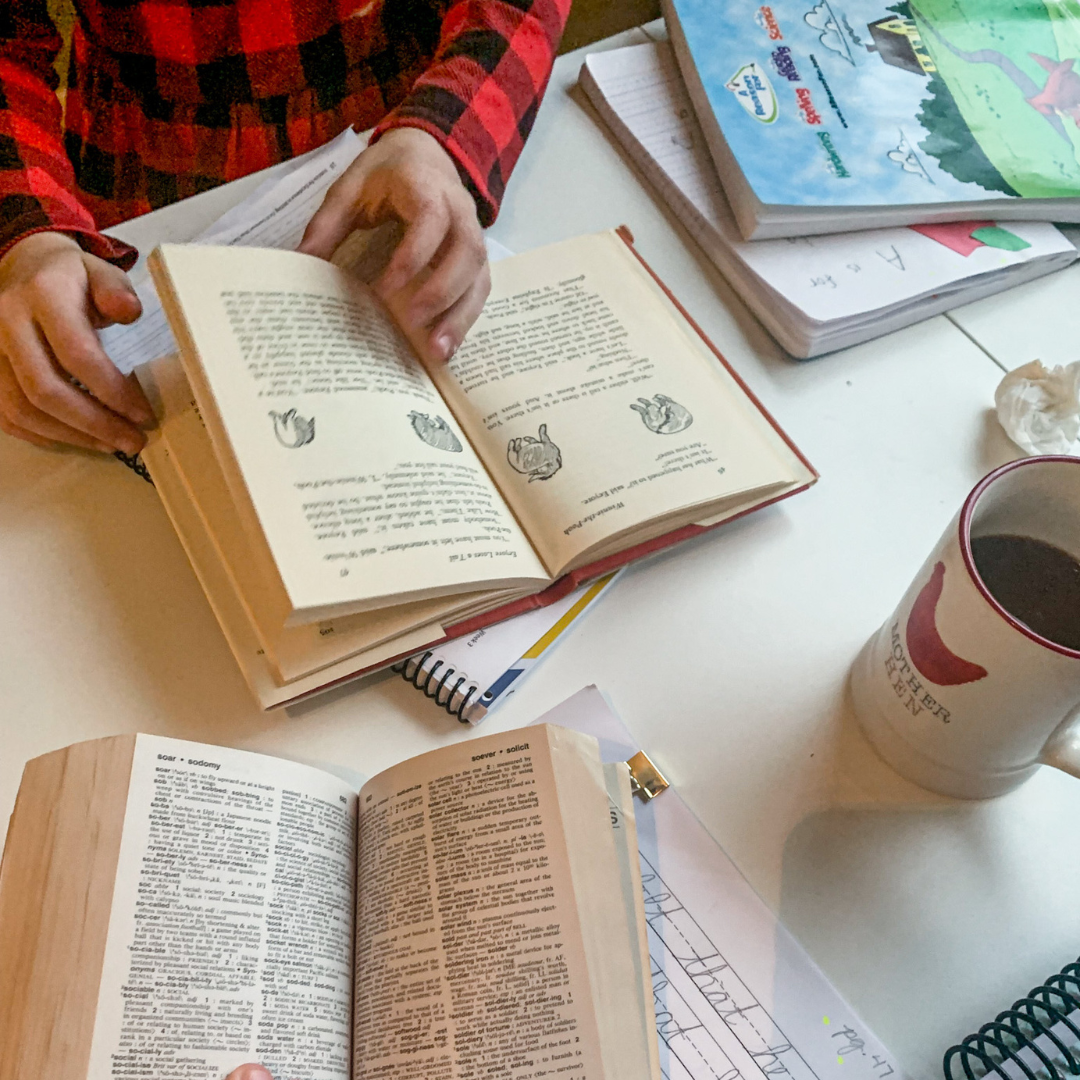
I’ll admit, there were a couple words I wasn’t sure about (yay for learning together!). The dictionary was very helpful. Find the word that matches the context of what you’re looking for and the dictionary lists the part of speech. So, if you see something off in my photo, blame Webster 😉

Ready to try it?

Does this sound like something you would enjoy? Sometimes it’s hard to explain what goes on in this crazy head of mine, but I hope that this explanation simplified the process for you. Isn’t it freeing to just read and chat about a book with your children? That’s what I love the most about this. Besides our daily grammar practice, there’s no workbooks, no busy work, just beautiful book discussion.

Want to see more novel units like this? We are starting another soon, and if this is helpful, I’m happy to break it down like I did with this one. Let me know in the comments or reach out to me on social media (Instagram: @simply.learning.together)

When I first started learning about the Charlotte Mason method, which is what inspired this study, I was nervous about the no-workbook-factor. Having a consistent plan like this with certain goals has really given me the confidence that a typical curriculum workbook doesn’t have to be necessary if it doesn’t bring you joy! It’s been so freeing to be able to study language arts through the books that we love!

NEW Novel Guide Available

For the last few years, my children and I have used this novel-based language arts program that is family-style and enriched with great literature each week. I’m so excited to share a NEW guide with you on how we do this in our home. If you’re tired of an all-in-one language arts workbook or if you’re itching for a great novel to read aloud to your kids, you’ve got to try this method! Below are two of the newest guides available now:

James and the Giant Peach

The Secret Garden

You can watch multiple videos about this method of Language Arts on my YouTube Channel HERE

Posted on 3 Comments

NEW (Mostly) Workbook Free Language Arts Method

winnie the pooh

(Mostly) Workbook Free! Did that reel you in? 😉 Well, this whole method was inspired by my research but also a desire to get rid of the workbooks! They were making me crazy…and bored! However, I have found it important to continue daily grammar practice. That’s where the workbook comes in. Even still, this new method has been such a breath of fresh air for us! I’m so excited to share. Let me tell you a bit about how we got here.

After Christmas, we kicked off the year with a fantastic history unit on the Vikings. We were having so much fun learning, but it would come time to sit down for language arts, and I dreaded it! I finally said to my husband – I can’t stand language arts workbooks. I’ve tried multiple workbooks over the years, and it never fits our family quite right. I just want to study language arts through what we are already learning in history or science.

Well, it wasn’t long after that, I was led (by prayer I’m sure of it!) to a post or a quote that mentioned Charlotte Mason, which I was pretty unfamiliar with at the time. Well, one thing led to another and suddenly I was listening to every Charlotte Mason podcast I could and reading all the info I could find online. I was fascinated by the methods, but nervous to commit.

Then, I came across a brand new book called “Modern Miss Mason” by Leah Boden, and it inspired me in the most beautiful way – WOW! I can’t recommend it enough. Her book encouraged me to learn the philosophies of Charlotte Mason but then to apply it to our homeschool in a way that suits are family well.

My point in all of this intro is to let you know that this novel unit is inspired by what I learned from studying Charlotte Mason’s methods. (I still have so much to learn!) It may not follow her philosophy exactly, but the whole process has brought my family (especially me) such a sense of joy, and I am certain that is what matters most. This unit has given me a freedom that makes language arts interesting for us again, and I hope if you try it that it may do the same for you.

Now, before I continue, I should mention that you could probably adapt this unit a little bit to use for any grade you’d like. My child (that I created this for) is in third grade, but I planned all of the lessons according to what she has already learned and what she is learning in her grammar book (More on that later). You can do this too, and I hope my breakdown of this method helps you see the simplicity that I see in that. I encourage you to continue reading no matter the grade level.

This post breaks down the actual process of putting this unit together. Definitely look through the detailed descriptions of each piece below first, but if you want to see a unit in action, check out our first novel unit like this, “Winnie the Pooh” (the book is so adorable!)

This post contains affiliate links. If you follow one of my links I earn a small commission at no extra cost to you. Thank you for supporting my blog!

Language Arts

From all of my research, I came up with the following list of what I wanted to include on a regular basis for my daughter’s language arts.

  • Good (living) book
  • Narration
  • Daily Grammar
  • Copy work (to practice Handwriting, Grammar, Spelling, and Vocabulary)
  • Written Narration
  • Dictation

As I go through this unit, you will see these pieces incorporated throughout. If you’re interested on where I’m learning about all this, I’ll leave a couple links for you here. (I listened and read so much! But these two sources stick out to me the most) Simply Charlotte Mason, and the Charlotte Mason Show Podcast.

Novel Unit Schedule

I’m going to outline the schedule of this unit, because I want you to see the simplicity of it – at least, I think it’s simple, and I hope you do too! Think of the lists you see as a checklist for the day. Each day of language arts requires about 5-10 minutes of independent work from your child and a 20 minute lesson with you, the parent. You’ll also be reading aloud at some point in your homeschool day, but I don’t really count that. Reading great books together as a family doesn’t feel like school for us. (We’ve read at bedtime and/or our morning time for the last couple years, and it’s been wonderful)

It probably won’t make any sense at first, but if you read further, I explain each piece of this schedule in my post.

I will put in the schedule to read each day. You can time it as you please. We read every day, whether it’s a school night or not. Our normal homeschool schedule is four days a week, but on the occasion that we are home on Fridays, I will mention my plan for that day as well.

DAY 1

  • Read novel and narrate [whole family]
  • Grammar Workbook [independent work]
  • Copy work – complete 2-3 lines of selected passage from novel [independent work]
  • Study passage – focus on grammar [language arts lesson with parent]

DAY 2

  • Read novel and narrate [whole family]
  • Grammar Workbook [independent work]
  • Copy work – complete 2-3 lines of selected passage from novel [independent work]
  • Study passage – focus on spelling and vocabulary [language arts lesson with parent]

DAY 3

  • Read novel and narrate [whole family]
  • Grammar Workbook [independent work]
  • Copy work – complete 2-3 lines of selected passage from novel [independent work]
  • Written Narration [language arts lesson with parent]
  • **Option – review passage/spelling words if necessary

DAY 4

  • Read novel and narrate [whole family.]
  • Grammar Workbook [independent work]
  • Copy work – finish copying selected passage from novel [independent work]
  • Dictation [language arts lesson with parent]

DAY 5 (OPTION)

  • Read novel and narrate [whole family]
  • Silent Reading (15-20 minutes) [independent work]
  • Narration [language arts lesson with parent, about 5 minutes]

Read Novel – A Good (Living) Book

Give me all the books! I love reading to my kids, and I especially love coming home with a bag full of books devoted to a unit study. This whole year, we have done all of our science and history using books from the library, and it has been the most wonderful time.

I tend to just get what the library has available, which I think is fine! Lately, I’ve been trying to be a little bit better about thinking ahead and finding good, quality literature. I might put a few books on hold or visit my local used bookstore. The effort has been worth it. Having good literature makes our studies come alive and become more enjoyable.

What is a living book? Well, that’s a good question. It’s a hot term in the Charlotte Mason world, and it honestly intimidates me a bit! So, here’s the method I use when choosing a book. Do I enjoy reading it? Is it helpful to our studies? Does it add something positive to what we are learning? Will my kids find it fun/interesting?

These are just a few questions I’m thinking about. This article breaks down the definition of a living book in an easy-to-read list. I find it very helpful, but I’ll be honest, my kids and I enjoy a good Magic Treehouse book here and there…is that “twaddle”? Maybe…but remember…my hope here is to do what’s best for my family, and we like it sometimes! So I encourage you to find books that your family enjoys too!

I mentioned this earlier, but we read our novels at bed time usually. We also have a time to read aloud during our morning time. When we read, it’s with all my kids, and it’s not part of our lesson time. What’s great about this is each child is benefiting from the literature, and my little ones are even practicing narrating as we do it. Whole family learning is my favorite!

Narration

I am new to narration, and I don’t know if I do it the “right” way, but I do it in a way that feels right for my family. (Are you catching a pattern here? Every family is so different, but what a blessing it is to have the freedom to adjust as needed, according to our family interests) Every time we read something we talk about the book together. Sometimes it’s in the middle of a chapter, sometimes it’s at the beginning, sometimes it’s at the end of our reading.

For this new language arts method, I made sure to encourage my children to talk more than we usually do. I wanted to be intentional about our book conversations. If I just say “tell me back what happened”, they look at me confused. So I usually start them off with a question or two to get them going.

So, what happened at the beginning of the chapter? What was your favorite part? What problem did they run into? How did they solve it? How do you feel about that character’s choices? I don’t ask every question every time, but this is just an example of what gets us started talking. Both of my school age girls participate in this daily book discussion.

There’s a lot more to narration than this, so if this is new for you as well, I encourage you to look into it further. (Check out this site)

Daily Grammar

We recently added Fix it Grammar to our homeschool day for my third grader, and I love it. I will link the product for you (not affiliated) if you want to learn more about it. It takes my daughter about 5 minutes a day to do this, and she can complete most of it independently.

She does this work daily, which gives me a boost of confidence knowing she is getting consistent practice. If you are looking into doing a unit like this, any grammar workbook can be used! Earlier this year, we used an Evan-Moor fundamentals workbook, and I feel like that could’ve been used just as well. The point is regular practice and connecting it with what you’re reading.

One of the days of the week, I like to do an alternate grammar activity instead of the grammar workbook. This usually happens on Day 2, because it doesn’t take us the whole 20 minutes to do spelling and vocabulary. We basically apply the rules of her Fix it Grammar sentences to our passage. Let me give you a concrete example.

Currently, in the Fix it Grammar books, she is labeling captalization, end marks, nouns, articles, and pronouns. She knows how to do this because it’s practiced daily. Well, one of the days during the week, we look at the novel passage and label it in the same way. This has been a great way to apply the same steps to a relevant passage from our novel. I love linking the two (grammar and novel) together.

You can see an example of this in our Winnie-the-Pooh unit.

copy work

Copy Work – Handwriting

The copy work is chosen by me using passages from our novel. My goal is to study one passage a week. This copy work will allow my child to practice handwriting, but we will also be working together to study grammar, spelling, and vocabulary through this passage.

Each week, I wrote the passage out onto lined paper, skipping every other line. (See photo) This gave her an example to follow. Each morning, during her independent work time, she would copy 2-3 lines. The goal is not to do a ton of copy work in one sitting. What does get finished must be done well, if that makes sense. This is another philosophy I am learning about from the Charlotte Mason method. Shorter lessons, better quality work. I’m finding it to be very true!

Copywork – Grammar, Spelling, and Vocabulary

This part of our lesson will vary depending on the passage, but you can see it in action by checking out one of our units.

On the first day we look at the grammar and punctuation. We go through each sentence and figure out together – Why is something capitalized? What is the punctuation at the end? Why is that comma there? When do we add quotes or indent? And so on…

I am very intentional about the passage I choose for this reason. I’m not going to pick something that has incorrect/odd grammar. I’m choosing passages I know will enhance what she’s already learning in her grammar book.

I also spend a day focusing on spelling and vocabulary. (See outline) If there are any words she is unfamiliar with, I try to have her guess the definition using the context. Then, we look the word up in the dictionary.

Next, for spelling, I quiz her on a variety of words in the passage. If she gets it right, we move on. If it’s wrong, we focus on that word for a bit and I try to remember to quiz her on that word a time or two during the rest of the week. There is no spelling test as she will be writing the words by memory during the dictation portion of our week.

Written Narration

Depending on the child’s age, your lessons may or may not include written narration. Based on my daughter’s abilities, I felt she was ready to start with my help.

One day a week, I require written narration from her. My goal here is for her to write about what we are reading. I like to help her brainstorm and figure out how to write a good narration. Eventually, I hope she will use these brainstorming techniques to write on her own.

I ask her the following questions and we jot down quick notes as our answers (see photo):

  • Who is involved?
  • Where did it take place?
  • What happened?
  • Any other important pieces to mention?
  • How did it end?

I just made these questions up. This is not an official strategy, but we used it for both passages, and it went really well.

Once she has short notes, she begins making sentences to form a paragraph about what we read that day. The first couple times I asked her to do written narration, it was rough. However, with consistency and my help, she is starting to get the hang of it. I was so proud of the last one she did! She’s made awesome improvement.

If you check out the picture below, you’ll see something else we add in for fun. As a reward for her hard work in writing, she likes to draw with Art for Kids Hub. We add it to her notebook, and it’s a cute addition to her work. (You’ll also get a peek at how she took my notes from the board in the last picture to her completed paragraph.)

I’ll admit, the hardest part of this lesson in written narration is for me to just be quiet. I always want to say things like, “Wouldn’t it sound better if…” Or, “Well, don’t you want to add…” I have to bite my tongue – a lot! It’s worth it though. I just LOVE hearing her voice in her writing.

written narration

Dictation

We’ve had practice with dictation from a couple different places. I first learned about it when we completed a Dart Guide from Brave Writer. We were also already doing it at the beginning of this year through the language arts program I chose, Learning Language Arts through Literature. I love it because it’s an easy way to assess that doesn’t feel like a test. Plus, it’s meaningful because it comes from what you are reading.

This article gives fantastic instruction, including a video, on how to do dictation. Like some of the other pieces of this unit, dictation gets easier with practice. The way we set all of this up, we study the passage Monday-Wednesday and dictation is on Thursday. By working on the passage a little bit each day, I feel like it’s a great way to set her up for success during dictation.

I was explaining to my daughter today during her dictation what a wonderful skill it was. Being able to write something and know how to add punctuation and edit it is a life skill that will be necessary her whole life – writing emails and letters, for example.

After I finish dictating the passage to her, we correct it together.

Freedom and Fun

I feel like that’s what it really boils down to here. By doing this method in our language arts, we’ve had more freedom to apply books we are already using to learn, making it more fun and interesting to actually work with.

A lot of things have inspired me to get here, as you may have read throughout this post, but I’m so thankful for what I’ve learned and how we can now find a way to do something that works so well for our family.

Have you tried something similar to this? Are you interested in seeing more units like this in the future? Let me know in the comments and be sure to sign up for my email list where I send all our updates, posts, and resources that we are using in our homeschool.

You can also catch me on Instagram @simply.learning.together If you try this out, take a photo and tag me. I love seeing your families enjoy learning together!

NEW Novel Guide Available!

For the last few years, my children and I have used this novel-based language arts program that is family-style and enriched with great literature each week. I’m so excited to share a NEW guide with you on how we do this in our home. If you’re tired of an all-in-one language arts workbook or if you’re itching for a great novel to read aloud to your kids, you’ve got to try this method! Below are two of the newest guides available now:

James and the Giant Peach

The Secret Garden

You can watch multiple videos about this method of Language Arts on my YouTube Channel HERE

Posted on 2 Comments

Homeschool Day in the Life – Timed Lessons

homeshool room

We recently adjusted our homeschool schedule so that we have timed lessons. Prior to this, I began researching a few Charlotte Mason methods and read a book, Modern Miss Mason by Leah Boden. From what I learned, I really loved the reasoning behind doing short, timed lessons. Short is key!

I’ve never been much of a fan of a tight schedule when it comes to our homeschool day, so this was weird for me to start. I always expressed our day as a “rhythm”, starting and finishing as we pleased. I have to remind myself that technically we can still do that, but once the lesson starts we are on a timer.

Want to know what’s crazy – we have LOVED it! This may sound weird, but we actually sit down for a lesson for a shorter amount of time, yet I’m able to get MORE done in our school day than before! Isn’t that crazy?

One day last week, I took some notes about what we did during the day, and I’ll be sharing that with you here. I am going to put start times, but I don’t every feel bound to that. I aim for it, but if I’m early or later than what my plan suggests, I just start when I can. The key is that the lesson is always the same amount of time.

Here’s a link to Charlotte Mason’s timetable, if you’re interested in learning more about the “why” of shorter lessons.

This post contains affiliate links. If you follow one of my links I earn a small commission at no extra cost to you. Thank you for supporting my blog!

morning checklist

Breakfast and Chores

I get up between 6 and 6:30. I like a few minutes to myself to read the bible and drink coffee. Getting up isn’t easy to do, because I still get woken up multiple times during the night by litle ones. My secret is having my coffee pot on a timer! It’s like a Folger’s commercial from the 90s…”The best part of waking up…” (are you singing it?) Seriously though, I can smell it and I love that it’s ready for me. Morning motivation.

I am currently reading the One Year Bible. I also use my study bible alongside it to help me dig deeper into what I’m reading for the day.

My kids start getting up between 6:30 and 7:30. They all wake up at different times, and I’m usually making breakfast by then. If someone isn’t up by 7:30, I’ll let them know breakfast is ready. I like to get our day going, so I do wake someone up if it gets pass a certain time.

After breakfast (8:00ish) my kids immediately start their morning checklist. You can read more about this in my morning routine post, but it’s one of the things in our homeschool that has stuck around through the years. It’s a list to get my kids ready for the day and to do a couple chores around the house before we begin.

Independent Work

Once the checklist is done, my two older girls have independent work. They each do something different, and they don’t always start at the same time together. It’s just whenever they’re done with their checklist.

For First Grade: Handwriting (5 mins). We set a timer when she starts, and I tell her she has to complete two lines. She is using a Reason For Level A right now. if she finishes before, great. If not, she stops and finishes it the next day. I used to have her do a lot more independent work than this – it was not successful. Every since we cut it to just writing for 5 min, it’s been so nice. She works hard and does the work well.

Third Grade: Handwriting (5 mins) Same as my first grader – she completes 2-3 lines in that time. We are not using a program for this. I create her copywork based on the literature we are reading. She also does her math independently. I shorten her math lessons so that she is able to complete it in 20 minutes or less. The last thing she completes is her Fix it Grammar lesson which takes about 5 minutes.

Morning Time and Outside

I aim to start our Morning Time at 9:00. Right now we are using Foundations of the Bible from Driven by Grace. We read poetry from “Poems to Learn by Heart” and we read aloud. Usually the book(s) we read is something we are learning in history/science.

At 9:40 We head outside to play, soak in the sun, and the kids usually have a snack. I also get outside for a minute during this time. It makes such a difference in my mood if I get out throughout the day. In the past we have also used this time to go on a short walk.

christian light education math

Lessons Begin

We start lessons at 10:00, and I do math with my first grader. We set a timer for 20 minutes to get the lesson done. I do my best to pick what is the most important and helpful in her lesson. We do not do every single review problem. At the end of the timer, we stop…even when I don’t want to!

I didn’t mention this, but I have four children. While I have lessons with one of my big girls (8yo and 6yo) the other one is playing with my youngest two (4yo and 2yo).

At 10:20 I switch my big girls and start lessons with my oldest. The first thing we do is like a math meeting. Her lesson is usually complete or almost finished because she does it during independent work time. I help her with anything she couldn’t do on her own and we check her work together. I don’t set a timer for this because it only takes about 5 minutes or less.

Next we immediately start our language arts lesson. I recently wrote a post on what we do for this, but I set a timer for 20 minutes to get it done.

I start my next lesson by 11:00. This is language arts with my first grader. We are using Logic of English Foundations B. For this lesson, I set the timer for 15 minutes. I can usually complete 2-4 sections of a lesson during this time. The lessons in this Foundations B book are very long. Even before I started using a timer, we were not completing a full lesson.

preschool fun

Preschool Fun

At this point we are done with our formal lessons! It’s 11:15, and I have a minute to regroup and think about the afternoon ahead. This is also a great time to play with my little two, and that’s exactly what we did.

My big kids were outside, and my little two came in together looking for some time with mommy. We might read books, do a puzzle, or color. I keep it very simple. On this day we did some counting. It was as simple as rolling a dice and counting math cubes into a cup. They loved it!

After 15-20 minutes of preschool fun, I prep our lunch. I don’t always use this time for preschool. I do try to set aside time to play with my little ones, but it’s more about when it fits best in the day. This just so happened to be the time it worked out on this day.

Movie Lunch

About once a week, I let my kids watch a movie during lunch. The movie has something to do with what we are studying. We are working through Foundations of the Bible from Driven by Grace and she lists certain Superbook shows that match the topic.

At 11:40 we watched an episode while eating a picnic lunch. This is always a fun treat!

Mom’s Chores and Outside Time

Between lunch and my son’s nap (12:00-1:00) is just a free time. My kids played outside which gave me an opportunity to work on my personal checklist. I’ve been doing this for about 3 months now, and it’s amazing.

At the start of every day, I write down three things I want to accomplish. It can be as simple as “sweep the kitchen”. My goal is to get those three things done by the end of the day. I feel more productive and it feels like I’m able to keep up with my house better.

At 1:00, I put my son down for a nap.

Afternoon Activity

At 1:15, I designate something I want to do with my older girls that is a little bit harder to do with a little one around. Now that he’s napping, it’s easier to get it done. This usually has something to do with the current unit study we are in.

Today we studied art during the the time of the Vikings. We sat at the table, researched the information with our library books, and looked at examples. We also read about runes and tried creating some on Play-Doh with a toothpick.

Reverse Planning

We finish up our afternoon activity by 2:00. During this time, I can clean up and fill out my planner. I use the reverse planning method and love it! I simply write down the things we accomplished for the day and shut down the school room for the afternoon.

Quiet Time/ Jog

At 2:30 we started quiet time. My son is still sleeping and my two big girls go into separate rooms to enjoy some quiet. Our days flow much better when we all have this quiet time to ourselves. My girls entertain themselves by reading, drawing, or listening to a book. They have come to really love and appreciate this time.

While they are in quiet time, I go for a jog. I look forward to this every day because I can get outside and I can listen to a book or a podcast that I love. It also gives me an energy boost for the rest of the afternoon/evening. My husband works from home so he is able to be the present adult while I’m gone.

My third daughter comes with me in the stroller. She needs a nap, but a full one is too long, if you know what I mean. So, she rides in the stroller and takes a catnap while I run.

Afternoon Snack

Quiet time is usually an hour. At 3:30 everyone comes out for a snack. I’ve learned to do this snack right away otherwise they get to playing and get hungry too close to dinner, snack late, and ruin their appetite. We’ve been using it as a time to just sit and chat together. Some days we even make tea for fun. I also enjoy an iced coffee while we talk 😉

Once we finish our snack time, my kids head outside for the afternoon. I usually spend this time picking up or prepping for dinner.

Evening Routine

At 6:00 we have dinner. My husband and I clean up at the end while the kids play. Right now it gets dark pretty early. We all look forward to when we can spend some more time outside after dinner.

At 6:45, we visit together in our living room. I wish I could say it was peaceful family time, but the energy level is usually quite high. We are together as a family, but it’s quite loud! Even still, I am grateful.

At 7:00 my kids get ready for bed. They don’t GO to bed. I’ve just learned to start our bedtime routine early. It helps me not to get frazzled in the rush to get to bed. By starting early I have more patience and better self control. Once they are ready for bed, we read aloud together.

It’s just me and the girls that read while my son plays with my husband. We have been reading our novels before bed for a couple years now, and it has been so nice. We read so much together! And it is a time that I cherish with them.

By 8:00 we finish up our reading and I put my son to bed. During this time, my girls read silently in their beds.

By 8:30 it’s lights out and time for bed.

Routine

Routine is so important in our home! Not only does it help our kids, but I’ve realized how much it helps me to follow a routine also. On days where we aren’t in routine, I feel pretty funky!

Our schedule has shifted and adjusted over the years, but this is the first time we’ve tried timing our lessons. It used to be where I’d be teaching all the way to lunch and then I’d have to catch up with someone when my son took a nap.

Now, with timed lessons, I’m able to be more efficient and complete our lessons quicker. This allows me extra time in the afternoon to add in some fun!

Does your routine look similar to this? Have you ever tried timed lessons? I was against it for quite sometime, but I’m glad I finally tried it. We have loved it so far!

Posted on 5 Comments

Vikings – Homeschool Unit Study

It’s time to learn about Vikings in our homeschool! I’m so pumped because I don’t know much about them (HA!) That doesn’t scare me! It makes it all the more exciting doing it with the kids. We will be learning so much together, and I’m thrilled! So, as we go through our unit, I’ll be writing this blog post. I hope to share the books we are reading for our unit study as well as the different activities we do.

This post contains affiliate links. If you follow one of my links I earn a small commission at no extra cost to you. Thank you for supporting my blog!

Library Haul

My first step in any unit study is to collect books from the library. I’ve shared this before, but my main strategy is to just head to the non-fiction section and start putting books in my bag.

This time around I did have a few books I put on hold just in case. So, I grabbed those first and the rest were a surprise.

I’m so excited! For this unit I had some time to make a YouTube video sharing all the books we used. Check that video out here.

Below are just a few of the books that we got and loved for our unit. The first three were great to read front to back as a fun read aloud. The rest are good reference books that we used to research other topics, like geography, art, clothing, and more.

planning a unit

Planning

Next, it’s my turn to do the studying. I like to just flip through the library books and skim through the pages. The pictures and text inspire me before I start hunting for different activities on Pinterest. This also helps me know which books will be easy to read to my kids and which ones might just be a good reference book on our shelf.

As I looked through each book, I made a note of some focus topics that the book discussed: ships, food, Viking men and women, recipes, clothing…anything.

Next, I headed to Pinterest and looked for some inspiration of any topics that I knew would interest me or my kids. I’ve saved all of my pins in one board called “Vikings” if you’d like to take a look.

Read Alouds

We always do our read aloud novels before bed time. This has been so great for us. We read so much more, my kids can wind down, and most of the time it’s quieter than our morning time.

For this unit, I’m trying something new and reading TWO books at bedtime. One is nonfiction – “Magic Tree House Fact Tracker: Vikings”. The other is a fictional novel – “Imagination Station: Voyage with the Vikings”

In addition to that, each of my bigger kids (8 yrs and 6 yrs) listened to an audio book separately during their quiet time. Through our library app (Libby) we checked out “Magic Treehouse: Viking Ships at Sunrise” The book is only about 40 minutes long so they were each able to listen to it in one day and had a chance to exchange what their favorite part was.

These three books alone will teach my kids and I so much. Having this as the backbone to our unit will help us learn all sorts of information, but it also gives me confidence that I don’t need a ton of extras. We will be soaking in facts and fun through books!

Extra Activities

Now is the part where I get to share the fun, “extra” things we did for our unit. I personally think reading together is great and the following things aren’t necessary to learn. However, it brings me joy planning them and my children LOVE them. So, we continue to add a few fun things here and there in our units. I hope sharing them with you may inspire your family, as well!

geography activity

Geography

The Vikings lived mostly in Scandinavia, but they sailed to many different countries. I felt like this was a great opportunity to talk about our seven continents.

First, I found a free printable online that was blank, black and white, and would allow us to label the continents. Once we did that we colored each continent a different color.

I also shared a couple of videos online that talked about the different continents and what you may find there. One is shorter, animated, and silly. The other is a little longer, has real pictures, and LOTS of facts. Both were great to watch!

We were also able to use a few of our library books. Almost every book has some sort of map in them, but a few had maps that showed different routes the Vikings traveled.

During our second week of study, I printed out a Viking Map that I found online for free. We were able to mark where the Vikings lived, where they raided, and where they settled. It was super simple and easy to do together. The website where I found this gave an example of the finished product so there was no guessing or researching for me.

baking Birka bread

Baking Bread

I planned to make a bread recipe that we found in one of our books from the library, “Viking Longships”. The recipe was for something called Birka bread. I’m not sure what happened, but it smelled bad, and it looked like slop. It did not have a dough consistency, so I was unsure how it would turn out.

I quickly found another recipe I saved on Pinterest and threw it together so that we could try both breads. It was really easy, and I happened to have all of the ingredients already in my pantry.

The Birka bread was sort of like a pancake consistency and had a sweet flavor. It definitely tasted better than it smelled. A couple of my kids actually preferred it over the other. The other bread was very dense and pretty dry. It was good with butter and honey.

Either way, it was fun to make and eat what the Vikings may have eaten long ago!

Viking lunch

Viking Lunch

This was probably the easiest themed lunch I’ve ever done. I had everything already at home and decided to throw it together last minute. I found the idea from a blog post that suggested to read “Leif the Lucky” along with it. Unfortunately, I couldn’t find that one at the library OR a good quality read aloud on Youtube. So, we just ate the lunch!

All it took was a PBJ sandwhich, pretzels, raisins and bananas. My kids were so surprised and thought it was so cute. Now, if you see the picture, the bananas act like horns on the helmet. However, from what we’ve been reading, that’s actually a false representation of a Viking helmet. Real viking helmets did NOT have horns. Fun fact of the day!

viking runes

Art/ Runes

The Vikings art was really in their craftsmanship. The carvings, and weapons, and jewelry were all really neat to see in our library books. We were also able to see runes, which are kind of like a Viking alphabet. We used one of our books that had a chart of all the runes to do a simple and fun activity.

Using a toothpick, we carved words into Play Doh to make it look like runes on stone. It was neat to see our names written that way.

My oldest and I enjoyed cracking the code a little bit. Her and I would come up with a 3-4 letter word and use the chart to try and decode the message. This can get tricky because some symbols represent multiple letters.

drinking horn snack

Snack – Drinking Horns

When I saw that the Vikings used drinking horns, I was certain there was a craft for that, but didn’t find anything! So, I came up with my own simple little snack to pretend we were Vikings.

You’ll need the triangular shaped waffle cones to be your horn. We filled ours with yogurt and granola to make a simple parfait, but you could definitely fill it with ice cream or something else.

That’s it! It was so silly and fun, and the kids loved saying “Cheers” before eating it.

Music

The DK find out! series had a page on the music that might have been played during Viking times. Over lunch one day I read through this page as we observed the different types of instruments and read about how they were used.

I found this GREAT selection of videos from YouTube that shared more about the same instruments and the guy hosting the video even played them. It was really neat, and it brought the instruments to life for us. The videos are short and sweet and made the instruments very memorable!

viking language arts

Language Arts

During this unit, I was re-evaluating our language arts program and trying some new things for my oldest daughter. While doing that, we were able to use the history books we read for a few language arts lessons, which was really a lot of fun.

I would read a story about the Vikings from the library. Then, my daughter would write 2-3 sentences about what we read. I’d sit down with her and help her edit her sentences or add to them if we needed to.

As a treat, I’d let her add a picture from an online drawing video. I’ll link the two videos we used below:

This was really a great way for us to incorporate our studies into language arts and it really inspired me to do it more.

Notebook/Portfolio

At the end of each unit we do, I like to have the kids draw a little keepsake for our study. It’s very simple. I have them tell me about something they learned and write it down on the paper (Sometimes my oldest will write it on her own) Next, they draw a picture.

While we did this, we listened to an audio book about vikings, “How to be a Viking” by Cressida Cowell. This book was written by the author of the “How to Train Your Dragon” series. We learned that this picture book was the one that started it all!

We keep all of these drawings in a binder, and it’s so neat to go back and look at all of the things we’ve learned together over the year. This is my first year doing a portfolio like this, and I will definitely continue!

We loved studying the Vikings!

This was such a fun study for us. A couple random things to add in…We did watch How to Train Your Dragon 2 during our study because it’s technically about Vikings. I was actually kind of disappointed with it. The movie itself was fine, but the Vikings didn’t look like what we studied and they didn’t even ride in longships! So, that ended up being kind of a bummer for me. Maybe the first one is better about that? I haven’t seen it in a while.

This next thing is not really kid-friendly…but I’ll share anyway. During our unit study, my husband and I started watching the series called “Vikings”. It was originally produced by the History Channel but eventually it moved to the Prime app. We started it about a week before our unit kicked off, and it got me really pumped up to begin our study. JUST A HEADS UP – this show is very gory, creepy/disturbing at times (I’m talkin’ human sacrifices and such…yikes!), and there are some love scenes as well. Like I said, NOT child friendly at all. However, it was very fun to connect with my husband in a way that related to our homeschool studies! So, watch at your own risk…everyone has their preferences.

Well, that about does it for our history unit! I always hated history as a child, but I am loving it as I study with my children. I feel so blessed to have these days with them. Have you studied the Vikings yet? I’d love to know if you do any of these activities! Comment below or tag me on Instagram @simply.learning.together. I love hearing from you guys!

More Unit Studies

NEW – American History

Ancient Egypt

Ancient China

Space

Weather

Knights and Castles

Novel Units

The Secret Garden

Mrs. Piggle Wiggle

The Boxcar Children

The Courage of Sarah Noble