Posted on Leave a comment

Teach Language Arts Without An All-In-One Curriculum (A Simple Approach for Homeschoolers)

If you’ve ever had the desire to get rid of the all-in-one language arts workbooks, you’re not alone.

I felt the same a few years ago as I was on the hunt for yet another workbook that would finally be the “right” fit for our family.

At first, that all-in-one workbook structure feels helpful. But over time, it often starts to feel repetitive and disconnected, leading to this constant search for something better.

One day it hit me:

Why is it that I get so much joy reading and talking about literature with my kids, but when we open these workbooks, we dread the task of completing it?

Shouldn’t these two things be connected? Isn’t reading and talking about literature a part of what language arts is all about??

I knew there had to be another way…

A New Approach

After some trial and error, lots of research, and a few years of experience, we have made habits and routines of learning language arts through the books we love.

We are no longer flipping through pages of random tasks, but instead we are engaged in great literature, having meaningful discussion, and still practicing different language skills such as spelling, vocabulary and grammar.

This approach put the spark back into learning – for both my children and me.

A Simpler Way to Think About Language Arts

Many homeschool parents rely on all-in-one language arts programs because they don’t want to miss anything. That makes sense, because the subject is made up of multiple parts.

But what if we simplified the standards of the subject a bit to really grasp what it is?

Suddenly, it doesn’t feel like such a monster of a subject anymore. Seeing each of it’s parts can help us truly grasp the subject and how to tackle it with a different, more natural approach – no all-inclusive workbook needed!

At its core, language arts is four parts working together:

  • Reading
  • Writing
  • Speaking & Listening
  • Language (grammar, spelling, vocabulary)

When you understand these pieces, something shifts.

You’re no longer relying on a workbook to tell you what to do.

You start to see how language naturally develops through reading great books, having meaningful conversation, and writing regularly.

But Is This Enough?

This is usually the biggest question.

If you step away from a full curriculum…are you doing enough?

With a simpler approach, nothing is getting skipped. You’re still covering everything—you’re just doing it in a more connected and meaningful way.

Instead of checking boxes, your child can truly get engaged with literature and language.

Taking the Leap

Even when this approach makes sense, it can still feel hard to start.

Without a workbook you might be wondering: “What exactly is language arts? How do I know what to cover? What does this look like in my daily schedule?”

An all-in-one workbook may feel safer, but is it truly bringing your family the joy you desire while reading and learning together?

If we look at language arts from a different angle, the leap starts to feel a little bit easier.

A Simple Way to Bring It All Together

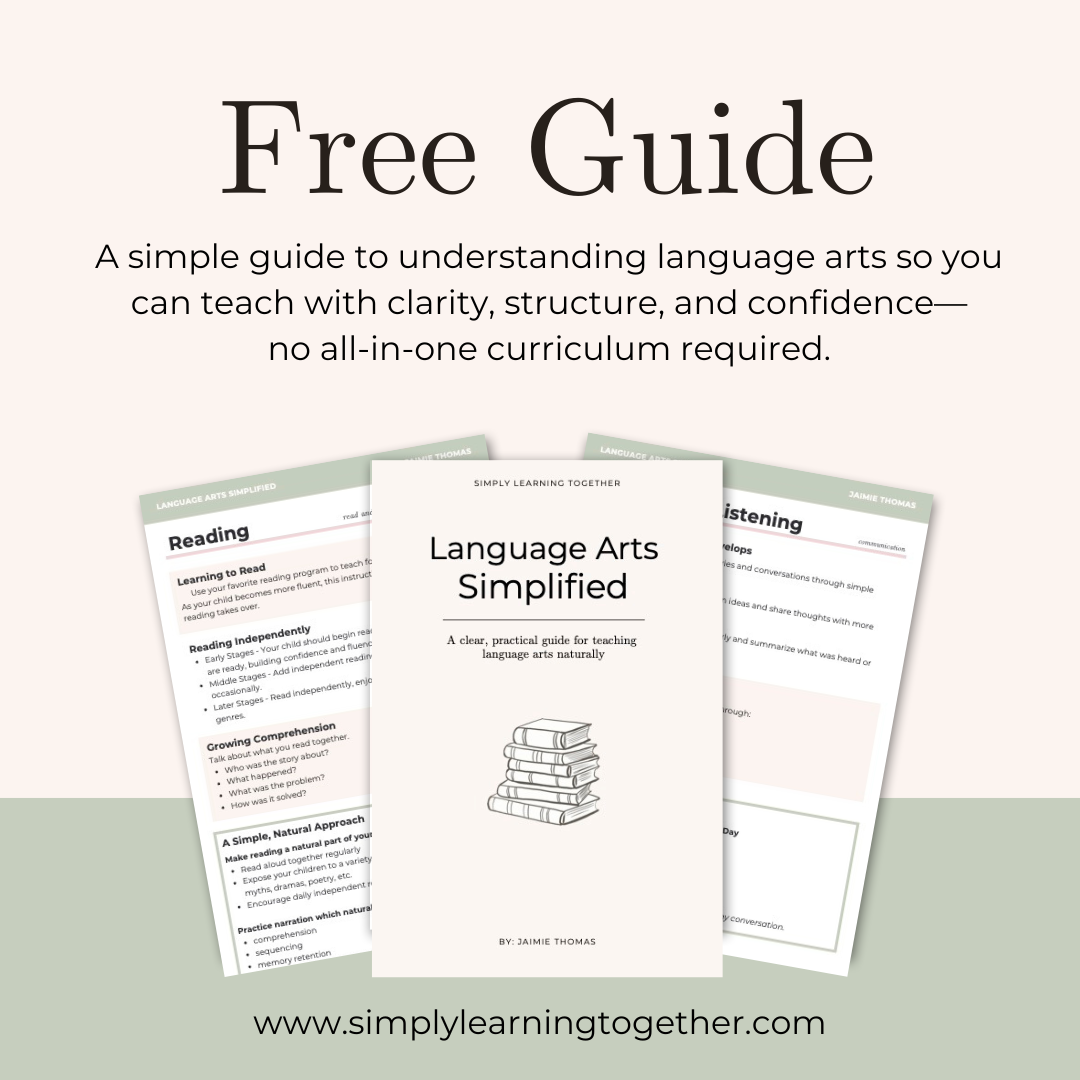
This is exactly why I created my free guide:

Language Arts Simplified

It breaks the subject down into clear, manageable pieces and shows you:

  • A simple breakdown of each part of language arts
  • An understanding of what your child truly needs to learn
  • Practical ways to meet those goals
  • Flexible options so you can build an approach that works for your family

You Don’t Need a New Curriculum

There’s no need to start over or buy something new.

You just need a clearer understanding of the subject—and a natural way to approach it.

Download the Free Guide

If you’ve been wanting a simpler, more connected way to approach language arts, you can download the guide below.

My hope is that it gives you the clarity and structure you’ve been craving—so you can move forward with confidence and finally feel at peace with your approach to language arts.

Get the Free Guide

Subscribe to get Language Arts Simplified sent straight to your email.

    We won’t send you spam. Unsubscribe at any time.
    Posted on 4 Comments

    Teach Science through Picture Books in Your Homeschool

    I love to teach science with picture books in our homeschool. The thing about picture books is they’re great for every age. From toddler, to teenager, to me – the adult! We can learn so much through one book.

    Over the last couple of years I find myself moving further and further away from textbooks and workbooks in multiple subjects and focusing more on literature-based learning. It has been such an engaging and memorable way to learn.

    There’s something about a science textbook where every time I open up to start the lesson, I dread reading it out loud. It’s like I already know it will be hard to keep their attention the whole time. This year I bought a science text for my older girls that they were taking in our co-op and thought we could just use it as a family study since it was made for elementary ages…I couldn’t do it!

    The thought of reading it to my youngest ones (ages 5 and 6) was overwhelming. I’ve been thinking a lot about my youngest two and how fun these elementary years can be – so much wonder and curiosity and play through learning. I want to take advantage of these years and enjoy what we are reading. This is what led me to create my newest literature-based curriculum – Science Through Picture Books.

    In this blog post I’ll share a little more about what it is and how it works. I’ll let you know my plans as I work on piecing units together over the next couple years to create it for my own family. Picture books have brought so much joy to our homeschool, and I hope it can do the same for you.

    This post contains affiliate links. If you follow one of my links I earn a small commission at no extra cost to you. Thank you for supporting my blog!

    An Overview of Science Through Picture Books

    Science Through Picture Books was created as a family study for your children ages kindergarten through fifth grade. It will be made up of multiple units, and each unit will contain a list of twelve books.

    These twelve books can be read at any pace you like. Read one per week and finish the unit in twelve weeks OR two per week and finish the unit in six weeks. Read three per week and finish in four weeks…and so on!

    You have the choice to read as many as you’d like throughout your week, making the unit fit into your family schedule as you desire.

    Each book is paired with an optional video. These are short videos to enrich the lesson from the stories and can provide more visuals and discussion opportunities with your children.

    As you read these books, I will guide you in introducing and discussing the stories with your children. (See example in photo above) For each book, I give you notes on reading it aloud, a script for introducing it to your kids, and optional discussion questions and narration prompts.

    Science note booking is also an option. I will teach and encourage you to practice narration as you read this books. The unit will list multiple ways to keep record of your science notebooks in order to differentiate your note booking for different ages and skill levels.

    Finally, I provide you with a list of enrichment activities that you have the option to add to your studies. The activities range in prep and difficulty containing super simple ideas or more complex projects that take a little more time.

    What is a Lesson Like in Science Through Picture Books?

    Picture this: Gather at the table, snuggle up on your couch, or lay out a blanket in the grass. Read a book and have your children narrate to you. It’s that simple. If you’re not familiar with narration, I’ll guide you through all of that in this guide. 

    Some of you may like to go a little further, and that’s encouraged if it brings you joy! You’ll see in the section above all of the additional videos and activities that are included in this unit. The point is, you can make this as simple or as complex as you’d like.

    Unit Topics – Meeting the Standards

    As a homeschooling mom, I try not to focus so much on the standards, but at the same time I know that some may feel peace of mind knowing they are following a certain standard as they teach their child. So, in this section, I hope to do my best to meet both sides in the middle.

    As I researched science standards while developing this curriculum, I realized that they are not the same across the country. Common Core standards exist, focusing on literacy through science in grades K-5, which is great, because you’ll get plenty of that through these books!

    Some states have their own unique science standards while others have adopted the Next Generation Science Standards, released in 2013. (NGSS)

    My hope is to provide a variety of science units for families to choose from to help build a foundation of knowledge in the subject. These units will focus on three out of the four disciplinary core ideas listed in the NGSS: physical sciences, life sciences, and earth and space sciences.

    These categories will guide me as I choose themes for the different units. The standards will not be stated in these units, because my intention is to make this a family study, which would be an extensive list covering multiple grade levels. However, if you’re curious about what these standards are, I encourage you to do your own research on their website which provides free, downloadable lists of the standards for each grade. 

    One thing you may notice is the majority of the standards can be met through these books and your discussion. Reading the standards can feel very “official” or possibly overwhelming, but remember that the goal of these elementary years is to build a foundation – the NGSS will tell you the same thing! We aren’t trying to reach a mastery of topics. We are encouraging curiosity and igniting their desire to learn even more!

    Look-Through the Curriculum

    Want to see inside one of these units? I know sometimes that can help get a better idea of what a specific curriculum is all about. Head to my YouTube channel to learn more about this and see inside the unit guide.

    Watch the Video Here.

    Future Units

    These units will be published as I complete them with my own children. I have a goal to complete four this year. We may or may not get to more than that. Here’s what you can expect this year:

    Each unit will follow the same pattern as I mentioned above in the overview.

    Choosing Books

    I work really hard to research and read tons of books for these units. I enjoy it very much as I get to know authors and illustrators while increasing my knowledge on different topics.

    There are hundreds of books on these topics. However, my goal is not to provide you with tons and tons of books. I hope to give you a simplified, streamlined list in order to help you build a foundation of science knowledge with your kids.

    A beautiful, informative picture book always engages my children and me. Some people might refer to these as living books. These are the books that draw your attention and make you eager to listen and learn. It never fails when I read a great picture book with my kids, we are wanting to read more! It’s like it can spark a certain curiosity to dig deeper. 

    That’s exactly what science should be in these elementary years. We want to spark our children’s curiosity to learn more about the world and increase their desire to explore and experiment and even question ideas. All of this will develop their knowledge of science topics as well as their critical thinking skills. 

    When it comes to collecting these books for your family, the library is such a great way to do that. With the list of books in hand, you can easily put books on hold as you prepare for the unit! It’s such an inexpensive way to learn science with your kids.

    How to Use these Units

    In my own home, I use these units as our whole science curriculum. I don’t find it necessary to add anything else. Even as I research standards, I am confident that the content and the discussions provide my children with an excellent foundation in science knowledge.

    You do have other options to consider:

    • As stated above, use this on its own for your homeschool science curriculum. More units coming soon!
    • Use the book list as a supplemental resource to enhance a science textbook you plan to work through.
    • Let the booklist be your guide as you create your own unit study stretching across multiple subject areas. 

    However you decide to use it, I can promise you one thing – You’re going to love these books! 

    Stay in-the-know About Releases

    If you’re not on my email list already, you’ll want to join now, because that’s where I will announce new releases. Each time I publish a unit, I’ll send out an announcement with a link. I know joining email lists can be frustrating at times, but it’s the best way to communicate with you all.

    Emails are sent to announce product releases, sales, and to share the videos I make on YouTube. I hope you’ll connect with me there!

    Interested in more Literature-Based Studies??

    American History through Picture Books – Work through the timeline of history, one picture book at a time.

    DIY Language Arts Novel Guides – Make LA a family study with these novels! No more workbook.

    DIY Language Arts Picture Book Studies (K-2nd) – Practice LA skills through books you know and love.

    Posted on 2 Comments

    Homeschool Novel Study – DIY Language Arts

    Novel study has been the most fun and engaging way for us to learn language arts in our homeschool, and adding in a DIY outlook has been so freeing. Two and a half years ago we actually eliminated an all-in-one language arts curriculum workbook to solely focus on novel study, and it’s been the best decision for us.

    We like to call this method DIY Language Arts because we are able to take any novel of our choosing and use it to learn all the parts of language arts including spelling, vocabulary, grammar, narration, handwriting, and more.

    After a couple years of adjusting and finding good rhythms for this, I am now able to share these novel studies with you. Multiple studies are available, but sometimes it’s nice to see inside one, and that’s exactly what I want this blog post to be for you.

    Included in this post is a download to receive an entire week free for one of the novel guides. In the text below, I’ll walk you through how it works, so you know exactly how to incorporate it into your homeschool. I can’t wait for you to try this!

    This post contains affiliate links. If you follow one of my links I earn a small commission at no extra cost to you. Thank you for supporting my blog

    Look-Through a Novel Study

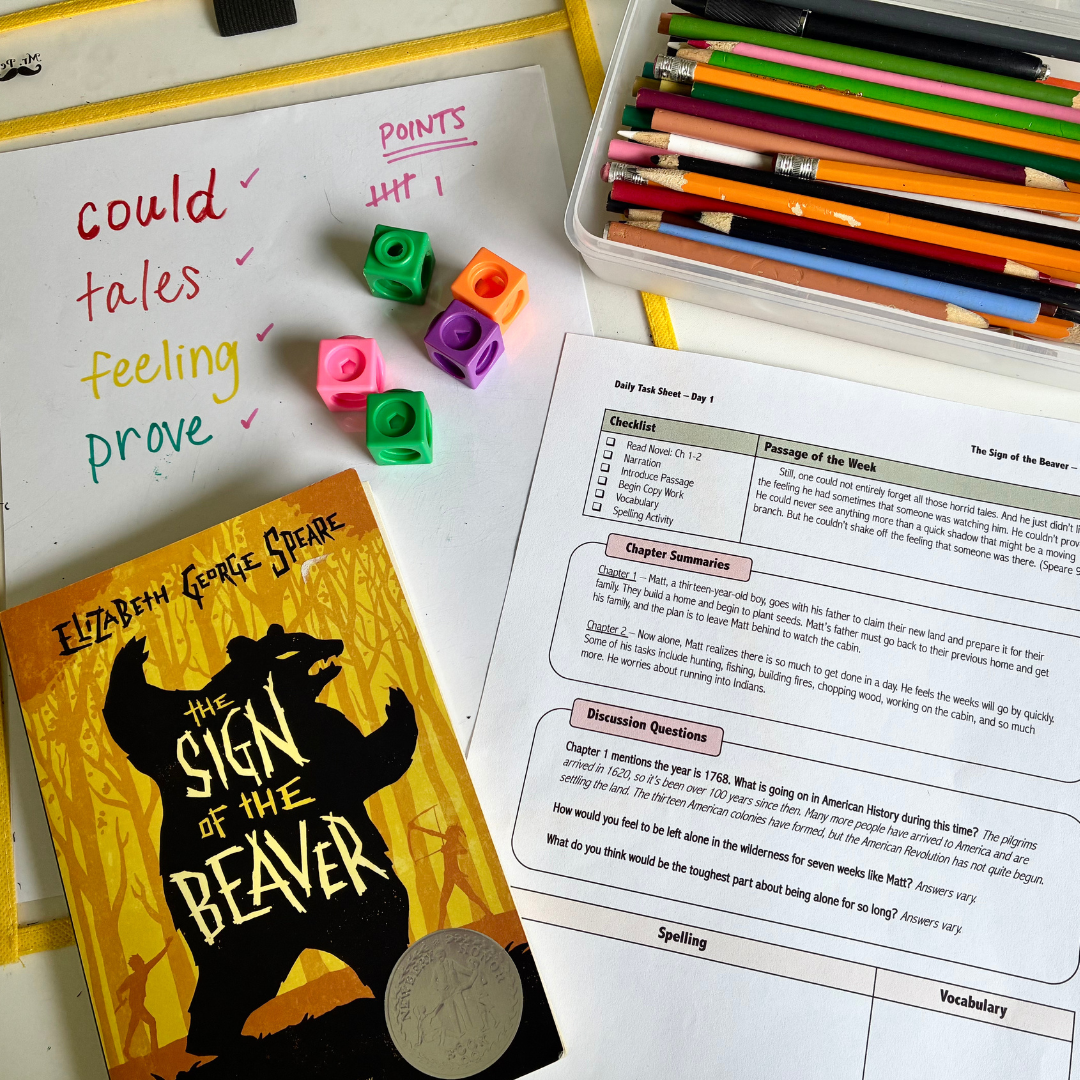
    If you would like to see a video of this particular novel study sample for “The Sign of the Beaver”, you can check out this link where I share more details. You can also see a complete look-through of one of the first studies I published. This will give you a better idea of all of the information and resources that come with the novel study. The novel studies have been updated since then and look much nicer now, but the content is still the same.

    Language Arts Overview

    Included in this sample is the “Language Arts Overview” page where I break down the subject explaining exactly what it is and how this novel guide meets the criteria for the subject. A clear and simple chart will show you this evidence.

    Language arts can be so overcomplicated in our minds, but by breaking it down and understanding what it is, we can get a better idea of how a novel can truly allow us to study the subject in its entirety.

    What age is this novel study for?

    These novel studies were created to be for the whole family. I’ve used them in my own home with one of my six year olds all the way up to my eleven year old. All of your kids will enjoy these novels, and the activities and work that are included are made to be able to adjust for different levels. If you purchase a novel study, I include the steps to walk you through this entire process in detail.

    Weekly Pattern

    Each week follows a pattern. Your daily tasks will look very similar (reading, discussion, narrating, copy work), but we will rotate an additional activity each day. This makes scheduling easy, and it allows you to loop different language arts skills for better focus instead of cramming everything in to an all-in-one lesson. The looping looks something like this:

    • Day 1: Spelling and Vocabulary
    • Day 2: Grammar
    • Day 3: Enriching Literature and Writing
    • Day 4: Dictation and Bonus Activity

    Let’s take a look at each day. As I describe each of these activities, you will have a better idea of how to use the free sample provided in this blog post.

    Spelling

    On the page labeled, “Spelling and Vocabulary Samples”, I have provided a couple of pre-made spelling lists. Multiple options are provided to help differentiate the words for the level of spellers you have. This is just an example to help you get started. You are encouraged to pick whatever words best suit your children. The words/list you choose can be recorded in the chart on the daily task sheet.

    On the day one task sheet you’ll notice “Spelling Activity” is listed. I’ve got you covered with options for this. Practicing the words can be as simple or as hands-on as you’d like. In this sample, I have provided you with multiple spelling activities to try with your family. Some are extremely simple. Others are a little more involved. The great thing about this is you can do what feels right for your week.

    As you practice the words, make a note of the ones your kids know well and the ones they don’t quite have memorized yet. This could be a simple checkmark next to the word in your spelling chart. Then, each day after that, remind them of these words. Have your child practice the missed words throughout the week. Spend about a minute or two each day reviewing the words that are needed. The final spelling assessment will be in their dictation.

    Vocabulary

    Optional vocabulary words are chosen for you in the “Spelling and Vocabulary Samples” list. Once again, you have the option to choose the best words for your family. We aren’t doing matching worksheets or flash cards. Instead we will focus on meaningful discussion the whole family can participate in. When you read the weekly passage aloud to your children, this discussion will come pretty naturally. A discussion might look something like this:

    1. Ask your child, “What do you think ____ means?” It doesn’t have to be a formal definition. Sometimes my child will describe to me with motions or sounds and then try to explain herself. Let this be casual. If she knows it well enough, move on to the next word. If not, move to step two.
    2. Next say, “Let’s look at the sentence and see if it can give us some clues to make a guess on what ____ means.” Read the sentence again that includes the vocabulary word. Then, encourage your child to make a guess.
    3. If the child is still not able to come up with a definition that is close to the real thing, look it up in the dictionary. This is a great way to practice dictionary skills. Sometimes you can even practice the process of looking it up on a phone or computer.

    Grammar

    There are many, many grammar lessons that can be taken from a passage. Throughout the guide I will provide you with one grammar focus on day two of each week. You have the option and are encouraged to practice more grammar, if you desire. In the full novel guide, I provide you with detailed information about grammar studies and how to engage in meaningful grammar lessons while practicing passage study.

    In my home, we also enjoy using a grammar review workbook alongside these novel guides. We have used Fix it Grammar in the past and now we use Easy Grammar. (See this video for details) The novel passages give us more opportunity to review what we have learned in those workbooks and see it in a more meaningful way.

    Enriching Literature and Writing

    On day three of the week, a picture book is chosen for you to read aloud to your children. This particular book will teach a little science as we learn about the life cycle of bees.

    I encourage you to check your library for this, but I will mention that it’s also read aloud on YouTube HERE. This picture book is an enriching option that provides your children with an exciting story related to the novel, and it will allow you to stretch your novel study across multiple subjects.

    I also use these picture books to practice written narration with my older children. Written narration has been such a beneficial practice in our homeschool (watch this video to hear more). Once I read the story, my oldest child will write a narration about the book.

    Dictation

    Dictation happens on the fourth day of the week, and I have provided you an option to help your younger writers in this process. Not all of your children will be ready for dictation yet, but those that are can complete dictation in two different ways.

    The first option is for your beginning writers. I have provided you with a fill-in-the blank dictation option that uses a shortened passage and contains the spelling words from one of the spelling lists.

    The other option is a full dictation where your child will write down the passage as you read it out loud. Feel free to dictate just one or two sentences, especially if you’ve never practiced dictation before. If you have a strong writer, you could try dictating the entire passage.

    For more information about dictation and how to do it, check out this article.

    Copy Work

    The copy work will match the weekly passage. You have multiple options when assigning copy work in order to best meet the needs of each of your children. In this sample, I have included the shortened copy work as well as the full passage.

    The goal of the copy work is to finish it by the end of the week. It may not take that long, but I challenge you to encourage your child to go slower with their best effort. I like to give short and sweet daily copy work assignments with the reminder that it has to be their best writing. In my experience, these short bits of copy work assigned over the week turn out much better than long, daily assignments.

    Download the Novel Study

    You can access the free sample to this novel study at the end of this post.

    If you enjoy this first week and you’d like to complete the novel study as a whole, you can find the entire guide here. This guide will include much more information about the DIY method and will even teach you how to take any novel that you choose and use these same patterns! The how-to guide is GOLD! You’ll learn so much about language arts and the simplicity of a good novel study.

    There are multiple novel studies available and more coming soon. To see more novel options, click here.

    Picture Book Studies for Grades K-2

    If you like the idea of book studies in your homeschool, check out my new picture book studies for your younger ones. These one-week units focus on one beautiful picture book and provide you with a passage for the week. This passage will allow you to practice copy work, spelling, vocabulary, and grammar.

    Each week also includes an outdoor activity as well as an optional bonus activity at the end of the week. These book studies are so much fun! Use them for one week or grab a themed bundle for the month!

    See all of the picture book studies available HERE.

    Download Free Sample

    Join my email list and receive a free one-week sample of the novel study for “The Sign of the Beaver”. This is such a great way to get an up-close look at what this DIY Language Arts learning style is all about.

      We won’t send you spam. Unsubscribe at any time.
      Posted on Leave a comment

      Homeschool Language Arts WITHOUT a workbook

      Have you been wondering if you could teach language arts without a workbook in your homeschool? It seems do-able and much more inviting than opening a workbook each day. Well, I’m here to tell you – you CAN! And it’s so freeing and fun! It can completely change the attitudes of this subject in your home, in the best way!

      A few years ago we did just that. I was having the hardest time teaching language arts, mostly because it was boring and the workbooks really felt like a chore to get through. Add the fact that I have multiple students to teach, and it really just wasn’t great for any of us!

      This is when I began to research passage study and novel-based language arts. There are multiple curricula options available to walk you through something like this, but I still was looking for even more freedom. That’s when I started practicing and using the term “DIY Language Arts”

      This post contains affiliate links. If you follow one of my links I earn a small commission at no extra cost to you. Thank you for supporting my blog!

      DiY Language Arts Template

      What is DIY Language Arts?

      As I mentioned in the introduction, over the past few years I have been passionate about letting go of an all-in-one language arts curriculum. They are great for pacing and consistency, but most of the time we found them to be boring and repetitive in our home. I want my children to love literature and since it is such a huge part of language arts, it’s important to me that we all find enjoyment in learning about it. Otherwise, in my experience, reading becomes more like a chore. 

      Using this DIY (Do-It-Yourself) method of language arts, we have been able to have so much more freedom, letting go of the workbooks and instead choosing what we learn based on passages from great novels.

      Choose A Novel

      First, we choose a novel we want to read and all of our studies come from passages in that novel. One passage per week is how we started. The novel works around our schedule, making it so much more enjoyable than trying to fit a novel and chapters into certain time frames. Since all of the passage studies revolve around the novel, it becomes simple to plan and inexpensive to purchase. We can almost always use the library to collect books.

      Passage Study

      As we read, I choose a passage from the upcoming chapters each week and that becomes our focus. What’s going on? Who’s involved? What are the emotions? Next, that passage provides us with new vocabulary to discuss as well as spelling words to practice for the week. Each day, my children write portions of the passage practicing their handwriting skills and getting accustomed to reading and writing well-written sentences. 

      Narration + Meaningful Discussions + Enriching Literature

      As we read the novel together, we practice narration and have meaningful discussions. This has allowed us to eliminate the need for busy-work worksheets and instead encourage connection and conversation about what we are reading. Through the addition of children’s literature, we can expand our language arts across multiple subjects as we relate our story to something in history or science or the arts. My older children use these engaging stories to practice writing skills. 

      Dictation/Assessment

      Finally, through the use of dictation, I am able to assess my children and their progress from the week. I can check spelling skills and punctuation use as I dictate the weekly passage. This pattern of passage study has been educational, flexible, and honestly just much easier and enjoyable than completing a workbook every day.   

      Family-Style

      This method of language arts works for my whole family! Currently my school-aged kids are 6, 9, and 11. We love that we can do language arts all together. With simple adjustments to copy work and spelling lists, each of my kids can participate in this study, making planning and time management so much easier in our homeschool!

      novel guide

      New Guides Available

      After doing this for a few years and forming rhythms, I’m so excited to share what I have learned with you all. Recently I created DIY Language Arts novel guides where I walk you through a complete novel PLUS I share with you the research and strategies I use to put something like this together. My goal is to help you be able to DIY your own language arts in your home whenever you choose. It’s freeing and FUN! The newest guides are linked below:

      The Secret Garden

      James and the Giant Peach

      Passage Study Chart

      If you are familiar with passage study or if you do something like this style in your own home, then you may enjoy the new Passage Study Charts. These charts break it down so simply providing a passage, sample spelling and vocabulary lists, chapters to read for the week, and weekly enriching children’s literature. This simple chart is perfect for someone who loves a little more freedom but wants decisions made already!

      Passage Study Chart – The Secret Garden

      DIY – Blank Planning Template

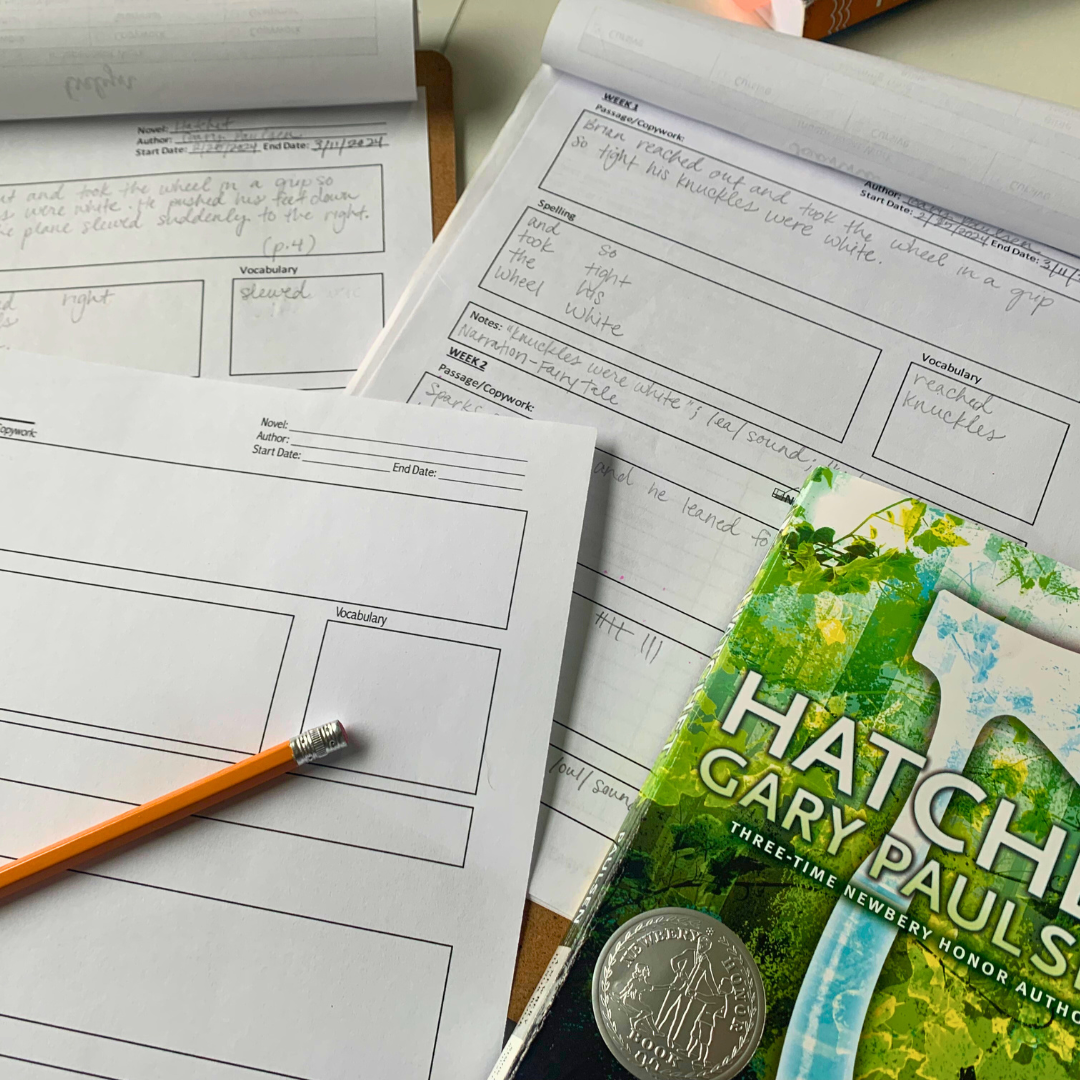
      Ready to plan your own? Before I made the guides, I used a simple template (pictured above) to help me organize and plan our passage study. By making quick notes at the beginning of the week, decisions were made and the process of studying the passage became easier. Plus, it doubles as a great record for our novels and how we have used them throughout our school year. This is a FREE template! Get yours below.

      Passage Study Template

      Final Thoughts

      I’ve done a lot of research on the different pieces of language arts and what it ACTUALLY is. I honestly think the subject gets over-complicated and as a result we end up with endless worksheets and exercises that feel more like busy work than meaningful education.

      Imagine if your language arts could suddenly feel like a little book-club in your home. Book after book you can make connections, expand your learning across multiple subjects, learn from character experiences, and MORE and you study language arts as a family. This method simplifies the process, makes learning meaningful, and truly creates much better connection than a workbook.

      I hope you’ll give it a try! If you do, share it with me here or on social media (@simply.learning.together). I love chatting about this so if you have questions, let me know. I also have multiple videos on YouTube sharing our experiences with this over the years:

      Language Arts Without a Workbook – You Can Do IT!

      DIY Language Arts Playlist

      More Literature Based Studies

      I absolutely LOVE adding literature to our homeschool studies. Recently we completed our study of American History using nothing but picture books! It was amazing! And so much fun! Check it out here:

      Posted on 12 Comments

      Learning American History through Picture Books

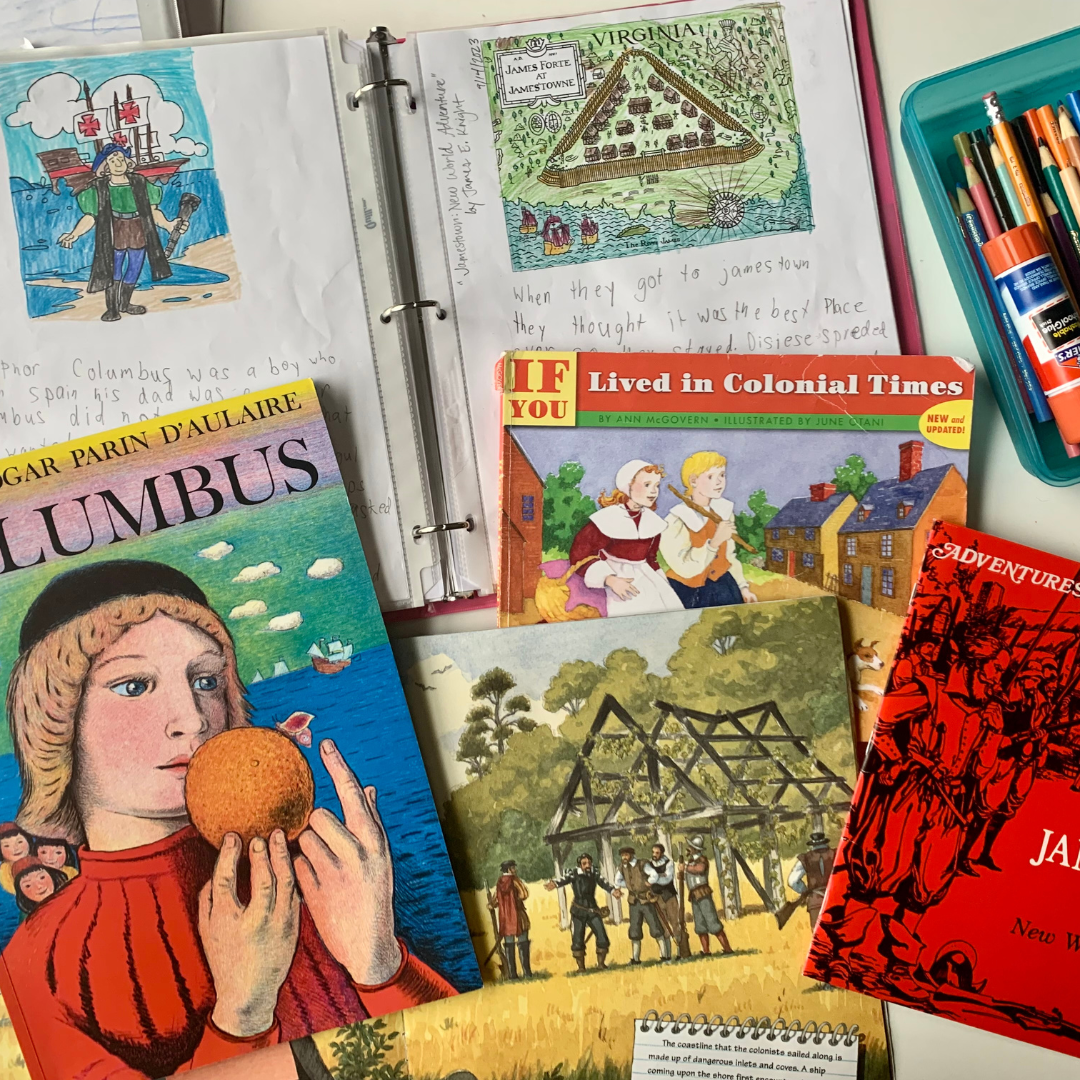
      Learning American History through picture books sounded so great to me, and I was determined to make it happen this year. Now that we’ve done it, I am so pleased with the way it turned out and how much we loved it!

      I was never a good history student growing up. Textbooks felt boring and not relatable. The information didn’t stick with me, and I didn’t enjoy it. Boy, did that change once I started teaching it to my own kids in our homeschool! It’s become one of my favorite subjects.

      There’s something about a good picture book that just grabs you in to the story. Reading them together with my kids is engaging and memorable. With American History as our focus for the year, I was itching to focus more on picture books and LESS on a textbook.

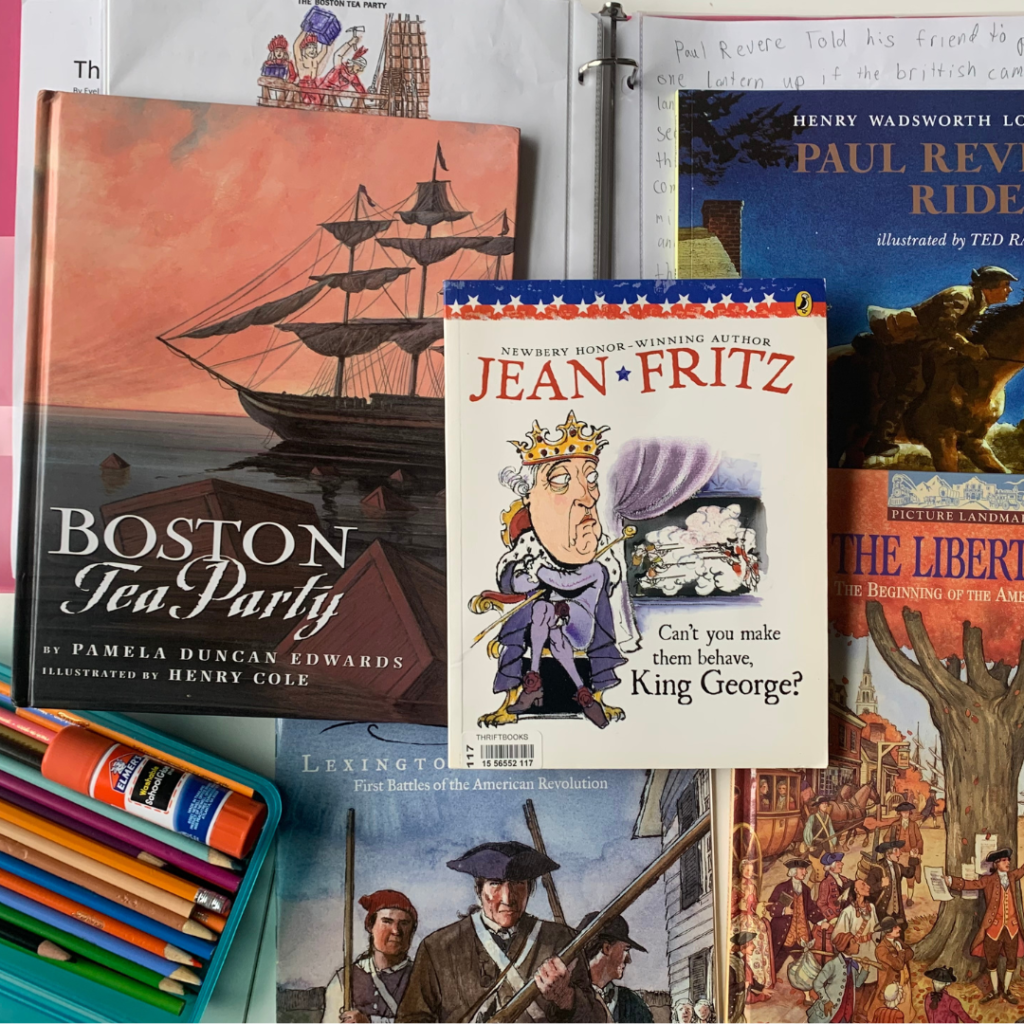
      I worked really hard to put this list together for my kids (ages 9, 7, 4, and 3). To be clear this list covers Viking explorers through the Treaty of Paris (1783). I know for a fact that there may be some gaps as we can not cover Every. Single. Detail…but can a textbook? No matter what curriculum you use, the information is going to be delivered in a unique way.

      This was our unique way of learning history this year, and we learned so much. Most importantly, we had fun doing it. It never felt like school. My hope in sharing this list with you is that it can provide that same feeling for you and your family. I pray it allows you to enjoy simply learning history together with your kids.

      This post contains affiliate links. If you follow one of my links I earn a small commission at no extra cost to you. Thank you for supporting my blog!

      Want to Make it Even Easier?

      I have created a complete curriculum of these books, based on the way we completed them in our own home. It includes all of the details of how we read them and what activities or videos we completed alongside them. If you would rather take the planning out and follow a step-by-step guide to completing this, than this is the curriculum for you!

      See a complete look-through of this curriculum on my YouTube channel HERE.

      It will break down a schedule for you, explain all the details of narration and writing, provide discussion questions, and it contains the links to all of the resources I mention below. You can check it out HERE.

      Prepping for the List

      Before I jump into the list, I want to share how I came up with it. This took some time and studying on my part, but it was worth it.

      TruthQuest history is where I started. This was recommended to me by another homeschooling mom, and it’s basically a gigantic book list. Now, when I say gigantic, I mean GIGANTIC. It’s overwhelming without a doubt. Want a book on George Washington? The book provides 31! And that’s just one person in American History.

      Now, times that by each person and event and you can see how this becomes an extremely extensive list. The reason I bring it up though is because it’s a fantastic resource if you’re looking for more book ideas about history. The author has multiple units from ancient history to modern times.

      After a little reading and studying on my own, I was able to come up with a list of books that would allow us to work through American History with picture books. I’ve learned in the past that quality is better than quantity, so I have chosen spectacular books to help us do this. I can’t wait to share this list with you!

      Narrations

      I am normally the crafty type, but for some reason I am just not in a crafting season right now. Maybe it’s the work load of my two bigger ones. Or maybe it’s because of the two little ones that need my time and attention as well. If you check out some of my other units I’ve shared about, you can see that I love a good craft at times.

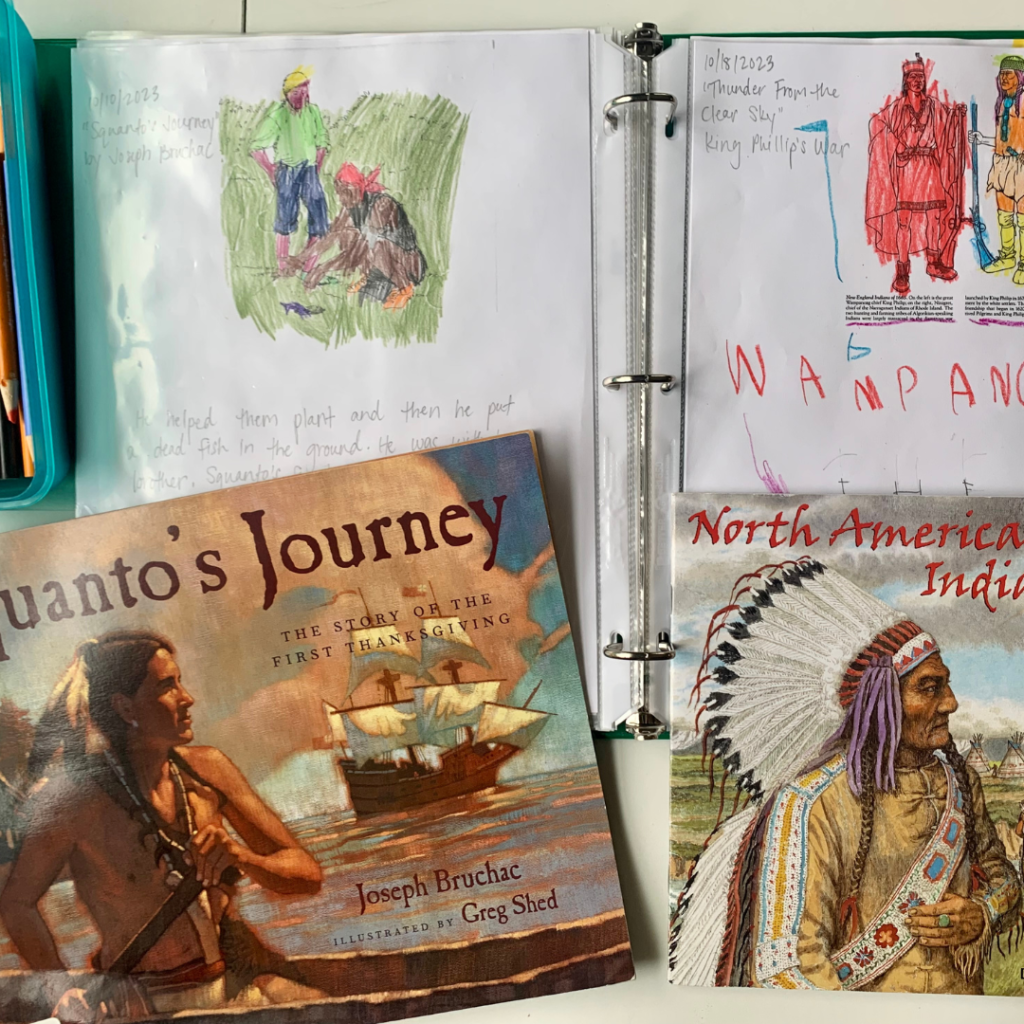
      As much as I love them, that wasn’t my goal in this unit. I wanted to keep it so, so simple. Our “assessment” or “learning products” came in the form of narration instead of a craft. Since narration uses my children’s actual words/thoughts I have actually come to really value them. What a treasure to see their sweet minds at work. I usually toss crafts…these I want to hang on to forever!

      I kept this really simple. My goal was one per week, but some weeks we did two. Add in a simple coloring page for them to work on while I read and it served two purposes – keeping their hands busy AND a page for me to record their narrations. (I share exactly how I did this in my unit)

      If you’re not familiar with narration, it’s basically telling back what you just read. We do this each time we read, but some books we record our narrations. My oldest (9) writes her own. My 7yo verbally narrates and I write it for her. Every once in a while my 4 year old will tell me something, and I melt at her cute little sentences about the book!

      This was such an easy way to “measure” their learning and it was FUN! I also love going back and reading what they wrote. It’s interesting to see how my 9 year old’s writing has changed, and I notice my 7yo improving in the way she verbally narrates as well. It’s just amazing to see all they remember.

      Videos

      There were definitely times I couldn’t find a book about what I needed. When this happened, I usually shared a short video with the kids on the topic. This made it easy to have a discussion as needed and move on to the next thing. I will list videos we watched in my list below.

      Picture Book List

      It is so exciting for me to share this list with you. I hope you and your family enjoy these books together! You can find all of the books linked HERE. I will also link them individually for you for convenience, especially because a couple of them can’t be found on Amazon.

      Some of these books are lengthy. Many of them we read half one day and finished it the next. I have little ones, so I totally get the need to cut read aloud time short. It’s hard to keep them quiet and still! Take your time. Enjoy the books for however long you need. Almost every book we were able to read in 1-2 days.

      At this point in our timeline, there are so many different people you could touch on in history…Abigail Adams, Thomas Jefferson, John Hancock, etc. We could read for days and days! I chose a select few before finishing out our unit before Christmas. Here’s what I went with:

      WOW! It is exciting to reach the end of this list and share! Of course I missed things. I am human, but I doubt you can find a textbook that covers every single detail either. The point is to experience the joy of learning all of this. By using picture books, that joy comes effortlessly, and the events and people are memorable in story form. I hope you feel that same way!

      Do you want to see how we lined all of these books up and turned it into a history unit? I have it detailed and explained in my unit that you can find HERE.

      Videos List

      The following videos helped us fill in some gaps between books:

      • “How did Europeans immigrate to the Americas?” by History on Maps  (Video Length – 11:52) This is a great video to touch on the fact that there were multiple explorers besides Columbus.
      •  “John Smith | PBS World Explorers” by Gerry Dincher  (Video Length – 4:44) A couple books on the list briefly mention John Smith. This is a short video giving more details of his life.
      • “13 American Colonies” by Kids Academy  (Video Length – 4:16) This video explains how the New World became the 13 Colonies.
      • “Crispus Attucks and the Boston Massacre” by The History Channel (Video Length – 6:08) You will read about the Boston Massacre in one of the books, but this video looks into the life of Crispus Attucks, one of the first men killed during the events of the American Revolution.
      • “Treaty of Paris 1783 | Daily Bellringer” by The Daily Bellringer (Video Length – 5:01) A peace treaty is mentioned in the couple of books that we read, but this video will go into detail about what it is and what it meant.

      Coloring Pages

      I have also linked the coloring pages we used for our narrations on a Pinterest board titled “American History Coloring Pages”. There are lots of options online, but be sure to check out the board for a few to start with.

      I would love to hear from you if this list is helpful! Be sure to check out the unit I put together that schedules all of these books and videos together. (Click here to view)

      Have you read any of these books? Do you have a favorite on this list? Any you never heard of? Share with me in the comments and connect with me on social media. You can find me on Instagram and YouTube.

      Helpful Links

      American History Curriculum

      Picture Book Links

      Coloring Pages

      Individual videos linked above.

      American History through Picture Books – Complete Curriculum

      I am so excited that this history curriculum is now complete. This has been a project I have been so passionate about over the last couple of years, and I am thrilled to share it all with you. You can now get ALL of the units to this curriculum which makes it a COMPLETE American History curriculum spanning from the explorers in 1000AD all the way through modern times (2000s).

      Unit 1 – Explorers through the Treaty of Paris (1000-1783)

      Unit 2 – Constitution through Civil War (1787-1865)

      Unit 3 – Reconstruction through World War II (1865-1945)

      Unit 4 – Post World War II through Current Times (1945-2003)

      You can also purchase all of the units as a bundle for a discounted price.

      NEW Science Through Picture Books

      We had so much fun learning history through these amazing picture books. I knew Science had to follow suit. Read more about it HERE.

      Looking for more literature-based curriculum?

      For the last few years, my children and I have created a novel-based language arts program that is family-style and enriched with great literature each week. I’m so excited to share a NEW guide with you on how we do this in our home. If you’re tired of an all-in-one language arts workbook or if you’re itching for a great novel to read aloud to your kids, you’ve got to try this method! Below are two of the newest guides available now:

      James and the Giant Peach

      The Secret Garden

      You can watch multiple videos about this method of Language Arts on my YouTube Channel HERE

      Posted on Leave a comment

      No-Sweat, Simple Composer Study – Beethoven

      One afternoon, my girls and I were enjoying a snack around the table when I decided to play classical music. This is not something I normally do. With four young children, the day fills quickly, and subjects like music tend to be pushed aside. (I’m sad to admit it.) However, I decided to try it, because I had just finished listening to a book that really encouraged me. (Modern Miss Mason by Leah Boden)

      Turns out the music quit playing and I didn’t even realize. (oops!) No one could hear it. When I finally remembered it was on, I quickly grabbed my phone to figure out what was going on. I turned it up and saw the name of the song. It was a song by Beethoven.

      My oldest daughter has an ear for music so I decided to “quiz” her on the spot, just for fun. “Do you know who this is?” I asked her. She looked at me like the answer was obvious and responded, “Yeah…it’s Beethoven!”

      I couldn’t believe it! I didn’t even know that, but how cool! I asked her how she knew, and she just said that it just “sounded like him”. Well, this got us thinking…what does he sound like?

      A quick YouTube search, and we were immersed in the world of Beethoven!

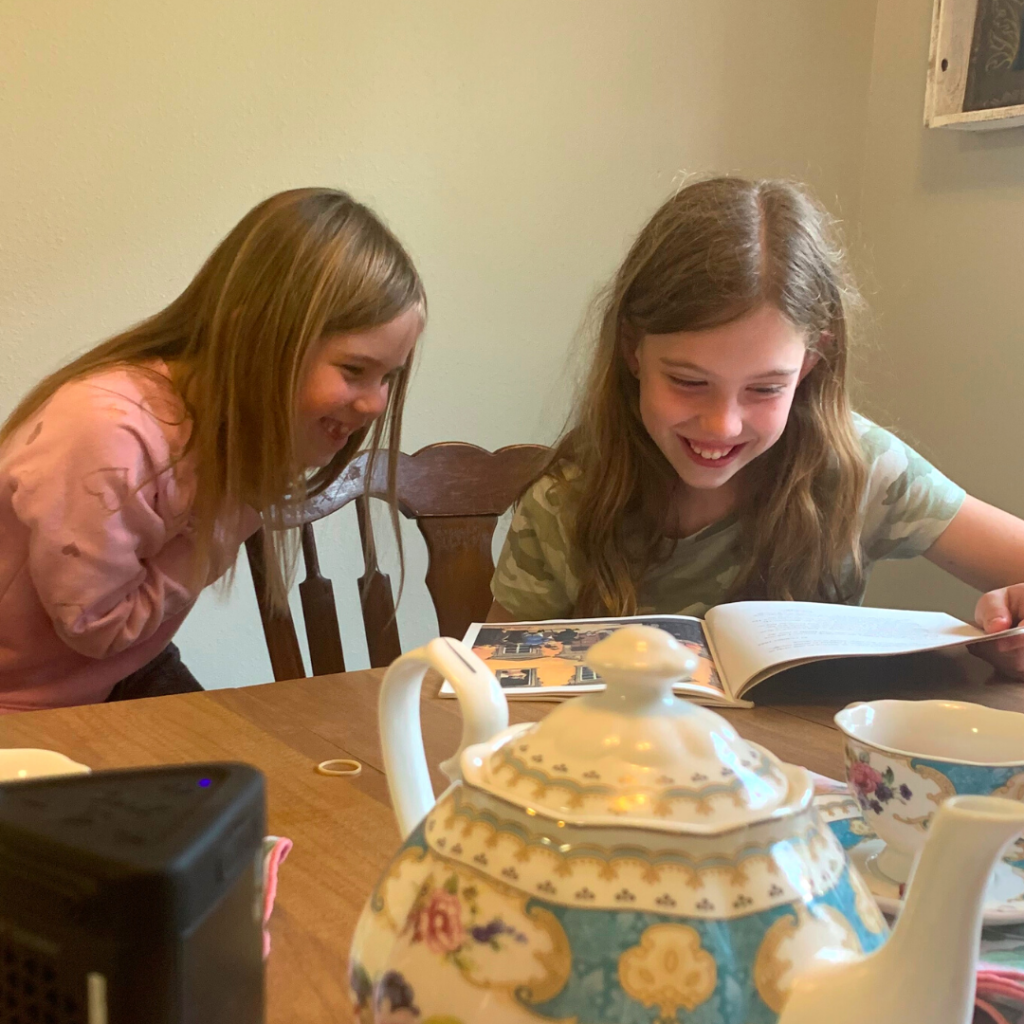
      At the end of this afternoon snack, I had this boost of confidence – I can do this! I can add this in without sweat. It was so easy to sit back and chit chat about a song over a snack. Of course, in homeschool mama fashion, I laid out a plan in my head to figure out how to make this work with consistency. The following is what I came up with and some tips on how to make it work.

      This post contains affiliate links. If you follow one of my links I earn a small commission at no extra cost to you. Thank you for supporting my blog!

      Choose your Composer

      This sort of fell in our lap, but there’s a couple ways you could do this. If you’re studying a specific time period, you could look to see if a composer lived during that time. It would be a great way to link your subjects.

      The other option would be to just pick something you’re familiar with or something that sounds interesting to you. For our first one, Beethoven was such a great fit, because it’s a well-known composer and I also knew the name well. So, it was fun to learn so much about it!

      Lastly, you could pick at random from a good list of composers! Check out this website from Simply Charlotte Mason for a list of suggested composers to study.

      Snack and Drink

      Little ones always seem to listen better when they’re eating. So, you may want to pick a time of day where a snack fits in.

      I chose the afternoon after our quiet time, but I have heard of people that do studies like this at breakfast or during a mid-morning snack. Now, a drink is not necessary, but my girls love a tea party. So, it’s turned into a little routine.

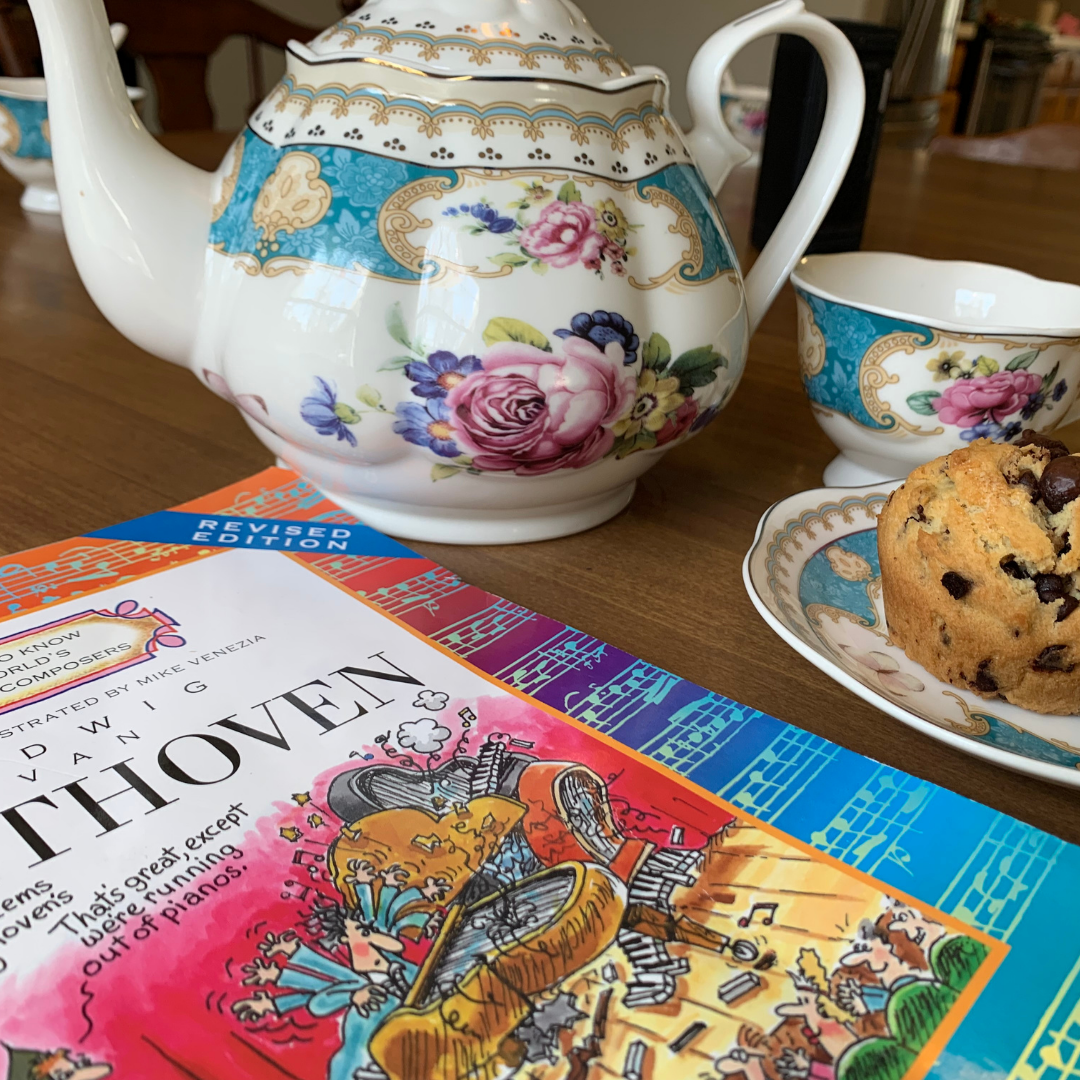
      We have a cute tea set that one of the girls got for Christmas one year, but other than that our “tea party” is not fancy! Our snack has been as simple as apple slices to something more intense, like homemade muffins. Always pick what feels easy for you.

      You want this time to be relaxing and enjoyable. Nobody has fun when they’re running around like crazy. Choose simplicity!

      I’ll be honest, the first week we did it, I did kind of feel like a crazy person. Balancing everyone’s tea, and the honey, and the mixing, and the temperature adjusting – it was a little nuts. However, the more we’ve done it, the easier it gets.

      I wonder if I should share some of my tricks with you?? If you’re interested in tea, I’ll let you know what we do to make it flow better. First, I prepare while my kids are still in quiet time. I boil the water and steep the tea.

      Next, I get the snack ready and at the table (usually I just put it on a paper towel!) I set out enough tea cups for everyone, and I actually put two ice cubes in each cup. This helps cool the tea quickly so no one burns their mouth.

      I also give each girl a little spoon (that came with the set). When it’s time to add the honey, the kids know the rule – fill the spoon and mix. No more 😉

      Just as a side note – I treat myself to a snack and drink too. I could drink tea with the kids, and sometimes I do, but I usually like to make myself a yummy iced coffee! It’s such an afternoon treat.

      beethoven books

      Books

      To keep it simple, I decided to look for books I could find at my library/local used bookstore. I put books on hold, and picked them up as they were ready. Since this study took about 7 weeks, I wasn’t in a rush to get them all at once.

      My goal was to try to read one book a week. Sometimes we did this in just one sitting. Some books, we split up into two different times. I basically just read until I feel like I’ve lost their attention. (This is usually around 15-20 minutes, sometimes even shorter if my two-year-old is awake)

      The books we got were great, and we learned so much! I’m going to list them here for you and I’ll put them in order of how much we enjoyed them. The first is the one we enjoyed the most!

      You’ll notice I didn’t have a book for every week. There was a week or two when I was waiting on a book so we just looked up some information about a song on the internet. It was a quick way to learn a little bit about the song/musician, even without a book.

      Music

      If you do a Google search for “Ludwig Van Beethoven Compositions” you’ll get a big list. I chose a small handful to look at over a 7 week period. I will list those below.

      I really don’t think it matters what order you listen to the songs. You could do it chronologically, but that would take a little research. I chose the songs based on the ones I recognized first. Then, I chose ones that were brought up in a book we read or that came up on an internet search.

      For each song, I used a YouTube video to play the music. There are a couple different ways I would integrate the music into our homeschool.

      First, I would try to play it while I prepared our afternoon tea. When we started reading, I would turn it down. When we finished our book, I’d play the music again and this time we would listen very closely. We might point out if it’s soft or loud. I might ask what instrument they could hear.

      Sometimes we would even pretend we were playing and move our body according to the feel of the music. It sounds silly, but Beethoven’s music is very up and down. One minute it’s quiet and playful and the next it’s loud and aggressive. We had fun acting this out on a pretend instrument.

      Lastly, I would try to play it a little bit throughout the week. I wasn’t always good about this, but I did try. Sometimes I could just play it in the house or I might play it while we were picking up.

      Playing the Music on the Piano

      Every once in a while my kids will do a piano lesson on Hoffman Academy. One afternoon, my oldest realized that there was a teaching video for “Fur Elise”, one of Beethoven’s compositions.

      So, instead of doing the normal Hoffman Academy lessons, she has been working on “Fur Elise” for a couple weeks. I thought it would be such a great way to experience the music, and it now had so much more meaning.

      Easy Break-Down

      Let’s break this down to visualize an easy-to-do checklist. Sometimes seeing it like this really shows off the simplicity, and that’s my hope here. A composer study can be this simple and still be so beneficial!

      • Prepare Snack and Drink
      • Gather around the table
      • Read a book about the composer aloud
      • Listen to a song by the composer
      • Discuss the book, the music, the instruments

      That’s it! No worksheets, no extra activities, just fun conversation and good food around the table. Doesn’t that sound wonderful?

      Simple, Fun, and Memorable

      “Hey, Mom, what’s Beethoven’s favorite fruit?” This was a joke my daughter read in a magazine and shared with me one night. Of course, after listening and learning about him for so long I was determined to get this joke. “Moonlight Banana,” I said. “SO CLOSE!” She responded. And then she sang the answer, “Ba-na-na-naaaaaa”

      Did you hear it? It’s from his Fifth Symphony. How cool that we can recognize that together. A silly joke suddenly has so much meaning.

      It’s such a beautiful part of homeschool. I knew very little about Beethoven, and now my children and I can all share in our learning together. I used to think that a composer study was just one-more-thing to add to our day. How in the world was I supposed to get it done?

      However, with this approach, not only was it simple, but it became one of the most relaxing parts of our day. I so much enjoyed pausing are afternoon to connect over music, food, and a good book about a GREAT musician.

      Posted on 4 Comments

      Knights and Castles – Middle Ages Mini Unit

      coat of arms

      We are beginning to study the middle ages in our homeschool, and I’ve decided to make it into a bunch of different mini-units. Our first one will focus on knights and castles.

      Read further for all the books we read as well as the activities we did, but come back soon and check out our other middle ages units as well. I will be posting them on the blog as we complete them!

      This post contains affiliate links. If you follow one of my links I earn a small commission at no extra cost to you. Thank you for supporting my blog!

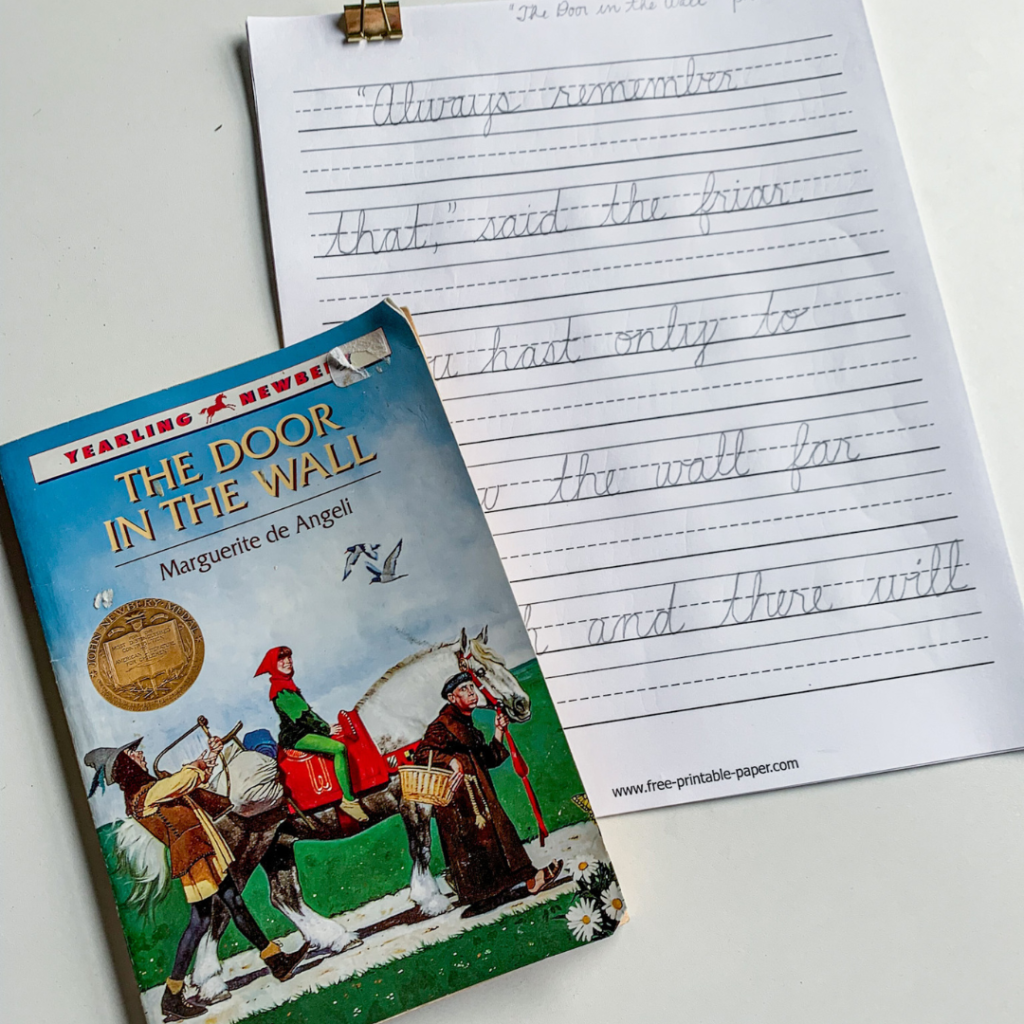
      the door in the wall

      Read Aloud Novel

      “The Door in the Wall” by Marguerite de Angeli takes place in the middle ages. It follows the story of a young boy who is destined to become a page but is suddenly ill and unable to fulfill his duty. A monk comes to his aid and encourages him to learn new things and work on becoming stronger. His hard work will soon pay off as he will play an important role in protecting the castle.

      This book came highly recommended (from many other homeschool mamas online) as a historical fiction novel to read while studying the middle ages. The language can be tricky to understand, and by reading it aloud, I was able to explain what many different things meant. (I also learned some things myself!)

      The book is 121 pages and contains 10 chapters, most of which we were able to read in one sitting. The last two chapters were much longer and took us a couple of days to get through.

      I also love the message and theme that surrounded the story. Hard work and perseverance can really pay off. When one opportunity ends, another one might come along. You may think about a modern day phrase, “When one door closes, another opens”. All of these ideas brought on great discussion with my kids.

      We all enjoyed this book so much. Although we used it to study history, we also used it for my oldest daughter’s language arts lessons. (Read about that here)

      More Books

      I love using the library as our main source for books, and for this unit, I even visited a local used bookstore. That may get dangerous in the future. I could’ve bought so much! I found tons of good reads and I’ll share the best ones here. You can also check out my YouTube video where I share a peak inside of the books as well.

      coat of arms

      Coat of Arms

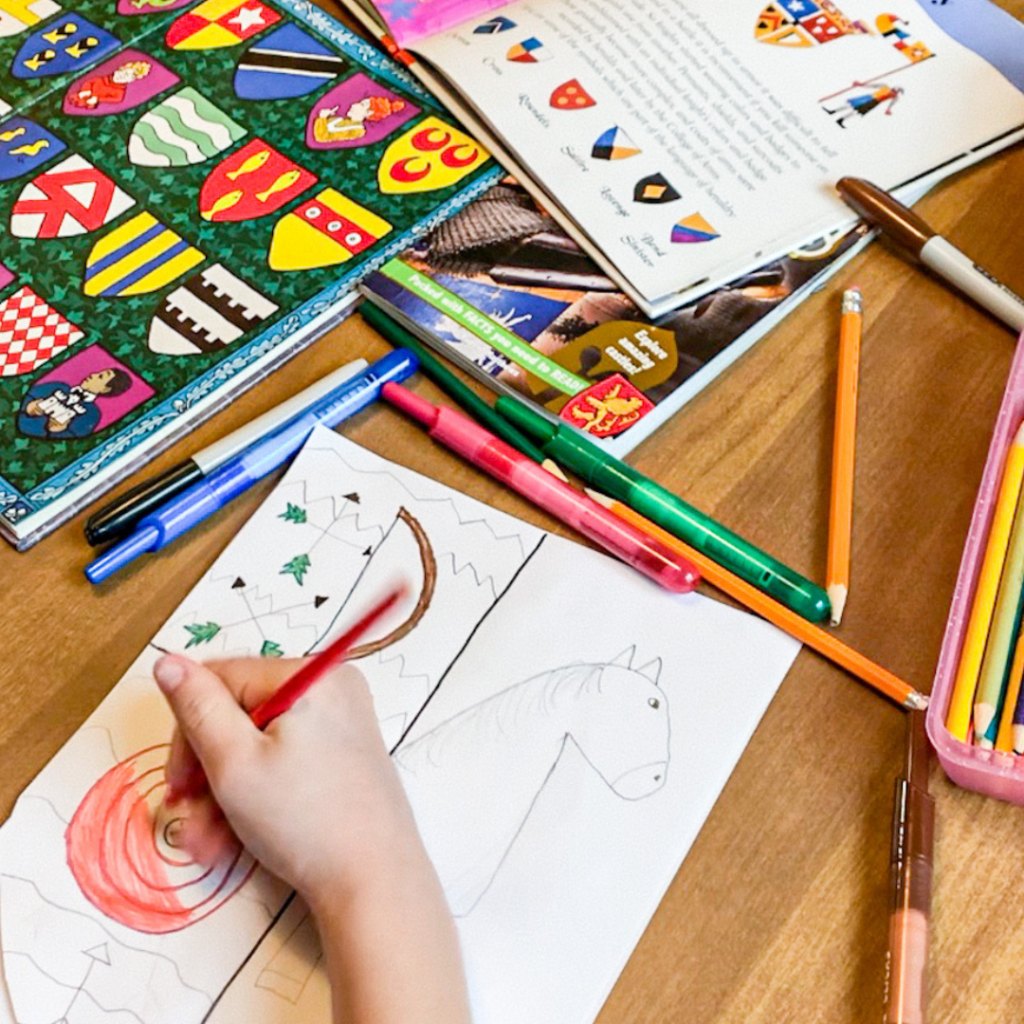
      Almost every book we read about knights talked about a coat of arms. Knights would decorate their shields in a way to represent who they were. This was a fun activity to express who we are and decorate our own pretend shields.

      You could definitely cut cardboard and paint if you wanted to go all out. We just used white paper! I cut the papers into a shape of a shield and I offered a couple of options. Decorate the whole shield or divide it into 2-4 pieces and add different designs to each piece. They each did something different, but I loved seeing what they chose to add to their shield.

      I had them tell me about their designs and what it meant to them so I could write it on the back. It’s a great piece of art for their portfolios.

      cardboard castles

      Create Castle and Drawbridge

      This activity and the two following activities were completed after reading portions of “Castle” by David Macaulay. This book seemed a little intimidating to me because it’s quite long, but it was highly recommended. It turned out to be absolutely wonderful and we learned so much! It did take about 3 days to get through it all.

      We created a castle using a cardboard box from our pantry. This blog post breaks down the entire process. Since I have younger ones, I did a little bit of prep to help the activity run smoother. By the time we were ready to start, I already had the boxes shaped.

      I had my two oldest each decorate their own castle. I will admit that once it was time to create the drawbridge, I could only help one at a time. If you had older kids, it may be fun to hand them the supplies and say – how can you make this work?

      With my two (ages 6 and 8), we talked about it as we went, and I had to do a lot of the work so that the drawbridge would do what it was supposed to. Even still, they loved the finished product and immediately got their Barbies out to start acting out a castle attack. It was pretty cute to watch, and such a fun way to assess what they’ve been learning – through play! I love it!

      Castle Drawing and Narration

      Before we read our Castle story one morning, I found a video that taught my girls how to draw a castle. Now, we love Art for Kids Hub, but their castle drawing could only be watched if you pay for a subscription on their website.

      So, we did something crazy and decided to just draw the Ice Castle from their YouTube channel. I encouraged my girls to decorate it like the castles we have been reading about. My oldest did just that and kept the snow. My other two girls just went full blown Frozen and kept the ice castle.

      Either way, it was still fun and I decided to use their pictures as a visual for their narration of what we read that morning. I wrote something for my two oldest girls and kept it in our yearly portfolio. I love how it turned out.

      Build-A-Castle Rotation

      Just one more day of reading this book (“Castle”), and I wanted something fun to finish it off. We have a few open-ended toys at our house, so I chose four different bins full of blocks to get us started.

      I set out four blankets for our morning time and put a bin on each blanket. We had Magnatiles, Mega Blocks , Duplo Legos, and wooden blocks. I told each of my kids that I would set a timer for five minutes and they’d have to build a castle out of that specific toy.

      At the end of the timer, no matter if they finished or not, they would rotate to the next blanket and build another castle. They thought this was the coolest. It really broke up the time well! They made all kinds of castles and it was the perfect way to finish off the book while keeping hands busy and ears listening. It was also neat to see their creativity and became a beautiful way to assess their understanding!

      Still on My Wishlist

      I always like to have a few ideas in my head of what I want to do for our unit studies. I’ll usually make a board on Pinterest (See my middle ages board). The thing is, I don’t always get to every single one. That’s because they are mostly enrichment! And if it adds more stress to complete it, then I put it off for another time.

      I love homeschooling with this philosophy because I don’t feel pressured to check a bunch of things off. We still learn so much through our readings! The next couple of activities are ones I wanted to do but didn’t quite get to during our unit. However, they’re too cute not to share! I’ll be saving them for a rainy day, but I hope they might inspire you if you’re studying the middle ages!

      Sir Cumference

      The Sir Cumference series is so much fun. They are picture books based in the medieval times that teach math concepts through stories.

      We found ours at the library. I checked out four of them and we simply read them together before bedtime for a few nights in a row. My kids loved them!

      Although we didn’t do an activity to go along with it. I kept thinking how fun it would be to do a simple graphing idea with some candy or cookies, just like in the “Roundabout Battle” story. Check out this candy bar graph for an idea of what I mean. You can also see this photo of an M&M pie chart for another type of graph the book used.

      These are such simple ways to bring the book to life and experience the graph in our own hands instead of just the story.

      Armor of God

      One of the books that we read had a Christian message, and it was called “The Brave Young Knight”. The book was great alone, but I had this idea to do a little armor of God study to go along with it.

      You can find the armor of God in the bible in Ephesians 6:10-20. Once we read about it in scripture, I wanted to create a fun, easy knight using aluminum foil shapes. This link will give you a better idea of what I’m talking about.

      As we review the armor of God, I hoped to cut the different pieces of the armor out of the foil, glue it on construction paper and label it. I just feel like this could be such a fun way to link our study of knights to what we learn in scripture. It’s also a great visual to help us memorize the verses.

      Movies/Shows

      We have a family movie night on the weekends, and I love when I can match it up to what we are learning. During this unit, we watched a couple of movies that were related to knights and castles.

      First, was The Sword in the Stone. This is an old Disney film that follows the adventures of a young boy who wants to be a knight. It is very magical, but it does take place in the time period. Since I have kids ages 2-8, it was a great one that we could all enjoy.

      Another weekend, we let the bigger kids watch A Knight’s Tale. Now, this one is rated PG-13 and it took a little editing on our part.

      First, we had to talk with the kids about the language. We also had to be prepared to skip a love scene in the film. The only other thing was one of the first scenes. You see a man’s butt and there’s also a visual of someone hanging in the background. Beyond those few parts, the rest of the film was fantastic!

      I highly suggest you read through the Common Sense Media page, and as always, choose what you think is best for your family. Everyone has a preference for movies, and as parents we get the privilege to choose what is shown in our home. In my opinion, it was worth the watch, even though we skipped a small bit. The film portrays that time period so well. You can really see the different classes of people as well as things like jousting and coats of arms, all of which we discussed together the weeks before.

      More Unit Studies

      Come back soon for more unit studies related to the middle ages. If you liked looking through these ideas or if you try one at home, I’d love to hear about it in the comments!

      We’ve been doing unit studies like this all year and I have most of them on the blog. I’ll link some of them below if you’d like check them out!

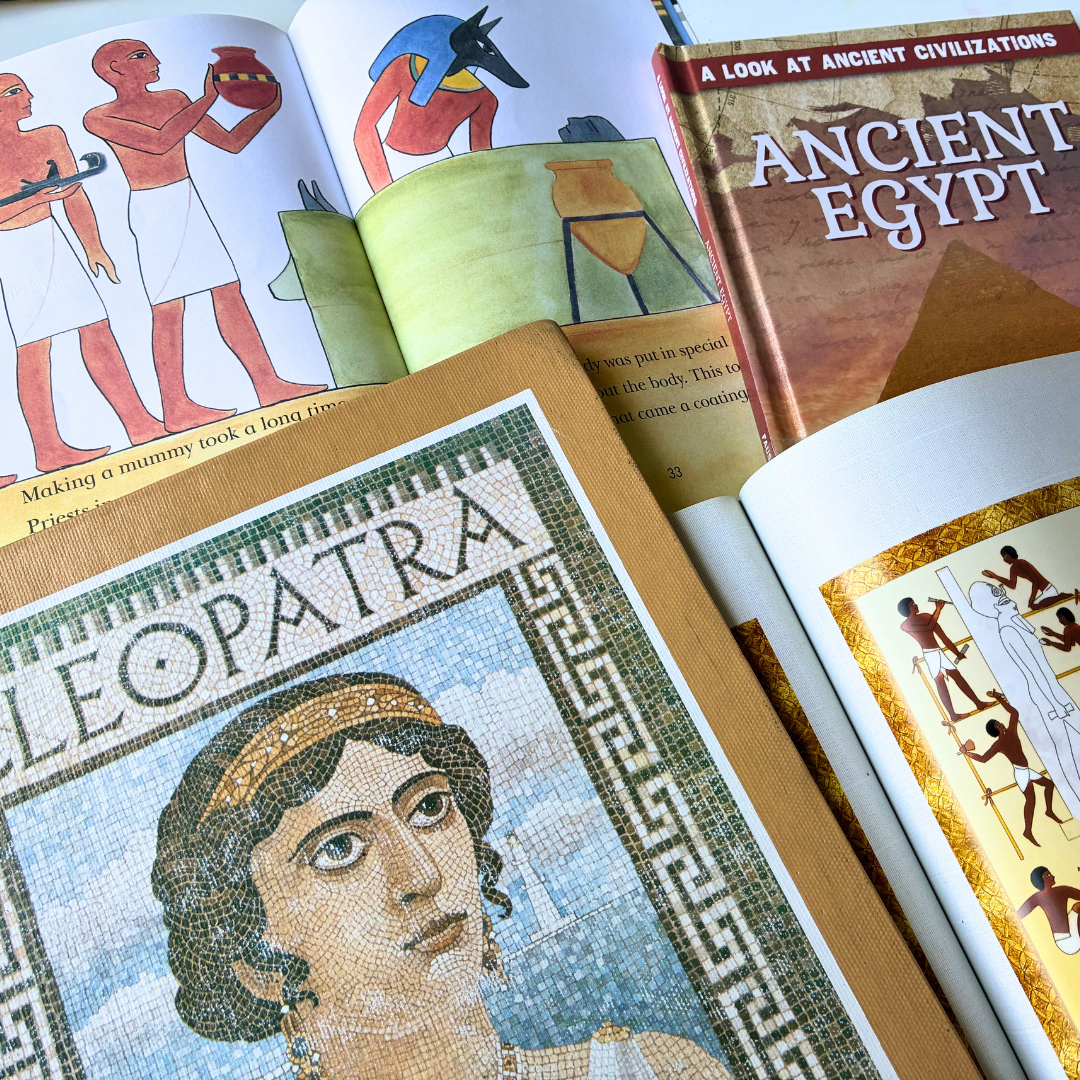
      Ancient Egypt

      Weather

      Space

      Ancient China

      Vikings

      Thanksgiving

      Posted on 1 Comment

      Winnie the Pooh Novel Unit – Homeschool Language Arts

      winnie the pooh novel unit

      This Winnie-the-Pooh novel unit has really brightened up our language arts. The way it is set up has given us a sense of freedom and fun in our homeschool routine.

      This method of language arts is new to us, but we love it so much. I actually break down the entire process in another blog post that I will link here. I highly suggest you read through that first as it will help the rest of this post make more sense.

      In this post, my goal will be to give you specifics about our studies and schedules for this particular book, Winnie-the-Pooh.

      This post contains affiliate links. If you follow one of my links I earn a small commission at no extra cost to you. Thank you for supporting my blog!

      Winnie-the-Pooh

      When I first heard that this was a great family read aloud, I ignored it. I thought it was going to be baby-ish and that my kids wouldn’t be interested. However, I was gifted the series from my husband’s grandmother and needed a good, living book to try this new method of novel unit out. Since we had it on our shelf, I went for it.

      WOW! Was I wrong! This book was one of the most adorable books we’ve read together. We giggled in every chapter and didn’t want it to end. It’s the sweetest, and it made this unit all the more special!

      The goal in reading this book was to try to get through a chapter a day. There are 10 chapters total, so we were able to finish the book in two weeks. I didn’t always read a whole chapter in one sitting. Sometimes I broke it up and read some at night and the rest in the morning. I have a couple little ones and longer chapters are harder to sit through. Breaking it up helped some days!

      Unit Schedule

      The following is a brief outline of what I hope to accomplish each day with my child. For more details on each piece, be sure to read my explanation post.

      In this post, I am going to focus on Winnie-the-Pooh and will share the passages we studied and how we broke them down each day in case you’d like to try the same sort of method.

      For a VERY brief overview – We read aloud as a family at different times in the day. For daily grammar, my daughter uses Fix it Grammar. I love that it can be done independently and takes about 5 minutes to complete. Copy work is also completed independently (5 minutes). I set a timer for our actual language arts lesson for 20 minutes.

      DAY 1

      • Read novel and narrate [whole family]
      • Grammar Workbook [independent work]
      • Copy work – complete 2-3 lines of selected passage from novel [independent work]
      • Study passage – focus on grammar [language arts lesson with parent]

      DAY 2

      • Read novel and narrate [whole family]
      • Grammar Workbook [independent work]
      • Copy work – complete 2-3 lines of selected passage from novel [independent work]
      • Study passage – focus on spelling and vocabulary [language arts lesson with parent]

      DAY 3

      • Read novel and narrate [whole family]
      • Grammar Workbook [independent work]
      • Copy work – complete 2-3 lines of selected passage from novel [independent work]
      • Written Narration [language arts lesson with parent]
      • **Option – review passage/spelling words if necessary

      DAY 4

      • Read novel and narrate [whole family.]
      • Grammar Workbook [independent work]
      • Copy work – complete 2-3 lines of selected passage from novel [independent work]
      • Dictation [language arts lesson with parent]

      DAY 5 (OPTION)

      • Read novel and narrate [whole family]
      • Silent Reading (15-20 minutes) [independent work]
      • Narration [language arts lesson with parent, about 5 minutes]

      Passage Selection – Week One

      I selected two passages to use for our copy work because it took us two weeks to read the book. Each week, we studied one passage during our language arts lesson time. Next, I will share with you how we study these passages throughout the week.

      “He was getting rather tired by this time, so that is why he sang a Complaining Song. He was nearly there now, and if he just stood on that branch…Crack!” (Winnie-the-Pooh, A.A.Milne)

      On the first day of our schedule, we focus on grammar and punctuation. The following is what we discussed for this passage:

      • Capitalize the first letter in a sentence and choose the correct end mark.
      • A comma and a conjunction can join two sentences together. (Conjunction Junction, what’s your function? — Are you singing yet?)
      • Complaining Song is capitalized by the author – Why? It’s possible he wanted to make it more official or to make it a title of a song. (Poetic License/Author’s Choice)
      • The “…” is called an ellipses. It encourages the reader to pause.
      • “Crack!” is italicized for emphasis, an exclamation point adds volume in this case. For fun, we also discussed what onomatopoeia was.

      As we study these topics we might practice different examples on the board or practice them orally, if possible. This might seem brief, but as you discuss each one with your child and provide alternate examples or even just look for more examples in the book, the time will go quickly.

      Spelling and Vocabulary

      For our second day of lessons, we are still using the same passage. This time we focus on spelling and vocabulary. I first ask my daughter if she knows what certain words mean based on the context. If we need to, we look them up in the dictionary.

      The vocabulary words we looked at for this passage: rather, nearly, complaining

      For spelling, I quiz her with many of the words from the passage and see which ones are mastered and which ones need practice. I have her write them on a board. You can make this list based on your child’s needs, but our list looked something like this: getting, rather, tired, why, complaining, nearly, there, stood, branch, crack

      Any word spelled incorrectly we practice a few times. I will also try to quiz her the following day as well to see if she can remember the word(s) she missed.

      Passage Selection – Week 2

      Week two follows the exact same schedule, just with a different passage. So for this section, I will list the passage as well as what we studied to go along with it.

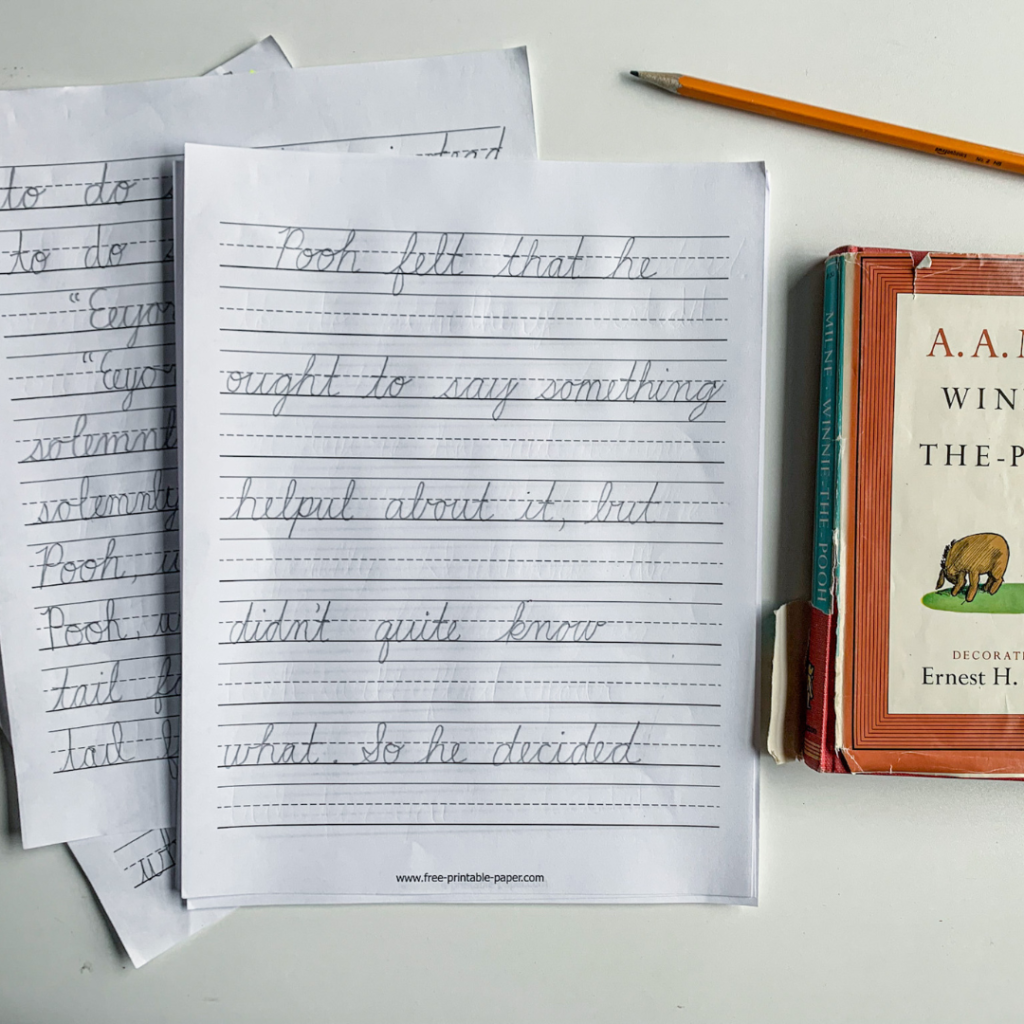
      “Pooh felt that he ought to say something helpful about it, but didn’t quite know what. So he decided to do something helpful instead.

      “Eeyore,” he said solemnly, “I, Winnie-the-Pooh, will find your tail for you.” (Winnie-the-Pooh, A.A. Milne)

      On the first day we discussed the following:

      • Capitalize the first letter in a sentence and choose the correct end mark.
      • Didn’t is a contraction – did not. We practiced writing other contractions.
      • A new speaker starts a new paragraph, indent.
      • A comma is placed after “Eeyore” to separate the quote, but we also discussed direct address.
      • Always capitalize “I”.
      • Winnie-the-Pooh is surrounded by commas because it is information that is not essential to the sentence.
      • Quotes go around what the character is saying.

      Now, if you wanted to simplify this even more, you could only focus on what connects to your grammar workbook. Point out what you’ve studied so far, and that’s it. That way it’s consistent between the two. However, I enjoy looking a little deeper than that. There are times when I don’t really know why a comma is there, and I just look it up online right there with her. That’s what it’s all about – learning together!

      vocabulary photo

      Spelling and Vocabulary

      On the second day of our week we look at spelling and vocabulary from the passage. The spelling words we practiced were as follows: ought, something, helpful, about, didn’t, quite, know, decided, instead, solemnly, tail.

      The vocabulary words we studied were “ought” and “solemnly”. Don’t forget to use context clues first, and then try the dictionary.

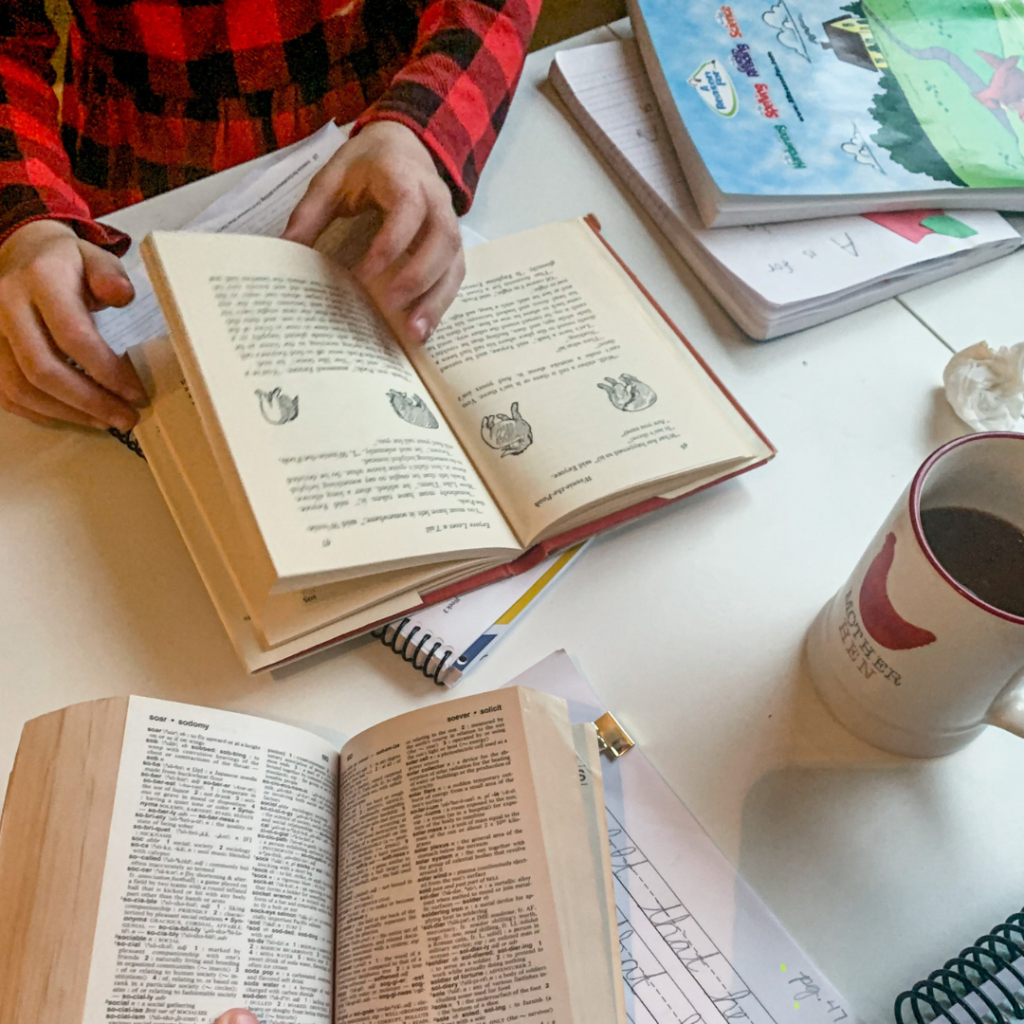
      optional grammar activity

      Optional Grammar Activity

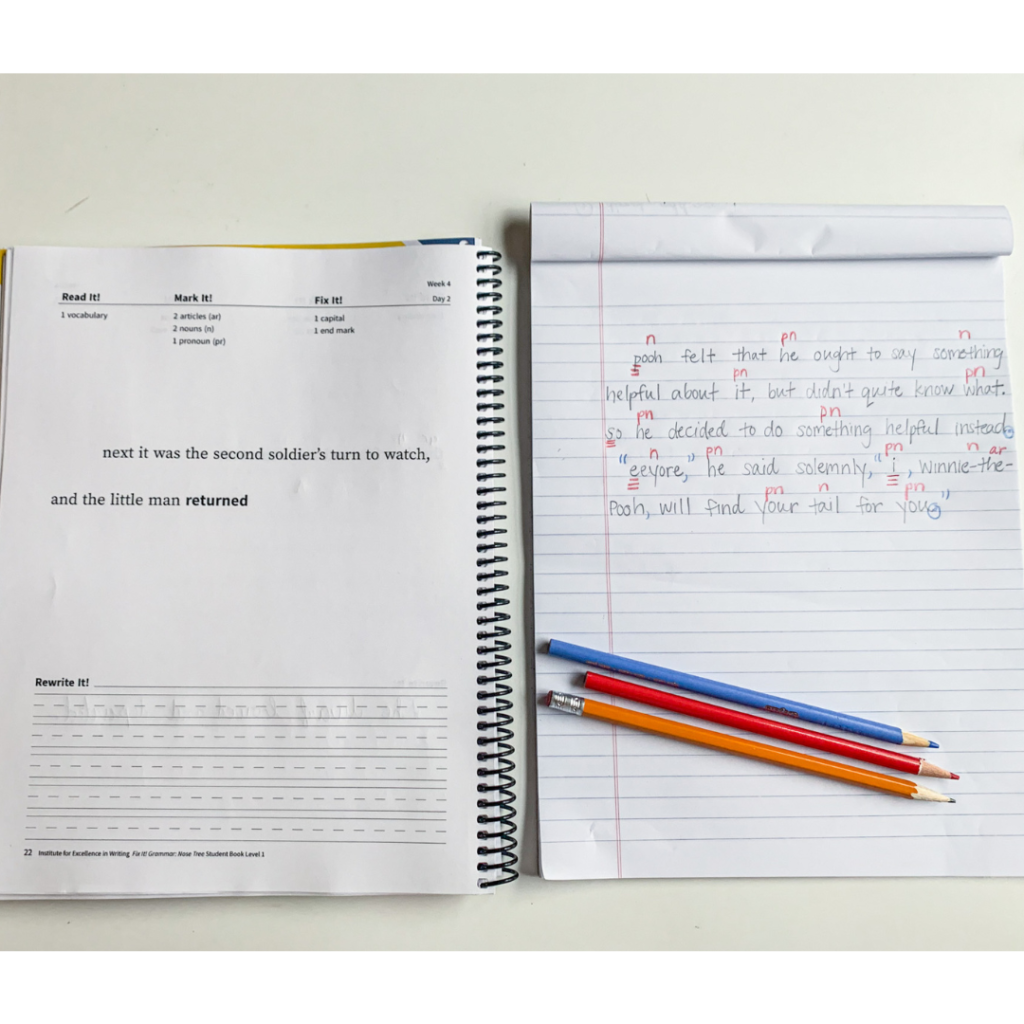
      Usually on our spelling and vocabulary day we have extra time. I like to switch out her Fix it Grammar page with a little something different. We use the exact same methods she is practicing in her workbook but we apply it to our passage instead.

      Here’s an example. In her Fix it Grammar book she is currently marking words that need to be capitalized, end marks, nouns, articles, and pronouns. So, I wrote the sentence on the board and had her do the same thing to our passage. It worked out great! I’ve snapped a picture (above) of an example for you to see.

      Honestly, you could do this with any grammar workbook. If you are practicing adjectives, find the adjectives. If you’re underlining the subject once and the verb twice, do the same here. See if you can combine your grammar book with your novel one day – It makes the workbook feel relevant!

      I’ll admit, there were a couple words I wasn’t sure about (yay for learning together!). The dictionary was very helpful. Find the word that matches the context of what you’re looking for and the dictionary lists the part of speech. So, if you see something off in my photo, blame Webster 😉

      Ready to try it?

      Does this sound like something you would enjoy? Sometimes it’s hard to explain what goes on in this crazy head of mine, but I hope that this explanation simplified the process for you. Isn’t it freeing to just read and chat about a book with your children? That’s what I love the most about this. Besides our daily grammar practice, there’s no workbooks, no busy work, just beautiful book discussion.

      Want to see more novel units like this? We are starting another soon, and if this is helpful, I’m happy to break it down like I did with this one. Let me know in the comments or reach out to me on social media (Instagram: @simply.learning.together)

      When I first started learning about the Charlotte Mason method, which is what inspired this study, I was nervous about the no-workbook-factor. Having a consistent plan like this with certain goals has really given me the confidence that a typical curriculum workbook doesn’t have to be necessary if it doesn’t bring you joy! It’s been so freeing to be able to study language arts through the books that we love!

      NEW Novel Guide Available

      For the last few years, my children and I have used this novel-based language arts program that is family-style and enriched with great literature each week. I’m so excited to share a NEW guide with you on how we do this in our home. If you’re tired of an all-in-one language arts workbook or if you’re itching for a great novel to read aloud to your kids, you’ve got to try this method! Below are two of the newest guides available now:

      James and the Giant Peach

      The Secret Garden

      You can watch multiple videos about this method of Language Arts on my YouTube Channel HERE

      Posted on Leave a comment

      The Boxcar Children – Novel Unit

      The Boxcar Children is an adorable, classic novel to add to your homeschool routine. This novel unit will provide you with optional activities, crafts, and library topics to enrich the novel topics and themes.

      This post contains affiliate links. If you follow one of my links I earn a small commission at no extra cost to you. Thank you for supporting my blog!

      Experience it in the Home

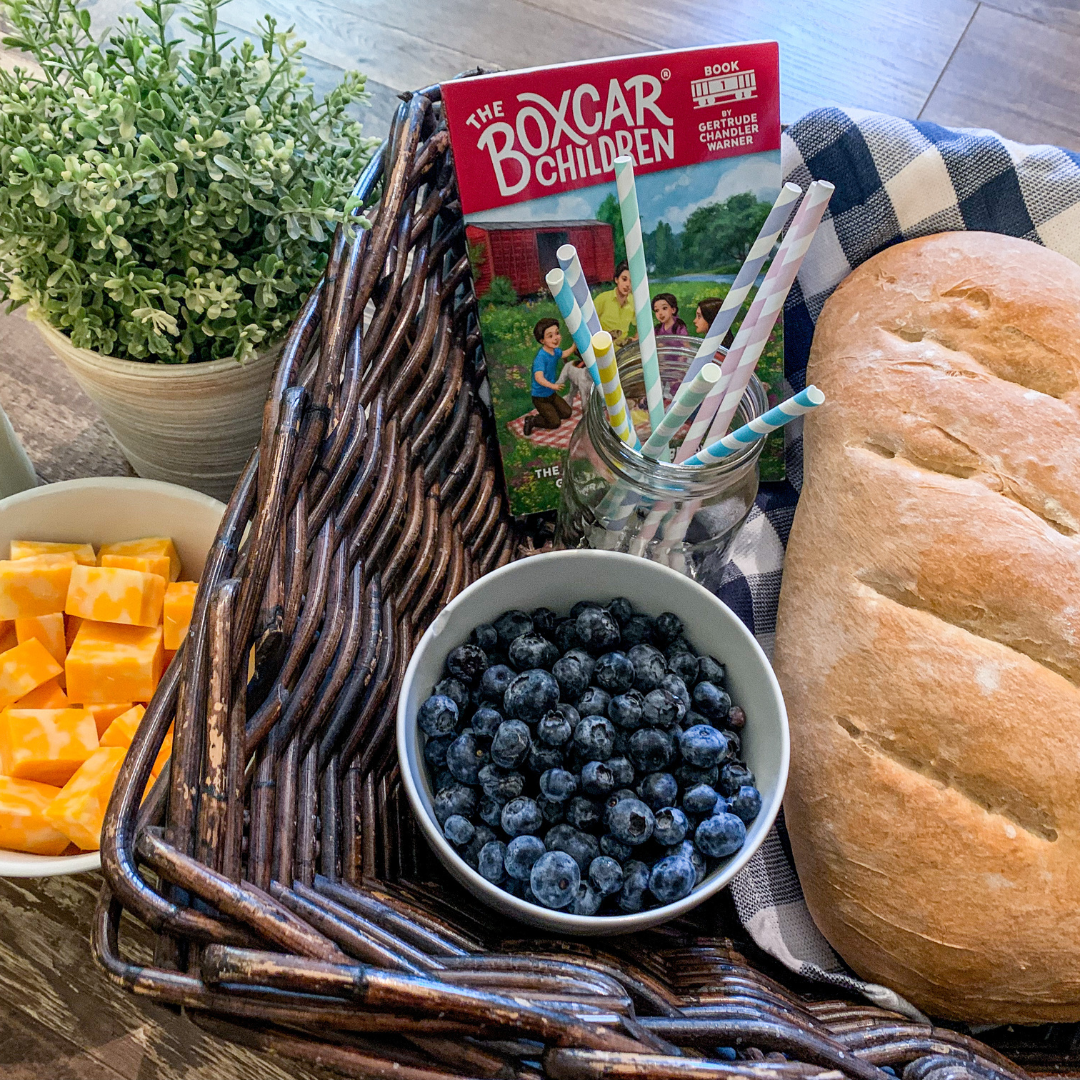
      The focus for this unit is “Experience it in the home…” The unit is designed so that you can add simple discussions, recipes, meals, and outdoor play to your day-to-day life while reading this book. These are related to the events in each chapter and provide a way for you to live out the book and experience it as a family…simply and easily.

      science experiment

      Experience it Across Multiple Subjects

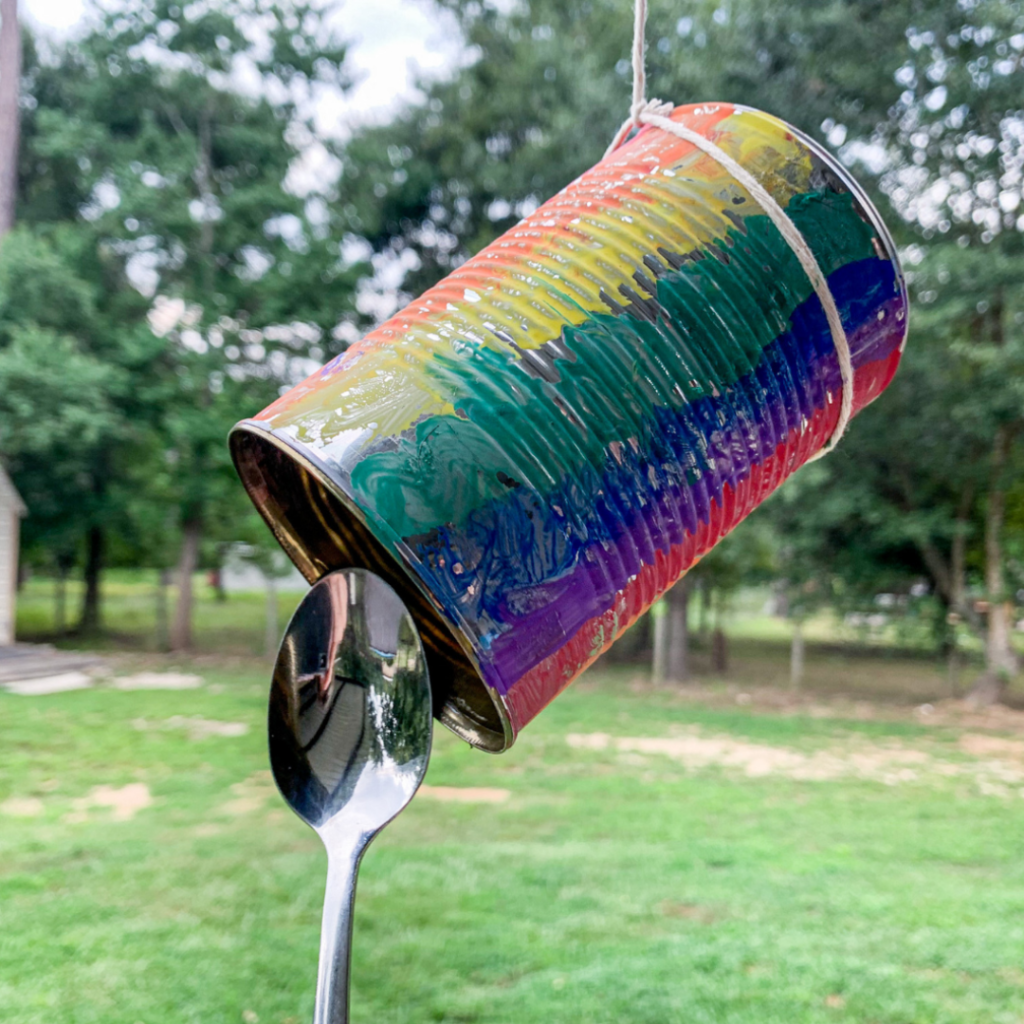
      There are also additional activities that you can choose to add on as you please. This would be for you to “Experience it across multiple subjects…” This may include crafts, science experiments, math activities or writing. These are all optional and can be completed at ANY time. (We know deep down the memory of a book never leaves us…save these for when it best suits your family)

      Organized by Chapter

      The novel unit is broken down by each chapter. Every chapter guide includes the following:

      • Summary
      • Discussion Questions
      • Crafts/Activities/Discussions
      • Library topics to add optional books to your study
      tin can bell

      Super Flexible

      Everything is OPTIONAL! No required book list. No required supplies. This unit is so flexible. Pick and choose what works for your family. Most importantly have fun with it. Learn together from the character experiences. Enjoy digging deeper into a novel.

      ***DOWNLOAD THE BOXCAR CHILDREN UNIT***

      More Read Aloud Experience Units

      You can read more about the Read Aloud Experience in this post where I explain our very first one that our family completed for The Secret Garden. To download the free units, click the links below:

      secret garden read aloud

      More Book Activities

      The Courage of Sarah Noble

      Adventures of Reddy Fox

      Caddie Woodlawn

      Posted on 2 Comments

      The Best Christmas Pageant Ever – Book Review

      One of our Christmas read alouds this year was “The Best Christmas Pageant Ever” by Barbara Robinson. I chose the book because it was on the Read Aloud Revival holiday booklist and because I had heard great things about it from others.

      A friend reached out to me before I read it, and gave me a heads up that there were some inappropriate parts in the story for little ears to hear. I was so thankful for this message, because she was right. There are definitely some parts in the book that may be worth editing or skipping, and I plan to share them with you here.

      This post contains affiliate links. If you follow one of my links I earn a small commission at no extra cost to you. Thank you for supporting my blog!

      Pointing Out the Bad

      Let me just start by saying that this book was so precious. If you’re wondering if it’s a good book to read for Christmas, my vote is YES! My kids looked forward to it every night, and I even teared up at the end!

      Now, with that in mind, you’ll have to make note that I’m about to point out the not-so-great things in the book. It’s the focus of this post – to warn you of some of the things that might be bad for little ears. But please don’t mistake that for this being a bad book. Of course, use your discretion to pick what’s best for your family, but please do not interpret my post as a negative review. We adored this story.

      I would read it again in a heartbeat!

      Age Group

      My girls and I read every night before bed. Their ages are 8, 6, and 3. So, you can see that a variety of ages will enjoy this. I will say that my older two caught on a bit more, but you better believe their youngest sister was giggling along with them at times.

      I truly feel this book would be great for even older kids as well. If you have middle school kids, they’d probably get a kick out of this too. It’s one the whole family can enjoy together.

      The Herdmans

      The book is about a group of siblings called the Herdmans. They’re naughty, and I mean really naughty. They are terrible to other kids, parents, and pretty much all authorities. They are mean, destroy property, smoke cigars, and set a terrible example. The thing is — they make this story! Their behavior and actions is what really drives this book home in the end, so you have to get past the bad to get to the good.

      What I love about reading aloud with my kids is that it provides us with a safe environment to talk about these things together. What do we think of the behavior? What would you do in that situation? How should we act towards others? Is this the right thing to do? We had lots of these discussions with this book, and they were very meaningful.

      Bullying

      I’m not going to cover each chapter, but I will tell you that chapter one is a doozy when it comes to bullying. The author does a great job setting up the characters and pointing to the fact that – the Herman’s are rude to all! There is a character in particular that this chapter focuses on, Imogene Herdman. There is an entire section about her sneaking around to find out everyone’s body weight and then using it against them later.

      The only time this got really uncomfortable for me is when the book started using words like “the fat kids” and then had an entire paragraph about what fat camp was. I try to teach my kids not to use the word “fat” and it was thrown around quite casually in this chapter. Once again…I’m not mad about it. I love being able to talk to them about these things in the safety of our home. This is just a heads up for you. The word “fat” comes up multiple times in this chapter.

      The first chapter also brings up “cooties”, so that was a new term for some of my kids. Needless to say the author does an amazing job making these kids sound straight up awful!

      Language

      We just finished this book, and I really can’t remember any curse words. In my opinion, those are easy to edit quickly or skip over, but I don’t recall them even coming up.

      I will point out that a couple of the Herdmans shout, “Oh my God!” during their rehearsals. The point of this is the rest of the children are in shock that someone would use God’s name in vain in the church.

      I chose to say “Oh my gosh” instead and the whole thing went right over my kids’ heads. I want to say it happens 2-3 times.

      The only other part that sticks out in my head is when a preacher says at the end of chapter 6, “Mrs. Wendelken says all they do is talk about sex and underwear.”

      I didn’t see that one coming, but I just skipped over sex and said “underwear”, not because it’s a bad word, but because I wasn’t about to have a discussion about sex right before bedtime. We’d be talking for hours! I just made the quick decision to skip it and move on.

      The Nativity

      I don’t want to give away too much in the story, but I think it’s also important to point out that the Herdmans are not aware of the Christmas story. They are very curious and want to make sense of it all. They throw around jokes and make up crazy scenarios about what might have happened. I personally don’t think it’s a bad thing. Just know that you are going to come across some things that add a sort of silliness to the nativity.

      Do you ever use Common Sense Media? I looked this book up to see what it had to say, and it made the point like this, “Parents need to know that this is a unique and entertaining spin on an age-old tale. Some parents may want to exercise discretion: Not everyone will want their children exposed to the antics of the main characters or will appreciate the liberties the story takes with what some people may consider sacred ground.”

      …But it’s SOO CUTE!

      I really hate saying all this. It makes the book sound terrible, but I promise you it’s absolutely adorable. The end of the book was so meaningful and it brought me to tears. I don’t want to spoil it for you.

      Here’s the thing – the book is only 7 chapters and just 90 pages. If you are considering it for your family, but you aren’t sure how you’ll feel, pre-read it. You could probably do it in one sitting! It’s that quick (and entertaining!) Find it in your library so you can do this for free, and decide whether or not you want to share it with your kids.

      We loved it! I don’t regret it one bit. I love the discussions we had. I love the giggles we shared, but I can’t spoil the beautiful message that is displayed at the end. Even if you read this on your own and decided to wait on it a few years to share with your kids, I truly feel your time wouldn’t be wasted.

      Christmas is about the birth of Jesus, and this author has a fun, unique way of pointing this out to us, even if it makes us slightly uncomfortable for a bit. Jesus came for all, and this story proves just that!