A simple, literature-based approach to studying ancient civilizations in your homeschool
Learning history through picture books is an incredibly effective way to build a strong foundation of knowledge.
I experienced this firsthand when we studied American history through picture books in our homeschool while my children were in the elementary years. Later, when we worked through a more advanced textbook covering modern American history, we found ourselves constantly recalling those earlier picture books. They had given us a solid background—and made the new material easier to understand and connect.
As we approach ancient history this upcoming year, I know I want to take a similar approach. But as I began researching, I realized that studying ancient history looks a little different.
A Different Approach to Ancient History
Unlike American history, ancient history doesn’t always work neatly in a straight timeline.
Instead, it often makes more sense to study individual civilizations as their own units. As you do this, the bigger picture begins to come together naturally over time.
I also noticed that dates don’t always align across resources. Questions about timelines—and even the age of the earth—can come up quickly. Because of that, I decided to focus less on exact dates and more on the quality of the content.
If a book presents meaningful, engaging, and educational material, then it stays on my list.
I’m so excited to share this list with you. As the parent, you can always choose how much detail you want to include with your children when it comes to exact timelines and dates.
A Note for Parents
It’s also worth mentioning—some of these books are a little wild.
Ancient history is full of folklore, gods, goddesses, and cultural traditions that may be unfamiliar or even contain beliefs that are different from what you believe.
As a Christian, discussing multiple gods can get tricky with little ones, but I also understand that it’s a huge part of these ancient civilizations. Each and every family will need to make unique decisions regarding this, and I encourage you to do what you think is best.
I do enjoy using these instances as teaching moments for my own children – sharing what we believe as a family and how it differs from what we are reading. With that being said, there are books on this list that I wouldn’t read to my youngest ones (under 8-10 years).
I’ve previewed these books, but ultimately, you know your children best. Please preview these books on your own as well to decide what feels like a good fit for your family.
What You’ll Find in These Book Lists
These lists are built around:
- A few carefully chosen nonfiction titles for background knowledge
- Story-driven, engaging picture books
- Rich literature that helps children experience the culture of each civilization
Once you’ve built a basic understanding of the ancient civilization, you’ll move into stories that bring the time period to life.
I’ve also included a novel for each civilization. This is simply a fun addition if you’d like to include a read-aloud alongside your studies.
Finding the Books
I encourage you to use your local library for the majority of these books. It’s a simple and affordable way to make this approach work in your homeschool.
If you’re unable to find a specific title, here are a few easy alternatives:
Interlibrary Loan
Check to see if your library offers interlibrary loan. This allows you to borrow books from other libraries—sometimes even from across the state or country—and is a great option when your local branch doesn’t have what you need.
Search for Read-Alouds Online
Some of these books can be found as read-alouds online. Try searching the book title followed by “read aloud” and see if it’s available.
Purchase the Books
You can always purchase books and build your home library. Check your local bookstore or order online. I’ve linked each book in this post. These are affiliate links. If you follow one of my links I earn a small commission at no extra cost to you. Thank you for supporting my blog.
Look for Used Copies
If you’re hoping to save money, used book websites can be a great option. Many offer discounted prices and occasional deals when you purchase multiple books. (www.thriftbooks.com is my go-to)
A Final Note
There are many wonderful books on each of these topics. I’ve chosen ones that I felt were especially engaging and well-suited for this approach, but they are not the only options.
If you can’t find a specific title, simply look for another book that covers a similar topic. It will still serve your purpose well.
Let this be a guide—not a set of rigid rules. Pick and choose the books you want to read. It’s OK if you don’t read all of them. The goal is to learn, enjoy the process, and build a meaningful understanding of history together.
As a heads up, some books may be a bit longer than your average picture book. My advice would be to split it up into a couple days to keep everyone’s attention and really get the most out of the story.
If you’d like a printable book list to stay organized and check books off as your read them, you can get that at the bottom of this post.
Informational Books
For each ancient civilization, I’ve included a selection of informational picture books.
Non-fiction books vary greatly! Some contain chapters and chapters of text, some are in graphic novel form, some contain hundreds of small images with captions…the list could go on.
I’m very particular about the ones I choose. I want it to be easily readable, almost like a story, and I want it to contain interesting images to keep it engaging. The length is also important to me as I have a variety of ages in my home.
I’ve noticed in my research that libraries don’t always have the entire set in a series for these nonfiction books. Because of that, I want to list a few of my favorite series that I think are easiest to read to elementary students.
As you work through these book lists, if you can’t find the specific non-fiction book I list, see if you can get your hands on one from a different series listed below:
- A Look at Ancient Civilizations by Daniel R. Faust
- Ancient Civilizations – Blastoff Discovery (Various Authors)
- You Are In… by Ivan Minnis
- DK Find Out! by DK Publishing
- If You Were Me and Lived in… by Carole P. Roman (more story-like than informational, but she does have a few in her series)
- Technology in the Ancient World by Charlie Samuels
- You Wouldn’t Want to… (various authors)
- Life in Ancient Civilizations (Various Authors; Published by Millbrook Press)
Ancient Mesopotamia
A Look at Ancient Civilizations: Ancient Mesopotamia by Daniel R. Faust
Technology in Ancient Mesopotamia by Charlie Samuels (When you get past the introduction of this book, there is a bold paragraph on each page. If I were reading this to my youngest children, I’d only read that bold paragraph and observe the pictures. Older children may enjoy digging deeper and reading more)
You Wouldn’t Want to be a Sumerian Slave by Jacqueline Morley (This series is pretty silly and filled with info. I’d save it for your older elementary kiddos. My suggestion would be to read the larger font so it reads more like a story. Then, pick and choose the small images you want to read about)
The Babylonians: Life in Ancient Babylon by Martha E. H Rustard
Gilgamesh the King by Ludmila Zeman (This ancient myth is part of a trilogy. You could read all three if you wanted to add to this unit.)
NOVEL: The Golden Bull by Marjorie Cowley
Ancient Egypt
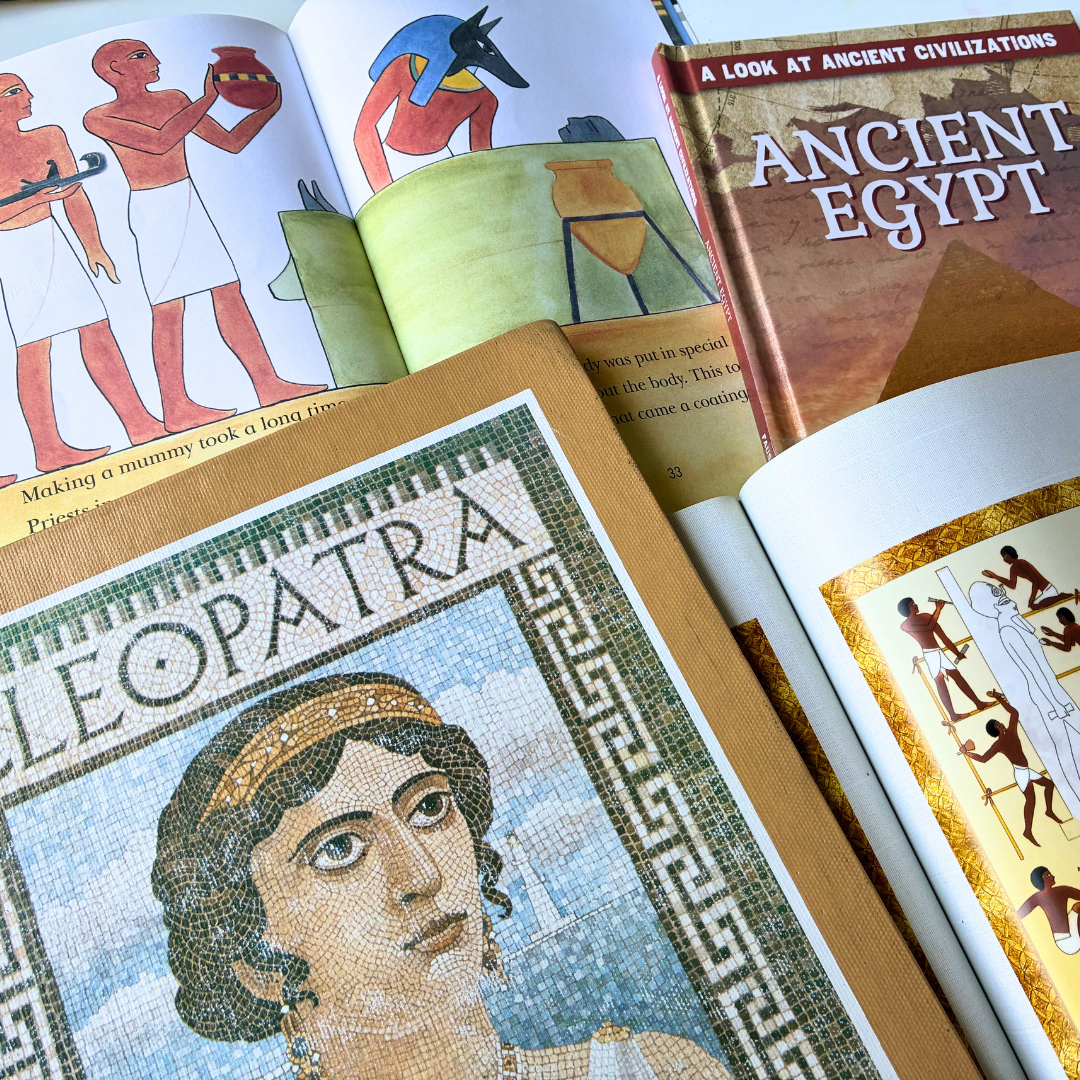
Ancient Egypt
A Look at Ancient Civilizations: Ancient Egypt by Daniel Faust
National Geographic Kids: Pyramids by Laura Marsh
Pharaoh’s Boat by David Weitzman (spend a few days with this one – It’s longer, but very interesting!)
Nile Crossing by Katy Beebe (fictional story based in ancient times; will introduce school and hieroglyphics)
Hieroglyphs from A to Z by Peter Der Manuelian
You Wouldn’t Want to Be Tutankhamen! by David Stewart (I’d save this for your upper elementary kiddos)
Egyptian Cinderella by Shirley Climo (fictional tale based in ancient times)
Egyptian gods and goddesses by Henry Barker (If you have older children and want to learn more about the different gods and goddesses of Egypt, this book will do that in a simple way. Preview it and make the call for your family.)
NOVEL: Boy of the Pyramids: A Mystery of Ancient Egypt by Ruth Fosdick Jones
Ancient Greece
If You Were Me and Lived In…Ancient Greece by Carole P. Roman
What’s your angle, Pythagoras? By Julie Ellis
The Librarian Who Measured the Earth by Kathryn Laskey
King Midas and the Golden Touch retold by Charlotte Craft (Greek myth)
Surprise, Trojans!: The Story of the Trojan Horse by Joan Holub (Greek myth/legend)
Aesop’s Fables by Jerry Pinkney (a collection of short stories written during these ancient times and still enjoyed today! You may enjoy reading these throughout your study of ancient Greece)
The Gods and Goddesses of Olympus by Aliki (This book is wild! I’d recommend for older children. If you want to learn about the different gods and goddesses of Greece, this book will do that in a simple way. Preview it and make the call for your family.)
NOVEL: The Chocolate Touch by Patrick Skene Catling (Not a historical novel, but a fictional story based on King Midas and the Golden Touch)
Ancient Rome
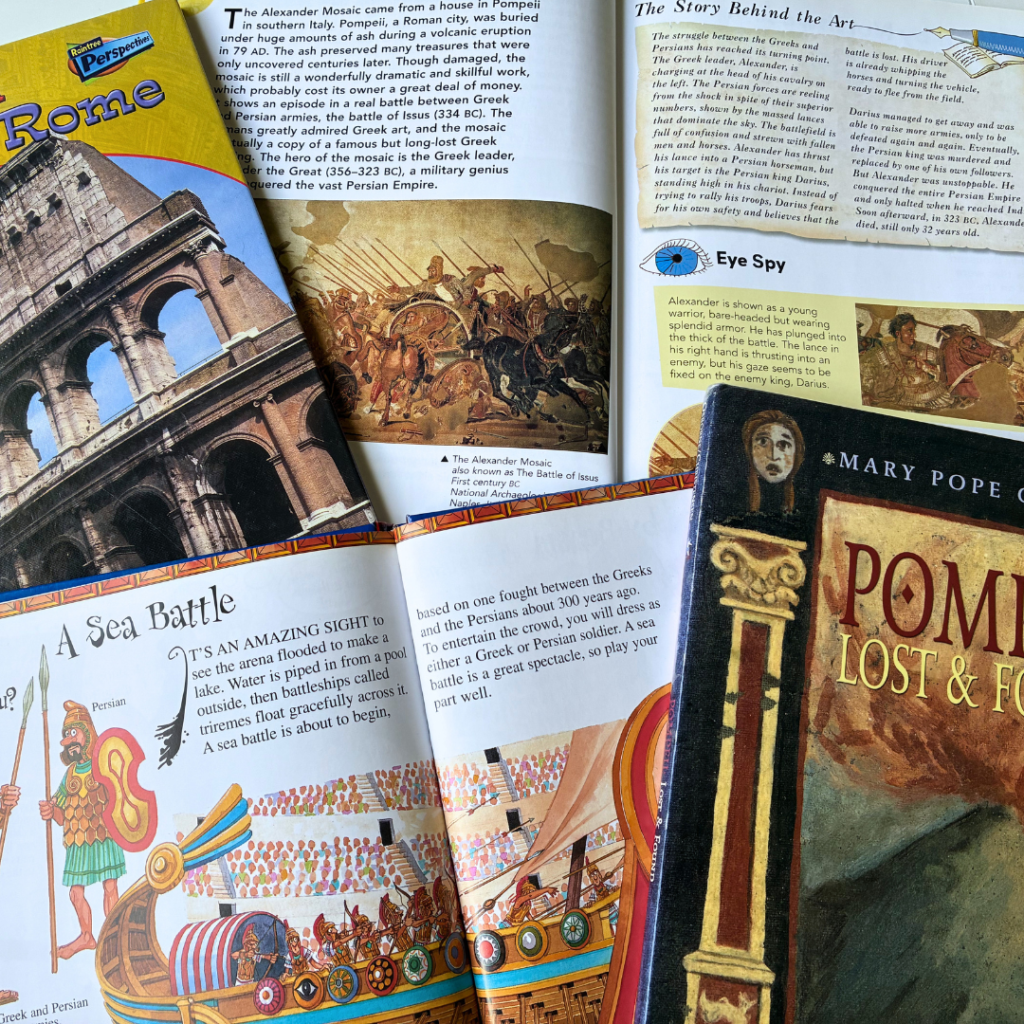
You Are in Ancient Rome by Ivan Minnis
20 Fun Facts About the Colosseum by Drew Nelson
DK Find Out!: Ancient Rome – This does not read like a story, but I love this series. It’s very enjoyable to look at, contains great photos, and even some quizzes. It may be a fun one to just skim through and read what interests you.
Pompeii: Lost and Found by Mary Pope Osborne
Mosaics by Nathanial Harris – This is not specifically about the ancient times, but it contains the history of mosaic art and three to four examples from ancient Rome and Greece. Read the intro and look at the story behind a painting or two from Rome. The back of the book contains a few art projects to try on your own as well.
You Wouldn’t Want to be a Roman Gladiator by John Malam (I’d recommend this for upper elementary and beyond. Stick to the larger text on the pages to shorten this read; enjoy picture captions as you are interested)
Romulus and Remus by Anne Rockwell (Roman mythology)
Eat Your Peas, Julius! by Shirin Yim Bridges (the storyline of this one is really pointless, but it’s cute and there’s great information in the back about Julius Caesar as well as the food eaten during this time period)
NOVEL: The Bronze Bow by Elizabeth George Speare
Ancient India
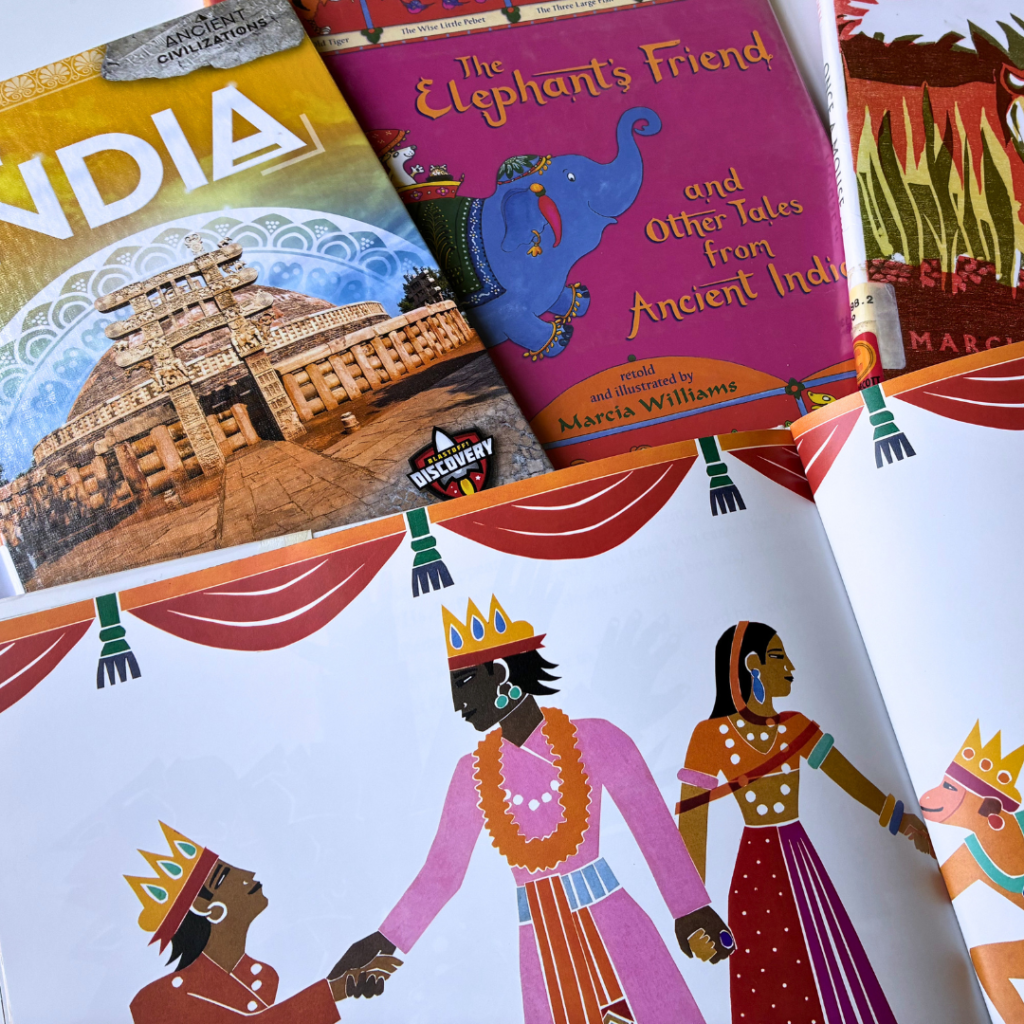
A Look at Ancient Civilizations: Ancient India by Daniel Faust
Ancient India (Blastoff! Discovery) by Sara Green – This is another informational book series. It’s very readable with great images and has a little more detail about the history and daily life of ancient India.
The Elephant’s Friend and Other Tales from Ancient India by Marcia Williams (multiple ancient tales to read, choose one or more)
Once a Mouse… by Marcia Brown (an ancient tale; I’ve listed multiple tales in this Ancient India category. Many tales were told to teach lessons. This could bring great discussion – What lessons do you think were behind these stories?)
Rama and the Demon King: An Ancient Tale from India by Jessica Souhami (an ancient tale)
One Grain of Rice by Demi (a folktale)
Savitri: A Tale of Ancient India by Aaron Shepherd (an ancient tale, may be better suited for your older kiddos)
Under the Bodhi Tree: A Story of Buddha by Deborah Hopkinson (Buddhism originated in ancient India. If this is something you want to explore with your children, this book will tell you who Buddha is and where he came from.)
NOVEL: The Jungle Book by Rudyard Kipling (not historical, but it is a classic novel based in India)
Ancient China
You Are in Ancient China by Ivan Minnis
Great Wall of China by Kristine Spanier
Ming’s Adventure on China’s Great Wall by Li Jian (a fictional story about a boy that visits the wall and travels back in time with a General; There are a few Ming’s Adventure series books about China. If you enjoy this one, you could look into the others, as well.)
Technology In Ancient China by Charlie Samuels (When you get past the introduction of this book, there is a bold paragraph on each page. If I were reading this to my youngest children, I’d only read that bold paragraph and observe the pictures. Older children may enjoy digging deeper and reading more)
The Silk Princess by Charles Santore (This is a fictional story based off an ancient Chinese legend. More information about the legend is in the back of the book. The process of making silk is fascinating! Dive deep into this with more books/videos if you have interest)
Mulan: The Legend of the Woman Warrior by Faye-Lynn Wu (Ancient Chinese legend; You may desire to compare this to the Disney movie, “Mulan”)
Scroll by Hui Li (fictional story, introduces Chinese calligraphy)
Additional Reading for Kids
If you have early readers in your house, another great option is to assign independent reading as you study the ancient civilizations. Below are a few suggestions. These could also be chosen as a read aloud or played as an audiobook, if you prefer.
Both of the series listed are designed for early readers and follow the same type of story line, kids traveling back in time to solve a mystery. Imagination Station is a Christian series.
Magic Tree House Series:
- Hour of the Olympics (Ancient Greece)
- Vacation Under the Volcano (Ancient Rome)
- Warriors in Winter (Ancient Rome)
- Mummies in the Morning (Ancient Egypt)
- Mummies in the Morning (Ancient Egypt)
- Day of the Dragon King (Ancient China)
Imagination Station Series:
- Attack at the Arena (Ancient Rome)
- Secret of the Prince’s Tomb (Ancient Egypt)
- Doomsday in Pompeii (Ancient Rome)
More Literature-Based Learning
We love learning through literature in our home. It’s such an engaging way to teach a subject and it makes our lessons memorable and enjoyable. Some of the other curricula I have created to do this are listed below:
American History Through Picture Books – With this literature-rich curriculum, your family will explore major events in American history through engaging stories that make the past feel vivid, memorable, and fun. Learn history together in a way that feels natural, connected, and truly enjoyable.
Science Through Picture Books – Experience science the simple, memorable, and joyful way—through beautiful, carefully selected picture books. These literature-based units give you a curated book list, discussion guides, narration and notebooking tips, enrichment ideas, and optional videos so you can confidently teach foundational science without a textbook. Perfect for family-style learning.
Novel Guides – Transform your language arts with a simple, story-driven method the whole family can enjoy. One novel, flexible plans, and rich learning for multiple ages.
Picture Book Studies – Gentle, one-week language arts units based on a theme. Teach spelling, vocabulary, grammar, handwriting, narration, and comprehension through one meaningful passage per book.