Posted on

A Simple Way to Teach Shakespeare in Your Homeschool

2

I used to be intimidated by Shakespeare.

I knew I wanted to introduce it to my kids, but it felt overwhelming, because I honestly just didn’t know much about it at all.

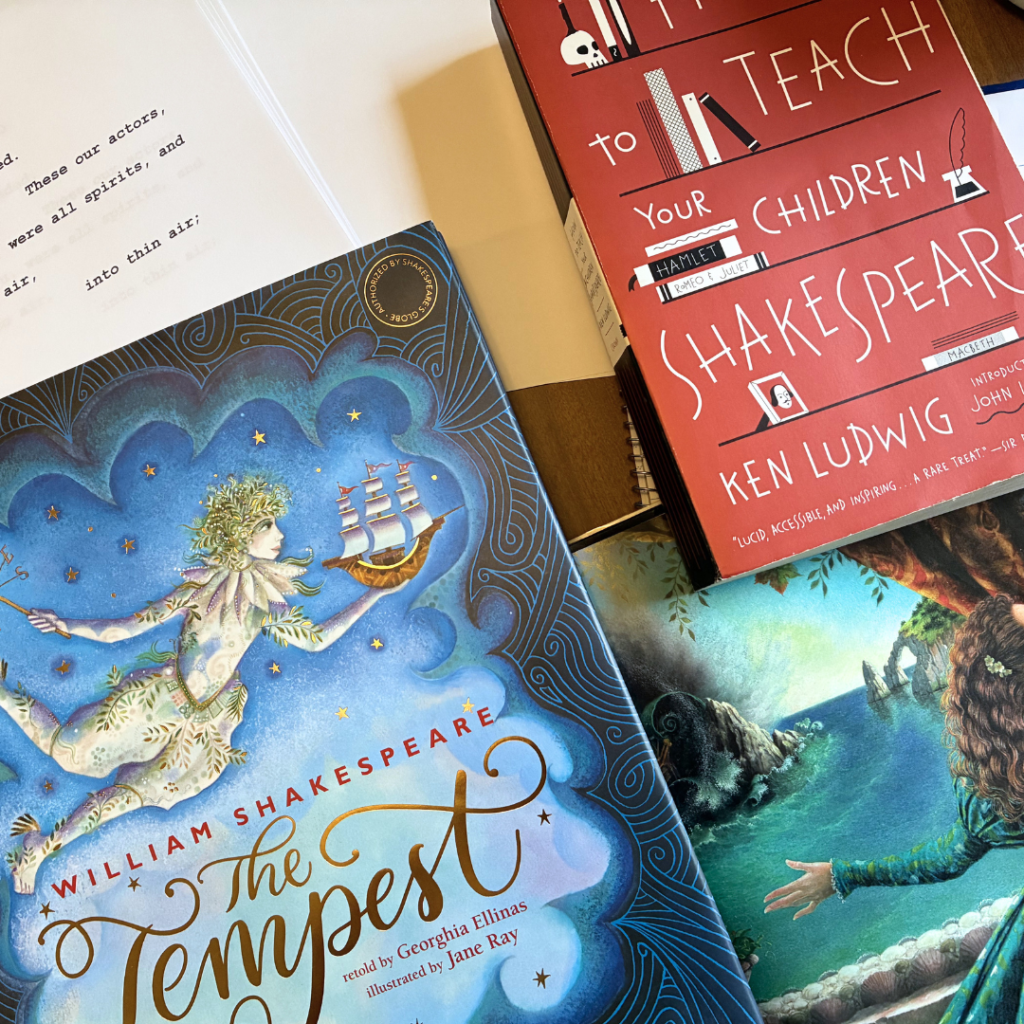
Sarah Mackenzie from Read-Aloud Revival was always encouraging me in this area through her podcast, and she’s the one who first introduced me to an incredible resource: How to Teach Your Children Shakespeare by Ken Ludwig.

However, I think you’ll be surprised by what finally made me take the leap.

What really pushed me to try it was a novel I read with my daughter—The Wednesday Wars by Gary D. Schmidt. In the story, a middle school boy has private lessons with his teacher, and she makes him listen to Shakespeare plays. Reading about his personal growth through those experiences made it an unforgettable read! (I highly recommend!)

That book made me think: We have to try this.

What We’ve Done (And Why It Works)

For the past two years, we’ve chosen one Shakespeare play each year. And we’ve kept it so simple that it no longer feels intimidating.

It’s something we all look forward to.

In this post, I want to show you exactly what we do—step by step—so you can try it in your own home without overthinking it.
shakespeare resources

Start with This Resource

Before I walk you through our routine, I want to quickly mention How to Teach Your Children Shakespeare again.

This book is incredibly helpful—but don’t feel like you need to read it all at once.

  • Start with the introduction and the first chapter or two for a little inspiration
  • Then come back to it when you’re ready to begin a specific play

Each chapter walks you through the plays, and the author also provides passages for memorization. On his website, you can find printable versions of these passages and audio recordings (so helpful!), which makes it easy to plan.

We use these passages for copy work and recitation.

Choosing a Play

If you’re not sure where to start, Ludwig’s book will help with that too.

  • Our first year: A Midsummer Night’s Dream
  • This year: The Tempest

The plan I’m about to share is based on The Tempest, but you can easily adapt it to any play.

Our Simple Shakespeare Plan (Step-by-Step)

The easiest way to explain this is to show you exactly what we do—almost like a checklist.

Planning

Before you begin:

  • It will help you to read the chapter in Ludwig’s book on your own for your chosen play. This will build your knowledge about the play as you get ready to share it with your children
  • Print any passages you want to use for copy work or memorization
  • Check your library/amazon for picture book retellings

These steps will help you feel a little more confident before starting.

Day 1: Gentle Introduction

Read and discuss a picture book version of the play.

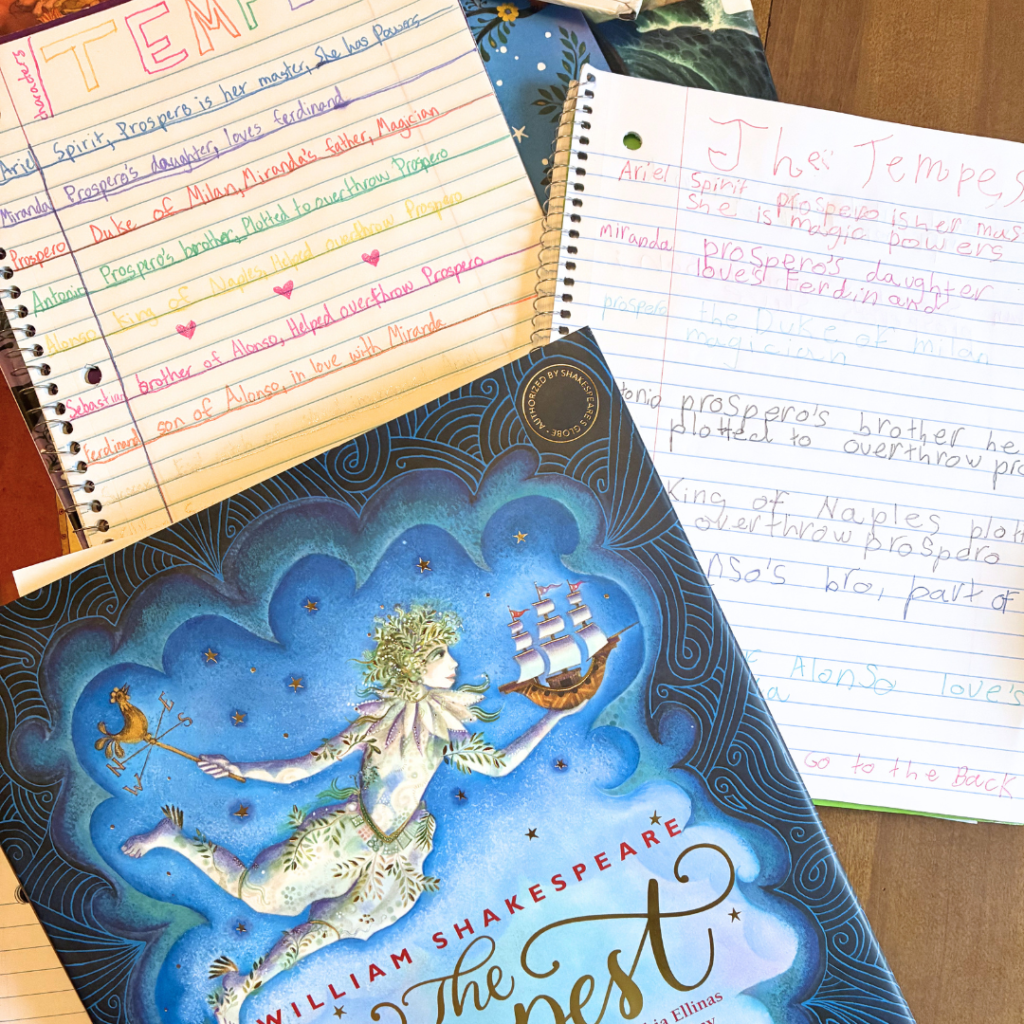
We used William Shakespeare’s The Tempest by Georghia Ellinas. This is such an easy, gentle way to introduce the storyline without overwhelming your kids.
3

Day 2: Get to Know the Characters

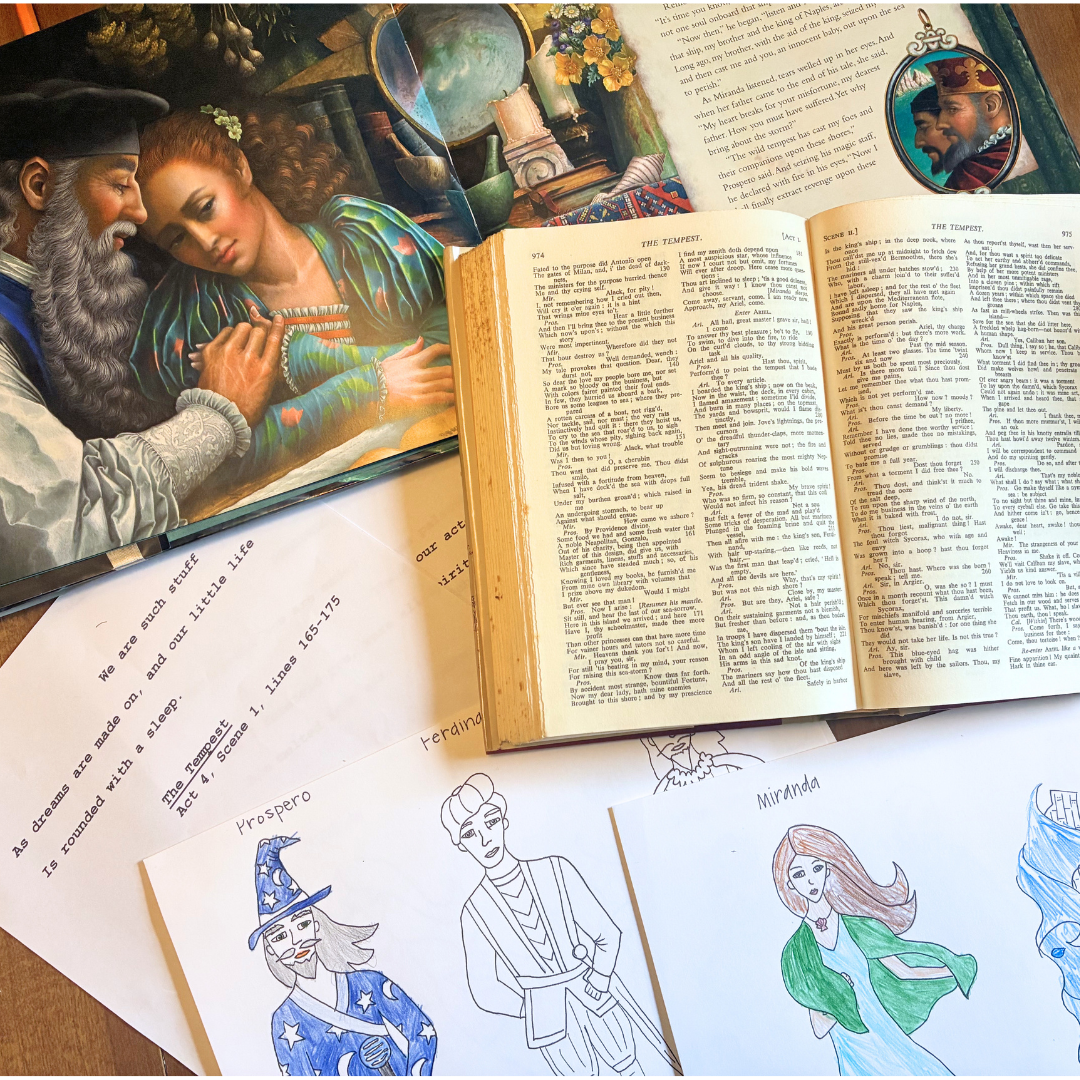
Create a simple character chart together. Write down each character and a few basic details. You don’t need to know this in advance. Learn as you read. Here’s an example:

  • Prospero: magician, Miranda’s father, Duke of Milan

We do this in notebooks and use colorful pens or pencils—it adds a little fun and makes it feel special.

Day 3: Begin the Passage

  • Play the audio of your chosen passage
  • Read a short section from Ludwig’s book aloud to your children to give background on the play (For this play, I read pgs. 310-312)
  • Begin copy work

This is a very light day, but it starts building familiarity.

Day 4: Practice Recitation

  • Practice saying the passage together
  • Let each child try on their own
  • Continue copywork

This repetition helps, but it doesn’t feel like too much.

Day 5: Deepen Understanding

Read another version of the story.

We read a longer picture book version (The Tempest by Marianna Mayer) for more detail, but you could definitely read the first picture book again.

After reading:

  • My older kids write a narration
  • My younger child draws a picture

Then we continue:

  • Copy work
  • Passage recitation practice

Day 6: Listen to the Play

This is where it all comes together—and it’s honestly the most fun.

We listen to a full-cast audio version of the play (we found one on Audible) for about 20 minutes at a time.

Because they already know the story and characters, they actually enjoy it.

A few things we add:

  • I follow along in a book so I can pause and ask simple questions. This isn’t necessary, but I enjoy it and find it helpful. (The book I own was a gift to me and isn’t in print anymore. This one may be similar: Complete Works of Shakespeare.)
  • The kids color paper puppets while they listen – it’s worth the few dollars. My kids love this! Later, they turn them into puppets and act out scenes

We also:

  • Finish any remaining copy work
  • Keep practicing the passage

Day 7 (and Beyond): Keep It Going

At this point, we’re nearing the end.

We simply:

  • Continue listening to the play in short chunks (about 20 mins at a time)
  • Practice recitation daily
  • Finish puppets and enjoy re-enacting

Sometimes it takes more than seven days—and that’s completely fine.

Sometimes we don’t even finish the whole play.

And I’m okay with that.

The Goal (This Matters Most)

My goal isn’t perfection or completion.

It’s exposure.

I want my young children to experience great stories, rich language, and beautiful ideas. And this simple approach allows us to do that without pressure.

You Can Do This

So what do you think?

Does it feel a little more doable?

It doesn’t have to be complicated. You don’t need a perfect plan. All it takes is a simple starting point—and a willingness to try.

You really can do this!

This post contains affiliate links. If you follow one of my links I earn a small commission at no extra cost to you. Thank you for supporting my blog.

Posted on 1 Comment

Winnie the Pooh Novel Unit – Homeschool Language Arts

winnie the pooh novel unit

This Winnie-the-Pooh novel unit has really brightened up our language arts. The way it is set up has given us a sense of freedom and fun in our homeschool routine.

This method of language arts is new to us, but we love it so much. I actually break down the entire process in another blog post that I will link here. I highly suggest you read through that first as it will help the rest of this post make more sense.

In this post, my goal will be to give you specifics about our studies and schedules for this particular book, Winnie-the-Pooh.

This post contains affiliate links. If you follow one of my links I earn a small commission at no extra cost to you. Thank you for supporting my blog!

Winnie-the-Pooh

When I first heard that this was a great family read aloud, I ignored it. I thought it was going to be baby-ish and that my kids wouldn’t be interested. However, I was gifted the series from my husband’s grandmother and needed a good, living book to try this new method of novel unit out. Since we had it on our shelf, I went for it.

WOW! Was I wrong! This book was one of the most adorable books we’ve read together. We giggled in every chapter and didn’t want it to end. It’s the sweetest, and it made this unit all the more special!

The goal in reading this book was to try to get through a chapter a day. There are 10 chapters total, so we were able to finish the book in two weeks. I didn’t always read a whole chapter in one sitting. Sometimes I broke it up and read some at night and the rest in the morning. I have a couple little ones and longer chapters are harder to sit through. Breaking it up helped some days!

Unit Schedule

The following is a brief outline of what I hope to accomplish each day with my child. For more details on each piece, be sure to read my explanation post.

In this post, I am going to focus on Winnie-the-Pooh and will share the passages we studied and how we broke them down each day in case you’d like to try the same sort of method.

For a VERY brief overview – We read aloud as a family at different times in the day. For daily grammar, my daughter uses Fix it Grammar. I love that it can be done independently and takes about 5 minutes to complete. Copy work is also completed independently (5 minutes). I set a timer for our actual language arts lesson for 20 minutes.

DAY 1

  • Read novel and narrate [whole family]
  • Grammar Workbook [independent work]
  • Copy work – complete 2-3 lines of selected passage from novel [independent work]
  • Study passage – focus on grammar [language arts lesson with parent]

DAY 2

  • Read novel and narrate [whole family]
  • Grammar Workbook [independent work]
  • Copy work – complete 2-3 lines of selected passage from novel [independent work]
  • Study passage – focus on spelling and vocabulary [language arts lesson with parent]

DAY 3

  • Read novel and narrate [whole family]
  • Grammar Workbook [independent work]
  • Copy work – complete 2-3 lines of selected passage from novel [independent work]
  • Written Narration [language arts lesson with parent]
  • **Option – review passage/spelling words if necessary

DAY 4

  • Read novel and narrate [whole family.]
  • Grammar Workbook [independent work]
  • Copy work – complete 2-3 lines of selected passage from novel [independent work]
  • Dictation [language arts lesson with parent]

DAY 5 (OPTION)

  • Read novel and narrate [whole family]
  • Silent Reading (15-20 minutes) [independent work]
  • Narration [language arts lesson with parent, about 5 minutes]
4 3

Passage Selection – Week One

I selected two passages to use for our copy work because it took us two weeks to read the book. Each week, we studied one passage during our language arts lesson time. Next, I will share with you how we study these passages throughout the week.

“He was getting rather tired by this time, so that is why he sang a Complaining Song. He was nearly there now, and if he just stood on that branch…Crack!” (Winnie-the-Pooh, A.A.Milne)

On the first day of our schedule, we focus on grammar and punctuation. The following is what we discussed for this passage:

  • Capitalize the first letter in a sentence and choose the correct end mark.
  • A comma and a conjunction can join two sentences together. (Conjunction Junction, what’s your function? — Are you singing yet?)
  • Complaining Song is capitalized by the author – Why? It’s possible he wanted to make it more official or to make it a title of a song. (Poetic License/Author’s Choice)
  • The “…” is called an ellipses. It encourages the reader to pause.
  • “Crack!” is italicized for emphasis, an exclamation point adds volume in this case. For fun, we also discussed what onomatopoeia was.

As we study these topics we might practice different examples on the board or practice them orally, if possible. This might seem brief, but as you discuss each one with your child and provide alternate examples or even just look for more examples in the book, the time will go quickly.

Spelling and Vocabulary

For our second day of lessons, we are still using the same passage. This time we focus on spelling and vocabulary. I first ask my daughter if she knows what certain words mean based on the context. If we need to, we look them up in the dictionary.

The vocabulary words we looked at for this passage: rather, nearly, complaining

For spelling, I quiz her with many of the words from the passage and see which ones are mastered and which ones need practice. I have her write them on a board. You can make this list based on your child’s needs, but our list looked something like this: getting, rather, tired, why, complaining, nearly, there, stood, branch, crack

Any word spelled incorrectly we practice a few times. I will also try to quiz her the following day as well to see if she can remember the word(s) she missed.

Passage Selection – Week 2

Week two follows the exact same schedule, just with a different passage. So for this section, I will list the passage as well as what we studied to go along with it.

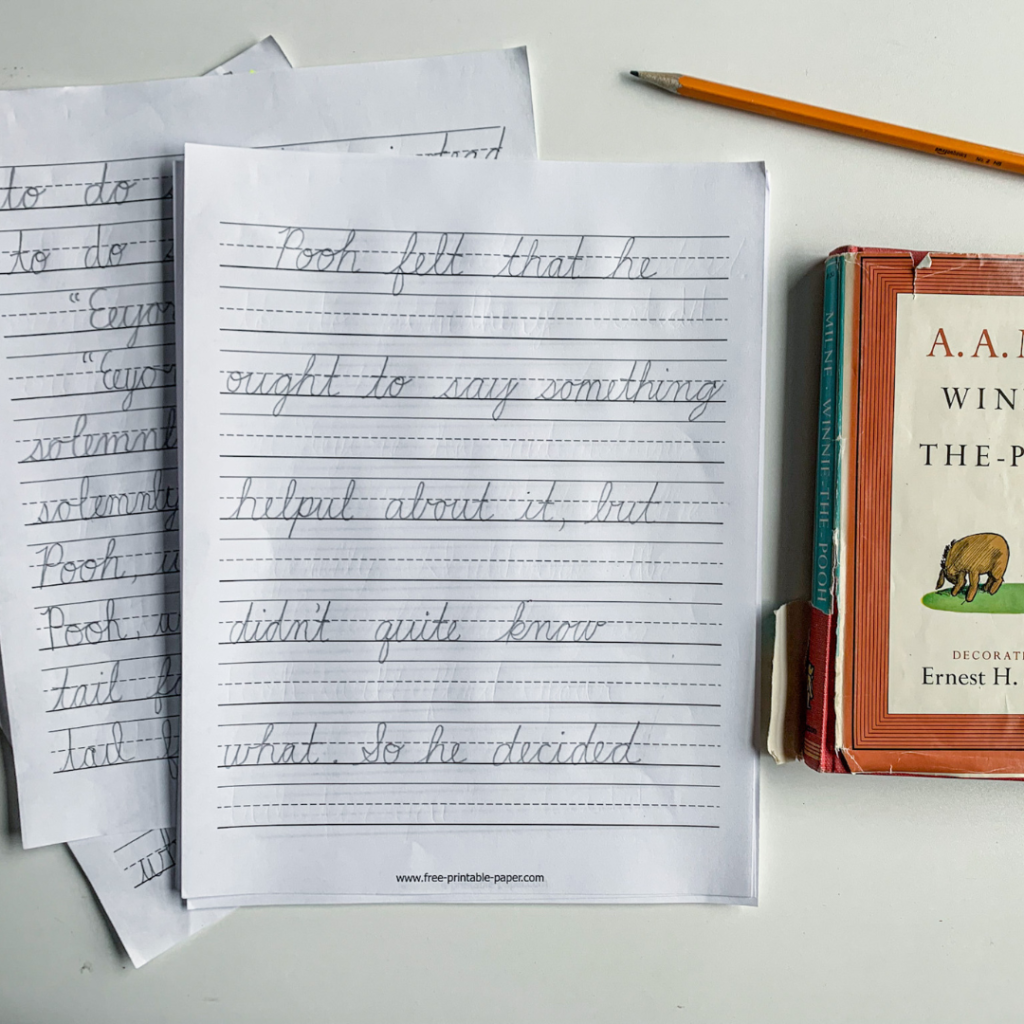
“Pooh felt that he ought to say something helpful about it, but didn’t quite know what. So he decided to do something helpful instead.

“Eeyore,” he said solemnly, “I, Winnie-the-Pooh, will find your tail for you.” (Winnie-the-Pooh, A.A. Milne)

On the first day we discussed the following:

  • Capitalize the first letter in a sentence and choose the correct end mark.
  • Didn’t is a contraction – did not. We practiced writing other contractions.
  • A new speaker starts a new paragraph, indent.
  • A comma is placed after “Eeyore” to separate the quote, but we also discussed direct address.
  • Always capitalize “I”.
  • Winnie-the-Pooh is surrounded by commas because it is information that is not essential to the sentence.
  • Quotes go around what the character is saying.

Now, if you wanted to simplify this even more, you could only focus on what connects to your grammar workbook. Point out what you’ve studied so far, and that’s it. That way it’s consistent between the two. However, I enjoy looking a little deeper than that. There are times when I don’t really know why a comma is there, and I just look it up online right there with her. That’s what it’s all about – learning together!

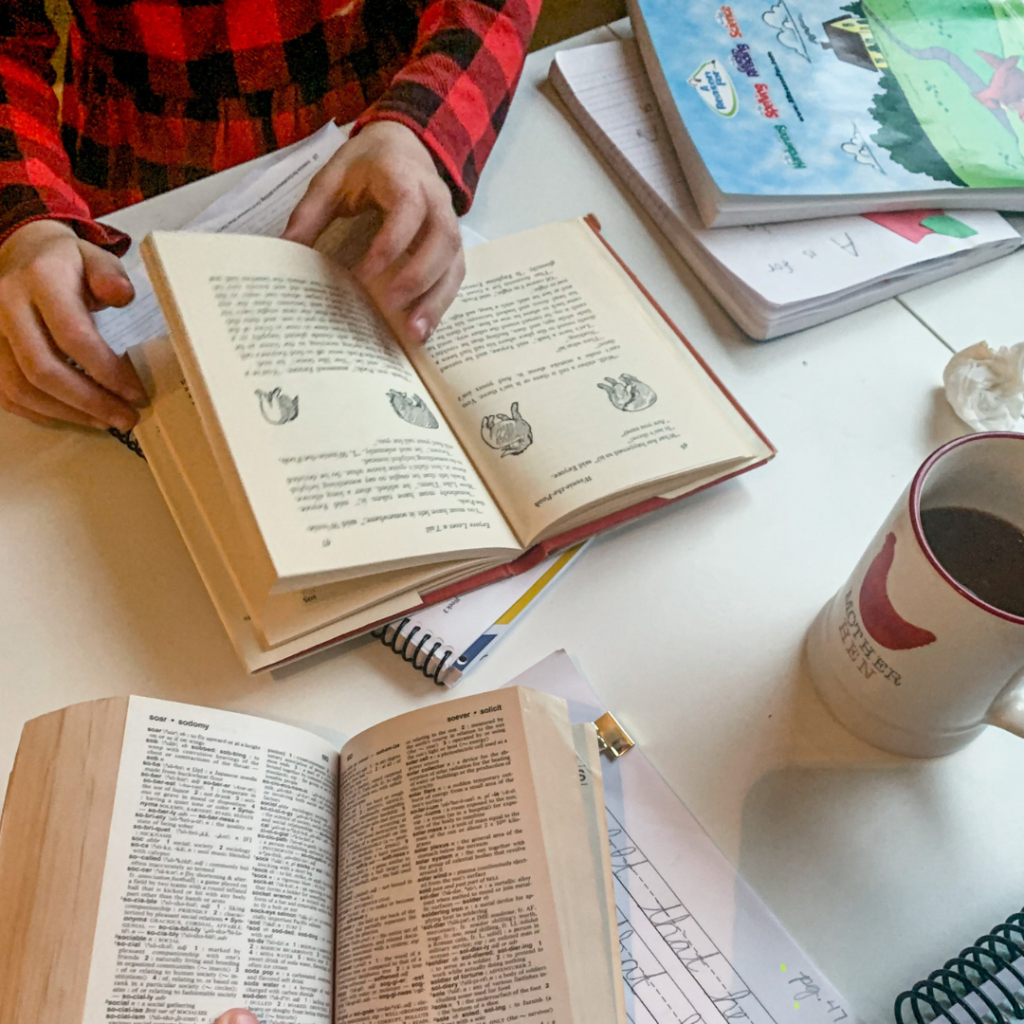
vocabulary photo

Spelling and Vocabulary

On the second day of our week we look at spelling and vocabulary from the passage. The spelling words we practiced were as follows: ought, something, helpful, about, didn’t, quite, know, decided, instead, solemnly, tail.

The vocabulary words we studied were “ought” and “solemnly”. Don’t forget to use context clues first, and then try the dictionary.

optional grammar activity

Optional Grammar Activity

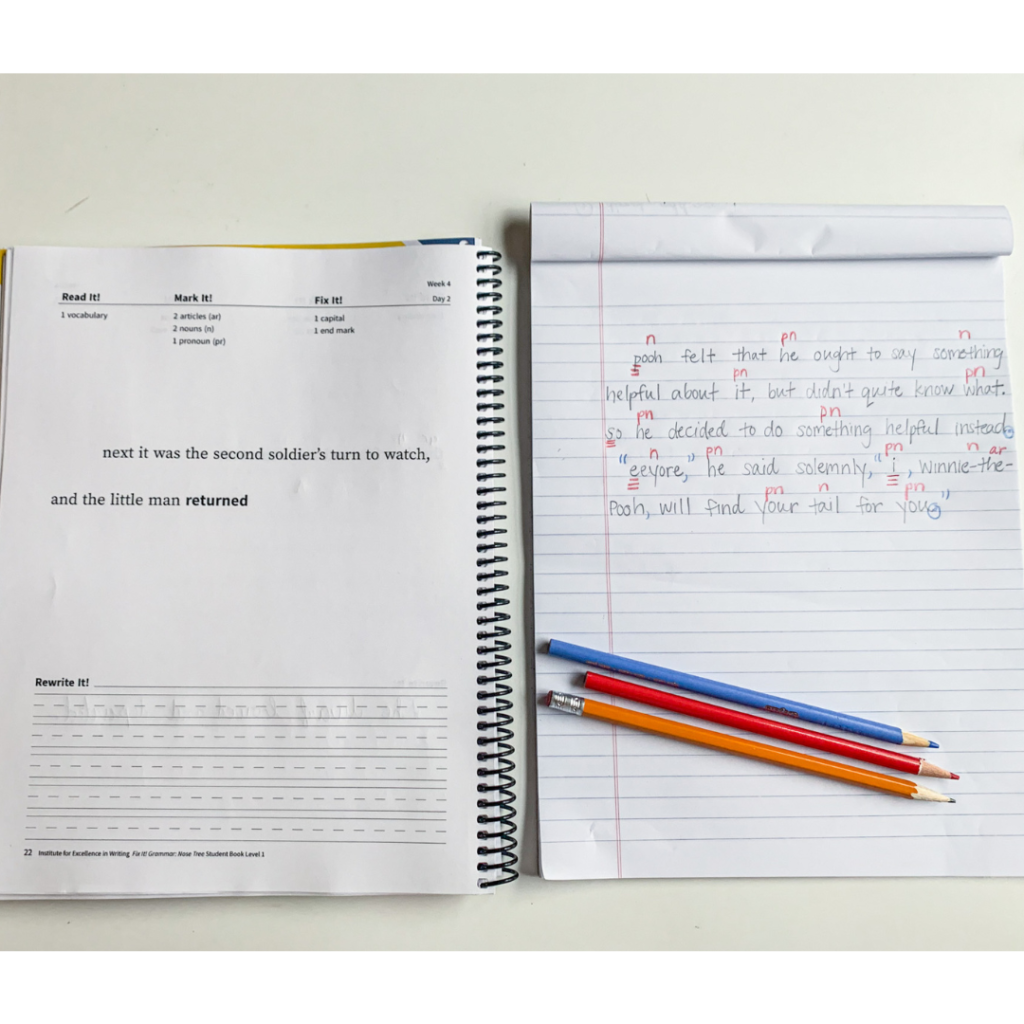
Usually on our spelling and vocabulary day we have extra time. I like to switch out her Fix it Grammar page with a little something different. We use the exact same methods she is practicing in her workbook but we apply it to our passage instead.

Here’s an example. In her Fix it Grammar book she is currently marking words that need to be capitalized, end marks, nouns, articles, and pronouns. So, I wrote the sentence on the board and had her do the same thing to our passage. It worked out great! I’ve snapped a picture (above) of an example for you to see.

Honestly, you could do this with any grammar workbook. If you are practicing adjectives, find the adjectives. If you’re underlining the subject once and the verb twice, do the same here. See if you can combine your grammar book with your novel one day – It makes the workbook feel relevant!

I’ll admit, there were a couple words I wasn’t sure about (yay for learning together!). The dictionary was very helpful. Find the word that matches the context of what you’re looking for and the dictionary lists the part of speech. So, if you see something off in my photo, blame Webster 😉

Ready to try it?

Does this sound like something you would enjoy? Sometimes it’s hard to explain what goes on in this crazy head of mine, but I hope that this explanation simplified the process for you. Isn’t it freeing to just read and chat about a book with your children? That’s what I love the most about this. Besides our daily grammar practice, there’s no workbooks, no busy work, just beautiful book discussion.

Want to see more novel units like this? We are starting another soon, and if this is helpful, I’m happy to break it down like I did with this one. Let me know in the comments or reach out to me on social media (Instagram: @simply.learning.together)

When I first started learning about the Charlotte Mason method, which is what inspired this study, I was nervous about the no-workbook-factor. Having a consistent plan like this with certain goals has really given me the confidence that a typical curriculum workbook doesn’t have to be necessary if it doesn’t bring you joy! It’s been so freeing to be able to study language arts through the books that we love!

NEW Novel Guide Available

For the last few years, my children and I have used this novel-based language arts program that is family-style and enriched with great literature each week. I’m so excited to share a NEW guide with you on how we do this in our home. If you’re tired of an all-in-one language arts workbook or if you’re itching for a great novel to read aloud to your kids, you’ve got to try this method! Below are two of the newest guides available now:

James and the Giant Peach

The Secret Garden

You can watch multiple videos about this method of Language Arts on my YouTube Channel HERE