Posted on 2 Comments

Homeschool Novel Study – DIY Language Arts

Novel study has been the most fun and engaging way for us to learn language arts in our homeschool, and adding in a DIY outlook has been so freeing. Two and a half years ago we actually eliminated an all-in-one language arts curriculum workbook to solely focus on novel study, and it’s been the best decision for us.

We like to call this method DIY Language Arts because we are able to take any novel of our choosing and use it to learn all the parts of language arts including spelling, vocabulary, grammar, narration, handwriting, and more.

After a couple years of adjusting and finding good rhythms for this, I am now able to share these novel studies with you. Multiple studies are available, but sometimes it’s nice to see inside one, and that’s exactly what I want this blog post to be for you.

Included in this post is a download to receive an entire week free for one of the novel guides. In the text below, I’ll walk you through how it works, so you know exactly how to incorporate it into your homeschool. I can’t wait for you to try this!

This post contains affiliate links. If you follow one of my links I earn a small commission at no extra cost to you. Thank you for supporting my blog

Look-Through a Novel Study

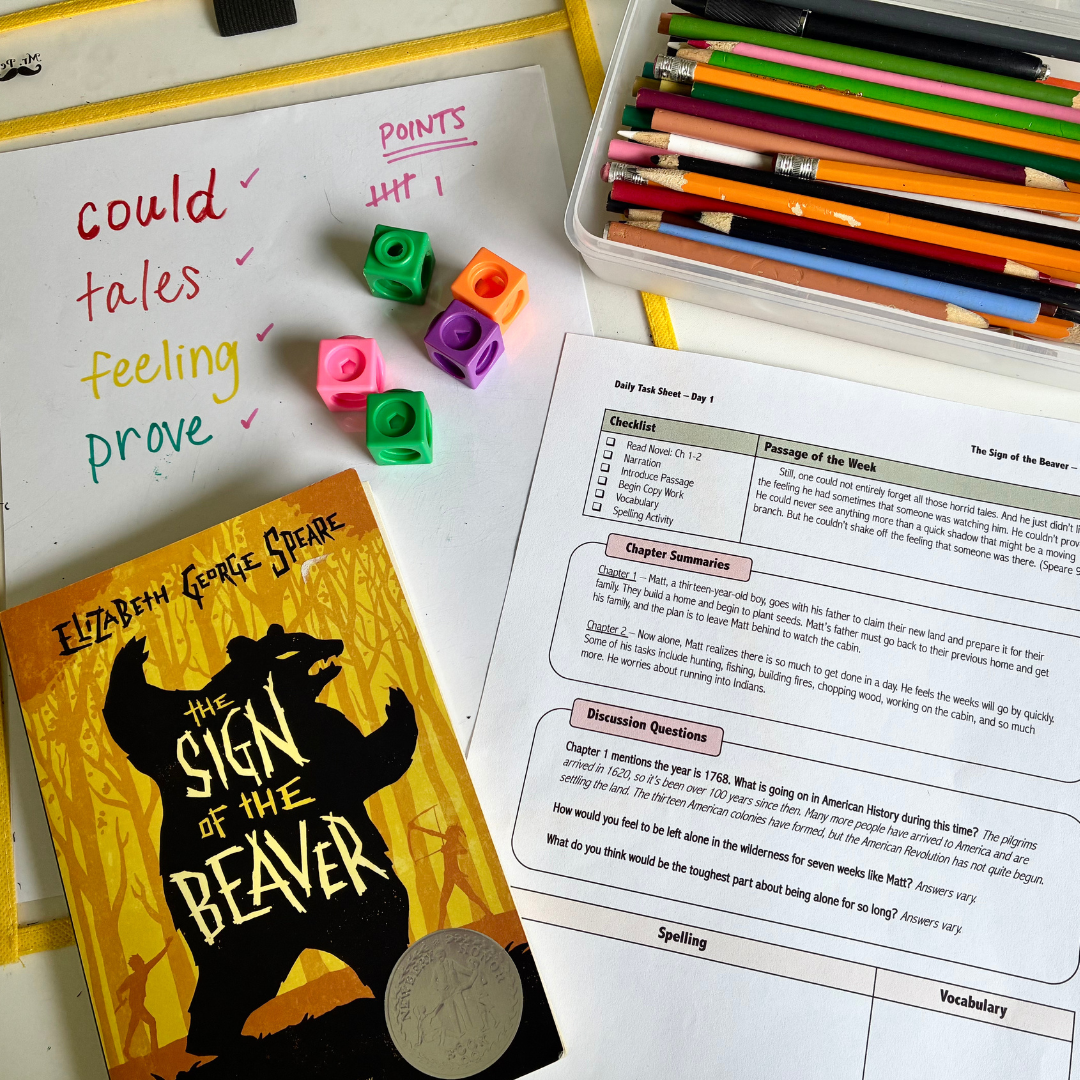
If you would like to see a video of this particular novel study sample for “The Sign of the Beaver”, you can check out this link where I share more details. You can also see a complete look-through of one of the first studies I published. This will give you a better idea of all of the information and resources that come with the novel study. The novel studies have been updated since then and look much nicer now, but the content is still the same.

Language Arts Overview

Included in this sample is the “Language Arts Overview” page where I break down the subject explaining exactly what it is and how this novel guide meets the criteria for the subject. A clear and simple chart will show you this evidence.

Language arts can be so overcomplicated in our minds, but by breaking it down and understanding what it is, we can get a better idea of how a novel can truly allow us to study the subject in its entirety.

What age is this novel study for?

These novel studies were created to be for the whole family. I’ve used them in my own home with one of my six year olds all the way up to my eleven year old. All of your kids will enjoy these novels, and the activities and work that are included are made to be able to adjust for different levels. If you purchase a novel study, I include the steps to walk you through this entire process in detail.

Weekly Pattern

Each week follows a pattern. Your daily tasks will look very similar (reading, discussion, narrating, copy work), but we will rotate an additional activity each day. This makes scheduling easy, and it allows you to loop different language arts skills for better focus instead of cramming everything in to an all-in-one lesson. The looping looks something like this:

  • Day 1: Spelling and Vocabulary
  • Day 2: Grammar
  • Day 3: Enriching Literature and Writing
  • Day 4: Dictation and Bonus Activity

Let’s take a look at each day. As I describe each of these activities, you will have a better idea of how to use the free sample provided in this blog post.

Spelling

On the page labeled, “Spelling and Vocabulary Samples”, I have provided a couple of pre-made spelling lists. Multiple options are provided to help differentiate the words for the level of spellers you have. This is just an example to help you get started. You are encouraged to pick whatever words best suit your children. The words/list you choose can be recorded in the chart on the daily task sheet.

On the day one task sheet you’ll notice “Spelling Activity” is listed. I’ve got you covered with options for this. Practicing the words can be as simple or as hands-on as you’d like. In this sample, I have provided you with multiple spelling activities to try with your family. Some are extremely simple. Others are a little more involved. The great thing about this is you can do what feels right for your week.

As you practice the words, make a note of the ones your kids know well and the ones they don’t quite have memorized yet. This could be a simple checkmark next to the word in your spelling chart. Then, each day after that, remind them of these words. Have your child practice the missed words throughout the week. Spend about a minute or two each day reviewing the words that are needed. The final spelling assessment will be in their dictation.

Vocabulary

Optional vocabulary words are chosen for you in the “Spelling and Vocabulary Samples” list. Once again, you have the option to choose the best words for your family. We aren’t doing matching worksheets or flash cards. Instead we will focus on meaningful discussion the whole family can participate in. When you read the weekly passage aloud to your children, this discussion will come pretty naturally. A discussion might look something like this:

  1. Ask your child, “What do you think ____ means?” It doesn’t have to be a formal definition. Sometimes my child will describe to me with motions or sounds and then try to explain herself. Let this be casual. If she knows it well enough, move on to the next word. If not, move to step two.
  2. Next say, “Let’s look at the sentence and see if it can give us some clues to make a guess on what ____ means.” Read the sentence again that includes the vocabulary word. Then, encourage your child to make a guess.
  3. If the child is still not able to come up with a definition that is close to the real thing, look it up in the dictionary. This is a great way to practice dictionary skills. Sometimes you can even practice the process of looking it up on a phone or computer.

Grammar

There are many, many grammar lessons that can be taken from a passage. Throughout the guide I will provide you with one grammar focus on day two of each week. You have the option and are encouraged to practice more grammar, if you desire. In the full novel guide, I provide you with detailed information about grammar studies and how to engage in meaningful grammar lessons while practicing passage study.

In my home, we also enjoy using a grammar review workbook alongside these novel guides. We have used Fix it Grammar in the past and now we use Easy Grammar. (See this video for details) The novel passages give us more opportunity to review what we have learned in those workbooks and see it in a more meaningful way.

Enriching Literature and Writing

On day three of the week, a picture book is chosen for you to read aloud to your children. This particular book will teach a little science as we learn about the life cycle of bees.

I encourage you to check your library for this, but I will mention that it’s also read aloud on YouTube HERE. This picture book is an enriching option that provides your children with an exciting story related to the novel, and it will allow you to stretch your novel study across multiple subjects.

I also use these picture books to practice written narration with my older children. Written narration has been such a beneficial practice in our homeschool (watch this video to hear more). Once I read the story, my oldest child will write a narration about the book.

Dictation

Dictation happens on the fourth day of the week, and I have provided you an option to help your younger writers in this process. Not all of your children will be ready for dictation yet, but those that are can complete dictation in two different ways.

The first option is for your beginning writers. I have provided you with a fill-in-the blank dictation option that uses a shortened passage and contains the spelling words from one of the spelling lists.

The other option is a full dictation where your child will write down the passage as you read it out loud. Feel free to dictate just one or two sentences, especially if you’ve never practiced dictation before. If you have a strong writer, you could try dictating the entire passage.

For more information about dictation and how to do it, check out this article.

Copy Work

The copy work will match the weekly passage. You have multiple options when assigning copy work in order to best meet the needs of each of your children. In this sample, I have included the shortened copy work as well as the full passage.

The goal of the copy work is to finish it by the end of the week. It may not take that long, but I challenge you to encourage your child to go slower with their best effort. I like to give short and sweet daily copy work assignments with the reminder that it has to be their best writing. In my experience, these short bits of copy work assigned over the week turn out much better than long, daily assignments.

Download the Novel Study

You can access the free sample to this novel study at the end of this post.

If you enjoy this first week and you’d like to complete the novel study as a whole, you can find the entire guide here. This guide will include much more information about the DIY method and will even teach you how to take any novel that you choose and use these same patterns! The how-to guide is GOLD! You’ll learn so much about language arts and the simplicity of a good novel study.

There are multiple novel studies available and more coming soon. To see more novel options, click here.

Picture Book Studies for Grades K-2

If you like the idea of book studies in your homeschool, check out my new picture book studies for your younger ones. These one-week units focus on one beautiful picture book and provide you with a passage for the week. This passage will allow you to practice copy work, spelling, vocabulary, and grammar.

Each week also includes an outdoor activity as well as an optional bonus activity at the end of the week. These book studies are so much fun! Use them for one week or grab a themed bundle for the month!

See all of the picture book studies available HERE.

Download Free Sample

Join my email list and receive a free one-week sample of the novel study for “The Sign of the Beaver”. This is such a great way to get an up-close look at what this DIY Language Arts learning style is all about.

    We won’t send you spam. Unsubscribe at any time.
    Posted on Leave a comment

    Homeschool Language Arts WITHOUT a workbook

    Have you been wondering if you could teach language arts without a workbook in your homeschool? It seems do-able and much more inviting than opening a workbook each day. Well, I’m here to tell you – you CAN! And it’s so freeing and fun! It can completely change the attitudes of this subject in your home, in the best way!

    A few years ago we did just that. I was having the hardest time teaching language arts, mostly because it was boring and the workbooks really felt like a chore to get through. Add the fact that I have multiple students to teach, and it really just wasn’t great for any of us!

    This is when I began to research passage study and novel-based language arts. There are multiple curricula options available to walk you through something like this, but I still was looking for even more freedom. That’s when I started practicing and using the term “DIY Language Arts”

    This post contains affiliate links. If you follow one of my links I earn a small commission at no extra cost to you. Thank you for supporting my blog!

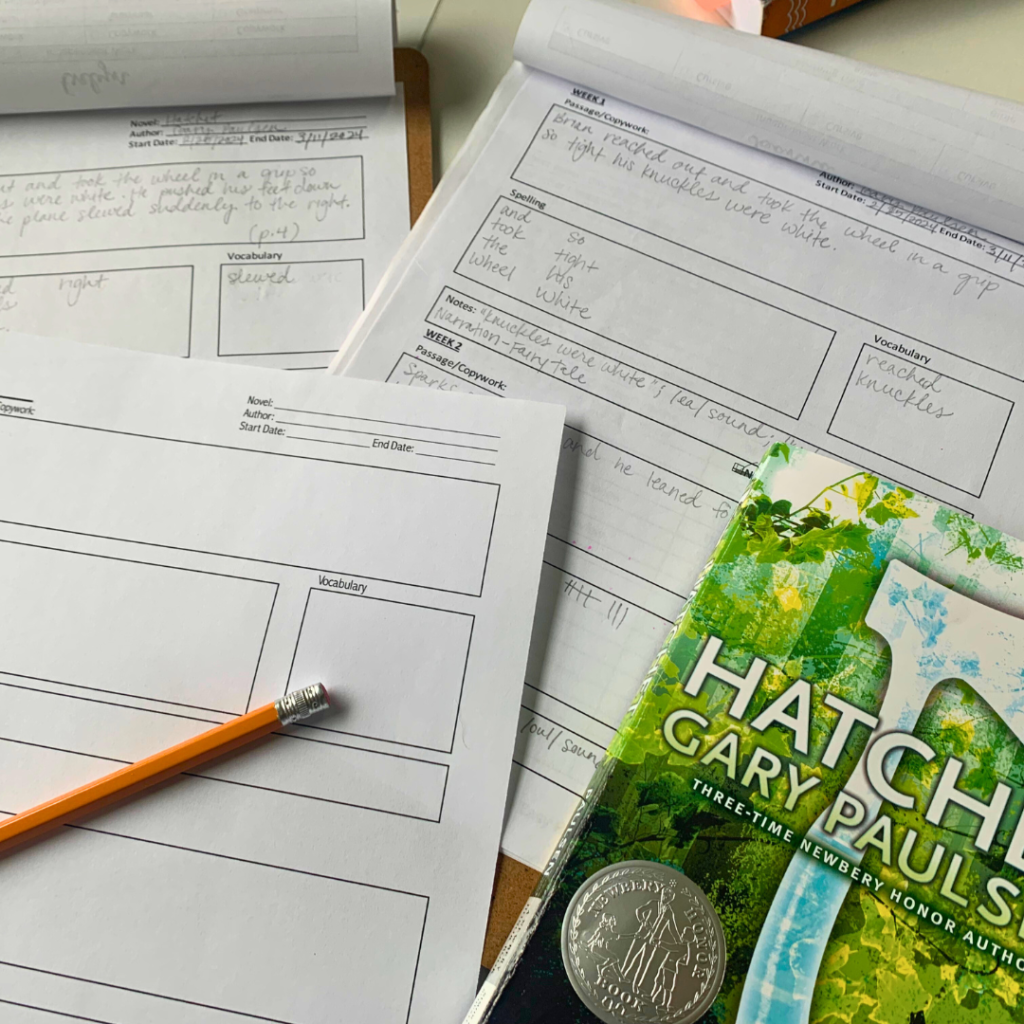
    DiY Language Arts Template

    What is DIY Language Arts?

    As I mentioned in the introduction, over the past few years I have been passionate about letting go of an all-in-one language arts curriculum. They are great for pacing and consistency, but most of the time we found them to be boring and repetitive in our home. I want my children to love literature and since it is such a huge part of language arts, it’s important to me that we all find enjoyment in learning about it. Otherwise, in my experience, reading becomes more like a chore. 

    Using this DIY (Do-It-Yourself) method of language arts, we have been able to have so much more freedom, letting go of the workbooks and instead choosing what we learn based on passages from great novels.

    Choose A Novel

    First, we choose a novel we want to read and all of our studies come from passages in that novel. One passage per week is how we started. The novel works around our schedule, making it so much more enjoyable than trying to fit a novel and chapters into certain time frames. Since all of the passage studies revolve around the novel, it becomes simple to plan and inexpensive to purchase. We can almost always use the library to collect books.

    Passage Study

    As we read, I choose a passage from the upcoming chapters each week and that becomes our focus. What’s going on? Who’s involved? What are the emotions? Next, that passage provides us with new vocabulary to discuss as well as spelling words to practice for the week. Each day, my children write portions of the passage practicing their handwriting skills and getting accustomed to reading and writing well-written sentences. 

    Narration + Meaningful Discussions + Enriching Literature

    As we read the novel together, we practice narration and have meaningful discussions. This has allowed us to eliminate the need for busy-work worksheets and instead encourage connection and conversation about what we are reading. Through the addition of children’s literature, we can expand our language arts across multiple subjects as we relate our story to something in history or science or the arts. My older children use these engaging stories to practice writing skills. 

    Dictation/Assessment

    Finally, through the use of dictation, I am able to assess my children and their progress from the week. I can check spelling skills and punctuation use as I dictate the weekly passage. This pattern of passage study has been educational, flexible, and honestly just much easier and enjoyable than completing a workbook every day.   

    Family-Style

    This method of language arts works for my whole family! Currently my school-aged kids are 6, 9, and 11. We love that we can do language arts all together. With simple adjustments to copy work and spelling lists, each of my kids can participate in this study, making planning and time management so much easier in our homeschool!

    novel guide

    New Guides Available

    After doing this for a few years and forming rhythms, I’m so excited to share what I have learned with you all. Recently I created DIY Language Arts novel guides where I walk you through a complete novel PLUS I share with you the research and strategies I use to put something like this together. My goal is to help you be able to DIY your own language arts in your home whenever you choose. It’s freeing and FUN! The newest guides are linked below:

    The Secret Garden

    James and the Giant Peach

    Passage Study Chart

    If you are familiar with passage study or if you do something like this style in your own home, then you may enjoy the new Passage Study Charts. These charts break it down so simply providing a passage, sample spelling and vocabulary lists, chapters to read for the week, and weekly enriching children’s literature. This simple chart is perfect for someone who loves a little more freedom but wants decisions made already!

    Passage Study Chart – The Secret Garden

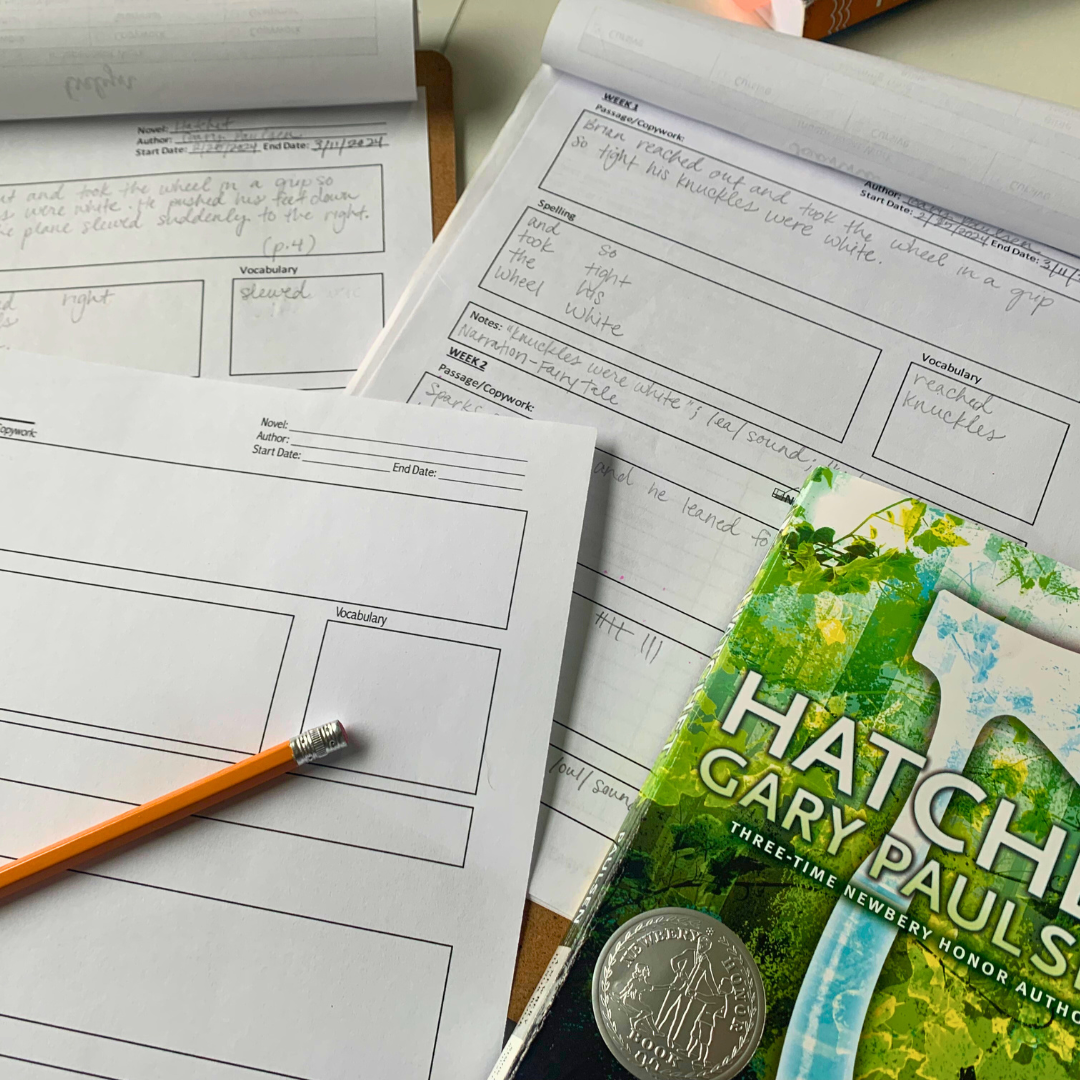
    DIY – Blank Planning Template

    Ready to plan your own? Before I made the guides, I used a simple template (pictured above) to help me organize and plan our passage study. By making quick notes at the beginning of the week, decisions were made and the process of studying the passage became easier. Plus, it doubles as a great record for our novels and how we have used them throughout our school year. This is a FREE template! Get yours below.

    Passage Study Template

    Final Thoughts

    I’ve done a lot of research on the different pieces of language arts and what it ACTUALLY is. I honestly think the subject gets over-complicated and as a result we end up with endless worksheets and exercises that feel more like busy work than meaningful education.

    Imagine if your language arts could suddenly feel like a little book-club in your home. Book after book you can make connections, expand your learning across multiple subjects, learn from character experiences, and MORE and you study language arts as a family. This method simplifies the process, makes learning meaningful, and truly creates much better connection than a workbook.

    I hope you’ll give it a try! If you do, share it with me here or on social media (@simply.learning.together). I love chatting about this so if you have questions, let me know. I also have multiple videos on YouTube sharing our experiences with this over the years:

    Language Arts Without a Workbook – You Can Do IT!

    DIY Language Arts Playlist

    More Literature Based Studies

    I absolutely LOVE adding literature to our homeschool studies. Recently we completed our study of American History using nothing but picture books! It was amazing! And so much fun! Check it out here:

    Posted on 4 Comments

    Knights and Castles – Middle Ages Mini Unit

    coat of arms

    We are beginning to study the middle ages in our homeschool, and I’ve decided to make it into a bunch of different mini-units. Our first one will focus on knights and castles.

    Read further for all the books we read as well as the activities we did, but come back soon and check out our other middle ages units as well. I will be posting them on the blog as we complete them!

    This post contains affiliate links. If you follow one of my links I earn a small commission at no extra cost to you. Thank you for supporting my blog!

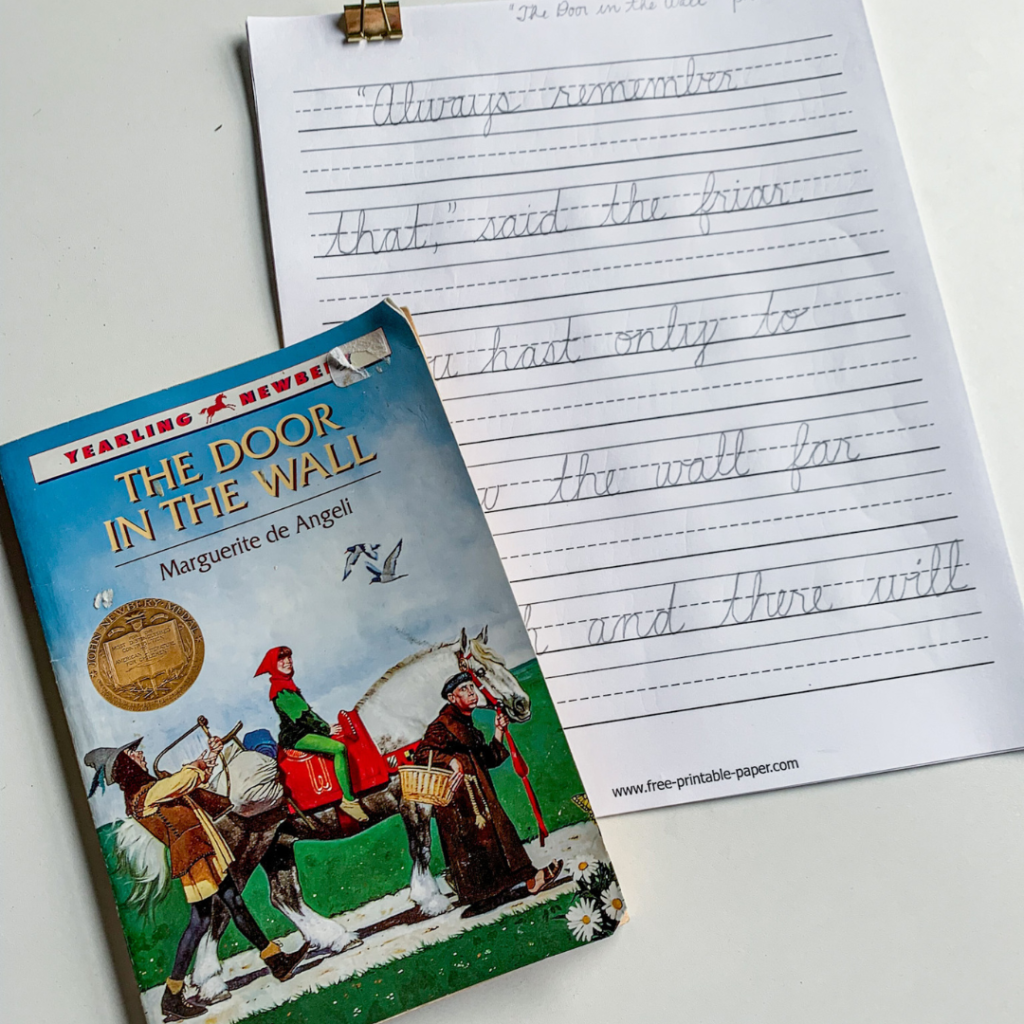
    the door in the wall

    Read Aloud Novel

    “The Door in the Wall” by Marguerite de Angeli takes place in the middle ages. It follows the story of a young boy who is destined to become a page but is suddenly ill and unable to fulfill his duty. A monk comes to his aid and encourages him to learn new things and work on becoming stronger. His hard work will soon pay off as he will play an important role in protecting the castle.

    This book came highly recommended (from many other homeschool mamas online) as a historical fiction novel to read while studying the middle ages. The language can be tricky to understand, and by reading it aloud, I was able to explain what many different things meant. (I also learned some things myself!)

    The book is 121 pages and contains 10 chapters, most of which we were able to read in one sitting. The last two chapters were much longer and took us a couple of days to get through.

    I also love the message and theme that surrounded the story. Hard work and perseverance can really pay off. When one opportunity ends, another one might come along. You may think about a modern day phrase, “When one door closes, another opens”. All of these ideas brought on great discussion with my kids.

    We all enjoyed this book so much. Although we used it to study history, we also used it for my oldest daughter’s language arts lessons. (Read about that here)

    More Books

    I love using the library as our main source for books, and for this unit, I even visited a local used bookstore. That may get dangerous in the future. I could’ve bought so much! I found tons of good reads and I’ll share the best ones here. You can also check out my YouTube video where I share a peak inside of the books as well.

    coat of arms

    Coat of Arms

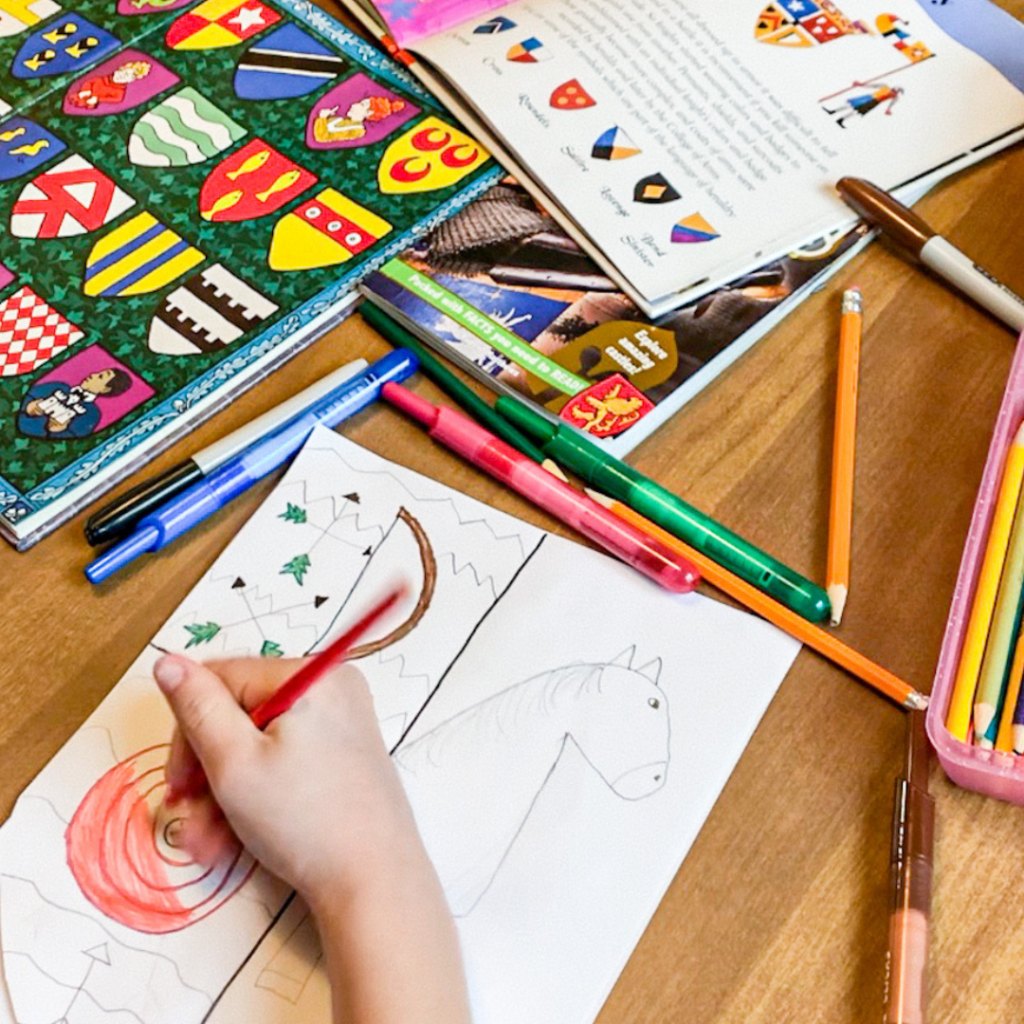
    Almost every book we read about knights talked about a coat of arms. Knights would decorate their shields in a way to represent who they were. This was a fun activity to express who we are and decorate our own pretend shields.

    You could definitely cut cardboard and paint if you wanted to go all out. We just used white paper! I cut the papers into a shape of a shield and I offered a couple of options. Decorate the whole shield or divide it into 2-4 pieces and add different designs to each piece. They each did something different, but I loved seeing what they chose to add to their shield.

    I had them tell me about their designs and what it meant to them so I could write it on the back. It’s a great piece of art for their portfolios.

    cardboard castles

    Create Castle and Drawbridge

    This activity and the two following activities were completed after reading portions of “Castle” by David Macaulay. This book seemed a little intimidating to me because it’s quite long, but it was highly recommended. It turned out to be absolutely wonderful and we learned so much! It did take about 3 days to get through it all.

    We created a castle using a cardboard box from our pantry. This blog post breaks down the entire process. Since I have younger ones, I did a little bit of prep to help the activity run smoother. By the time we were ready to start, I already had the boxes shaped.

    I had my two oldest each decorate their own castle. I will admit that once it was time to create the drawbridge, I could only help one at a time. If you had older kids, it may be fun to hand them the supplies and say – how can you make this work?

    With my two (ages 6 and 8), we talked about it as we went, and I had to do a lot of the work so that the drawbridge would do what it was supposed to. Even still, they loved the finished product and immediately got their Barbies out to start acting out a castle attack. It was pretty cute to watch, and such a fun way to assess what they’ve been learning – through play! I love it!

    Castle Drawing and Narration

    Before we read our Castle story one morning, I found a video that taught my girls how to draw a castle. Now, we love Art for Kids Hub, but their castle drawing could only be watched if you pay for a subscription on their website.

    So, we did something crazy and decided to just draw the Ice Castle from their YouTube channel. I encouraged my girls to decorate it like the castles we have been reading about. My oldest did just that and kept the snow. My other two girls just went full blown Frozen and kept the ice castle.

    Either way, it was still fun and I decided to use their pictures as a visual for their narration of what we read that morning. I wrote something for my two oldest girls and kept it in our yearly portfolio. I love how it turned out.

    Build-A-Castle Rotation

    Just one more day of reading this book (“Castle”), and I wanted something fun to finish it off. We have a few open-ended toys at our house, so I chose four different bins full of blocks to get us started.

    I set out four blankets for our morning time and put a bin on each blanket. We had Magnatiles, Mega Blocks , Duplo Legos, and wooden blocks. I told each of my kids that I would set a timer for five minutes and they’d have to build a castle out of that specific toy.

    At the end of the timer, no matter if they finished or not, they would rotate to the next blanket and build another castle. They thought this was the coolest. It really broke up the time well! They made all kinds of castles and it was the perfect way to finish off the book while keeping hands busy and ears listening. It was also neat to see their creativity and became a beautiful way to assess their understanding!

    Still on My Wishlist

    I always like to have a few ideas in my head of what I want to do for our unit studies. I’ll usually make a board on Pinterest (See my middle ages board). The thing is, I don’t always get to every single one. That’s because they are mostly enrichment! And if it adds more stress to complete it, then I put it off for another time.

    I love homeschooling with this philosophy because I don’t feel pressured to check a bunch of things off. We still learn so much through our readings! The next couple of activities are ones I wanted to do but didn’t quite get to during our unit. However, they’re too cute not to share! I’ll be saving them for a rainy day, but I hope they might inspire you if you’re studying the middle ages!

    Sir Cumference

    The Sir Cumference series is so much fun. They are picture books based in the medieval times that teach math concepts through stories.

    We found ours at the library. I checked out four of them and we simply read them together before bedtime for a few nights in a row. My kids loved them!

    Although we didn’t do an activity to go along with it. I kept thinking how fun it would be to do a simple graphing idea with some candy or cookies, just like in the “Roundabout Battle” story. Check out this candy bar graph for an idea of what I mean. You can also see this photo of an M&M pie chart for another type of graph the book used.

    These are such simple ways to bring the book to life and experience the graph in our own hands instead of just the story.

    Armor of God

    One of the books that we read had a Christian message, and it was called “The Brave Young Knight”. The book was great alone, but I had this idea to do a little armor of God study to go along with it.

    You can find the armor of God in the bible in Ephesians 6:10-20. Once we read about it in scripture, I wanted to create a fun, easy knight using aluminum foil shapes. This link will give you a better idea of what I’m talking about.

    As we review the armor of God, I hoped to cut the different pieces of the armor out of the foil, glue it on construction paper and label it. I just feel like this could be such a fun way to link our study of knights to what we learn in scripture. It’s also a great visual to help us memorize the verses.

    Movies/Shows

    We have a family movie night on the weekends, and I love when I can match it up to what we are learning. During this unit, we watched a couple of movies that were related to knights and castles.

    First, was The Sword in the Stone. This is an old Disney film that follows the adventures of a young boy who wants to be a knight. It is very magical, but it does take place in the time period. Since I have kids ages 2-8, it was a great one that we could all enjoy.

    Another weekend, we let the bigger kids watch A Knight’s Tale. Now, this one is rated PG-13 and it took a little editing on our part.

    First, we had to talk with the kids about the language. We also had to be prepared to skip a love scene in the film. The only other thing was one of the first scenes. You see a man’s butt and there’s also a visual of someone hanging in the background. Beyond those few parts, the rest of the film was fantastic!

    I highly suggest you read through the Common Sense Media page, and as always, choose what you think is best for your family. Everyone has a preference for movies, and as parents we get the privilege to choose what is shown in our home. In my opinion, it was worth the watch, even though we skipped a small bit. The film portrays that time period so well. You can really see the different classes of people as well as things like jousting and coats of arms, all of which we discussed together the weeks before.

    More Unit Studies

    Come back soon for more unit studies related to the middle ages. If you liked looking through these ideas or if you try one at home, I’d love to hear about it in the comments!

    We’ve been doing unit studies like this all year and I have most of them on the blog. I’ll link some of them below if you’d like check them out!

    Ancient Egypt

    Weather

    Space

    Ancient China

    Vikings

    Thanksgiving

    Posted on 1 Comment

    Winnie the Pooh Novel Unit – Homeschool Language Arts

    winnie the pooh novel unit

    This Winnie-the-Pooh novel unit has really brightened up our language arts. The way it is set up has given us a sense of freedom and fun in our homeschool routine.

    This method of language arts is new to us, but we love it so much. I actually break down the entire process in another blog post that I will link here. I highly suggest you read through that first as it will help the rest of this post make more sense.

    In this post, my goal will be to give you specifics about our studies and schedules for this particular book, Winnie-the-Pooh.

    This post contains affiliate links. If you follow one of my links I earn a small commission at no extra cost to you. Thank you for supporting my blog!

    Winnie-the-Pooh

    When I first heard that this was a great family read aloud, I ignored it. I thought it was going to be baby-ish and that my kids wouldn’t be interested. However, I was gifted the series from my husband’s grandmother and needed a good, living book to try this new method of novel unit out. Since we had it on our shelf, I went for it.

    WOW! Was I wrong! This book was one of the most adorable books we’ve read together. We giggled in every chapter and didn’t want it to end. It’s the sweetest, and it made this unit all the more special!

    The goal in reading this book was to try to get through a chapter a day. There are 10 chapters total, so we were able to finish the book in two weeks. I didn’t always read a whole chapter in one sitting. Sometimes I broke it up and read some at night and the rest in the morning. I have a couple little ones and longer chapters are harder to sit through. Breaking it up helped some days!

    Unit Schedule

    The following is a brief outline of what I hope to accomplish each day with my child. For more details on each piece, be sure to read my explanation post.

    In this post, I am going to focus on Winnie-the-Pooh and will share the passages we studied and how we broke them down each day in case you’d like to try the same sort of method.

    For a VERY brief overview – We read aloud as a family at different times in the day. For daily grammar, my daughter uses Fix it Grammar. I love that it can be done independently and takes about 5 minutes to complete. Copy work is also completed independently (5 minutes). I set a timer for our actual language arts lesson for 20 minutes.

    DAY 1

    • Read novel and narrate [whole family]
    • Grammar Workbook [independent work]
    • Copy work – complete 2-3 lines of selected passage from novel [independent work]
    • Study passage – focus on grammar [language arts lesson with parent]

    DAY 2

    • Read novel and narrate [whole family]
    • Grammar Workbook [independent work]
    • Copy work – complete 2-3 lines of selected passage from novel [independent work]
    • Study passage – focus on spelling and vocabulary [language arts lesson with parent]

    DAY 3

    • Read novel and narrate [whole family]
    • Grammar Workbook [independent work]
    • Copy work – complete 2-3 lines of selected passage from novel [independent work]
    • Written Narration [language arts lesson with parent]
    • **Option – review passage/spelling words if necessary

    DAY 4

    • Read novel and narrate [whole family.]
    • Grammar Workbook [independent work]
    • Copy work – complete 2-3 lines of selected passage from novel [independent work]
    • Dictation [language arts lesson with parent]

    DAY 5 (OPTION)

    • Read novel and narrate [whole family]
    • Silent Reading (15-20 minutes) [independent work]
    • Narration [language arts lesson with parent, about 5 minutes]

    Passage Selection – Week One

    I selected two passages to use for our copy work because it took us two weeks to read the book. Each week, we studied one passage during our language arts lesson time. Next, I will share with you how we study these passages throughout the week.

    “He was getting rather tired by this time, so that is why he sang a Complaining Song. He was nearly there now, and if he just stood on that branch…Crack!” (Winnie-the-Pooh, A.A.Milne)

    On the first day of our schedule, we focus on grammar and punctuation. The following is what we discussed for this passage:

    • Capitalize the first letter in a sentence and choose the correct end mark.
    • A comma and a conjunction can join two sentences together. (Conjunction Junction, what’s your function? — Are you singing yet?)
    • Complaining Song is capitalized by the author – Why? It’s possible he wanted to make it more official or to make it a title of a song. (Poetic License/Author’s Choice)
    • The “…” is called an ellipses. It encourages the reader to pause.
    • “Crack!” is italicized for emphasis, an exclamation point adds volume in this case. For fun, we also discussed what onomatopoeia was.

    As we study these topics we might practice different examples on the board or practice them orally, if possible. This might seem brief, but as you discuss each one with your child and provide alternate examples or even just look for more examples in the book, the time will go quickly.

    Spelling and Vocabulary

    For our second day of lessons, we are still using the same passage. This time we focus on spelling and vocabulary. I first ask my daughter if she knows what certain words mean based on the context. If we need to, we look them up in the dictionary.

    The vocabulary words we looked at for this passage: rather, nearly, complaining

    For spelling, I quiz her with many of the words from the passage and see which ones are mastered and which ones need practice. I have her write them on a board. You can make this list based on your child’s needs, but our list looked something like this: getting, rather, tired, why, complaining, nearly, there, stood, branch, crack

    Any word spelled incorrectly we practice a few times. I will also try to quiz her the following day as well to see if she can remember the word(s) she missed.

    Passage Selection – Week 2

    Week two follows the exact same schedule, just with a different passage. So for this section, I will list the passage as well as what we studied to go along with it.

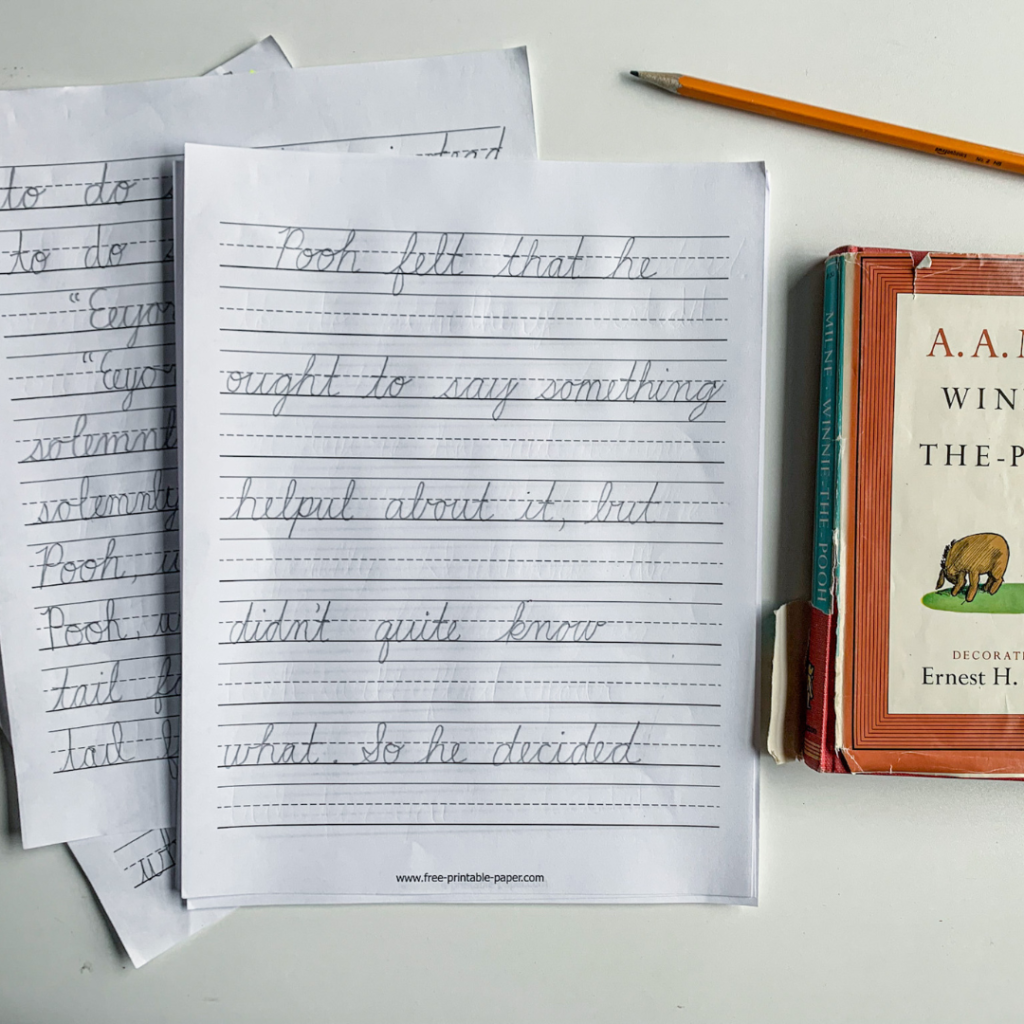
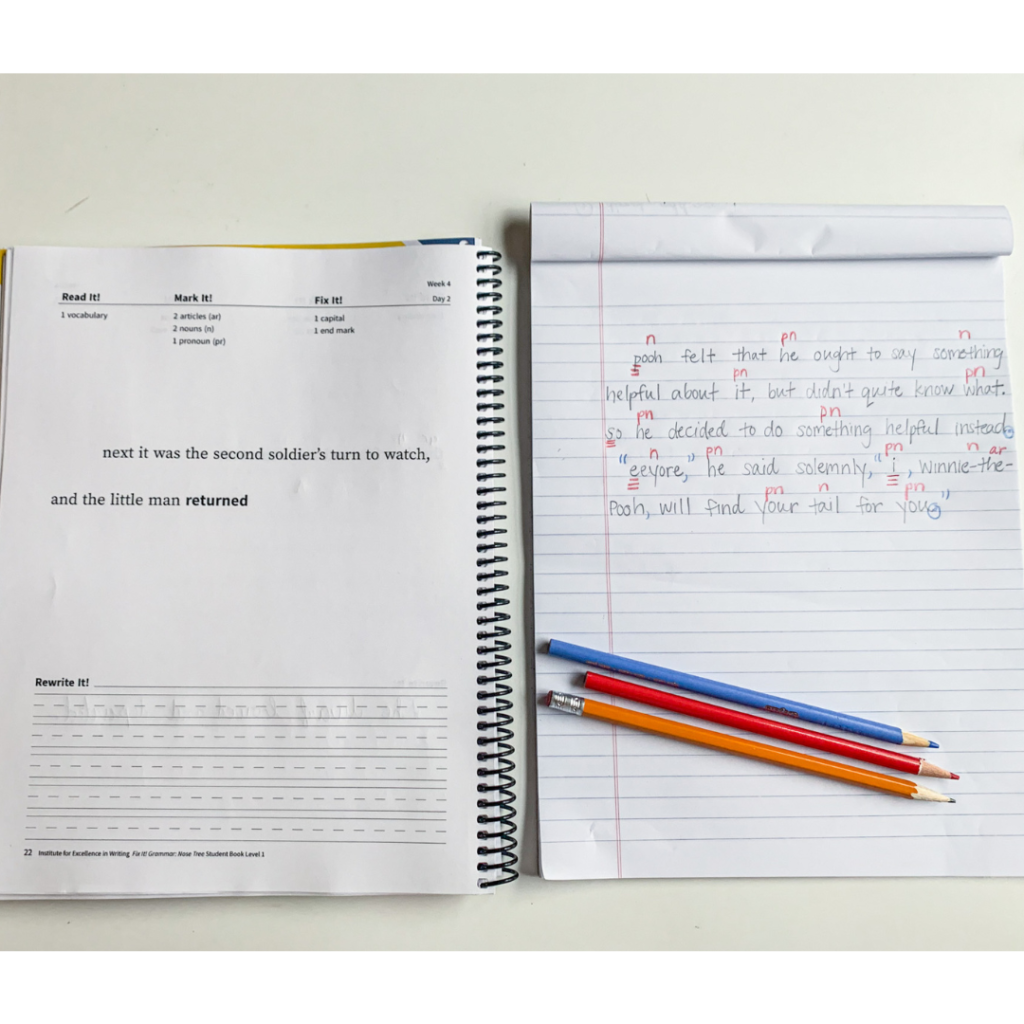
    “Pooh felt that he ought to say something helpful about it, but didn’t quite know what. So he decided to do something helpful instead.

    “Eeyore,” he said solemnly, “I, Winnie-the-Pooh, will find your tail for you.” (Winnie-the-Pooh, A.A. Milne)

    On the first day we discussed the following:

    • Capitalize the first letter in a sentence and choose the correct end mark.
    • Didn’t is a contraction – did not. We practiced writing other contractions.
    • A new speaker starts a new paragraph, indent.
    • A comma is placed after “Eeyore” to separate the quote, but we also discussed direct address.
    • Always capitalize “I”.
    • Winnie-the-Pooh is surrounded by commas because it is information that is not essential to the sentence.
    • Quotes go around what the character is saying.

    Now, if you wanted to simplify this even more, you could only focus on what connects to your grammar workbook. Point out what you’ve studied so far, and that’s it. That way it’s consistent between the two. However, I enjoy looking a little deeper than that. There are times when I don’t really know why a comma is there, and I just look it up online right there with her. That’s what it’s all about – learning together!

    vocabulary photo

    Spelling and Vocabulary

    On the second day of our week we look at spelling and vocabulary from the passage. The spelling words we practiced were as follows: ought, something, helpful, about, didn’t, quite, know, decided, instead, solemnly, tail.

    The vocabulary words we studied were “ought” and “solemnly”. Don’t forget to use context clues first, and then try the dictionary.

    optional grammar activity

    Optional Grammar Activity

    Usually on our spelling and vocabulary day we have extra time. I like to switch out her Fix it Grammar page with a little something different. We use the exact same methods she is practicing in her workbook but we apply it to our passage instead.

    Here’s an example. In her Fix it Grammar book she is currently marking words that need to be capitalized, end marks, nouns, articles, and pronouns. So, I wrote the sentence on the board and had her do the same thing to our passage. It worked out great! I’ve snapped a picture (above) of an example for you to see.

    Honestly, you could do this with any grammar workbook. If you are practicing adjectives, find the adjectives. If you’re underlining the subject once and the verb twice, do the same here. See if you can combine your grammar book with your novel one day – It makes the workbook feel relevant!

    I’ll admit, there were a couple words I wasn’t sure about (yay for learning together!). The dictionary was very helpful. Find the word that matches the context of what you’re looking for and the dictionary lists the part of speech. So, if you see something off in my photo, blame Webster 😉

    Ready to try it?

    Does this sound like something you would enjoy? Sometimes it’s hard to explain what goes on in this crazy head of mine, but I hope that this explanation simplified the process for you. Isn’t it freeing to just read and chat about a book with your children? That’s what I love the most about this. Besides our daily grammar practice, there’s no workbooks, no busy work, just beautiful book discussion.

    Want to see more novel units like this? We are starting another soon, and if this is helpful, I’m happy to break it down like I did with this one. Let me know in the comments or reach out to me on social media (Instagram: @simply.learning.together)

    When I first started learning about the Charlotte Mason method, which is what inspired this study, I was nervous about the no-workbook-factor. Having a consistent plan like this with certain goals has really given me the confidence that a typical curriculum workbook doesn’t have to be necessary if it doesn’t bring you joy! It’s been so freeing to be able to study language arts through the books that we love!

    NEW Novel Guide Available

    For the last few years, my children and I have used this novel-based language arts program that is family-style and enriched with great literature each week. I’m so excited to share a NEW guide with you on how we do this in our home. If you’re tired of an all-in-one language arts workbook or if you’re itching for a great novel to read aloud to your kids, you’ve got to try this method! Below are two of the newest guides available now:

    James and the Giant Peach

    The Secret Garden

    You can watch multiple videos about this method of Language Arts on my YouTube Channel HERE

    Posted on Leave a comment

    The Boxcar Children – Novel Unit

    The Boxcar Children is an adorable, classic novel to add to your homeschool routine. This novel unit will provide you with optional activities, crafts, and library topics to enrich the novel topics and themes.

    This post contains affiliate links. If you follow one of my links I earn a small commission at no extra cost to you. Thank you for supporting my blog!

    Experience it in the Home

    The focus for this unit is “Experience it in the home…” The unit is designed so that you can add simple discussions, recipes, meals, and outdoor play to your day-to-day life while reading this book. These are related to the events in each chapter and provide a way for you to live out the book and experience it as a family…simply and easily.

    science experiment

    Experience it Across Multiple Subjects

    There are also additional activities that you can choose to add on as you please. This would be for you to “Experience it across multiple subjects…” This may include crafts, science experiments, math activities or writing. These are all optional and can be completed at ANY time. (We know deep down the memory of a book never leaves us…save these for when it best suits your family)

    Organized by Chapter

    The novel unit is broken down by each chapter. Every chapter guide includes the following:

    • Summary
    • Discussion Questions
    • Crafts/Activities/Discussions
    • Library topics to add optional books to your study
    tin can bell

    Super Flexible

    Everything is OPTIONAL! No required book list. No required supplies. This unit is so flexible. Pick and choose what works for your family. Most importantly have fun with it. Learn together from the character experiences. Enjoy digging deeper into a novel.

    ***DOWNLOAD THE BOXCAR CHILDREN UNIT***

    More Read Aloud Experience Units

    You can read more about the Read Aloud Experience in this post where I explain our very first one that our family completed for The Secret Garden. To download the free units, click the links below:

    secret garden read aloud

    More Book Activities

    The Courage of Sarah Noble

    Adventures of Reddy Fox

    Caddie Woodlawn

    Posted on 2 Comments

    The Best Christmas Pageant Ever – Book Review

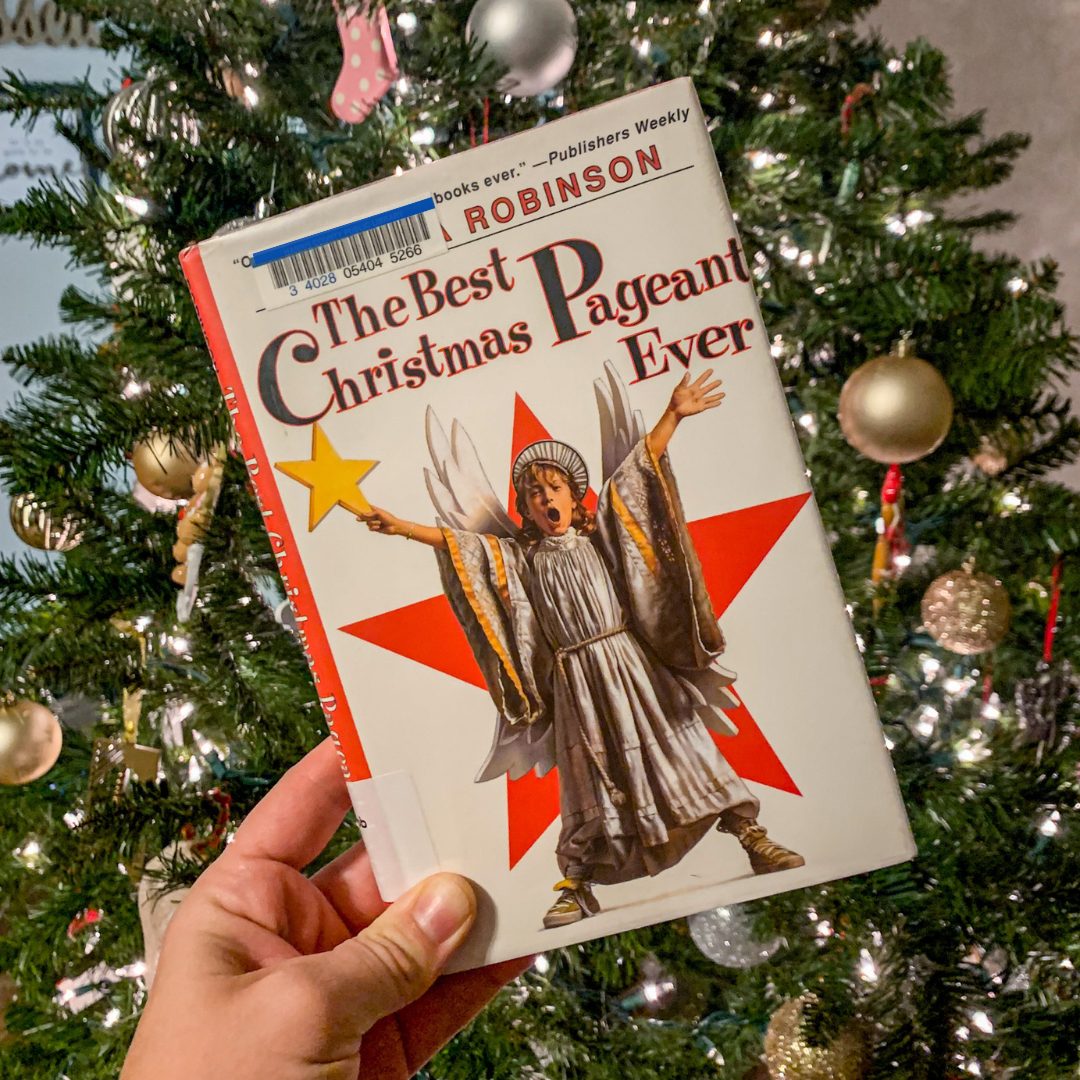
    One of our Christmas read alouds this year was “The Best Christmas Pageant Ever” by Barbara Robinson. I chose the book because it was on the Read Aloud Revival holiday booklist and because I had heard great things about it from others.

    A friend reached out to me before I read it, and gave me a heads up that there were some inappropriate parts in the story for little ears to hear. I was so thankful for this message, because she was right. There are definitely some parts in the book that may be worth editing or skipping, and I plan to share them with you here.

    This post contains affiliate links. If you follow one of my links I earn a small commission at no extra cost to you. Thank you for supporting my blog!

    Pointing Out the Bad

    Let me just start by saying that this book was so precious. If you’re wondering if it’s a good book to read for Christmas, my vote is YES! My kids looked forward to it every night, and I even teared up at the end!

    Now, with that in mind, you’ll have to make note that I’m about to point out the not-so-great things in the book. It’s the focus of this post – to warn you of some of the things that might be bad for little ears. But please don’t mistake that for this being a bad book. Of course, use your discretion to pick what’s best for your family, but please do not interpret my post as a negative review. We adored this story.

    I would read it again in a heartbeat!

    Age Group

    My girls and I read every night before bed. Their ages are 8, 6, and 3. So, you can see that a variety of ages will enjoy this. I will say that my older two caught on a bit more, but you better believe their youngest sister was giggling along with them at times.

    I truly feel this book would be great for even older kids as well. If you have middle school kids, they’d probably get a kick out of this too. It’s one the whole family can enjoy together.

    The Herdmans

    The book is about a group of siblings called the Herdmans. They’re naughty, and I mean really naughty. They are terrible to other kids, parents, and pretty much all authorities. They are mean, destroy property, smoke cigars, and set a terrible example. The thing is — they make this story! Their behavior and actions is what really drives this book home in the end, so you have to get past the bad to get to the good.

    What I love about reading aloud with my kids is that it provides us with a safe environment to talk about these things together. What do we think of the behavior? What would you do in that situation? How should we act towards others? Is this the right thing to do? We had lots of these discussions with this book, and they were very meaningful.

    Bullying

    I’m not going to cover each chapter, but I will tell you that chapter one is a doozy when it comes to bullying. The author does a great job setting up the characters and pointing to the fact that – the Herman’s are rude to all! There is a character in particular that this chapter focuses on, Imogene Herdman. There is an entire section about her sneaking around to find out everyone’s body weight and then using it against them later.

    The only time this got really uncomfortable for me is when the book started using words like “the fat kids” and then had an entire paragraph about what fat camp was. I try to teach my kids not to use the word “fat” and it was thrown around quite casually in this chapter. Once again…I’m not mad about it. I love being able to talk to them about these things in the safety of our home. This is just a heads up for you. The word “fat” comes up multiple times in this chapter.

    The first chapter also brings up “cooties”, so that was a new term for some of my kids. Needless to say the author does an amazing job making these kids sound straight up awful!

    Language

    We just finished this book, and I really can’t remember any curse words. In my opinion, those are easy to edit quickly or skip over, but I don’t recall them even coming up.

    I will point out that a couple of the Herdmans shout, “Oh my God!” during their rehearsals. The point of this is the rest of the children are in shock that someone would use God’s name in vain in the church.

    I chose to say “Oh my gosh” instead and the whole thing went right over my kids’ heads. I want to say it happens 2-3 times.

    The only other part that sticks out in my head is when a preacher says at the end of chapter 6, “Mrs. Wendelken says all they do is talk about sex and underwear.”

    I didn’t see that one coming, but I just skipped over sex and said “underwear”, not because it’s a bad word, but because I wasn’t about to have a discussion about sex right before bedtime. We’d be talking for hours! I just made the quick decision to skip it and move on.

    The Nativity

    I don’t want to give away too much in the story, but I think it’s also important to point out that the Herdmans are not aware of the Christmas story. They are very curious and want to make sense of it all. They throw around jokes and make up crazy scenarios about what might have happened. I personally don’t think it’s a bad thing. Just know that you are going to come across some things that add a sort of silliness to the nativity.

    Do you ever use Common Sense Media? I looked this book up to see what it had to say, and it made the point like this, “Parents need to know that this is a unique and entertaining spin on an age-old tale. Some parents may want to exercise discretion: Not everyone will want their children exposed to the antics of the main characters or will appreciate the liberties the story takes with what some people may consider sacred ground.”

    …But it’s SOO CUTE!

    I really hate saying all this. It makes the book sound terrible, but I promise you it’s absolutely adorable. The end of the book was so meaningful and it brought me to tears. I don’t want to spoil it for you.

    Here’s the thing – the book is only 7 chapters and just 90 pages. If you are considering it for your family, but you aren’t sure how you’ll feel, pre-read it. You could probably do it in one sitting! It’s that quick (and entertaining!) Find it in your library so you can do this for free, and decide whether or not you want to share it with your kids.

    We loved it! I don’t regret it one bit. I love the discussions we had. I love the giggles we shared, but I can’t spoil the beautiful message that is displayed at the end. Even if you read this on your own and decided to wait on it a few years to share with your kids, I truly feel your time wouldn’t be wasted.

    Christmas is about the birth of Jesus, and this author has a fun, unique way of pointing this out to us, even if it makes us slightly uncomfortable for a bit. Jesus came for all, and this story proves just that!

    Posted on 2 Comments

    First Grade Homeschool Curriculum Review

    homeschool curriculum

    Curriculum can sometimes feel overwhelming. As a parent, you want to do what’s best for your child. There are so many wonderful options out there, so what do you choose?

    The answer to that question will always depend on your child. Even within a home, curriculum needs can be different. For example, my two oldest children do not always use the same books.

    In this post, I’ll be sharing what we used for my oldest daughter for first grade and how it worked for us.

    Every family is going to be different, but sometimes it helps to hear how something works for someone else. That’s what I hope to do here.

    Keep in mind, this is all based on my opinion. What works for me may not work for you, and vice versa. I’ll be sharing the good and the bad experiences we have had this year.

    This post contains affiliate links. If you follow one of my links, I earn a small commission at no extra cost to you. Thank you for supporting my blog!

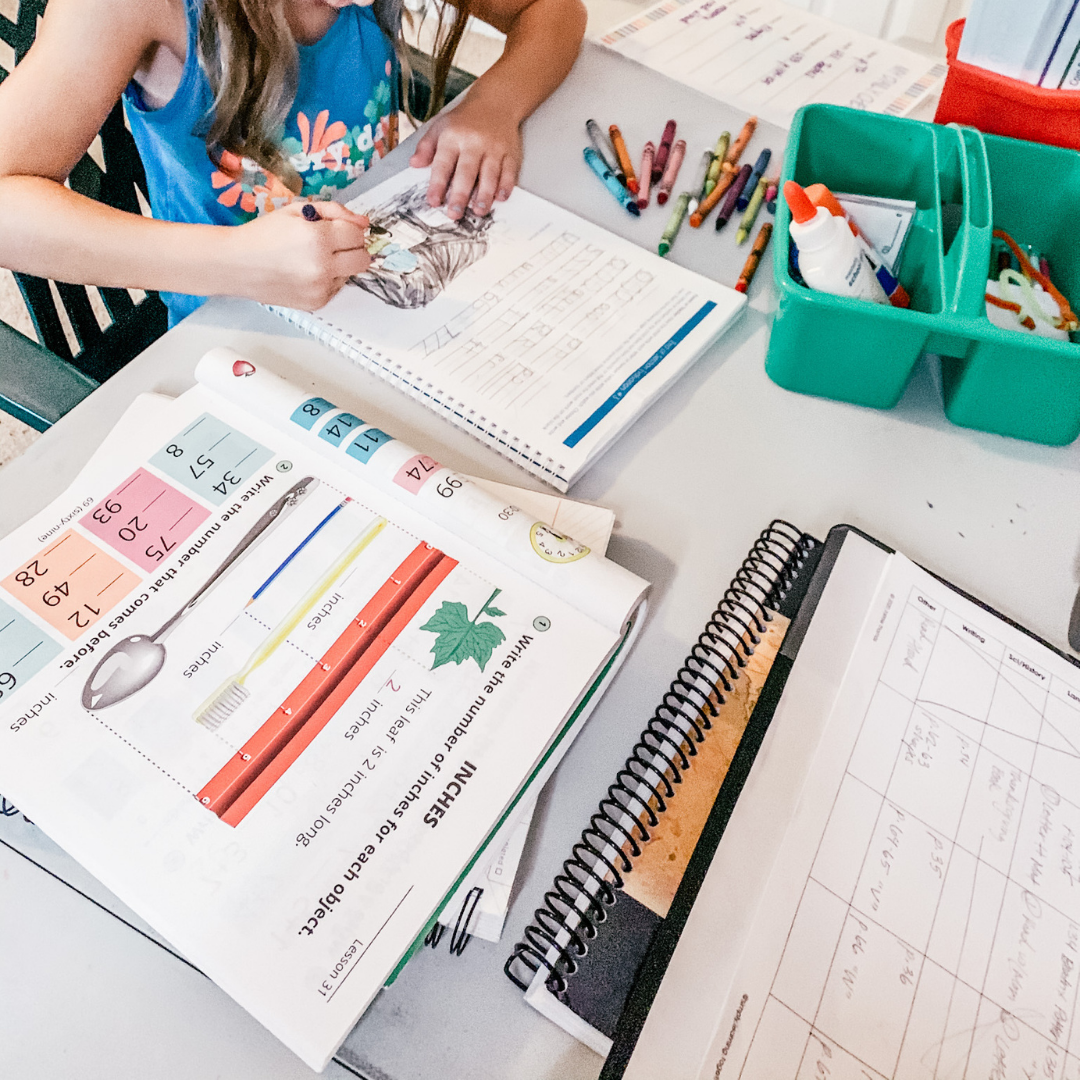
    homeschool math

    Horizons Math

    I chose to stick with Horizons Math for first grade. We used it in Kindergarten, and I really enjoyed it. (Click here for some super fun math activities to go along with Horizons K)

    We purchased Book 1 and Book 2, and that’s it. We did not purchase any sort of curriculum set from the company or the teacher guide this year. (I had the guide for Kindergarten and never used it.)

    After my experience with kindergarten, I knew I wanted to have a few manipulatives on hand to use with the lessons. I purchased a small set of base ten blocks and uni-fix cubes. Both are used almost every week. I highly recommend having these to go along with the workbooks.

    Horizons uses a spiral method to teach math skills.

    This means topics are introduced and practiced throughout the entire book. The alternative to that is to introduce a topic, master it, and move on. Horizons is not set up that way. Each lesson reviews multiple concepts – old and new.

    The student workbook is colorful and easy to follow. Lessons are usually front and back, and there are tests throughout. The tests look just like the lessons, so there is nothing surprising there. For the student, it may just feel like another lesson.

    I would not describe Horizons as “open and go”, because at times there is a small bit of prep involved.

    Once you get used to the book, the prep only takes a minute or two. Many curricula include a script for parents. In the Horizons student workbook, there are only directions for the student. You could definitely just have your child complete it, but I’ll tell you right now – that will get really boring really quick.

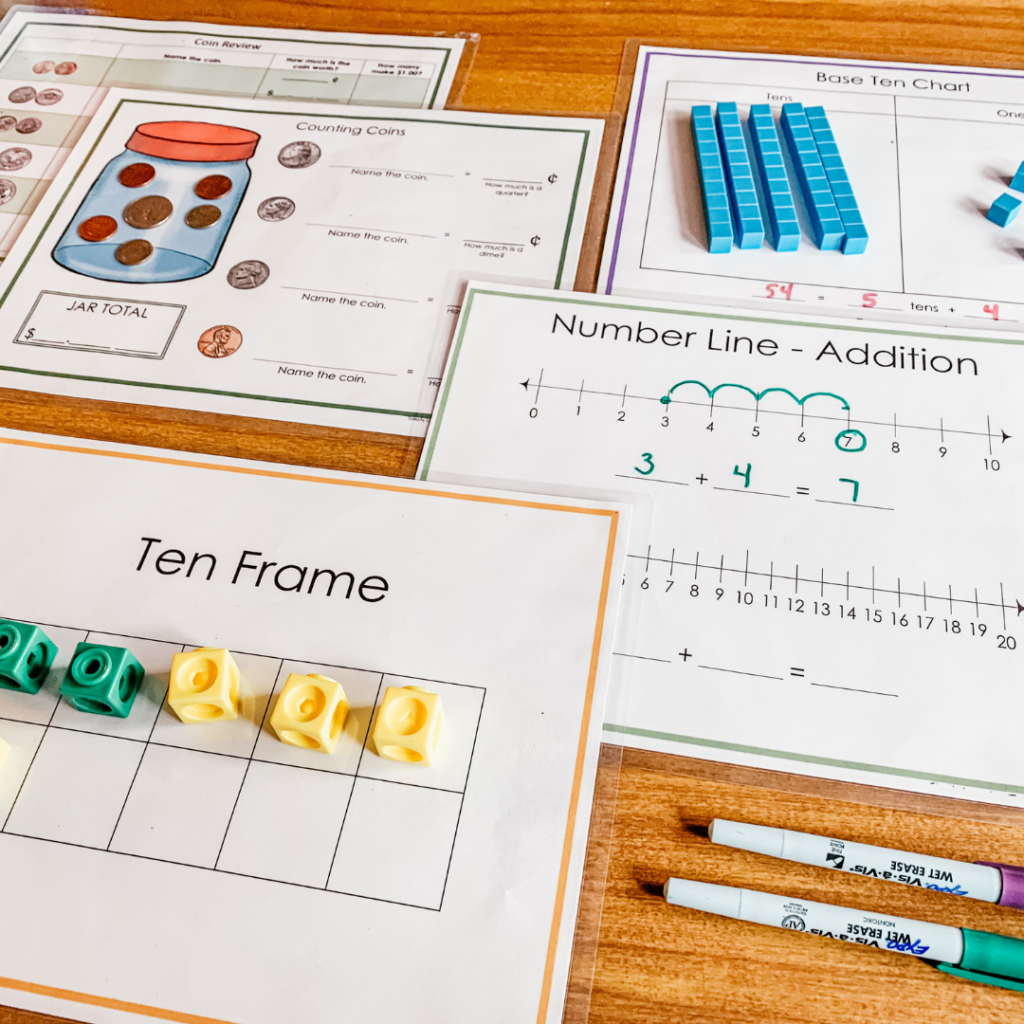
    I’ve learned a little creativity is necessary, so I created math mats to make the planning and prep super easy! Having a go-to set allows me to just grab and go as I am getting the lesson ready. They are easy to store, easy to use, and fun to do!

    math mats

    Before we begin a lesson, I quickly look through the page and grab a math math that will go with it. I briefly look at the content to see if there’s any new skill to introduce. If so, I introduce that skill and help her practice. The rest of the lesson she completes independently. This works great for us because it puts less pressure on me. It only takes a minute or two for me to get it ready for her.

    The teacher’s guide does include the steps to introducing the lesson and practicing the skill. It also gives an idea or two for an activity to do along with the lesson, but the guide is a separate purchase from the workbooks. Think of it as directions and not a script. (This was my experience with the Kindergarten guide since I did not purchase it for first.)

    I personally love this curriculum because I can get creative at my own pace.

    I can easily add manipulatives (base ten blocks, uni-fix cubes, coins) with simple math mats so that any lesson can be hands on. I can play basic flash card games or math games to practice a skill. This is always fun, because we are not glued to the workbook. We can move around and review. (Check out this flash card blog post.)

    Or, if we want to just stick to the workbook page, we can. Some days it’s nice to just get it done! I don’t ever feel pressure to complete a planned out script.

    I have four children and sometimes following a script gets tricky.

    I love that the Horizons curriculum allows me to do as much or as little as I like, without feeling guilty. I can be creative and add simple activities. On the flip side to that, if I need to tend to other children or we need to work quickly, my daughter can work on her own without much help at all. For now, this is what feels good for our family, so we plan to stick with Horizons next year.

    For More Horizons tips, check out this video on how we shorten a lesson.

    the good and the beautiful

    Language Arts: The Good and the Beautiful

    We started the first grade year with The Good and The Beautiful Level 1. When I first received the curriculum, it was exactly as it says – good and beautiful!

    I loved all of the art and stories. It had activities and games within the workbook that we could play during the lesson. Everything was easy to follow and scripted. I always felt prepared when I taught the lesson, and I thought this would be perfect for us.

    The Good and the Beautiful comes with a few different pieces.

    There is the workbook, phonics cards, and a leveled reader with multiple stories.

    I loved the reader because it was at my daughter’s level and the stories were really cute. The student is expected to read every day, but it’s not always from the reader. The reader was assigned in the lesson 4-5 times a month.

    The included phonics cards are to be practiced a couple times a week. The lesson will specifically say when to practice the cards.  Honestly, I used them maybe 2-3 times and then quit. There is no guidance on which ones to practice or whether or not to practice them in a certain order. There are over 100 cards in the set. It can feel overwhelming to practice them and, to be frank, it’s quite boring.

    We started the curriculum in August and by the time we made it to Christmas, I made the decision to switch to something else. We did not switch because the curriculum was bad. We switched because it wasn’t the right fit for our family.

    The lesson itself takes anywhere from 30-45 minutes to complete.

    Add on phonics cards and shared reading time, and it gets to feel quite time consuming. This is another reason why I skipped the phonics cards. I wish I could sit and do school with my daughter one on one all day. But, let’s be honest, I can’t! With a new baby in tow, it became really hard for me to set aside so much time each day for just one subject.

    Eventually, the lessons felt like too much.

    We both became bored and started skipping things…I just knew we needed something fresh and different. We needed something that could be more flexible.

    We decided to switch to Christian Light Education Language Arts.

    I picked this program because it is sold in small booklets. You can buy an individual booklet or the whole set. I bought one booklet for less than $5.00, and I thought this would be a great way to try it out.

    The Christian Light Education Language Arts is set up very similar to the Horizons math program I mentioned above. This could be why I ended up liking it so much. The program covers phonics, grammar, punctuation, writing, and spelling.

    It introduces new topics and reviews previous skills throughout. It’s easy for me to teach my daughter the new skill, practice it, and then let her work independently. There are no stories to read, no games to play, it is straight to the point.

    Now, this doesn’t mean we can’t have fun with it. I can easily create or search for some sort of practice game or activity If I want to. I do not own the teacher guide, so I am unaware if there are ideas for activities to add along with the lesson.

    When we switched to Christian Light, I decided to use classic novels to read aloud and practice reading skills. I’ll share those later in this post.

    I loved that we finally had time do read alouds because our workbook didn’t take as much time to complete.

    I love reading novels with my kids, and I was having the hardest time fitting it in until we switched to Christian Light. I plan to stick with this program for second grade (See second grade curriculum review here), and I will purchase the guide. There are many days I wish I had it.

    If you look on their website, there are many other helpful resources you can use to enhance your language arts. Phonics cards, information sheets, and a handwriting workbook are all options I can consider next year. Their reading curriculum also correlates with the language arts. (I plan to stick with classic novels.)

    Once again (just like math), I like that I can be as creative as I want with this program. If I want to search for a game to practice, I can. If I want to just let her work, I can do that too. It’s flexible for us.

    I don’t feel stuck to a script, so it works for this phase of our life.

    If you enjoy a script, I would definitely recommend The Good and the Beautiful. It really is well thought out and thorough. When it comes down to it, I just needed more flexibility.

    who was christopher columbus

    Science/History

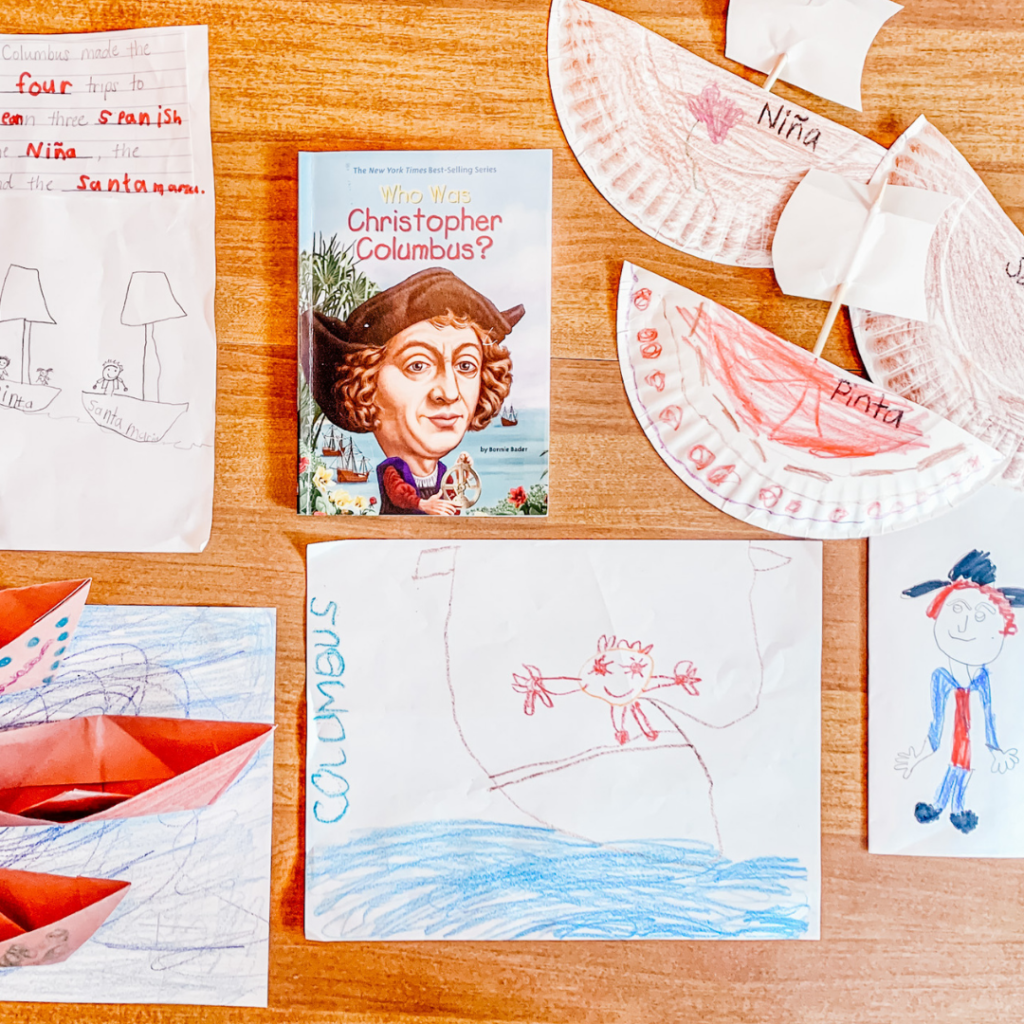
    We are part of a Classical Conversations Community, so we do not purchase a separate science or history curriculum. However, we have loved reading the “Who Was…?” series this year. We read a couple in the first semester, and I’d like to read more! They are such a fun and easy read.

    Before I had my baby, we were using a devotional book to determine our science lesson. I’ll talk more about this book below, but we had a lot of fun with it. Whatever the devotion was about, I would check out specific books related to that topic from the library. It was easy to read and so easy to do! However, it did require planning in advance (to check out books in time).

    We are not consistent with either of these two science or history supplements, but we do love adding it in when we need something new and fresh in our routine.

    family devotion

    Bible/Devotional

    This year we have been reading “Indescribable: 100 Devotions About God and Science”. This devotional is awesome! They are short and so interesting, even for me as the parent. Every day is a different science lesson related to a bible verse. We never get bored with it.

    This book would be great for all ages. I used to teach 5th grade, and they would have loved this book!

    If you have younger kids, you could definitely get creative and use this to help plan your science.

    As I mentioned earlier, we did this at the beginning of the year, and it was a lot of fun. The only reason we stopped was because I had a hard time planning in time to get books from the library.

    You know, this book would also be great for a summer read! If you take a break from your school books, you could still do mini science lessons along with the devotionals. Simply, look through the devotions for the week and check out library books on those topics.

    Whether you use it to supplement your science or not, this was a great purchase! We will work through the rest of it this year, and I look forward to pulling it out again in a few years.

    first grade curriculum

    Handwriting

    I chose The Good and the Beautiful for handwriting for two reasons. It was inexpensive and my daughter requested a program with three lines (with a dashed mid-line).

    The workbook is put together well and can be completed independently. I love how there are lessons of good character and basic life skills like first and last name, phone number, and home address.

    Each lesson has some sort of drawing or coloring activity at the bottom of the page. Eventually, we started skipping those, because my daughter was not interested. Overall, we were happy with it.

    I think handwriting can be a tricky thing because it does get a little boring and tedious for the child.

    However, I do think it’s good practice. I don’t know if we will purchase this one again only because I feel like it will be a waste to have all of the extra drawing and coloring that won’t get used. Most likely I will look for something without that.

    We did change it up half way through the year. For a while we used the copy work from The Secret Garden Read Aloud Experience. We also use Draw Right Now to add some fun.

    secret garden read aloud

    Read Aloud Novels

    I wish I would’ve read more this year, but with the new baby, this is one of the things that got skipped for a bit. We did read a few great ones that I will share with you.

    I mentioned before that we have used the “Who Was…?” series to supplement history. We read “Who Was Christopher Columbus?” and “Who Was Davy Crockett?” I love how these books are short, interesting, and easy to read.

    Once I switched to Christian Light Language Arts, I really wanted to focus on a novel since the workbook did not have any reading portions (it’s a separate curriculum).

    We started with The Secret Garden. We followed the free Read Aloud Experience that allowed us to have new copy work for handwriting and a simple craft/activity to do every day. It was super easy and it gave us something to look forward to every day.

    The Secret Garden has 27 chapters, so it’s a definitely a time commitment. Even still, we thought the book was so wonderful and even enjoyed the movies afterwards.

    I wanted our next book to be much lighter, so we chose Mrs. Piggle Wiggle. Once again we followed the free Read Aloud Experience. There is no copy work with this one, but we did add it into our devotion time, as each chapter is assigned a scripture verse.

    We had a ton of fun with Mrs. Piggle Wiggle. Every chapter brought great discussion, and we continue to refer to the lessons we learned even after finishing. It’s great for all ages and it’s so silly!

    It’s hard to believe we are headed towards the end of our first grade year.

    Maybe you’ve thought about using something in your homeschool that I mentioned above. It’s even possible that you did use something and loved it, even though I didn’t. Whatever the reason is, remember that every child is different. You are the parent. You are obviously doing your research! (That’s why you’re here.) Be confident with what you pick, and jump in. You’ve got this!

    Posted on 10 Comments

    Secret Garden Read Aloud Experience

    secret garden read aloud

    Reading Aloud is such a great habit to form with your family, but what if you could take it one step further?

    It all started for my family during our first year of homeschool. We were reading the Little House series and kept talking about what it would be like to live like Laura and Mary. We were craving that experience, and I wanted my children to understand how different it was back then. As a result, we started digging a little deeper.

    We started planning simple activities and lessons based on our chapter readings.

    It was almost as if we were diving into the book world and getting lost in reading magic. My children could understand and comprehend better, and we were having so much fun learning a variety of different lessons…this includes me! I learned right alongside them.

    The Read Aloud Experience is designed to be low budget, low stress, and without all the “extras”.

    I can’t tell you how many times I’ve downloaded a unit/curriculum for my children only to find out I need to buy 5-10 specific books to go with it. Or, it’s asking for something I can only find at a craft store, and I really don’t want to load up my car and make the trip! Many times it ends in money wasted or just an incomplete lesson.

    Most supplies in the Read Aloud Experience can be picked up at your trip to the the grocery store, and there’s no required book list.

    I don’t always have time for that extra craft store trip, so adding a thing or two to my grocery list makes it so easy to prepare. As much as a I would love to buy ALL.THE.BOOKS, I just can’t. So, I take advantage of my library as much as possible.

    The Read Aloud Experience provides you with a list of library topics that go along with each chapter. That way, you can grab a few books (for free!) to enhance your reading. I love doing library pick-up because I search the topic and look at the book covers to figure out what I like best. I add it to my hold cart, and picking them all up is like Christmas! I have no idea what’s inside, and most of the time I am positively surprised!

    homeschool create a self portrait
    “She found herself in one long gallery whose walls were covered with these portraits.” The Secret Garden – Create a self-portrait

    A variety of activities are included.

    History, science, arts/crafts, music, food, nature, life skills, writing, map skills, and more!…these are the types of activities you’ll get to experience. Some are as simple as – go on a nature walk and use your five senses. Others will require a teeny bit of set up – like a science experiment or craft.

    Remember, nothing is too crazy. I have four kids and 2 are under 2. I don’t have extra time to do something extremely intense. If I can do it, so can you!

    All book suggestions and activities are optional.

    Not feeling up to an extra activity? No problem! Is Thursday your afternoon sports practice and your short on time?…it’s ok! Nothing is required. If you’re in love with the activity but don’t have time to complete it, save it for the next day or move it to the weekend when you’re kids are wondering what the plan is for the day.

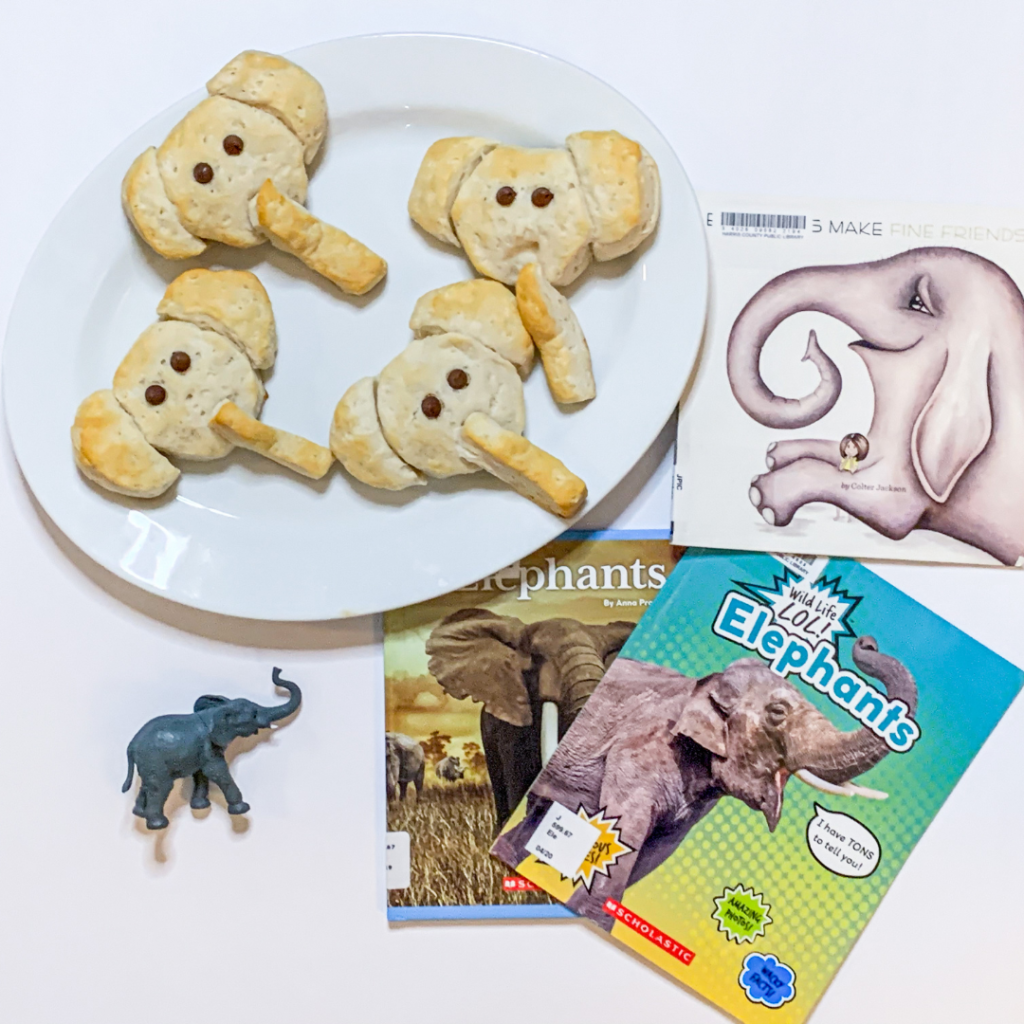
    homeschool elephant mini lesson elephant snack
    “In one room, which looked like a lady’s sitting-room, the hangings were all embroidered velvet, and in a cabinet were about a hundred little elephants made of ivory.” The Secret Garden Elephant mini-lesson

    Everything is made to be flexible and adjustable for your family.

    A supply list and library topic list is included for every chapter. A Planning Guide is also provided so that you can decide what works best for your family. The Read Aloud Experience can revolve around your routine and your rhythms for the day.

    Involve your whole family – all ages.

    Everyone can participate in the Read Aloud Experience. It’s like your own little mini book club inside your house. It’s so fun how we all can talk about the book and the things we’ve learned. Dad is usually working during the day and misses the reading, but he always gets to read our library books before bed, learning with the kids. The babies don’t always get to participate in crafts and activities, but many days they’re on the floor listening to me read.

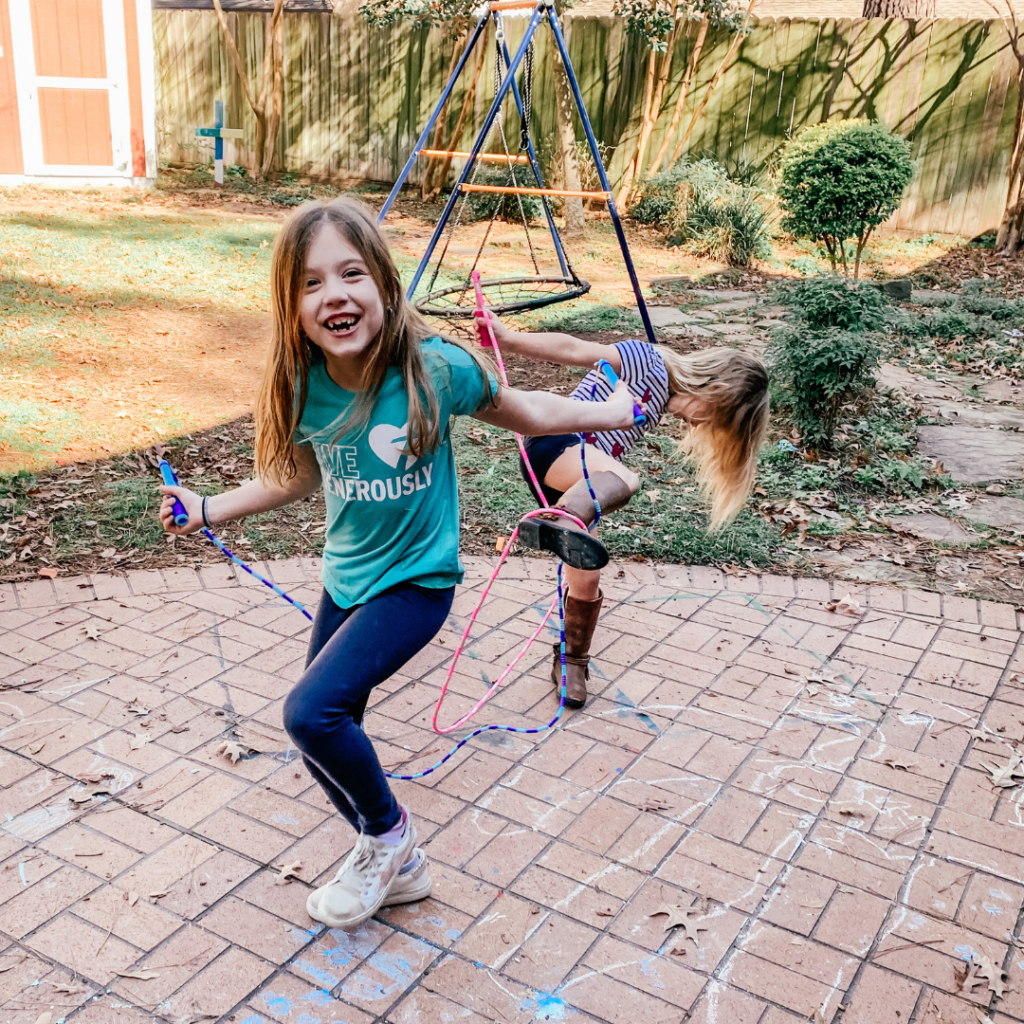
    jump rope and learn through play skip count
    “The skipping-rope was a wonderful thing. She counted and skipped, and skipped and counted, until her cheeks were quite red, and she was more interested than she had ever been since she was born. ” The Secret Garden – Jumping Rope

    Easily incorporate the Read Aloud Experience into your day.

    Simply add the read aloud to your day and pick and choose activities as time allows. One chapter a day – It’s that easy!

    You can also use this as a break from your language arts curriculum. You know that funk you get in when you just need a change? This is exactly what we did, and it was wonderful. There is just so much to learn from reading literature together!!

    It is a novel unit that leads you to discuss story elements, vocabulary, and comprehension while diving into other subjects, as well. At my house, we have placed the curriculum workbook aside. Honestly, it got boring! I dreaded doing it. Now, we complete our read aloud experience, a quick phonics page, shared reading time, and that’s it for language arts. It’s been so nice and refreshing.

    This is also great when you’re taking a break from school in general, and you still want to have a little bit of structure. For example, this could be summer, holidays, or a break after a new baby.

    You can get the entire Read Aloud Experience for FREE!

    Still unsure if this is right for your family? Don’t believe me that it’s easy and low stress? Check it out for yourself and decide. You can get the entire Read Aloud Experience for The Secret Garden free and test it out for yourself.

    Remember that just reading to your children is going to be beneficial and time well spent. You’ll always cherish that time together. The Read Aloud Experience allows you to take it one step further with ease.

    Complete the included science experiment and take a break from your science curriculum that day. Save the activities for a rainy day when you can’t get outside. Or, plan to do them in the afternoon during that awkward time when you’re kids keep asking about dinner. (Anyone else?)

    Most importantly, have fun with it! Get the whole family involved. There’s nothing better than gathering around a great book.

    Check out the following links for more Read Aloud Experiences:

    Mrs. Piggle Wiggle

    The Boxcar Children

    The Courage of Sarah Noble

    NEW American History through Picture Books is AVAILABLE

    Check out this simple, picture-book-based American History curriculum that your whole family will love!

    american history