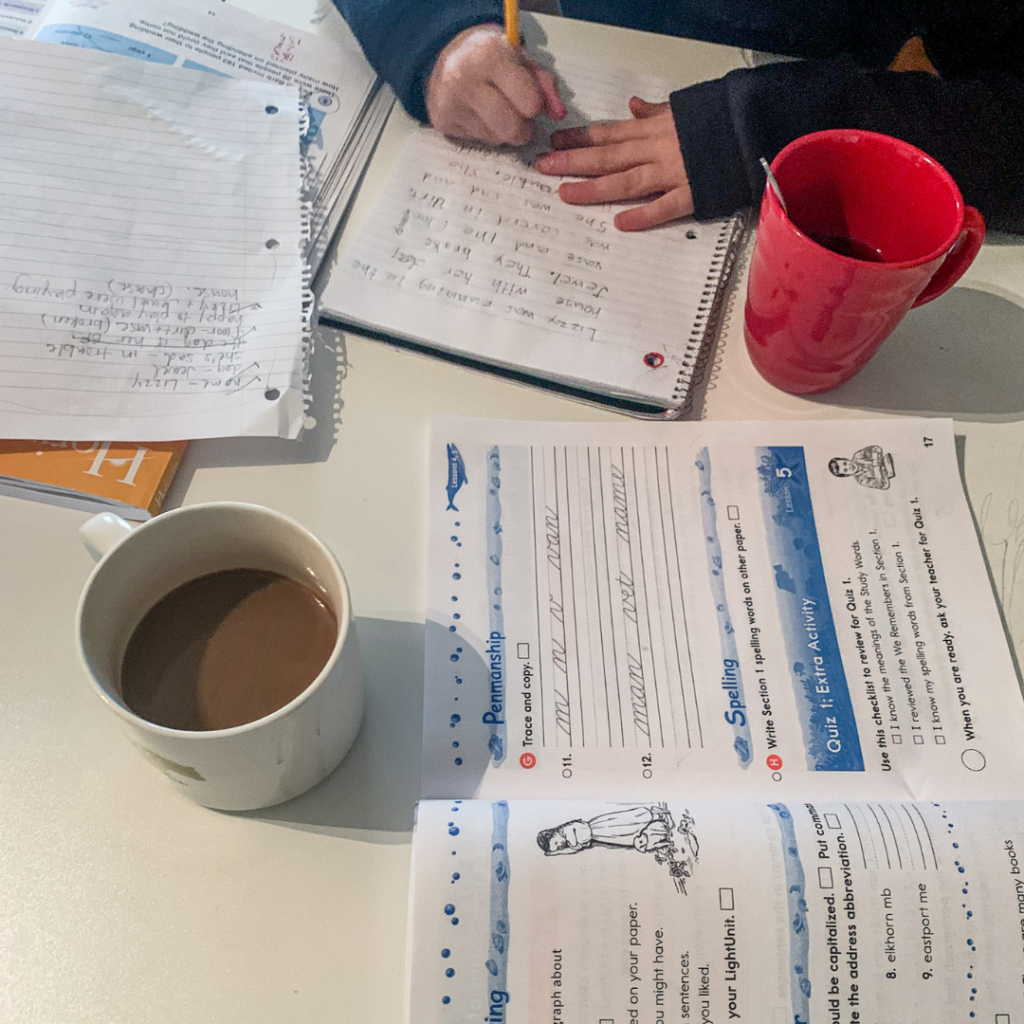
If you’ve ever had the desire to get rid of the all-in-one language arts workbooks, you’re not alone.
I felt the same a few years ago as I was on the hunt for yet another workbook that would finally be the “right” fit for our family.
At first, that all-in-one workbook structure feels helpful. But over time, it often starts to feel repetitive and disconnected, leading to this constant search for something better.
One day it hit me:
Why is it that I get so much joy reading and talking about literature with my kids, but when we open these workbooks, we dread the task of completing it?
Shouldn’t these two things be connected? Isn’t reading and talking about literature a part of what language arts is all about??
I knew there had to be another way…
A New Approach
After some trial and error, lots of research, and a few years of experience, we have made habits and routines of learning language arts through the books we love.
We are no longer flipping through pages of random tasks, but instead we are engaged in great literature, having meaningful discussion, and still practicing different language skills such as spelling, vocabulary and grammar.
This approach put the spark back into learning – for both my children and me.
A Simpler Way to Think About Language Arts
Many homeschool parents rely on all-in-one language arts programs because they don’t want to miss anything. That makes sense, because the subject is made up of multiple parts.
But what if we simplified the standards of the subject a bit to really grasp what it is?
Suddenly, it doesn’t feel like such a monster of a subject anymore. Seeing each of it’s parts can help us truly grasp the subject and how to tackle it with a different, more natural approach – no all-inclusive workbook needed!
At its core, language arts is four parts working together:
Reading
Writing
Speaking & Listening
Language (grammar, spelling, vocabulary)
When you understand these pieces, something shifts.
You’re no longer relying on a workbook to tell you what to do.
You start to see how language naturally develops through reading great books, having meaningful conversation, and writing regularly.
But Is This Enough?
This is usually the biggest question.
If you step away from a full curriculum…are you doing enough?
With a simpler approach, nothing is getting skipped. You’re still covering everything—you’re just doing it in a more connected and meaningful way.
Instead of checking boxes, your child can truly get engaged with literature and language.
Taking the Leap
Even when this approach makes sense, it can still feel hard to start.
Without a workbook you might be wondering: “What exactly is language arts? How do I know what to cover? What does this look like in my daily schedule?”
An all-in-one workbook may feel safer, but is it truly bringing your family the joy you desire while reading and learning together?
If we look at language arts from a different angle, the leap starts to feel a little bit easier.
A Simple Way to Bring It All Together
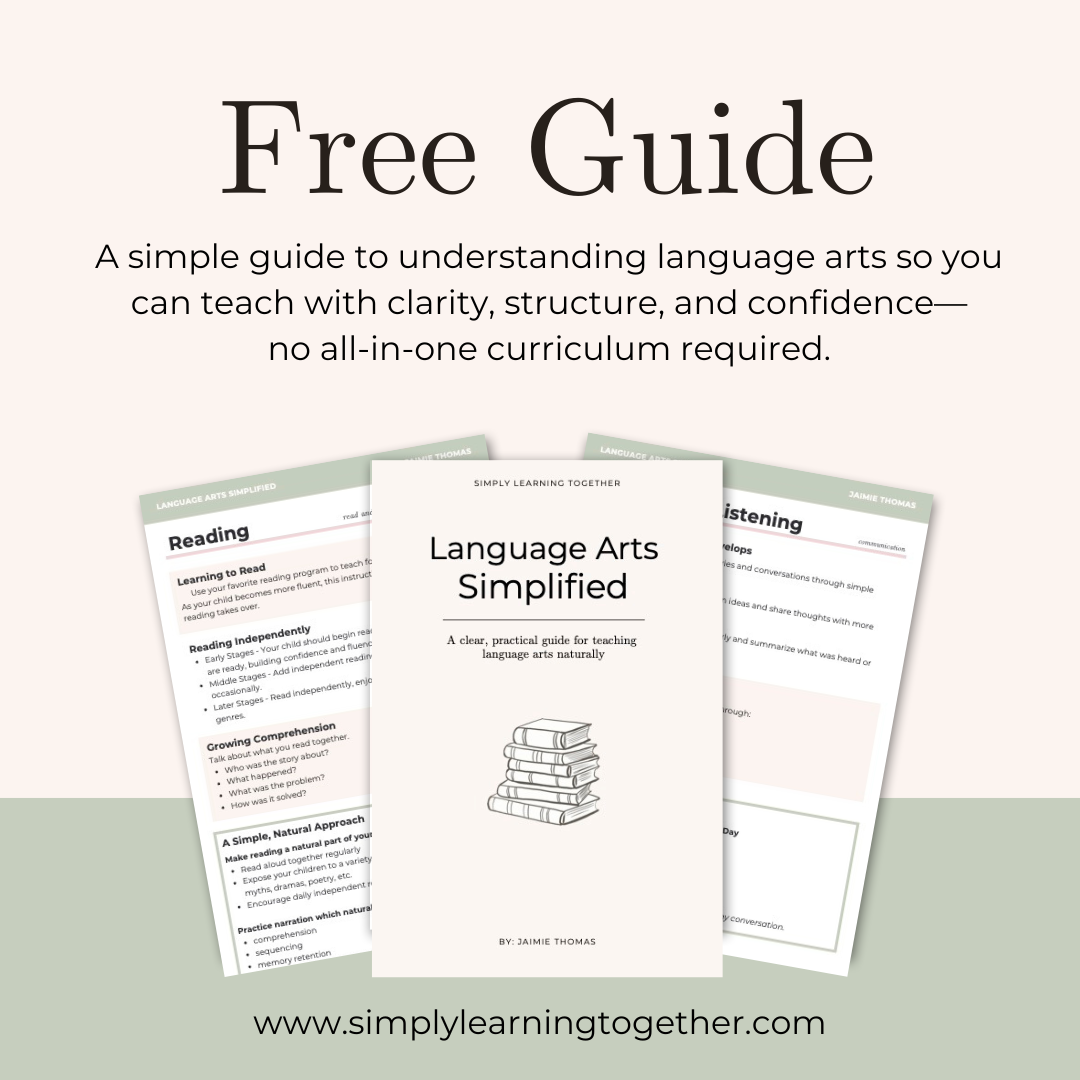
This is exactly why I created my free guide:
Language Arts Simplified
It breaks the subject down into clear, manageable pieces and shows you:
A simple breakdown of each part of language arts
An understanding of what your child truly needs to learn
Practical ways to meet those goals
Flexible options so you can build an approach that works for your family
You Don’t Need a New Curriculum
There’s no need to start over or buy something new.
You just need a clearer understanding of the subject—and a natural way to approach it.
Download the Free Guide
If you’ve been wanting a simpler, more connected way to approach language arts, you can download the guide below.
My hope is that it gives you the clarity and structure you’ve been craving—so you can move forward with confidence and finally feel at peace with your approach to language arts.
Novel study has been the most fun and engaging way for us to learn language arts in our homeschool, and adding in a DIY outlook has been so freeing. Two and a half years ago we actually eliminated an all-in-one language arts curriculum workbook to solely focus on novel study, and it’s been the best decision for us.
We like to call this method DIY Language Arts because we are able to take any novel of our choosing and use it to learn all the parts of language arts including spelling, vocabulary, grammar, narration, handwriting, and more.
After a couple years of adjusting and finding good rhythms for this, I am now able to share these novel studies with you. Multiple studies are available, but sometimes it’s nice to see inside one, and that’s exactly what I want this blog post to be for you.
Included in this post is a download to receive an entire week free for one of the novel guides. In the text below, I’ll walk you through how it works, so you know exactly how to incorporate it into your homeschool. I can’t wait for you to try this!
This post contains affiliate links. If you follow one of my links I earn a small commission at no extra cost to you. Thank you for supporting my blog
Look-Through a Novel Study
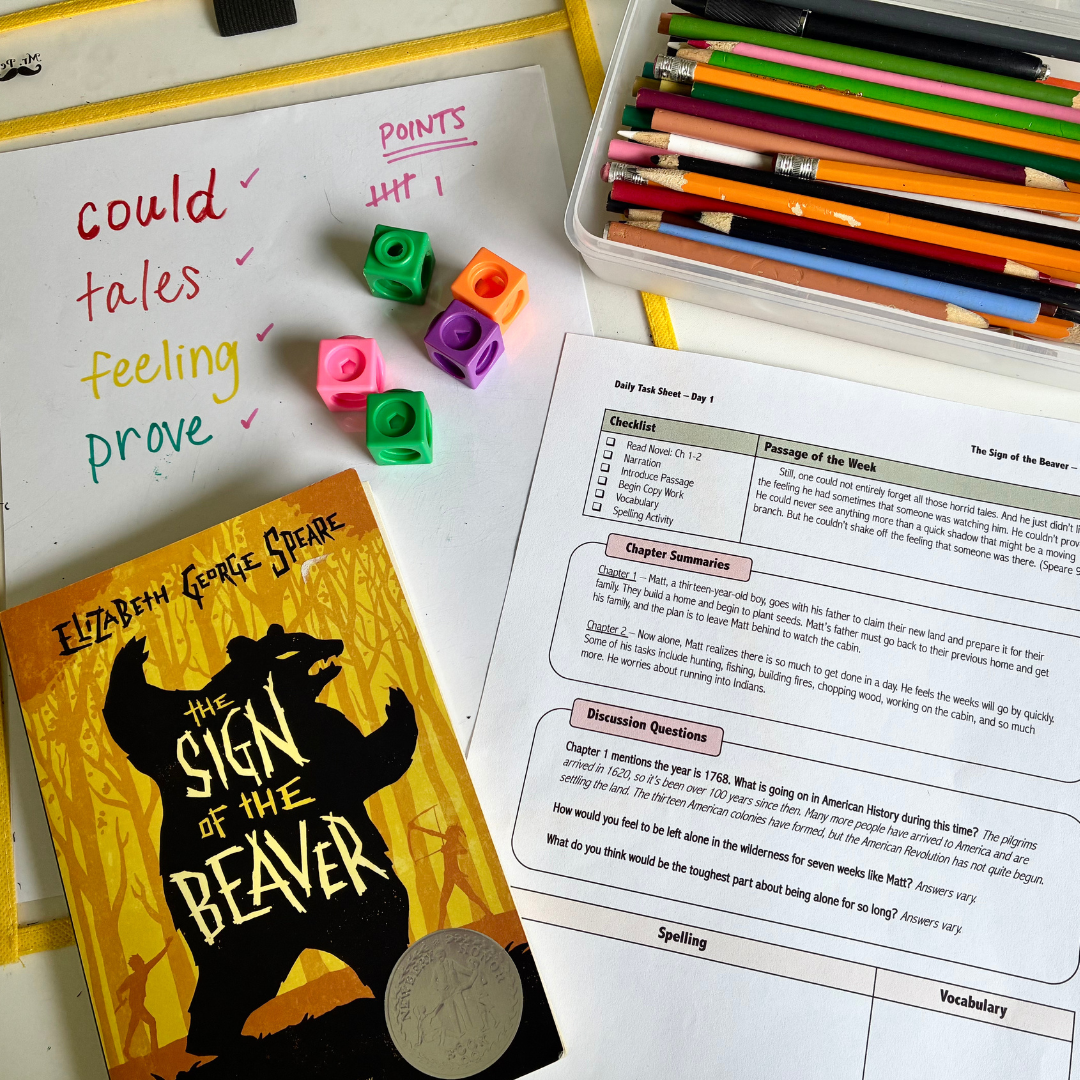
If you would like to see a video of this particular novel study sample for “The Sign of the Beaver”, you can check out this link where I share more details. You can also see a complete look-through of one of the first studies I published. This will give you a better idea of all of the information and resources that come with the novel study. The novel studies have been updated since then and look much nicer now, but the content is still the same.
Language Arts Overview
Included in this sample is the “Language Arts Overview” page where I break down the subject explaining exactly what it is and how this novel guide meets the criteria for the subject. A clear and simple chart will show you this evidence.
Language arts can be so overcomplicated in our minds, but by breaking it down and understanding what it is, we can get a better idea of how a novel can truly allow us to study the subject in its entirety.
What age is this novel study for?
These novel studies were created to be for the whole family. I’ve used them in my own home with one of my six year olds all the way up to my eleven year old. All of your kids will enjoy these novels, and the activities and work that are included are made to be able to adjust for different levels. If you purchase a novel study, I include the steps to walk you through this entire process in detail.
Weekly Pattern
Each week follows a pattern. Your daily tasks will look very similar (reading, discussion, narrating, copy work), but we will rotate an additional activity each day. This makes scheduling easy, and it allows you to loop different language arts skills for better focus instead of cramming everything in to an all-in-one lesson. The looping looks something like this:
Day 1: Spelling and Vocabulary
Day 2: Grammar
Day 3: Enriching Literature and Writing
Day 4: Dictation and Bonus Activity
Let’s take a look at each day. As I describe each of these activities, you will have a better idea of how to use the free sample provided in this blog post.
Spelling
On the page labeled, “Spelling and Vocabulary Samples”, I have provided a couple of pre-made spelling lists. Multiple options are provided to help differentiate the words for the level of spellers you have. This is just an example to help you get started. You are encouraged to pick whatever words best suit your children. The words/list you choose can be recorded in the chart on the daily task sheet.
On the day one task sheet you’ll notice “Spelling Activity” is listed. I’ve got you covered with options for this. Practicing the words can be as simple or as hands-on as you’d like. In this sample, I have provided you with multiple spelling activities to try with your family. Some are extremely simple. Others are a little more involved. The great thing about this is you can do what feels right for your week.
As you practice the words, make a note of the ones your kids know well and the ones they don’t quite have memorized yet. This could be a simple checkmark next to the word in your spelling chart. Then, each day after that, remind them of these words. Have your child practice the missed words throughout the week. Spend about a minute or two each day reviewing the words that are needed. The final spelling assessment will be in their dictation.
Vocabulary
Optional vocabulary words are chosen for you in the “Spelling and Vocabulary Samples” list. Once again, you have the option to choose the best words for your family. We aren’t doing matching worksheets or flash cards. Instead we will focus on meaningful discussion the whole family can participate in. When you read the weekly passage aloud to your children, this discussion will come pretty naturally. A discussion might look something like this:
Ask your child, “What do you think ____ means?” It doesn’t have to be a formal definition. Sometimes my child will describe to me with motions or sounds and then try to explain herself. Let this be casual. If she knows it well enough, move on to the next word. If not, move to step two.
Next say, “Let’s look at the sentence and see if it can give us some clues to make a guess on what ____ means.” Read the sentence again that includes the vocabulary word. Then, encourage your child to make a guess.
If the child is still not able to come up with a definition that is close to the real thing, look it up in the dictionary. This is a great way to practice dictionary skills. Sometimes you can even practice the process of looking it up on a phone or computer.
Grammar
There are many, many grammar lessons that can be taken from a passage. Throughout the guide I will provide you with one grammar focus on day two of each week. You have the option and are encouraged to practice more grammar, if you desire. In the full novel guide, I provide you with detailed information about grammar studies and how to engage in meaningful grammar lessons while practicing passage study.
In my home, we also enjoy using a grammar review workbook alongside these novel guides. We have used Fix it Grammar in the past and now we use Easy Grammar. (See this video for details) The novel passages give us more opportunity to review what we have learned in those workbooks and see it in a more meaningful way.
Enriching Literature and Writing
On day three of the week, a picture book is chosen for you to read aloud to your children. This particular book will teach a little science as we learn about the life cycle of bees.
I encourage you to check your library for this, but I will mention that it’s also read aloud on YouTube HERE. This picture book is an enriching option that provides your children with an exciting story related to the novel, and it will allow you to stretch your novel study across multiple subjects.
I also use these picture books to practice written narration with my older children. Written narration has been such a beneficial practice in our homeschool (watch this video to hear more). Once I read the story, my oldest child will write a narration about the book.
Dictation
Dictation happens on the fourth day of the week, and I have provided you an option to help your younger writers in this process. Not all of your children will be ready for dictation yet, but those that are can complete dictation in two different ways.
The first option is for your beginning writers. I have provided you with a fill-in-the blank dictation option that uses a shortened passage and contains the spelling words from one of the spelling lists.
The other option is a full dictation where your child will write down the passage as you read it out loud. Feel free to dictate just one or two sentences, especially if you’ve never practiced dictation before. If you have a strong writer, you could try dictating the entire passage.
The copy work will match the weekly passage. You have multiple options when assigning copy work in order to best meet the needs of each of your children. In this sample, I have included the shortened copy work as well as the full passage.
The goal of the copy work is to finish it by the end of the week. It may not take that long, but I challenge you to encourage your child to go slower with their best effort. I like to give short and sweet daily copy work assignments with the reminder that it has to be their best writing. In my experience, these short bits of copy work assigned over the week turn out much better than long, daily assignments.
Download the Novel Study
You can access the free sample to this novel study at the end of this post.
If you enjoy this first week and you’d like to complete the novel study as a whole, you can find the entire guide here. This guide will include much more information about the DIY method and will even teach you how to take any novel that you choose and use these same patterns! The how-to guide is GOLD! You’ll learn so much about language arts and the simplicity of a good novel study.
There are multiple novel studies available and more coming soon. To see more novel options, click here.
Picture Book Studies for Grades K-2
If you like the idea of book studies in your homeschool, check out my new picture book studies for your younger ones. These one-week units focus on one beautiful picture book and provide you with a passage for the week. This passage will allow you to practice copy work, spelling, vocabulary, and grammar.
Each week also includes an outdoor activity as well as an optional bonus activity at the end of the week. These book studies are so much fun! Use them for one week or grab a themed bundle for the month!
Have you been wondering if you could teach language arts without a workbook in your homeschool? It seems do-able and much more inviting than opening a workbook each day. Well, I’m here to tell you – you CAN! And it’s so freeing and fun! It can completely change the attitudes of this subject in your home, in the best way!
A few years ago we did just that. I was having the hardest time teaching language arts, mostly because it was boring and the workbooks really felt like a chore to get through. Add the fact that I have multiple students to teach, and it really just wasn’t great for any of us!
This is when I began to research passage study and novel-based language arts. There are multiple curricula options available to walk you through something like this, but I still was looking for even more freedom. That’s when I started practicing and using the term “DIY Language Arts”
This post contains affiliate links. If you follow one of my links I earn a small commission at no extra cost to you. Thank you for supporting my blog!
What is DIY Language Arts?
As I mentioned in the introduction, over the past few years I have been passionate about letting go of an all-in-one language arts curriculum. They are great for pacing and consistency, but most of the time we found them to be boring and repetitive in our home. I want my children to love literature and since it is such a huge part of language arts, it’s important to me that we all find enjoyment in learning about it. Otherwise, in my experience, reading becomes more like a chore.
Using this DIY (Do-It-Yourself) method of language arts, we have been able to have so much more freedom, letting go of the workbooks and instead choosing what we learn based on passages from great novels.
Choose A Novel
First, we choose a novel we want to read and all of our studies come from passages in that novel. One passage per week is how we started. The novel works around our schedule, making it so much more enjoyable than trying to fit a novel and chapters into certain time frames. Since all of the passage studies revolve around the novel, it becomes simple to plan and inexpensive to purchase. We can almost always use the library to collect books.
Passage Study
As we read, I choose a passage from the upcoming chapters each week and that becomes our focus. What’s going on? Who’s involved? What are the emotions? Next, that passage provides us with new vocabulary to discuss as well as spelling words to practice for the week. Each day, my children write portions of the passage practicing their handwriting skills and getting accustomed to reading and writing well-written sentences.
Narration + Meaningful Discussions + Enriching Literature
As we read the novel together, we practice narration and have meaningful discussions. This has allowed us to eliminate the need for busy-work worksheets and instead encourage connection and conversation about what we are reading. Through the addition of children’s literature, we can expand our language arts across multiple subjects as we relate our story to something in history or science or the arts. My older children use these engaging stories to practice writing skills.
Dictation/Assessment
Finally, through the use of dictation, I am able to assess my children and their progress from the week. I can check spelling skills and punctuation use as I dictate the weekly passage. This pattern of passage study has been educational, flexible, and honestly just much easier and enjoyable than completing a workbook every day.
Family-Style
This method of language arts works for my whole family! Currently my school-aged kids are 6, 9, and 11. We love that we can do language arts all together. With simple adjustments to copy work and spelling lists, each of my kids can participate in this study, making planning and time management so much easier in our homeschool!
New Guides Available
After doing this for a few years and forming rhythms, I’m so excited to share what I have learned with you all. Recently I created DIY Language Arts novel guides where I walk you through a complete novel PLUS I share with you the research and strategies I use to put something like this together. My goal is to help you be able to DIY your own language arts in your home whenever you choose. It’s freeing and FUN! The newest guides are linked below:
If you are familiar with passage study or if you do something like this style in your own home, then you may enjoy the new Passage Study Charts. These charts break it down so simply providing a passage, sample spelling and vocabulary lists, chapters to read for the week, and weekly enriching children’s literature. This simple chart is perfect for someone who loves a little more freedom but wants decisions made already!
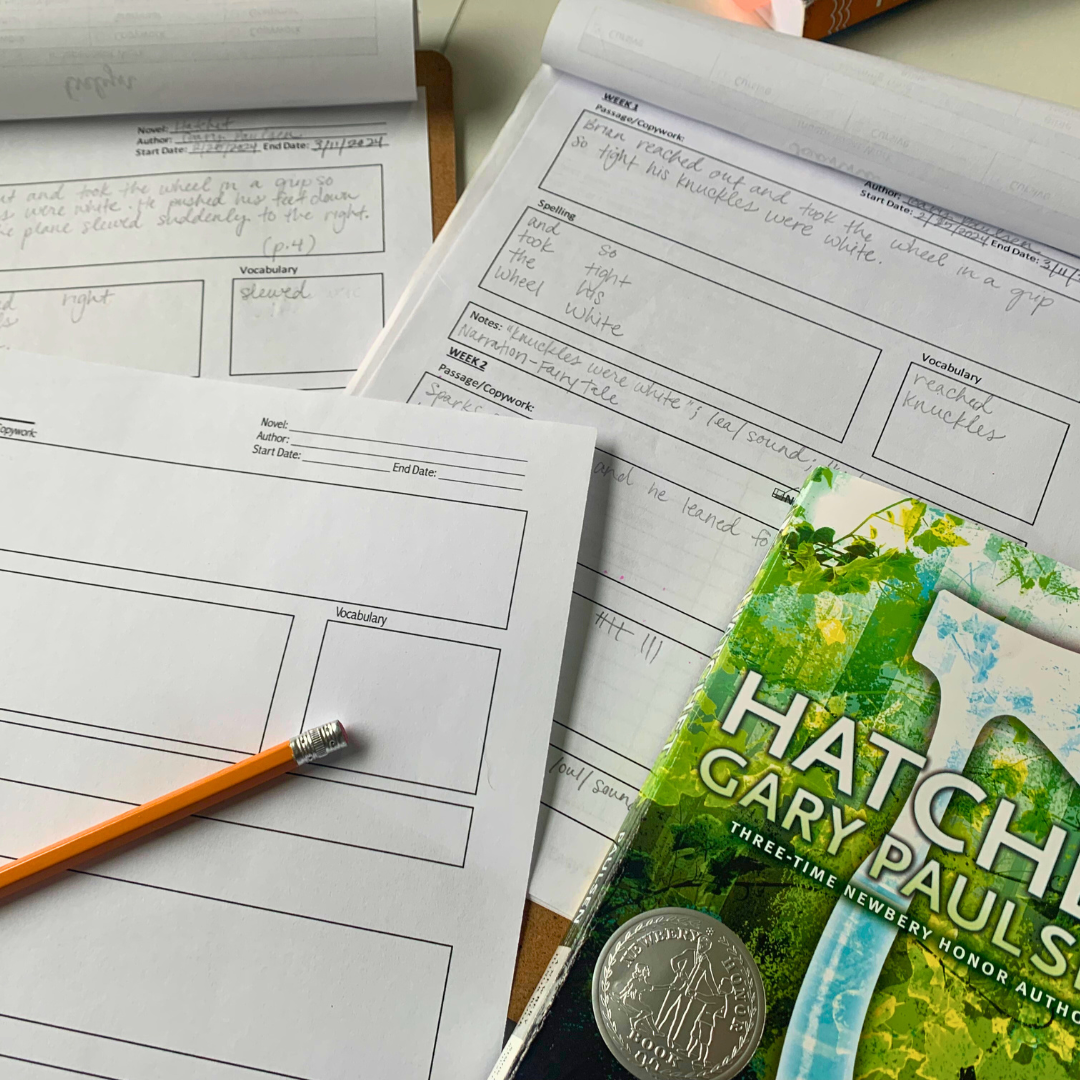
Ready to plan your own? Before I made the guides, I used a simple template (pictured above) to help me organize and plan our passage study. By making quick notes at the beginning of the week, decisions were made and the process of studying the passage became easier. Plus, it doubles as a great record for our novels and how we have used them throughout our school year. This is a FREE template! Get yours below.
I’ve done a lot of research on the different pieces of language arts and what it ACTUALLY is. I honestly think the subject gets over-complicated and as a result we end up with endless worksheets and exercises that feel more like busy work than meaningful education.
Imagine if your language arts could suddenly feel like a little book-club in your home. Book after book you can make connections, expand your learning across multiple subjects, learn from character experiences, and MORE and you study language arts as a family. This method simplifies the process, makes learning meaningful, and truly creates much better connection than a workbook.
I hope you’ll give it a try! If you do, share it with me here or on social media (@simply.learning.together). I love chatting about this so if you have questions, let me know. I also have multiple videos on YouTube sharing our experiences with this over the years:
I absolutely LOVE adding literature to our homeschool studies. Recently we completed our study of American History using nothing but picture books! It was amazing! And so much fun! Check it out here:
This Winnie-the-Pooh novel unit has really brightened up our language arts. The way it is set up has given us a sense of freedom and fun in our homeschool routine.
This method of language arts is new to us, but we love it so much. I actually break down the entire process in another blog post that I will link here. I highly suggest you read through that first as it will help the rest of this post make more sense.
In this post, my goal will be to give you specifics about our studies and schedules for this particular book, Winnie-the-Pooh.
This post contains affiliate links. If you follow one of my links I earn a small commission at no extra cost to you. Thank you for supporting my blog!
Winnie-the-Pooh
When I first heard that this was a great family read aloud, I ignored it. I thought it was going to be baby-ish and that my kids wouldn’t be interested. However, I was gifted the series from my husband’s grandmother and needed a good, living book to try this new method of novel unit out. Since we had it on our shelf, I went for it.
WOW! Was I wrong! This book was one of the most adorable books we’ve read together. We giggled in every chapter and didn’t want it to end. It’s the sweetest, and it made this unit all the more special!
The goal in reading this book was to try to get through a chapter a day. There are 10 chapters total, so we were able to finish the book in two weeks. I didn’t always read a whole chapter in one sitting. Sometimes I broke it up and read some at night and the rest in the morning. I have a couple little ones and longer chapters are harder to sit through. Breaking it up helped some days!
Unit Schedule
The following is a brief outline of what I hope to accomplish each day with my child. For more details on each piece, be sure to read my explanation post.
In this post, I am going to focus on Winnie-the-Pooh and will share the passages we studied and how we broke them down each day in case you’d like to try the same sort of method.
For a VERY brief overview – We read aloud as a family at different times in the day. For daily grammar, my daughter uses Fix it Grammar. I love that it can be done independently and takes about 5 minutes to complete. Copy work is also completed independently (5 minutes). I set a timer for our actual language arts lesson for 20 minutes.
DAY 1
Read novel and narrate [whole family]
Grammar Workbook [independent work]
Copy work – complete 2-3 lines of selected passage from novel [independent work]
Study passage – focus on grammar [language arts lesson with parent]
DAY 2
Read novel and narrate [whole family]
Grammar Workbook [independent work]
Copy work – complete 2-3 lines of selected passage from novel [independent work]
Study passage – focus on spelling and vocabulary [language arts lesson with parent]
DAY 3
Read novel and narrate [whole family]
Grammar Workbook [independent work]
Copy work – complete 2-3 lines of selected passage from novel [independent work]
Written Narration [language arts lesson with parent]
**Option – review passage/spelling words if necessary
DAY 4
Read novel and narrate [whole family.]
Grammar Workbook [independent work]
Copy work – complete 2-3 lines of selected passage from novel [independent work]
Dictation [language arts lesson with parent]
DAY 5 (OPTION)
Read novel and narrate [whole family]
Silent Reading (15-20 minutes) [independent work]
Narration [language arts lesson with parent, about 5 minutes]
Passage Selection – Week One
I selected two passages to use for our copy work because it took us two weeks to read the book. Each week, we studied one passage during our language arts lesson time. Next, I will share with you how we study these passages throughout the week.
“He was getting rather tired by this time, so that is why he sang a Complaining Song. He was nearly there now, and if he just stood on that branch…Crack!” (Winnie-the-Pooh, A.A.Milne)
On the first day of our schedule, we focus on grammar and punctuation. The following is what we discussed for this passage:
Capitalize the first letter in a sentence and choose the correct end mark.
A comma and a conjunction can join two sentences together. (Conjunction Junction, what’s your function? — Are you singing yet?)
Complaining Song is capitalized by the author – Why? It’s possible he wanted to make it more official or to make it a title of a song. (Poetic License/Author’s Choice)
The “…” is called an ellipses. It encourages the reader to pause.
“Crack!” is italicized for emphasis, an exclamation point adds volume in this case. For fun, we also discussed what onomatopoeia was.
As we study these topics we might practice different examples on the board or practice them orally, if possible. This might seem brief, but as you discuss each one with your child and provide alternate examples or even just look for more examples in the book, the time will go quickly.
Spelling and Vocabulary
For our second day of lessons, we are still using the same passage. This time we focus on spelling and vocabulary. I first ask my daughter if she knows what certain words mean based on the context. If we need to, we look them up in the dictionary.
The vocabulary words we looked at for this passage: rather, nearly, complaining
For spelling, I quiz her with many of the words from the passage and see which ones are mastered and which ones need practice. I have her write them on a board. You can make this list based on your child’s needs, but our list looked something like this: getting, rather, tired, why, complaining, nearly, there, stood, branch, crack
Any word spelled incorrectly we practice a few times. I will also try to quiz her the following day as well to see if she can remember the word(s) she missed.
Passage Selection – Week 2
Week two follows the exact same schedule, just with a different passage. So for this section, I will list the passage as well as what we studied to go along with it.
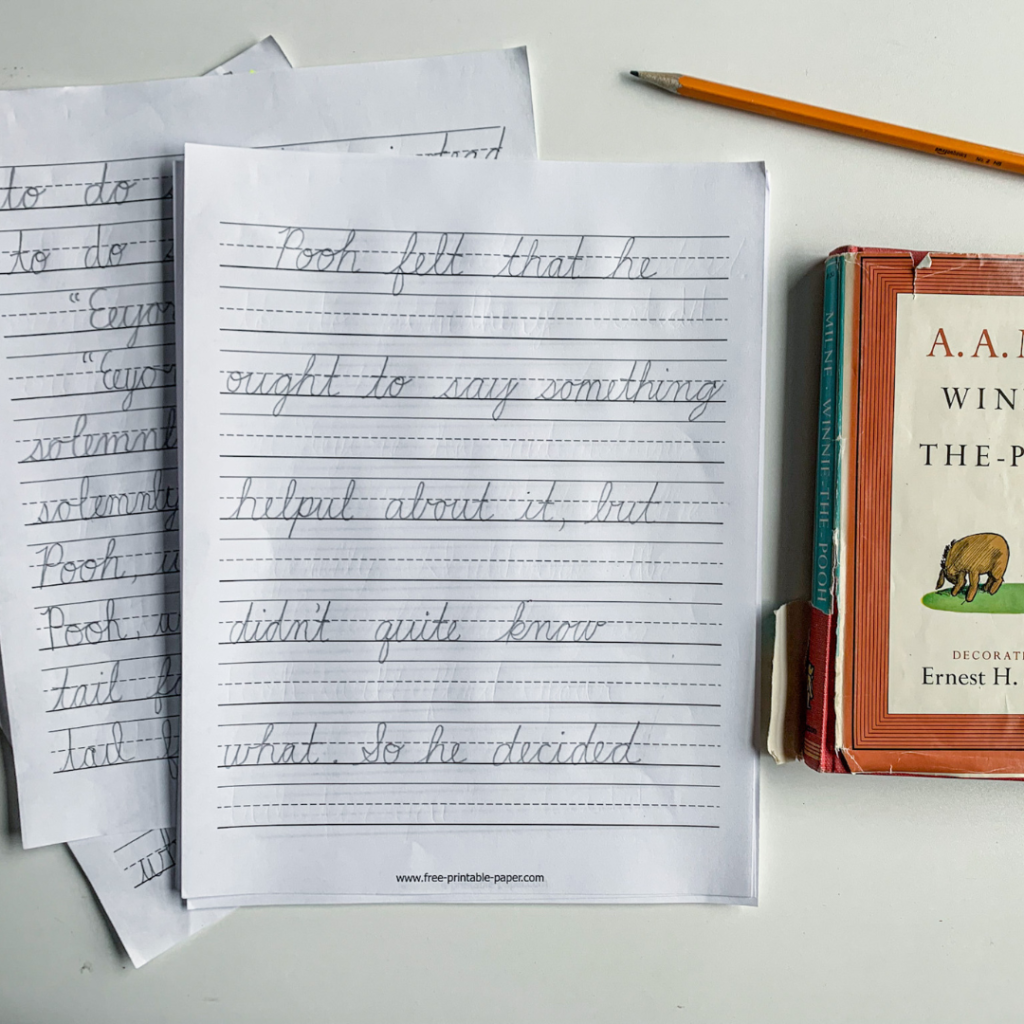
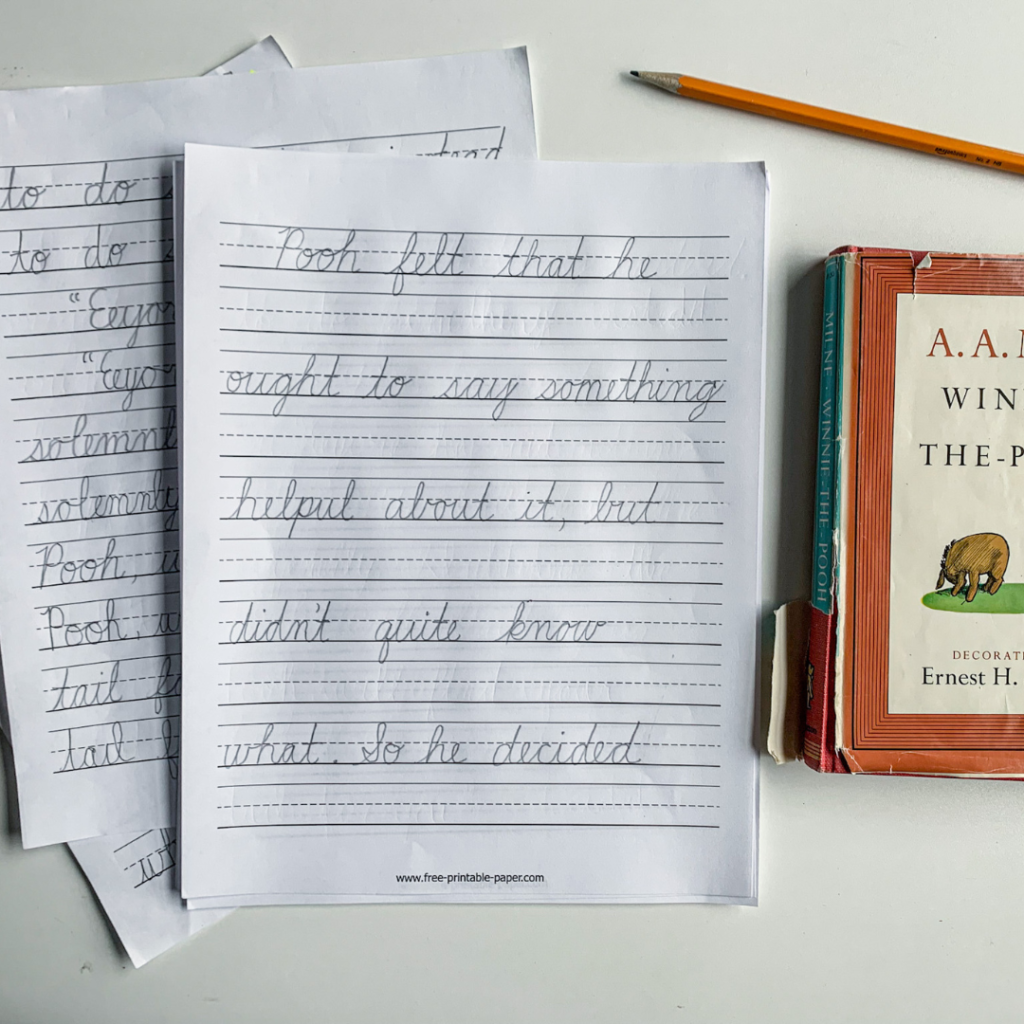
“Pooh felt that he ought to say something helpful about it, but didn’t quite know what. So he decided to do something helpful instead.
“Eeyore,” he said solemnly, “I, Winnie-the-Pooh, will find your tail for you.” (Winnie-the-Pooh, A.A. Milne)
On the first day we discussed the following:
Capitalize the first letter in a sentence and choose the correct end mark.
Didn’t is a contraction – did not. We practiced writing other contractions.
A new speaker starts a new paragraph, indent.
A comma is placed after “Eeyore” to separate the quote, but we also discussed direct address.
Always capitalize “I”.
Winnie-the-Pooh is surrounded by commas because it is information that is not essential to the sentence.
Quotes go around what the character is saying.
Now, if you wanted to simplify this even more, you could only focus on what connects to your grammar workbook. Point out what you’ve studied so far, and that’s it. That way it’s consistent between the two. However, I enjoy looking a little deeper than that. There are times when I don’t really know why a comma is there, and I just look it up online right there with her. That’s what it’s all about – learning together!
Spelling and Vocabulary
On the second day of our week we look at spelling and vocabulary from the passage. The spelling words we practiced were as follows: ought, something, helpful, about, didn’t, quite, know, decided, instead, solemnly, tail.
The vocabulary words we studied were “ought” and “solemnly”. Don’t forget to use context clues first, and then try the dictionary.
Optional Grammar Activity
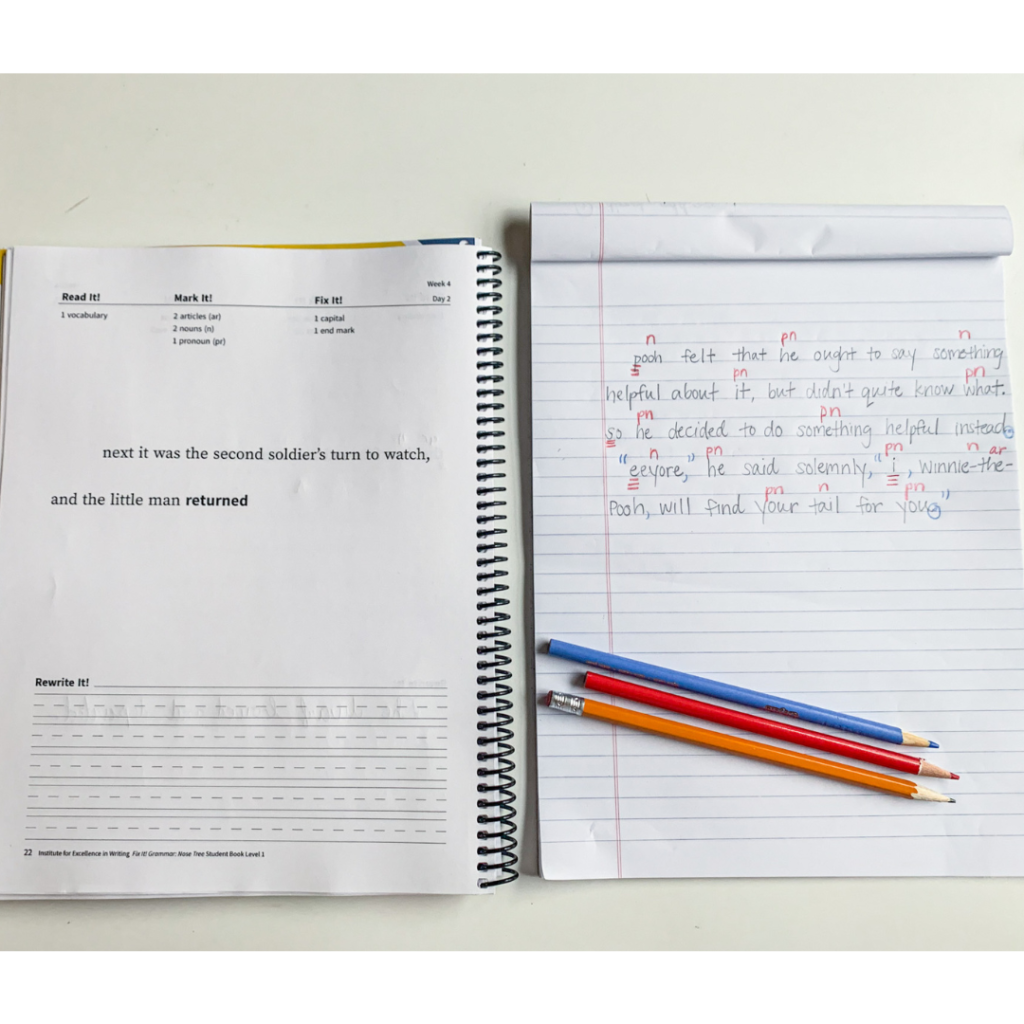
Usually on our spelling and vocabulary day we have extra time. I like to switch out her Fix it Grammar page with a little something different. We use the exact same methods she is practicing in her workbook but we apply it to our passage instead.
Here’s an example. In her Fix it Grammar book she is currently marking words that need to be capitalized, end marks, nouns, articles, and pronouns. So, I wrote the sentence on the board and had her do the same thing to our passage. It worked out great! I’ve snapped a picture (above) of an example for you to see.
Honestly, you could do this with any grammar workbook. If you are practicing adjectives, find the adjectives. If you’re underlining the subject once and the verb twice, do the same here. See if you can combine your grammar book with your novel one day – It makes the workbook feel relevant!
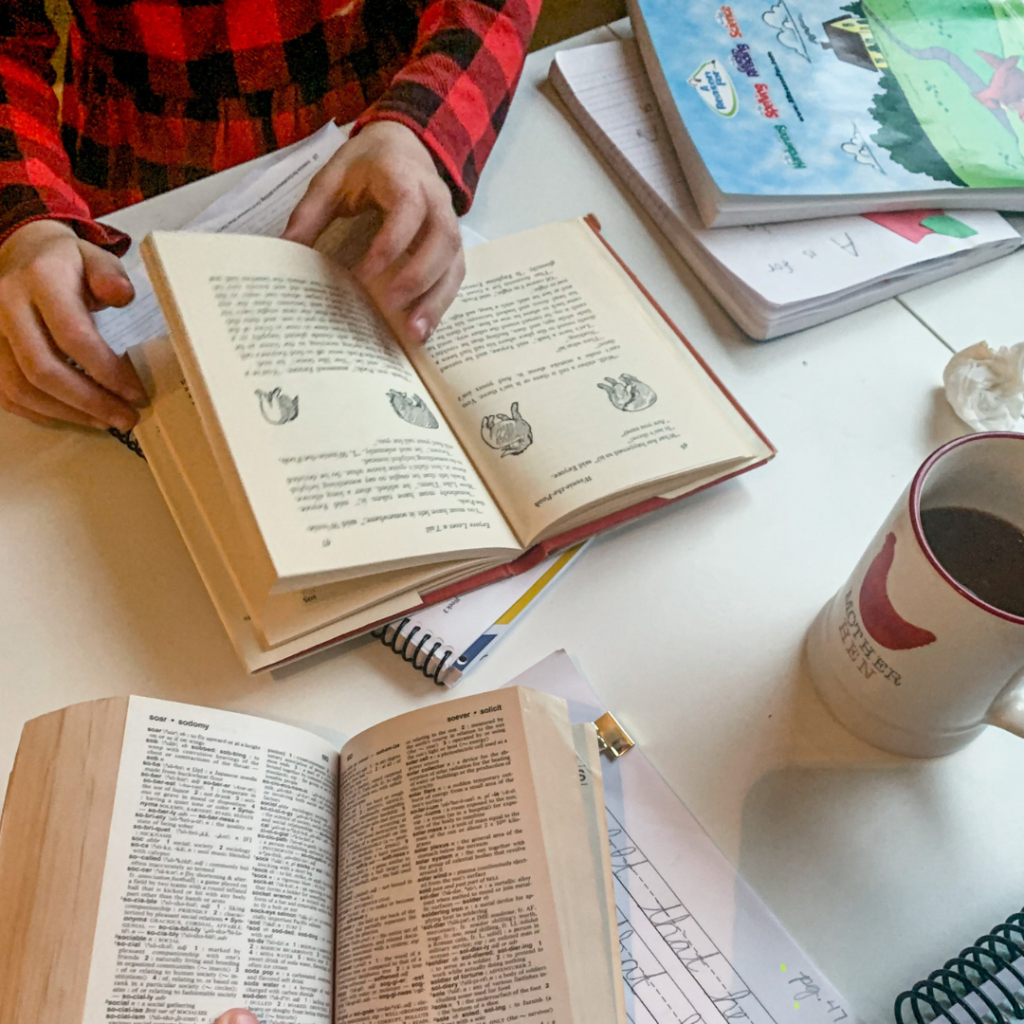
I’ll admit, there were a couple words I wasn’t sure about (yay for learning together!). The dictionary was very helpful. Find the word that matches the context of what you’re looking for and the dictionary lists the part of speech. So, if you see something off in my photo, blame Webster 😉
Ready to try it?
Does this sound like something you would enjoy? Sometimes it’s hard to explain what goes on in this crazy head of mine, but I hope that this explanation simplified the process for you. Isn’t it freeing to just read and chat about a book with your children? That’s what I love the most about this. Besides our daily grammar practice, there’s no workbooks, no busy work, just beautiful book discussion.
Want to see more novel units like this? We are starting another soon, and if this is helpful, I’m happy to break it down like I did with this one. Let me know in the comments or reach out to me on social media (Instagram: @simply.learning.together)
When I first started learning about the Charlotte Mason method, which is what inspired this study, I was nervous about the no-workbook-factor. Having a consistent plan like this with certain goals has really given me the confidence that a typical curriculum workbook doesn’t have to be necessary if it doesn’t bring you joy! It’s been so freeing to be able to study language arts through the books that we love!
NEW Novel Guide Available
For the last few years, my children and I have used this novel-based language arts program that is family-style and enriched with great literature each week. I’m so excited to share a NEW guide with you on how we do this in our home. If you’re tired of an all-in-one language arts workbook or if you’re itching for a great novel to read aloud to your kids, you’ve got to try this method! Below are two of the newest guides available now:
(Mostly) Workbook Free! Did that reel you in? 😉 Well, this whole method was inspired by my research but also a desire to get rid of the workbooks! They were making me crazy…and bored! However, I have found it important to continue daily grammar practice. That’s where the workbook comes in. Even still, this new method has been such a breath of fresh air for us! I’m so excited to share. Let me tell you a bit about how we got here.
After Christmas, we kicked off the year with a fantastic history unit on the Vikings. We were having so much fun learning, but it would come time to sit down for language arts, and I dreaded it! I finally said to my husband – I can’t stand language arts workbooks. I’ve tried multiple workbooks over the years, and it never fits our family quite right. I just want to study language arts through what we are already learning in history or science.
Well, it wasn’t long after that, I was led (by prayer I’m sure of it!) to a post or a quote that mentioned Charlotte Mason, which I was pretty unfamiliar with at the time. Well, one thing led to another and suddenly I was listening to every Charlotte Mason podcast I could and reading all the info I could find online. I was fascinated by the methods, but nervous to commit.
Then, I came across a brand new book called “Modern Miss Mason” by Leah Boden, and it inspired me in the most beautiful way – WOW! I can’t recommend it enough. Her book encouraged me to learn the philosophies of Charlotte Mason but then to apply it to our homeschool in a way that suits are family well.
My point in all of this intro is to let you know that this novel unit is inspired by what I learned from studying Charlotte Mason’s methods. (I still have so much to learn!) It may not follow her philosophy exactly, but the whole process has brought my family (especially me) such a sense of joy, and I am certain that is what matters most. This unit has given me a freedom that makes language arts interesting for us again, and I hope if you try it that it may do the same for you.
Now, before I continue, I should mention that you could probably adapt this unit a little bit to use for any grade you’d like. My child (that I created this for) is in third grade, but I planned all of the lessons according to what she has already learned and what she is learning in her grammar book (More on that later). You can do this too, and I hope my breakdown of this method helps you see the simplicity that I see in that. I encourage you to continue reading no matter the grade level.
This post breaks down the actual process of putting this unit together. Definitely look through the detailed descriptions of each piece below first, but if you want to see a unit in action, check out our first novel unit like this, “Winnie the Pooh” (the book is so adorable!)
This post contains affiliate links. If you follow one of my links I earn a small commission at no extra cost to you. Thank you for supporting my blog!
Language Arts
From all of my research, I came up with the following list of what I wanted to include on a regular basis for my daughter’s language arts.
Good (living) book
Narration
Daily Grammar
Copy work (to practice Handwriting, Grammar, Spelling, and Vocabulary)
Written Narration
Dictation
As I go through this unit, you will see these pieces incorporated throughout. If you’re interested on where I’m learning about all this, I’ll leave a couple links for you here. (I listened and read so much! But these two sources stick out to me the most) Simply Charlotte Mason, and the Charlotte Mason Show Podcast.
Novel Unit Schedule
I’m going to outline the schedule of this unit, because I want you to see the simplicity of it – at least, I think it’s simple, and I hope you do too! Think of the lists you see as a checklist for the day. Each day of language arts requires about 5-10 minutes of independent work from your child and a 20 minute lesson with you, the parent. You’ll also be reading aloud at some point in your homeschool day, but I don’t really count that. Reading great books together as a family doesn’t feel like school for us. (We’ve read at bedtime and/or our morning time for the last couple years, and it’s been wonderful)
It probably won’t make any sense at first, but if you read further, I explain each piece of this schedule in my post.
I will put in the schedule to read each day. You can time it as you please. We read every day, whether it’s a school night or not. Our normal homeschool schedule is four days a week, but on the occasion that we are home on Fridays, I will mention my plan for that day as well.
DAY 1
Read novel and narrate [whole family]
Grammar Workbook [independent work]
Copy work – complete 2-3 lines of selected passage from novel [independent work]
Study passage – focus on grammar [language arts lesson with parent]
DAY 2
Read novel and narrate [whole family]
Grammar Workbook [independent work]
Copy work – complete 2-3 lines of selected passage from novel [independent work]
Study passage – focus on spelling and vocabulary [language arts lesson with parent]
DAY 3
Read novel and narrate [whole family]
Grammar Workbook [independent work]
Copy work – complete 2-3 lines of selected passage from novel [independent work]
Written Narration [language arts lesson with parent]
**Option – review passage/spelling words if necessary
DAY 4
Read novel and narrate [whole family.]
Grammar Workbook [independent work]
Copy work – finish copying selected passage from novel [independent work]
Dictation [language arts lesson with parent]
DAY 5 (OPTION)
Read novel and narrate [whole family]
Silent Reading (15-20 minutes) [independent work]
Narration [language arts lesson with parent, about 5 minutes]
Read Novel – A Good (Living) Book
Give me all the books! I love reading to my kids, and I especially love coming home with a bag full of books devoted to a unit study. This whole year, we have done all of our science and history using books from the library, and it has been the most wonderful time.
I tend to just get what the library has available, which I think is fine! Lately, I’ve been trying to be a little bit better about thinking ahead and finding good, quality literature. I might put a few books on hold or visit my local used bookstore. The effort has been worth it. Having good literature makes our studies come alive and become more enjoyable.
What is a living book? Well, that’s a good question. It’s a hot term in the Charlotte Mason world, and it honestly intimidates me a bit! So, here’s the method I use when choosing a book. Do I enjoy reading it? Is it helpful to our studies? Does it add something positive to what we are learning? Will my kids find it fun/interesting?
These are just a few questions I’m thinking about. This article breaks down the definition of a living book in an easy-to-read list. I find it very helpful, but I’ll be honest, my kids and I enjoy a good Magic Treehouse book here and there…is that “twaddle”? Maybe…but remember…my hope here is to do what’s best for my family, and we like it sometimes! So I encourage you to find books that your family enjoys too!
I mentioned this earlier, but we read our novels at bed time usually. We also have a time to read aloud during our morning time. When we read, it’s with all my kids, and it’s not part of our lesson time. What’s great about this is each child is benefiting from the literature, and my little ones are even practicing narrating as we do it. Whole family learning is my favorite!
Narration
I am new to narration, and I don’t know if I do it the “right” way, but I do it in a way that feels right for my family. (Are you catching a pattern here? Every family is so different, but what a blessing it is to have the freedom to adjust as needed, according to our family interests) Every time we read something we talk about the book together. Sometimes it’s in the middle of a chapter, sometimes it’s at the beginning, sometimes it’s at the end of our reading.
For this new language arts method, I made sure to encourage my children to talk more than we usually do. I wanted to be intentional about our book conversations. If I just say “tell me back what happened”, they look at me confused. So I usually start them off with a question or two to get them going.
So, what happened at the beginning of the chapter? What was your favorite part? What problem did they run into? How did they solve it? How do you feel about that character’s choices? I don’t ask every question every time, but this is just an example of what gets us started talking. Both of my school age girls participate in this daily book discussion.
There’s a lot more to narration than this, so if this is new for you as well, I encourage you to look into it further. (Check out this site)
Daily Grammar
We recently added Fix it Grammar to our homeschool day for my third grader, and I love it. I will link the product for you (not affiliated) if you want to learn more about it. It takes my daughter about 5 minutes a day to do this, and she can complete most of it independently.
She does this work daily, which gives me a boost of confidence knowing she is getting consistent practice. If you are looking into doing a unit like this, any grammar workbook can be used! Earlier this year, we used an Evan-Moor fundamentals workbook, and I feel like that could’ve been used just as well. The point is regular practice and connecting it with what you’re reading.
One of the days of the week, I like to do an alternate grammar activity instead of the grammar workbook. This usually happens on Day 2, because it doesn’t take us the whole 20 minutes to do spelling and vocabulary. We basically apply the rules of her Fix it Grammar sentences to our passage. Let me give you a concrete example.
Currently, in the Fix it Grammar books, she is labeling captalization, end marks, nouns, articles, and pronouns. She knows how to do this because it’s practiced daily. Well, one of the days during the week, we look at the novel passage and label it in the same way. This has been a great way to apply the same steps to a relevant passage from our novel. I love linking the two (grammar and novel) together.
The copy work is chosen by me using passages from our novel. My goal is to study one passage a week. This copy work will allow my child to practice handwriting, but we will also be working together to study grammar, spelling, and vocabulary through this passage.
Each week, I wrote the passage out onto lined paper, skipping every other line. (See photo) This gave her an example to follow. Each morning, during her independent work time, she would copy 2-3 lines. The goal is not to do a ton of copy work in one sitting. What does get finished must be done well, if that makes sense. This is another philosophy I am learning about from the Charlotte Mason method. Shorter lessons, better quality work. I’m finding it to be very true!
Copywork – Grammar, Spelling, and Vocabulary
This part of our lesson will vary depending on the passage, but you can see it in action by checking out one of our units.
On the first day we look at the grammar and punctuation. We go through each sentence and figure out together – Why is something capitalized? What is the punctuation at the end? Why is that comma there? When do we add quotes or indent? And so on…
I am very intentional about the passage I choose for this reason. I’m not going to pick something that has incorrect/odd grammar. I’m choosing passages I know will enhance what she’s already learning in her grammar book.
I also spend a day focusing on spelling and vocabulary. (See outline) If there are any words she is unfamiliar with, I try to have her guess the definition using the context. Then, we look the word up in the dictionary.
Next, for spelling, I quiz her on a variety of words in the passage. If she gets it right, we move on. If it’s wrong, we focus on that word for a bit and I try to remember to quiz her on that word a time or two during the rest of the week. There is no spelling test as she will be writing the words by memory during the dictation portion of our week.
Written Narration
Depending on the child’s age, your lessons may or may not include written narration. Based on my daughter’s abilities, I felt she was ready to start with my help.
One day a week, I require written narration from her. My goal here is for her to write about what we are reading. I like to help her brainstorm and figure out how to write a good narration. Eventually, I hope she will use these brainstorming techniques to write on her own.
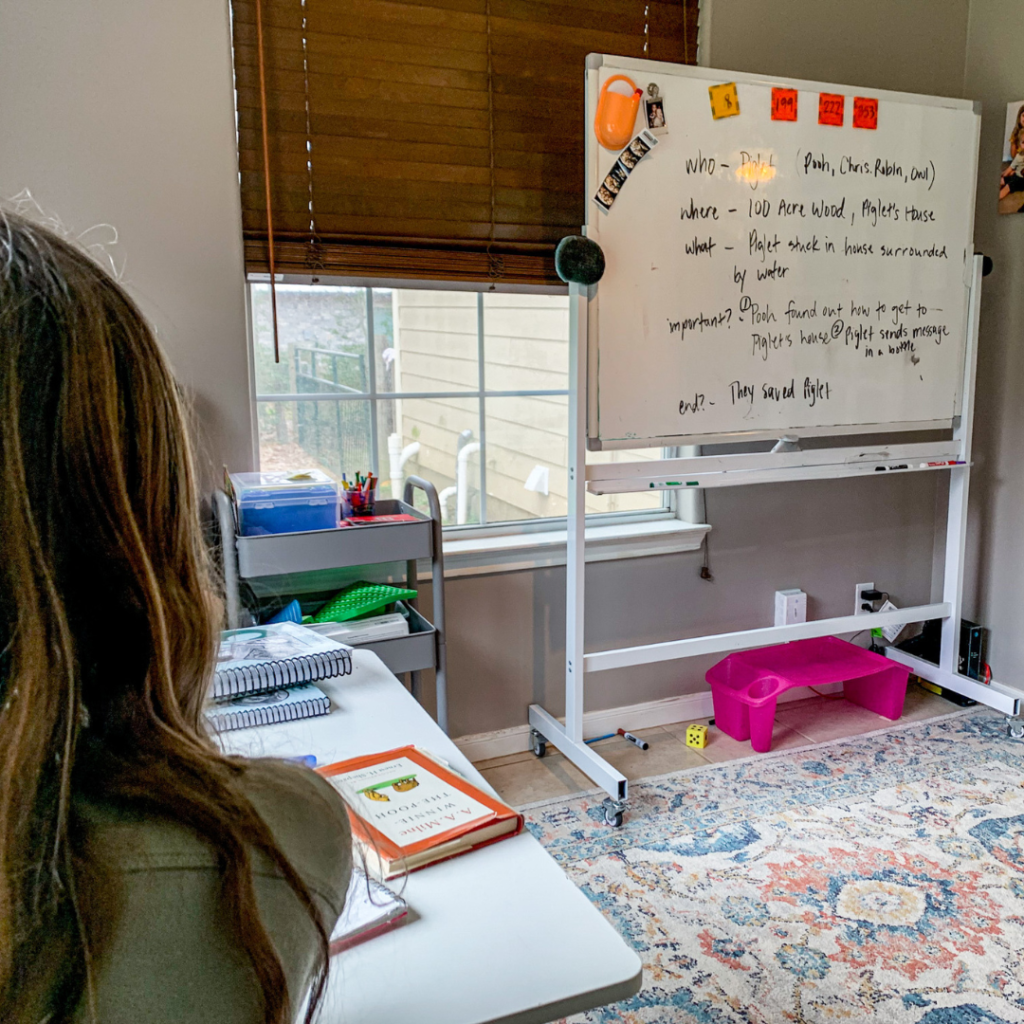
I ask her the following questions and we jot down quick notes as our answers (see photo):
Who is involved?
Where did it take place?
What happened?
Any other important pieces to mention?
How did it end?
I just made these questions up. This is not an official strategy, but we used it for both passages, and it went really well.
Once she has short notes, she begins making sentences to form a paragraph about what we read that day. The first couple times I asked her to do written narration, it was rough. However, with consistency and my help, she is starting to get the hang of it. I was so proud of the last one she did! She’s made awesome improvement.
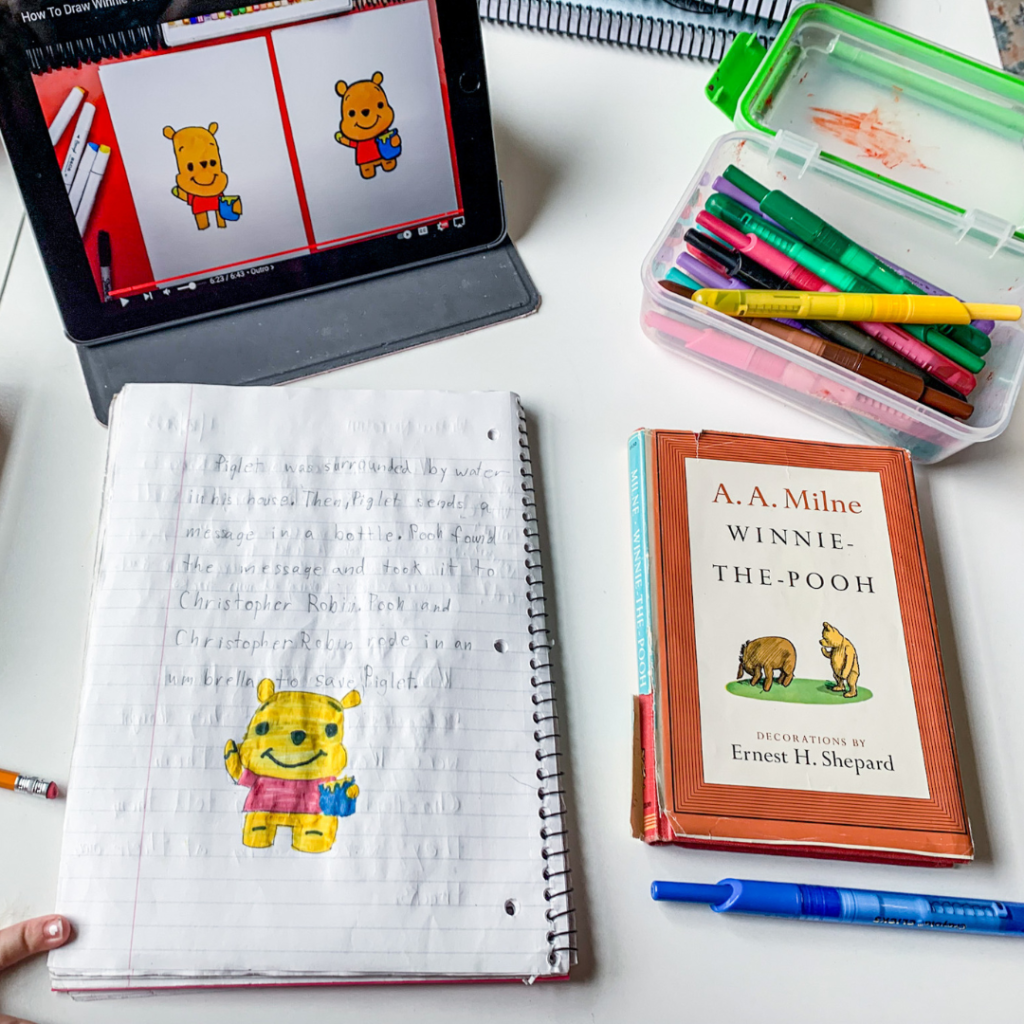
If you check out the picture below, you’ll see something else we add in for fun. As a reward for her hard work in writing, she likes to draw with Art for Kids Hub. We add it to her notebook, and it’s a cute addition to her work. (You’ll also get a peek at how she took my notes from the board in the last picture to her completed paragraph.)
I’ll admit, the hardest part of this lesson in written narration is for me to just be quiet. I always want to say things like, “Wouldn’t it sound better if…” Or, “Well, don’t you want to add…” I have to bite my tongue – a lot! It’s worth it though. I just LOVE hearing her voice in her writing.
Dictation
We’ve had practice with dictation from a couple different places. I first learned about it when we completed a Dart Guide from Brave Writer. We were also already doing it at the beginning of this year through the language arts program I chose, Learning Language Arts through Literature. I love it because it’s an easy way to assess that doesn’t feel like a test. Plus, it’s meaningful because it comes from what you are reading.
This article gives fantastic instruction, including a video, on how to do dictation. Like some of the other pieces of this unit, dictation gets easier with practice. The way we set all of this up, we study the passage Monday-Wednesday and dictation is on Thursday. By working on the passage a little bit each day, I feel like it’s a great way to set her up for success during dictation.
I was explaining to my daughter today during her dictation what a wonderful skill it was. Being able to write something and know how to add punctuation and edit it is a life skill that will be necessary her whole life – writing emails and letters, for example.
After I finish dictating the passage to her, we correct it together.
Freedom and Fun
I feel like that’s what it really boils down to here. By doing this method in our language arts, we’ve had more freedom to apply books we are already using to learn, making it more fun and interesting to actually work with.
A lot of things have inspired me to get here, as you may have read throughout this post, but I’m so thankful for what I’ve learned and how we can now find a way to do something that works so well for our family.
Have you tried something similar to this? Are you interested in seeing more units like this in the future? Let me know in the comments and be sure to sign up for my email list where I send all our updates, posts, and resources that we are using in our homeschool.
You can also catch me on Instagram @simply.learning.together If you try this out, take a photo and tag me. I love seeing your families enjoy learning together!
NEW Novel Guide Available!
For the last few years, my children and I have used this novel-based language arts program that is family-style and enriched with great literature each week. I’m so excited to share a NEW guide with you on how we do this in our home. If you’re tired of an all-in-one language arts workbook or if you’re itching for a great novel to read aloud to your kids, you’ve got to try this method! Below are two of the newest guides available now:
This is my second child I’ve taught to read, but my approach has been completely different from my first. This year we used Logic of English Foundations A to teach reading, and I’ll be sharing how it worked for us.
This is not a sponsored post. I chose Logic of English on my own and plan to share my honest opinion about it with you.
This post contains affiliate links. If you follow one of my links I earn a small commission at no extra cost to you. Thank you for supporting my blog!
Why Logic of English?
I was actually pretty stubborn about teaching reading. I did not use a reading curriculum with my first daughter, and I was certain I could follow the same path with my second daughter. Alas, I have learned that each of my children is unique and their gifts of learning vary greatly! What works for one does not always work for the other.
The summer before my daughter’s first grade year, I decided to purchase an inexpensive reading workbook to complete casually throughout the summer. As we did it together, the thought came to my mind that it was so nice to have directions to follow each time we worked instead of coming up with my own activity like I was used to.
This was my realization that a reading program would be helpful for the both of us, and I had to let go of my stubbornness. Unfortunately, these programs can get pretty costly!
Years ago, I heard great things about 100 Easy Lessons, purchased it, and didn’t really like it. I wish I would have because it costs a lot less! So, I wanted to choose between the two price-y ones I heard the most about – Logic of English and All About Reading.
Here’s Some of the Reasons I chose Logic of English:
Low prep for each lesson
Handwriting included (manuscript/cursive)
I can easily re-use it with other children (minus the student workbook)
Doodling Dragons Picture Book (my daughter would love this)
Not grade-level focused, moves at the pace of my child
Activities included are simple and follow my style of teaching
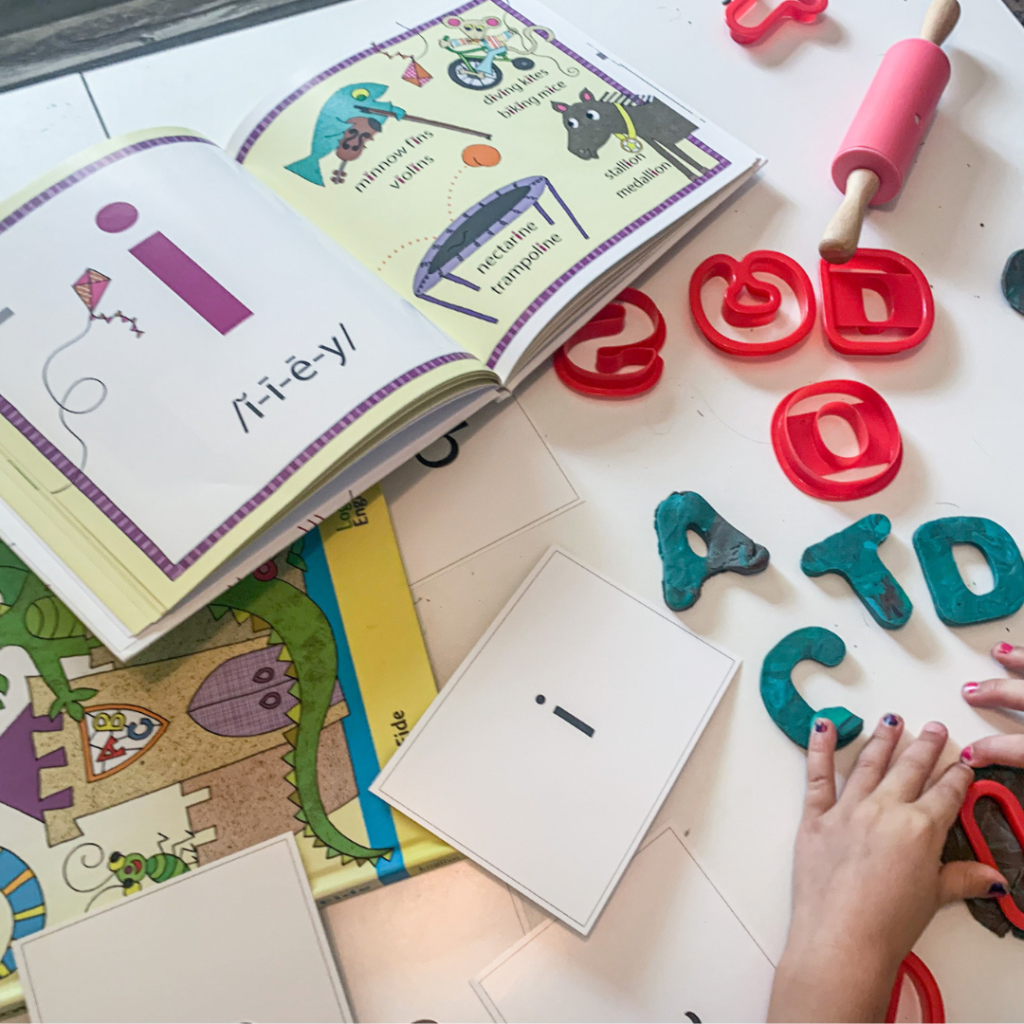
Tactile Handwriting Cards and activities for multi-sensory learning
Items Included
The Foundations A set comes with a handful of items that I will discuss in this post. To see my unboxing of this set, check out my YouTube video for a detailed look at each item.
Lessons and Assessments
Foundations A includes 40 lessons and 8 Assessments (A-H). Each lesson and assessment comes with a script for the parent to follow. With each lesson there is anywhere between 1-4 workbook pages for the student to complete. Each workbook page is very short and can be a simple as pointing at a picture.
One of the things I love about each lesson is that there are so may activities to pick from. I feel like at first this was a little overwhelming. As I get with every new curriculum, I felt like I had to do everything. After a while, I got used to the set up and was able to pick and choose things based on our own needs and schedule.
The assessments were actually the most fun! Isn’t that interesting? You assess your child using games and hands on activities, and we looked forward to each one. The assessments also made it easy for me to see what she understood and what needed more work.
Handwriting
Every lesson includes handwriting practice. Strokes and lowercase letters are introduced and there is space to practice in the student workbook. My child is not a fan of writing, and the amount of handwriting practice was perfect for her. It’s very minimal. For example, the workbook may say to write the letter a few times on your favorite line. So it’s not rigorous by any means.
The Tactile Cards that go along with the handwriting lesson are so fun. We didn’t use them every time, but my daughter loved them! It’s almost like a sandpaper feeling and it really helps learn the letters using multiple senses.
We chose to use the manuscript version. (You have the option to choose manuscript or cursive) I was happy with this choice, but I will say that the handwriting that is taught is very unique. It’s slanted and curvy, which is excellent in preparation for cursive, but it matches nothing else that we have. This would be my only negative thought about the handwriting (more on this later).
I’ve heard of many parents that skip the handwriting all together, but learning the strokes and using the tactile cards was so helpful to my daughter that I decided to stick with it. They do offer a handwriting book separately, and now that she is more confident in writing, I may add that in as practice.
Spelling
Spelling is introduced in lesson 21 and continues with each lesson after that. The lesson comes with 3-5 words that follow what you’ve been practicing, so it really sets the student up for success. I will say that once spelling was introduced the lessons felt really long. We ended up splitting them up into two sometimes three days.
Games and Activities
I love the variety of games so much. It matches my teaching style, and I think that’s why we enjoyed it. Every game option they give you uses the cards that comes with the set. So you’re never having to cut a bunch of things or laminate or find a list of supplies.
To give you an example you might practice your phonograms by hiding the cards around the room and having a scavenger hunt. Or you might lay the cards on the table and slap the correct one. They’re all just really fun and easy to do.
And there are so many!! The Teacher’s Manual provides you with a variety of games to pick from for each lesson. When you finish an assessment, there’s a whole page of ideas on how to practice different skills using the games. It’s so helpful!
Readers
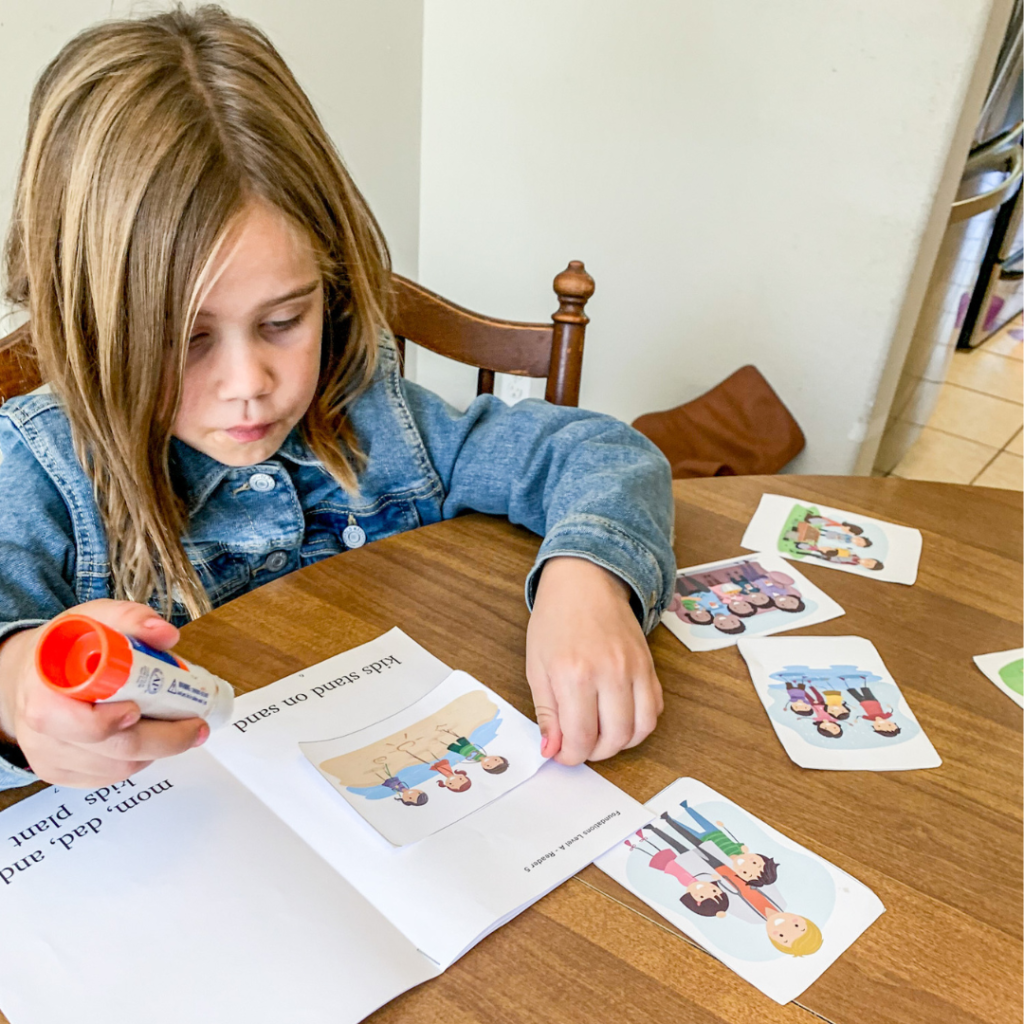
The readers are created by the students! This is the cutest thing to me. I believe there are 6 total and each one comes with a set of pictures and then a group of blank pages with the words to read. Your child reads the words and matches the pictures to each page.
There’s cutting and pasting and matching. This makes the reading so fun! Not only is the process of putting it together unique, but the pictures are so silly. We really got a kick out of these!
Doodling Dragons
This picture book has a page for each phonogram. There are silly pictures and rhymes that use all the sounds of the phonograms. It’s very cute, and my daughter loved looking at each page. On YouTube, there are songs that go along with each page as well. These were wonderful, but we usually forgot to listen to them. I believe you can purchase a CD, so if you have a CD player or like listening to things like that in the car, it may be worth the purchase.
Sometimes I think that if we would listen to them in the car, my younger kids would catch on and begin learning them as well.
The Not-So-Great Things
Can you tell we loved this? I could go on and on about how easy it was to use and how much my daughter enjoyed lessons. My complaints are so minimal, but I’ll share in order to give a thorough review.
LONG LESSONS – This was an easy fix, but it also could vary with the child. We simply split the lessons up into a couple days. The book encourages you to do this as well, but if you feel bound to a lesson number and completing one a day, that will get tougher as you work further into the book.
LOTS OF PIECES – When I received the box for the set, I was immediately overwhelmed by all of the cards and pieces that come with it. There’s a lot! So, finding a way to organize it all was key. I went with a plastic container that allowed me to keep the cards in their own box but still altogether. It’s been great!
HANDWRITING – I mentioned this earlier, but the handwriting is unique. It really doesn’t match any other writing in other books we do. So, it’s something you’ll have to decide if you want to do or not. We stuck with it, and I just plan to get their handwriting book at some point to practice.
SO MUCH TO DO – This really isn’t a bad thing, but I will say that there are so many options of things to do, and it would be very difficult to do it all. So, it’s important to look through and pick what’s best. For example, with every letter the child learns, the book provides ways to “celebrate” the letter. We never did this. The ideas were so cute, but ultimately it didn’t fit in the schedule of our family.
COST – A program like this doesn’t come cheap. It’s one of the reasons I hesitated to get it in the first place. It’s also tough because set A is only 40 lessons, and although it took us until Thanksgiving to finish (we started in July), it’s kind of a bummer to already have to spend another $100 to keep going. My hope is that the cost will eventually even out when I am able to use it for my next two kids, as well. All I will have to purchase in the future is the student workbook.
Other Random Things I Love
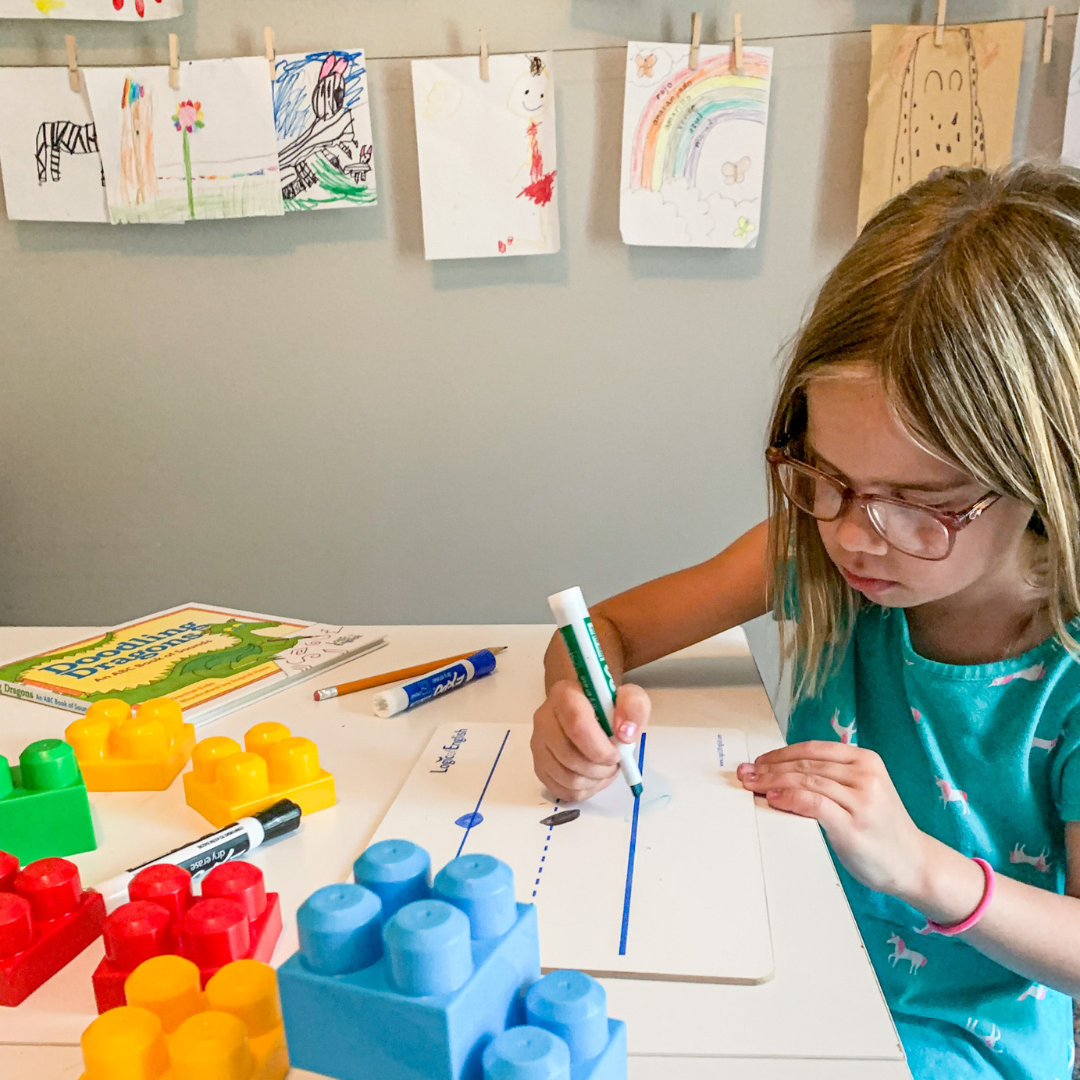
WHITEBOARD: The miniature whiteboard that comes with the set got used every day. It was so helpful and I love that it had a giant set of handwriting lines and then smaller ones on the opposite side.
MOMMY IS LEARNING: I’ve learned so much with this program. I never knew every sound of every letter. I learned about voiced and unvoiced sounds. We’ve learned things about consonants and vowels that I had no idea about. I love learning alongside my kids!
TEACHER’S MANUAL: The Teacher’s Manual is bound in a hardcover. Almost every spiral book I have ends up coming apart in some way, and this one has no spiral. It makes me happy knowing it will last through the years!
Final Thoughts
My daughter’s attitude about reading has changed so much since we started this. Her and I were both frustrated the year before this, and using Logic of English has given us so much joy. I can specifically remember a lesson where we giggled and had fun, and when I told her she could get up to leave she ran up and hugged me! I just melted – so thankful for the progress we were making and continue to make to this day.
It took me a while to finally bite the bullet and pick a reading program, but once I did I felt so much less pressure when it came to teaching reading. It gave me confidence each day knowing a plan was in place, and it built up my daughter’s confidence each step of the way.
Christian Light Education really improved our second year of homeschooling for a variety of reasons. I picked it because it was inexpensive to try it out and it gave us the flexibility we needed.
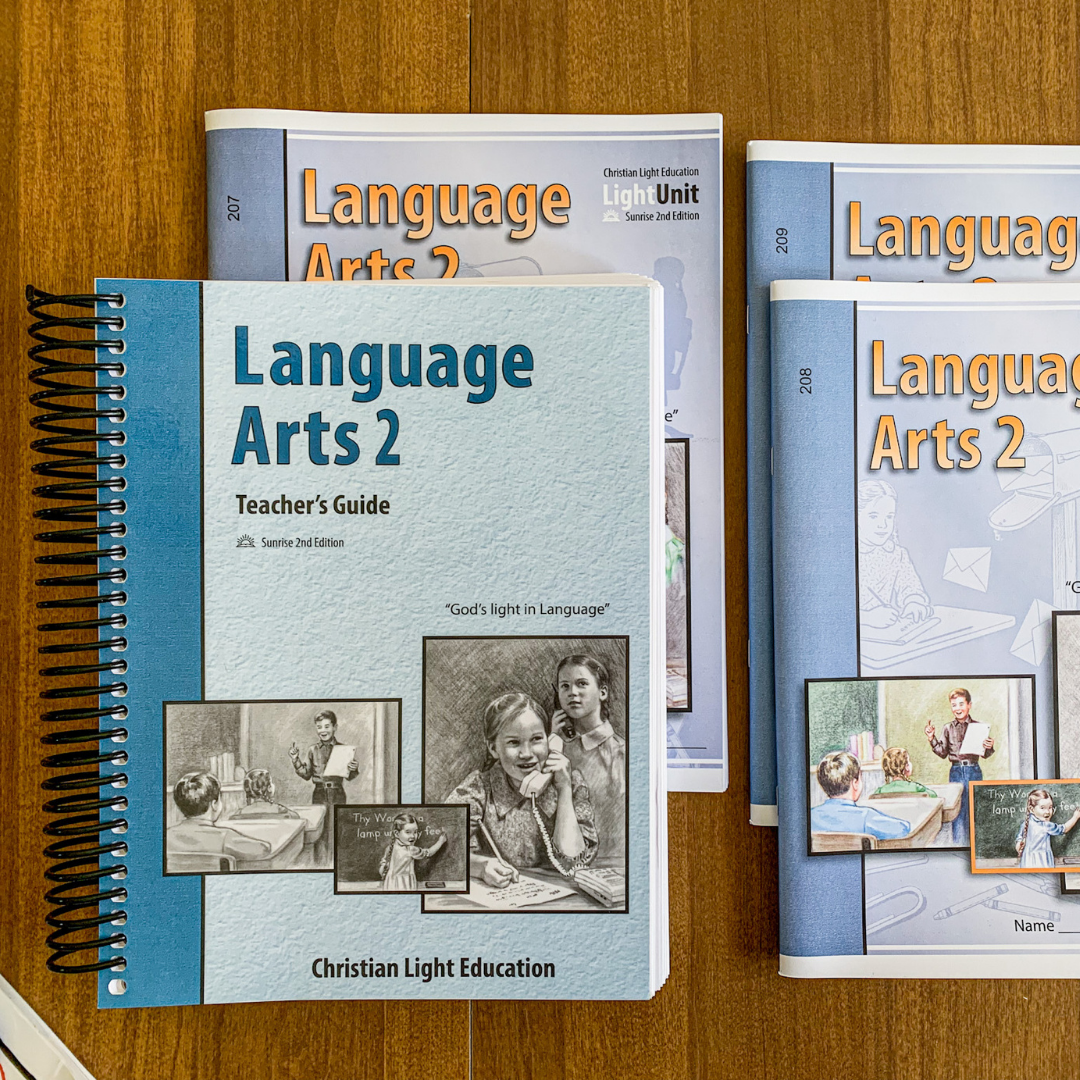
We finished our first grade year with CLE and continued using it for second grade. The second grade level added quite a bit more that made the program even more thorough than I thought it was. In this post I hope to give you a very thorough description and honest review of the second grade program so that you can get a better idea of what it is.
If you’d rather watch the video version of this post, check it out on my YouTube channel HERE.
This post contains affiliate links. If you follow one of my links I earn a small commission at no extra cost to you. Thank you for supporting my blog!
Christian Light Education is published by Christian Light Publications
They are a Christian Mennonite company, and you can read all about their beliefs and practices here. I am a Christian, and although I do not practice some of the same things listed in the “what we believe” section for Christian Light Publications, I have never felt turned off by the curriculum because of this.
I actually didn’t even realize the difference in beliefs until I heard someone else tell me about it. Then certain things clicked – like the images in the workbook. It was hard for us to figure out what a few of the images were because we couldn’t relate to them. This happened two or three times and we moved right along.
The program does talk about God often and believing in Him and making good choices that please Him. It teaches good character and provides short readings for the kids, teaching about manners, kindness, and good study habits.
The Language Arts curriculum is broken up into 10 units.
This is one of the reasons I chose this curriculum to replace an old one in the middle of the year. You can buy individual units for less than $5. I loved this because I could buy a unit and test it out with my daughter without really breaking the bank or feeling like I wasted a workbook.
That’s exactly what we did. I started with one unit, and we kept going from there. There are also optional materials you can purchase, and you can check those out here. We have not used the optional items in our homeschool.
The lesson content is set up as a spiral review.
This means that a topic is introduced and practiced again and again throughout the year. You do not master a skill and move on. Instead you are working on a variety of skills every day and repeating them here and there throughout the program.
I personally love this set up, because it makes it harder to forget things. For example, we can learn and practice alphabetical order and 2 months later we end up practicing it again.
I also like this because every section in a lesson is just a few practice problems for each skill.
Beginning in Level 2, the Language Arts program includes handwriting, spelling, AND writing.
How nice to be able to have that all in one! This is not the case in their level one, so I was happily surprised when we figured this out.
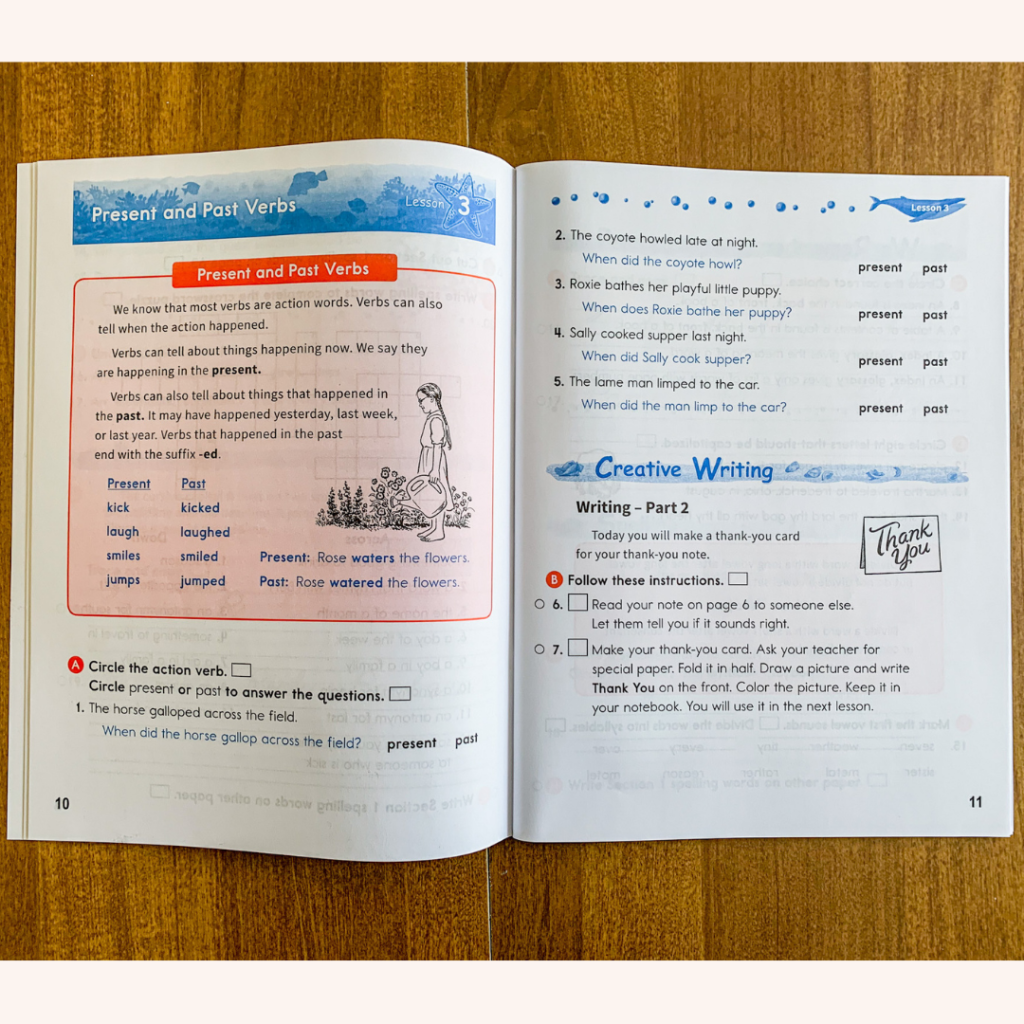
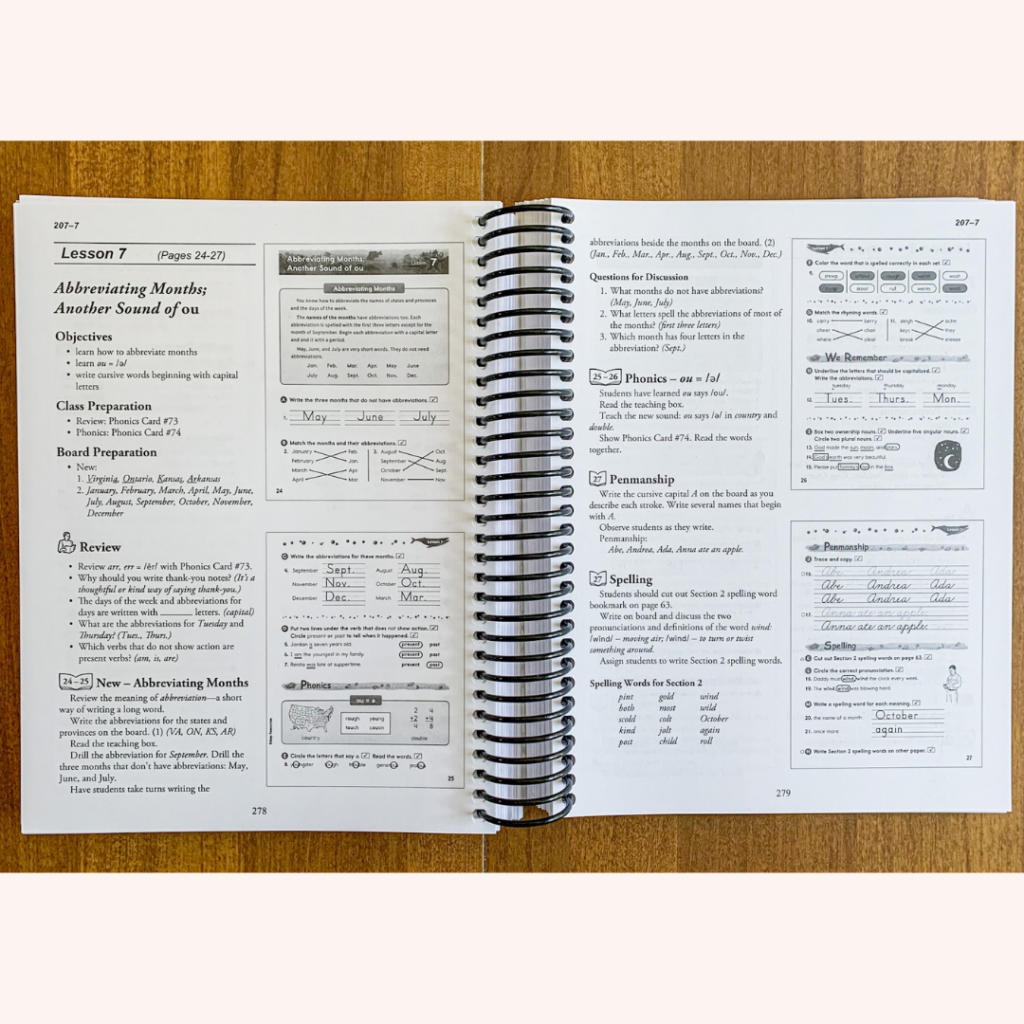
The handwriting sections start off with manuscript writing. It is a very short section in the lesson (see the image above). Next, it moves into curves and lines to get ready for cursive writing. When you get to unit 3, cursive letters and words are introduced.
The writing program becomes part of the lessons beginning in unit 3, as well. (See image below.) It’s so nice that I do not have to rearrange days or routines in order to incorporate writing practice. The process is broken down in the unit and easy to follow.
Each student book is called a LightUnit.
A LightUnit comes with the lessons, 2 quizzes, a self-check, and a test. One lesson usually begins with a new language skill followed by phonics and grammar review. Next, there is a short penmanship section to practice handwriting and, lastly, spelling practice.
There are also a few enrichment activities included in each LightUnit. (I’ve never actually even looked at these.)
The lessons are very to-the-point without extra things.
If you are looking for a variety of art and nature and song and poetry throughout your lessons…well, this isn’t for you.
A lesson is 4-5 pages long. Although it sounds like a lot, every section averages 2-6 practice problems.
If you sit and complete a lesson exactly as it is in the workbook every day, week after week, you are going to get bored.
Wow…that came off really strong, but hear me out. You can make it what you want! Honestly, that statement stands for almost anything! Homeschool is about making adjustments for your family.
The set-up of the lessons provide a flexibility when you plan!
For example, let’s say the review section is something that really doesn’t need practice. Your child has mastered it and is confident…so skip it!
Or maybe you’re feeling crazy and want to add some movement. Come up with a scavenger hunt or an activity to help get through some of the questions. Change up your routine and have fun with it!
Or MAYBE your infant won’t stop crying and your 3 year old is having a melt down and it’s raining outside and you haven’t even cleaned up breakfast yet…let your child work on it independently! I LOVE love LOVE that there are days that she can just practice on her own. As a mom of four, it’s so important to have this flexibility!
However, with the lack of variety in the lessons, it does tend to bore us after a while. Every couple months, I step away from it for a week or two and dive into something different. I might read a book with my daughter or complete a mini-unit together. This helps us go back to it fresh and ready to continue.
I do NOT follow the lessons exactly as they are written.
On the topic of spelling, I started the year by skipping the spelling section in the workbook completely and just having her write the words each day. We made this fun, and I can share more about how we did it soon. Even with fun spelling practice, we eventually tired of it after a few months and started only doing the spelling practice section in the workbook. We do not do daily list writing anymore.
After Christmas, I quit giving the quizzes and self-checks. It was a wasted day of lessons! My daughter was completing lessons well and was not struggling through the skills. (If she were, I may have kept doing them for practice).
One day, I just completely forgot about giving the quiz, and it affected us in zero ways. So, I stopped! We work through the lessons, and I give the test at the end of the LightUnit, if I feel she’s ready.
We also skip the penmanship sections most days. I do this because we already have a handwriting curriculum that I love (A Reason For, Level T). Completing the penmanship was overkill to me, so we only do it if we want a super short handwriting day and skip our handwriting book.
My point in telling you all of this is don’t ever feel like you have to do EVERYTHING!! You have the freedom to choose in your homeschool. If it feels like too much, cut it out. If it’s not enough, add to it. Do what’s best for your kiddo. Because of the way these lessons are set up, this is easy for me to do.
Let’s focus on the Teacher Guide for a second.
The guide is very thorough. The answer keys are actually on the same page as the lesson guide, and I really like that. You don’t have to flip back and forth to check answers.
Each lesson in the guide starts with scripted review questions. Next, it moves into a script for teaching the new skill. It provides questions for discussion as well as an explanation for each section in the lesson.
If there is any prep, it explains it at the beginning of the lesson guide. It also gives you optional activities to do during a lesson.
When it is time for a spelling test, the list of words and sentences are provided.
When I first received the guide, I was extremely overwhelmed. It’s a lot. However, once I read through the explanations and figured out how it worked with the lesson, I felt much better. It’s one of those things where you kind of just need to jump in and try it out to see how it would work best for you.
The guide is very helpful, but once we got in a groove, I didn’t feel like we needed it as much. It would be hard to have the program without it though. I’m glad I have it to refer to, as needed.
I’m really happy with CLE, but I’m not 100% sure yet if we will continue for 3rd grade.
The truth is…I’m somewhat bored. I want to read more books! I want to dive into novels with my kids and explore new characters and places and events. We do read chapter books together, but I feel like I want more. I’m starting to look for something more literature based.
My decision is not final. I really do love the flexibility I have with this. It’s almost like I would love to do CLE for 6 weeks and a novel for 6 weeks and than back to CLE…and so on. And I could…
I just have a couple more things I want to research, so I’ll keep you posted.
Let’s look at the pros and cons here.
PROS:
Inexpensive to try
easy to follow
includes spelling, handwriting, and writing beginning in 2nd level
flexible
can be completed independently (depending on child)
Christian values
CONS:
cut and dry
not hands-on
difference in beliefs
can feel boring at times
not much classic literature or fine arts (at least not in level 2)
I think this is all just proof that no ONE curriculum is going to be the perfect fit.
We get to make it what we want and add or take away as we please. Even when I was a classroom teacher, I was doing this with our textbooks for my students. The reason I bring that up is to point out that learning is not a one-size-fits-all matter.
My suggestion to you if you are considering trying Christian Light Education is to do what we did. Purchase one LightUnit. Look at the samples to get an idea of which one you should buy, based on your child’s abilities.
Then, try it out in your home! It’s the perfect way to figure out if it’s what you need for your language arts program.
Cookie Consent
We use cookies to improve your experience on our site. By using our site, you consent to cookies.
Cookie Preferences
Manage your cookie preferences below:
Essential cookies enable basic functions and are necessary for the proper function of the website.
Name
Description
Duration
Cookie Preferences
This cookie is used to store the user's cookie consent preferences.
30 days
These cookies are needed for adding comments on this website.
Name
Description
Duration
comment_author
Used to track the user across multiple sessions.
Session
comment_author_email
Used to track the user across multiple sessions.
Session
comment_author_url
Used to track the user across multiple sessions.
Session
WooCommerce is a customizable eCommerce platform for building online stores using WordPress.
Name
Description
Duration
wp_woocommerce_session_
Contains a unique code for each customer so that it knows where to find the cart data in the database for each customer.
2 days
woocommerce_recently_viewed
Powers the Recent Viewed Products widget
session
store_notice
Allows customers to dismiss the Store Notice.
session
woocommerce_snooze_suggestions__
Allows dashboard users to dismiss Marketplace suggestions, if enabled.
2 days
woocommerce_dismissed_suggestions__
Count of suggestion dismissals, if enabled.
1 month
woocommerce_cart_hash
Helps WooCommerce determine when cart contents/data changes.
session
woocommerce_items_in_cart
Helps WooCommerce determine when cart contents/data changes.
session
WPForms is a user-friendly WordPress plugin for creating custom forms with drag-and-drop functionality.
Name
Description
Duration
wpfuuid
Used to track user interactions with forms.
11 years
Statistics cookies collect information anonymously. This information helps us understand how visitors use our website.
SourceBuster is used by WooCommerce for order attribution based on user source.
Name
Description
Duration
sbjs_session
The number of page views in this session and the current page path
30 minutes
sbjs_udata
Information about the visitor’s user agent, such as IP, the browser, and the device type
session
sbjs_first
Traffic origin information for the visitor’s first visit to your store (only applicable if the visitor returns before the session expires)
session
sbjs_current
Traffic origin information for the visitor’s current visit to your store
session
sbjs_first_add
Timestamp, referring URL, and entry page for your visitor’s first visit to your store (only applicable if the visitor returns before the session expires)
session
sbjs_current_add
Timestamp, referring URL, and entry page for your visitor’s current visit to your store
session
sbjs_migrations
Technical data to help with migrations between different versions of the tracking feature