Posted on 1 Comment

Logic of English Foundations A Review

logic of english

This is my second child I’ve taught to read, but my approach has been completely different from my first. This year we used Logic of English Foundations A to teach reading, and I’ll be sharing how it worked for us.

This is not a sponsored post. I chose Logic of English on my own and plan to share my honest opinion about it with you.

This post contains affiliate links. If you follow one of my links I earn a small commission at no extra cost to you. Thank you for supporting my blog!

Why Logic of English?

I was actually pretty stubborn about teaching reading. I did not use a reading curriculum with my first daughter, and I was certain I could follow the same path with my second daughter. Alas, I have learned that each of my children is unique and their gifts of learning vary greatly! What works for one does not always work for the other.

The summer before my daughter’s first grade year, I decided to purchase an inexpensive reading workbook to complete casually throughout the summer. As we did it together, the thought came to my mind that it was so nice to have directions to follow each time we worked instead of coming up with my own activity like I was used to.

This was my realization that a reading program would be helpful for the both of us, and I had to let go of my stubbornness. Unfortunately, these programs can get pretty costly!

Years ago, I heard great things about 100 Easy Lessons, purchased it, and didn’t really like it. I wish I would have because it costs a lot less! So, I wanted to choose between the two price-y ones I heard the most about – Logic of English and All About Reading.

Here’s Some of the Reasons I chose Logic of English:

  • Low prep for each lesson
  • Handwriting included (manuscript/cursive)
  • I can easily re-use it with other children (minus the student workbook)
  • Doodling Dragons Picture Book (my daughter would love this)
  • Not grade-level focused, moves at the pace of my child
  • Activities included are simple and follow my style of teaching
  • Tactile Handwriting Cards and activities for multi-sensory learning

Items Included

The Foundations A set comes with a handful of items that I will discuss in this post. To see my unboxing of this set, check out my YouTube video for a detailed look at each item.

Lessons and Assessments

Foundations A includes 40 lessons and 8 Assessments (A-H). Each lesson and assessment comes with a script for the parent to follow. With each lesson there is anywhere between 1-4 workbook pages for the student to complete. Each workbook page is very short and can be a simple as pointing at a picture.

One of the things I love about each lesson is that there are so may activities to pick from. I feel like at first this was a little overwhelming. As I get with every new curriculum, I felt like I had to do everything. After a while, I got used to the set up and was able to pick and choose things based on our own needs and schedule.

The assessments were actually the most fun! Isn’t that interesting? You assess your child using games and hands on activities, and we looked forward to each one. The assessments also made it easy for me to see what she understood and what needed more work.

Handwriting

Every lesson includes handwriting practice. Strokes and lowercase letters are introduced and there is space to practice in the student workbook. My child is not a fan of writing, and the amount of handwriting practice was perfect for her. It’s very minimal. For example, the workbook may say to write the letter a few times on your favorite line. So it’s not rigorous by any means.

The Tactile Cards that go along with the handwriting lesson are so fun. We didn’t use them every time, but my daughter loved them! It’s almost like a sandpaper feeling and it really helps learn the letters using multiple senses.

We chose to use the manuscript version. (You have the option to choose manuscript or cursive) I was happy with this choice, but I will say that the handwriting that is taught is very unique. It’s slanted and curvy, which is excellent in preparation for cursive, but it matches nothing else that we have. This would be my only negative thought about the handwriting (more on this later).

I’ve heard of many parents that skip the handwriting all together, but learning the strokes and using the tactile cards was so helpful to my daughter that I decided to stick with it. They do offer a handwriting book separately, and now that she is more confident in writing, I may add that in as practice.

Spelling

Spelling is introduced in lesson 21 and continues with each lesson after that. The lesson comes with 3-5 words that follow what you’ve been practicing, so it really sets the student up for success. I will say that once spelling was introduced the lessons felt really long. We ended up splitting them up into two sometimes three days.
doodling dragons

Games and Activities

I love the variety of games so much. It matches my teaching style, and I think that’s why we enjoyed it. Every game option they give you uses the cards that comes with the set. So you’re never having to cut a bunch of things or laminate or find a list of supplies.

To give you an example you might practice your phonograms by hiding the cards around the room and having a scavenger hunt. Or you might lay the cards on the table and slap the correct one. They’re all just really fun and easy to do.

And there are so many!! The Teacher’s Manual provides you with a variety of games to pick from for each lesson. When you finish an assessment, there’s a whole page of ideas on how to practice different skills using the games. It’s so helpful!
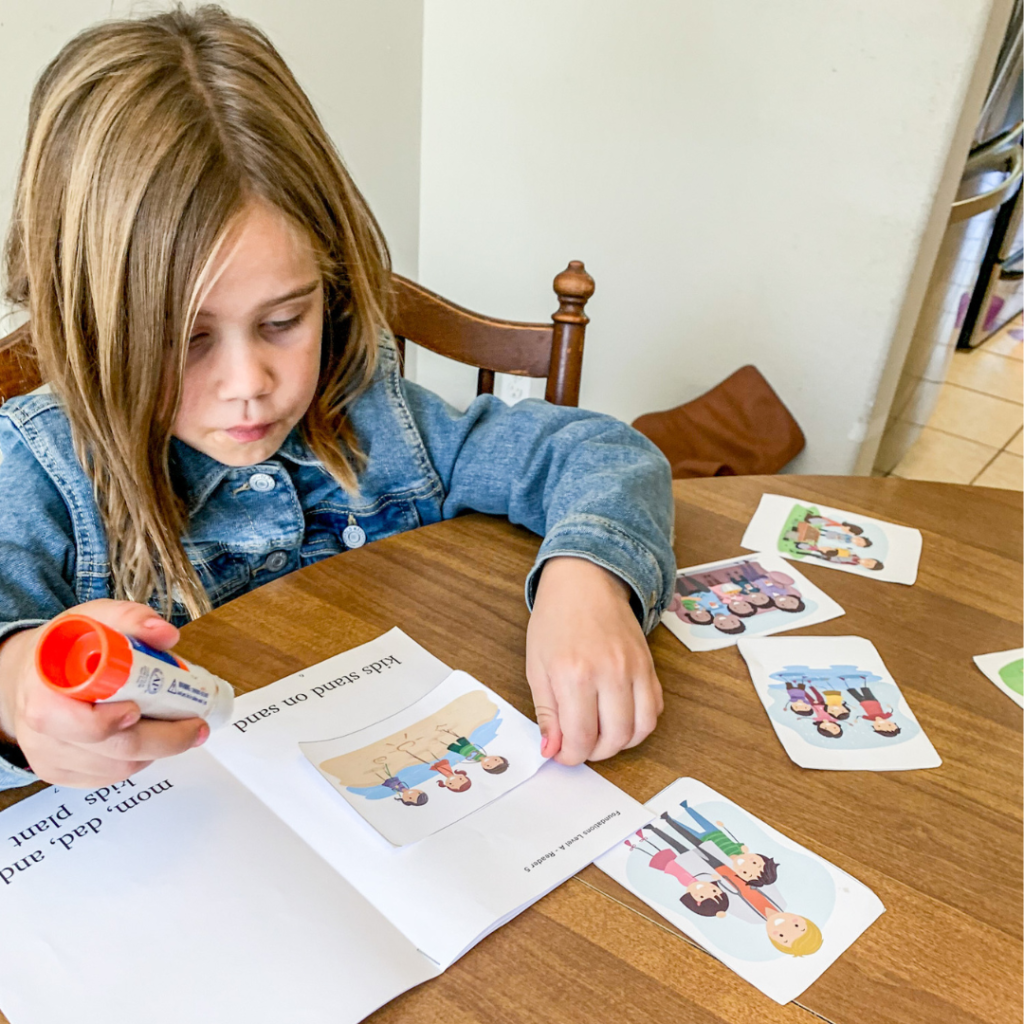
make your own reader

Readers

The readers are created by the students! This is the cutest thing to me. I believe there are 6 total and each one comes with a set of pictures and then a group of blank pages with the words to read. Your child reads the words and matches the pictures to each page.

There’s cutting and pasting and matching. This makes the reading so fun! Not only is the process of putting it together unique, but the pictures are so silly. We really got a kick out of these!

Doodling Dragons

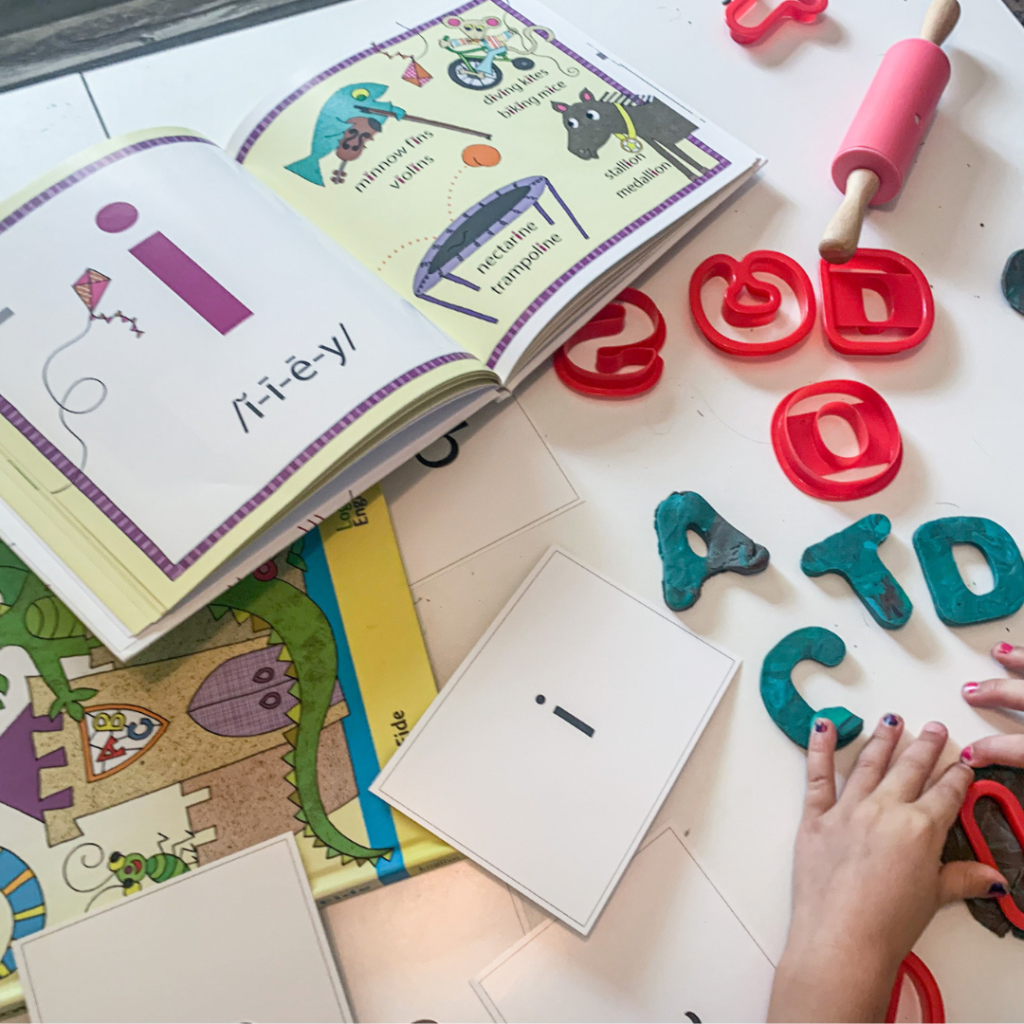
This picture book has a page for each phonogram. There are silly pictures and rhymes that use all the sounds of the phonograms. It’s very cute, and my daughter loved looking at each page. On YouTube, there are songs that go along with each page as well. These were wonderful, but we usually forgot to listen to them. I believe you can purchase a CD, so if you have a CD player or like listening to things like that in the car, it may be worth the purchase.

Sometimes I think that if we would listen to them in the car, my younger kids would catch on and begin learning them as well.

The Not-So-Great Things

Can you tell we loved this? I could go on and on about how easy it was to use and how much my daughter enjoyed lessons. My complaints are so minimal, but I’ll share in order to give a thorough review.

LONG LESSONS – This was an easy fix, but it also could vary with the child. We simply split the lessons up into a couple days. The book encourages you to do this as well, but if you feel bound to a lesson number and completing one a day, that will get tougher as you work further into the book.

LOTS OF PIECES – When I received the box for the set, I was immediately overwhelmed by all of the cards and pieces that come with it. There’s a lot! So, finding a way to organize it all was key. I went with a plastic container that allowed me to keep the cards in their own box but still altogether. It’s been great!

HANDWRITING – I mentioned this earlier, but the handwriting is unique. It really doesn’t match any other writing in other books we do. So, it’s something you’ll have to decide if you want to do or not. We stuck with it, and I just plan to get their handwriting book at some point to practice.

SO MUCH TO DO – This really isn’t a bad thing, but I will say that there are so many options of things to do, and it would be very difficult to do it all. So, it’s important to look through and pick what’s best. For example, with every letter the child learns, the book provides ways to “celebrate” the letter. We never did this. The ideas were so cute, but ultimately it didn’t fit in the schedule of our family.

COST – A program like this doesn’t come cheap. It’s one of the reasons I hesitated to get it in the first place. It’s also tough because set A is only 40 lessons, and although it took us until Thanksgiving to finish (we started in July), it’s kind of a bummer to already have to spend another $100 to keep going. My hope is that the cost will eventually even out when I am able to use it for my next two kids, as well. All I will have to purchase in the future is the student workbook.

Other Random Things I Love

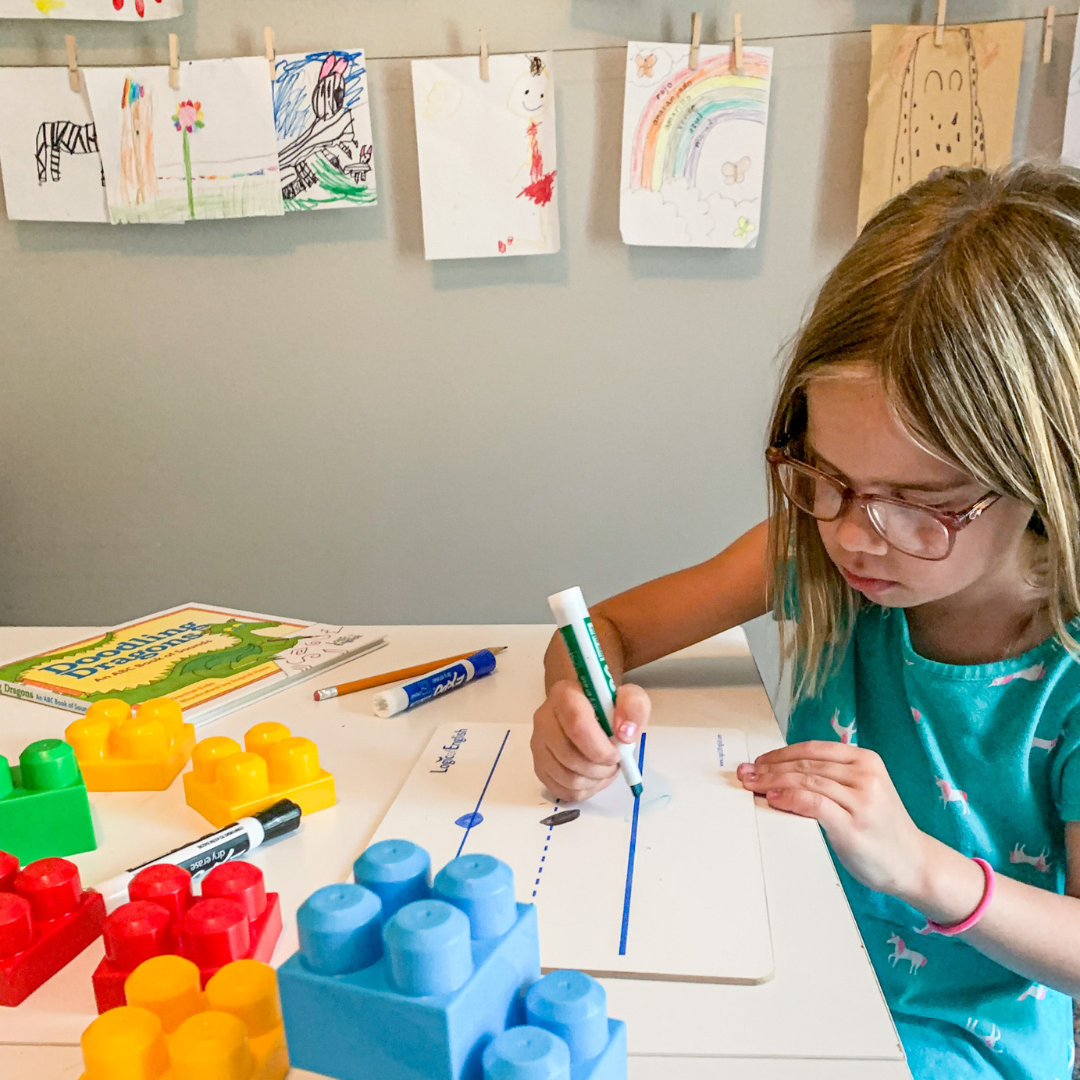
WHITEBOARD: The miniature whiteboard that comes with the set got used every day. It was so helpful and I love that it had a giant set of handwriting lines and then smaller ones on the opposite side.

MOMMY IS LEARNING: I’ve learned so much with this program. I never knew every sound of every letter. I learned about voiced and unvoiced sounds. We’ve learned things about consonants and vowels that I had no idea about. I love learning alongside my kids!

TEACHER’S MANUAL: The Teacher’s Manual is bound in a hardcover. Almost every spiral book I have ends up coming apart in some way, and this one has no spiral. It makes me happy knowing it will last through the years!

Final Thoughts

My daughter’s attitude about reading has changed so much since we started this. Her and I were both frustrated the year before this, and using Logic of English has given us so much joy. I can specifically remember a lesson where we giggled and had fun, and when I told her she could get up to leave she ran up and hugged me! I just melted – so thankful for the progress we were making and continue to make to this day.

It took me a while to finally bite the bullet and pick a reading program, but once I did I felt so much less pressure when it came to teaching reading. It gave me confidence each day knowing a plan was in place, and it built up my daughter’s confidence each step of the way.

Posted on Leave a comment

Make Explode the Code FUN – Adding variety to the workbook pages

IF YOU PREFER TO WATCH THE VIDEO ON THIS SAME TOPIC, CLICK HERE: Make Explode the Code Fun!

Explode the code is set up with a very consistent format. I love this, because it’s easy for my daughter to follow. However, it wasn’t long before I was itching to add a little variety to the workbook pages. We wanted to have some FUN.

We started Explode the Code (Book One) half way through my kindergartener’s year, and I wish we would’ve had it from the beginning. It’s great practice, and I love how the lessons are set up. She can do a lot of it independently.

Sometimes repetitive practice gets old. When this happens I like to mix up the lesson a bit in order to add some excitement. It makes teaching more fun and it really helps my daughter have a great time learning, as well.

Are you ready to add some variety to the workbook? I’m so excited for this. I want to give you a SIMPLE alternative way to complete the majority of the workbook pages in Book One. Mark this page, or write down what you like. We are about to spice up some phonics!

This post contains affiliate links. If you follow one of my links I earn a small commission at no extra cost to you. Thank you for supporting my blog!

These are not activities to do every day.

That would be incredibly exhausting! These ideas are more for you to keep in your pocket for a day that really needs some mixing up!

Let’s be honest, some of the workbook pages can be completed so quickly on their own. We even combine a couple pages at times. We definitely just do the workbook most days. However, my point is to provide you with options. You never know what day you’ll need a change in routine.

For some of these, we will be cutting the textbook.

Yes, cutting it up! I LOVE doing this. I’ve cut almost all our workbooks at some point. The reason for cutting is because it’s less work. Hear me out! The book has the practice we need – so let’s use it! No need to go searching online for extra. Let’s use what we paid for.

So, think ahead…If you are cutting up a page, what do you want to do with the other side? Sometimes, I skip it altogether. Other days, I’ll do the back side FIRST so that it’s done, and then I can cut the other side the next day. You could also make a copy. It’s completely up to you.

Let’s get to it!

Some of these activities would work for multiple pages, so feel free to change them around a bit if you’d like. But like I said earlier, the point is just to have fun options for each one.

Cut and Paste

SUPPLIES: Construction Paper, Writing Utensil, Glue stick, Scissors

Book Directions: Find the picture that begins with the sound of the letter below. Circle it.

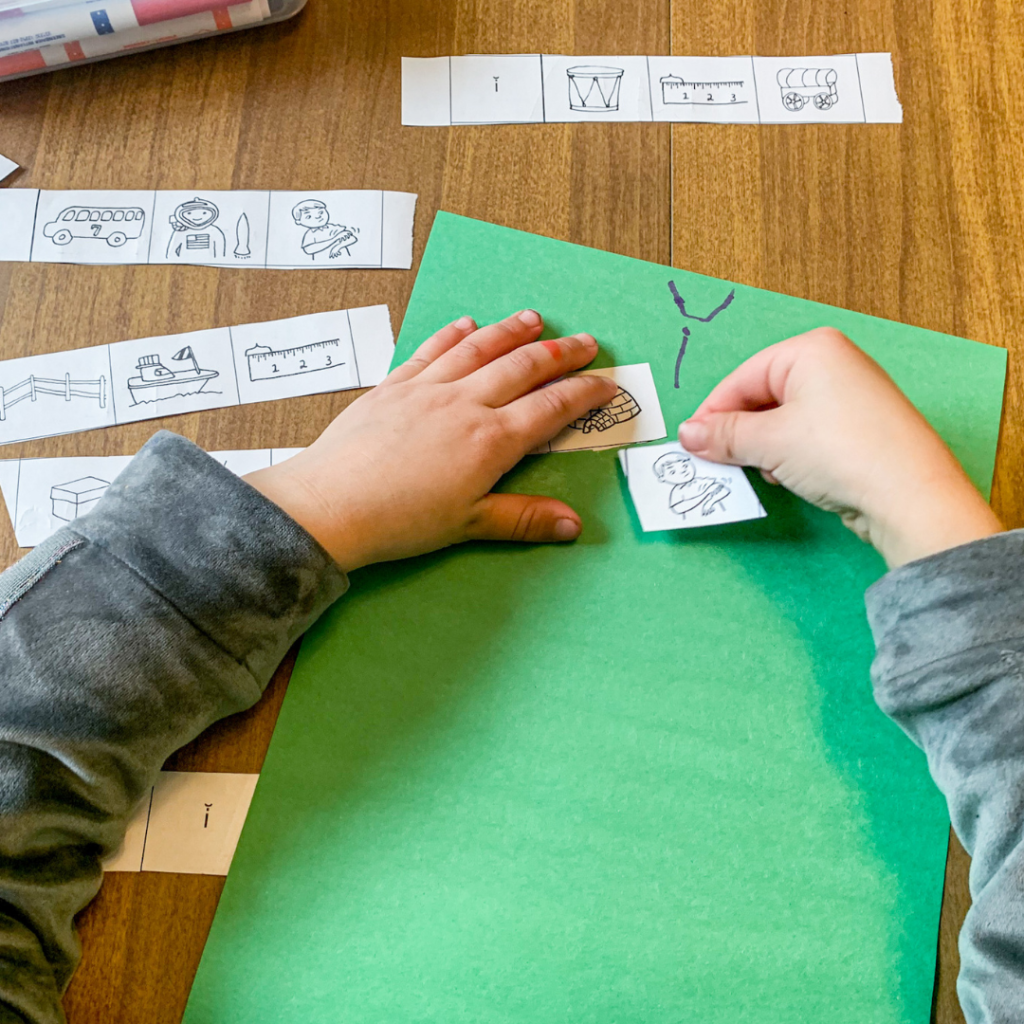
To prep this activity, cut the rows of pictures out. Leave them in their rows so you’re left with strips of paper. (See image)

Begin by introducing the letter and its sound. (Follow the wording from the book) Have your child write the letter at the top of the construction paper. Next, he/she will look at each row of pictures and cut out the picture that makes the correct sound.

Then, glue the picture onto the paper. Repeat this for each of the rows of pictures.

explode the code watercolors

Watercolor Matching

SUPPLIES: Watercolors (or just colored pencils), construction paper and glue stick (optional)

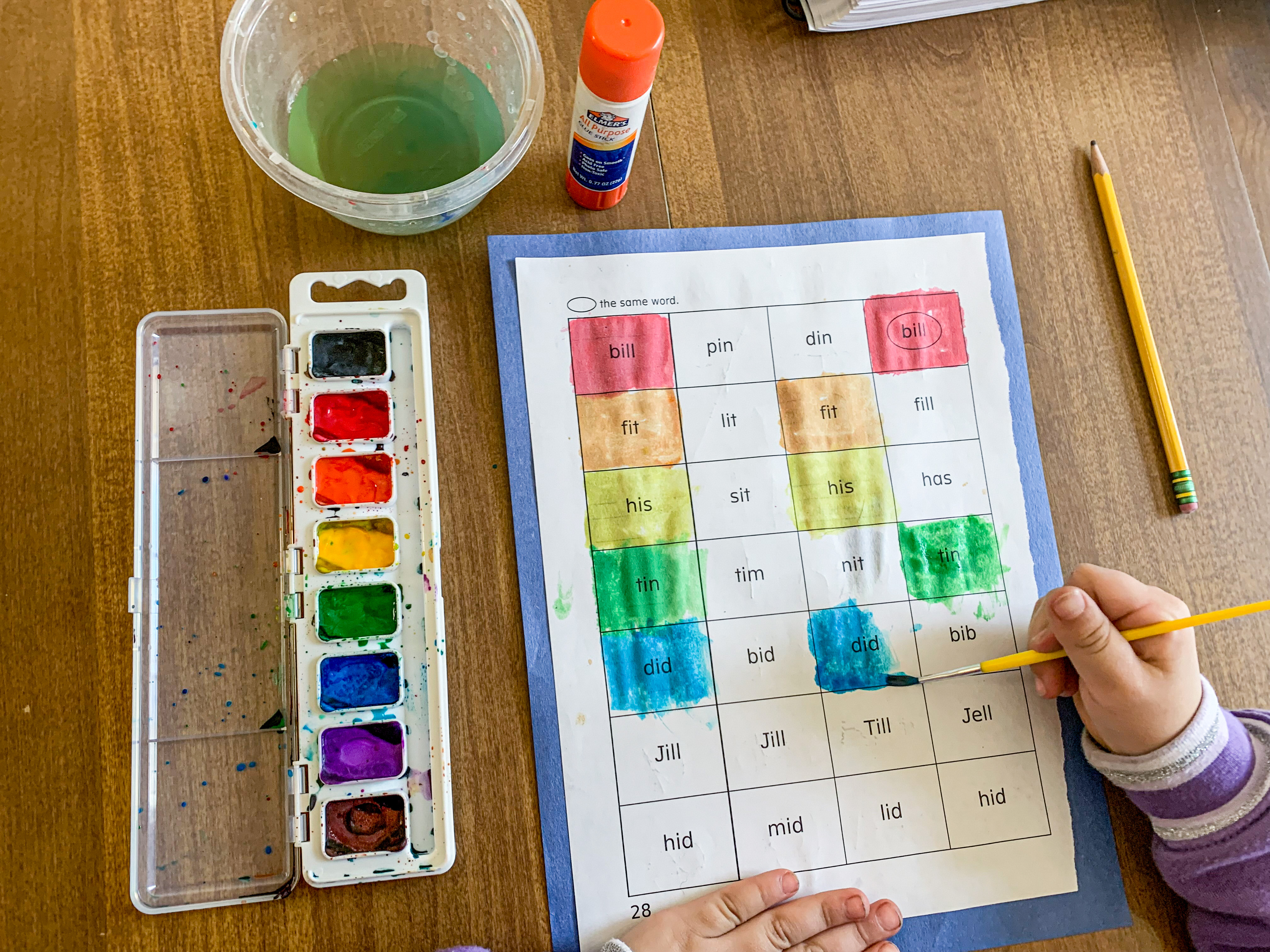
Book Directions: Circle the same word.

We love using watercolors at our house. If that’s something you’d prefer not to use, you can also use colored pencils. Since we were using the watercolors, I tore the page out and glued it to a piece of colored construction paper to make the paper a little thicker.

I chose to go with a rainbow theme, because I knew my daughter would enjoy that. She read the word on the side of the page and painted it red. Next, she found the matching word and painted it red, as well. Now, the matching words also match in color.

We painted with orange next, and then yellow, and so on until we had all of the colors of the rainbow. If there were any extra boxes, I let her pick the color.

At the end we had a pretty workbook page that now hangs up on our work display wall.

Matching Words

I love setting up a DIY matching game and it would be perfect for the workbook page mentioned above. Cut up some scraps of construction paper and write the words on the paper scraps. I would just write the given word and exact match, not the extra words.

If you wanted to add to it, you could make cards with words from the previous pages that look just like this. Save the scraps and add to it as you move through the book. your game will get bigger and BIGGER as you complete it.

Read, Roll, and Write

SUPPLIES: Dry Erase marker, dry erase board/pocket, die, paper, pencil

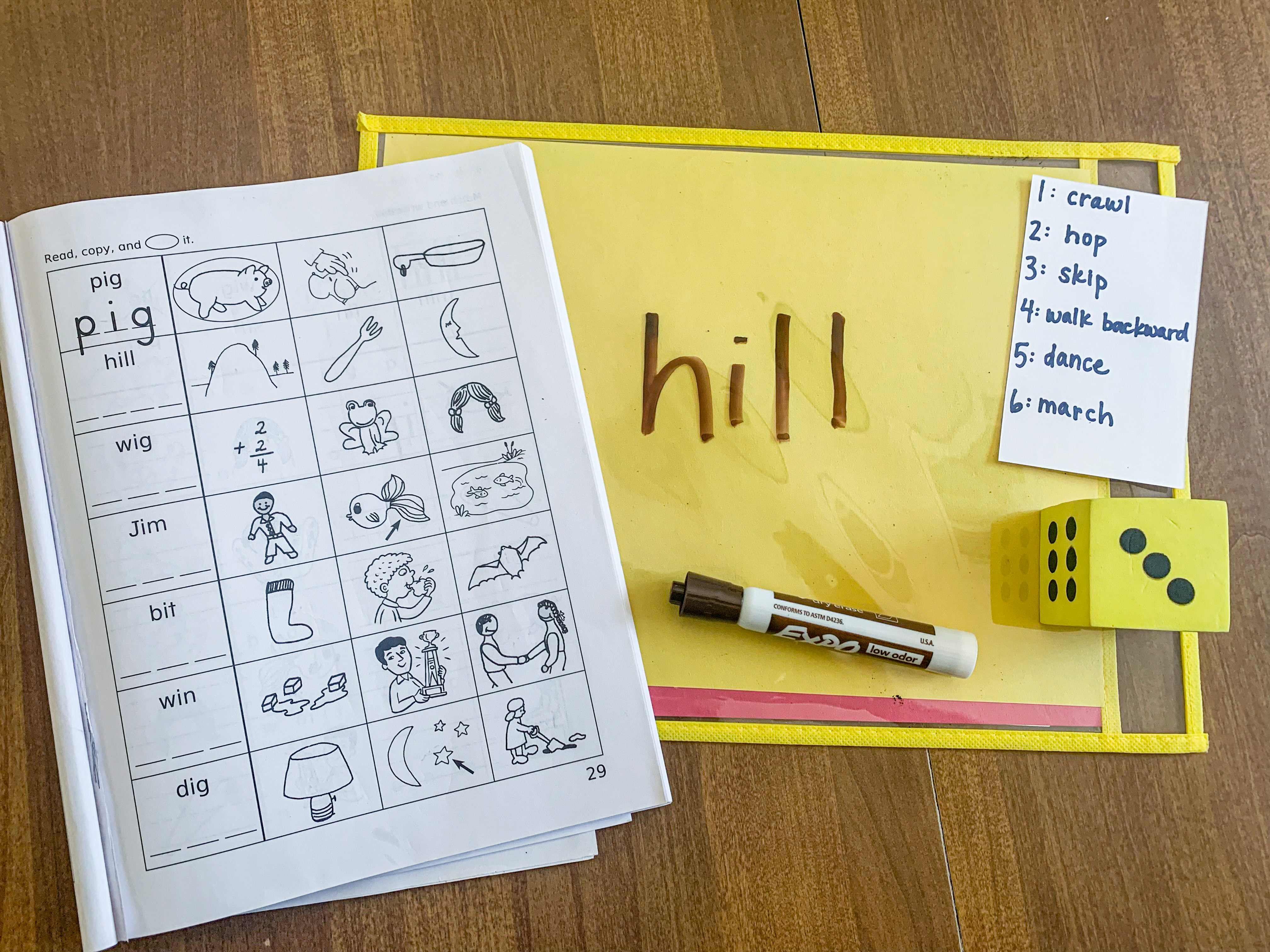
Book Directions: Read, copy, and circle it.

On a piece of paper, assign an exercise/movement to a number 1-6. (See image above). Have your child read the word in the workbook and circle the matching image.

When it’s time to write the word, add in some movement! Roll the die. Whatever number is landed on determines the movement to be completed.

I like to put our dry erase pocket on the other side of the room. This gives my child a place to go while moving. Once she arrived to the pocket, she wrote the word and then returned for another.

Sidewalk Chalk – Jump on the Sound

SUPPLIES: Sidewalk Chalk

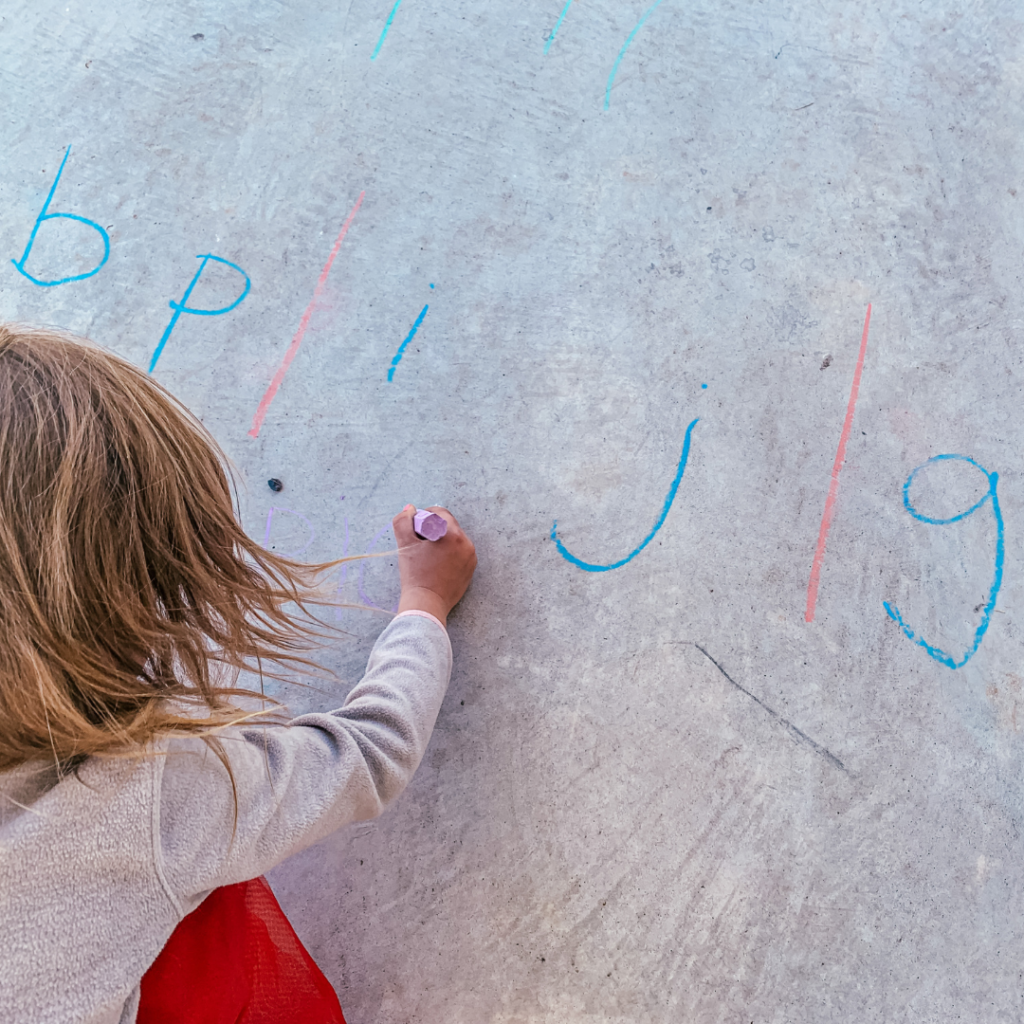
Book Directions: Spell. Write.

For this activity I showed my daughter the picture in the book for her to identify. Next I wrote the letters on our patio, just as they are written in the workbook. By using 2 different colors, it was easy to separate the columns (see image).

As she sounded out the word, she jumped from letter to letter, sounding out the word with the correct letter sounds. We had fun putting the letters further and further apart! Actually, I should rephrase that and be a little real with you – she insisted I make it further to jump, because the way I wrote it was just way too easy! (ha!)

I also gave her a piece of chalk to write the word on the patio as well.

Squirt the Sound

Follow all of the directions above, but instead of jumping on the sound, use a squirt bottle! Get them from the dollar store. These are so great to have.

Wait for a beautiful day and take your lesson outside. Have your child squirt the letter that makes the correct sound! This is so much fun!

DIY Write the Room

SUPPLIES: Scissors, clipboard/folder, pencil, tape

Book Directions: Match and write it.

This worksheet is set up so that there is a group of words to pick from at the top. The bottom 3/4 of the page are the pictures with a space to write the word.

For this one, I wrote the words on scratch pieces of paper and taped them around the room. We created a “Write-the-Room” activity. Next, I put the rest of the workbook page on a clipboard and handed it to my daughter.

As she walked around the room, she’d read the word on the card and then write the word down on her clipboard.

window writing

Window Writing

SUPPLIES: Dry erase marker, scissors, tape, mirror/window

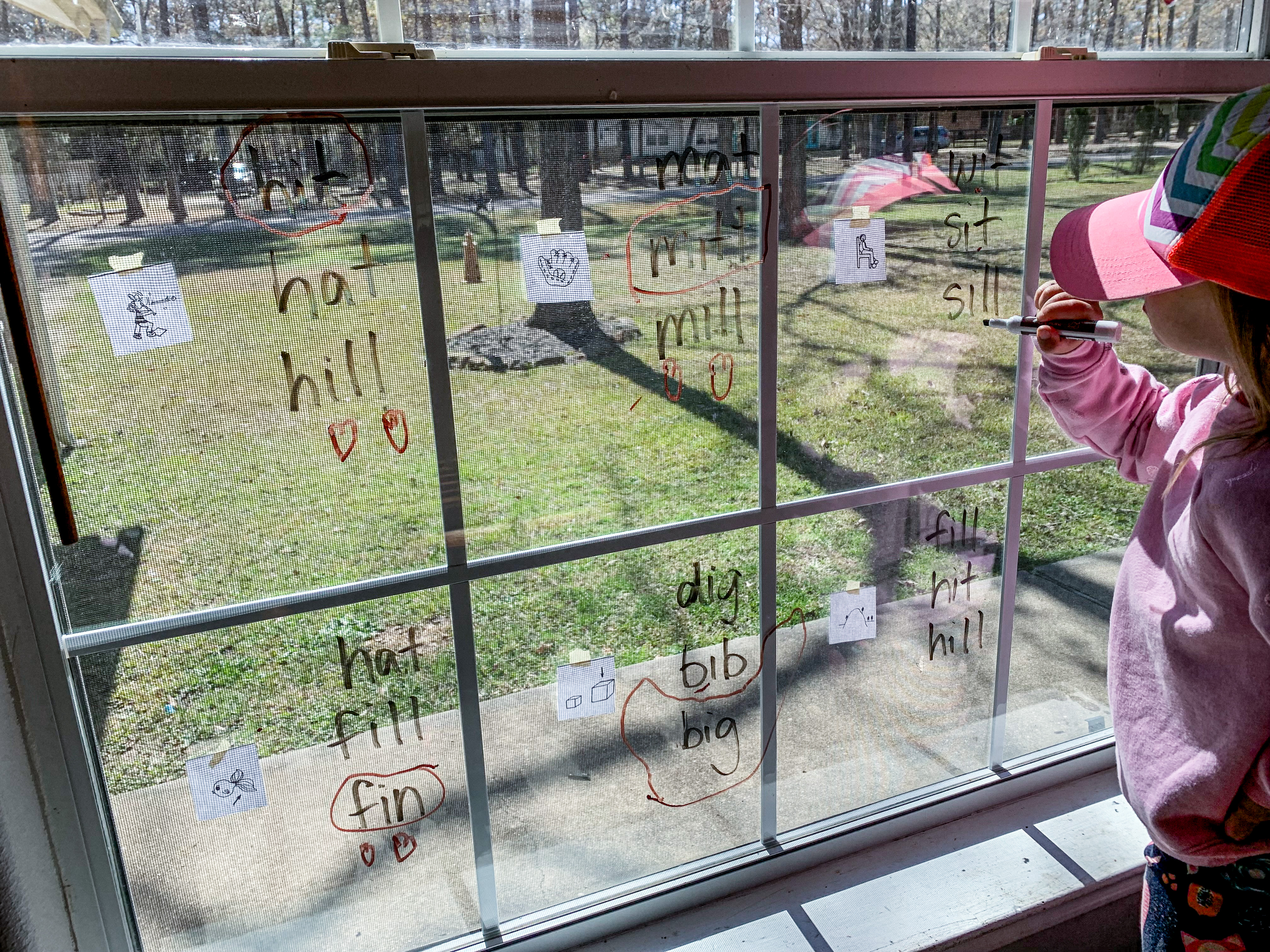
Book Directions: Circle it.

Window/mirror writing is a a simple and fun way to add a twist to any lesson. I set this one up so it looked just like the workbook page.

Cut the picture out and paste it to the window. Write the set of words next to the picture. Your child can go to each picture and circle the right word with a dry erase marker.

When you finish, remove the pictures and wipe it off with a towel. Easy clean-up!

Chatterpix Reading

SUPPLIES: iPad/iPhone, Toys (optional)

Book Directions: X it.

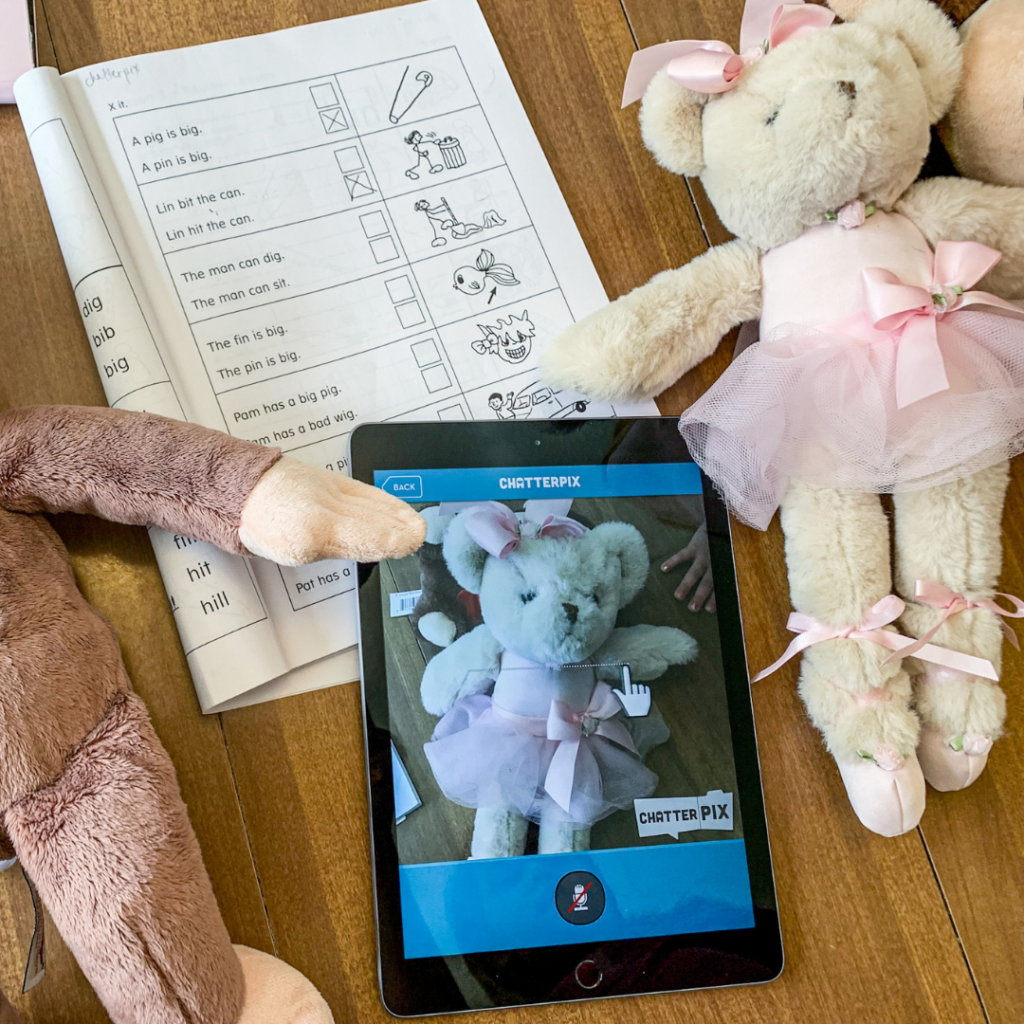
When we get to this page, I have my daughter read the sentences to me and then she decides which one matches the picture. She’s not always happy about doing this, so I wanted to come up with something crazy-fun for her to do.

Enter Chatterpix Kids. This app is free. I never really use apps in our homeschool, so this was quite the treat. To use the app, you take a picture of something – It can be ANYTHING. I chose to focus on stuffed animals.

I let my daughter take a picture of her stuffed animal. Then, we traced a line where the mouth is. Next, I had her sound out the words of the sentence so she would know what it said. When she was ready, she hit the record button and said the sentence into the iPad.

You have the option to add stickers to the picture as well. I let her pick one sticker, and then we hit PLAY. Oh my goodness, did we giggle!! It was such a silly time.

I’ll be honest, you could probably do the worksheet in five minutes. By doing this app, we spent probably 30 minutes playing. So, it more than triples the time. However, like I mentioned above, this is not an everyday thing. This is meant to be something fun and special to add variety to your workbook.

It was obviously very special and enjoyable to her as she has asked me to skip all the other workbook pages and just do this sentence one again and again! 😉

Microphone Fun

Another idea I had for this one is to use a microphone. My daughter loves talking. So, naturally I bought her a bluetooth microphone for Christmas (lol!) Even though it’s silly, we can get it out and read sentences or words into it. There’s even an echo feature on there to add something to her voice if we want to.

We used a microphone for one of the pages, and I encouraged her to come up with a new voice every time. She sure made us laugh!

If your child loves singing, you could connect it to some background music and let your child sing their sentences! Maybe it sounds crazy, but I promise your kids will get a kick out of it!

Shaving Cream Spelling

SUPPLIES: scissors, shaving cream, wash cloth for clean-up

Book Directions: Write it.

Cut out the pictures on the side of the workbook page. Just a tip – When I cut ours, there was also part of a picture on the back, so I made sure to put an “X” on the back side of the cut-outs. I didn’t want to confuse the sides.

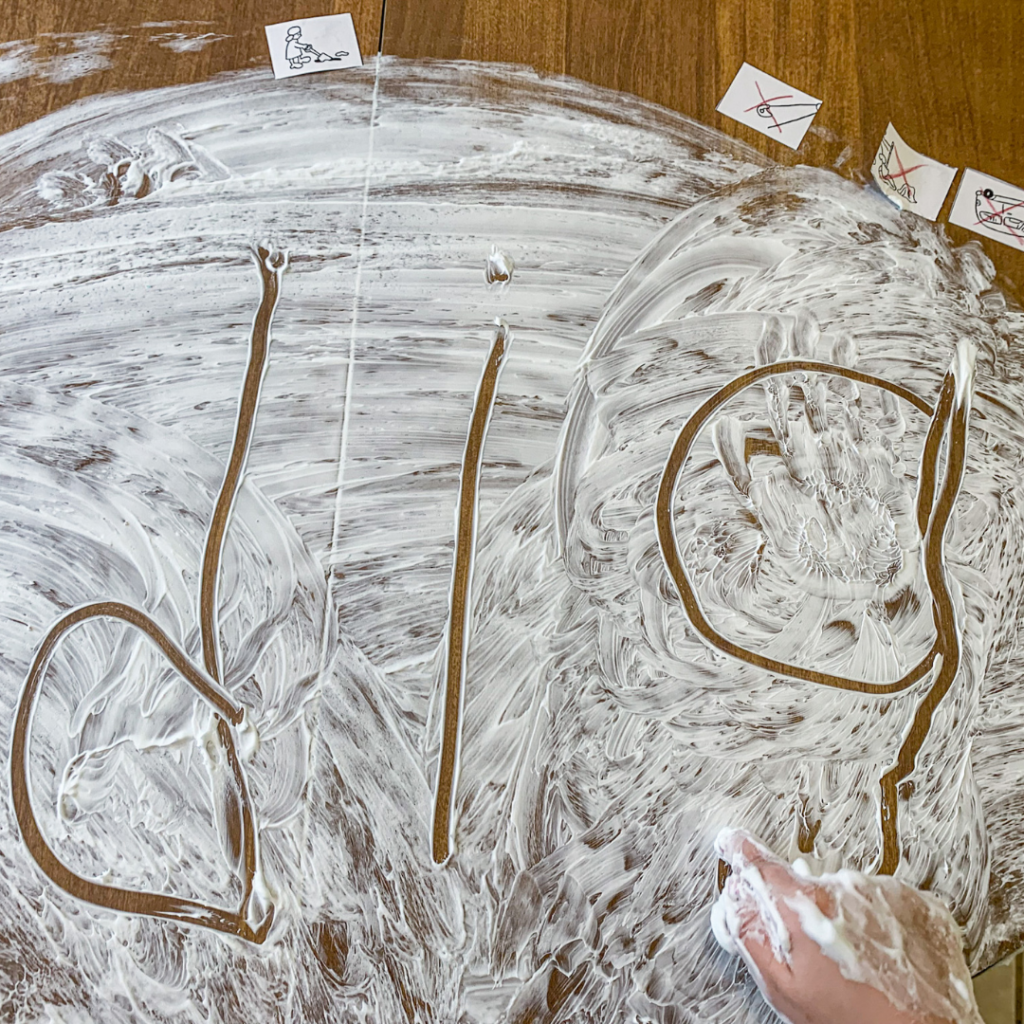
Have your child sit at a table with the pictures piled on the side. Squirt shaving cream onto the table and spread it around (you’ll want to give a minute to free play first).

Have your child draw from the pile of words (or if you need to, show one of the pictures) and then write the word in the shaving cream. For every new word, wipe the shaving cream to make a blank slate.

This is so much fun, and most of the time it doesn’t even feel like school work!

Letter Play

If you don’t feel like making a shaving cream mess, try just using wooden letters or magnetic letters instead of writing the word. Choose a picture and make the word. A simple change like that can really make it interesting.

Do you have letter stamps? These stamps are great to have on hand. You could stamp right in the workbook if you wanted to! Spell out the word using the stamps. Add some color patterns by using your different colored stamp ink.

Small changes can be so much fun!

Sometimes it’s nice to have a go-to list like this to keep in your back pocket for a day that really needs it. I would not recommend doing something like this every day, but if you wanted to take a week off of the workbook, this would be a fun way to do it! Or, if you’re feeling a little funky, a small twist can make a big change in attitudes.

I’d love for you to share your activities with me! Send me an email or tag me on social media @simply.learning.together

Have fun with phonics!

Posted on Leave a comment

Why we stopped Horizons K mid-year

I really did not think this would happen, but we stopped Horizons K mid-year. I love Horizons! We’ve used it for three years with my oldest daughter (now in Horizons 2). As a matter of fact, she still uses it, and I don’t have plans to stop.

This has been a tough decision for me. I know how Horizons works. I know how to add hands-on activities, and I know how to manipulate it to work for us. I’m very comfortable with it and recommend it to many. That hasn’t changed, but, let’s be honest…this isn’t about me. It’s about my daughter.

If you prefer to watch instead of read, check out my YouTube video on this same topic HERE.

This post contains affiliate links. If you follow one of my links I earn a small commission at no extra cost to you. Thank you for supporting my blog!

I’ve known since November that something wasn’t right.

This decision has been quite the journey and my choice to stop was not based on a quick mishap. It’s been a process, and I’ll explain.

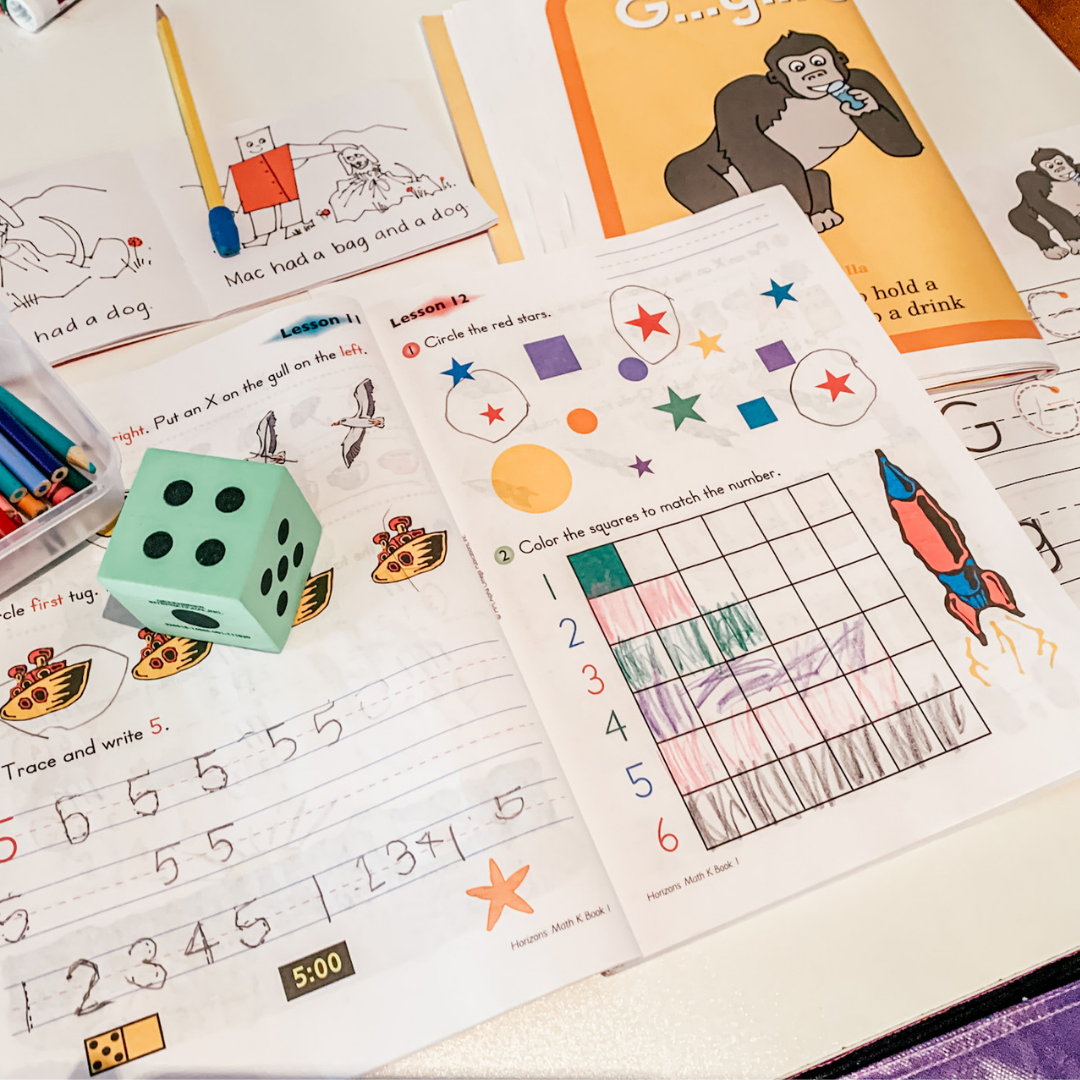
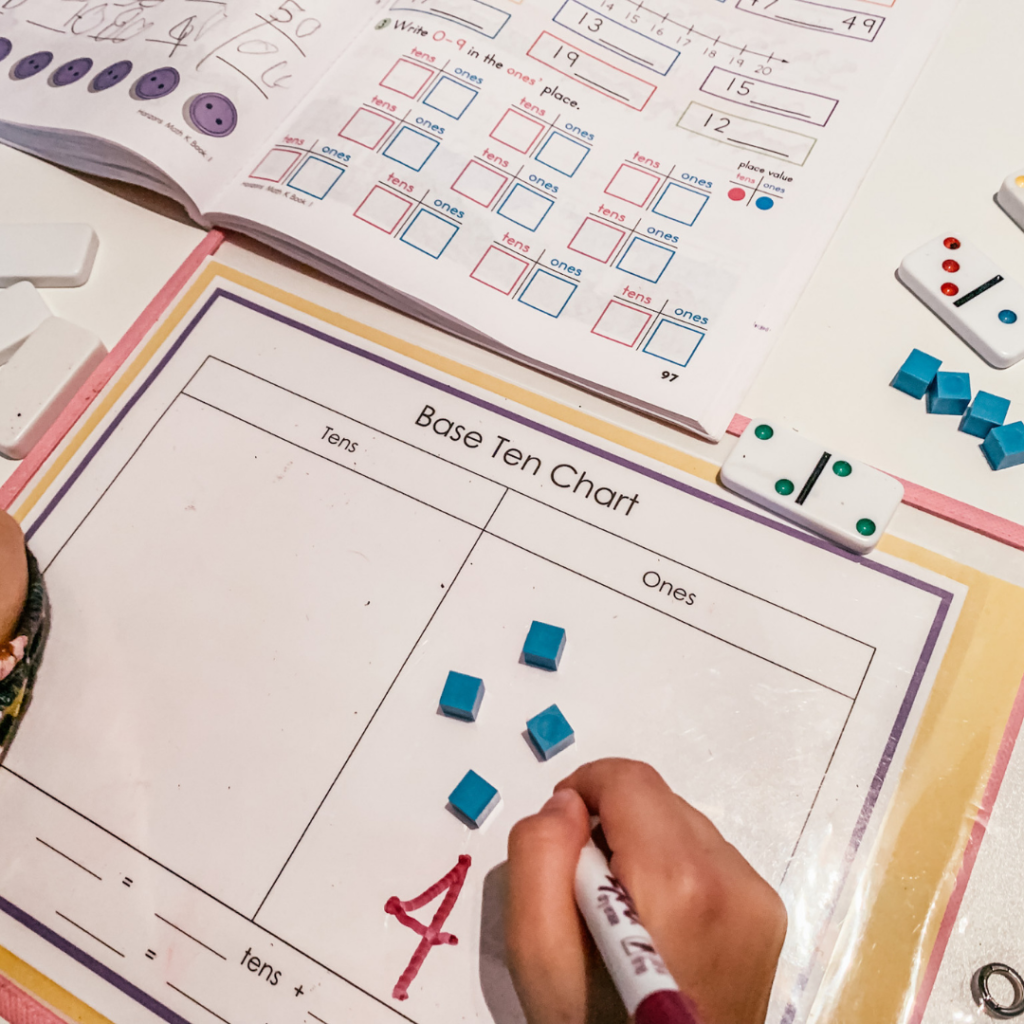
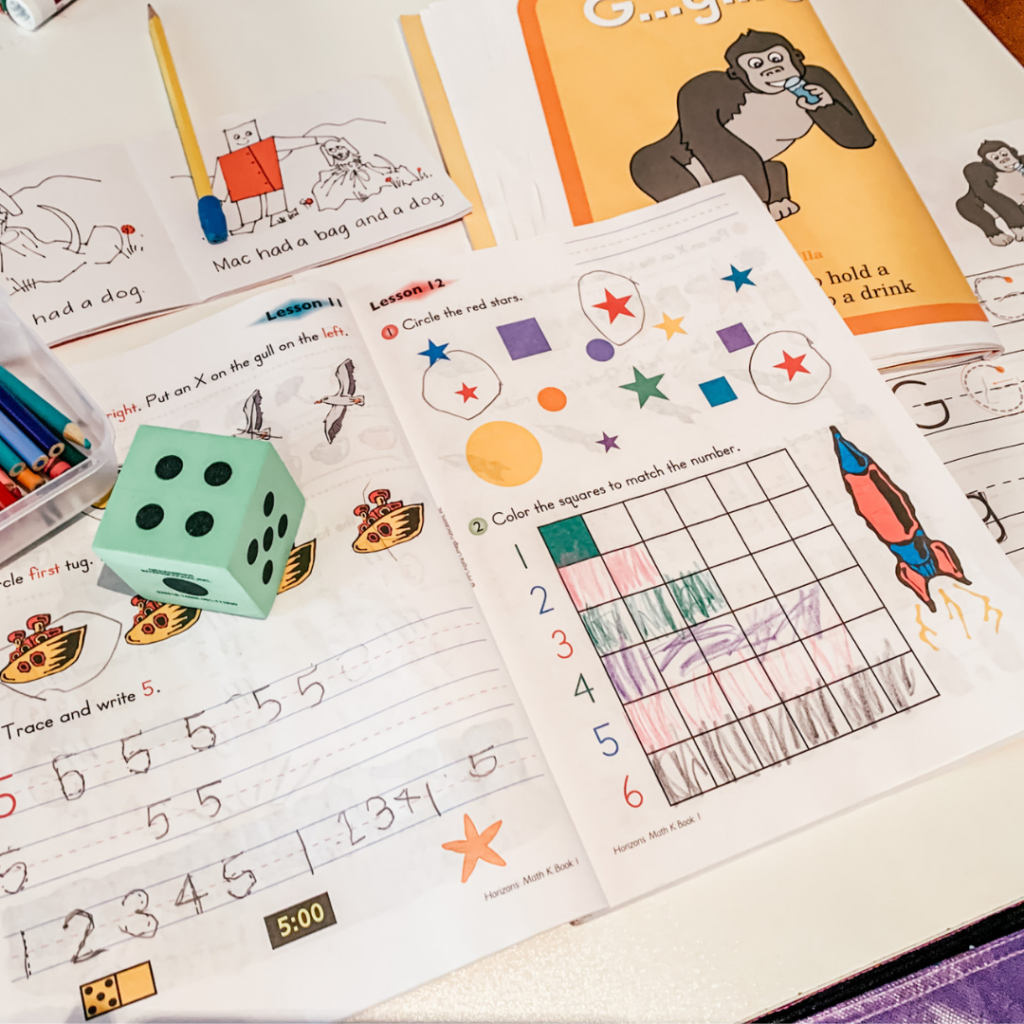
We started our school year the first week of August, and Horizons K starts very slow. It’s wonderful! The pictures are bright and colorful with just a few problems to complete in each section. It’s perfect. We can add a game to re-enforce a skill, and the lesson would be awesome.

Then, a few months in, it started moving very quickly. I tried not to worry. Horizons is set up in a spiral review format, so I knew she’d be getting practice again and again.

I put a large amount of energy into making it work for us.

It was tough to get through a lesson, mostly because it was a lot of problems to get through. We went outside. We played games. We added manipulatives and more movement.

The effort was worth it! We definitely enjoyed it more, but after a while, I could tell it had nothing to do with how “fun” it was anymore…

We took a couple weeks off to re-group and connect

Maybe I was trying too hard. It’s possible I was setting my expectations too high. I was dreading our math lessons, and I knew we needed a break. I prayed about it so much.

Those two weeks were needed. I highly suggest a break when you’re feeling confused about something in your homeschool. Connect with your kiddos and relax. It’s so refreshing and so helpful!

We didn’t do math for two weeks, and then the best thing happened. She ASKED to start again. YES! Ok, this is great. It’s exactly what I wanted. We jumped back in and pushed through.

Just a couple of weeks into January and she was moving on to Book 2. Woohoo! I was a proud mama, and she worked so hard to get there.

But book 2 is a whole new ball game.

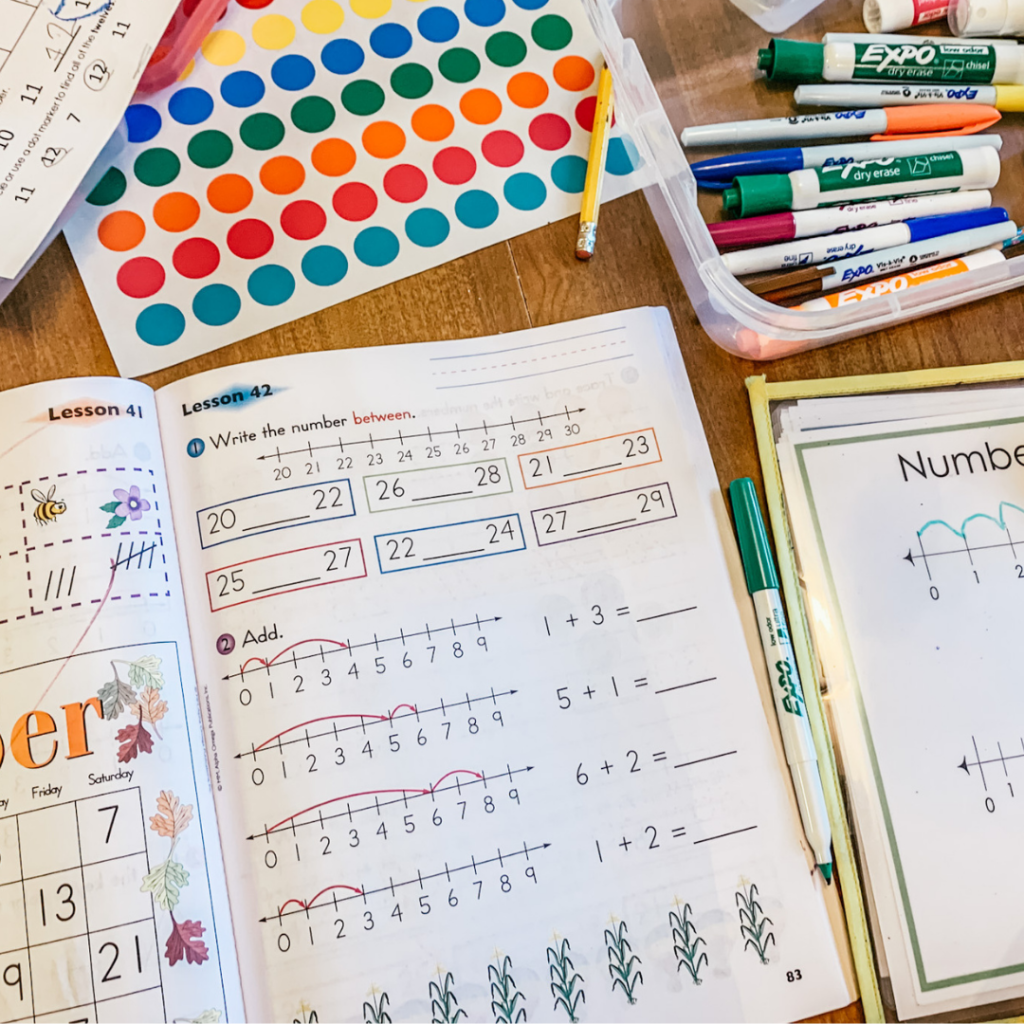
The work practically triples! What used to take us 15 minutes was now taking 45 minutes to an hour. On top of it, I kept feeling like we needed to go back! She needed to keep working on things she’d learned in book one. It felt too soon to be adding in brand new material.

Maybe you’re thinking I should’ve just not made her do all of the problems, and I’m all about that! Sometimes, I cut out half the work in our second grader’s workbook. However, if I feel like the practice is necessary, I want her to do it. I can’t cut the work if full understanding is not there.

It was this weird balance of trying to build her skills and confidence while also not pushing her too hard.

I really don’t remember it moving that fast when my oldest completed it three years ago. Of course it did, but as a new homeschooling mama at that time, I’m betting I just kept encouraging her to keep going- We had to finish. (Or so I thought.)

I’m thankful I know better now. We don’t have to just keep going. I have the freedom to make the changes needed to best fit the needs of my kids.

You know, I really don’t like swapping curriculum mid-year.

I’ve done it once before, and there’s this awkward phase of trying to figure out where to start in the new curriculum and figuring out how the new book works. It’s a scary commitment to me and a big decision! I don’t want to flip-flop from book to book.

There’s a part of me that feels like I’ve done something wrong. Did I do enough? (Isn’t that the million dollar homeschool question!?) I just have to keep reminding myself though that I know my child best.

As you can see, this has been a prayer of mine for months. I don’t think it’s coincidence that something keeps prodding me to change what we are doing. It’s no mistake that it suddenly felt very clear that we needed to pick something else. I truly feel God leading me to this next step in our homeschool.

So, what now?

Well, I have researched a lot of math curriculum over the years. I really do enjoy learning about it. There’s one other program that I’ve thought about using, because it is set up in a simple, spiral review format as well. I’m referring to Christian Light Education.

As I looked through Christian Light’s kindergarten program, I immediately went to their sample books and My. Jaw. Dropped!

Three quarters of the way through the units, and we would be counting dots on a domino for math. Wait…what?! We were past that. WAY past that.

Two feelings came over me. 1) That’s way too easy for her! 2) Oh my goodness, I feel awful that I’ve been pushing my daughter so hard.

In order to practice the skills that my daughter needed, I had to purchase the level one book. I’m talking- skills we learned back in August. WOW! This program was at a completely different pace! I felt so weird getting level one, but as I reviewed the scope and sequence over and over, I knew it was a good fit.

Honestly, even level one is MUCH easier than what we are doing now, but I want to start slow. I am not in a rush. This was even more proof to me that I made the right decision. Horizons was very advanced.

My goal for the end of the year is simple and easy-going.

I have hopes to work through book one and book two of CLE to end this year. Then, we will take a summer break and I’ll pick up where we left off for her first grade year.

It’s kind of nice because normally so much time is wasted reviewing at the beginning of the year. In our case, we are doing that at the end of this year and moving forward at the start of next!

This is very new to us. I plan to update you guys soon on how it’s working for us.

Let me go on one short rant here…

First, always make the decision that’s best for your kid. Stop thinking about how YOU feel (ahem…speaking to myself) and think about your child’s needs.

Every. Child. Is. Different. Like WAY different – I have four completely different kiddos in my home, and I am so grateful that God has chosen me to be their mother. He has given each of them their unique gifts and abilities, and it is my joy and pleasure to help them grow up and live out the purpose he has set for them.

My oldest child is a numbers girl. Math comes easy for her. I only bring this up because Horizons has been amazing for her, and we plan to stick with it. This is proof that it really is about the child. As much as I love Horizons, I’ve learned it may not work for all four of my kids the same.

Think about what brought you here to this post. You probably have something on your mind about math, whether its what curriculum to buy or which one to stop! If you haven’t prayed about it, take a minute and do it. My homeschool changed drastically for the better when I started praying about specific needs in my homeschool. (God is so faithful!)

I am not one to say, “Yes! Change it! Get something new!” But, sometimes, we just know that it’s not a good fit.

There’s so many options out there! Sometimes I wish I could just have a little taste of all of them in one book. Wouldn’t that be nice? Here’s the thing – no curriculum is going to be perfect for you. Not ONE. So, pray about the steps to take in making it work. Does that mean changing it up a bit? Shortening the lesson? Adding in games? Switching to every other day?

Or…does that mean it’s time for a bigger change? It took me almost three months to finally say yes, but I’m so glad I did.