Posted on Leave a comment

End of Year Curriculum Review – Family Subjects

As we come to the end of the year it’s always good to look back and reflect on the curriculum we use and how it fit with our homeschool. As a mom of four, I try to teach as many subjects as I can as a family. So, in this post, I’m going to share with you all of our family subjects plus the curriculum that worked and what didn’t.

This post contains affiliate links. If you follow one of my links I earn a small commission at no extra cost to you. Thank you for supporting my blog!

Bible

I started the year with “Who is Jesus?: Forty Pictures to Share with Your Family”. I actually really loved this one, but for some reason we quit using it after a few weeks. As I think back about why, there’s really not a clear answer besides the fact that I may have wanted to simplify/shorten our morning time for a bit.

The pictures are memorable and the devotions are meaningful, but I might have decided to put it aside for a while to wait until my littlest ones were just a bit older. With two under 5 years old, our morning time can’t get too long or I lose them! I do love this devotional, and I will definitely pull it out again in the future.

The devotion book that we stuck with for most of the year was 365 Trivia Twist Devotions. This devotion is family friendly and engaging. It doesn’t really go in depth, but it was a great fit for what we needed at the time.

The trivia devotion is a great book if you have young kids OR if you’ve never really read devotions as a family before. The trivia facts are really fun and it’s “light-hearted”. I know that might not be the greatest thing to say about a devotional, but sometimes it can be intimidating to start family devotion if you’ve never done it before!

We actually added Dad into our morning time with the trivia book. He works from home, and it was the perfect way to kick off our morning as a family. Because of the nature of the book, he was able to jump right in and lead us each morning.

As we came to the end of the year, we ran out of our trivia devotions, so I pulled out my tried and true Louis Giglio devotion books. For the last couple months of school we’ve been reading through “Indescribable”. I really do love these books for the whole family. Plus, it’s bible and science in one! That’s a win!
History

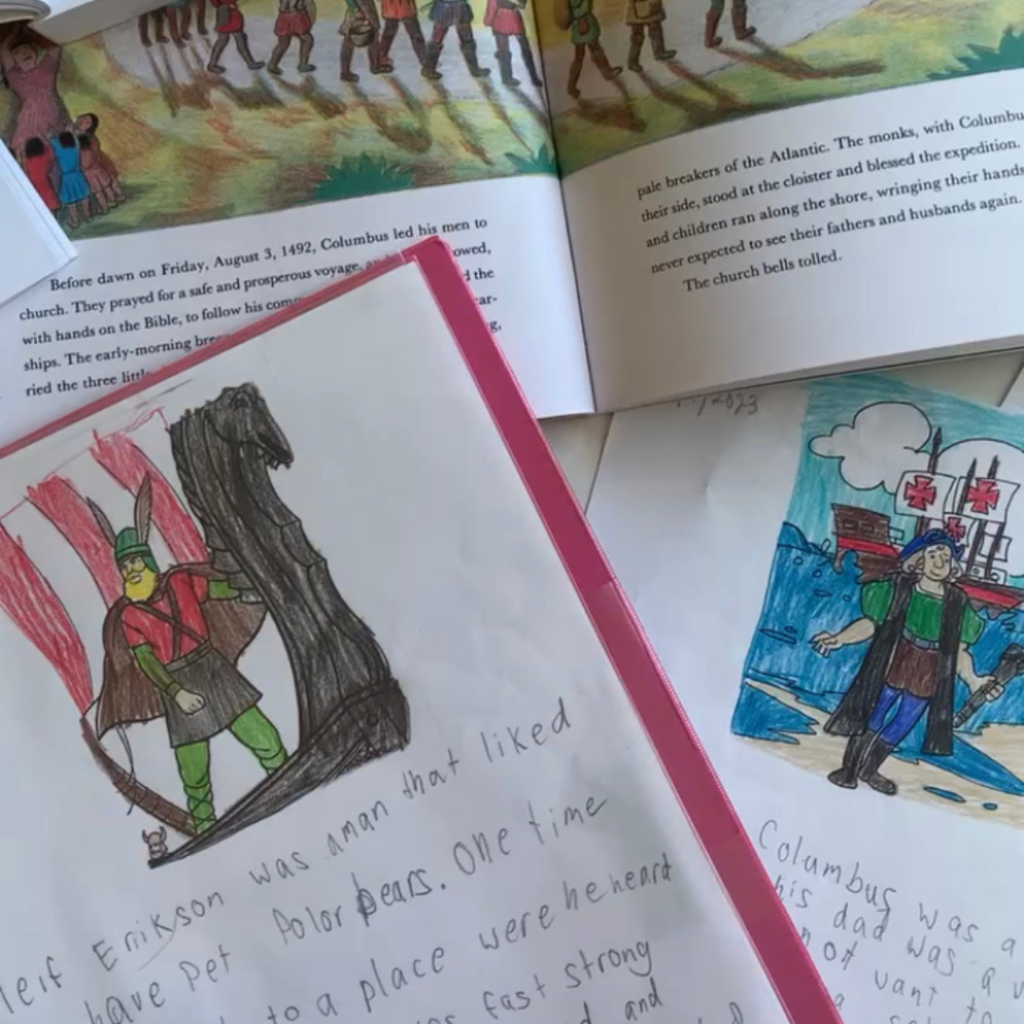
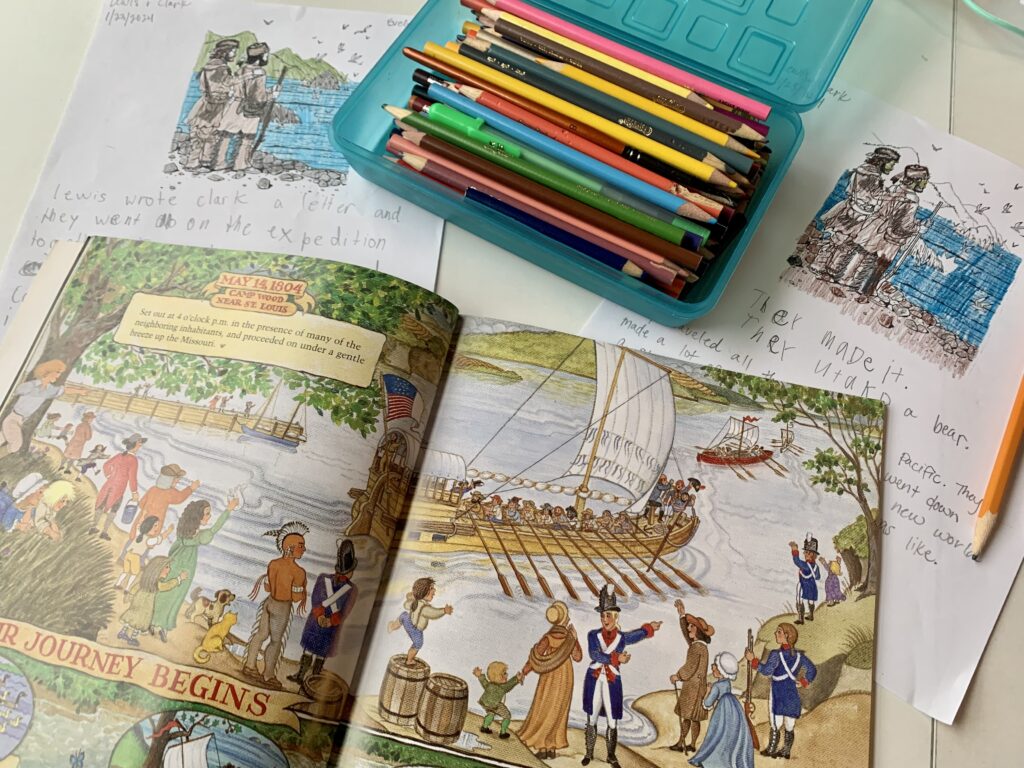
This school year I wanted to simplify our history by focusing on engaging picture books. We all know that a beautiful picture book is so much more memorable than a textbook, and I knew I wanted to give that to my kids. As a result, American History through Picture Books was created!

I was certain I could work through the timeline of American History with Picture Books, and after a lot of research, we did just that! Our history this year was one amazing picture book after another. I can’t even describe to you how simple and enjoyable it was. We learned so much! Yes, WE! It includes ME! It’s like I’m learning history all over again with my kids, but this time it’s actually sticking!

This was no worksheets, no extras – just a simple checklist of picture books that completely simplified our history lessons for the better. We worked through part 1 which covered explorers through the Treaty of Paris (1000-1783) and in the spring we completed part 2 which covered the constitution through the civil war (1787-1865).

I am currently researching for our picture books for next year, and I can’t wait to continue this style of learning for history. If you’d like to read more about this curriculum, check it out in this blog post.

Science

Why is science so hard to do? Is it just me? It’s always the subject that gets pushed aside. I struggled with science this year, but towards the end of the year I found a much better fit/groove for us, so I’m excited to share more about that.

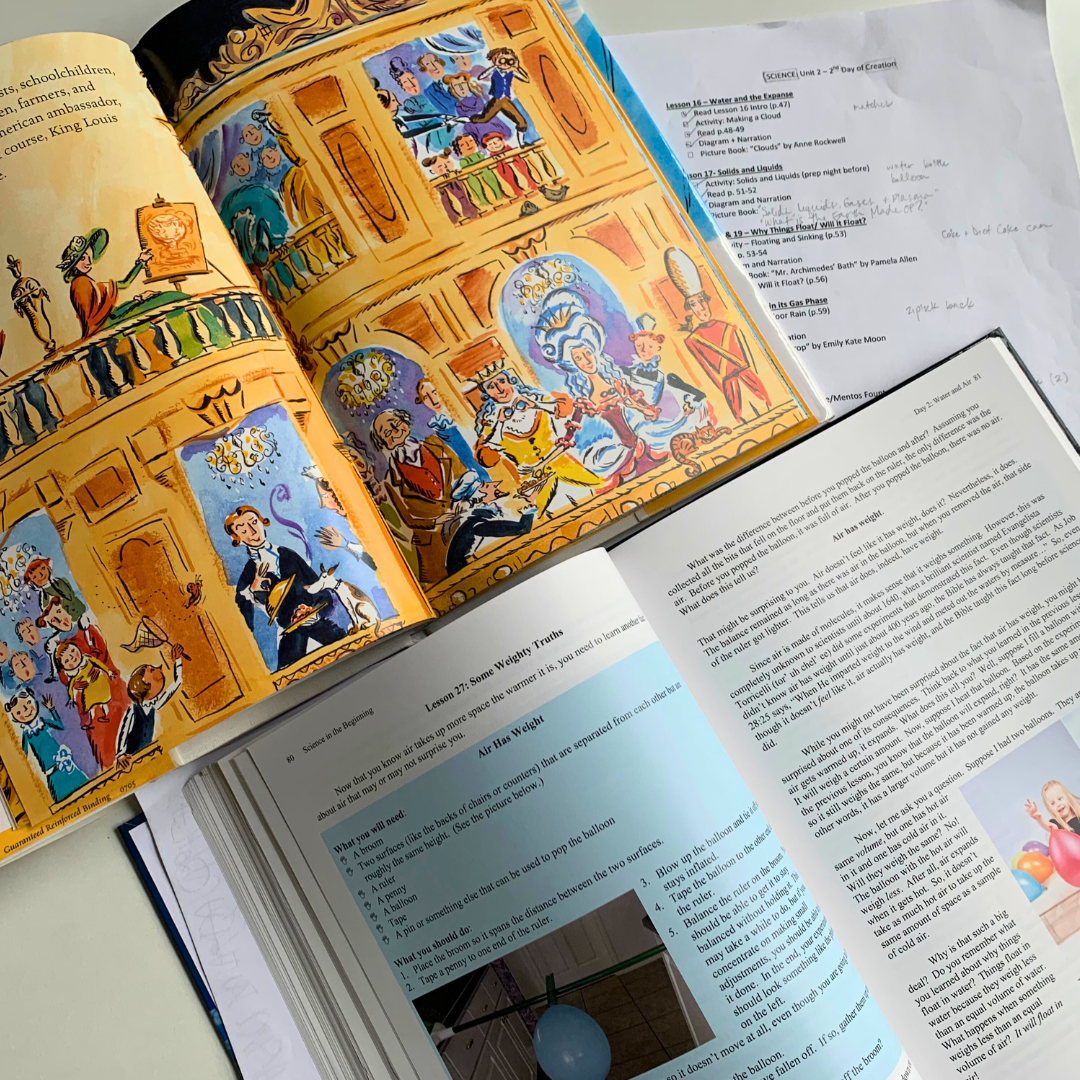
We started the year with Apologia Science – Zoology 1. I was really excited about this because the text was written a little differently than your average textbook. It was just a much more fluid, engaging read. I also loved that there were activities throughout the lessons that seemed do-able and not too intense. All of the pictures were beautiful, and I really had high hopes for this one.

Unfortunately, it really wasn’t my favorite. I ended up using it more as a guide instead of our textbook. For example, if there was a lesson on butterflies, I would just go to the library and get books about butterflies. Sometimes we would do the activity in the book to go along with it.

I think the lessons were just too long. It was hard to read through an entire one (we even tried the audiobook!) and it was tough to skip around because I felt like the information was good! The other problem I had with it was after a while I was ready to move on to a new topic. The whole textbook focused on flying creatures, and it got to the point where I needed something new.

After Christmas I searched and searched for something that would better fit our family. This is when I found Berean Builders. I love how short the lessons are, and I have also loved the activities that come with each lesson. Many of them use supplies we have already at home.

After a few weeks of using it though, I did find myself tiring out of preparing activities every time we did a lesson, so recently I’ve slowed us down a bit and I have loved the rhythm we have created. In a week I will spend one day doing the activity and reading the lesson. Another day of the week, I read a picture book that goes along with the lesson.

This does take some extra planning on my part, but it feels so much more do-able than doing an activity every single time. Plus, we are really learning a lot from the picture books we read as well. I’m hoping to share this planning process (and our picture books that we picked!) with you guys soon, so stay tuned for that science update.

If you’re interested in looking into Berean Builders, check out a couple videos I put on Youtube. One is an introduction of the text. The other video is an update on how we use narration/notebooking alongside it.
Bedtime Studies

Bedtime studies sounds kind of silly I know, but I have found the wind-down time right before bed to be the perfect time to complete a few different things I want to teach my kids. So, I’m including all of this in our family studies. You can watch about how I do this in this video, but the following things are all included in our bedtime routine!
DIY Language Arts/Read Aloud

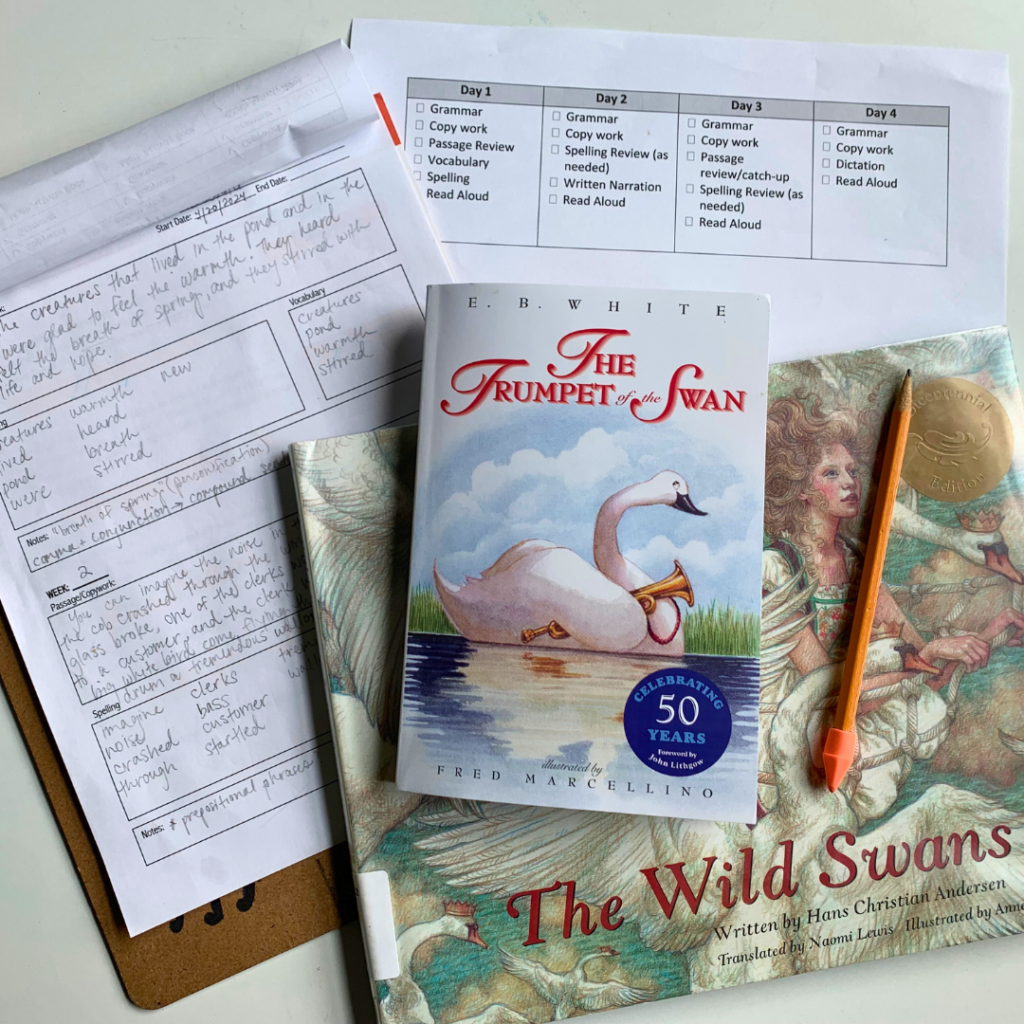
A year and a half ago I ditched our all-in-one language arts curriculum and decided I would make our own based on the novels we love reading together. It was the best decision I ever made. We have so much more freedom now with language arts and it has really increased our love for books!

At night I read aloud the novel that we are studying for language arts. This includes all of my kids except my youngest, so that language arts really becomes more of a family subject – which simplifies things so much!!

My oldest then has other lessons related to the novel, but I feel like that would be a completely separate blog post. Check out my DIY Language Arts playlist HERE.

Soon I will need to review all of the read aloud we did this year. There were so many! Some of my favorites included “Willodeen”, “Mixed Up Files of Mrs. Basil E. Frankweiler”, and “True Confessions of Charlotte Doyle”. You can see all of our novels in my Language Arts Read Aloud list through Amazon.

Scripture Memory

Starting in December, we started memorizing one bible verse a month. I usually pick the verse based on what I want my kids to think about at the time. For example, when we were dealing with bedtime fears, we memorized a verse about not being afraid.

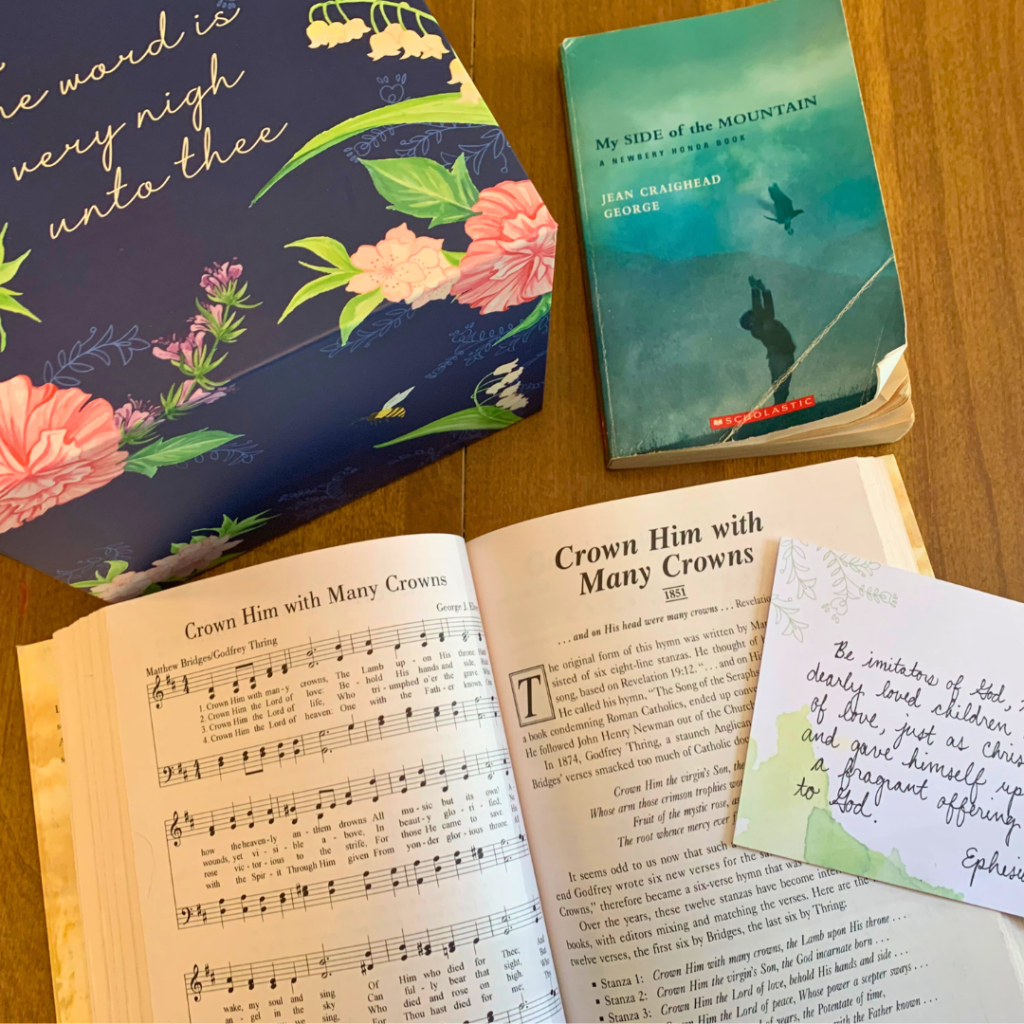
Recently, I was sent a beautiful scripture memory box from Shop Butter N Honey, and this has helped us keep the verses on our hearts. With this memory box, we are able to practice and review the verses every night. It’s been so much fun and my kids love seeing what they remember each night.

I love adding scripture memory before bed. It doesn’t feel like “school” and it really does set the tone for bedtime. The addition of the memory box was so helpful because it has allowed me and the kids to keep reviewing our verses even after the month is over. I hope to keep this habit of bible verses before bed even through the summer.

Hymn Study

I have always wanted to study hymns with my kids. I tried adding it into our morning time once but it didn’t stick. Then one night I randomly sang a hymn to the kids and we’ve been singing every night since.

I choose one hymn a month from a book called “Then Sings My Soul”. I grew up with traditional hymns in church, so I just choose one that I can remember the tune. Eventually, I’ll probably end up having to look them up on YouTube or something.

This has been such an easy way to memorize hymns. The book comes with a little description of the author so we read that and memorize the first verse together. Each night (most nights) we sing the verse and by the end of the month it’s memorized.

I have loved learning hymns with the kids and the way we do it has been so simple and effortless. I definitely love using this book as well because it gives us a little background of the hymn we are learning.

What’s Staying?

Well, I plan to continue almost everything next year! I do have a new plan for our devotional. I’ll be picking some new read alouds of course. I’m most excited for our next American History unit and all the books we will be reading for that. (The unit will cover post-Civil War through World War 2 and will be available to you around Christmas 2024) Science will keep going with Berean Builders now that I have found a better groove.

Overall, I’ve been happy with our family studies. I will make a few tweaks here and there, but once that’s done I’ll probably do a YouTube video sharing our “official” picks for the year! I’m ready to get into planning mode soon!
Posted on 7 Comments

ABeCeDarian Reading Curriculum – First Impressions

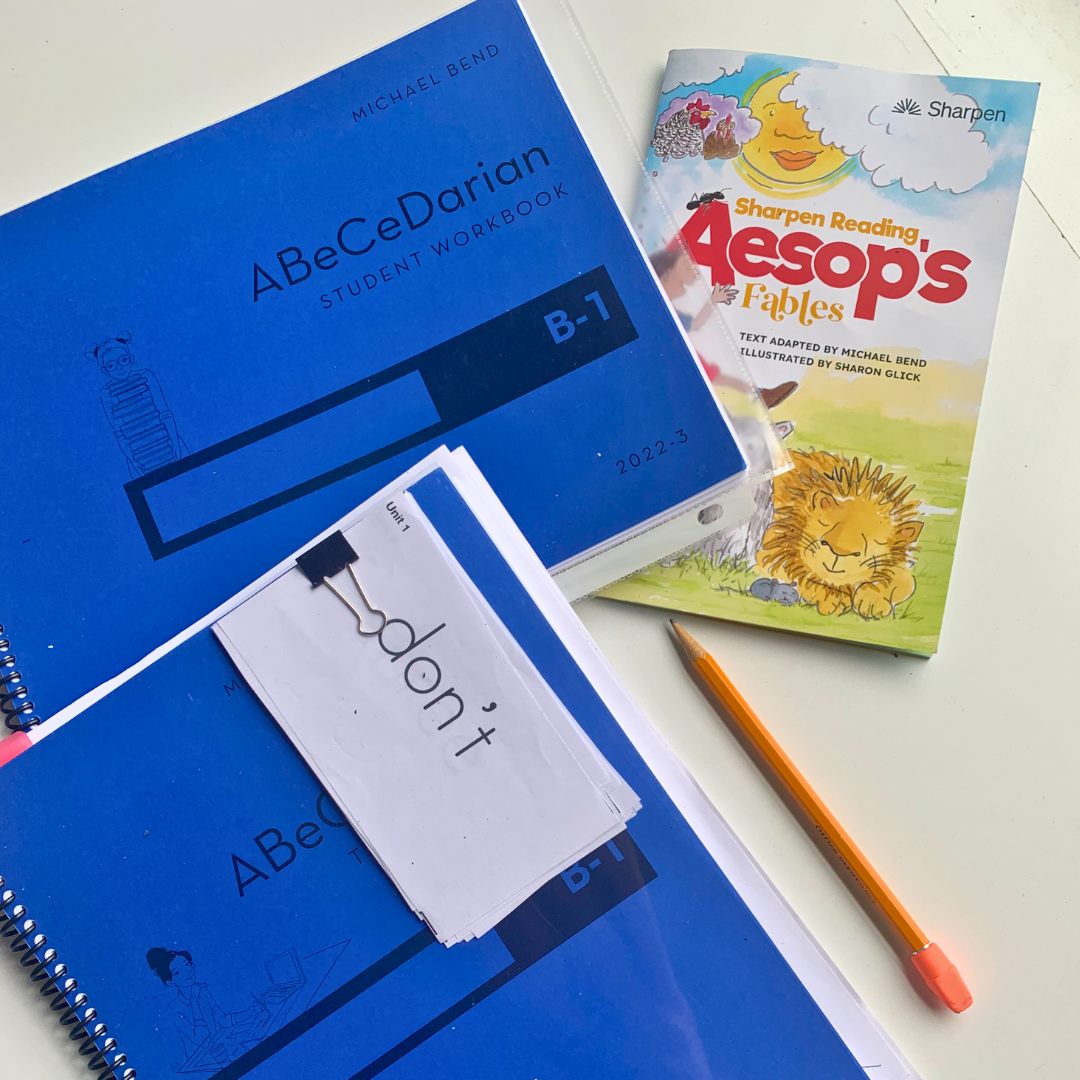
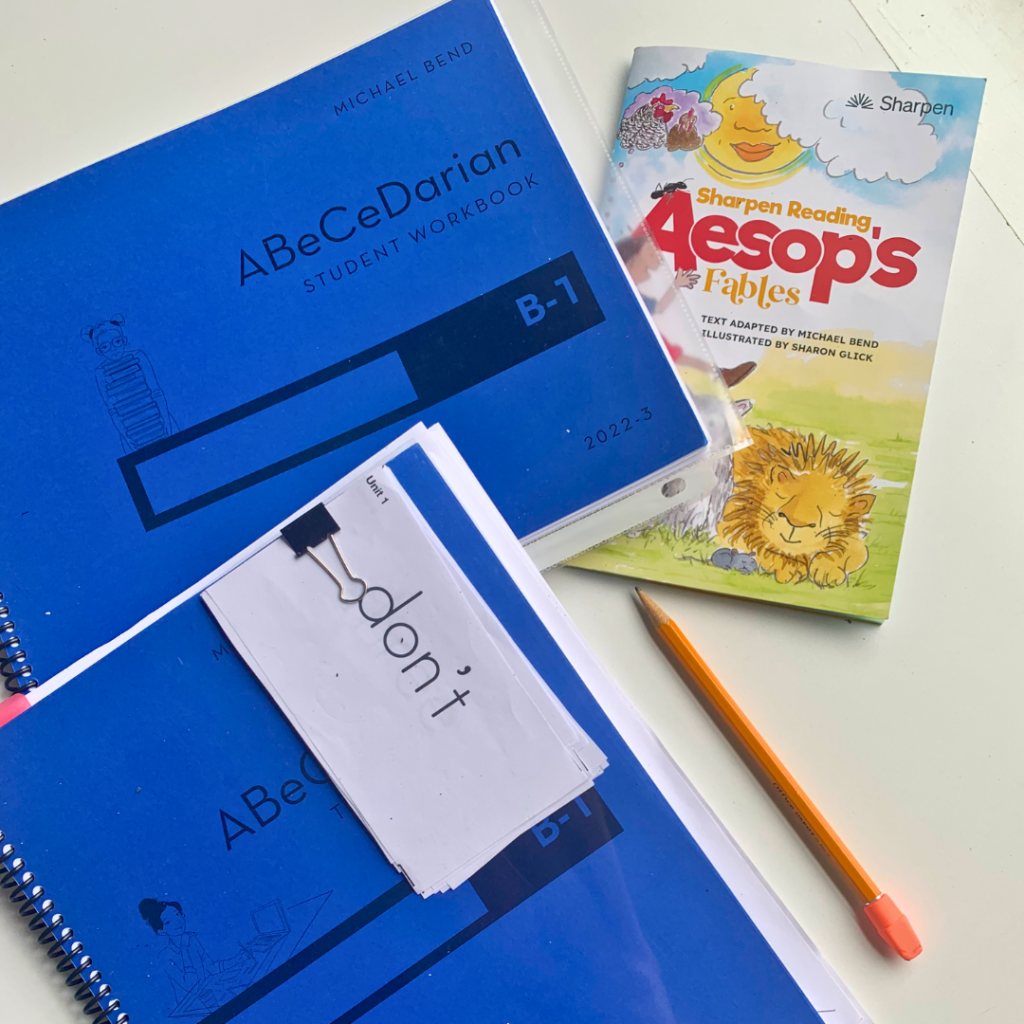
We recently switched our curriculum to the ABeCeDarian reading program. I had never heard of it before and I had a hard time finding a lot of information about it online. So, I’m so excited to share with you our first impressions about it.

I recently published a YouTube video describing our first impressions, and it also contains a complete look through of the level we are using. Be sure to check it out to get a thorough look into the teacher guide and the units.

This post contains affiliate links. If you follow one of my links I earn a small commission at no extra cost to you. Thank you for supporting my blog!

Why We Switched

This year was a big review year for us. In the previous school year we completed Foundations A and B from Logic of English. It went really well, and I thought the curriculum was great, but I felt the need to review some more.

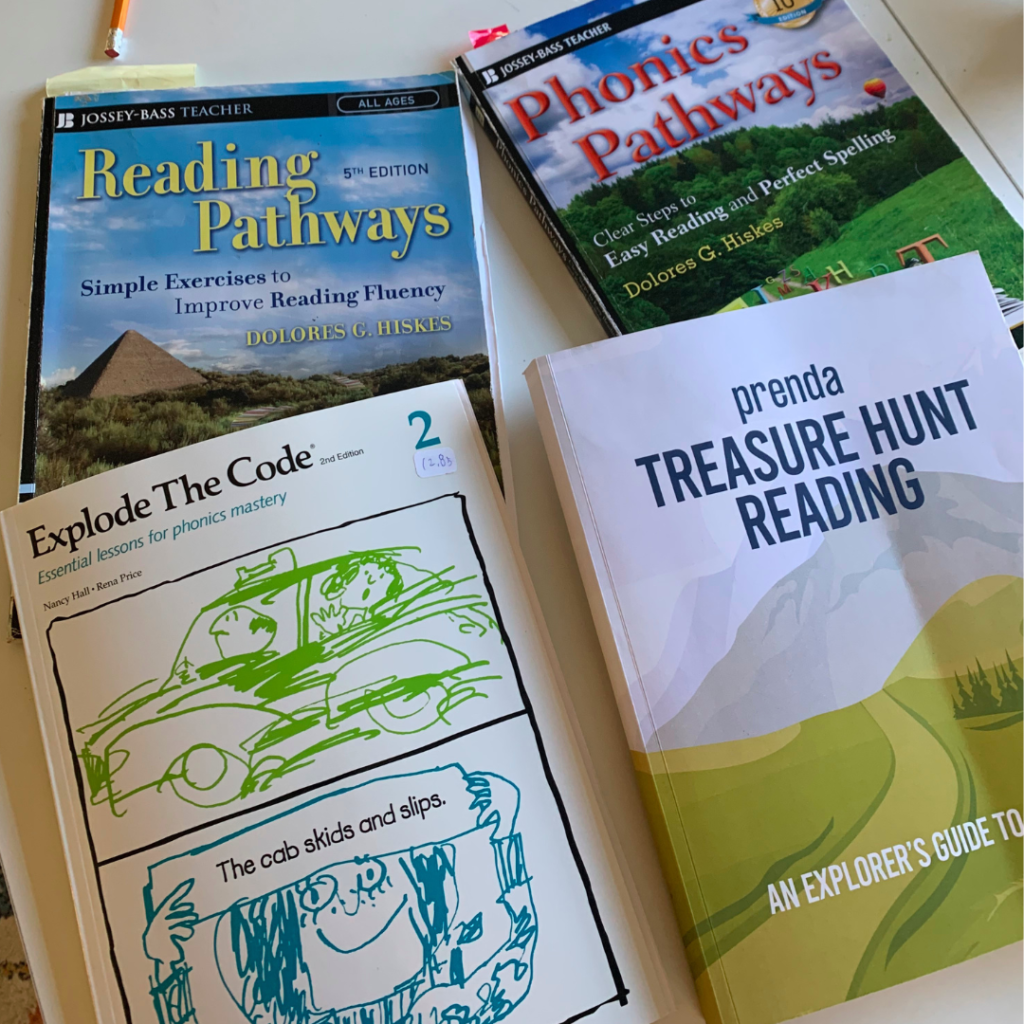
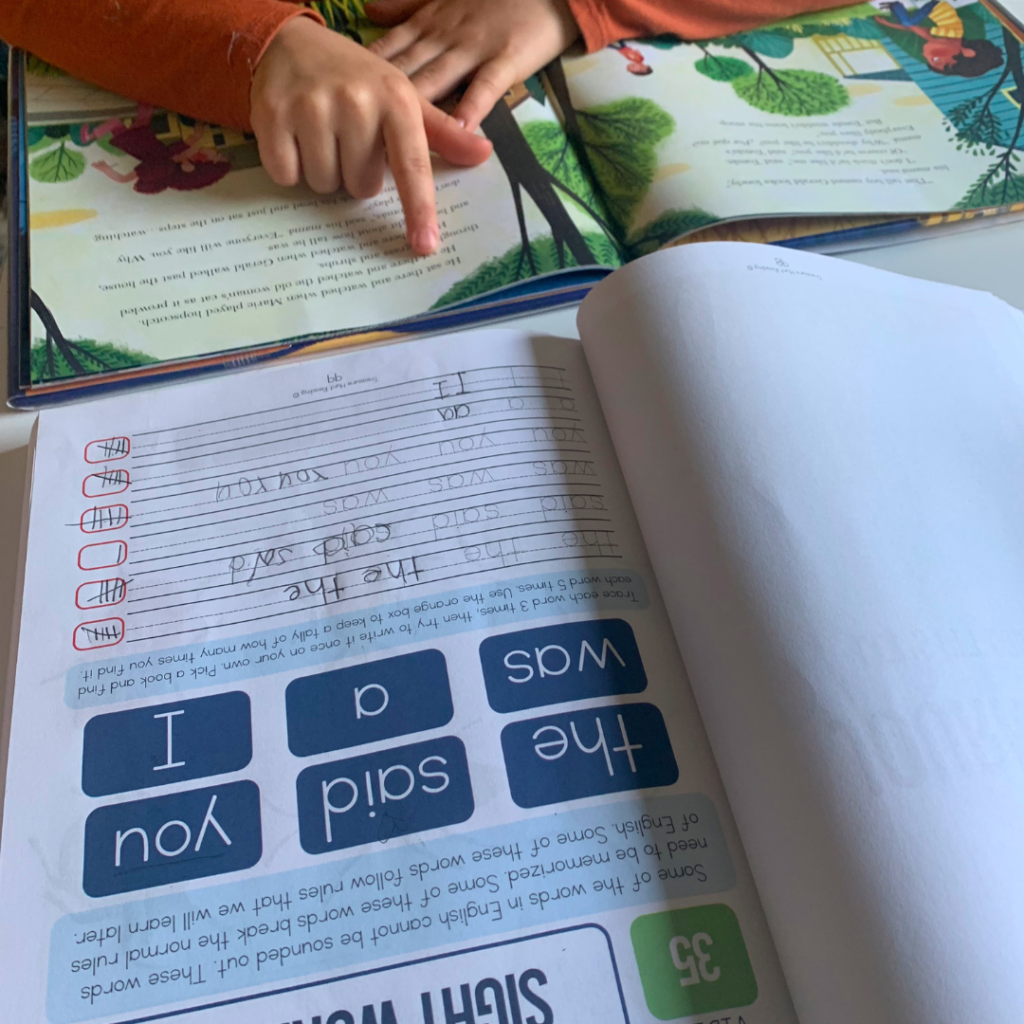
At that point I found a couple different programs that I used together to help me do this. One was called Treasure Hunt Reading. This was a super cute, inexpensive workbook that came with free online videos. My daughter loved the video host, and it was just a great way for us to get some review in without feeling like we were starting all over.

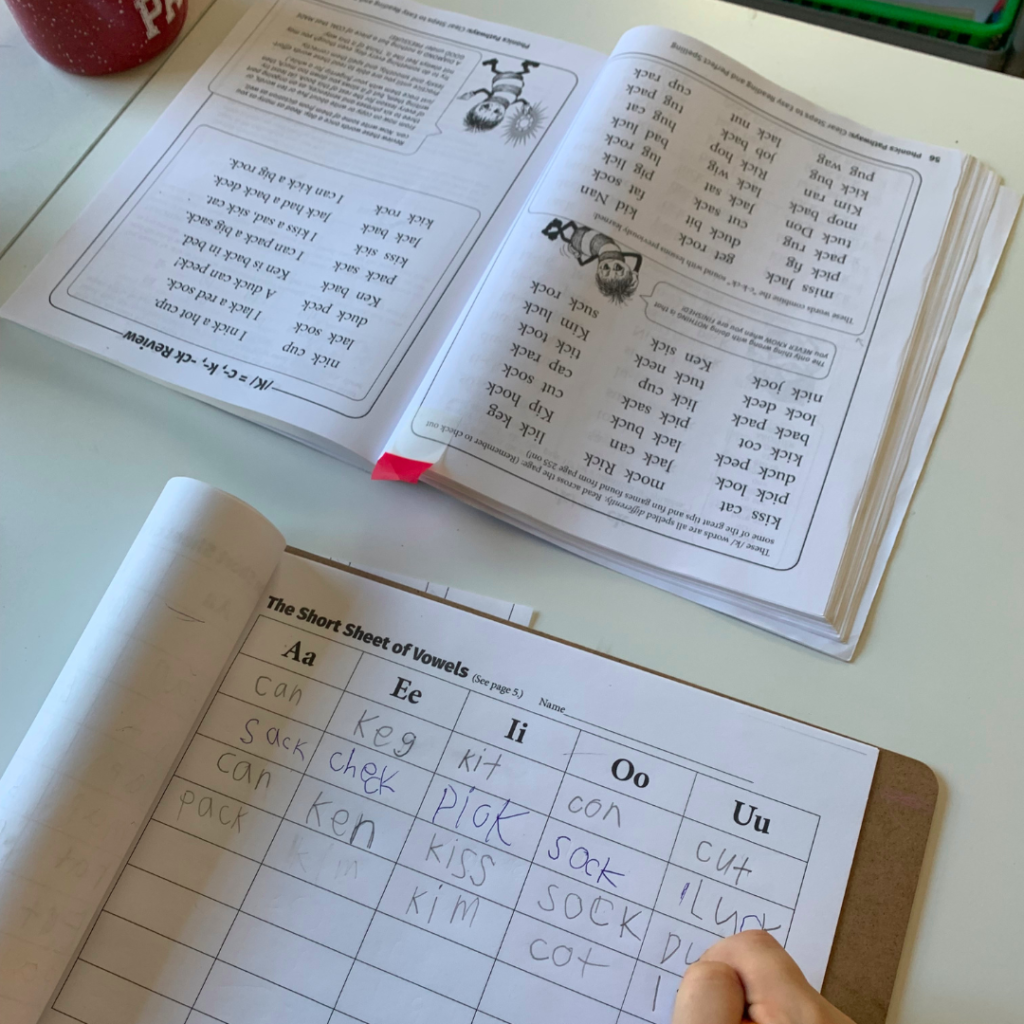
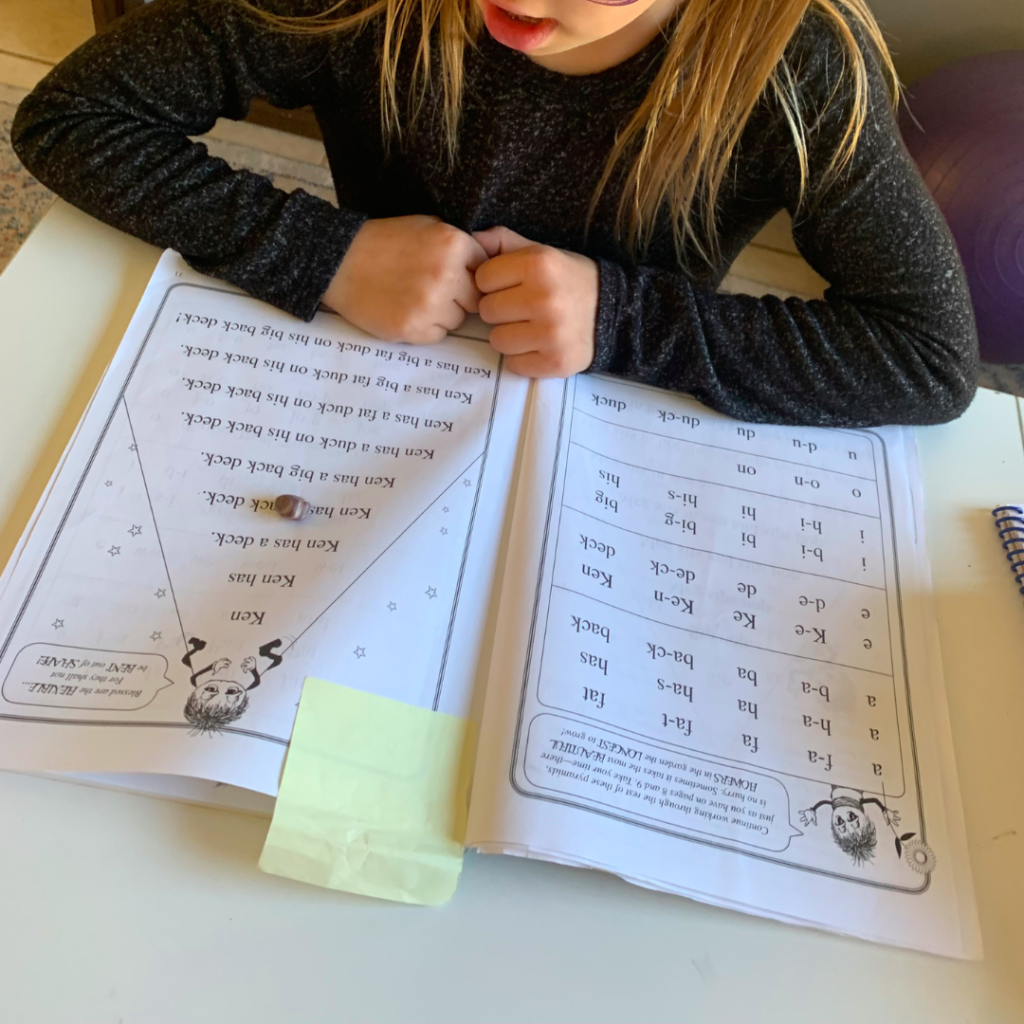
The other program we used was called Phonics Pathways. This was much different than Treasure Hunt Reading, but it is specifically made for students that may need extra reading instruction. As we used it, I could really tell she was starting to improve in her blending skills and at the same time I was learning so much about phonics and teaching reading.

You can see a look through of both of these workbooks on my YouTube channel: Phonics Pathways and Treasure Hunt Reading

We used Treasure Hunt Reading off and on, but we were more consistent with Phonics Pathways for about eight months. After a while though, we started to feel bored by the lessons and it was a struggle to complete a short ten-minute phonics review. At this point I knew I needed to try something different.

Why ABeCeDarian?

I started by searching the internet for reading programs that helped struggling readers. I have had my eye on Pinwheels for about a year, but I just can’t get myself to commit to the cost and the printing involved! Then All About Reading came to mind which has such a great reputation, but once again the cost was a factor.

I wasn’t looking to spend $150+ on something. I had already done that with Logic of English (which was worth it at the time!) However, I didn’t think it was the right move this time.

Then I came across a video on YouTube where a mom described Abecedarian and how her daughter started reading so quickly and became so confident. Now this was what I needed! I wanted a confidence boost in my house. With all of the review we were doing, I felt like my child was in a place where reading just didn’t interest her at all!

abecedarian workbook

Materials

After reading about the different levels, I chose to start my daughter in their B-1 Level. I bought the teacher guide for about $25, the student book for about $25, and their leveled reader for $12. So, for about $65 I was set to try this out.

This B-1 level contains 12 units, and I figured it would help me get through the end of our school year. Once we completed it, I could re-evaluate where we were at and if we wanted to continue.

The workbooks for ABeCeDarian can be purchased on this site.

Teacher Guide

The Teacher Guide is jam-packed with information. My favorite part is that at the beginning it contains of Quick-Start Guide. So, with just a little bit of reading, I could start the program immediately. Then, I spent the next few days reading more of the information provided.

The guide includes a description of the components of reading, teaching struggling readers, descriptions of all the activities, tips on error correction, scheduling and more! It’s quite the read, but it’s very helpful!

unit sounds

First Impressions

After you complete a unit, your child is supposed to read a fable from the leveled reader. After just one unit, my daughter read the fable so well! I literally cried listening to her. I was so proud, and she was SO happy! It’s like a huge bulb went off and suddenly she was so interested in reading and overjoyed that she could do it!

I started noticing her trying to read out in public – signs, papers, words on a TV screen. She was recognizing some of the sounds we had been practicing. She also started getting books from the library and was making an attempt to read them – and was doing really well!

This would’ve been unheard of before. I feel like in the past she just felt like – “I can’t read.” Now, suddenly, she had this feeling of “…maybe I can!” And I was thrilled!

key words

Nothing Like I’ve Seen Before

This program is nothing like I have ever seen before – seriously! In the teacher guide it tells you not to use terms like “silent e”, “short vowels”, “buddy letters”, and more. Every reading program we have ever tried always has some type of trick to memorize the rules of letters, and this guy is telling you – don’t even say it! Isn’t that crazy?

Sight words are another example. He explains that many programs state sight words need to be memorized because they don’t follow the normal rules. Then he goes on to explain that your child WILL be breaking down the sounds of these letters and a “sight word” category of words is completely unnecessary.

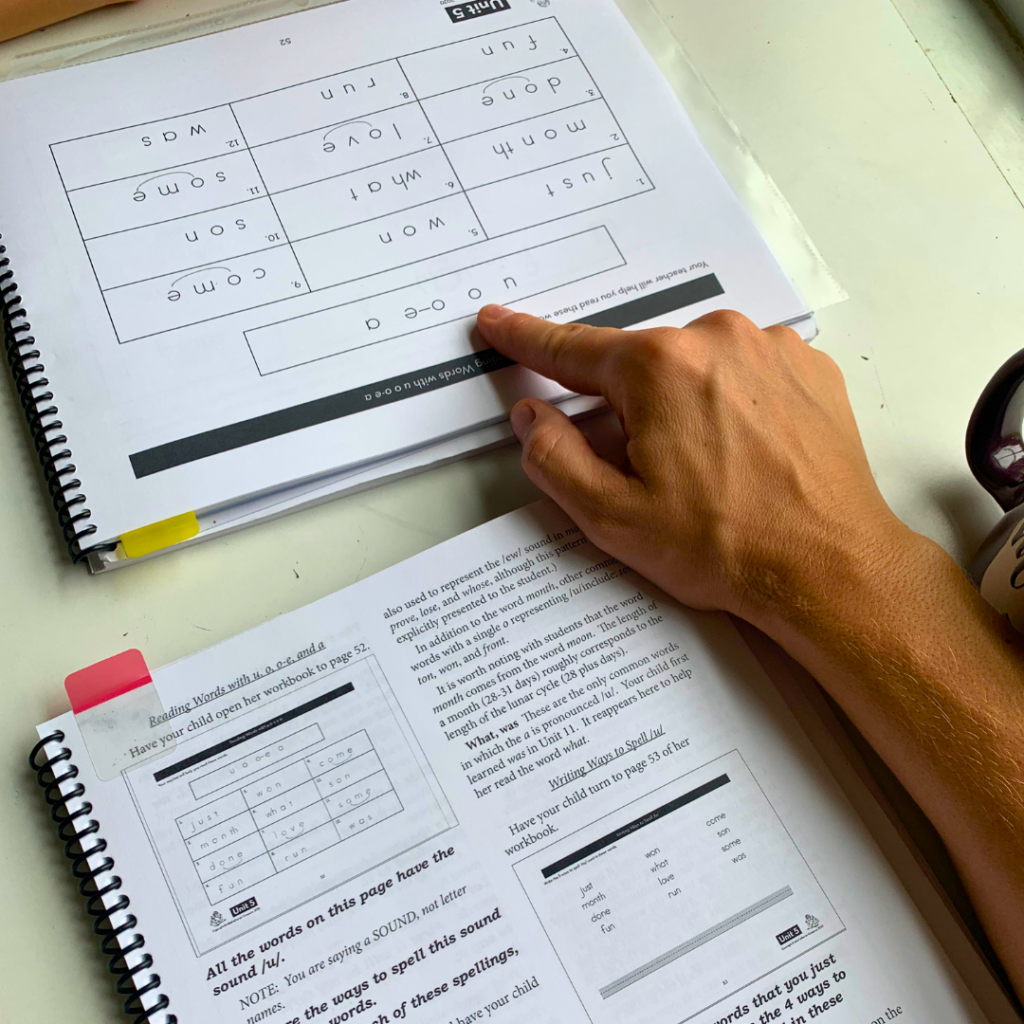
Instead of teaching letter by letter or even a group of letters, this book teaches vowel sounds. So for example, the unit we just completed taught the sound /u/ (what we might know as the short u). However, it doesn’t describe it like that. Instead it introduced four different groups of letters that make that same sound.

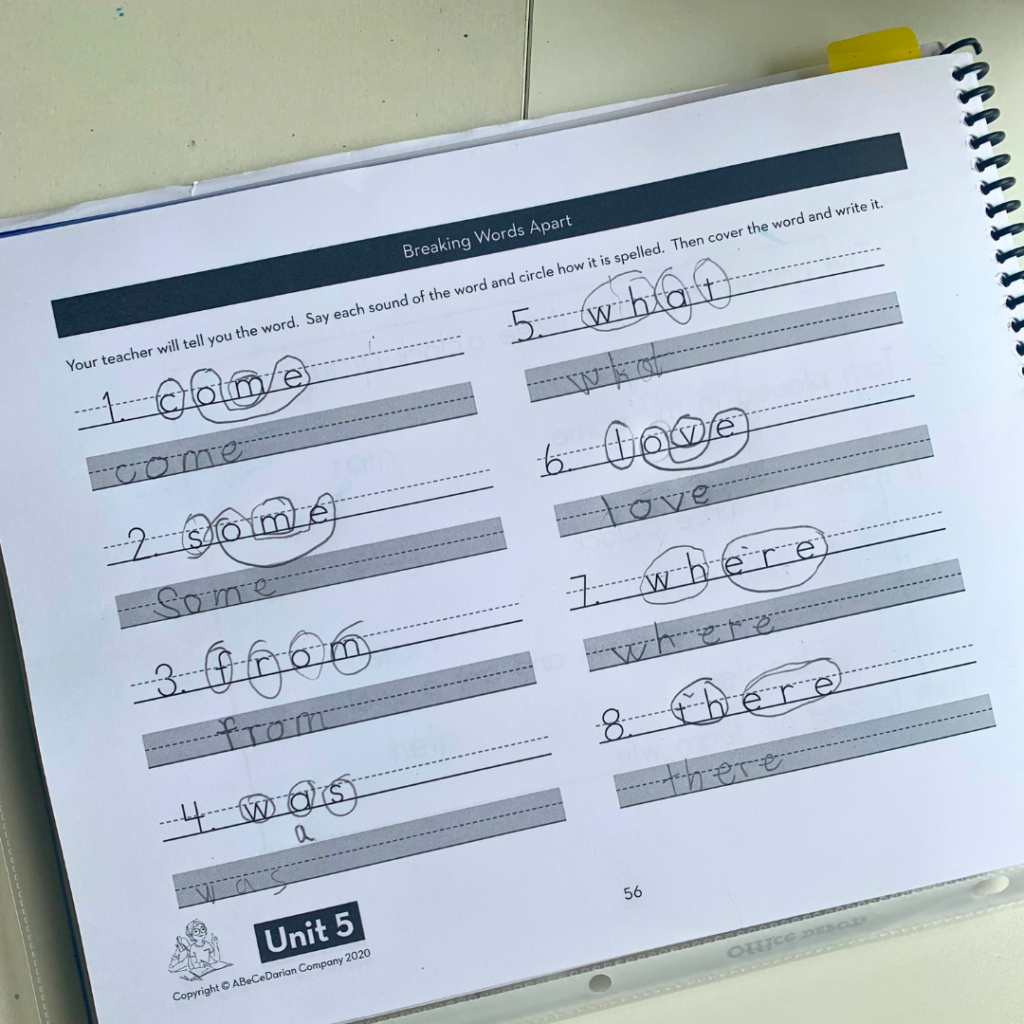
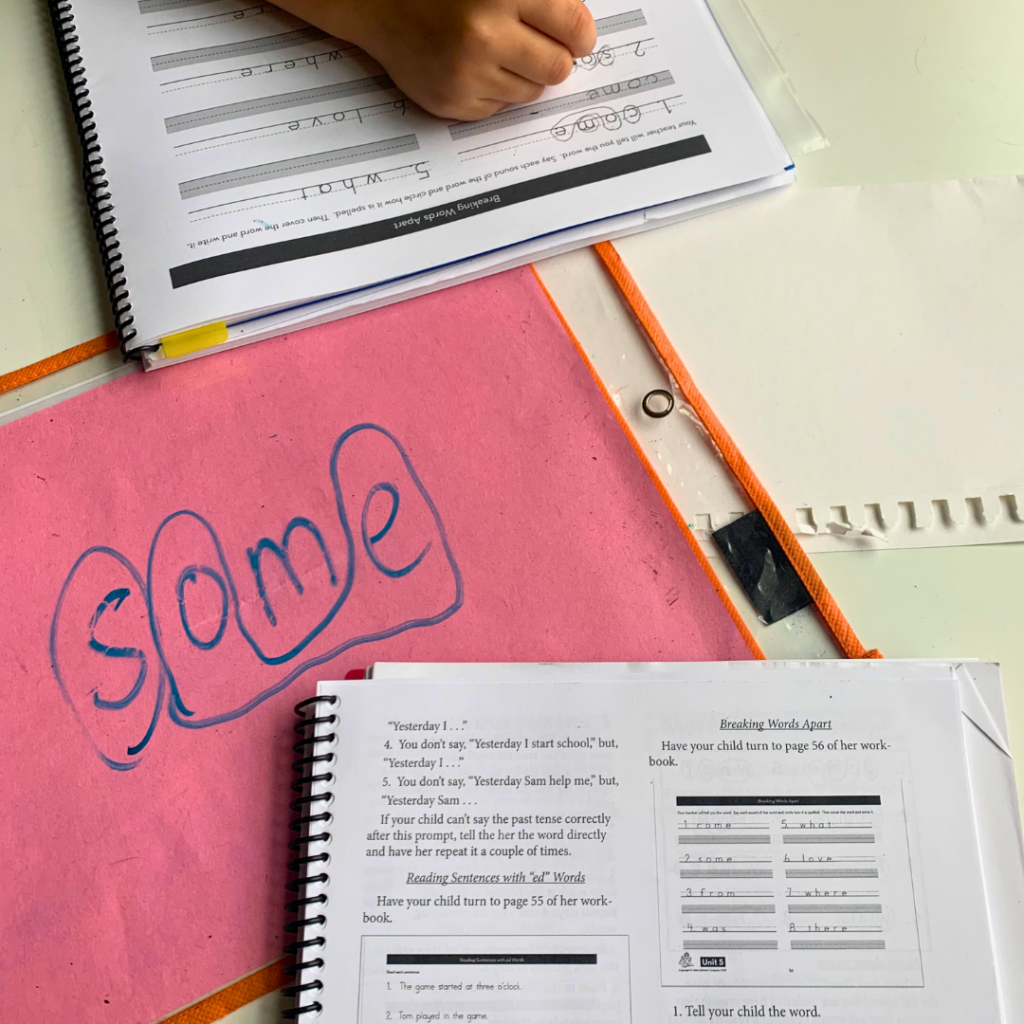
One unit focuses on eight key words that make the particular sound. So, by the end of the the unit your child will master the eight words and continues to review them with flash cards, the leveled readers, and eventually fluency lists.

key words 2

Getting Started

I can’t express enough to really get to know this program before you jump in. It is VERY unique, and I think it’s important that you recognize that and make sure it’s the right fit for you family. I found 1-2 videos that helped me, but I also now have published a full look-through on YouTube that may be helpful.

Check out their websites. Yes, that’s multiple sites. From what I have researched, ABeCeDarian is now under the name Sharpen. The original website still exists and contains information about the different levels, downloadable resources, and samples to the units. However, if you want to purchase their units, it will re-direct you to their Sharpen site.

Take a look at some of the videos the website offers. The videos are a little outdated, but you can watch the creator tutor children using the program, and it is SO helpful to see him do it. Some of the terminology he uses and his correction process is really interesting to watch. It really helped me understand what I was about to teach.

Online Edition

If you click around on the Sharpen site, you may notice that the company provides an online version of this program as well as some tutoring options. I am not familiar with this at all, but I do know they offer a trial and from what I have read, it seems like the online version is the same as the text.

Curriculum Goals

I have been so happy with the progress I have seen using this program. Now, that we are halfway through B-1, I understand the teaching method a little bit better and the lessons don’t feel as overwhelming as they did with the first 1-2 units.

There’s no way I can stop this now. I have seen too much progress and such a positive attitude switch in my child. I don’t think we will get through the book by the end of the school year, so my hope is to somehow incorporate it into our summer review. I’m still thinking about how to do this. For now, my goal is to complete B-1 in it’s entirety and see where we are from there.

When I first went looking around to find information about this program, I didn’t find much, so I hope sharing about it here can be helpful to anyone looking to know more. Be sure to check out my look-through video for a closer look. Finally, as always, remember that every family is unique. What works for mine may be different from yours. I always use this blog to provide our experiences in hopes that it might inspire you in a way that best suits your family.

Posted on Leave a comment

The Language Arts Combination I Love

In the middle of our year I found us needing to pause on our regular language arts curriculum, back-up, and review. In this process, I have discovered a language arts combination I love in order to teach my child to read.

Previously, we had used Logic of English to teach reading. It’s a great program, but we hit a wall. We made it all the way through Foundations A and almost finished Foundations B. But getting through the last lessons was starting to become a struggle.

I was really tempted to throw in the towel with LOE and completely switch to another reading program. However, to be more budget-friendly, I decided to do a little research and put together a collection of low-cost resources that I love.

We’ve been doing this for two months now. Not only do we have a great routine in place, but I have seen tremendous progress in my daughter’s reading AND writing progress. This combination has been a game-changer.

This post contains affiliate links. If you follow one of my links I earn a small commission at no extra cost to you. Thank you for supporting my blog!

reading curriculum

Why Multiple Books?

The truth is, at this point in our homeschool, reading lessons were a struggle for my sweet girl. I needed something that was simple, fun, and short. I couldn’t just blow off extra practice. She really needed repetition. By combining a selection of books, I’m able to spread out the practice and use each one daily for a handful of minutes per day.

A really long and tough language arts lesson became little bursts of practice, and that has been so helpful for us. Reading lessons are more fun and consistent AND they’re working!

I’ll be honest, for some kiddos that catch on to reading quickly, this combination may be a little over-kill. Don’t think that this is the best combo for every child. I know for a fact that in my own house this wouldn’t work so well for one of my other daughters. Each child is unique, and I have seen that come to life over the last five years of our homeschooling journey.

Even if you don’t use all of these books at once, they are all VERY helpful resources to teach reading. You might enjoy browsing through each one to see if it’s a good fit for your sweet kiddo.

phonics pathways

Phonics Pathways

I bought this book last year because I heard such great reviews about it on YouTube. When it came in the mail, I looked through it and was immediately overwhelmed. So, it sat on my shelf for a good year before I pulled it out again and started using it to supplement our Logic of English lessons.

Well, one day a BIG light bulb went off when I remembered that this was a full-blown phonics/reading curriculum! I quickly began studying how to use it and was hooked.

Each day when I start our lesson, I set a timer for 10 minutes. (That’s it!) I get through as much as I can in that time frame.

The book walks you through the process and how to use each page, so as long as you’re reading the directions it’s easy to follow. I also save the last couple of minutes for her to practice writing from dictation (suggested by the book). This has been amazing practice and has improved her reading, writing, and spelling all in one!

See a curriculum look-through for Phonics Pathways HERE.

reading pyramids

Reading Pathways

This book is filled with reading pyramids. It helps the reader to develop fluency in reading. It is a fantastic supplement on its own, and that’s exactly how we started using it at first.

I’ve been using Reading Pathways off and on over the last year. It’s actually the partner-book to Phonics Pathways mentioned above. The reason I continue to use it is because the Phonics Pathways book suggests doing one pyramid a day as a warm-up. (Check out this YouTube video for a look through.)

That’s exactly how we use it! Before we open up Phonics Pathways, she reads one pyramid. It only takes her about a minute.

treasure hunt reading

Treasure Hunt Reading

I had never heard of this program until this year – never! And I research curriculum all the time! This is such an incredible resource. You can download and print FOR FREE if you’d like, but to make it even easier you can buy it on Amazon. Every time I look online the price is $11, and that is a steal in my opinion for what this is.

Each lesson in this workbook comes with short video lessons hosted by “Adventure Kate”. She’s the best! She’s easy to listen to, and has almost brought me to tears at times as she encourages little readers to just keep practicing! I love her. You can watch some of the videos HERE. Check out the “Program Overview” video for parents.

I have also recorded a look through of this workbook on my YouTube channel if you want to see a closer look. We actually blew through Journey 1 in a couple of days because my daughter already had letter sounds down. Once we hit Journey 2, we slowed down a bit. On average, we complete about two pages a day. This usually takes us about 10-15 minutes.

Explode the Code

Explode the Code has been a helpful workbook for my daughter. She is currently working in level 2. I do feel like for some kids it can be busy work, and I actually don’t use it with all of my kids. I do love using it in this case because it encourages independence (She can do it on her own.) and the phonics practice is needed.

I’ve also been able to see a lot of progress with Explode the Code. Going from not being able to do an exercise…to doing it with help…to doing it on her own. We have even used their 1/2 levels to reinforce a few skills and I’m so glad that we did.

She completes a page of Explode the Code daily during her independent work time. This happens right after she gets ready for the day and finishes her morning checklist. It only takes a couple minutes for her to do.

Other Language Arts Components

The following components are technically language arts, but they happen naturally in our day. I’m going to list them here though because I think it’s important to point out that not all reading and language has to be learned in workbook form.

Independent Reading: I aim to have her read to me for 10 minutes a day. I am really bad about sticking to this. However, the goal remains, and I do try to reach it.

Narration: Narration has impacted our homeschool in the best way. If you’re unfamiliar, I highly recommend looking into it. It has simplified our days while enhancing our conversations about what we are reading. The book “Know and Tell” by Karen Glass was a huge help to me with this. I could go on and on about this book, but I’ll be sharing another blog post about it soon. 😉

Family Read Alouds: We read aloud constantly. Every morning we read devotions and picture books during morning time. I read throughout the day, maybe during the afternoon. I also read a novel to my big girls every night. Reading aloud doesn’t feel like school, but it’s technically part of language arts. To us, it’s life!

Audiobooks: We love audiobooks in my house. My daughter is an audiobook super-girl. It’s her favorite thing to listen books, and I love that she’s been exposed to so many. I can barely keep up with what she’s reading most of the time. We get our audiobooks free from the library. I check out the CD’s and we have a system at home in their room using a simple CD player. We also use the Libby app from our library, which I love!

Lesson Timeline

Lastly, I want to break down a language arts lesson in the simplest form to show how our routine plays out. It looks a little something like this…

  • Independent Work – Explode the Code – First thing after breakfast and chores (1-5min)
  • Morning Time – Read alouds and narration
  • Phonics with Mom (10 min)
    • Reading Pathways
    • Phonics Pathways
  • Treasure Hunt Reading with Mom (10-15 min)
  • Independent Reading (10 min…when I remember! Just being honest.)
  • Evening Read Aloud

Yes, it’s a lot of pieces but the short bursts of learning are fun for her and it honestly feels like less work for me too!

As I share this post, I hope for a few things. One, I hope it exposes you to some resources that may be helpful to you and your family. Two, I hope it encourages you to always do what’s best for your child. And three, don’t be afraid to mix things up! Have fun with learning…and make sure you’re having fun as the teacher too!

Posted on 1 Comment

Logic of English Foundations A Review

logic of english

This is my second child I’ve taught to read, but my approach has been completely different from my first. This year we used Logic of English Foundations A to teach reading, and I’ll be sharing how it worked for us.

This is not a sponsored post. I chose Logic of English on my own and plan to share my honest opinion about it with you.

This post contains affiliate links. If you follow one of my links I earn a small commission at no extra cost to you. Thank you for supporting my blog!

Why Logic of English?

I was actually pretty stubborn about teaching reading. I did not use a reading curriculum with my first daughter, and I was certain I could follow the same path with my second daughter. Alas, I have learned that each of my children is unique and their gifts of learning vary greatly! What works for one does not always work for the other.

The summer before my daughter’s first grade year, I decided to purchase an inexpensive reading workbook to complete casually throughout the summer. As we did it together, the thought came to my mind that it was so nice to have directions to follow each time we worked instead of coming up with my own activity like I was used to.

This was my realization that a reading program would be helpful for the both of us, and I had to let go of my stubbornness. Unfortunately, these programs can get pretty costly!

Years ago, I heard great things about 100 Easy Lessons, purchased it, and didn’t really like it. I wish I would have because it costs a lot less! So, I wanted to choose between the two price-y ones I heard the most about – Logic of English and All About Reading.

Here’s Some of the Reasons I chose Logic of English:

  • Low prep for each lesson
  • Handwriting included (manuscript/cursive)
  • I can easily re-use it with other children (minus the student workbook)
  • Doodling Dragons Picture Book (my daughter would love this)
  • Not grade-level focused, moves at the pace of my child
  • Activities included are simple and follow my style of teaching
  • Tactile Handwriting Cards and activities for multi-sensory learning

Items Included

The Foundations A set comes with a handful of items that I will discuss in this post. To see my unboxing of this set, check out my YouTube video for a detailed look at each item.

Lessons and Assessments

Foundations A includes 40 lessons and 8 Assessments (A-H). Each lesson and assessment comes with a script for the parent to follow. With each lesson there is anywhere between 1-4 workbook pages for the student to complete. Each workbook page is very short and can be a simple as pointing at a picture.

One of the things I love about each lesson is that there are so may activities to pick from. I feel like at first this was a little overwhelming. As I get with every new curriculum, I felt like I had to do everything. After a while, I got used to the set up and was able to pick and choose things based on our own needs and schedule.

The assessments were actually the most fun! Isn’t that interesting? You assess your child using games and hands on activities, and we looked forward to each one. The assessments also made it easy for me to see what she understood and what needed more work.

Handwriting

Every lesson includes handwriting practice. Strokes and lowercase letters are introduced and there is space to practice in the student workbook. My child is not a fan of writing, and the amount of handwriting practice was perfect for her. It’s very minimal. For example, the workbook may say to write the letter a few times on your favorite line. So it’s not rigorous by any means.

The Tactile Cards that go along with the handwriting lesson are so fun. We didn’t use them every time, but my daughter loved them! It’s almost like a sandpaper feeling and it really helps learn the letters using multiple senses.

We chose to use the manuscript version. (You have the option to choose manuscript or cursive) I was happy with this choice, but I will say that the handwriting that is taught is very unique. It’s slanted and curvy, which is excellent in preparation for cursive, but it matches nothing else that we have. This would be my only negative thought about the handwriting (more on this later).

I’ve heard of many parents that skip the handwriting all together, but learning the strokes and using the tactile cards was so helpful to my daughter that I decided to stick with it. They do offer a handwriting book separately, and now that she is more confident in writing, I may add that in as practice.

Spelling

Spelling is introduced in lesson 21 and continues with each lesson after that. The lesson comes with 3-5 words that follow what you’ve been practicing, so it really sets the student up for success. I will say that once spelling was introduced the lessons felt really long. We ended up splitting them up into two sometimes three days.

doodling dragons

Games and Activities

I love the variety of games so much. It matches my teaching style, and I think that’s why we enjoyed it. Every game option they give you uses the cards that comes with the set. So you’re never having to cut a bunch of things or laminate or find a list of supplies.

To give you an example you might practice your phonograms by hiding the cards around the room and having a scavenger hunt. Or you might lay the cards on the table and slap the correct one. They’re all just really fun and easy to do.

And there are so many!! The Teacher’s Manual provides you with a variety of games to pick from for each lesson. When you finish an assessment, there’s a whole page of ideas on how to practice different skills using the games. It’s so helpful!

make your own reader

Readers

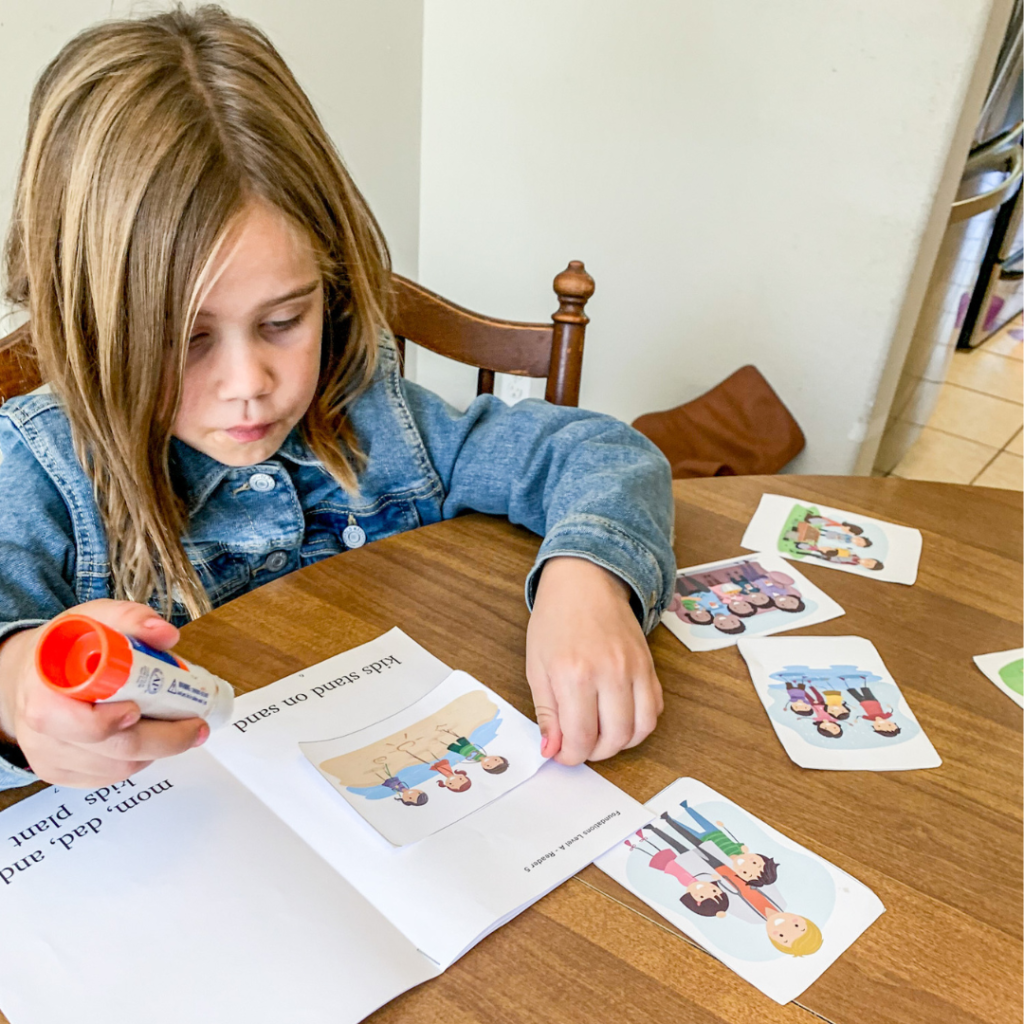
The readers are created by the students! This is the cutest thing to me. I believe there are 6 total and each one comes with a set of pictures and then a group of blank pages with the words to read. Your child reads the words and matches the pictures to each page.

There’s cutting and pasting and matching. This makes the reading so fun! Not only is the process of putting it together unique, but the pictures are so silly. We really got a kick out of these!

Doodling Dragons

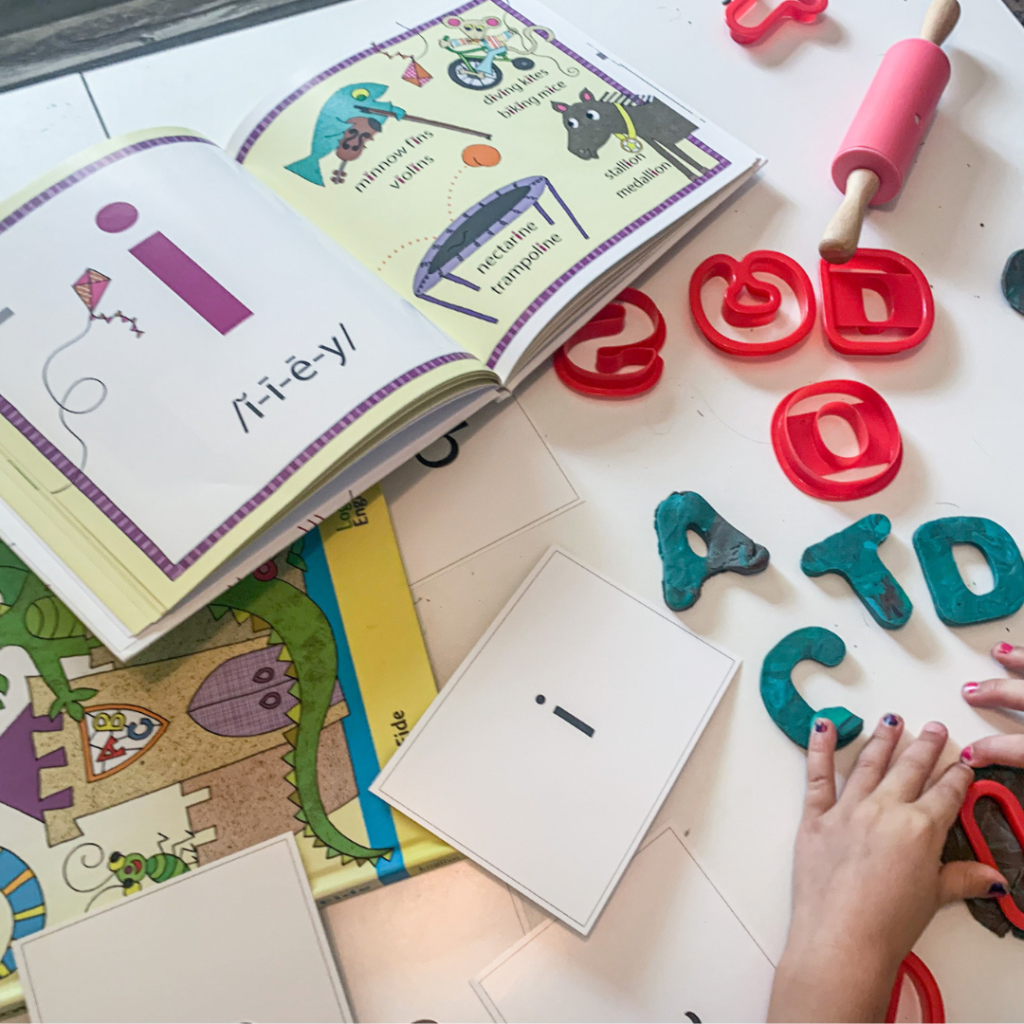
This picture book has a page for each phonogram. There are silly pictures and rhymes that use all the sounds of the phonograms. It’s very cute, and my daughter loved looking at each page. On YouTube, there are songs that go along with each page as well. These were wonderful, but we usually forgot to listen to them. I believe you can purchase a CD, so if you have a CD player or like listening to things like that in the car, it may be worth the purchase.

Sometimes I think that if we would listen to them in the car, my younger kids would catch on and begin learning them as well.

The Not-So-Great Things

Can you tell we loved this? I could go on and on about how easy it was to use and how much my daughter enjoyed lessons. My complaints are so minimal, but I’ll share in order to give a thorough review.

LONG LESSONS – This was an easy fix, but it also could vary with the child. We simply split the lessons up into a couple days. The book encourages you to do this as well, but if you feel bound to a lesson number and completing one a day, that will get tougher as you work further into the book.

LOTS OF PIECES – When I received the box for the set, I was immediately overwhelmed by all of the cards and pieces that come with it. There’s a lot! So, finding a way to organize it all was key. I went with a plastic container that allowed me to keep the cards in their own box but still altogether. It’s been great!

HANDWRITING – I mentioned this earlier, but the handwriting is unique. It really doesn’t match any other writing in other books we do. So, it’s something you’ll have to decide if you want to do or not. We stuck with it, and I just plan to get their handwriting book at some point to practice.

SO MUCH TO DO – This really isn’t a bad thing, but I will say that there are so many options of things to do, and it would be very difficult to do it all. So, it’s important to look through and pick what’s best. For example, with every letter the child learns, the book provides ways to “celebrate” the letter. We never did this. The ideas were so cute, but ultimately it didn’t fit in the schedule of our family.

COST – A program like this doesn’t come cheap. It’s one of the reasons I hesitated to get it in the first place. It’s also tough because set A is only 40 lessons, and although it took us until Thanksgiving to finish (we started in July), it’s kind of a bummer to already have to spend another $100 to keep going. My hope is that the cost will eventually even out when I am able to use it for my next two kids, as well. All I will have to purchase in the future is the student workbook.

Other Random Things I Love

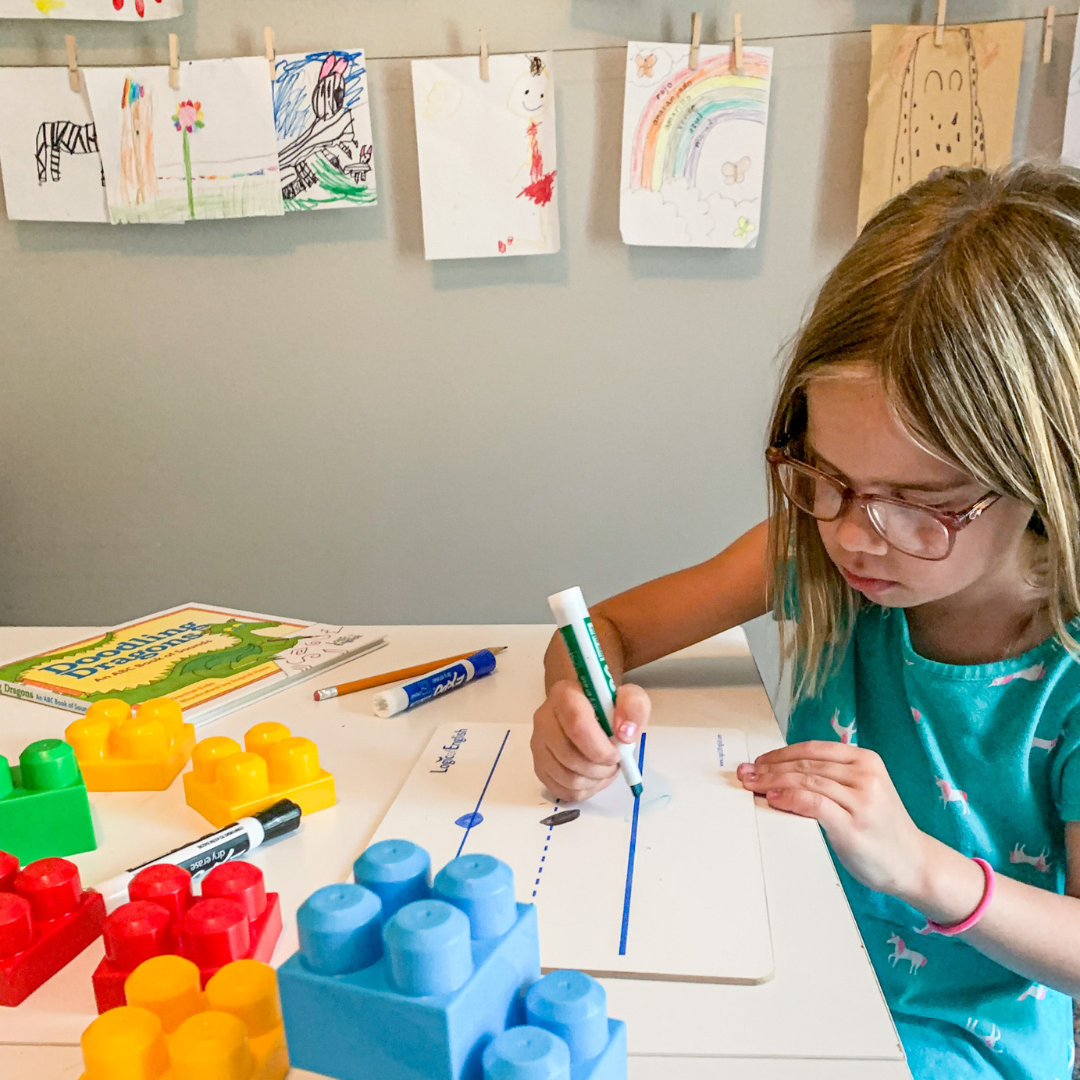
WHITEBOARD: The miniature whiteboard that comes with the set got used every day. It was so helpful and I love that it had a giant set of handwriting lines and then smaller ones on the opposite side.

MOMMY IS LEARNING: I’ve learned so much with this program. I never knew every sound of every letter. I learned about voiced and unvoiced sounds. We’ve learned things about consonants and vowels that I had no idea about. I love learning alongside my kids!

TEACHER’S MANUAL: The Teacher’s Manual is bound in a hardcover. Almost every spiral book I have ends up coming apart in some way, and this one has no spiral. It makes me happy knowing it will last through the years!

Final Thoughts

My daughter’s attitude about reading has changed so much since we started this. Her and I were both frustrated the year before this, and using Logic of English has given us so much joy. I can specifically remember a lesson where we giggled and had fun, and when I told her she could get up to leave she ran up and hugged me! I just melted – so thankful for the progress we were making and continue to make to this day.

It took me a while to finally bite the bullet and pick a reading program, but once I did I felt so much less pressure when it came to teaching reading. It gave me confidence each day knowing a plan was in place, and it built up my daughter’s confidence each step of the way.

Posted on 2 Comments

Homeschool Math Curriculum Switch

christian light math

This year I made an unexpected switch in our math curriculum. For the longest time, I was nervous to pick something new from what we started with in our homeschool. There’s something intimidating about picking a math curriculum…I’m not sure why! Well, I am – math matters and it builds on itself. You can’t just jump from one to another and not expect some bumps.

I want to share with you in this post what led me to make the switch, the transitional parts of switching and how we are liking the new program.

This post contains affiliate links. If you follow one of my links I earn a small commission at no extra cost to you. Thank you for supporting my blog!

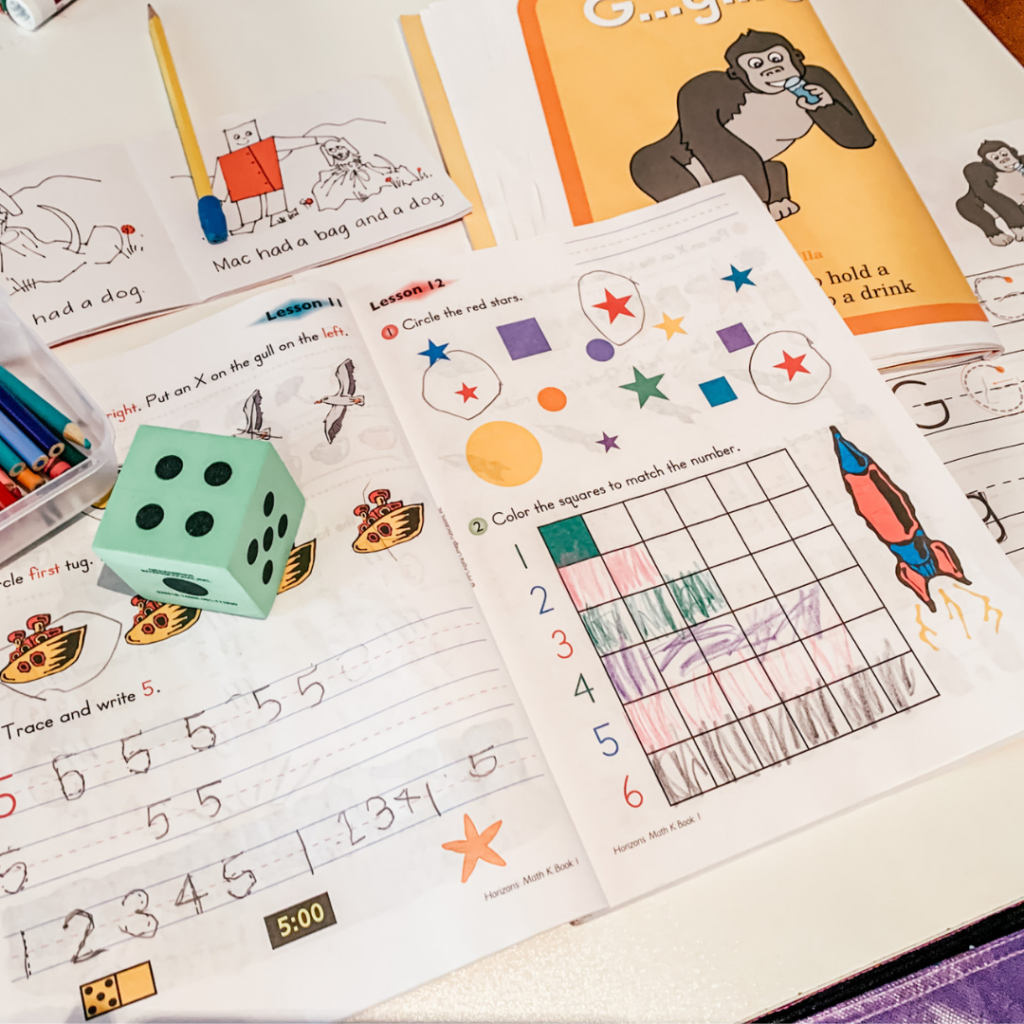
Horizons K

We started with Horizons math when my oldest daughter was in kindergarten. It worked great. We had no problems, and I was happy with it. When my second daughter entered kindergarten, I went with the same plan. Horizons was not a great fit for her, but I spent a LOT of energy and time and stress trying to make it work.

If you’re interested in hearing more about this experience, check out my YouTube video where I talk in detail about why I dropped Horizons for my second daughter.

Sometime right before spring, I made the switch to Christian Light Education (CLE) for her, and it was like a breath of fresh air. We actually started with the Math 1, because the Horizons K book had pushed her so far ahead of their K level. We worked through the first unit and then paused for a summer break. I was confident it was the right curriculum to continue with at the start of first grade for her.

Horizons 3

That next school year, when my oldest daughter entered third grade, I bought the Horizons set as a habit. This meant I would have one child using Christian Light and one using Horizons. We had used Horizons every year for her since kinder. It was working, so why change it? I was tempted to, but I decided not to think too hard about it and stick with it.

The more I became familiar with how CLE was working, the more I realized the gaps in our Horizons program with my oldest daughter. She struggled with word problems and memorizing her math facts, and CLE focused on both of those things so well!

Then, we started to get to parts of a lesson in the Horizons 3 book where I had no idea what the student book was instructing her to do. I’d pull out the teacher book as a reference and the directions would say something like “discuss estimation”…OK – but how? What should we discuss? Can you be more specific? Check out my YouTube video for an example of this. It’s actually quite shocking!

Now, I taught math in the classroom, so I know about estimation, but what exactly were they wanting? There were no tricks, strategies, or examples. It just said to discuss it. So, I taught her what I know…turns out it was too much! Once we got started in the student workbook, I had to back track. I felt so misguided by the teacher guide.

Then, there would be directions in the student workbook that would be so unclear- it was impossible to figure out what to do unless you pulled out the teacher book for the explanation. That doesn’t make sense to me. A student should be able to read the instructions and work.

At this point I was so frustrated each day when I pulled out the book. Comparing it to CLE in my head constantly, I felt like it wasn’t as good.

third grade math

Testing out Christian Light Math for 3rd Grade

One thing I love about Christian Light is their curriculum is broken up into little units. You can purchase just one of them for about $5, and it’s the perfect way for me to try out their program. So that’s exactly what I did.

I picked the unit that would best fit my third grader, and we started there. If we hated it, we could always go back to Horizons. Well, spoiler alert, we LOVED it – and haven’t looked back! Let me tell you why.

Designed for the Student

Each lesson in Christian Light starts with a new skill. The skill is explained and demonstrated in the student workbook with pictures and examples. This is such a great way to start independent learning. My daughter attempts to do the new skill on her own, and we look over it together when she finishes the lesson. Everything she needs to complete the lesson is in her book.

I use the teacher guide to check her work daily, but honestly, that’s it! It does provide me with a flashcard schedule as well as a quick tip or suggestion to help with the new skill. Other than that, the student is learning to become more independent!

Mental Math Strategies

CLE is so good about teaching mental math strategies! I’m not the best mental math student, and I love that it actually forces my daughter to compute problems mentally. Horizons wasn’t good about doing this at all. It’s possible it was in the teacher book somewhere, but let’s be honest, that thing was so unfriendly and hard to look at.

My daughter has started to realize this as well. She gets so excited about all the things she can do in her head now, thanks to the mental strategies the book has taught her.

Daily Checklist

At the start of a lesson there is a daily checklist for the student to practice certain skills. Skip-counting, math facts, and speed drills are on the list which makes for a great routine in practicing these things daily. We have learned how to adjust the checklist to best fit our needs (in other words, sometimes we skip it), but I have seen so much benefit in regular practice.

My daughter’s fact memorization has improved so much and she’s being challenged to count out loud in ways that she hadn’t before. For example, counting by 4s forward AND backward. When we first started this, it was like a foreign language, but with the help of a hundred chart and routine practice she’s really caught on well. What a great way to form number sense!

Story Problems/ Word Problems

The first time we came across a story problem in level 3, the student book walked my daughter through every step. It told her what information to look for and how to choose the operation she would use. It provided her with a space to work out her problem as well as a line to write her answer. This was just what she needed!

She actually told me that the word problems in CLE were so much easier. I had to point out to her that they were exactly the same! This new book just broke it down so much nicer, making it easier to understand.

Learning Gaps Between the Two Programs

There were definitely some things we had to “catch up” on, but it was easy for us to do. For example, some of the geography (rays, lines, angles) was not covered in what we completed for Horizons, but it was easy enough to teach her quickly. Plus, Christian Light encourages the use of a reference chart, and those items are on there as well to remind her, if needed.

We’ve also had to brush up on math facts. In the third grade level they are practicing multiplication, but it’s so important that the addition and subtraction facts are solid too. So we’ve really been focusing on those flashcards first. She still gets lots of multiplication practice in her book, but I don’t plan to get her the multiplication cards until she gets through the addition/subtraction set.

christian light education math

Some Final Thoughts

When we were working with Horizons, I felt like we were just doing worksheets every day…which we were! Now, I did know this going into each year. If I wanted “more”, I had to come up with it on my own. For a while, that worked, but once I was homeschooling more than one child that became difficult.

After switching to Christian Light, it feels like my daughter is actually learning something and improving daily. She’s still just working in the book, but it’s enjoyable and meaningful. The units are themed and the mix of flashcards and drills and counting and using a reference chart…all of those routine skills put together feel fresh and not monotonous. She enjoys doing the work and the spiral review format keeps everything fresh in her brain.

Horizons is also a spiral review, but there were SO MANY problems to do. We were skipping half of the sections each day. We have enjoyed that CLE only asks for a few problems in each section.

I’ve heard people say before that the lessons in CLE are long, but we have found a way to make it work for us. On days we need to move quickly, we skip the checklist at the beginning. If we get to one of the review sections and I know my daughter knows it well, we skip it. Most days we aren’t doing every single thing in the lesson.

I’m So Happy We Made the Switch

After using Horizons for three years, it really felt tough to make a switch, but I’m so glad we did. The transition was smooth and the benefits I’ve seen have far outweighed the time spent in adjusting to a new program.

If you’d like to see more about Christian Light, check out the curriculum look through on my YouTube channel.

Posted on Leave a comment

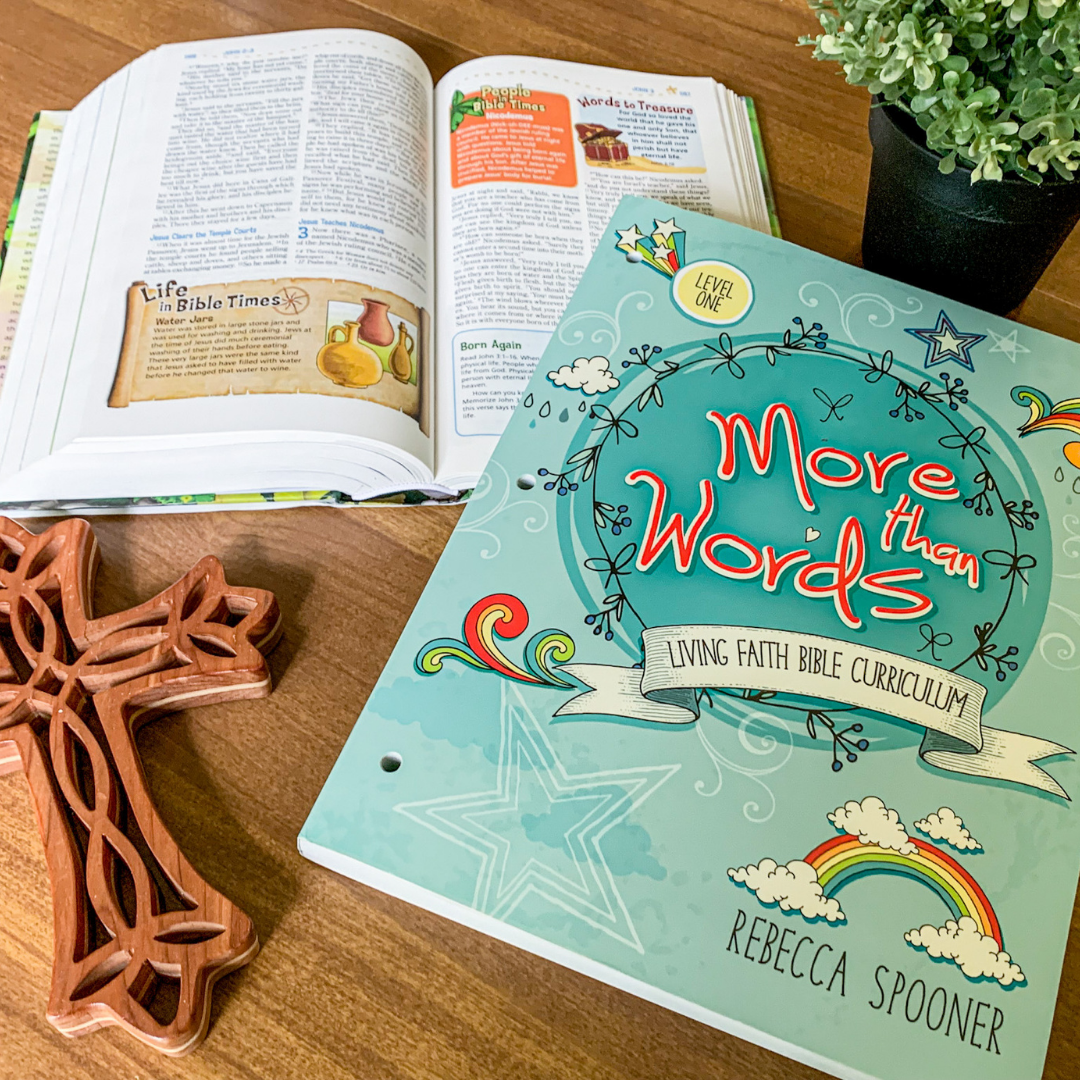
More Than Words Curriculum Review

more than words

I chose More Than Words: Level 1 for our bible curriculum this year because I wanted something that could guide us in our studies through scripture. In our previous two years of homeschool we used simple devotional books that we read together each day, which were amazing! (The Jesus Storybook Bible and Indescribable: 100 Devotions for Kids About God and Science)

Now that my daughter was entering the second grade, I wanted to dig a little deeper. I also knew I wanted something that talked about character, and More Than Words does that and more!

I am going to tell you all about this book and the goodness it contains, but I’m also going to share things that I don’t like about it as well. (Everything has their pros and cons…and they’re probably different for every family!) However, I encourage you to read all the way through, because I’ll let you in on a little secret later on that I think may surprise you!

To get a detailed look inside this book, check out my video HERE for a look-through and review where I discuss some of the same points I make below.

This post contains affiliate links. If you follow one of my links I earn a small commission at no extra cost to you. Thank you for supporting my blog!

The book is written to follow a 4-day-per-week schedule.

I love this because we are usually gone one morning of the week. So, I never feel like I fall behind. On weeks where I need a fifth day, I usually just review the week’s material and read the prayer at the end.

Each week covers one specific bible passage, one key truth, a look into fine arts, and one character trait. The weekly lessons follow the same sort of pattern, which makes it super easy to follow as the parent (and child!).

Day 1: Journal Intro, Bible Verse, Key Truth, Copywork

Day 2: Art/Song/Poem

Day 3: Character Study, Coloring Page

Day 4: Drawing, Discussion Questions, and Prayer

Journal Intro

This is a short journal entry to start off the week, written by a character from the curriculum. These characters are based on the author’s daughter and son and some of the experiences they have had.

My children enjoy these very much because it makes the lesson extremely relatable for them. It’s a great way to start off the discussion and dive into what we will be learning for the week.

Bible Verse

After a few discussion questions about the journal introduction (provided in the workbook), the bible verse for the week is introduced. The book encourages you to read it from your bible, but it is also printed directly in the workbook.

Even though the verse is only listed for “Day 1”, we read and recite it each day of the week to work on memorization.

As a side note, I love finding songs that relate to the bible verses. There are so many great Christian groups on YouTube that write awesome children’s songs. So, it’s definitely something we like to add in as we learn the scripture.

Key Truth

Each week there is a Key Truth related to the bible verse. The book encourages you to memorize the different truths each week and has cute review cards to go with it.

We simply discuss the idea and repeat it throughout the week together. The sentences are short and easy to remember and, even better, I love teaching and talking about them with my kids.

Copy Work

A copy work page is provided for each week. This is usually a shortened version of the bible passage. It is also what the kids and I work on memorizing for the week. My kids are 7 and under, so it’s short and easy enough for all of us to say together, even my little ones.

Art/Song/Poem

This alternates each week. Our favorite is the art. We love looking at the different pieces and talking about them. Discussions and questions are provided in the workbook. This makes it easy for me because I’m not very familiar with art.

For the poems, I usually just read it out loud and discuss the questions provided. When a song comes along, I like to find it on YouTube and play it for my kids. We don’t try to memorize it or anything, but we do enjoy listening to what it’s supposed to sound like.

I really love the way this book alternates the three art studies (art/song/poem). It keeps it interesting and we never really tire of them.

Character Study and Coloring Page

This is one of the main reasons I bought this curriculum. Each week, I look forward to the new word based on a character trait. A short paragraph explains the meaning and why it is important. At the bottom of the page, their is usually a circling activity finding synonyms and antonyms of the word in order to help understand its meaning.

It’s been so helpful studying these words because I can use them in our day-to-day discussions and they have so much meaning to us. When I am speaking to a child about a bad choice or if I’m trying to help them make a good one, we can easily bring up these traits, and I love that.

The coloring page is a bonus to the character study. It’s a sweet picture with the character word in big letters. Honestly, my kids complete this when they want to. They aren’t really interested in coloring, but they have asked at times to do it.

Drawing, Discussion Questions, and Prayer

Each week, the lesson closes out with an opportunity to draw a picture about something related to what you’ve been studying. The last page contains a couple of questions to think about and a place for your child to write an answer.

Finally, a short prayer to read closes out your week.

The book is divided into 4 quarters that focus on specific topics.

The topics are, “Who is God?”, “Who Am I to God?”, “Walking the Walk”, and “The Great Relationship”. At the end of each quarter, there is an opportunity to discuss these questions and talk about it more in depth.

The book encourages you to review the “Key Truth” topics as well as the character traits discussed in that quarter. A few options are provided about how to do this.

There is also a hands-on art project that is a part of the review and all directions are provided for this.

Here’s my Confession…

We don’t actually WRITE in the book…AT ALL! Not one bit. I don’t feel that the book is wasted though because we use it to guide our morning discussions.

I originally purchased the book for my second grader to work on independently. However, it turned out to be a part of our morning routine and we all discuss it together instead. All four of my kids participate as we learn verses, sing songs, look at paintings, and talk about character.

The honest truth…I kind of feel like all the writing and coloring and drawing is busy-work. I know that’s harsh, but it felt true in my home. It was just another thing to have to get finished. So, instead I looked at it as another great workbook for our whole family to learn from.

There are times that my children request the coloring page. So, I rip it out and they color as they please, but it’s never my intention to assign them anything from this book. It is purely a guide for our discussions.

My Review

Even though we don’t actually use it properly, I really do love this book. I like the pattern that it follows each week. My kids and I know what to expect and look forward to certain pages. No teacher guide is needed. Everything is right there for you in one book, making it a cost-effective way to study together.

I love that it’s helping us remember different verses in the bible. My three year old even says them with us and it’s one of the main reasons I wanted all of us to use it. We can all learn together as a family.

I don’t really feel like all the writing and drawing is necessary. If you have a child that truly enjoys all of that extra work, then go for it. Otherwise, my suggestion would be to skip it.

I definitely recommend this book if you are thinking about using it. I have even considered using the second book they created as well.

We spend about five to ten minutes each day looking through the book, following the lesson, and practicing the weekly verse. Although it’s not a ton of time, our conversations are meaningful, memorable, and something I look forward to each morning.

Posted on 4 Comments

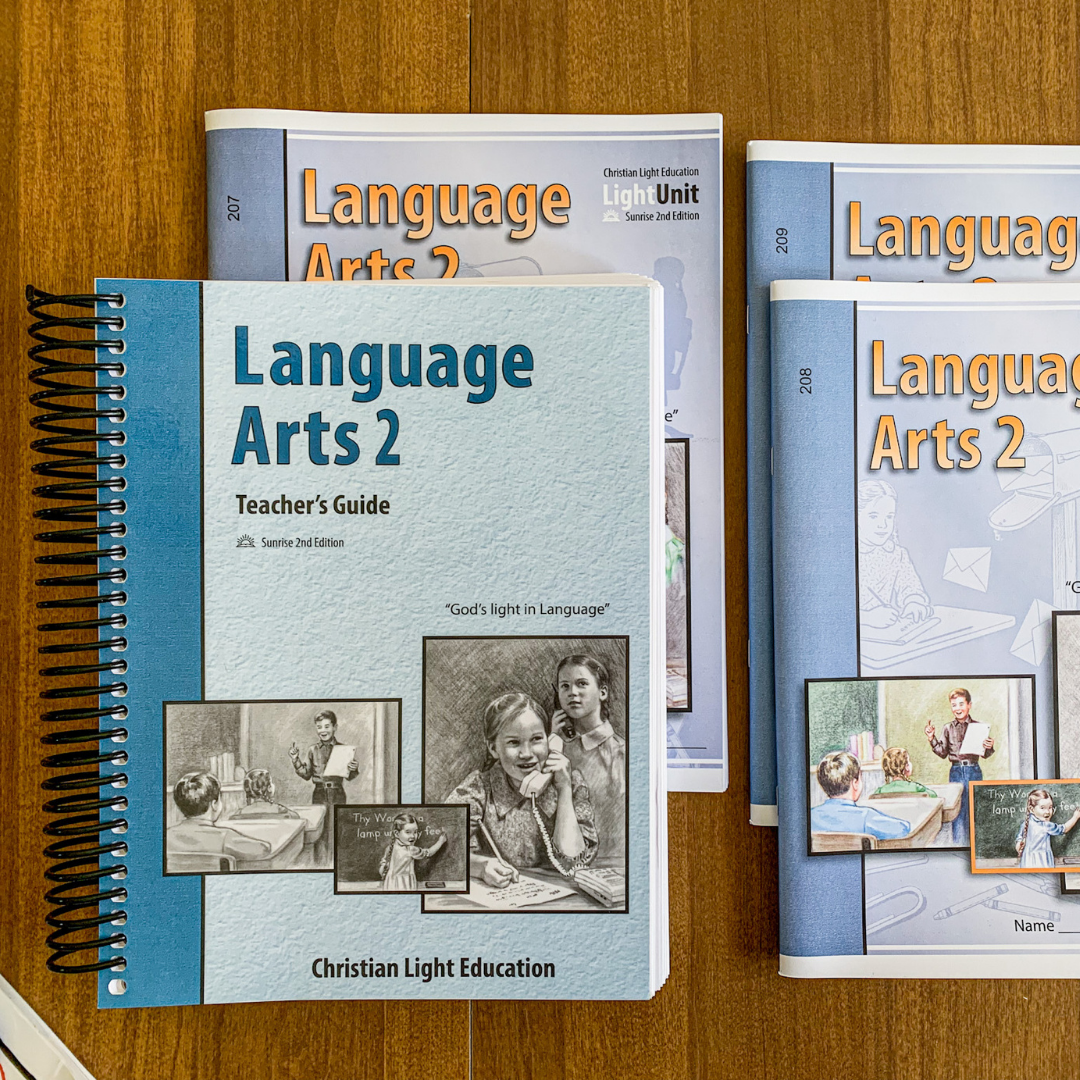
Christian Light Education Language Arts Review

christian light education

Christian Light Education really improved our second year of homeschooling for a variety of reasons. I picked it because it was inexpensive to try it out and it gave us the flexibility we needed.

We finished our first grade year with CLE and continued using it for second grade. The second grade level added quite a bit more that made the program even more thorough than I thought it was. In this post I hope to give you a very thorough description and honest review of the second grade program so that you can get a better idea of what it is.

If you’d rather watch the video version of this post, check it out on my YouTube channel HERE.

This post contains affiliate links. If you follow one of my links I earn a small commission at no extra cost to you. Thank you for supporting my blog!

Christian Light Education is published by Christian Light Publications

They are a Christian Mennonite company, and you can read all about their beliefs and practices here. I am a Christian, and although I do not practice some of the same things listed in the “what we believe” section for Christian Light Publications, I have never felt turned off by the curriculum because of this.

I actually didn’t even realize the difference in beliefs until I heard someone else tell me about it. Then certain things clicked – like the images in the workbook. It was hard for us to figure out what a few of the images were because we couldn’t relate to them. This happened two or three times and we moved right along.

The program does talk about God often and believing in Him and making good choices that please Him. It teaches good character and provides short readings for the kids, teaching about manners, kindness, and good study habits.

The Language Arts curriculum is broken up into 10 units.

This is one of the reasons I chose this curriculum to replace an old one in the middle of the year. You can buy individual units for less than $5. I loved this because I could buy a unit and test it out with my daughter without really breaking the bank or feeling like I wasted a workbook.

That’s exactly what we did. I started with one unit, and we kept going from there. There are also optional materials you can purchase, and you can check those out here. We have not used the optional items in our homeschool.

The lesson content is set up as a spiral review.

This means that a topic is introduced and practiced again and again throughout the year. You do not master a skill and move on. Instead you are working on a variety of skills every day and repeating them here and there throughout the program.

I personally love this set up, because it makes it harder to forget things. For example, we can learn and practice alphabetical order and 2 months later we end up practicing it again.

I also like this because every section in a lesson is just a few practice problems for each skill.

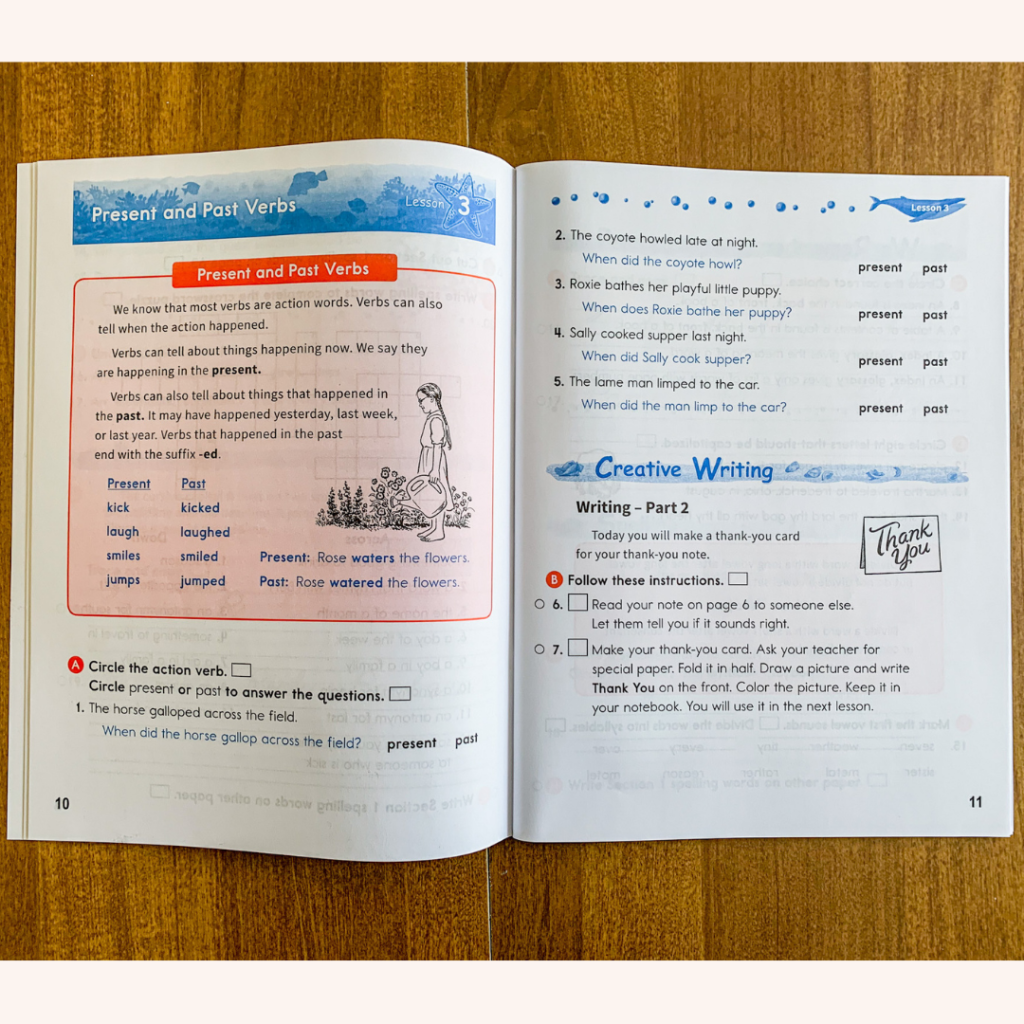
Beginning in Level 2, the Language Arts program includes handwriting, spelling, AND writing.

How nice to be able to have that all in one! This is not the case in their level one, so I was happily surprised when we figured this out.

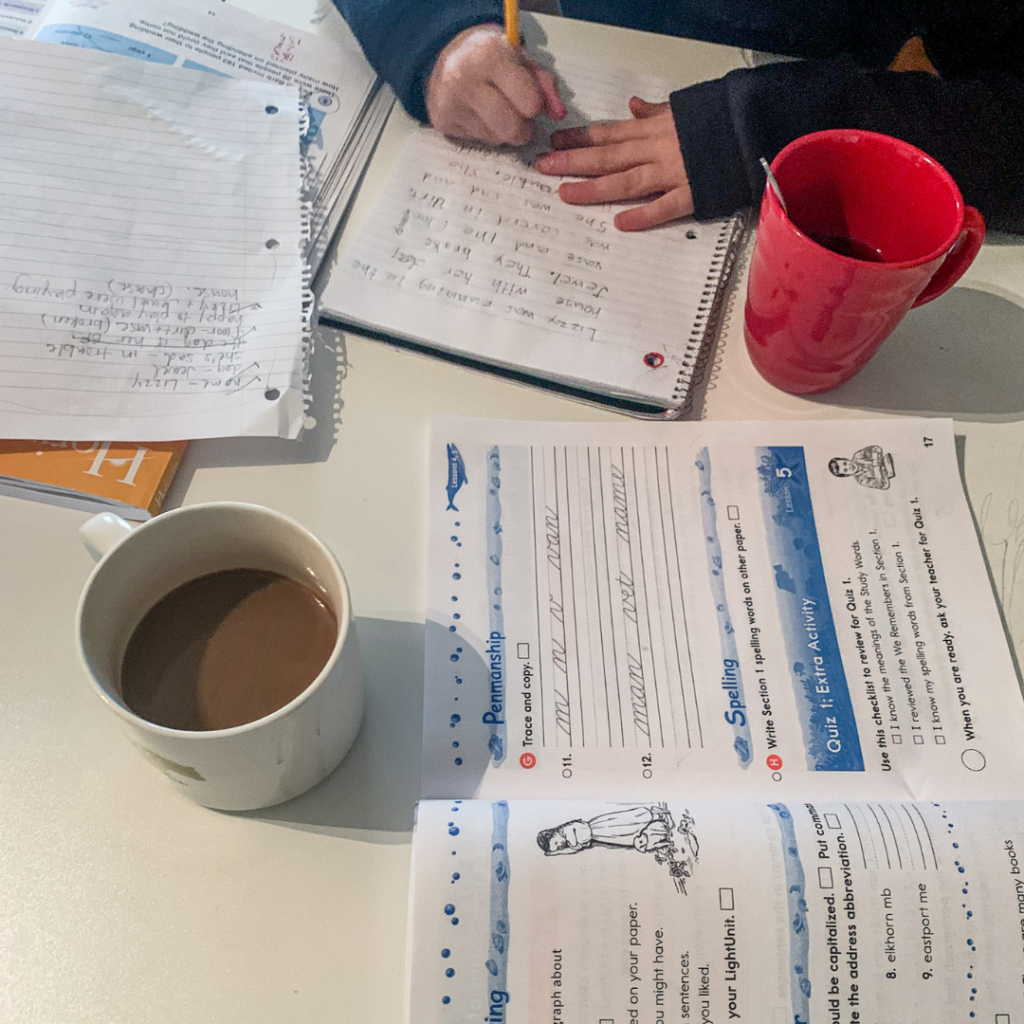
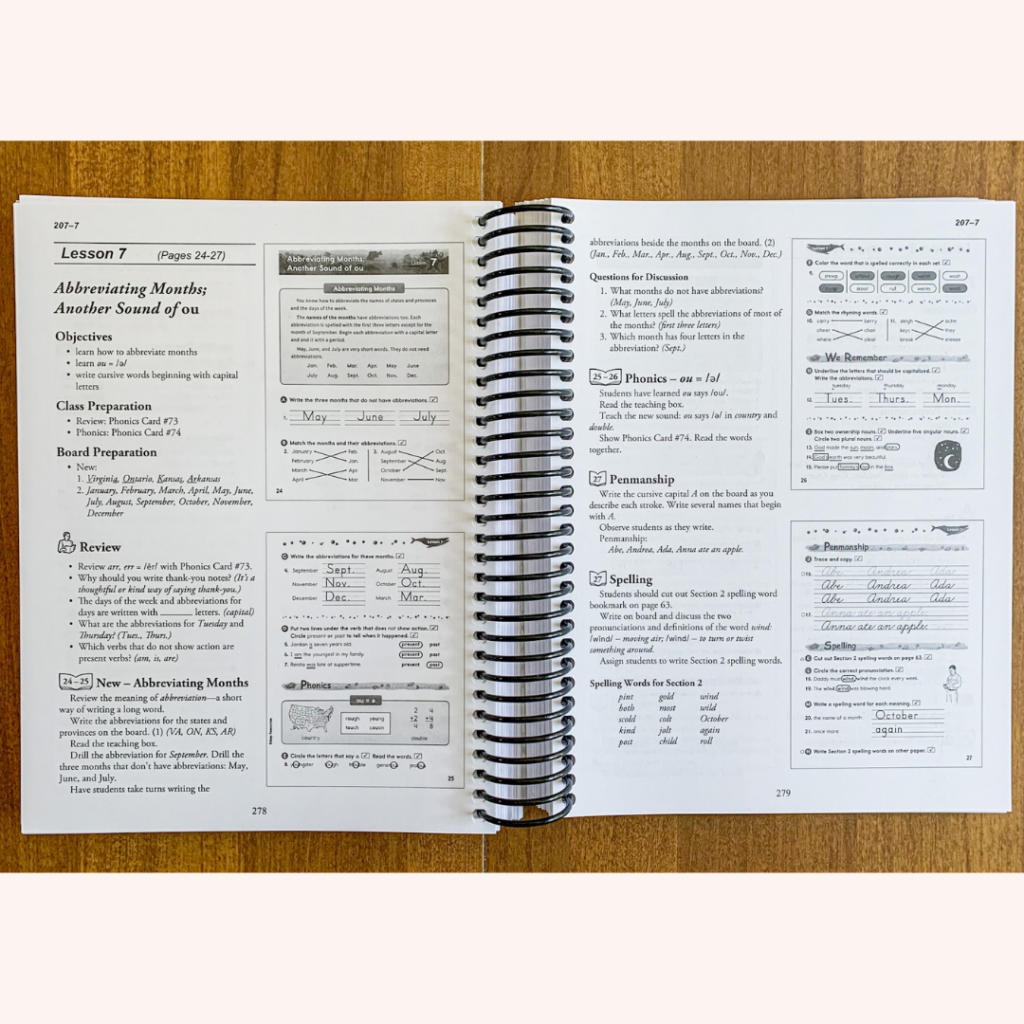
The handwriting sections start off with manuscript writing. It is a very short section in the lesson (see the image above). Next, it moves into curves and lines to get ready for cursive writing. When you get to unit 3, cursive letters and words are introduced.

The writing program becomes part of the lessons beginning in unit 3, as well. (See image below.) It’s so nice that I do not have to rearrange days or routines in order to incorporate writing practice. The process is broken down in the unit and easy to follow.

Each student book is called a LightUnit.

A LightUnit comes with the lessons, 2 quizzes, a self-check, and a test. One lesson usually begins with a new language skill followed by phonics and grammar review. Next, there is a short penmanship section to practice handwriting and, lastly, spelling practice.

There are also a few enrichment activities included in each LightUnit. (I’ve never actually even looked at these.)

The lessons are very to-the-point without extra things.

If you are looking for a variety of art and nature and song and poetry throughout your lessons…well, this isn’t for you.

A lesson is 4-5 pages long. Although it sounds like a lot, every section averages 2-6 practice problems.

If you sit and complete a lesson exactly as it is in the workbook every day, week after week, you are going to get bored.

Wow…that came off really strong, but hear me out. You can make it what you want! Honestly, that statement stands for almost anything! Homeschool is about making adjustments for your family.

The set-up of the lessons provide a flexibility when you plan!

For example, let’s say the review section is something that really doesn’t need practice. Your child has mastered it and is confident…so skip it!

Or maybe you’re feeling crazy and want to add some movement. Come up with a scavenger hunt or an activity to help get through some of the questions. Change up your routine and have fun with it!

Or MAYBE your infant won’t stop crying and your 3 year old is having a melt down and it’s raining outside and you haven’t even cleaned up breakfast yet…let your child work on it independently! I LOVE love LOVE that there are days that she can just practice on her own. As a mom of four, it’s so important to have this flexibility!

However, with the lack of variety in the lessons, it does tend to bore us after a while. Every couple months, I step away from it for a week or two and dive into something different. I might read a book with my daughter or complete a mini-unit together. This helps us go back to it fresh and ready to continue.

I do NOT follow the lessons exactly as they are written.

On the topic of spelling, I started the year by skipping the spelling section in the workbook completely and just having her write the words each day. We made this fun, and I can share more about how we did it soon. Even with fun spelling practice, we eventually tired of it after a few months and started only doing the spelling practice section in the workbook. We do not do daily list writing anymore.

After Christmas, I quit giving the quizzes and self-checks. It was a wasted day of lessons! My daughter was completing lessons well and was not struggling through the skills. (If she were, I may have kept doing them for practice).

One day, I just completely forgot about giving the quiz, and it affected us in zero ways. So, I stopped! We work through the lessons, and I give the test at the end of the LightUnit, if I feel she’s ready.

We also skip the penmanship sections most days. I do this because we already have a handwriting curriculum that I love (A Reason For, Level T). Completing the penmanship was overkill to me, so we only do it if we want a super short handwriting day and skip our handwriting book.

My point in telling you all of this is don’t ever feel like you have to do EVERYTHING!! You have the freedom to choose in your homeschool. If it feels like too much, cut it out. If it’s not enough, add to it. Do what’s best for your kiddo. Because of the way these lessons are set up, this is easy for me to do.

Let’s focus on the Teacher Guide for a second.

The guide is very thorough. The answer keys are actually on the same page as the lesson guide, and I really like that. You don’t have to flip back and forth to check answers.

Each lesson in the guide starts with scripted review questions. Next, it moves into a script for teaching the new skill. It provides questions for discussion as well as an explanation for each section in the lesson.

If there is any prep, it explains it at the beginning of the lesson guide. It also gives you optional activities to do during a lesson.

When it is time for a spelling test, the list of words and sentences are provided.

When I first received the guide, I was extremely overwhelmed. It’s a lot. However, once I read through the explanations and figured out how it worked with the lesson, I felt much better. It’s one of those things where you kind of just need to jump in and try it out to see how it would work best for you.

The guide is very helpful, but once we got in a groove, I didn’t feel like we needed it as much. It would be hard to have the program without it though. I’m glad I have it to refer to, as needed.

I’m really happy with CLE, but I’m not 100% sure yet if we will continue for 3rd grade.

The truth is…I’m somewhat bored. I want to read more books! I want to dive into novels with my kids and explore new characters and places and events. We do read chapter books together, but I feel like I want more. I’m starting to look for something more literature based.

My decision is not final. I really do love the flexibility I have with this. It’s almost like I would love to do CLE for 6 weeks and a novel for 6 weeks and than back to CLE…and so on. And I could…

I just have a couple more things I want to research, so I’ll keep you posted.

Let’s look at the pros and cons here.

PROS:

  • Inexpensive to try
  • easy to follow
  • includes spelling, handwriting, and writing beginning in 2nd level
  • flexible
  • can be completed independently (depending on child)
  • Christian values

CONS:

  • cut and dry
  • not hands-on
  • difference in beliefs
  • can feel boring at times
  • not much classic literature or fine arts (at least not in level 2)

I think this is all just proof that no ONE curriculum is going to be the perfect fit.

We get to make it what we want and add or take away as we please. Even when I was a classroom teacher, I was doing this with our textbooks for my students. The reason I bring that up is to point out that learning is not a one-size-fits-all matter.

My suggestion to you if you are considering trying Christian Light Education is to do what we did. Purchase one LightUnit. Look at the samples to get an idea of which one you should buy, based on your child’s abilities.

Then, try it out in your home! It’s the perfect way to figure out if it’s what you need for your language arts program.

Posted on Leave a comment

Why we stopped Horizons K mid-year

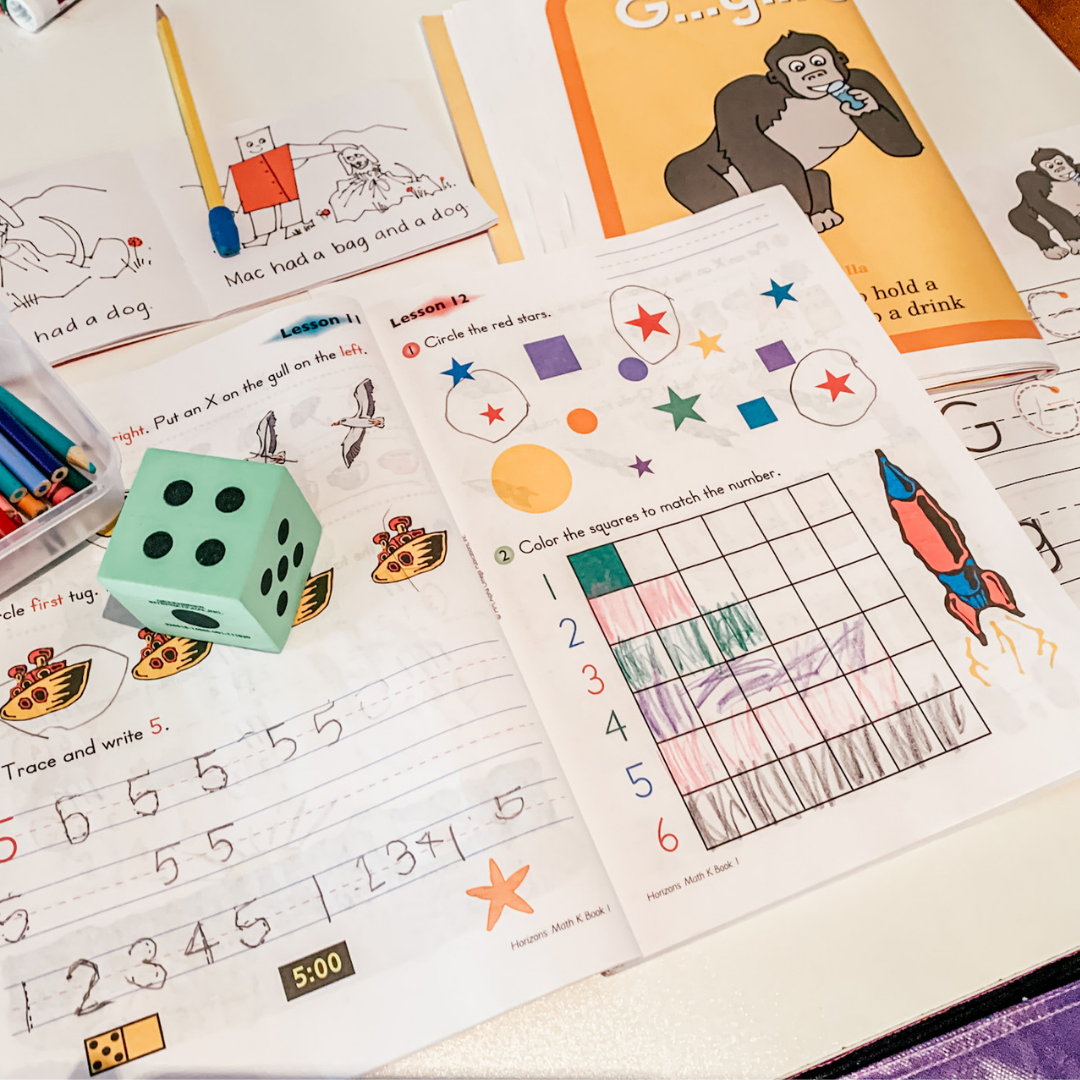
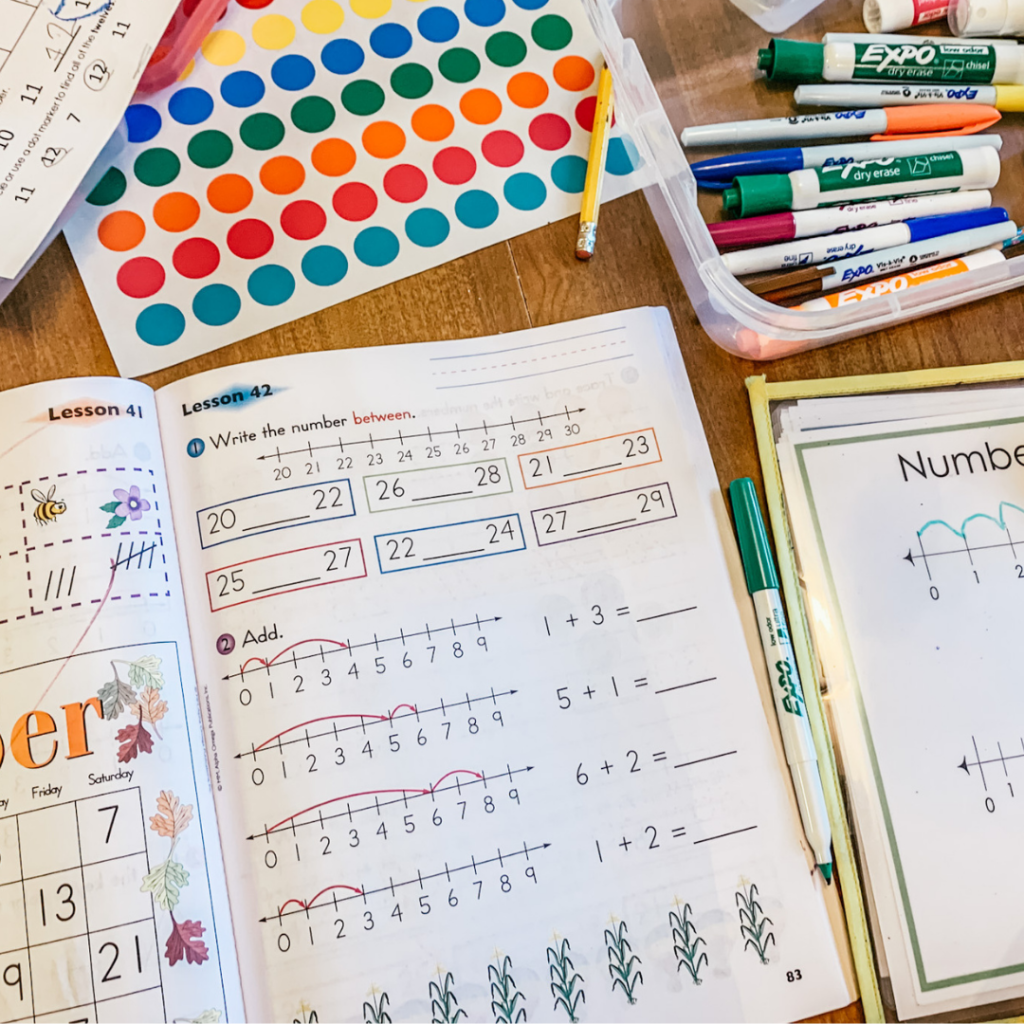
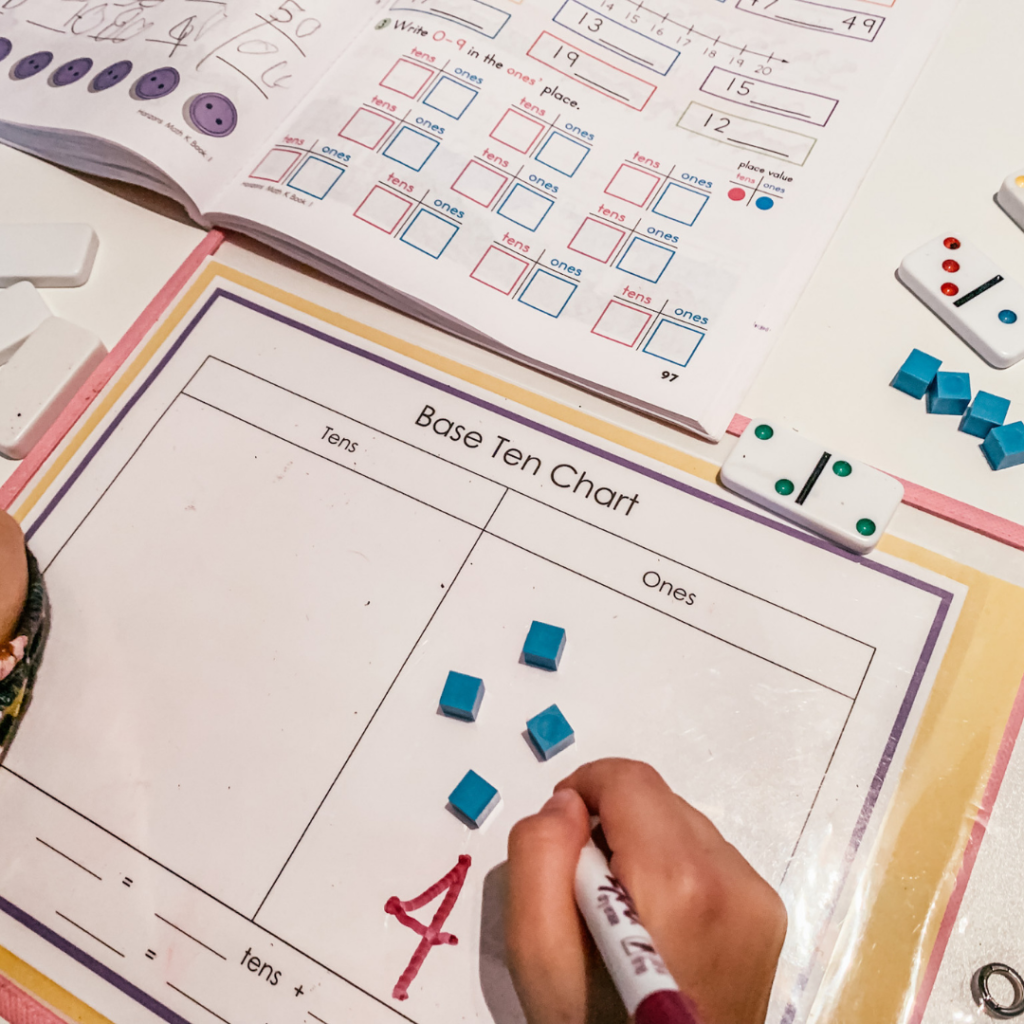
I really did not think this would happen, but we stopped Horizons K mid-year. I love Horizons! We’ve used it for three years with my oldest daughter (now in Horizons 2). As a matter of fact, she still uses it, and I don’t have plans to stop.

This has been a tough decision for me. I know how Horizons works. I know how to add hands-on activities, and I know how to manipulate it to work for us. I’m very comfortable with it and recommend it to many. That hasn’t changed, but, let’s be honest…this isn’t about me. It’s about my daughter.

If you prefer to watch instead of read, check out my YouTube video on this same topic HERE.

This post contains affiliate links. If you follow one of my links I earn a small commission at no extra cost to you. Thank you for supporting my blog!

I’ve known since November that something wasn’t right.

This decision has been quite the journey and my choice to stop was not based on a quick mishap. It’s been a process, and I’ll explain.

We started our school year the first week of August, and Horizons K starts very slow. It’s wonderful! The pictures are bright and colorful with just a few problems to complete in each section. It’s perfect. We can add a game to re-enforce a skill, and the lesson would be awesome.

Then, a few months in, it started moving very quickly. I tried not to worry. Horizons is set up in a spiral review format, so I knew she’d be getting practice again and again.

I put a large amount of energy into making it work for us.

It was tough to get through a lesson, mostly because it was a lot of problems to get through. We went outside. We played games. We added manipulatives and more movement.

The effort was worth it! We definitely enjoyed it more, but after a while, I could tell it had nothing to do with how “fun” it was anymore…

We took a couple weeks off to re-group and connect

Maybe I was trying too hard. It’s possible I was setting my expectations too high. I was dreading our math lessons, and I knew we needed a break. I prayed about it so much.

Those two weeks were needed. I highly suggest a break when you’re feeling confused about something in your homeschool. Connect with your kiddos and relax. It’s so refreshing and so helpful!

We didn’t do math for two weeks, and then the best thing happened. She ASKED to start again. YES! Ok, this is great. It’s exactly what I wanted. We jumped back in and pushed through.

Just a couple of weeks into January and she was moving on to Book 2. Woohoo! I was a proud mama, and she worked so hard to get there.

But book 2 is a whole new ball game.

The work practically triples! What used to take us 15 minutes was now taking 45 minutes to an hour. On top of it, I kept feeling like we needed to go back! She needed to keep working on things she’d learned in book one. It felt too soon to be adding in brand new material.

Maybe you’re thinking I should’ve just not made her do all of the problems, and I’m all about that! Sometimes, I cut out half the work in our second grader’s workbook. However, if I feel like the practice is necessary, I want her to do it. I can’t cut the work if full understanding is not there.

It was this weird balance of trying to build her skills and confidence while also not pushing her too hard.

I really don’t remember it moving that fast when my oldest completed it three years ago. Of course it did, but as a new homeschooling mama at that time, I’m betting I just kept encouraging her to keep going- We had to finish. (Or so I thought.)

I’m thankful I know better now. We don’t have to just keep going. I have the freedom to make the changes needed to best fit the needs of my kids.

You know, I really don’t like swapping curriculum mid-year.

I’ve done it once before, and there’s this awkward phase of trying to figure out where to start in the new curriculum and figuring out how the new book works. It’s a scary commitment to me and a big decision! I don’t want to flip-flop from book to book.

There’s a part of me that feels like I’ve done something wrong. Did I do enough? (Isn’t that the million dollar homeschool question!?) I just have to keep reminding myself though that I know my child best.

As you can see, this has been a prayer of mine for months. I don’t think it’s coincidence that something keeps prodding me to change what we are doing. It’s no mistake that it suddenly felt very clear that we needed to pick something else. I truly feel God leading me to this next step in our homeschool.

So, what now?

Well, I have researched a lot of math curriculum over the years. I really do enjoy learning about it. There’s one other program that I’ve thought about using, because it is set up in a simple, spiral review format as well. I’m referring to Christian Light Education.

As I looked through Christian Light’s kindergarten program, I immediately went to their sample books and My. Jaw. Dropped!

Three quarters of the way through the units, and we would be counting dots on a domino for math. Wait…what?! We were past that. WAY past that.

Two feelings came over me. 1) That’s way too easy for her! 2) Oh my goodness, I feel awful that I’ve been pushing my daughter so hard.

In order to practice the skills that my daughter needed, I had to purchase the level one book. I’m talking- skills we learned back in August. WOW! This program was at a completely different pace! I felt so weird getting level one, but as I reviewed the scope and sequence over and over, I knew it was a good fit.

Honestly, even level one is MUCH easier than what we are doing now, but I want to start slow. I am not in a rush. This was even more proof to me that I made the right decision. Horizons was very advanced.

My goal for the end of the year is simple and easy-going.

I have hopes to work through book one and book two of CLE to end this year. Then, we will take a summer break and I’ll pick up where we left off for her first grade year.

It’s kind of nice because normally so much time is wasted reviewing at the beginning of the year. In our case, we are doing that at the end of this year and moving forward at the start of next!

This is very new to us. I plan to update you guys soon on how it’s working for us.

Let me go on one short rant here…

First, always make the decision that’s best for your kid. Stop thinking about how YOU feel (ahem…speaking to myself) and think about your child’s needs.

Every. Child. Is. Different. Like WAY different – I have four completely different kiddos in my home, and I am so grateful that God has chosen me to be their mother. He has given each of them their unique gifts and abilities, and it is my joy and pleasure to help them grow up and live out the purpose he has set for them.

My oldest child is a numbers girl. Math comes easy for her. I only bring this up because Horizons has been amazing for her, and we plan to stick with it. This is proof that it really is about the child. As much as I love Horizons, I’ve learned it may not work for all four of my kids the same.

Think about what brought you here to this post. You probably have something on your mind about math, whether its what curriculum to buy or which one to stop! If you haven’t prayed about it, take a minute and do it. My homeschool changed drastically for the better when I started praying about specific needs in my homeschool. (God is so faithful!)

I am not one to say, “Yes! Change it! Get something new!” But, sometimes, we just know that it’s not a good fit.

There’s so many options out there! Sometimes I wish I could just have a little taste of all of them in one book. Wouldn’t that be nice? Here’s the thing – no curriculum is going to be perfect for you. Not ONE. So, pray about the steps to take in making it work. Does that mean changing it up a bit? Shortening the lesson? Adding in games? Switching to every other day?

Or…does that mean it’s time for a bigger change? It took me almost three months to finally say yes, but I’m so glad I did.