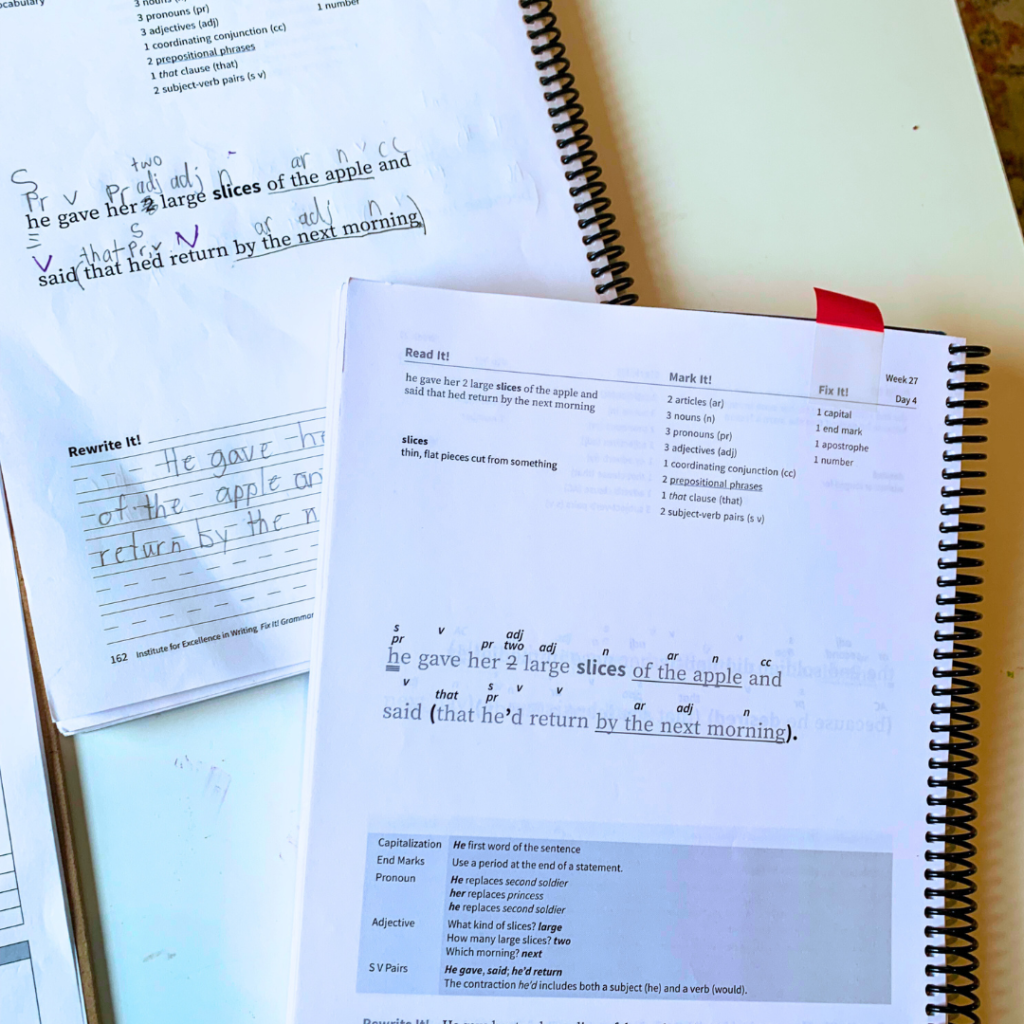
When we first started homeschooling, language arts workbooks felt like a chore in our homeschool.
We would read wonderful books together, have meaningful conversations, and genuinely enjoy it… but then we’d open a giant workbook filled with assignments, and everything changed.
That frustration eventually led me to create my own literature-based approach to language arts — one that allowed us to learn naturally through stories instead of busywork.
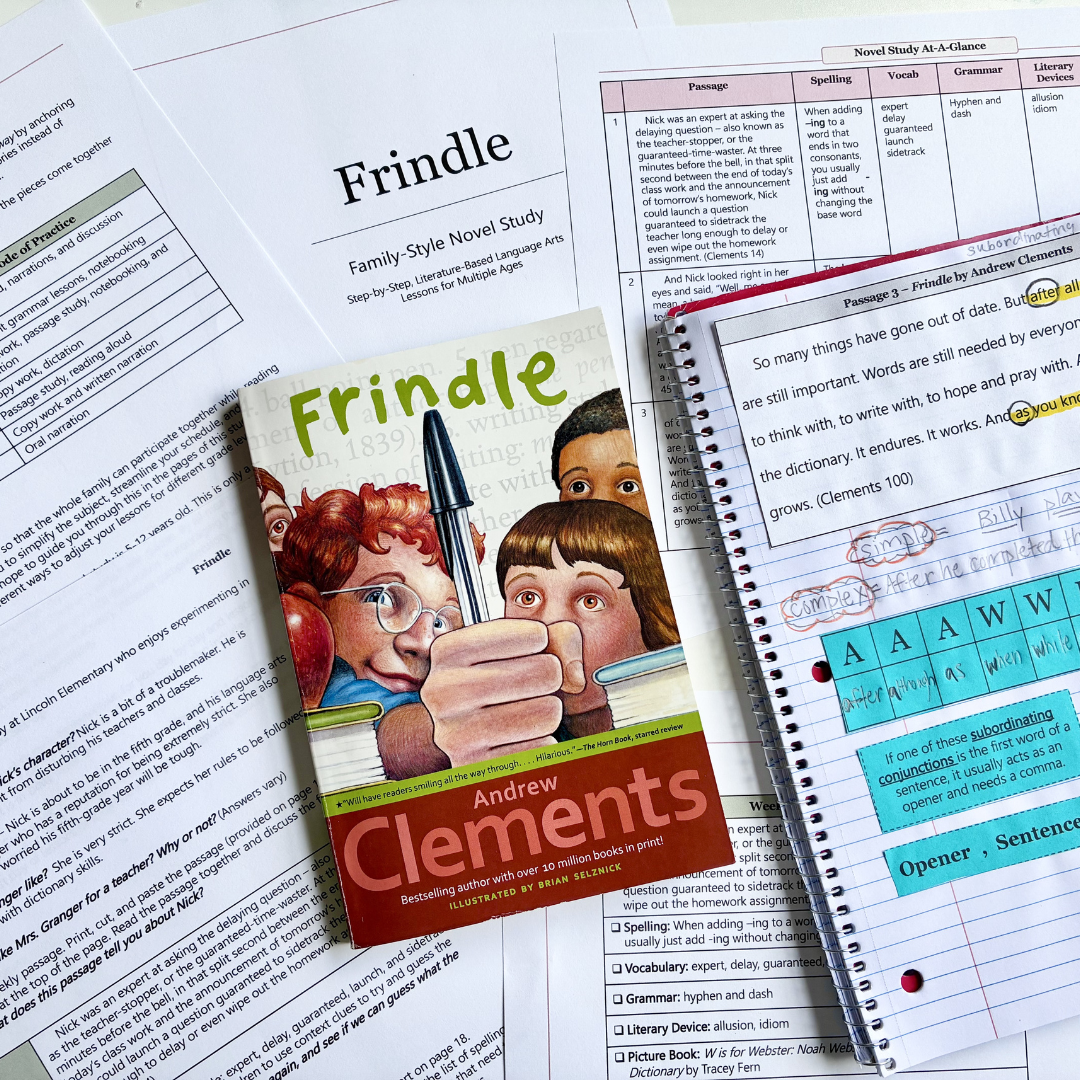
That approach is exactly what this new Frindle novel study is designed to do.
What Makes This Novel Study Different?
This is not a packet of random comprehension questions.
Instead, every part of language arts grows directly from the novel itself.
As you read together as a family, your children will naturally practice:
reading comprehension
vocabulary
grammar
spelling
narration
writing
copy work
dictation
literary devices
discussion skills
All from great literature.
The lessons are broken down day-by-day with simple, scripted guidance so you can open the guide and teach without spending hours planning.
Designed for Multiple Ages
One of my favorite parts of this style of learning is that it works beautifully for family-style homeschool lessons.
This study was created with ages 5–12 in mind, with flexible options throughout so younger and older students can participate together.
Instead of juggling separate language arts curriculum for every child, you can gather together around one meaningful book.
Language Arts That Feels Connected
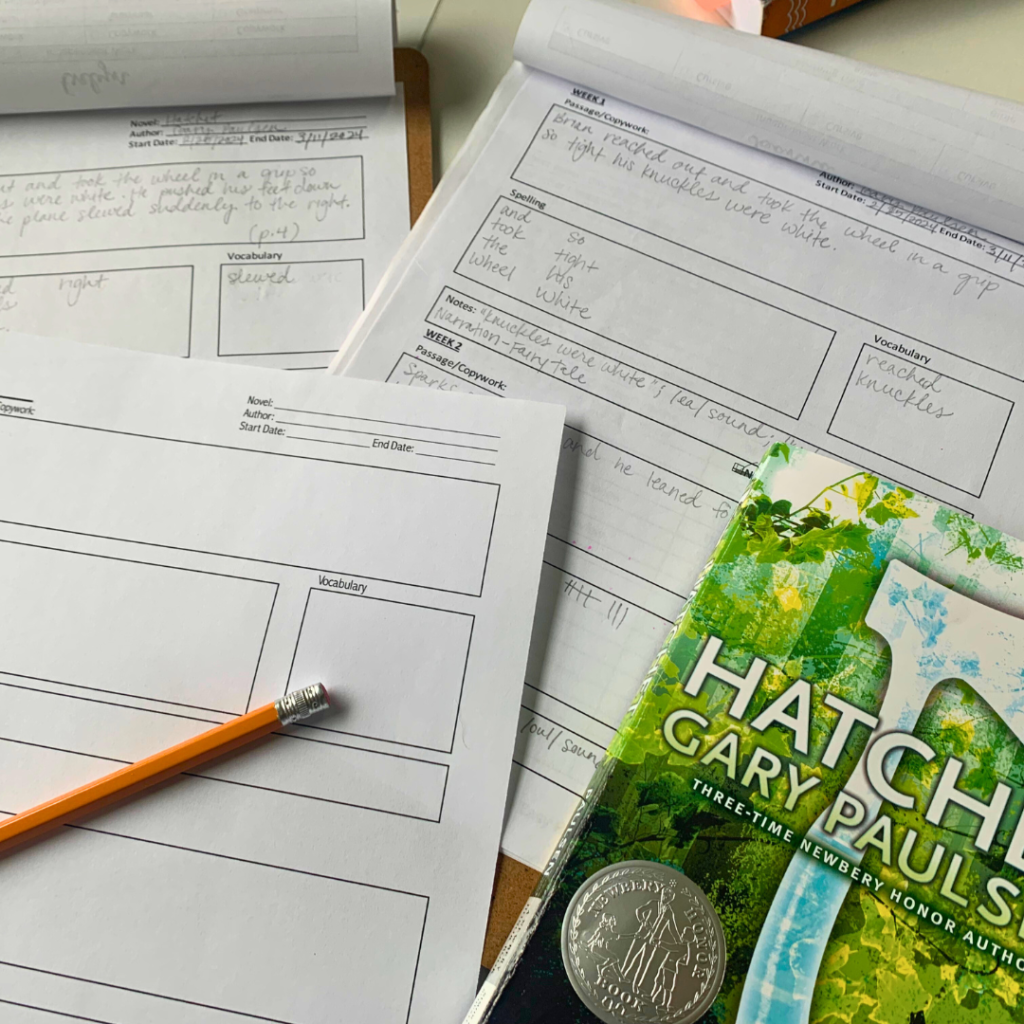
Each week centers around a short passage from the novel.
That single passage becomes the foundation for spelling, grammar, vocabulary, copy work, notebooking, and dictation lessons.
For example, children might:
study grammar directly from the story
learn spelling patterns using words from the passage
discuss literary devices used by the author
complete narration activities
practice copy work using rich, real literature
Everything stays connected and meaningful.
Gentle, Flexible, and Realistic
I am so passionate about nurturing a love for literature and making language arts enjoyable.
This study includes optional notebooking, journaling, picture books, hands-on bonus activities, and narration prompts — but families are encouraged to adapt the lessons however they need.
The goal is never perfection. Instead, we want to help children grow in language arts while continuing to love books.
Explore the Frindle Novel Study
If you’ve been looking for a simpler, literature-based approach to language arts, I would love for you to take a look at this new study.
However, I think you’ll be surprised by what finally made me take the leap.
What really pushed me to try it was a novel I read with my daughter—The Wednesday Wars by Gary D. Schmidt. In the story, a middle school boy has private lessons with his teacher, and she makes him listen to Shakespeare plays. Reading about his personal growth through those experiences made it an unforgettable read! (I highly recommend!)
That book made me think: We have to try this.
What We’ve Done (And Why It Works)
For the past two years, we’ve chosen one Shakespeare play each year. And we’ve kept it so simple that it no longer feels intimidating.
It’s something we all look forward to.
In this post, I want to show you exactly what we do—step by step—so you can try it in your own home without overthinking it.
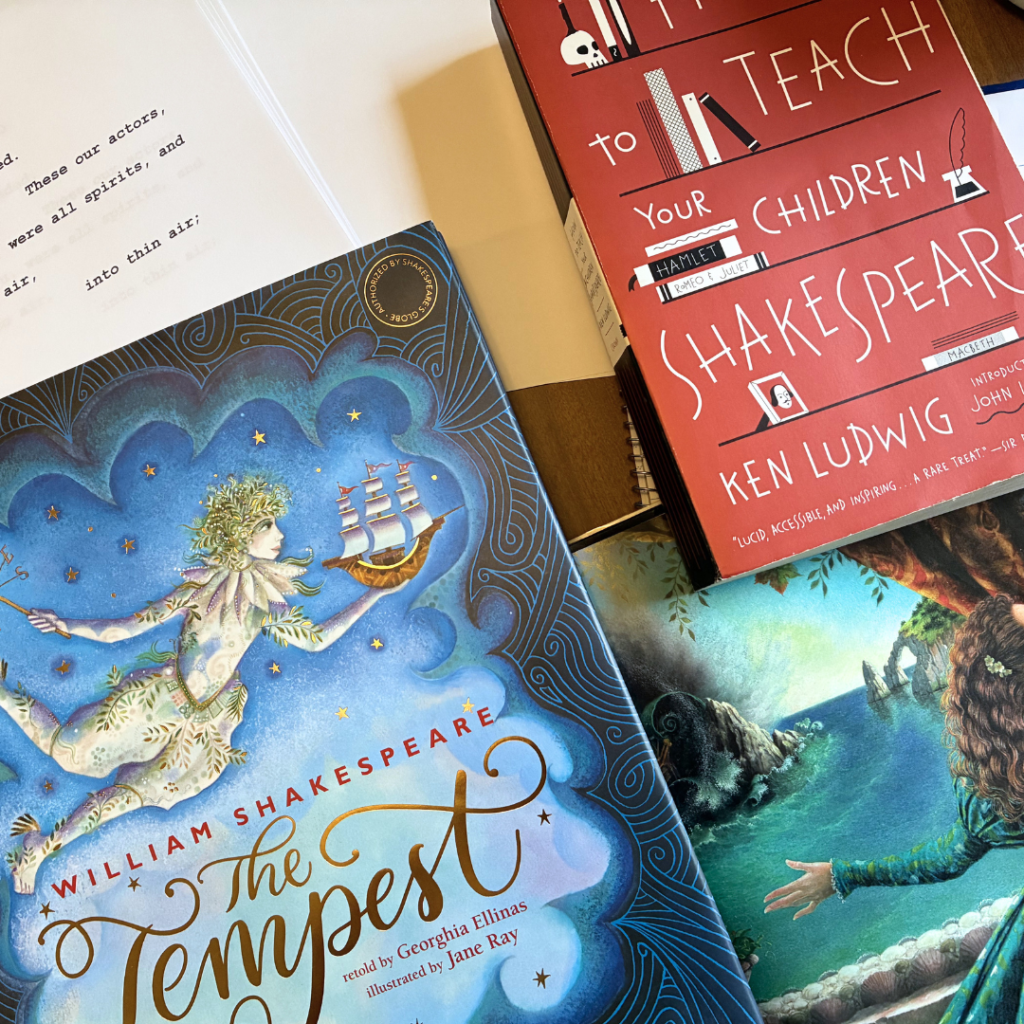
This book is incredibly helpful—but don’t feel like you need to read it all at once.
Start with the introduction and the first chapter or two for a little inspiration
Then come back to it when you’re ready to begin a specific play
Each chapter walks you through the plays, and the author also provides passages for memorization. On his website, you can find printable versions of these passages and audio recordings (so helpful!), which makes it easy to plan.
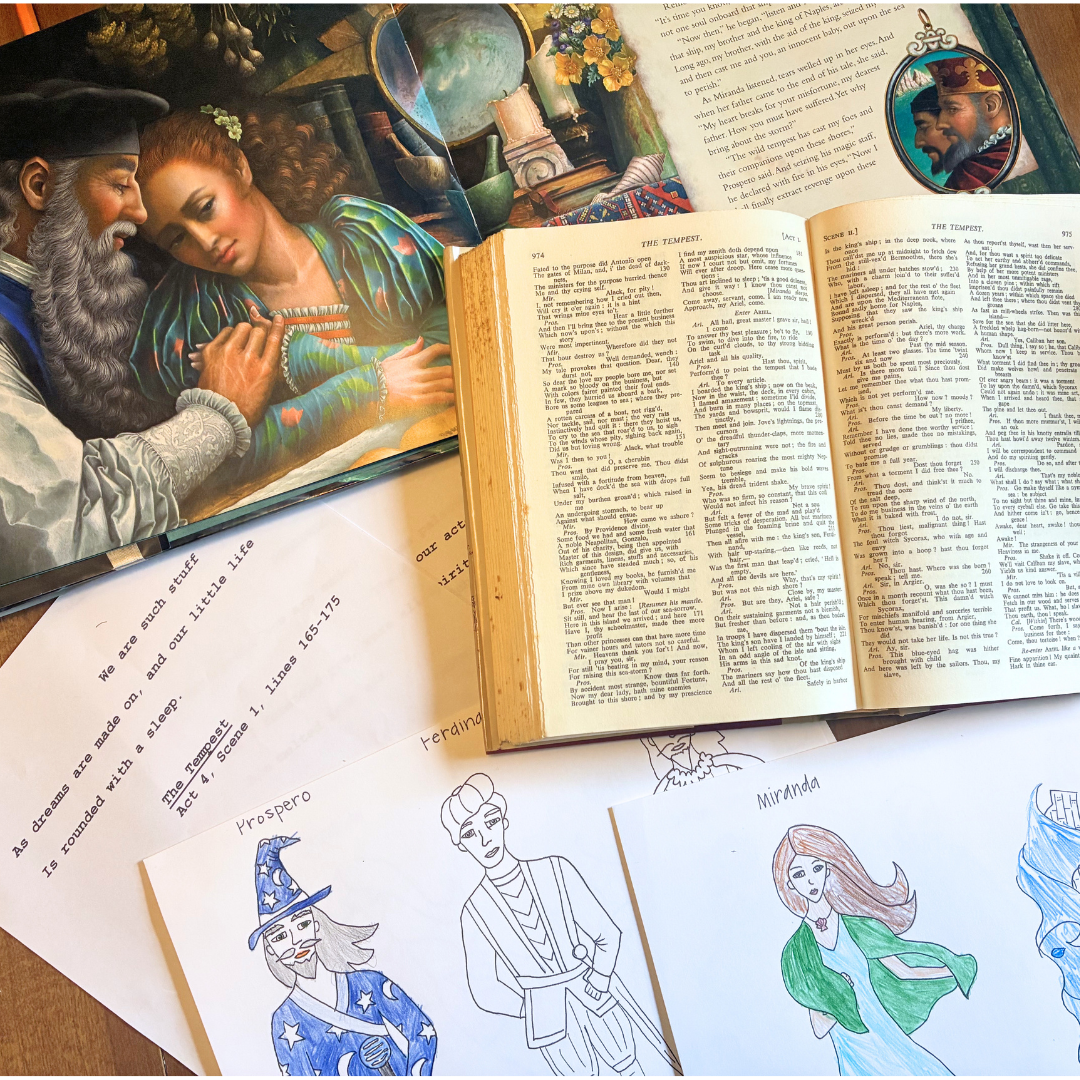
We use these passages for copy work and recitation.
Choosing a Play
If you’re not sure where to start, Ludwig’s book will help with that too.
Our first year: A Midsummer Night’s Dream
This year: The Tempest
The plan I’m about to share is based on The Tempest, but you can easily adapt it to any play.
Our Simple Shakespeare Plan (Step-by-Step)
The easiest way to explain this is to show you exactly what we do—almost like a checklist.
Planning
Before you begin:
It will help you to read the chapter in Ludwig’s book on your own for your chosen play. This will build your knowledge about the play as you get ready to share it with your children
Print any passages you want to use for copy work or memorization
Check your library/amazon for picture book retellings
These steps will help you feel a little more confident before starting.
Day 1: Gentle Introduction
Read and discuss a picture book version of the play.
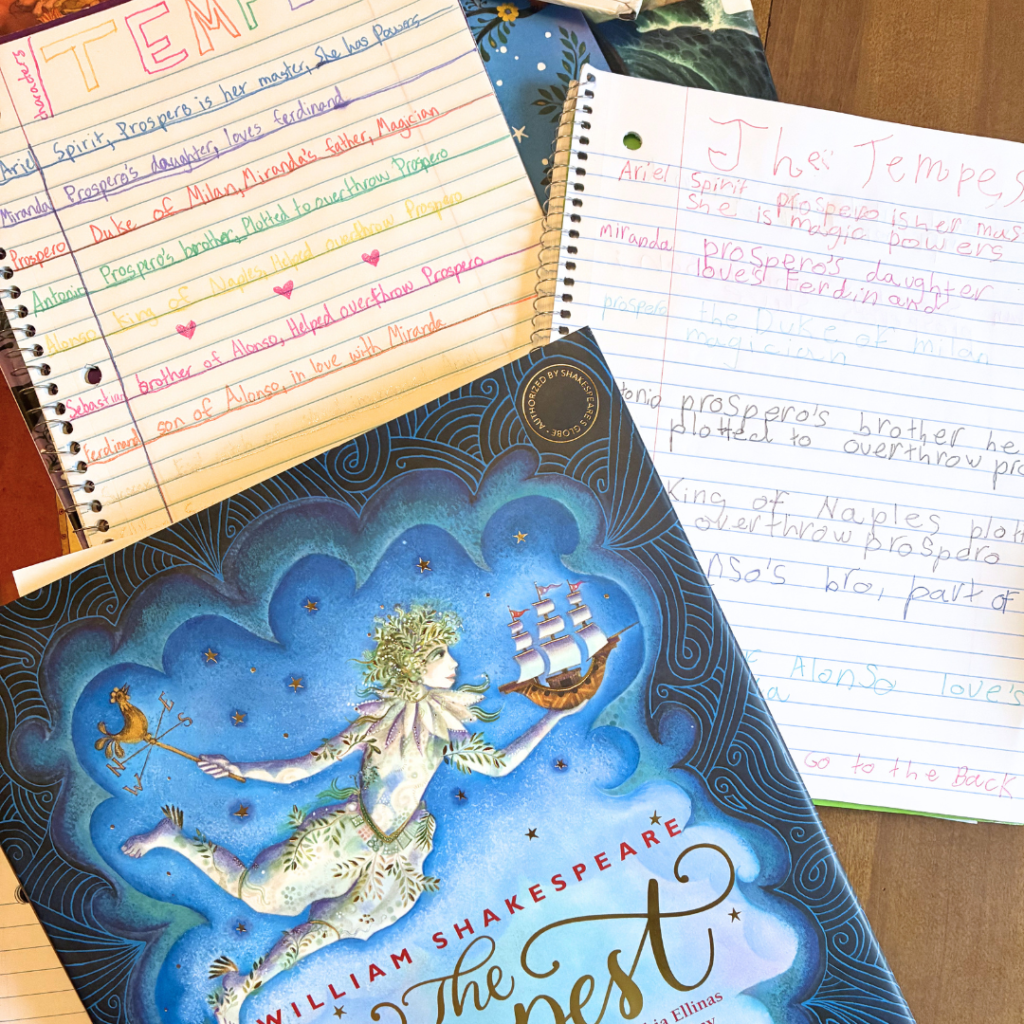
Create a simple character chart together. Write down each character and a few basic details. You don’t need to know this in advance. Learn as you read. Here’s an example:
Prospero: magician, Miranda’s father, Duke of Milan
We do this in notebooks and use colorful pens or pencils—it adds a little fun and makes it feel special.
Day 3: Begin the Passage
Play the audio of your chosen passage
Read a short section from Ludwig’s book aloud to your children to give background on the play (For this play, I read pgs. 310-312)
Begin copy work
This is a very light day, but it starts building familiarity.
Day 4: Practice Recitation
Practice saying the passage together
Let each child try on their own
Continue copywork
This repetition helps, but it doesn’t feel like too much.
Day 5: Deepen Understanding
Read another version of the story.
We read a longer picture book version (The Tempest by Marianna Mayer) for more detail, but you could definitely read the first picture book again.
After reading:
My older kids write a narration
My younger child draws a picture
Then we continue:
Copy work
Passage recitation practice
Day 6: Listen to the Play
This is where it all comes together—and it’s honestly the most fun.
We listen to a full-cast audio version of the play (we found one on Audible) for about 20 minutes at a time.
Because they already know the story and characters, they actually enjoy it.
A few things we add:
I follow along in a book so I can pause and ask simple questions. This isn’t necessary, but I enjoy it and find it helpful. (The book I own was a gift to me and isn’t in print anymore. This one may be similar: Complete Works of Shakespeare.)
The kids color paper puppets while they listen – it’s worth the few dollars. My kids love this! Later, they turn them into puppets and act out scenes
We also:
Finish any remaining copy work
Keep practicing the passage
Day 7 (and Beyond): Keep It Going
At this point, we’re nearing the end.
We simply:
Continue listening to the play in short chunks (about 20 mins at a time)
Practice recitation daily
Finish puppets and enjoy re-enacting
Sometimes it takes more than seven days—and that’s completely fine.
Sometimes we don’t even finish the whole play.
And I’m okay with that.
The Goal (This Matters Most)
My goal isn’t perfection or completion.
It’s exposure.
I want my young children to experience great stories, rich language, and beautiful ideas. And this simple approach allows us to do that without pressure.
You Can Do This
So what do you think?
Does it feel a little more doable?
It doesn’t have to be complicated. You don’t need a perfect plan. All it takes is a simple starting point—and a willingness to try.
You really can do this!
This post contains affiliate links.If you follow one of my links I earn a small commission at no extra cost to you. Thank you for supporting my blog.
If you’ve ever had the desire to get rid of the all-in-one language arts workbooks, you’re not alone.
I felt the same a few years ago as I was on the hunt for yet another workbook that would finally be the “right” fit for our family.
At first, that all-in-one workbook structure feels helpful. But over time, it often starts to feel repetitive and disconnected, leading to this constant search for something better.
One day it hit me:
Why is it that I get so much joy reading and talking about literature with my kids, but when we open these workbooks, we dread the task of completing it?
Shouldn’t these two things be connected? Isn’t reading and talking about literature a part of what language arts is all about??
I knew there had to be another way…
A New Approach
After some trial and error, lots of research, and a few years of experience, we have made habits and routines of learning language arts through the books we love.
We are no longer flipping through pages of random tasks, but instead we are engaged in great literature, having meaningful discussion, and still practicing different language skills such as spelling, vocabulary and grammar.
This approach put the spark back into learning – for both my children and me.
A Simpler Way to Think About Language Arts
Many homeschool parents rely on all-in-one language arts programs because they don’t want to miss anything. That makes sense, because the subject is made up of multiple parts.
But what if we simplified the standards of the subject a bit to really grasp what it is?
Suddenly, it doesn’t feel like such a monster of a subject anymore. Seeing each of it’s parts can help us truly grasp the subject and how to tackle it with a different, more natural approach – no all-inclusive workbook needed!
At its core, language arts is four parts working together:
Reading
Writing
Speaking & Listening
Language (grammar, spelling, vocabulary)
When you understand these pieces, something shifts.
You’re no longer relying on a workbook to tell you what to do.
You start to see how language naturally develops through reading great books, having meaningful conversation, and writing regularly.
But Is This Enough?
This is usually the biggest question.
If you step away from a full curriculum…are you doing enough?
With a simpler approach, nothing is getting skipped. You’re still covering everything—you’re just doing it in a more connected and meaningful way.
Instead of checking boxes, your child can truly get engaged with literature and language.
Taking the Leap
Even when this approach makes sense, it can still feel hard to start.
Without a workbook you might be wondering: “What exactly is language arts? How do I know what to cover? What does this look like in my daily schedule?”
An all-in-one workbook may feel safer, but is it truly bringing your family the joy you desire while reading and learning together?
If we look at language arts from a different angle, the leap starts to feel a little bit easier.
A Simple Way to Bring It All Together
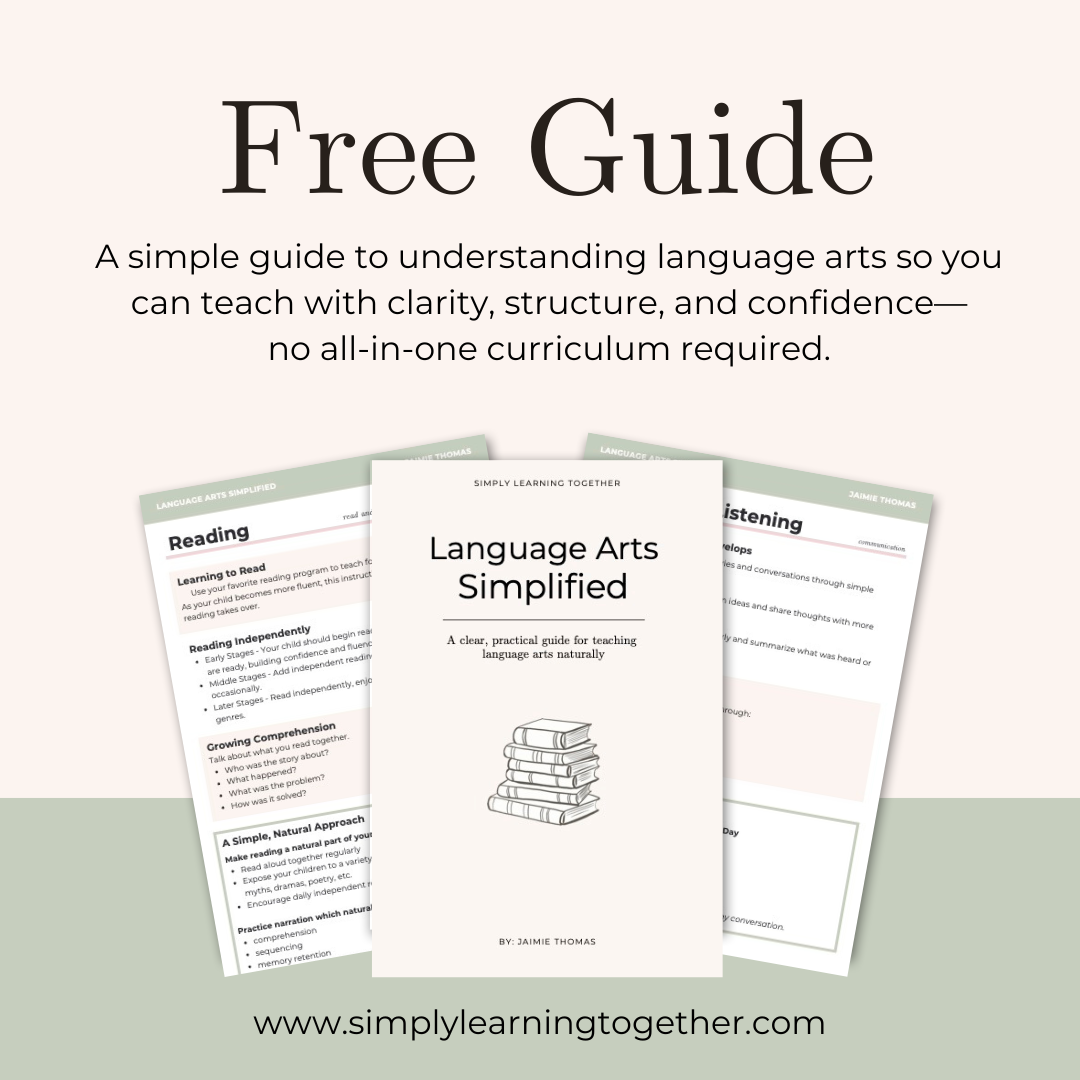
This is exactly why I created my free guide:
Language Arts Simplified
It breaks the subject down into clear, manageable pieces and shows you:
A simple breakdown of each part of language arts
An understanding of what your child truly needs to learn
Practical ways to meet those goals
Flexible options so you can build an approach that works for your family
You Don’t Need a New Curriculum
There’s no need to start over or buy something new.
You just need a clearer understanding of the subject—and a natural way to approach it.
Download the Free Guide
If you’ve been wanting a simpler, more connected way to approach language arts, you can download the guide below.
My hope is that it gives you the clarity and structure you’ve been craving—so you can move forward with confidence and finally feel at peace with your approach to language arts.
I love to teach science with picture books in our homeschool. The thing about picture books is they’re great for every age. From toddler, to teenager, to me – the adult! We can learn so much through one book.
Over the last couple of years I find myself moving further and further away from textbooks and workbooks in multiple subjects and focusing more on literature-based learning. It has been such an engaging and memorable way to learn.
There’s something about a science textbook where every time I open up to start the lesson, I dread reading it out loud. It’s like I already know it will be hard to keep their attention the whole time. This year I bought a science text for my older girls that they were taking in our co-op and thought we could just use it as a family study since it was made for elementary ages…I couldn’t do it!
The thought of reading it to my youngest ones (ages 5 and 6) was overwhelming. I’ve been thinking a lot about my youngest two and how fun these elementary years can be – so much wonder and curiosity and play through learning. I want to take advantage of these years and enjoy what we are reading. This is what led me to create my newest literature-based curriculum – Science Through Picture Books.
In this blog post I’ll share a little more about what it is and how it works. I’ll let you know my plans as I work on piecing units together over the next couple years to create it for my own family. Picture books have brought so much joy to our homeschool, and I hope it can do the same for you.
This post contains affiliate links. If you follow one of my links I earn a small commission at no extra cost to you. Thank you for supporting my blog!
An Overview of Science Through Picture Books
Science Through Picture Books was created as a family study for your children ages kindergarten through fifth grade. It will be made up of multiple units, and each unit will contain a list of twelve books.
These twelve books can be read at any pace you like. Read one per week and finish the unit in twelve weeks OR two per week and finish the unit in six weeks. Read three per week and finish in four weeks…and so on!
You have the choice to read as many as you’d like throughout your week, making the unit fit into your family schedule as you desire.
Each book is paired with an optional video. These are short videos to enrich the lesson from the stories and can provide more visuals and discussion opportunities with your children.
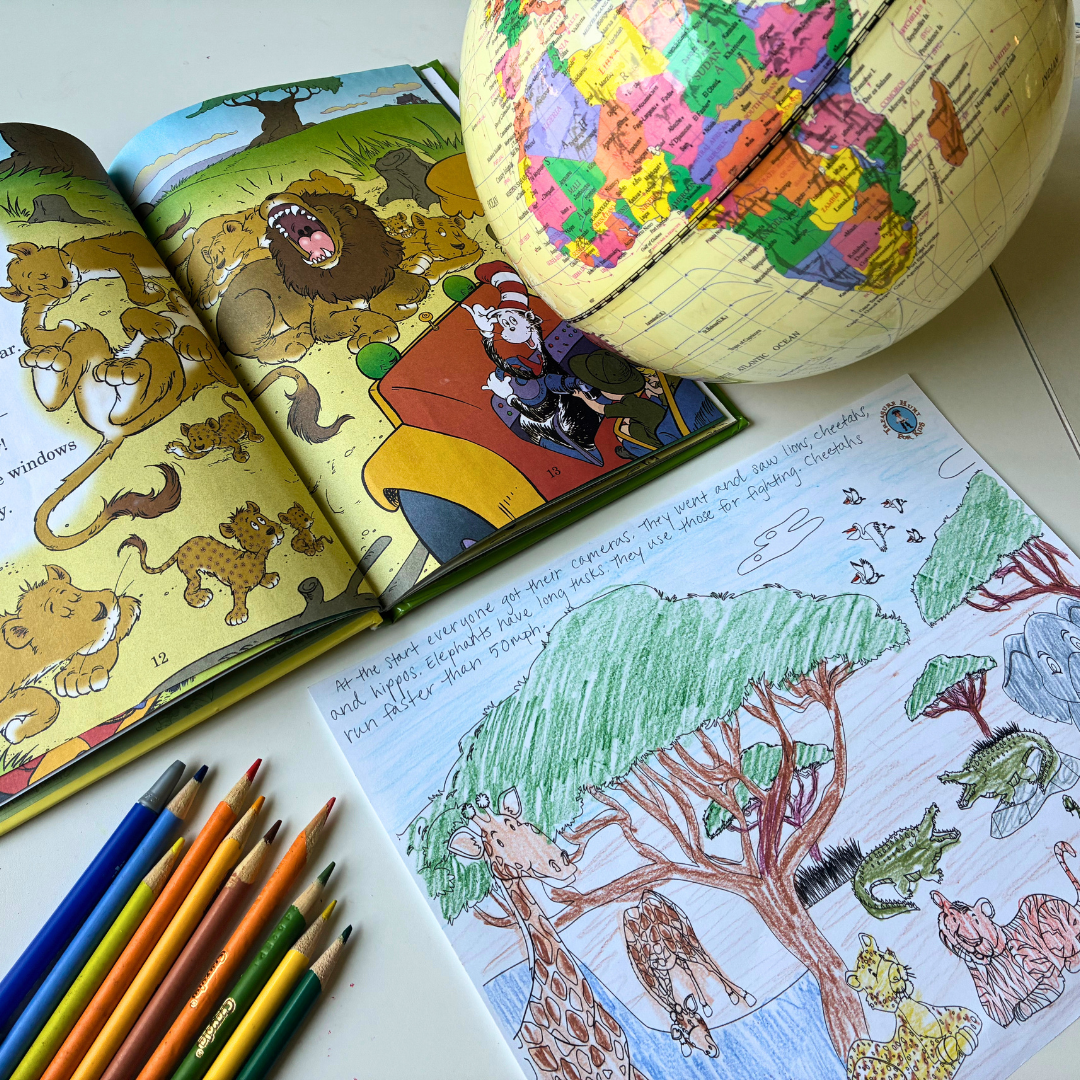
As you read these books, I will guide you in introducing and discussing the stories with your children. (See example in photo above) For each book, I give you notes on reading it aloud, a script for introducing it to your kids, and optional discussion questions and narration prompts.
Science note booking is also an option. I will teach and encourage you to practice narration as you read this books. The unit will list multiple ways to keep record of your science notebooks in order to differentiate your note booking for different ages and skill levels.
Finally, I provide you with a list of enrichment activities that you have the option to add to your studies. The activities range in prep and difficulty containing super simple ideas or more complex projects that take a little more time.
What is a Lesson Like in Science Through Picture Books?
Picture this: Gather at the table, snuggle up on your couch, or lay out a blanket in the grass. Read a book and have your children narrate to you. It’s that simple. If you’re not familiar with narration, I’ll guide you through all of that in this guide.
Some of you may like to go a little further, and that’s encouraged if it brings you joy! You’ll see in the section above all of the additional videos and activities that are included in this unit. The point is, you can make this as simple or as complex as you’d like.
Unit Topics – Meeting the Standards
As a homeschooling mom, I try not to focus so much on the standards, but at the same time I know that some may feel peace of mind knowing they are following a certain standard as they teach their child. So, in this section, I hope to do my best to meet both sides in the middle.
As I researched science standards while developing this curriculum, I realized that they are not the same across the country. Common Core standards exist, focusing on literacy through science in grades K-5, which is great, because you’ll get plenty of that through these books!
Some states have their own unique science standards while others have adopted the Next Generation Science Standards, released in 2013. (NGSS)
My hope is to provide a variety of science units for families to choose from to help build a foundation of knowledge in the subject. These units will focus on three out of the four disciplinary core ideas listed in the NGSS: physical sciences, life sciences, and earth and space sciences.
These categories will guide me as I choose themes for the different units. The standards will not be stated in these units, because my intention is to make this a family study, which would be an extensive list covering multiple grade levels. However, if you’re curious about what these standards are, I encourage you to do your own research on their website which provides free, downloadable lists of the standards for each grade.
One thing you may notice is the majority of the standards can be met through these books and your discussion. Reading the standards can feel very “official” or possibly overwhelming, but remember that the goal of these elementary years is to build a foundation – the NGSS will tell you the same thing! We aren’t trying to reach a mastery of topics. We are encouraging curiosity and igniting their desire to learn even more!
Look-Through the Curriculum
Want to see inside one of these units? I know sometimes that can help get a better idea of what a specific curriculum is all about. Head to my YouTube channel to learn more about this and see inside the unit guide.
These units will be published as I complete them with my own children. I have a goal to complete four this year. We may or may not get to more than that. Here’s what you can expect this year:
Each unit will follow the same pattern as I mentioned above in the overview.
Choosing Books
I work really hard to research and read tons of books for these units. I enjoy it very much as I get to know authors and illustrators while increasing my knowledge on different topics.
There are hundreds of books on these topics. However, my goal is not to provide you with tons and tons of books. I hope to give you a simplified, streamlined list in order to help you build a foundation of science knowledge with your kids.
A beautiful, informative picture book always engages my children and me. Some people might refer to these as living books. These are the books that draw your attention and make you eager to listen and learn. It never fails when I read a great picture book with my kids, we are wanting to read more! It’s like it can spark a certain curiosity to dig deeper.
That’s exactly what science should be in these elementary years. We want to spark our children’s curiosity to learn more about the world and increase their desire to explore and experiment and even question ideas. All of this will develop their knowledge of science topics as well as their critical thinking skills.
When it comes to collecting these books for your family, the library is such a great way to do that. With the list of books in hand, you can easily put books on hold as you prepare for the unit! It’s such an inexpensive way to learn science with your kids.
How to Use these Units
In my own home, I use these units as our whole science curriculum. I don’t find it necessary to add anything else. Even as I research standards, I am confident that the content and the discussions provide my children with an excellent foundation in science knowledge.
You do have other options to consider:
As stated above, use this on its own for your homeschool science curriculum. More units coming soon!
Use the book list as a supplemental resource to enhance a science textbook you plan to work through.
Let the booklist be your guide as you create your own unit study stretching across multiple subject areas.
However you decide to use it, I can promise you one thing – You’re going to love these books!
Stay in-the-know About Releases
If you’re not on my email list already, you’ll want to join now, because that’s where I will announce new releases. Each time I publish a unit, I’ll send out an announcement with a link. I know joining email lists can be frustrating at times, but it’s the best way to communicate with you all.
Emails are sent to announce product releases, sales, and to share the videos I make on YouTube. I hope you’ll connect with me there!
Novel study has been the most fun and engaging way for us to learn language arts in our homeschool, and adding in a DIY outlook has been so freeing. Two and a half years ago we actually eliminated an all-in-one language arts curriculum workbook to solely focus on novel study, and it’s been the best decision for us.
We like to call this method DIY Language Arts because we are able to take any novel of our choosing and use it to learn all the parts of language arts including spelling, vocabulary, grammar, narration, handwriting, and more.
After a couple years of adjusting and finding good rhythms for this, I am now able to share these novel studies with you. Multiple studies are available, but sometimes it’s nice to see inside one, and that’s exactly what I want this blog post to be for you.
Included in this post is a download to receive an entire week free for one of the novel guides. In the text below, I’ll walk you through how it works, so you know exactly how to incorporate it into your homeschool. I can’t wait for you to try this!
This post contains affiliate links. If you follow one of my links I earn a small commission at no extra cost to you. Thank you for supporting my blog
Look-Through a Novel Study
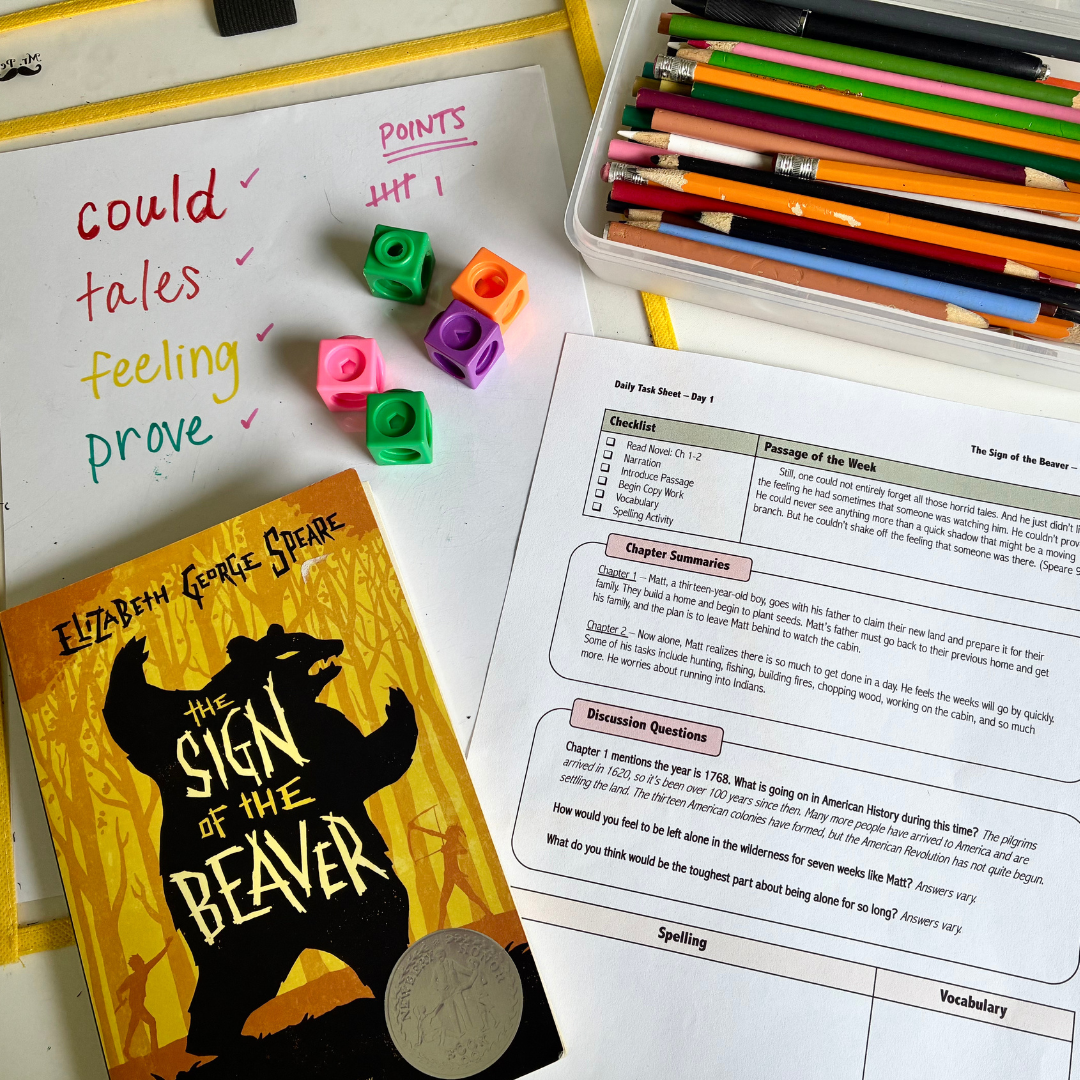
If you would like to see a video of this particular novel study sample for “The Sign of the Beaver”, you can check out this link where I share more details. You can also see a complete look-through of one of the first studies I published. This will give you a better idea of all of the information and resources that come with the novel study. The novel studies have been updated since then and look much nicer now, but the content is still the same.
Language Arts Overview
Included in this sample is the “Language Arts Overview” page where I break down the subject explaining exactly what it is and how this novel guide meets the criteria for the subject. A clear and simple chart will show you this evidence.
Language arts can be so overcomplicated in our minds, but by breaking it down and understanding what it is, we can get a better idea of how a novel can truly allow us to study the subject in its entirety.
What age is this novel study for?
These novel studies were created to be for the whole family. I’ve used them in my own home with one of my six year olds all the way up to my eleven year old. All of your kids will enjoy these novels, and the activities and work that are included are made to be able to adjust for different levels. If you purchase a novel study, I include the steps to walk you through this entire process in detail.
Weekly Pattern
Each week follows a pattern. Your daily tasks will look very similar (reading, discussion, narrating, copy work), but we will rotate an additional activity each day. This makes scheduling easy, and it allows you to loop different language arts skills for better focus instead of cramming everything in to an all-in-one lesson. The looping looks something like this:
Day 1: Spelling and Vocabulary
Day 2: Grammar
Day 3: Enriching Literature and Writing
Day 4: Dictation and Bonus Activity
Let’s take a look at each day. As I describe each of these activities, you will have a better idea of how to use the free sample provided in this blog post.
Spelling
On the page labeled, “Spelling and Vocabulary Samples”, I have provided a couple of pre-made spelling lists. Multiple options are provided to help differentiate the words for the level of spellers you have. This is just an example to help you get started. You are encouraged to pick whatever words best suit your children. The words/list you choose can be recorded in the chart on the daily task sheet.
On the day one task sheet you’ll notice “Spelling Activity” is listed. I’ve got you covered with options for this. Practicing the words can be as simple or as hands-on as you’d like. In this sample, I have provided you with multiple spelling activities to try with your family. Some are extremely simple. Others are a little more involved. The great thing about this is you can do what feels right for your week.
As you practice the words, make a note of the ones your kids know well and the ones they don’t quite have memorized yet. This could be a simple checkmark next to the word in your spelling chart. Then, each day after that, remind them of these words. Have your child practice the missed words throughout the week. Spend about a minute or two each day reviewing the words that are needed. The final spelling assessment will be in their dictation.
Vocabulary
Optional vocabulary words are chosen for you in the “Spelling and Vocabulary Samples” list. Once again, you have the option to choose the best words for your family. We aren’t doing matching worksheets or flash cards. Instead we will focus on meaningful discussion the whole family can participate in. When you read the weekly passage aloud to your children, this discussion will come pretty naturally. A discussion might look something like this:
Ask your child, “What do you think ____ means?” It doesn’t have to be a formal definition. Sometimes my child will describe to me with motions or sounds and then try to explain herself. Let this be casual. If she knows it well enough, move on to the next word. If not, move to step two.
Next say, “Let’s look at the sentence and see if it can give us some clues to make a guess on what ____ means.” Read the sentence again that includes the vocabulary word. Then, encourage your child to make a guess.
If the child is still not able to come up with a definition that is close to the real thing, look it up in the dictionary. This is a great way to practice dictionary skills. Sometimes you can even practice the process of looking it up on a phone or computer.
Grammar
There are many, many grammar lessons that can be taken from a passage. Throughout the guide I will provide you with one grammar focus on day two of each week. You have the option and are encouraged to practice more grammar, if you desire. In the full novel guide, I provide you with detailed information about grammar studies and how to engage in meaningful grammar lessons while practicing passage study.
In my home, we also enjoy using a grammar review workbook alongside these novel guides. We have used Fix it Grammar in the past and now we use Easy Grammar. (See this video for details) The novel passages give us more opportunity to review what we have learned in those workbooks and see it in a more meaningful way.
Enriching Literature and Writing
On day three of the week, a picture book is chosen for you to read aloud to your children. This particular book will teach a little science as we learn about the life cycle of bees.
I encourage you to check your library for this, but I will mention that it’s also read aloud on YouTube HERE. This picture book is an enriching option that provides your children with an exciting story related to the novel, and it will allow you to stretch your novel study across multiple subjects.
I also use these picture books to practice written narration with my older children. Written narration has been such a beneficial practice in our homeschool (watch this video to hear more). Once I read the story, my oldest child will write a narration about the book.
Dictation
Dictation happens on the fourth day of the week, and I have provided you an option to help your younger writers in this process. Not all of your children will be ready for dictation yet, but those that are can complete dictation in two different ways.
The first option is for your beginning writers. I have provided you with a fill-in-the blank dictation option that uses a shortened passage and contains the spelling words from one of the spelling lists.
The other option is a full dictation where your child will write down the passage as you read it out loud. Feel free to dictate just one or two sentences, especially if you’ve never practiced dictation before. If you have a strong writer, you could try dictating the entire passage.
The copy work will match the weekly passage. You have multiple options when assigning copy work in order to best meet the needs of each of your children. In this sample, I have included the shortened copy work as well as the full passage.
The goal of the copy work is to finish it by the end of the week. It may not take that long, but I challenge you to encourage your child to go slower with their best effort. I like to give short and sweet daily copy work assignments with the reminder that it has to be their best writing. In my experience, these short bits of copy work assigned over the week turn out much better than long, daily assignments.
Download the Novel Study
You can access the free sample to this novel study at the end of this post.
If you enjoy this first week and you’d like to complete the novel study as a whole, you can find the entire guide here. This guide will include much more information about the DIY method and will even teach you how to take any novel that you choose and use these same patterns! The how-to guide is GOLD! You’ll learn so much about language arts and the simplicity of a good novel study.
There are multiple novel studies available and more coming soon. To see more novel options, click here.
Picture Book Studies for Grades K-2
If you like the idea of book studies in your homeschool, check out my new picture book studies for your younger ones. These one-week units focus on one beautiful picture book and provide you with a passage for the week. This passage will allow you to practice copy work, spelling, vocabulary, and grammar.
Each week also includes an outdoor activity as well as an optional bonus activity at the end of the week. These book studies are so much fun! Use them for one week or grab a themed bundle for the month!
Have you been wondering if you could teach language arts without a workbook in your homeschool? It seems do-able and much more inviting than opening a workbook each day. Well, I’m here to tell you – you CAN! And it’s so freeing and fun! It can completely change the attitudes of this subject in your home, in the best way!
A few years ago we did just that. I was having the hardest time teaching language arts, mostly because it was boring and the workbooks really felt like a chore to get through. Add the fact that I have multiple students to teach, and it really just wasn’t great for any of us!
This is when I began to research passage study and novel-based language arts. There are multiple curricula options available to walk you through something like this, but I still was looking for even more freedom. That’s when I started practicing and using the term “DIY Language Arts”
This post contains affiliate links. If you follow one of my links I earn a small commission at no extra cost to you. Thank you for supporting my blog!
What is DIY Language Arts?
As I mentioned in the introduction, over the past few years I have been passionate about letting go of an all-in-one language arts curriculum. They are great for pacing and consistency, but most of the time we found them to be boring and repetitive in our home. I want my children to love literature and since it is such a huge part of language arts, it’s important to me that we all find enjoyment in learning about it. Otherwise, in my experience, reading becomes more like a chore.
Using this DIY (Do-It-Yourself) method of language arts, we have been able to have so much more freedom, letting go of the workbooks and instead choosing what we learn based on passages from great novels.
Choose A Novel
First, we choose a novel we want to read and all of our studies come from passages in that novel. One passage per week is how we started. The novel works around our schedule, making it so much more enjoyable than trying to fit a novel and chapters into certain time frames. Since all of the passage studies revolve around the novel, it becomes simple to plan and inexpensive to purchase. We can almost always use the library to collect books.
Passage Study
As we read, I choose a passage from the upcoming chapters each week and that becomes our focus. What’s going on? Who’s involved? What are the emotions? Next, that passage provides us with new vocabulary to discuss as well as spelling words to practice for the week. Each day, my children write portions of the passage practicing their handwriting skills and getting accustomed to reading and writing well-written sentences.
Narration + Meaningful Discussions + Enriching Literature
As we read the novel together, we practice narration and have meaningful discussions. This has allowed us to eliminate the need for busy-work worksheets and instead encourage connection and conversation about what we are reading. Through the addition of children’s literature, we can expand our language arts across multiple subjects as we relate our story to something in history or science or the arts. My older children use these engaging stories to practice writing skills.
Dictation/Assessment
Finally, through the use of dictation, I am able to assess my children and their progress from the week. I can check spelling skills and punctuation use as I dictate the weekly passage. This pattern of passage study has been educational, flexible, and honestly just much easier and enjoyable than completing a workbook every day.
Family-Style
This method of language arts works for my whole family! Currently my school-aged kids are 6, 9, and 11. We love that we can do language arts all together. With simple adjustments to copy work and spelling lists, each of my kids can participate in this study, making planning and time management so much easier in our homeschool!
New Guides Available
After doing this for a few years and forming rhythms, I’m so excited to share what I have learned with you all. Recently I created DIY Language Arts novel guides where I walk you through a complete novel PLUS I share with you the research and strategies I use to put something like this together. My goal is to help you be able to DIY your own language arts in your home whenever you choose. It’s freeing and FUN! The newest guides are linked below:
If you are familiar with passage study or if you do something like this style in your own home, then you may enjoy the new Passage Study Charts. These charts break it down so simply providing a passage, sample spelling and vocabulary lists, chapters to read for the week, and weekly enriching children’s literature. This simple chart is perfect for someone who loves a little more freedom but wants decisions made already!
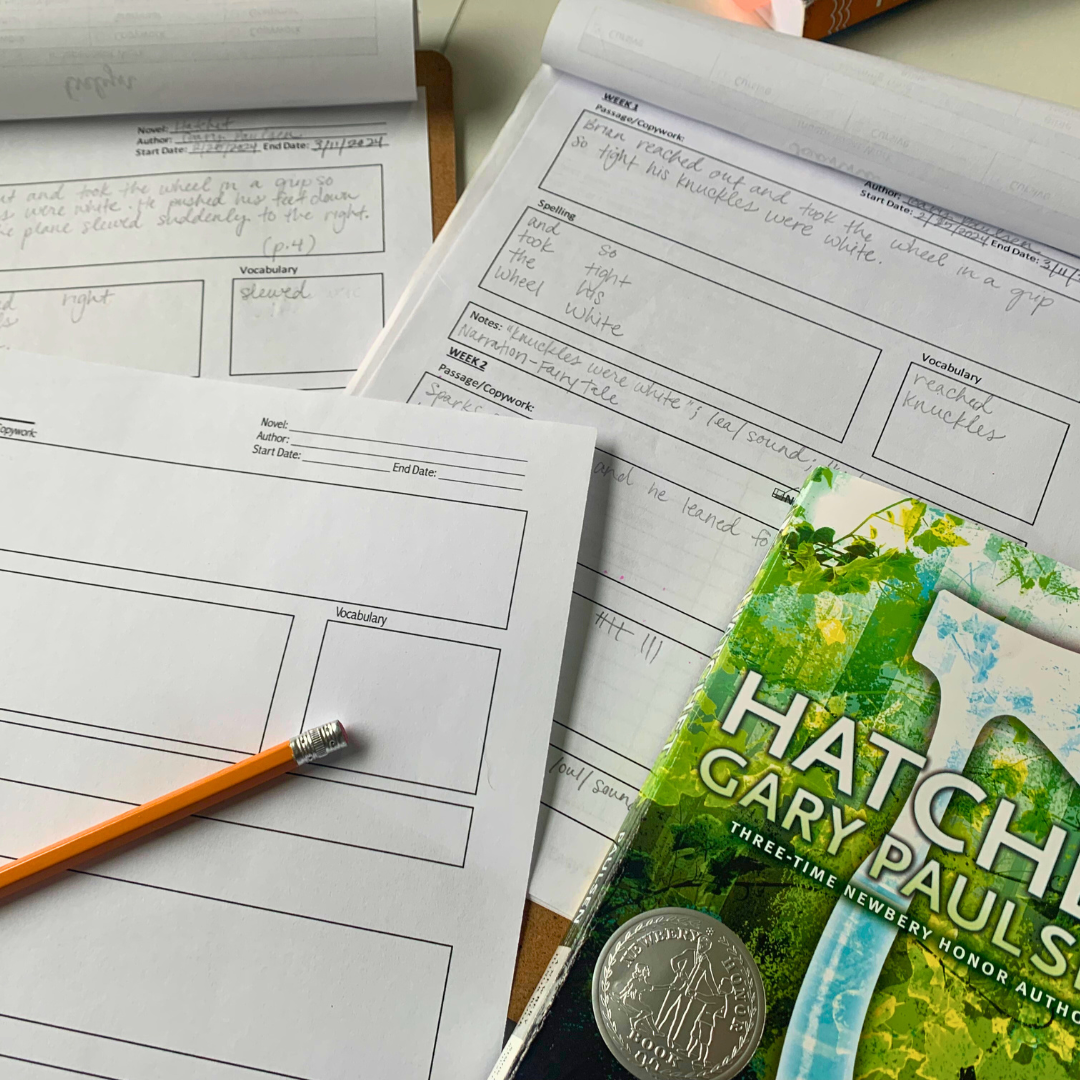
Ready to plan your own? Before I made the guides, I used a simple template (pictured above) to help me organize and plan our passage study. By making quick notes at the beginning of the week, decisions were made and the process of studying the passage became easier. Plus, it doubles as a great record for our novels and how we have used them throughout our school year. This is a FREE template! Get yours below.
I’ve done a lot of research on the different pieces of language arts and what it ACTUALLY is. I honestly think the subject gets over-complicated and as a result we end up with endless worksheets and exercises that feel more like busy work than meaningful education.
Imagine if your language arts could suddenly feel like a little book-club in your home. Book after book you can make connections, expand your learning across multiple subjects, learn from character experiences, and MORE and you study language arts as a family. This method simplifies the process, makes learning meaningful, and truly creates much better connection than a workbook.
I hope you’ll give it a try! If you do, share it with me here or on social media (@simply.learning.together). I love chatting about this so if you have questions, let me know. I also have multiple videos on YouTube sharing our experiences with this over the years:
I absolutely LOVE adding literature to our homeschool studies. Recently we completed our study of American History using nothing but picture books! It was amazing! And so much fun! Check it out here:
Two years ago I was on a mission to learn American History through picture books, and I am thrilled to say that we did it! It’s been hard work getting here in regards to research, but we have all enjoyed the process – I have learned more American History than I ever did in my own schooling, and my kids have actually enjoyed each and every history lesson we’ve learned together.
In the beginning of this project, as I researched different picture books for specific topics, I always ran into the same problem – there were so many! Which one should I read? Which one would give me the best information to teach the topic? The more and more books I found, the more I wanted to stream line the idea and make it much simpler. That is exactly how Learning American History through Picture Books came to be.
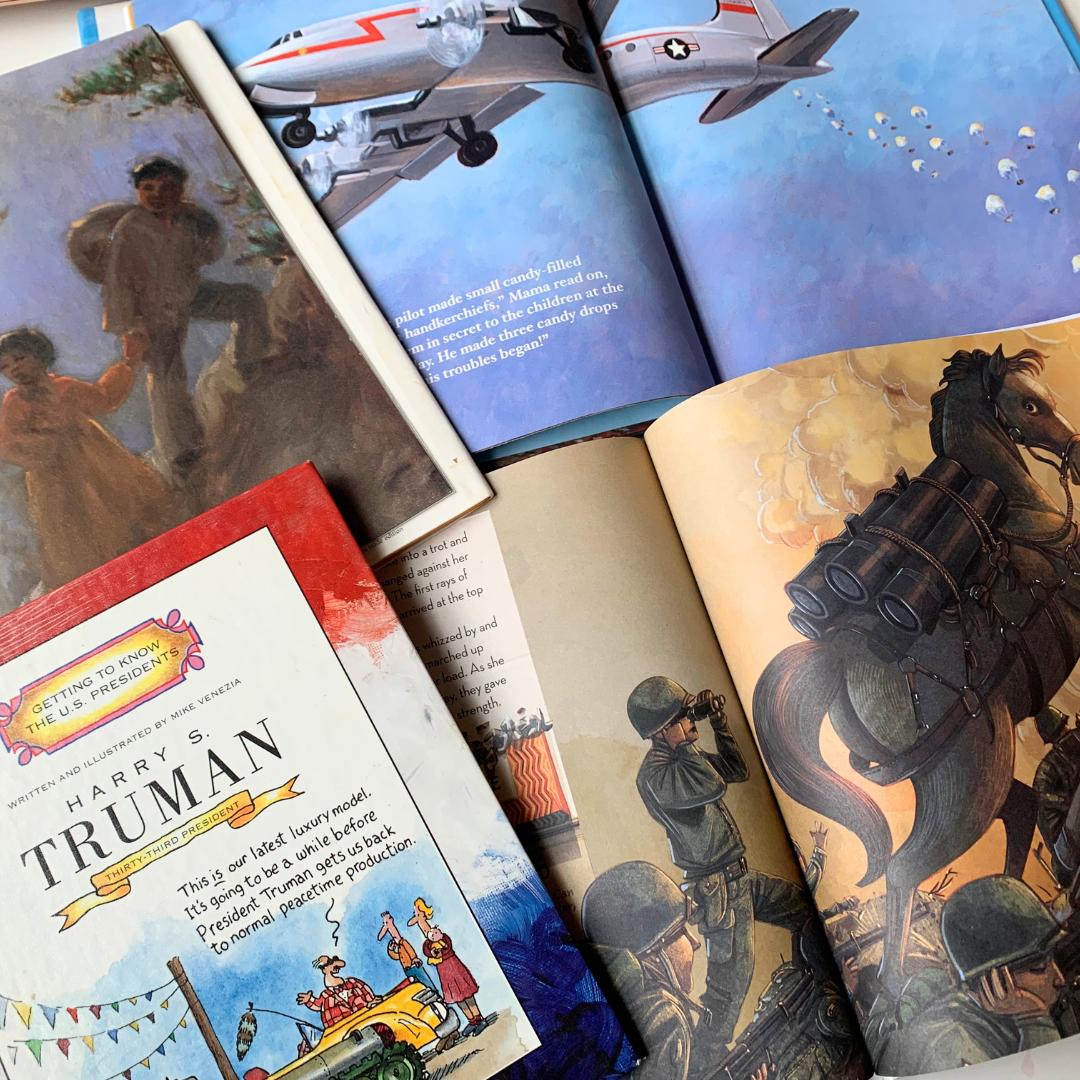
As you journey through the timeline of American History, a picture book will take you through each event, and all the books are chosen for you – one book per topic. (We’re focusing on quality over quantity here, and I’m so excited about it!) I’ve organized them all into a simple book list making it easy for you to follow along, check out books from the library, and plan for simple history lessons.
Starting as early as the Viking explorers in Unit 1, this curriculum will take you all the way through current times. To learn more about this curriculum and the different units, start HERE.
This post contains affiliate links. If you follow one of my links I earn a small commission at no extra cost to you. Thank you for supporting my blog!
The Final Unit – Part 4
It’s bittersweet to come to the end of this since it’s been a big project of mine for the last couple years. My kids and I have learned so much, and we have had a blast doing it.
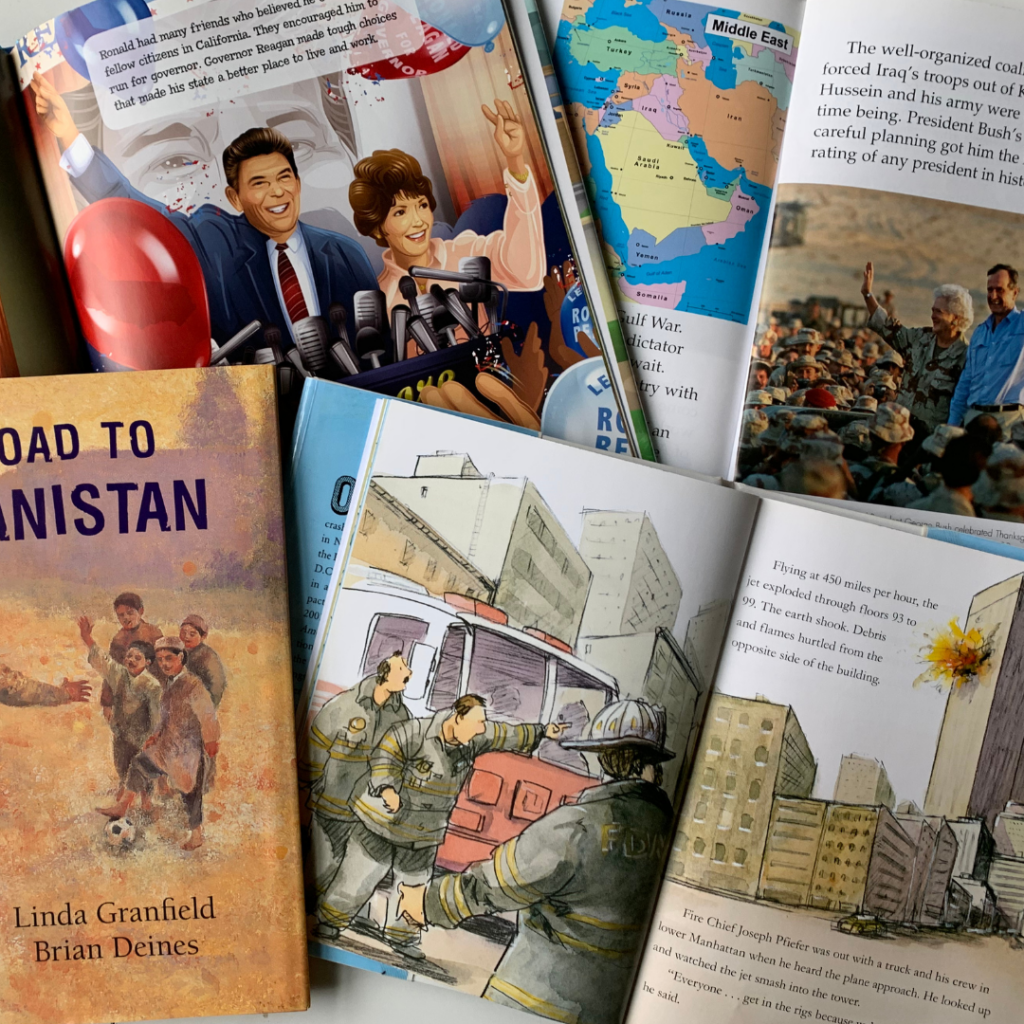
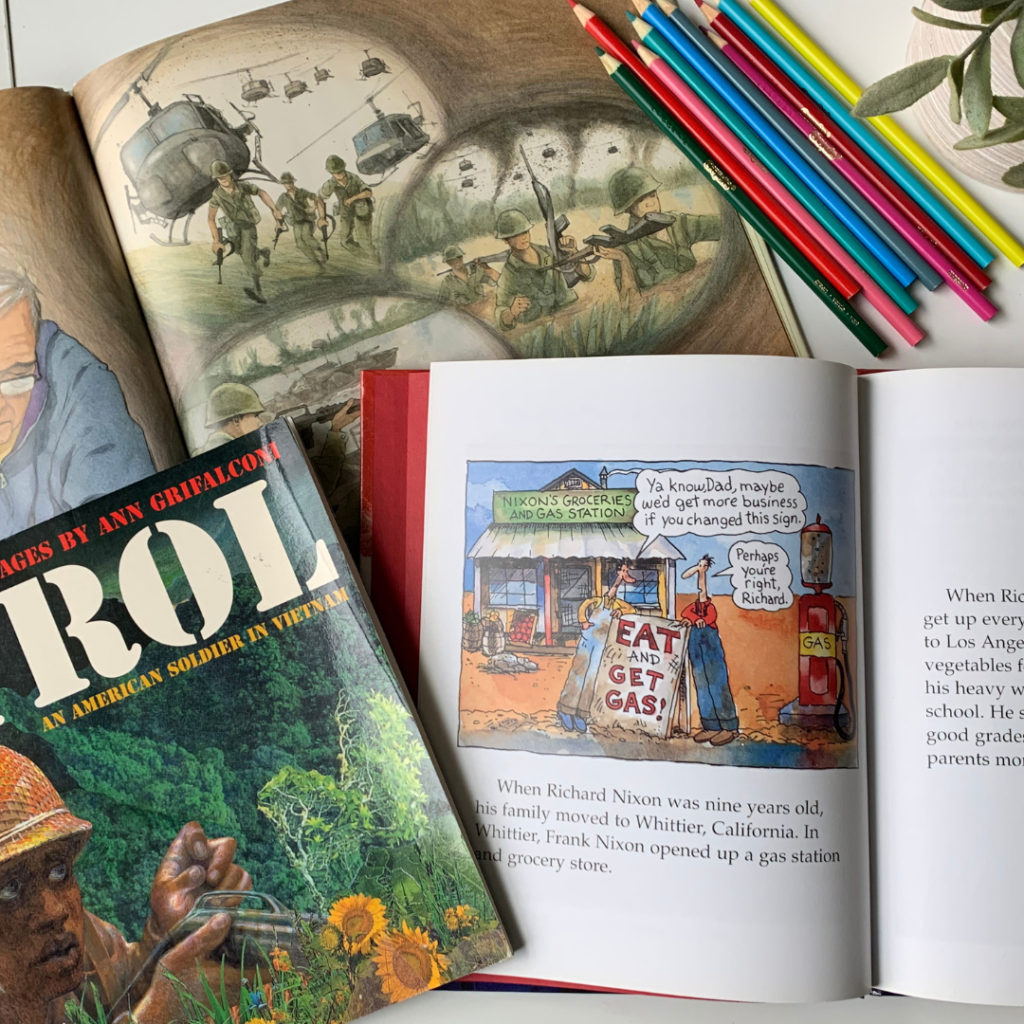
This newest unit will cover the time period after World War II through current times. You will touch on topics like the Cold War, the space race, the Vietnam war, 9/11, and so much more! Specifically this unit ends about the year 2003, as the last book in the main book list covers the invasion of Iraq in that same year.
The following is a breakdown of each unit and the time period it covers:
Since the whole point of this unit is for me to research and pick what I think is the best book for each topic, it’s so hard for me to narrow down my favorites! However, if I had to pick a few, the following were the ones we enjoyed the most. I share these to give you an idea of the kind of beautiful, engaging books you’ll be reading to your kids. You will look forward to reading these books each and every lesson!
The favorite books listed above are the types of stories that walked us through history. They are unforgettable! Each picture book beats a textbook paragraph any day of the week! You can find ALL our favorite American History books in my Amazon store front HERE.
Each of these units comes with a list of videos to enrich the learning of certain stories. Not every book is connected to a video, but sometimes I felt like some background information was helpful. Or, at other times, the video might fill in a gap from one story to the other. The following is the direct link to each video listed in part 4. For more information on each of these videos, you’ll want to check out the descriptions in the curriculum.
Finally, I’d like to share a link to my Pinterest board that contains the coloring pages we used to help us record our narrations. This is an optional part of the curriculum, but it’s such a simple task that I enjoy so much. The narration process is amazing to me, and I love looking back and reading their words of how they remember each story. It’s the perfect little product of learning to hang on to.
Honestly, I have no idea (ha!) Here’s the thing…I have poured my heart into this over the last two years. I am so passionate about what it is and how much better it is than any kind of history textbook you will ever buy. With that being said, I am having such a hard time trying to decide what we will do next as a family. I don’t want to let this style of learning go!
I am in prayer about this, because I don’t want to give up reading picture books…EVER! However, I am in a busier season of life that makes it tricky to create and research. I also feel a pull to focus on science for a bit because I feel like a slacker in that subject! My point is – something is brewing…I just can’t pin it down quite yet.
You’ll probably never stop hearing about picture books from me – I use them in almost all of our subjects. So, I hope you’ll stay tuned for what’s to come…even if that’s not clear to me just yet. Although deep down, I know a textbook won’t cut it for me. 😉
(EDIT – It’s been a few months of prayer, reading, and writing…and I’m back with more literature-based curricula! See below)
NEW Science Through Picture Books
We had so much fun learning history through these amazing picture books. I knew Science had to follow suit. Read more about it HERE.
Looking for more literature-based curriculum?
For the last few years, my children and I have created a novel-based language arts program that is family-style and enriched with great literature each week. I’m so excited to share a NEW guides with you on how we do this in our home. If you’re tired of an all-in-one language arts workbook or if you’re itching for a great novel to read aloud to your kids, you’ve got to try this method!
We recently found Berean Builders science for our homeschool, and we’ve been enjoying it so much more by adding picture books to supplement the content. I’m so excited to share with you how we do this as well as a list of books!
Berean Builders is plenty on its own, but I tend to get bored by textbooks. Adding in picture books makes a subject so much more exciting and engaging – this goes for my children but also for me teaching it! As you read this I’ll fill you in on what Berean Builders is, how we schedule it, and of course I’ll share a full picture book list for the current unit we are working on!
This post contains affiliate links. If you follow one of my links I earn a small commission at no extra cost to you. Thank you for supporting my blog!
About Berean Builders
Berean Builders is a scripture based, homeschool science curriculum that is presented through a timeline of history starting with creation in the first textbook. You can read more about their philosophy and explore their other texts on this website.
Every lesson comes with a hands-on activity to help discover the information that is taught in the lesson. There are no worksheets with the text, but instead you are encouraged to keep a science notebook of your discoveries. At the end of every lesson there are questions for discussion for a variety of ages. So, this curriculum is great for the whole family.
The introduction of the text provides a couple of options for completing the curriculum in a school year. They suggest completing a lesson every other day OR two days a week. However, they encourage planning in a way that best suits your family even if it’s less than what is suggested. (We only do it once a week – more on this later)
Our Experience and First Impressions
The first lessons we did in this book were so exciting! The activities included were things that I could do with materials around my house and we were all amazed at the results. For some reason I was doing the lessons daily. Maybe I felt the need to catch up after being so relaxed about science that year, but I can tell you after a couple weeks of that I knew slowing down would be the the better option.
The activities included are really quite simple, but having to put them together every day (or even every other day) became a little exhausting. I found myself wanting to skip science altogether. So this year I knew I needed to pull back a bit and not worry about finishing the text. Instead we would take our time and set a goal for completing science once a week.
Once we aimed for one lesson a week, the curriculum felt like a much better fit, but I was still feeling like I was missing something.
Adding Picture Books
We recently started a history curriculum that was picture book focused, and it has been the best. It makes our lessons whole-family friendly and so much more fun and engaging. I really wanted that feeling for science! This is when I started to think that adding in picture books for science may be helpful to our family.
The lessons in Berean Builders are not that long, but the information is packed in there. I don’t think this is a bad thing, but I think that my children (ages 3-10) would benefit so much better from that same information presented in a picture book. There’s just something about a picture book that makes a topic so much more interesting and easy to remember.
Once I added picture books in, our progress through the text slowed down even more, but I knew it was the better fit for us. There’s something about science that can get overwhelming at times. Experiments and messes make it hard to complete, especially if you have little ones. Approaching science with a slow mindset made me feel like the subject was so much more do-able, and I quit skipping it all the time.
Notebooking
We try to do some notebooking when we read through the textbook lessons. I keep this very simple! I ask my children to draw what they are observing from the activity. Then, we use the questions at the end of the lessons to help us narrate what we just read. My older ones write on their own. One of my younger ones tells me and I write her response.
I have a video about how we did this with little half sheets of paper at the end of last year. This was really great because I loved the small paper. This year my oldest daughter really wanted a notebook. So we are doing the same concept, just putting it on notebook paper.
Scheduling
I am always adjusting our schedule, so it’s totally possible that in six months I’ve made little tweaks to what I’m about to share with you. However, I want to explain the pattern that is working for us now for science.
Science is a part of our afternoon loop. We aim to do it once a week. I do not try to read the textbook and a picture book in one sitting. My kiddos would never last that long. So, the better option is to alternate. One week we do the textbook and the activity. The next week we read a picture book about the lesson. I love this because then we don’t do an activity/experiment every single week. Don’t get me wrong – they’re super fun and meaningful, but as a mom of four young kids, it can get tricky to throw that together all the time.
I’ll be completely honest – the more and more I work on my picture book lists, the more I want to stick with just that! So I can see myself slowly starting to do the activity in the text, but then read the picture book instead of the textbook. Many of the picture books present a lot of the same content, just in a friendlier way. We all enjoy reading them so much more, so I just feel like that’s probably what I’ll end up doing for the majority of the lessons. The book will become my guide instead of my main source if that makes sense.
Picture Book List
I’m so excited to share this picture book list with you. I heard from so many of you that it would be helpful, and I’m excited to finally get it to you. The one I’m sharing with you is the current unit we are working through. The first unit we completed the textbook only. It wasn’t until halfway through unit 2 that I came up with the picture book idea.
So, the following list is for Unit 3 of Berean Builders: Science in the Beginning. I’d be willing to share more lists like this if I knew there was an interest. So, if you do find this list helpful to you, can you let me know? You can comment on this blog – or, even better, shoot me a message on social media. Follow me @simply.learning.together on Instagram and let me know how you like the picture books.
Most of these books can hopefully be found at your library. Many are also on YouTube. You can also find links to all of the picture books for this science unit in my Amazon storefront. Use the link below to download the list.
I have exciting news! My family and I are now learning science through picture books! I do not have any more lists that correspond with Berean Builders, but if you love adding picture books to your science studies, you have to check out this new curriculum I’ve developed for my family. It is literature-based, simple, and most importantly fun and engaging! Help your kids build a foundation of science knowledge with these outstanding books!
For the last few years, my children and I have created a novel-based language arts program that is family-style and enriched with great literature each week. I’m so excited to share a NEW guide with you on how we do this in our home. If you’re tired of an all-in-one language arts workbook or if you’re itching for a great novel to read aloud to your kids, you’ve got to try this method! Below are two of the newest guides available now:
One of my kiddos will be a third grader this year, and in this post I plan to share our curriculum picks for the upcoming year. This will be my second time having a third grader and the funny thing is the line up looks completely different! It’s just proof that every child is unique. What a blessing to be able to adjust their education based on their needs!
As a reminder, I pick this curriculum because I feel like it’s the best fit for my individual child. What works for us might not work for you OR it might work great for you. That is always up to you to decide. As you read through this, I hope you are inspired with ideas as you plan for your own homeschool year. Please do not read this as expert advice.
This post contains affiliate links. If you follow one of my links I earn a small commission at no extra cost to you. Thank you for supporting my blog!
Family Subjects
As a mom of four, I group a lot of our subjects together. This has been such a big blessing for us and it makes our days so much more simple. I have a separate post about the subjects we are covering as a family this year, and you can check that one out here.
Our family subjects include Bible, history, science, fine arts, and some language arts.
Math
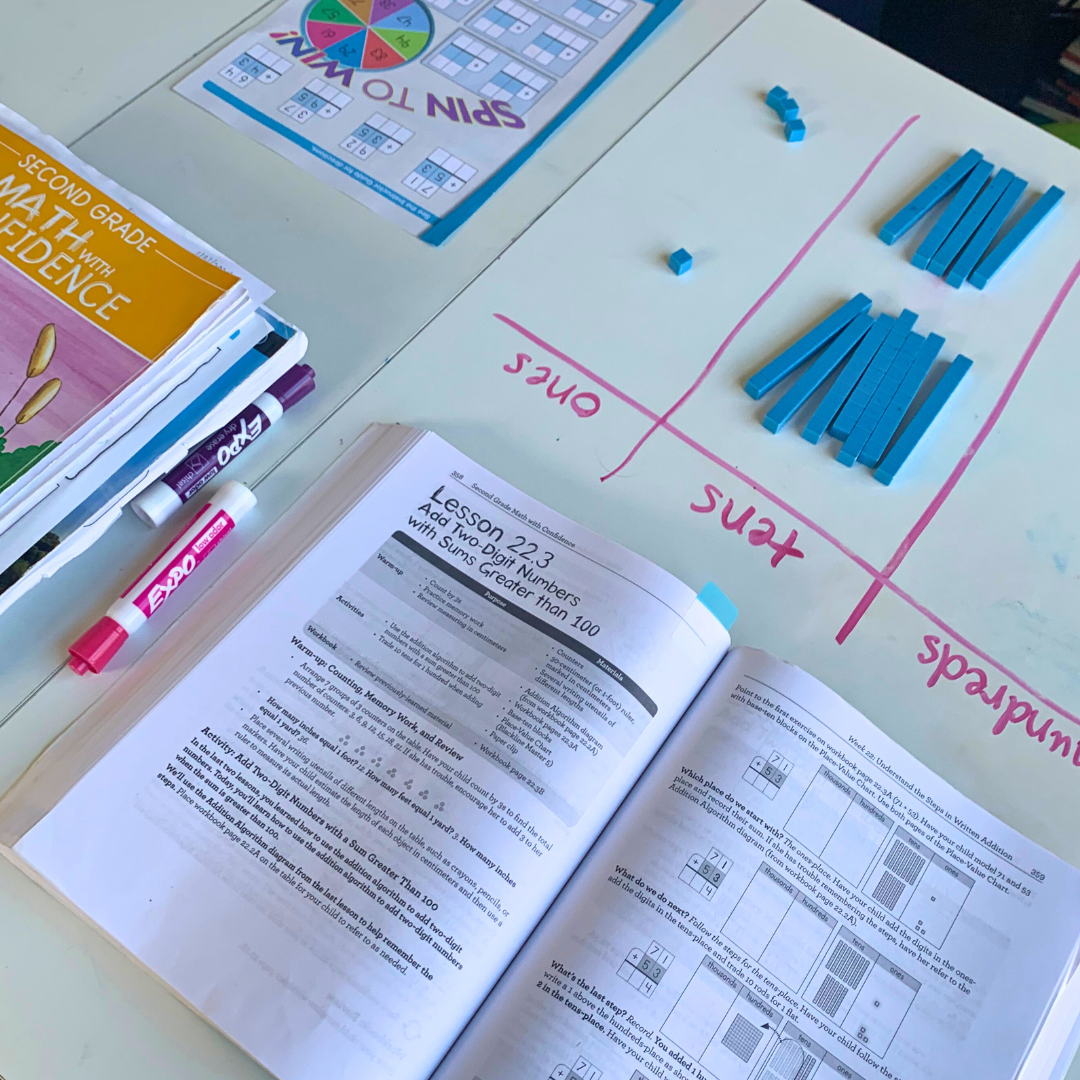
We will be completing Math with Confidence level 3 this year. This program has been such a good fit for my child and for me teaching this specific child. We have completed level 1 and level 2 so I have felt the benefits of using it.
The teacher guide is scripted and walks me through every step of the lesson. The actual lessons are full of hands-on activities and games to help practice the skills. The student workbook is colorful and easy to follow.
From what I’ve seen (and heard) the level 3 has a lot more work/practice problems than the previous levels. So that will be something I will have to play by ear. I may set it up similar to how I teach math with my oldest: She completes the review on her own in the morning then together we do the lesson and practice later in the day.
Math with Confidence is just that – confidence! It has increased my child’s confidence, but it also gives ME confidence as the teacher. Math doesn’t come easy for every child and sometimes as the parent it can cause a little anxiety about whether or not you’re doing the right program. This math curriculum really helped me overcome that fear and now after two years of using it, I trust the process and know the lessons will be great!
Language Arts
This will be in a lot of pieces. We don’t use an all-in-one curriculum in my house, so our language arts is a combination of a few things. I talk a lot about this with my oldest child’s work and have many videos about it on my YouTube channel if you are interested in learning more.
Eventually, I will follow that same routine with my 3rd grader, but we are still trying to work on improving reading skills. So I will share how we plan to do that below and any other pieces of language arts that we complete.
Some of her language arts will be a part of our family studies (novel read alouds and poetry). So be sure to check out that post or watch this video to see more about that.
Reading
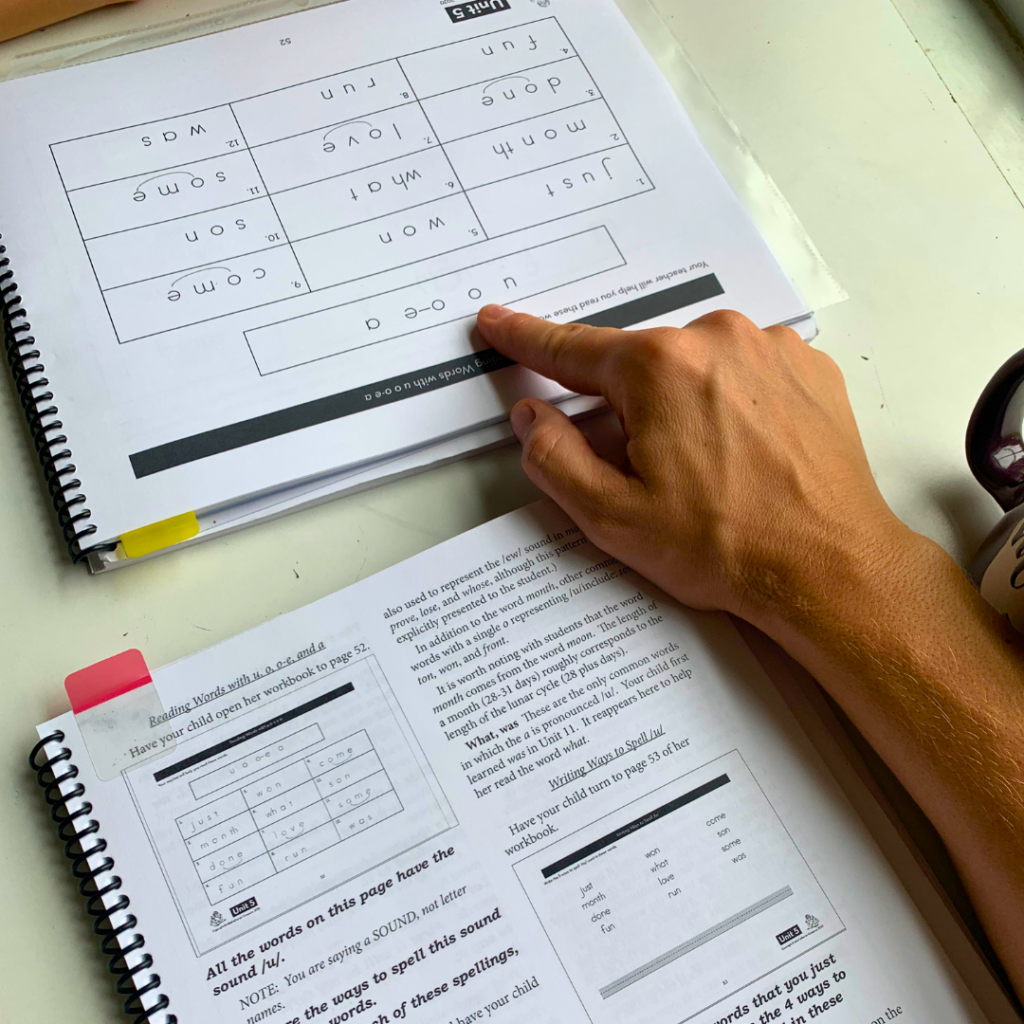
This year we are using a new program called ABeCeDarian (also under the name Sharpen Reading). We spent most of second grade reviewing with a variety of resources, and it wasn’t until the end of the year that I found ABeCeDarian and made the switch.
We started in Level B1 and although I had made plans in my head to continue it in the summer to start a new level for third – it didn’t happen that way. The need for rest was greater, and so I shelved it for a bit.
When we start the year, we will review the units we have completed and then just continue where we left off. I have loved this program for her. It has boosted her confidence and increased her desire to read. I have a blog post about this program as well as a complete look through on YouTube if you are interested in seeing what it’s all about.
Handwriting
Handwriting is slow-going right now. We do a very little bit each day mostly to encourage focus and best effort. I really would like for her to master cursive because I have read that it actually helps with reluctant writers if you use the “right” type of program.
This type of cursive program is one where all of the lower case letters start on the bottom line. This strategy can help struggling writers. I read about it when we used Logic of English a couple years ago and I’ve read more about the benefits of cursive since then.
I found our handwriting book, Handwriting Program for Cursive, at a local homeschool store and loved it because it was very basic. It has a giant letter to refer to and possibly trace with your finger. Then it had some practice lines. There are no distracting images or busy work.
This upcoming year we will continue to slowly work through this workbook to try and master cursive writing.
Grammar
I have waited to start grammar with this child. We have been working really hard on reading and that has been our focus. Last year I introduced a grammar book I found to see how it would work for her, and I loved it. So, I do intend to add it in at some point this year.
The book is called Easy Grammar. It reminds me a little bit of Fix it Grammar in that you are practicing multiple skills each day, a little bit at a time. I completely ignored the grade levels and started with the first one, and I’m really happy with that decision. When we did use it, she was confident and able to work through it without any problems, but at the same time she was getting the grammar review that I felt was necessary.
Eventually, I hope to have her tag along with us for our DIY language arts units and this will be her grammar component, but my priority right now is for her to work through her reading books. She is still reading so many fantastic novels with us, but the passage study will wait until I feel like she’s ready.
I will make a note that we only have the Teacher book. The website specifically states that if you are only using it for one child you do NOT need a student workbook. The child can simply write in the teacher book, and we’ve done just that. The answers are not visible on the work pages.
Recap
I feel really good about this year. I’ve worked really hard to find the best curricula to fit the needs of this child, and I am so thankful for the different programs we have come across over the years. Many of these workbooks were new to me, so I hope sharing them here might be helpful for one of you!
I’m so excited to share our 5th grade curriculum picks for 2024-2025. First, can I just say that I can’t believe I have a fifth grader! I used to teach fifth grade, so this milestone is hitting me a little bit harder. This is our sixth year homeschooling, and I feel so blessed to be able to choose the curriculum for each of my kiddos.
As a reminder, I pick this curriculum because I feel like it’s the best fit for my individual child. What works for us might not work for you OR it might work great for you. That is always up to you to decide. As you read through this, I hope you are inspired with ideas as you plan for your own homeschool year. Please do not read this as expert advice.
This post contains affiliate links. If you follow one of my links I earn a small commission at no extra cost to you. Thank you for supporting my blog!
Family Subjects
As a mom of four, I group a lot of our subjects together. This has been such a big blessing for us and it makes our days so much more simple. I have a separate post about the subjects we are covering as a family this year, and you can check that one out here.
Our family subjects include Bible, history, science, fine arts, and some language arts.
Math
I finally feel like I found a math I love for this particular child! It feels so good to say that. For the last couple of years I just knew we didn’t have the right fit and it was so hard to work through it. In January of this past year we tried BJU Press Math 4, and we both loved it!
I am so excited to continue with Math 5 this year from BJU, and so is my daughter. The set up is so perfect for her, and we have found a really great way to work through it.
This year I ordered the textbook kit which comes with a Teacher’s Edition, Worktext, Activities Book, Assessments, and Assessment Keys.
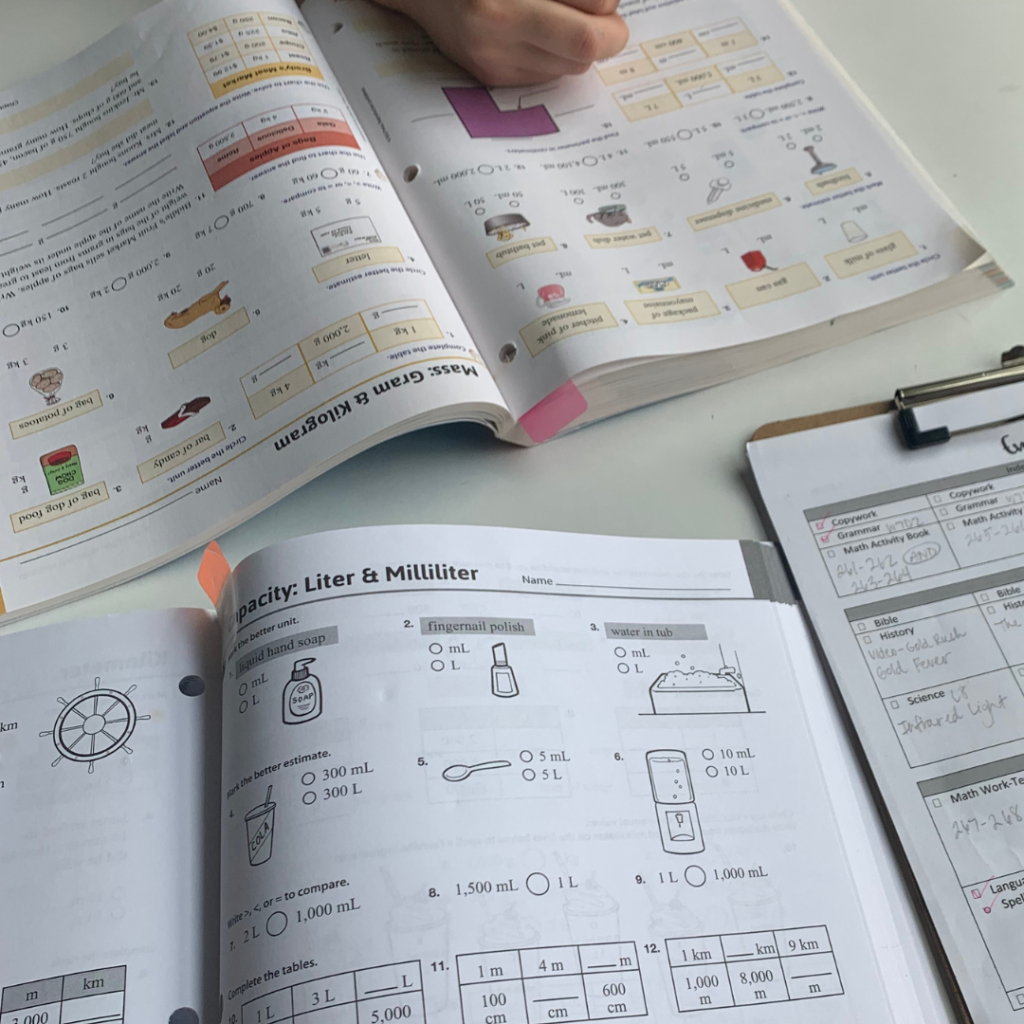
The way that we do math works like this: I teach my daughter the lesson using the Worktext. It’s a colored textbook with plenty of examples to practice the skill. We usually only work through the front side of the lesson, but there’s even a back side if we need it. The next day, during her independent work time first thing in the morning, she will complete a lesson in the Activity Book. This lesson includes practice from the skill we worked on PLUS review.
I love breaking up our math like this. I talk about it in more detail in this video if you have interest in seeing inside the textbooks and how we use them.
Language Arts
We do not use an all-in-one curriculum for language arts. I like to call it “DIY Language Arts” because we make up our own curriculum using novels that we are reading. We have been doing this for a year and a half and it is so freeing and enjoyable. (If you’ve ever wondered about getting rid of the workbook and going the more literature-based route – you have to look into this! Check out this blog post here)
I am looking forward to reading some fantastic novels. I have a few in mind related to our history unit we will be doing, but I usually wait to pick the books as we need them. This allows us to follow our interest instead of following a strict schedule. We actually WANT to read the books by the time we get to them.
With our novel units we cover handwriting, spelling, and vocabulary using passage study from the novels. By practicing copywork, dictation, narration, and just great conversation about books our language arts studies have become so enjoyable!
Some books I have in mind this year…The Hobbit, Where the Red Fern Grows, Little Britches, Pollyanna, Wingfeather Saga, Number the Stars, and The Book Thief. It’s a little historical-fiction-heavy because that’s my favorite! It’s not my daughter’s favorite (ha!) so I will need to be thinking of a few more, but, like I said, we will choose as we need them!
I’m so excited to share that NEW NOVEL GUIDES are now available using this method. Check them out here.
Grammar
We do use a daily grammar curriculum alongside our novel studies, and we plan to use Fix it Grammar again this year. She is currently working through Level 2. I want to say she made it almost half way at the end of last year, so she will just pick up where she left off when we start our year.
I love using Fix it Grammar because the lessons are short and she can do them independently. It’s also nice because it’s not one mastered skill at a time. She really has to know and remember each part of speech she learns because it may or may not come up in any sentence that she edits.
Writing
I almost didn’t put this in here, but I think it’s important to point out. I can confidently say that we do not use a writing curriculum in our home. I use that word “confidently” because there were a couple of years where I stressed about adding in writing prompts and assignments, and it was quite miserable! I don’t feel that way anymore.
One book completely changed my outlook on writing, and even in just one full year I have seen the difference it has made to let go of a formal writing curriculum for now.
The book is called “Know and Tell” by Karen Glass. It’s a book about narration and how to start with oral narration and gradually move into written narration. It encourages the flow of ideas and thoughts and explains that a writing curriculum can sometimes prevent a writer from writing freely.
Although the book is not a “curriculum”, it is a fantastic resource that contains multiple charts showing how to progress at each grade level and when to actually add in a formal curriculum. (Eventually we will – but not for a while!) It also contains multiple examples of narrations from students of a variety of ages which allows you to actually see results from this method.
Just to give you an idea of what happened in our house – I quit forcing writing about a year and a half ago. I even stopped editing writing. After a few months of doing this, she suddenly WANTED to write. She was asking for notebooks and writing the most random selections (hello, creative writing) and she didn’t stop. She suddenly loved writing!
Her written narrations went from just a couple of choppy sentences to full pages of writing. Is it perfectly edited? Absolutely not, but we are learning editing in our Fix it Grammar and I have witnessed her writing gradually get more and more edits by her own doing, based on what she has learned in grammar.
I could write an entire blog post about this. My point is we are choosing NOT to do a writing curriculum. Instead we will be practicing written narration by writing about what we are reading. This will happen across multiple subjects (science, history, language arts). I will also continue to let her write as she pleases and will listen, without correcting, to what she puts together on her own. That is our plan for writing this year.
Foreign Language
I never intended to start a foreign language at this point, but last fall my daughter expressed an interest in learning French. I know absolutely zero French and had hoped one day to teach them Spanish, so this was a little unexpected for me. I let her know that I could provide her with materials if she committed and did the work independently. For her, I knew an interest-led study would be good.
We tried multiple things: workbooks and websites – and we stuck the longest with Duolingo. It’s great for a free program, but her and I both were feeling like she needed more of a challenge. This is why we chose Rosetta Stone for this upcoming year.
I love the idea of using an online program for this especially because I don’t speak the language. When we tried workbooks in the past I was having such a hard time with pronunciation and was spending lots of time learning it myself. It’s doable with a workbook, but it’s not a good fit in my house.
Rosetta Stone can be a little pricey, but they have great sales and from my research it seems the sales happen often. We are currently in a 3 month trial period so we will re-evaluate when that time ends.
What I love most about Rosetta Stone is the fact that it’s interactive. She uses the microphone in the computer to record her voice so she’s actually speaking what they are teaching her. The lessons are broken up into 10 minute segments, so it’s easy to add in to her independent work for the day.
Piano
As much as I would love to sign all of my kids up for piano lessons, financially it doesn’t make sense for us. Using an online program is an alternative I am thankful for! This summer we started using Voetberg Music Academy, and it’s going so well that we plan to continue it through the year.
Voetberg Music Academy is affordable and the whole family can participate! Currently, it’s just my oldest daughter using it, and she is taking the Piano course.
The course is broken up into weekly lessons. Each week contains about a 20-minute video teaching the lesson and then it’s the student’s job to practice what was learned that week. You can move at your own pace and complete the lessons as you are ready for them.
Their website is also very interactive and helpful. It almost feels like a Facebook group. You can chat with the teachers and other families that participate. The program also offers opportunities to have a virtual meeting with their teacher, perform in an online recital, and it provides multiple ways to track for success.
Typing
My oldest daughter consistently practiced typing during her fourth grade year. At the end of the year, it seemed like the best fit for her was to practice once a week, so I plan to set that same goal for the year ahead.
We use typing.com which is a free typing program online. It’s a mix of short videos, typing practice, and games. With the free program, the computer screen contains ads. So, that’s something to be aware of. I know that there is an option to pay a fee and remove the ads, but so far it hasn’t been a problem for her.
You can set time goals for typing.com so that each day they are actually typing for a certain amount of time. If I remember correctly the videos and games don’t count for the time.
Recap
This fifth grade year feels like such a milestone to me, mostly because I used to teach this grade level and I just can’t believe she’s here already! Here is a recap of what we are using this year:
We use cookies to improve your experience on our site. By using our site, you consent to cookies.
Cookie Preferences
Manage your cookie preferences below:
Essential cookies enable basic functions and are necessary for the proper function of the website.
Name
Description
Duration
Cookie Preferences
This cookie is used to store the user's cookie consent preferences.
30 days
These cookies are needed for adding comments on this website.
Name
Description
Duration
comment_author
Used to track the user across multiple sessions.
Session
comment_author_email
Used to track the user across multiple sessions.
Session
comment_author_url
Used to track the user across multiple sessions.
Session
WooCommerce is a customizable eCommerce platform for building online stores using WordPress.
Name
Description
Duration
wp_woocommerce_session_
Contains a unique code for each customer so that it knows where to find the cart data in the database for each customer.
2 days
woocommerce_recently_viewed
Powers the Recent Viewed Products widget
session
store_notice
Allows customers to dismiss the Store Notice.
session
woocommerce_snooze_suggestions__
Allows dashboard users to dismiss Marketplace suggestions, if enabled.
2 days
woocommerce_dismissed_suggestions__
Count of suggestion dismissals, if enabled.
1 month
woocommerce_cart_hash
Helps WooCommerce determine when cart contents/data changes.
session
woocommerce_items_in_cart
Helps WooCommerce determine when cart contents/data changes.
session
WPForms is a user-friendly WordPress plugin for creating custom forms with drag-and-drop functionality.
Name
Description
Duration
wpfuuid
Used to track user interactions with forms.
11 years
Statistics cookies collect information anonymously. This information helps us understand how visitors use our website.
SourceBuster is used by WooCommerce for order attribution based on user source.
Name
Description
Duration
sbjs_session
The number of page views in this session and the current page path
30 minutes
sbjs_udata
Information about the visitor’s user agent, such as IP, the browser, and the device type
session
sbjs_first
Traffic origin information for the visitor’s first visit to your store (only applicable if the visitor returns before the session expires)
session
sbjs_current
Traffic origin information for the visitor’s current visit to your store
session
sbjs_first_add
Timestamp, referring URL, and entry page for your visitor’s first visit to your store (only applicable if the visitor returns before the session expires)
session
sbjs_current_add
Timestamp, referring URL, and entry page for your visitor’s current visit to your store
session
sbjs_migrations
Technical data to help with migrations between different versions of the tracking feature