However, I think you’ll be surprised by what finally made me take the leap.
What really pushed me to try it was a novel I read with my daughter—The Wednesday Wars by Gary D. Schmidt. In the story, a middle school boy has private lessons with his teacher, and she makes him listen to Shakespeare plays. Reading about his personal growth through those experiences made it an unforgettable read! (I highly recommend!)
That book made me think: We have to try this.
What We’ve Done (And Why It Works)
For the past two years, we’ve chosen one Shakespeare play each year. And we’ve kept it so simple that it no longer feels intimidating.
It’s something we all look forward to.
In this post, I want to show you exactly what we do—step by step—so you can try it in your own home without overthinking it.
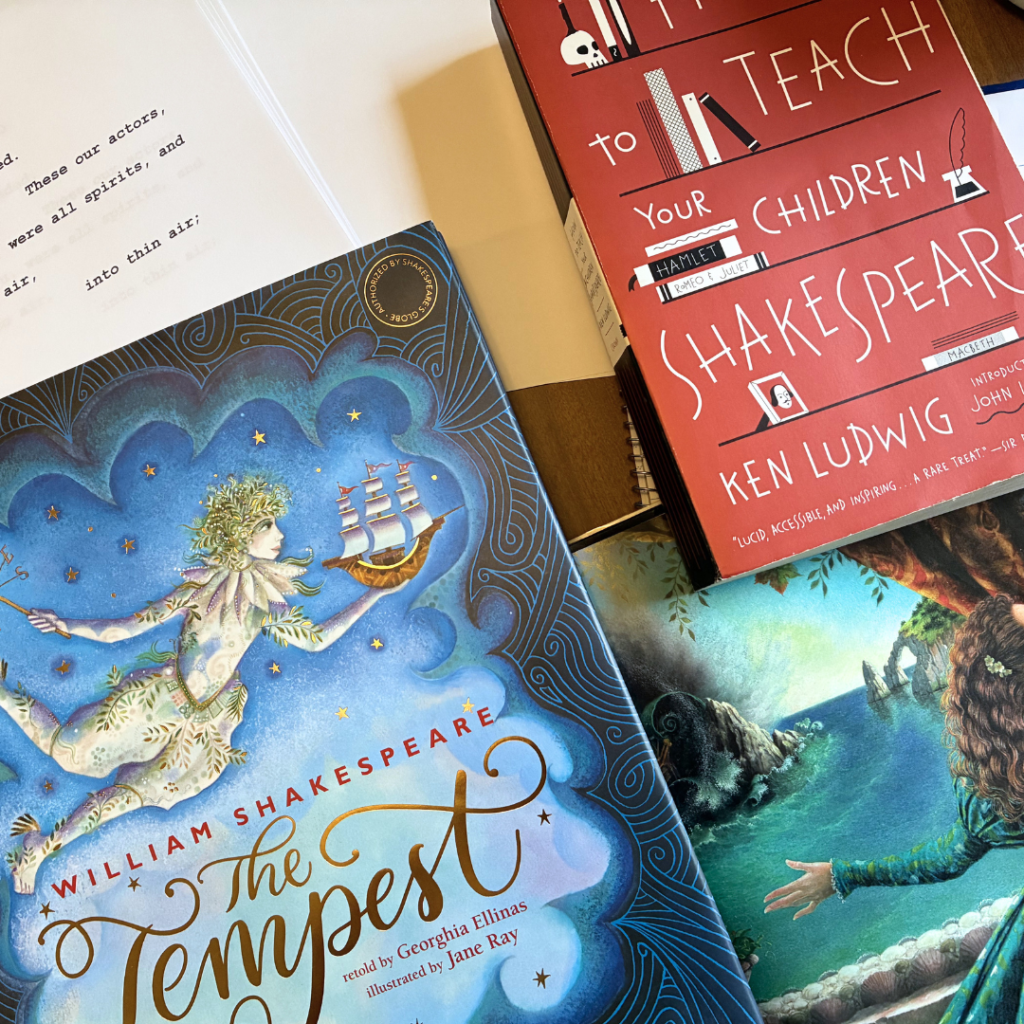
This book is incredibly helpful—but don’t feel like you need to read it all at once.
Start with the introduction and the first chapter or two for a little inspiration
Then come back to it when you’re ready to begin a specific play
Each chapter walks you through the plays, and the author also provides passages for memorization. On his website, you can find printable versions of these passages and audio recordings (so helpful!), which makes it easy to plan.
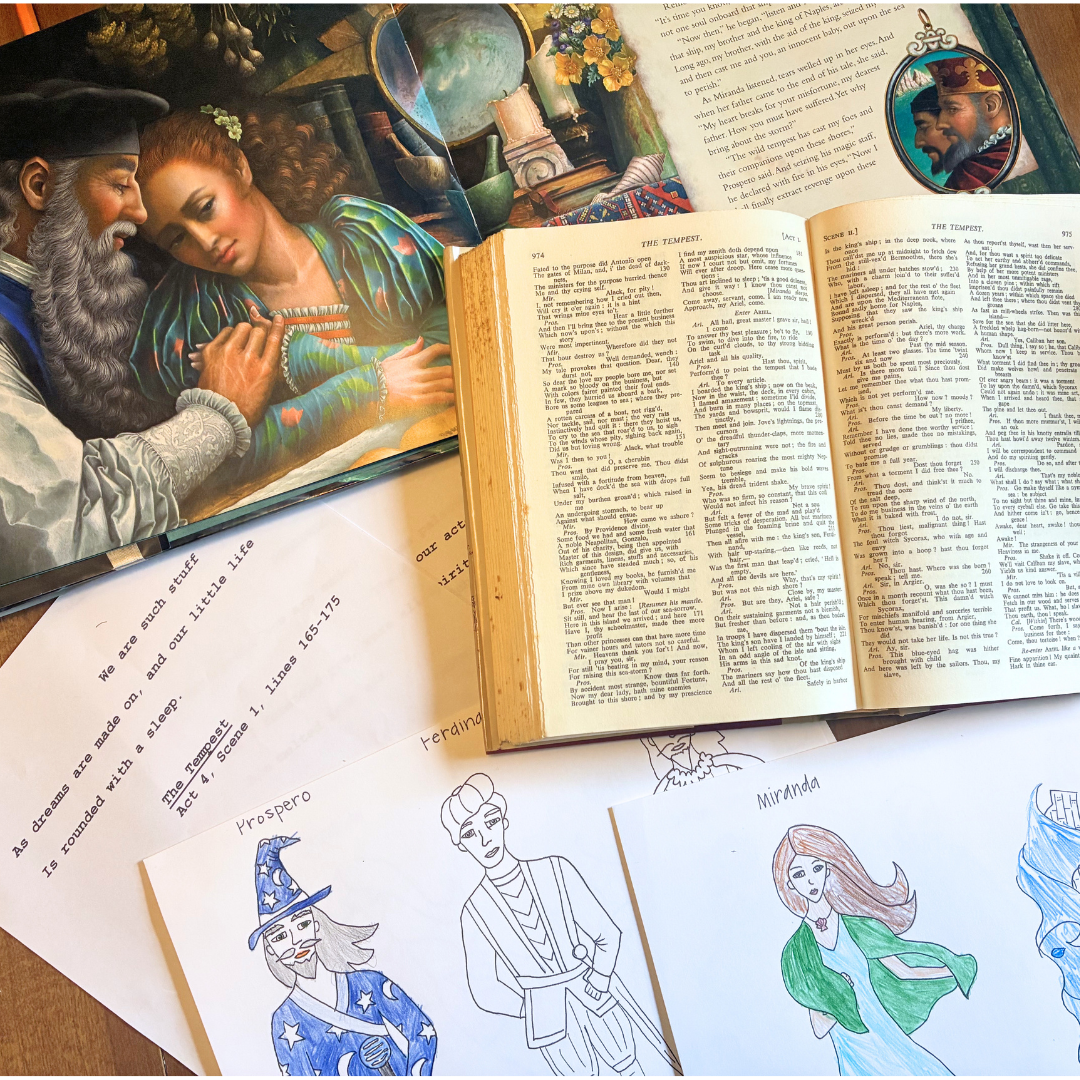
We use these passages for copy work and recitation.
Choosing a Play
If you’re not sure where to start, Ludwig’s book will help with that too.
Our first year: A Midsummer Night’s Dream
This year: The Tempest
The plan I’m about to share is based on The Tempest, but you can easily adapt it to any play.
Our Simple Shakespeare Plan (Step-by-Step)
The easiest way to explain this is to show you exactly what we do—almost like a checklist.
Planning
Before you begin:
It will help you to read the chapter in Ludwig’s book on your own for your chosen play. This will build your knowledge about the play as you get ready to share it with your children
Print any passages you want to use for copy work or memorization
Check your library/amazon for picture book retellings
These steps will help you feel a little more confident before starting.
Day 1: Gentle Introduction
Read and discuss a picture book version of the play.
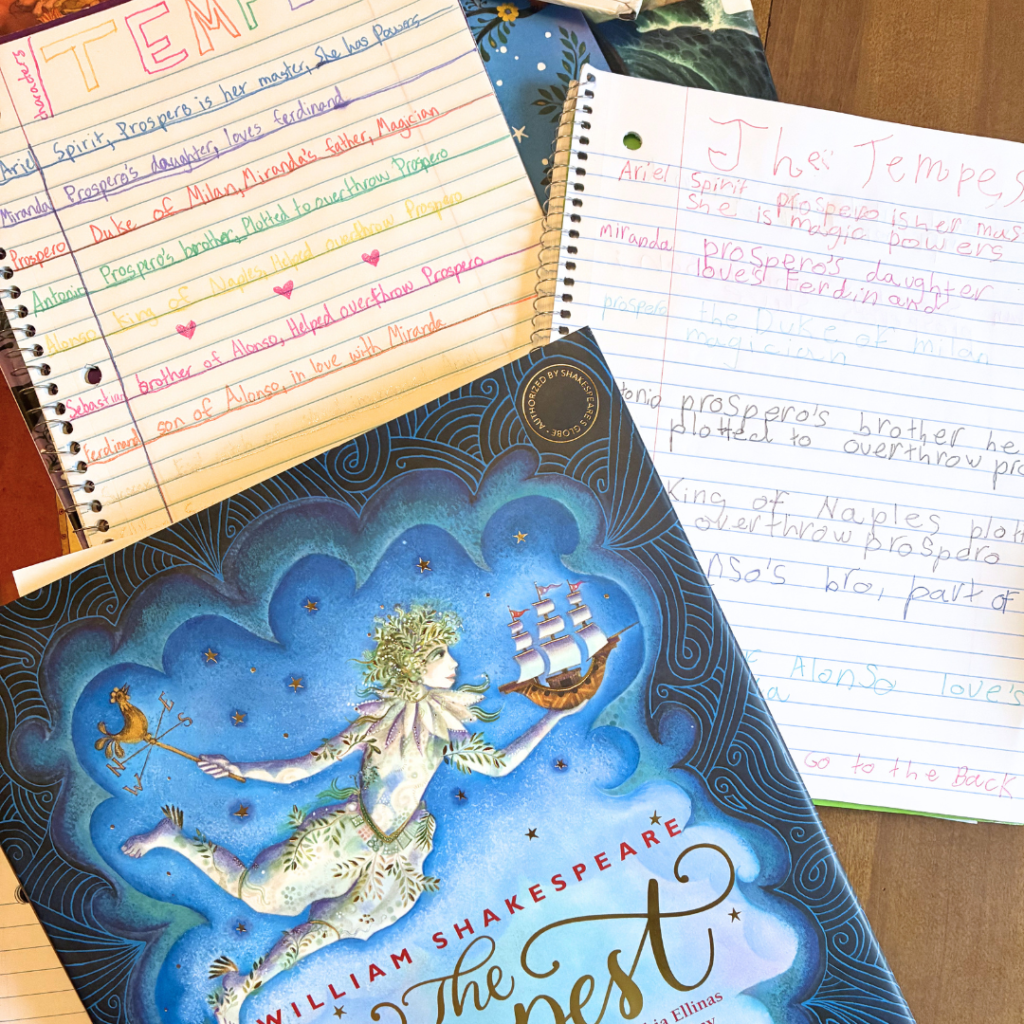
Create a simple character chart together. Write down each character and a few basic details. You don’t need to know this in advance. Learn as you read. Here’s an example:
Prospero: magician, Miranda’s father, Duke of Milan
We do this in notebooks and use colorful pens or pencils—it adds a little fun and makes it feel special.
Day 3: Begin the Passage
Play the audio of your chosen passage
Read a short section from Ludwig’s book aloud to your children to give background on the play (For this play, I read pgs. 310-312)
Begin copy work
This is a very light day, but it starts building familiarity.
Day 4: Practice Recitation
Practice saying the passage together
Let each child try on their own
Continue copywork
This repetition helps, but it doesn’t feel like too much.
Day 5: Deepen Understanding
Read another version of the story.
We read a longer picture book version (The Tempest by Marianna Mayer) for more detail, but you could definitely read the first picture book again.
After reading:
My older kids write a narration
My younger child draws a picture
Then we continue:
Copy work
Passage recitation practice
Day 6: Listen to the Play
This is where it all comes together—and it’s honestly the most fun.
We listen to a full-cast audio version of the play (we found one on Audible) for about 20 minutes at a time.
Because they already know the story and characters, they actually enjoy it.
A few things we add:
I follow along in a book so I can pause and ask simple questions. This isn’t necessary, but I enjoy it and find it helpful. (The book I own was a gift to me and isn’t in print anymore. This one may be similar: Complete Works of Shakespeare.)
The kids color paper puppets while they listen – it’s worth the few dollars. My kids love this! Later, they turn them into puppets and act out scenes
We also:
Finish any remaining copy work
Keep practicing the passage
Day 7 (and Beyond): Keep It Going
At this point, we’re nearing the end.
We simply:
Continue listening to the play in short chunks (about 20 mins at a time)
Practice recitation daily
Finish puppets and enjoy re-enacting
Sometimes it takes more than seven days—and that’s completely fine.
Sometimes we don’t even finish the whole play.
And I’m okay with that.
The Goal (This Matters Most)
My goal isn’t perfection or completion.
It’s exposure.
I want my young children to experience great stories, rich language, and beautiful ideas. And this simple approach allows us to do that without pressure.
You Can Do This
So what do you think?
Does it feel a little more doable?
It doesn’t have to be complicated. You don’t need a perfect plan. All it takes is a simple starting point—and a willingness to try.
You really can do this!
This post contains affiliate links.If you follow one of my links I earn a small commission at no extra cost to you. Thank you for supporting my blog.
(Mostly) Workbook Free! Did that reel you in? 😉 Well, this whole method was inspired by my research but also a desire to get rid of the workbooks! They were making me crazy…and bored! However, I have found it important to continue daily grammar practice. That’s where the workbook comes in. Even still, this new method has been such a breath of fresh air for us! I’m so excited to share. Let me tell you a bit about how we got here.
After Christmas, we kicked off the year with a fantastic history unit on the Vikings. We were having so much fun learning, but it would come time to sit down for language arts, and I dreaded it! I finally said to my husband – I can’t stand language arts workbooks. I’ve tried multiple workbooks over the years, and it never fits our family quite right. I just want to study language arts through what we are already learning in history or science.
Well, it wasn’t long after that, I was led (by prayer I’m sure of it!) to a post or a quote that mentioned Charlotte Mason, which I was pretty unfamiliar with at the time. Well, one thing led to another and suddenly I was listening to every Charlotte Mason podcast I could and reading all the info I could find online. I was fascinated by the methods, but nervous to commit.
Then, I came across a brand new book called “Modern Miss Mason” by Leah Boden, and it inspired me in the most beautiful way – WOW! I can’t recommend it enough. Her book encouraged me to learn the philosophies of Charlotte Mason but then to apply it to our homeschool in a way that suits are family well.
My point in all of this intro is to let you know that this novel unit is inspired by what I learned from studying Charlotte Mason’s methods. (I still have so much to learn!) It may not follow her philosophy exactly, but the whole process has brought my family (especially me) such a sense of joy, and I am certain that is what matters most. This unit has given me a freedom that makes language arts interesting for us again, and I hope if you try it that it may do the same for you.
Now, before I continue, I should mention that you could probably adapt this unit a little bit to use for any grade you’d like. My child (that I created this for) is in third grade, but I planned all of the lessons according to what she has already learned and what she is learning in her grammar book (More on that later). You can do this too, and I hope my breakdown of this method helps you see the simplicity that I see in that. I encourage you to continue reading no matter the grade level.
This post breaks down the actual process of putting this unit together. Definitely look through the detailed descriptions of each piece below first, but if you want to see a unit in action, check out our first novel unit like this, “Winnie the Pooh” (the book is so adorable!)
This post contains affiliate links. If you follow one of my links I earn a small commission at no extra cost to you. Thank you for supporting my blog!
Language Arts
From all of my research, I came up with the following list of what I wanted to include on a regular basis for my daughter’s language arts.
Good (living) book
Narration
Daily Grammar
Copy work (to practice Handwriting, Grammar, Spelling, and Vocabulary)
Written Narration
Dictation
As I go through this unit, you will see these pieces incorporated throughout. If you’re interested on where I’m learning about all this, I’ll leave a couple links for you here. (I listened and read so much! But these two sources stick out to me the most) Simply Charlotte Mason, and the Charlotte Mason Show Podcast.
Novel Unit Schedule
I’m going to outline the schedule of this unit, because I want you to see the simplicity of it – at least, I think it’s simple, and I hope you do too! Think of the lists you see as a checklist for the day. Each day of language arts requires about 5-10 minutes of independent work from your child and a 20 minute lesson with you, the parent. You’ll also be reading aloud at some point in your homeschool day, but I don’t really count that. Reading great books together as a family doesn’t feel like school for us. (We’ve read at bedtime and/or our morning time for the last couple years, and it’s been wonderful)
It probably won’t make any sense at first, but if you read further, I explain each piece of this schedule in my post.
I will put in the schedule to read each day. You can time it as you please. We read every day, whether it’s a school night or not. Our normal homeschool schedule is four days a week, but on the occasion that we are home on Fridays, I will mention my plan for that day as well.
DAY 1
Read novel and narrate [whole family]
Grammar Workbook [independent work]
Copy work – complete 2-3 lines of selected passage from novel [independent work]
Study passage – focus on grammar [language arts lesson with parent]
DAY 2
Read novel and narrate [whole family]
Grammar Workbook [independent work]
Copy work – complete 2-3 lines of selected passage from novel [independent work]
Study passage – focus on spelling and vocabulary [language arts lesson with parent]
DAY 3
Read novel and narrate [whole family]
Grammar Workbook [independent work]
Copy work – complete 2-3 lines of selected passage from novel [independent work]
Written Narration [language arts lesson with parent]
**Option – review passage/spelling words if necessary
DAY 4
Read novel and narrate [whole family.]
Grammar Workbook [independent work]
Copy work – finish copying selected passage from novel [independent work]
Dictation [language arts lesson with parent]
DAY 5 (OPTION)
Read novel and narrate [whole family]
Silent Reading (15-20 minutes) [independent work]
Narration [language arts lesson with parent, about 5 minutes]
Read Novel – A Good (Living) Book
Give me all the books! I love reading to my kids, and I especially love coming home with a bag full of books devoted to a unit study. This whole year, we have done all of our science and history using books from the library, and it has been the most wonderful time.
I tend to just get what the library has available, which I think is fine! Lately, I’ve been trying to be a little bit better about thinking ahead and finding good, quality literature. I might put a few books on hold or visit my local used bookstore. The effort has been worth it. Having good literature makes our studies come alive and become more enjoyable.
What is a living book? Well, that’s a good question. It’s a hot term in the Charlotte Mason world, and it honestly intimidates me a bit! So, here’s the method I use when choosing a book. Do I enjoy reading it? Is it helpful to our studies? Does it add something positive to what we are learning? Will my kids find it fun/interesting?
These are just a few questions I’m thinking about. This article breaks down the definition of a living book in an easy-to-read list. I find it very helpful, but I’ll be honest, my kids and I enjoy a good Magic Treehouse book here and there…is that “twaddle”? Maybe…but remember…my hope here is to do what’s best for my family, and we like it sometimes! So I encourage you to find books that your family enjoys too!
I mentioned this earlier, but we read our novels at bed time usually. We also have a time to read aloud during our morning time. When we read, it’s with all my kids, and it’s not part of our lesson time. What’s great about this is each child is benefiting from the literature, and my little ones are even practicing narrating as we do it. Whole family learning is my favorite!
Narration
I am new to narration, and I don’t know if I do it the “right” way, but I do it in a way that feels right for my family. (Are you catching a pattern here? Every family is so different, but what a blessing it is to have the freedom to adjust as needed, according to our family interests) Every time we read something we talk about the book together. Sometimes it’s in the middle of a chapter, sometimes it’s at the beginning, sometimes it’s at the end of our reading.
For this new language arts method, I made sure to encourage my children to talk more than we usually do. I wanted to be intentional about our book conversations. If I just say “tell me back what happened”, they look at me confused. So I usually start them off with a question or two to get them going.
So, what happened at the beginning of the chapter? What was your favorite part? What problem did they run into? How did they solve it? How do you feel about that character’s choices? I don’t ask every question every time, but this is just an example of what gets us started talking. Both of my school age girls participate in this daily book discussion.
There’s a lot more to narration than this, so if this is new for you as well, I encourage you to look into it further. (Check out this site)
Daily Grammar
We recently added Fix it Grammar to our homeschool day for my third grader, and I love it. I will link the product for you (not affiliated) if you want to learn more about it. It takes my daughter about 5 minutes a day to do this, and she can complete most of it independently.
She does this work daily, which gives me a boost of confidence knowing she is getting consistent practice. If you are looking into doing a unit like this, any grammar workbook can be used! Earlier this year, we used an Evan-Moor fundamentals workbook, and I feel like that could’ve been used just as well. The point is regular practice and connecting it with what you’re reading.
One of the days of the week, I like to do an alternate grammar activity instead of the grammar workbook. This usually happens on Day 2, because it doesn’t take us the whole 20 minutes to do spelling and vocabulary. We basically apply the rules of her Fix it Grammar sentences to our passage. Let me give you a concrete example.
Currently, in the Fix it Grammar books, she is labeling captalization, end marks, nouns, articles, and pronouns. She knows how to do this because it’s practiced daily. Well, one of the days during the week, we look at the novel passage and label it in the same way. This has been a great way to apply the same steps to a relevant passage from our novel. I love linking the two (grammar and novel) together.
The copy work is chosen by me using passages from our novel. My goal is to study one passage a week. This copy work will allow my child to practice handwriting, but we will also be working together to study grammar, spelling, and vocabulary through this passage.
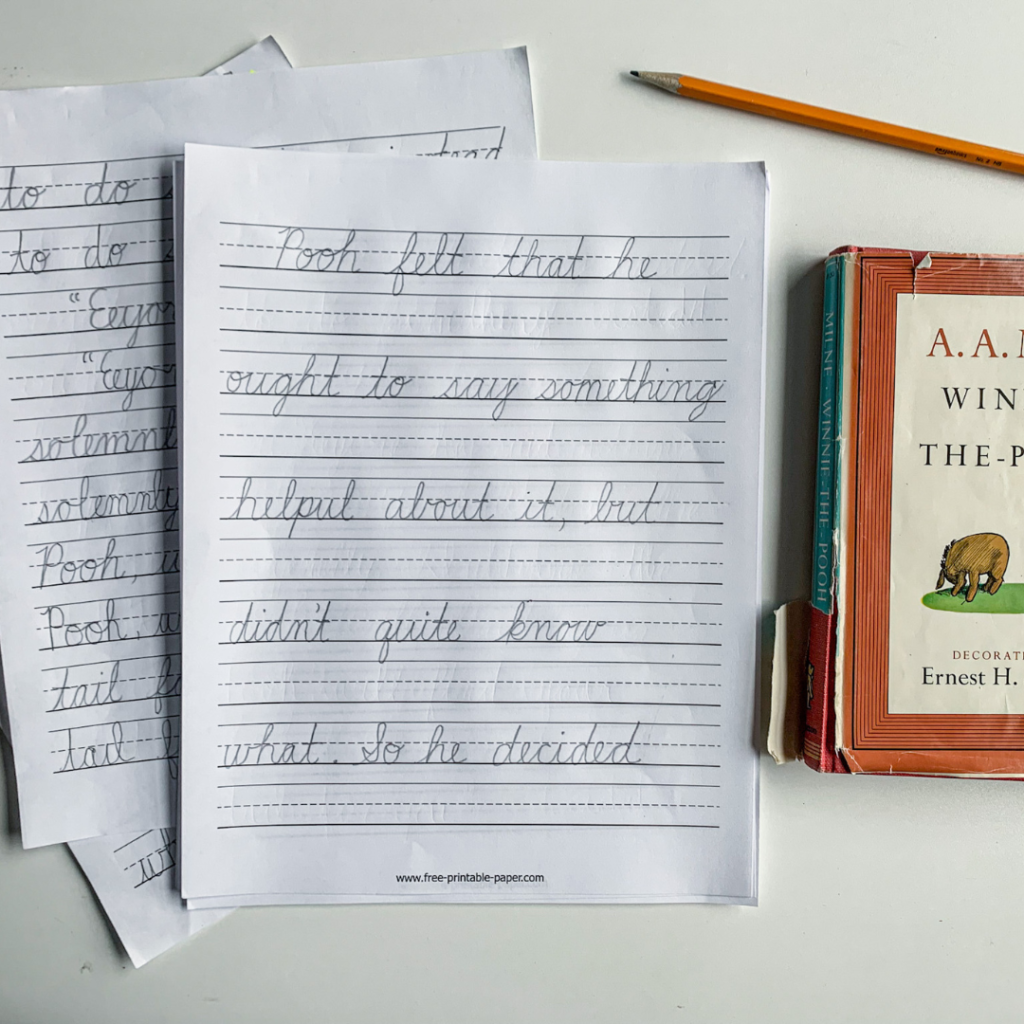
Each week, I wrote the passage out onto lined paper, skipping every other line. (See photo) This gave her an example to follow. Each morning, during her independent work time, she would copy 2-3 lines. The goal is not to do a ton of copy work in one sitting. What does get finished must be done well, if that makes sense. This is another philosophy I am learning about from the Charlotte Mason method. Shorter lessons, better quality work. I’m finding it to be very true!
Copywork – Grammar, Spelling, and Vocabulary
This part of our lesson will vary depending on the passage, but you can see it in action by checking out one of our units.
On the first day we look at the grammar and punctuation. We go through each sentence and figure out together – Why is something capitalized? What is the punctuation at the end? Why is that comma there? When do we add quotes or indent? And so on…
I am very intentional about the passage I choose for this reason. I’m not going to pick something that has incorrect/odd grammar. I’m choosing passages I know will enhance what she’s already learning in her grammar book.
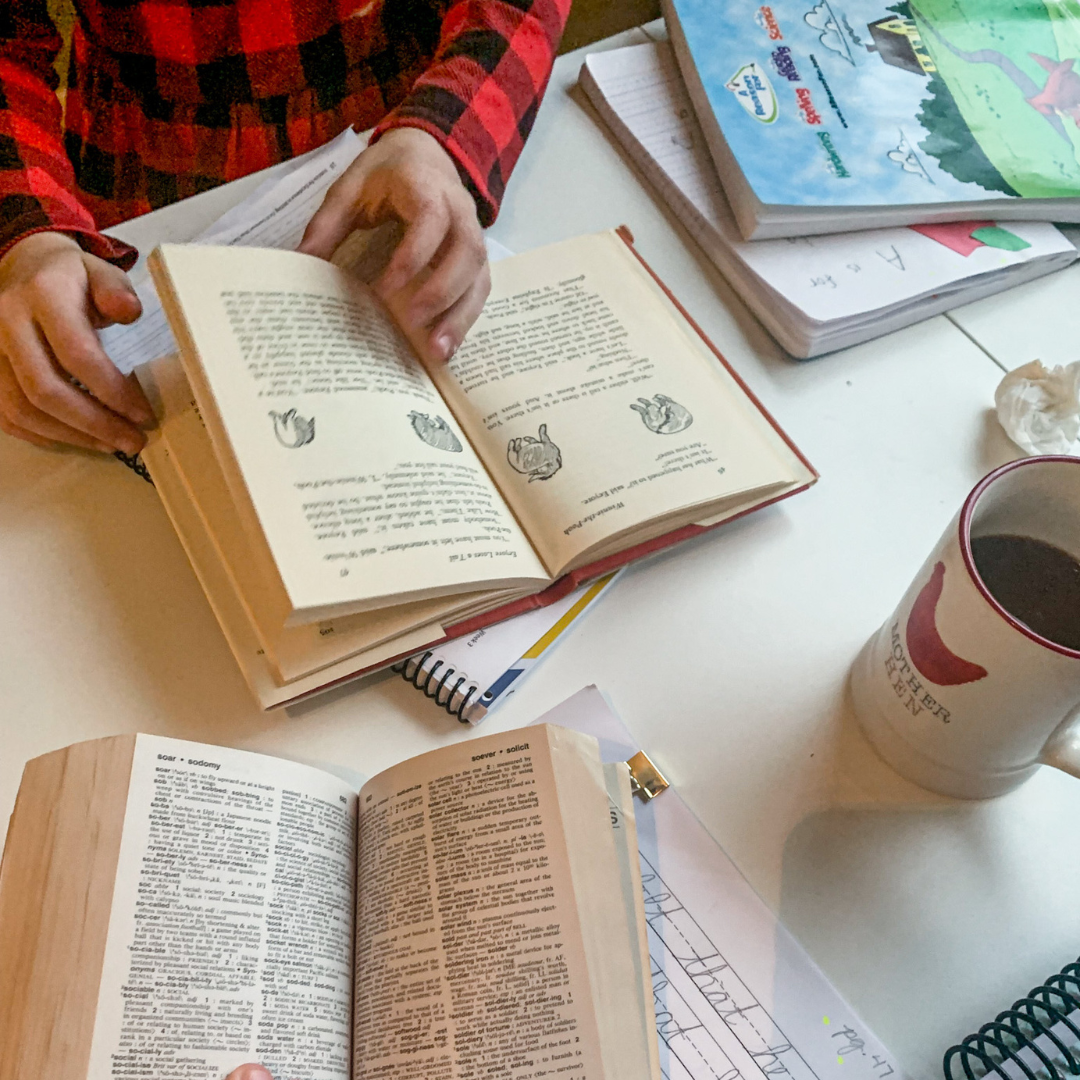
I also spend a day focusing on spelling and vocabulary. (See outline) If there are any words she is unfamiliar with, I try to have her guess the definition using the context. Then, we look the word up in the dictionary.
Next, for spelling, I quiz her on a variety of words in the passage. If she gets it right, we move on. If it’s wrong, we focus on that word for a bit and I try to remember to quiz her on that word a time or two during the rest of the week. There is no spelling test as she will be writing the words by memory during the dictation portion of our week.
Written Narration
Depending on the child’s age, your lessons may or may not include written narration. Based on my daughter’s abilities, I felt she was ready to start with my help.
One day a week, I require written narration from her. My goal here is for her to write about what we are reading. I like to help her brainstorm and figure out how to write a good narration. Eventually, I hope she will use these brainstorming techniques to write on her own.
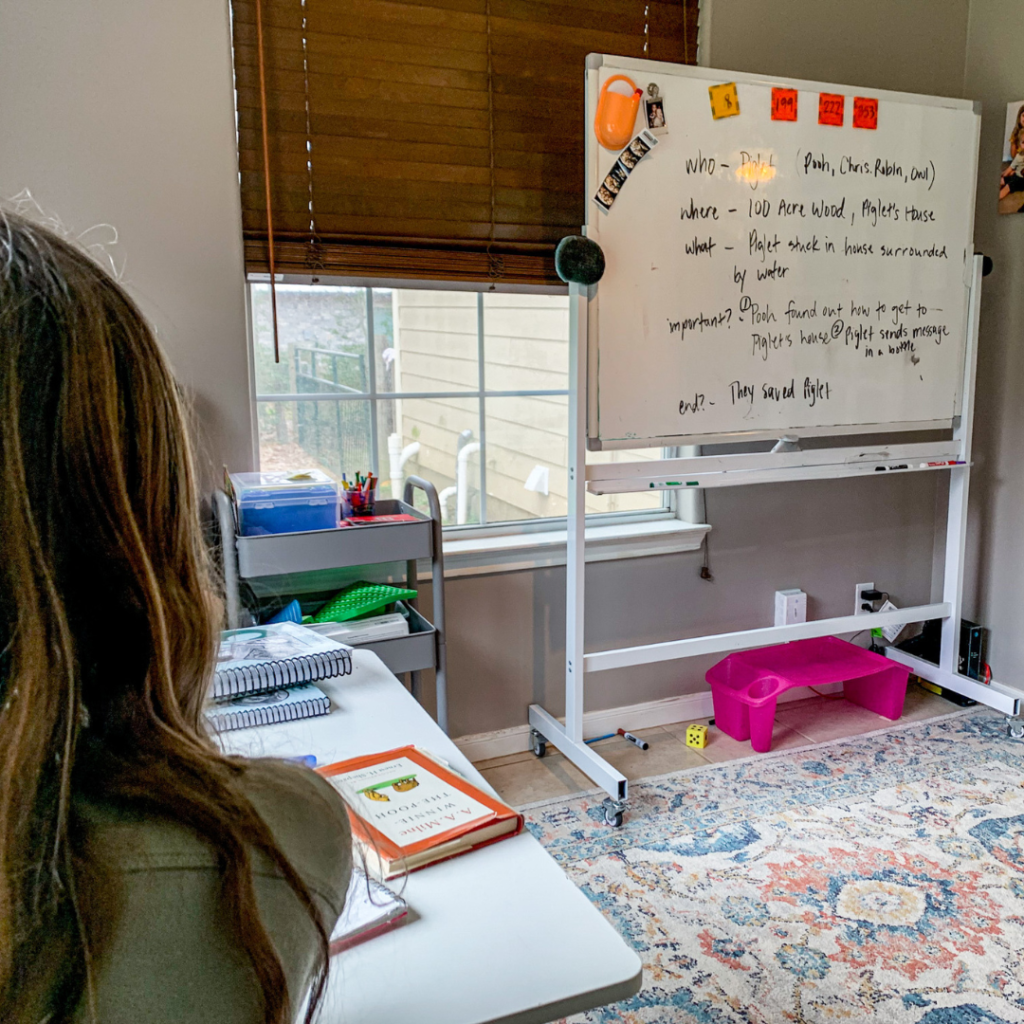
I ask her the following questions and we jot down quick notes as our answers (see photo):
Who is involved?
Where did it take place?
What happened?
Any other important pieces to mention?
How did it end?
I just made these questions up. This is not an official strategy, but we used it for both passages, and it went really well.
Once she has short notes, she begins making sentences to form a paragraph about what we read that day. The first couple times I asked her to do written narration, it was rough. However, with consistency and my help, she is starting to get the hang of it. I was so proud of the last one she did! She’s made awesome improvement.
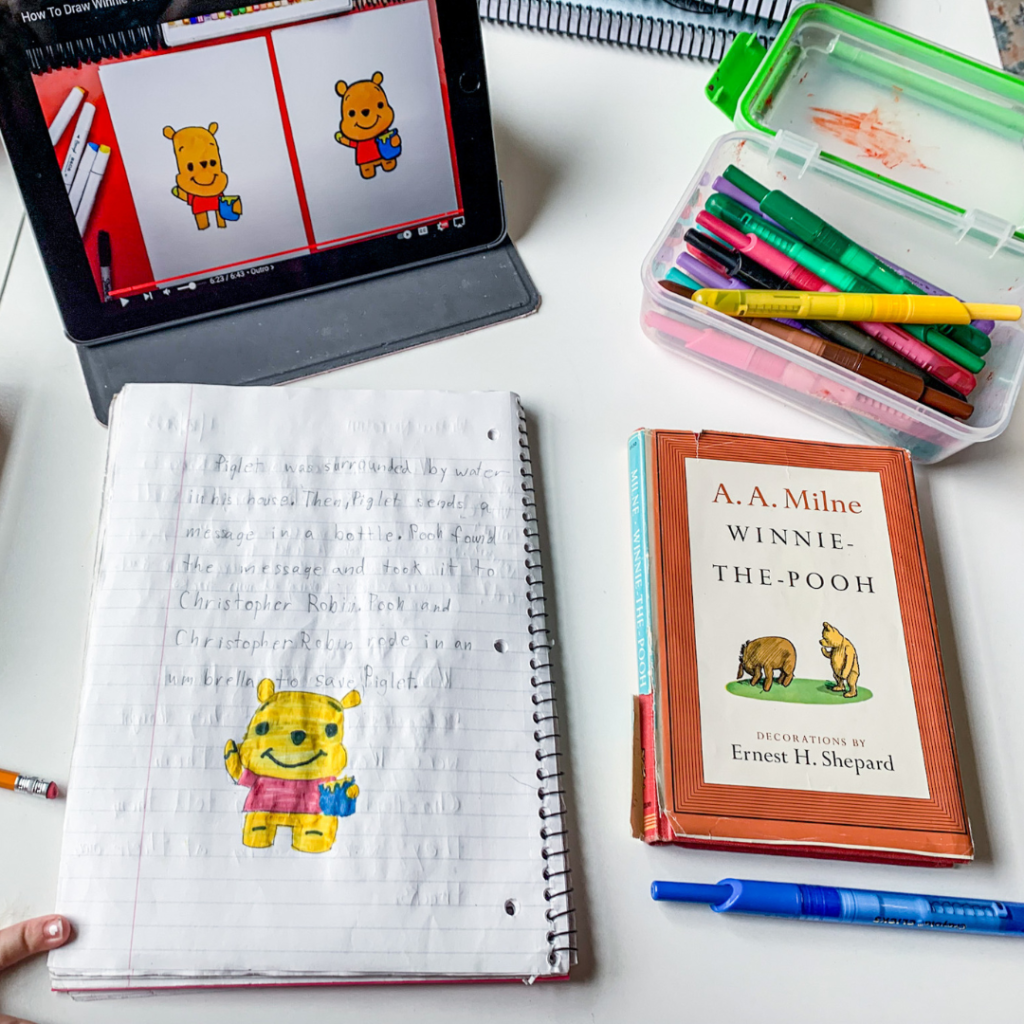
If you check out the picture below, you’ll see something else we add in for fun. As a reward for her hard work in writing, she likes to draw with Art for Kids Hub. We add it to her notebook, and it’s a cute addition to her work. (You’ll also get a peek at how she took my notes from the board in the last picture to her completed paragraph.)
I’ll admit, the hardest part of this lesson in written narration is for me to just be quiet. I always want to say things like, “Wouldn’t it sound better if…” Or, “Well, don’t you want to add…” I have to bite my tongue – a lot! It’s worth it though. I just LOVE hearing her voice in her writing.
Dictation
We’ve had practice with dictation from a couple different places. I first learned about it when we completed a Dart Guide from Brave Writer. We were also already doing it at the beginning of this year through the language arts program I chose, Learning Language Arts through Literature. I love it because it’s an easy way to assess that doesn’t feel like a test. Plus, it’s meaningful because it comes from what you are reading.
This article gives fantastic instruction, including a video, on how to do dictation. Like some of the other pieces of this unit, dictation gets easier with practice. The way we set all of this up, we study the passage Monday-Wednesday and dictation is on Thursday. By working on the passage a little bit each day, I feel like it’s a great way to set her up for success during dictation.
I was explaining to my daughter today during her dictation what a wonderful skill it was. Being able to write something and know how to add punctuation and edit it is a life skill that will be necessary her whole life – writing emails and letters, for example.
After I finish dictating the passage to her, we correct it together.
Freedom and Fun
I feel like that’s what it really boils down to here. By doing this method in our language arts, we’ve had more freedom to apply books we are already using to learn, making it more fun and interesting to actually work with.
A lot of things have inspired me to get here, as you may have read throughout this post, but I’m so thankful for what I’ve learned and how we can now find a way to do something that works so well for our family.
Have you tried something similar to this? Are you interested in seeing more units like this in the future? Let me know in the comments and be sure to sign up for my email list where I send all our updates, posts, and resources that we are using in our homeschool.
You can also catch me on Instagram @simply.learning.together If you try this out, take a photo and tag me. I love seeing your families enjoy learning together!
NEW Novel Guide Available!
For the last few years, my children and I have used this novel-based language arts program that is family-style and enriched with great literature each week. I’m so excited to share a NEW guide with you on how we do this in our home. If you’re tired of an all-in-one language arts workbook or if you’re itching for a great novel to read aloud to your kids, you’ve got to try this method! Below are two of the newest guides available now:
You can watch multiple videos about this method of Language Arts on my YouTube Channel HERE
Cookie Consent
We use cookies to improve your experience on our site. By using our site, you consent to cookies.
Cookie Preferences
Manage your cookie preferences below:
Essential cookies enable basic functions and are necessary for the proper function of the website.
Name
Description
Duration
Cookie Preferences
This cookie is used to store the user's cookie consent preferences.
30 days
These cookies are needed for adding comments on this website.
Name
Description
Duration
comment_author
Used to track the user across multiple sessions.
Session
comment_author_email
Used to track the user across multiple sessions.
Session
comment_author_url
Used to track the user across multiple sessions.
Session
WooCommerce is a customizable eCommerce platform for building online stores using WordPress.
Name
Description
Duration
wp_woocommerce_session_
Contains a unique code for each customer so that it knows where to find the cart data in the database for each customer.
2 days
woocommerce_recently_viewed
Powers the Recent Viewed Products widget
session
store_notice
Allows customers to dismiss the Store Notice.
session
woocommerce_snooze_suggestions__
Allows dashboard users to dismiss Marketplace suggestions, if enabled.
2 days
woocommerce_dismissed_suggestions__
Count of suggestion dismissals, if enabled.
1 month
woocommerce_cart_hash
Helps WooCommerce determine when cart contents/data changes.
session
woocommerce_items_in_cart
Helps WooCommerce determine when cart contents/data changes.
session
WPForms is a user-friendly WordPress plugin for creating custom forms with drag-and-drop functionality.
Name
Description
Duration
wpfuuid
Used to track user interactions with forms.
11 years
Statistics cookies collect information anonymously. This information helps us understand how visitors use our website.
SourceBuster is used by WooCommerce for order attribution based on user source.
Name
Description
Duration
sbjs_session
The number of page views in this session and the current page path
30 minutes
sbjs_udata
Information about the visitor’s user agent, such as IP, the browser, and the device type
session
sbjs_first
Traffic origin information for the visitor’s first visit to your store (only applicable if the visitor returns before the session expires)
session
sbjs_current
Traffic origin information for the visitor’s current visit to your store
session
sbjs_first_add
Timestamp, referring URL, and entry page for your visitor’s first visit to your store (only applicable if the visitor returns before the session expires)
session
sbjs_current_add
Timestamp, referring URL, and entry page for your visitor’s current visit to your store
session
sbjs_migrations
Technical data to help with migrations between different versions of the tracking feature