As a new month arrives, it’s a reminder for me to practice using the calendar with my kids in our homeschool.
When we first started homeschooling, I thought it was necessary to have daily calendar practice. So, of course, I bought the cutest set I could find for a good deal, made precious binders, and encouraged my children each morning to complete it. The set included things like tracing days of the week, filling in the numbers for the calendar, and recording the temperature and weather.
Well, the truth is – it got really boring after a while, and it just felt like busy work. So over time we’ve made some adjustments, and I’ll be sharing our super simple approach to learning the calendar. The best part – it works!
This post contains affiliate links. If you follow one of my links I earn a small commission at no extra cost to you. Thank you for supporting my blog!
Daily Calendar
I don’t think there’s anything wrong with practicing the calendar daily. I know there are children that truly enjoy working in a notebook or something similar and filling out their pages each day.
In our home, I soon realized, that learning the calendar comes quite naturally, and a daily calendar wasn’t needed for us. So, we got rid of the daily practice and to keep it simple, I use each new month to practice calendar skills.
New Month = Calendar Time
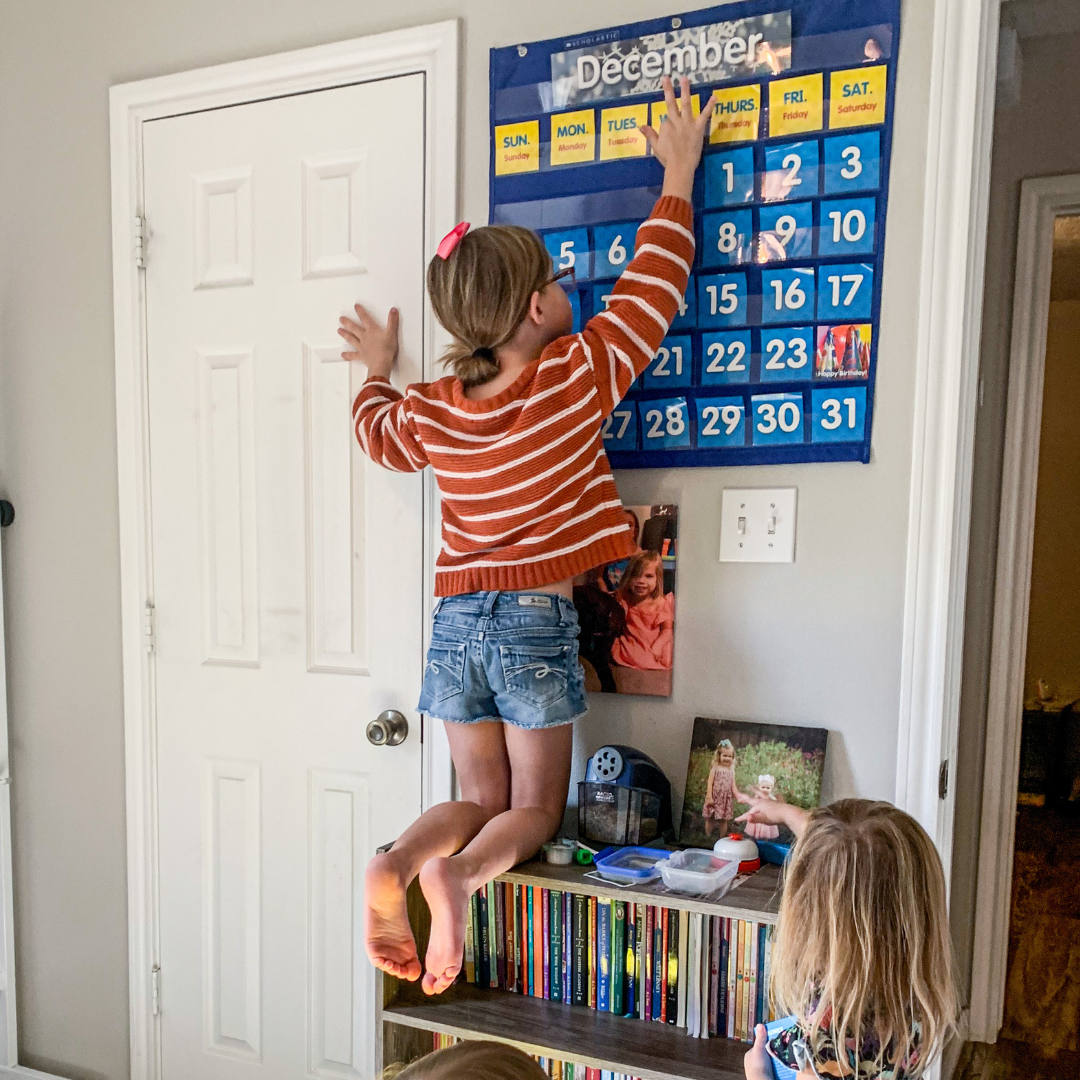
We have a calendar in our school room to display the month. This is a great visual that we can refer to often. Each month I have to change out the little cards so that it displays the correct order of days and month.
When I do this, I gather the kids and we practice a few simple things to get acclimated with the calendar. So this means we practice about 12 times in the year (as long as I remember each month!) That’s it! Easy peasy.
Months of the Year
You’re about to see that we love using songs to memorize. We sing a months of the year song a few times in a row to start memorizing the names of the months. All of my kids participate, including my two year old. He tries to follow along with us – it’s adorable!
Sometimes I like to write the names of the months on the board so that my child that is learning to read can start practicing to recognize the months in print. Next month I’m thinking I’ll have my oldest write the months out for us. Then, I can see how she spells the months – great practice!
If I feel like we need to mix it up we can sing loud and soft or fast and slow. The link I shared with you for the song actually repeats the song about 3 times. So, even just listening to it one time through works!
Days of the Week
Once we finish the months, we move on to the days of the week. This is when my childhood Barney episodes come into play. The song we sing is one I remember from my own childhood! It’s still in my head – proof that songs stick! (Be sure to check out the link to that song for a trip back to the late 80s, early 90s)
I have my kids take turns pointing to the days on the big calendar as we sing them. Everyone likes a turn doing this, so we end up singing it 3-4 times. It’s also fun with a silly pointer, which we have used in the past.
Calendar Questions
Finally, I’ll ask questions about the calendar that are relevant to us and the kids will take turns answering. Below are some questions I might ask:
Today is Tuesday. What is tomorrow? What was yesterday?
We have a field trip on the second Friday of the month. What day is that?
What day of the week is the 15th?
What day is Stella’s birthday on?
We meet with Adventure Club on Fridays. How many times will we go this month?
It Works and It’s Fun!
We have been doing this for a little over two years now, and I can see how it has worked with my littlest ones. For example, my current four year old has the songs memorized! So she knows her days of the week and months of the year already just by singing along with us each month.
My older two have known the songs for a while, so each month I challenge them with the calendar questions. It really doesn’t take much effort because I just ask questions about our own calendar.
The rest of the calendar practice comes up naturally in conversation. If the days of the week get brought up, we can sing the song quick to answer a question. For example, a question I get all the time is “Mom, how many days until my gymnastics class?” This is the perfect opportunity to put our songs to use!
This is something that has worked well for our family, and it’s been so nice not to have to worry about a sheet to fill out or print out. Every family will be different. It might be helpful to have your children sit and work on something like a calendar each day. If that’s true for you, I encourage you to keep on with it! I only share our experiences as a way to share ideas – I hope it can be helpful or inspiring to you!
What’s your favorite way to learn the calendar? Do you do something similar or do you prefer daily calendar work? I’m curious what other songs might be sung in your homes!
We recently adjusted our homeschool schedule so that we have timed lessons. Prior to this, I began researching a few Charlotte Mason methods and read a book, Modern Miss Mason by Leah Boden. From what I learned, I really loved the reasoning behind doing short, timed lessons. Short is key!
I’ve never been much of a fan of a tight schedule when it comes to our homeschool day, so this was weird for me to start. I always expressed our day as a “rhythm”, starting and finishing as we pleased. I have to remind myself that technically we can still do that, but once the lesson starts we are on a timer.
Want to know what’s crazy – we have LOVED it! This may sound weird, but we actually sit down for a lesson for a shorter amount of time, yet I’m able to get MORE done in our school day than before! Isn’t that crazy?
One day last week, I took some notes about what we did during the day, and I’ll be sharing that with you here. I am going to put start times, but I don’t every feel bound to that. I aim for it, but if I’m early or later than what my plan suggests, I just start when I can. The key is that the lesson is always the same amount of time.
This post contains affiliate links. If you follow one of my links I earn a small commission at no extra cost to you. Thank you for supporting my blog!
Breakfast and Chores
I get up between 6 and 6:30. I like a few minutes to myself to read the bible and drink coffee. Getting up isn’t easy to do, because I still get woken up multiple times during the night by litle ones. My secret is having my coffee pot on a timer! It’s like a Folger’s commercial from the 90s…”The best part of waking up…” (are you singing it?) Seriously though, I can smell it and I love that it’s ready for me. Morning motivation.
I am currently reading the One Year Bible. I also use my study bible alongside it to help me dig deeper into what I’m reading for the day.
My kids start getting up between 6:30 and 7:30. They all wake up at different times, and I’m usually making breakfast by then. If someone isn’t up by 7:30, I’ll let them know breakfast is ready. I like to get our day going, so I do wake someone up if it gets pass a certain time.
After breakfast (8:00ish) my kids immediately start their morning checklist. You can read more about this in my morning routine post, but it’s one of the things in our homeschool that has stuck around through the years. It’s a list to get my kids ready for the day and to do a couple chores around the house before we begin.
Independent Work
Once the checklist is done, my two older girls have independent work. They each do something different, and they don’t always start at the same time together. It’s just whenever they’re done with their checklist.
For First Grade: Handwriting (5 mins). We set a timer when she starts, and I tell her she has to complete two lines. She is using a Reason For Level A right now. if she finishes before, great. If not, she stops and finishes it the next day. I used to have her do a lot more independent work than this – it was not successful. Every since we cut it to just writing for 5 min, it’s been so nice. She works hard and does the work well.
Third Grade: Handwriting (5 mins) Same as my first grader – she completes 2-3 lines in that time. We are not using a program for this. I create her copywork based on the literature we are reading. She also does her math independently. I shorten her math lessons so that she is able to complete it in 20 minutes or less. The last thing she completes is her Fix it Grammar lesson which takes about 5 minutes.
Morning Time and Outside
I aim to start our Morning Time at 9:00. Right now we are using Foundations of the Bible from Driven by Grace. We read poetry from “Poems to Learn by Heart” and we read aloud. Usually the book(s) we read is something we are learning in history/science.
At 9:40 We head outside to play, soak in the sun, and the kids usually have a snack. I also get outside for a minute during this time. It makes such a difference in my mood if I get out throughout the day. In the past we have also used this time to go on a short walk.
Lessons Begin
We start lessons at 10:00, and I do math with my first grader. We set a timer for 20 minutes to get the lesson done. I do my best to pick what is the most important and helpful in her lesson. We do not do every single review problem. At the end of the timer, we stop…even when I don’t want to!
I didn’t mention this, but I have four children. While I have lessons with one of my big girls (8yo and 6yo) the other one is playing with my youngest two (4yo and 2yo).
At 10:20 I switch my big girls and start lessons with my oldest. The first thing we do is like a math meeting. Her lesson is usually complete or almost finished because she does it during independent work time. I help her with anything she couldn’t do on her own and we check her work together. I don’t set a timer for this because it only takes about 5 minutes or less.
Next we immediately start our language arts lesson. I recently wrote a post on what we do for this, but I set a timer for 20 minutes to get it done.
I start my next lesson by 11:00. This is language arts with my first grader. We are using Logic of English Foundations B. For this lesson, I set the timer for 15 minutes. I can usually complete 2-4 sections of a lesson during this time. The lessons in this Foundations B book are very long. Even before I started using a timer, we were not completing a full lesson.
Preschool Fun
At this point we are done with our formal lessons! It’s 11:15, and I have a minute to regroup and think about the afternoon ahead. This is also a great time to play with my little two, and that’s exactly what we did.
My big kids were outside, and my little two came in together looking for some time with mommy. We might read books, do a puzzle, or color. I keep it very simple. On this day we did some counting. It was as simple as rolling a dice and counting math cubes into a cup. They loved it!
After 15-20 minutes of preschool fun, I prep our lunch. I don’t always use this time for preschool. I do try to set aside time to play with my little ones, but it’s more about when it fits best in the day. This just so happened to be the time it worked out on this day.
Movie Lunch
About once a week, I let my kids watch a movie during lunch. The movie has something to do with what we are studying. We are working through Foundations of the Bible from Driven by Grace and she lists certain Superbook shows that match the topic.
At 11:40 we watched an episode while eating a picnic lunch. This is always a fun treat!
Mom’s Chores and Outside Time
Between lunch and my son’s nap (12:00-1:00) is just a free time. My kids played outside which gave me an opportunity to work on my personal checklist. I’ve been doing this for about 3 months now, and it’s amazing.
At the start of every day, I write down three things I want to accomplish. It can be as simple as “sweep the kitchen”. My goal is to get those three things done by the end of the day. I feel more productive and it feels like I’m able to keep up with my house better.
At 1:00, I put my son down for a nap.
Afternoon Activity
At 1:15, I designate something I want to do with my older girls that is a little bit harder to do with a little one around. Now that he’s napping, it’s easier to get it done. This usually has something to do with the current unit study we are in.
Today we studied art during the the time of the Vikings. We sat at the table, researched the information with our library books, and looked at examples. We also read about runes and tried creating some on Play-Doh with a toothpick.
Reverse Planning
We finish up our afternoon activity by 2:00. During this time, I can clean up and fill out my planner. I use the reverse planning method and love it! I simply write down the things we accomplished for the day and shut down the school room for the afternoon.
Quiet Time/ Jog
At 2:30 we started quiet time. My son is still sleeping and my two big girls go into separate rooms to enjoy some quiet. Our days flow much better when we all have this quiet time to ourselves. My girls entertain themselves by reading, drawing, or listening to a book. They have come to really love and appreciate this time.
While they are in quiet time, I go for a jog. I look forward to this every day because I can get outside and I can listen to a book or a podcast that I love. It also gives me an energy boost for the rest of the afternoon/evening. My husband works from home so he is able to be the present adult while I’m gone.
My third daughter comes with me in the stroller. She needs a nap, but a full one is too long, if you know what I mean. So, she rides in the stroller and takes a catnap while I run.
Afternoon Snack
Quiet time is usually an hour. At 3:30 everyone comes out for a snack. I’ve learned to do this snack right away otherwise they get to playing and get hungry too close to dinner, snack late, and ruin their appetite. We’ve been using it as a time to just sit and chat together. Some days we even make tea for fun. I also enjoy an iced coffee while we talk 😉
Once we finish our snack time, my kids head outside for the afternoon. I usually spend this time picking up or prepping for dinner.
Evening Routine
At 6:00 we have dinner. My husband and I clean up at the end while the kids play. Right now it gets dark pretty early. We all look forward to when we can spend some more time outside after dinner.
At 6:45, we visit together in our living room. I wish I could say it was peaceful family time, but the energy level is usually quite high. We are together as a family, but it’s quite loud! Even still, I am grateful.
At 7:00 my kids get ready for bed. They don’t GO to bed. I’ve just learned to start our bedtime routine early. It helps me not to get frazzled in the rush to get to bed. By starting early I have more patience and better self control. Once they are ready for bed, we read aloud together.
It’s just me and the girls that read while my son plays with my husband. We have been reading our novels before bed for a couple years now, and it has been so nice. We read so much together! And it is a time that I cherish with them.
By 8:00 we finish up our reading and I put my son to bed. During this time, my girls read silently in their beds.
By 8:30 it’s lights out and time for bed.
Routine
Routine is so important in our home! Not only does it help our kids, but I’ve realized how much it helps me to follow a routine also. On days where we aren’t in routine, I feel pretty funky!
Our schedule has shifted and adjusted over the years, but this is the first time we’ve tried timing our lessons. It used to be where I’d be teaching all the way to lunch and then I’d have to catch up with someone when my son took a nap.
Now, with timed lessons, I’m able to be more efficient and complete our lessons quicker. This allows me extra time in the afternoon to add in some fun!
Does your routine look similar to this? Have you ever tried timed lessons? I was against it for quite sometime, but I’m glad I finally tried it. We have loved it so far!
Get ready for a list of preschool fun in the kitchen! These simple activities can provide a variety of learning experiences for your little one.
The inspiration for this really started a few weeks back when I could really sense that my almost-four-year old was eager to start learning more. I previously told myself I wasn’t going to start anything formal this year, because I wanted her to just be a kid and PLAY and have fun and pretend with her sisters! However, I was really feeling a push to work with her a bit because I knew she was excited for it.
Of course, I immediately began thinking of what kind of work she could do, but wasn’t sure how I’d fit in the time to sit down with her while also keeping my 2 year old happy. And then it hit me, “Jaimie – stop taking this so seriously, and just PLAY with her!”
So that’s what we did. I was so inspired that I spent all last week coming up with fun things for us to do in the kitchen together, her favorite place to be with me. Some of these activities include the option of different learning manipulatives, but others are just kitchen tools. We had such a blast, and you know what? It was perfect! The best part – when my two year old was with us, he joined in as well! That’s a win-win!
This post contains affiliate links. If you follow one of my links I earn a small commission at no extra cost to you. Thank you for supporting my blog!
Why Kitchen Tools?
I don’t know what it is about my kitchen tools, but my kids are always taking them and playing with them. Is that just in my house? They pretend and do who-knows-what with them, and unfortunately I lose a few.
What is so intriguing about the kitchen stuff? Maybe there’s something about it that makes them feel “big” or just like mom. It’s just the perfect, simple hands-on fun that requires no prep!
Take it from an experienced mother that is missing tools on a regular basis. (ha!) Set some rules and boundaries. We eventually had to do this, and they are pretty good about asking permission and caring for my kitchen stuff now. OR! If you don’t want them using your things, head to the dollar store. Make a kitchen tub full of utensils that you can pull out and play with at any time! (Here’s an inexpensive set from Amazon – but maybe take out the cheese grater and can opener for safety reasons!)
Mixing and Scooping
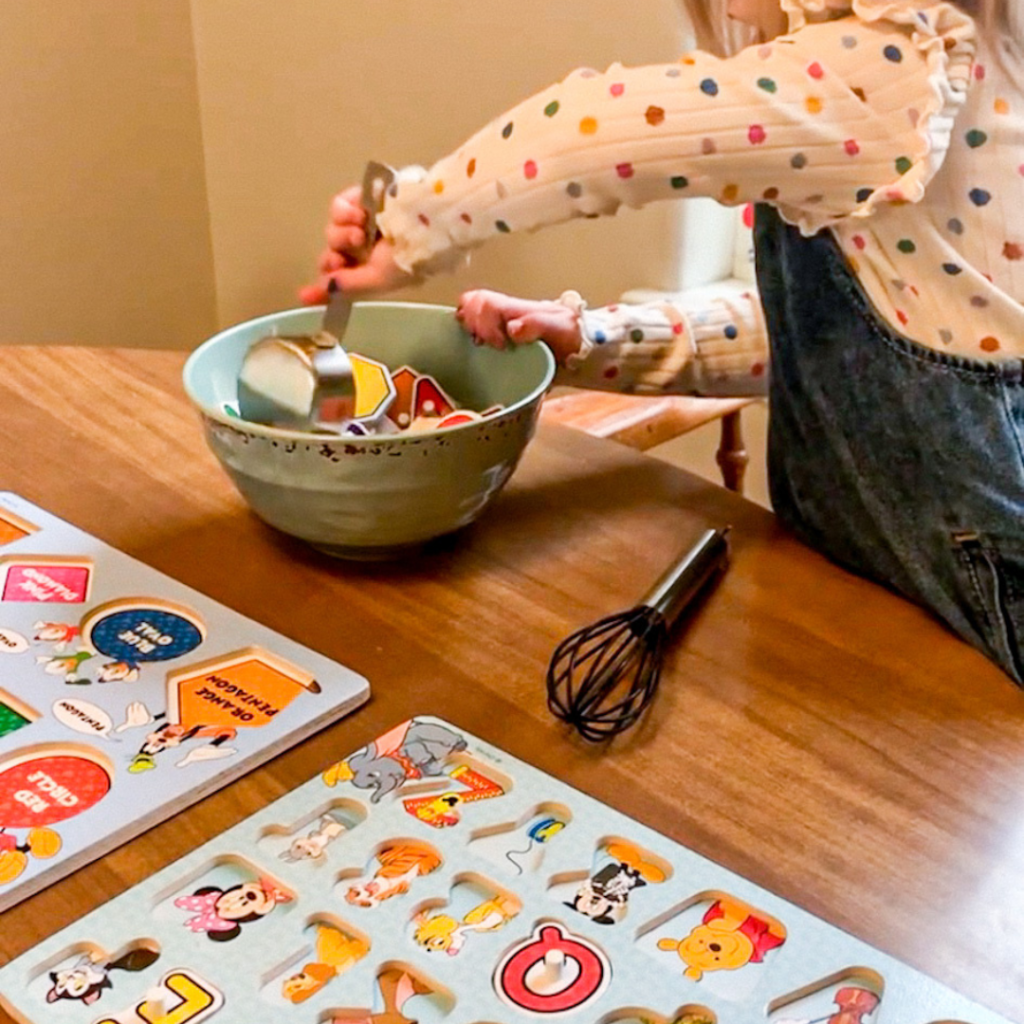
For this activity we used a mixing bowl, puzzle pieces, a whisk, and a measuring cup. Place all of the puzzle pieces in the bowl. Encourage your child to mix the pieces around with the whisk. Next, scoop a piece (or more!) out of the bowl. Talk about what it is – are you doing letters? numbers? colors? maybe animals? Ask questions about what was chosen. Then, place it in the correct spot in the puzzle.
We used two puzzles. One was shapes and the other was letters. If she drew a shape we talked about the name of the shape and it’s color. If she drew a letter, she identified it and we practiced the sound and gave some examples of words that start with that sound.
This was so fun, and she played until all the pieces were out!
Sorting
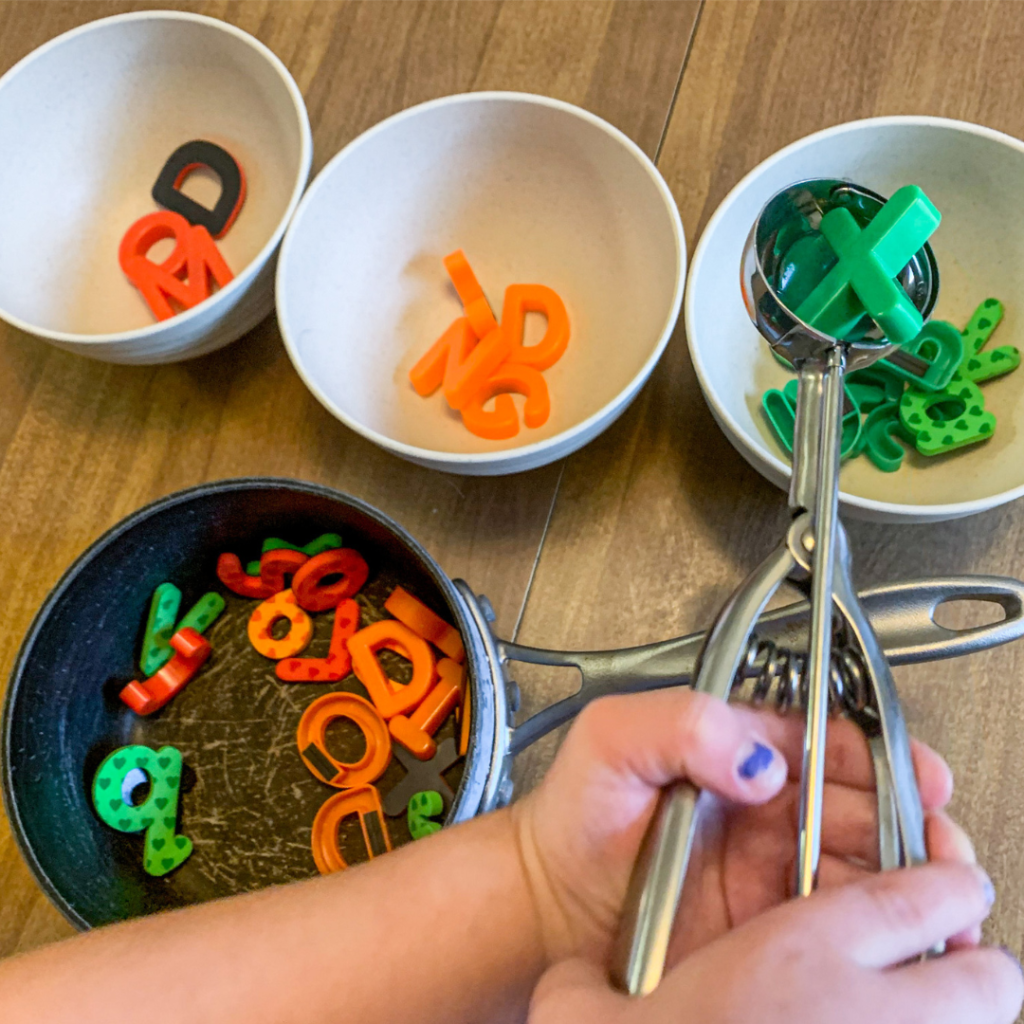
One morning I placed three identical bowls on the table and gathered up my magnetic alphabet letters. I picked three colors and set the rest aside. We mixed the three colors of letters in a cooking pot and used a cookie scoop to scoop them out and sort them into a bowl.
A cookie scoop! Something so simple, but it was such a hit. She did it over and over and loved popping the letter out by squeezing the scoop. I placed one letter of each color in the bowl when we started so she would know which color went to which bowl. We would talk about the letters she scooped. Sometimes we’d say the sounds. It was so fun!
My two year old saw the action and wanted in, so I just gave him a bowl of letters and the cookie scoop to explore. The cookie scoop now in his hands, my daughter begged to continue playing, so she settled for an ice cream scoop instead and had just as much fun.
I’m not sure why, but using real tools in the kitchen is a blast to them!
You don’t have to use letters. Craft poms would be great or if you have counting bears, that would work also. You could honestly take a sheet of paper, cut it into squares and crumble the squares in a ball. Don’t make this complicated. Use what you have! Here’s a fun idea! Write a color or shape on that crumbled paper and have your kiddo open it up and then sort it! I may do this again and try that!
Pretend Restaurant
Ok, so this one was a little silly, but we had a ball! You’re going to have to get in there and pretend right along with them. They’ll love it!
So we pretended to be at a restaurant while in our kitchen. My preschooler was the waitress/cook (I was her helper) and she seated her siblings at the kitchen table.
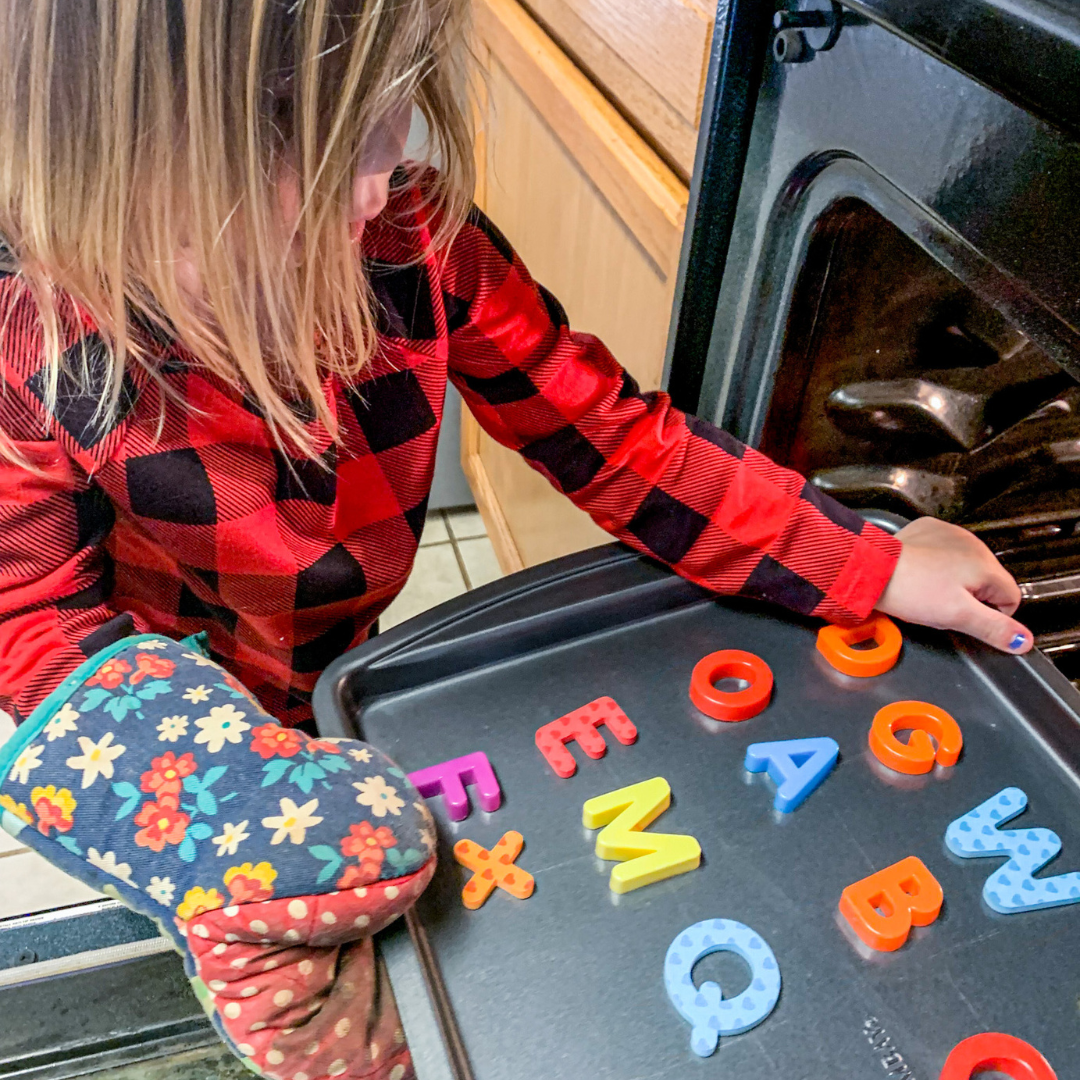
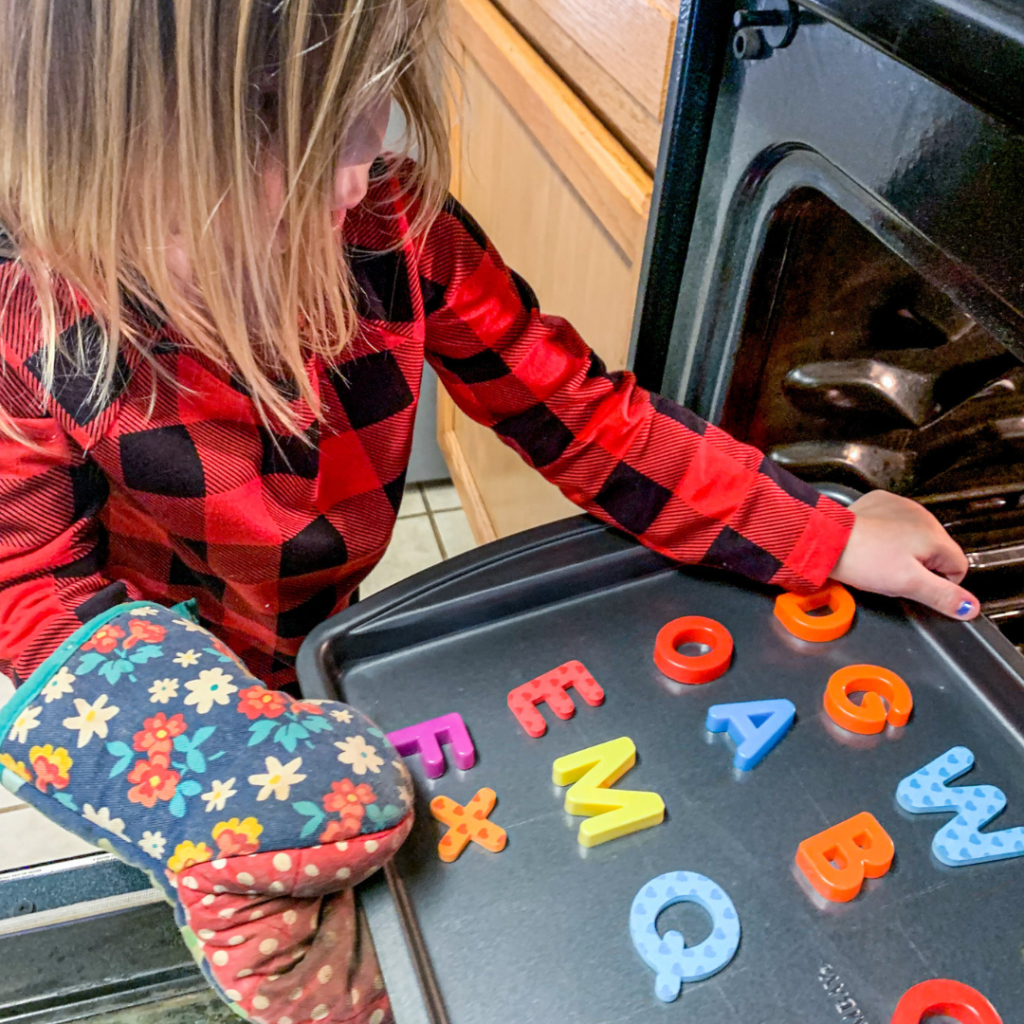
I prepped very quickly. First I had a big pot of colored blocks on the stove with a big spoon. Second, I had a baking sheet with the magnetic letters (A-Z) stuck to the sheet in a random order. I put that baking sheet in the oven – seriously! It makes the pretend play so real!
Do we need to have a safety talk? Please please please make sure your kitchen stove and oven are off. Also, be clear to your children that they can’t be touched or open without your permission in the future. OK, let’s keep going.
I told my big girls they could choose one thing – blocks or letters, and their order could be something like this…
“I’d like 4 blue blocks please.”
“Yes, I’d like an E and an X”
My preschooler was in heaven. She took one order at a time and then went to “her kitchen” and prepared them on a paper plate.
Once she got the hang of it, I encouraged her siblings to challenge her without frustrating her. So, maybe 2 red blocks and 4 green blocks. Or, an “A” and 1 blue block. We went back and forth ordering, and I’ll tell you what – guess who else wanted to play?! Her big sisters!
Want to know how I changed it for them? I made a quick menu of 6 CVC words for my first grader. She gave the menu to her siblings and they ordered a word. My daughter wrote it down, went to the oven, and made the word from the letters on the baking sheet and sent it to them. So fun!
My third grader (Yes, even she wanted in on it!) is fun to challenge. I gave her a pencil and paper and started ordering lots of things. She quickly wrote it down and then organized it on a plate. We had a good time making her work hard 😉
Sink Play
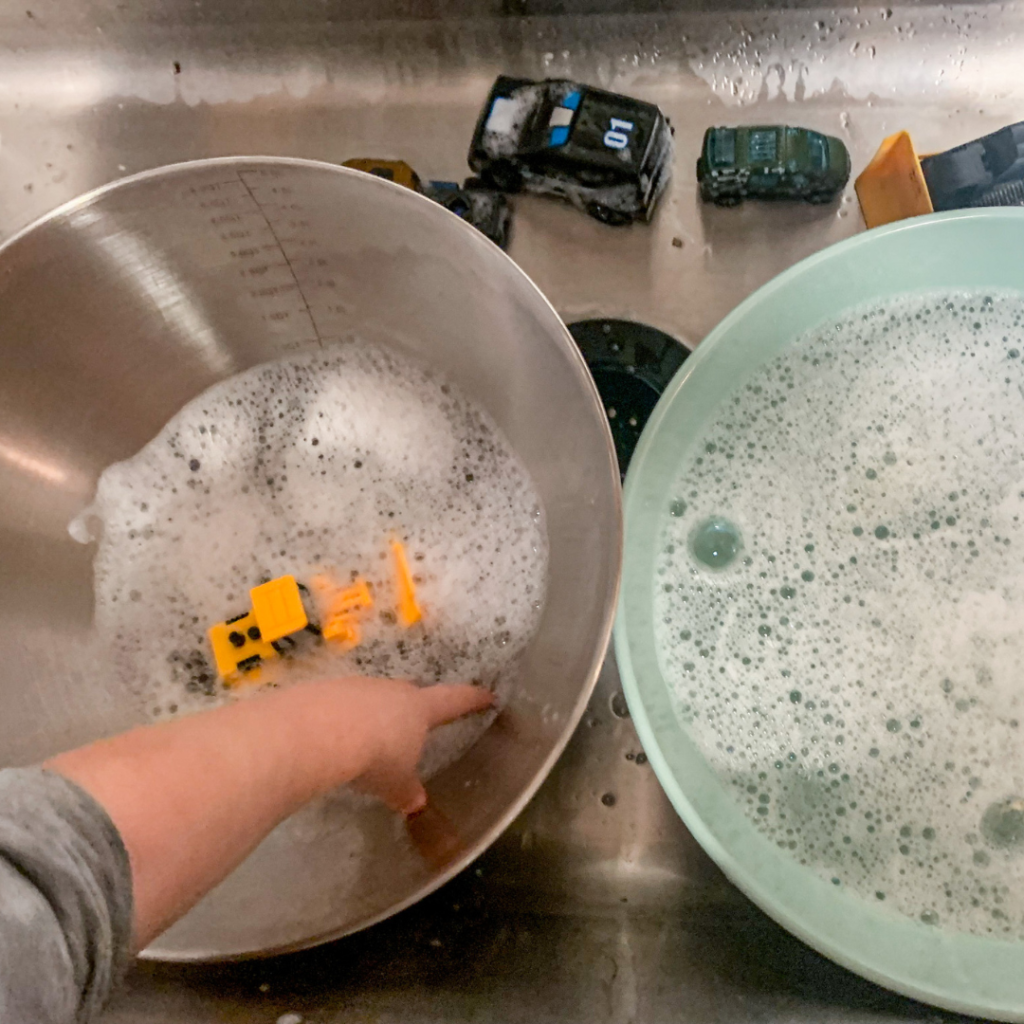
This is the one thing that will keep my toddler (2yo) busy for a long time, and my almost-four-year old loves it just as much. I have a big, wide sink, and I put two large mixing bowls inside of it. I put soapy water in one and water in the other.
Collect toys around your house that you don’t mind getting wet. Most recently we’ve done cars or dinosaurs. Do you have those floating bath letters? That would be fun, as well!
I place a good, sturdy chair in front of the sink for them to stand on and show my them how to wash the toys and rinse them off. I also make sure to give them a spot to set them to dry.
Their clothes may get a little wet and you might get some extra water around your sink, but the mess is worth it. This is a winner! It’s important to stick around nearby as some of the splashing can get slippery, so a hand towel on-the-ready would be a good practice.
Kitchen Tongs and an Egg Carton
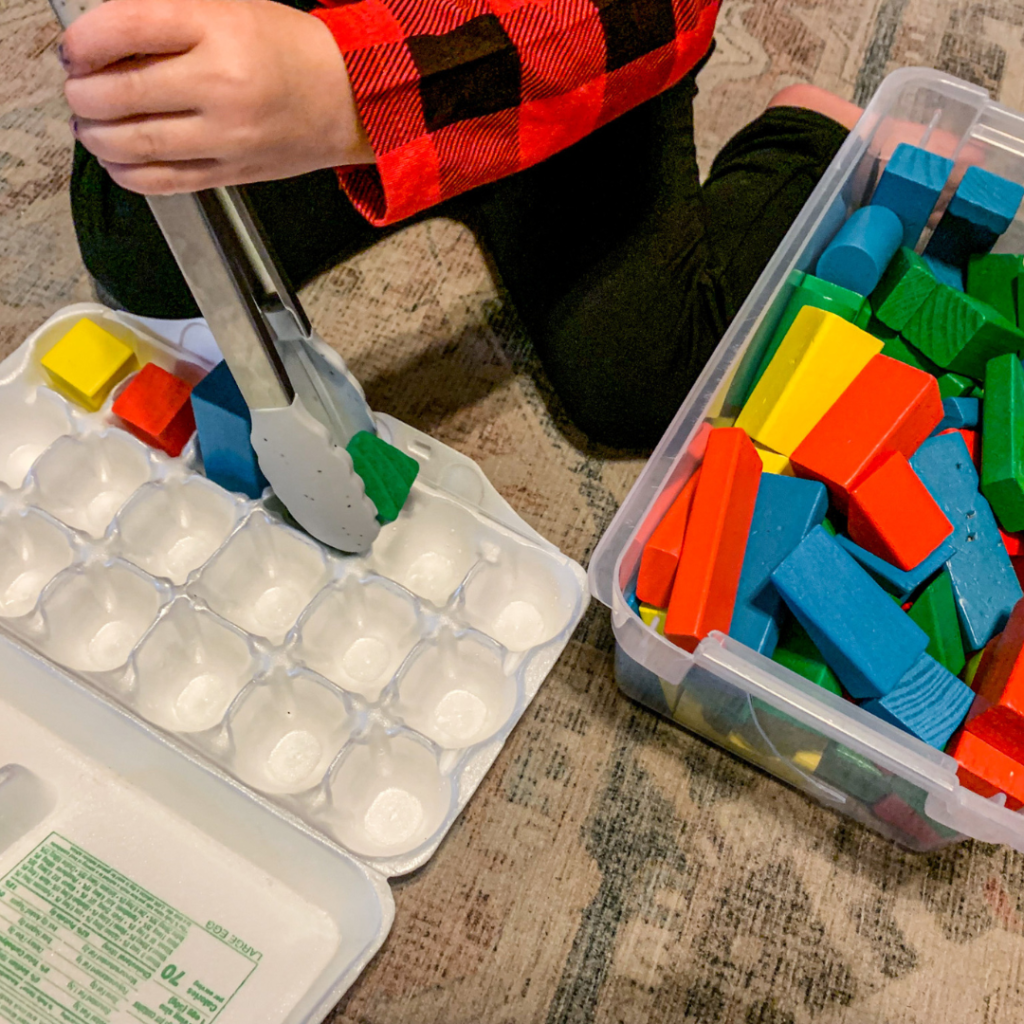
I always have empty egg cartons handy. They’re great for paint because you can just throw them away, but one morning we used them to sort blocks.
I gave my daughter our bucket of colored blocks and a pair of kitchen tongs and showed her how to grab a block and put it in the egg carton. It’s so simple, but once again, so entertaining for little ones. My two year old joined her and they moved blocks from one place to the other while I got ready for the day.
Once she filled the carton we tried filling it with only one color. Then we tried one row red, one row, green, and one row blue. You could also do patterns or finding the same shape.
Just like some of these other activities, the colored blocks isn’t a must. Try unifix cubes or counting bears or Legos. All you need is something small enough to fit in the egg spot.
Flipping Pancakes
I found this idea online a few years ago, and it is the cutest! I did it with my older girls when they were little, and I was so excited to do it again.
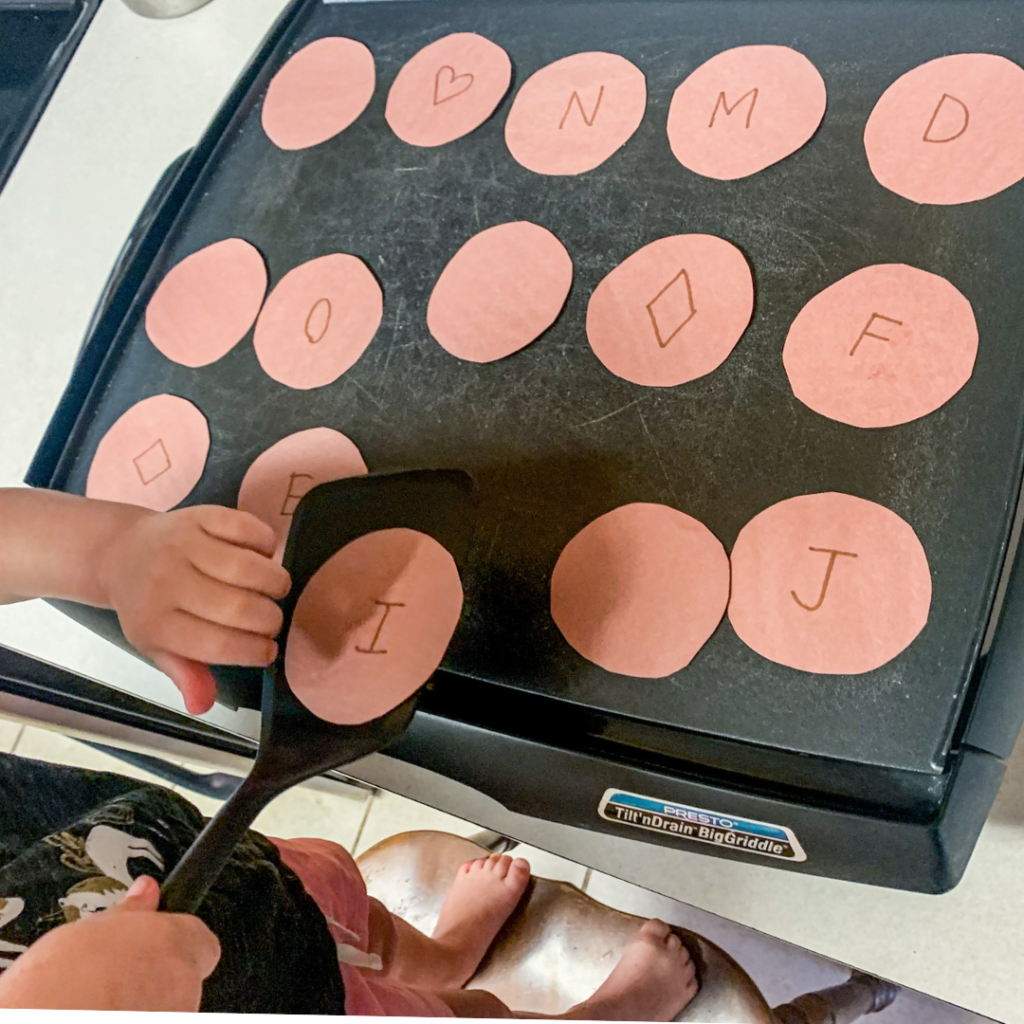
First, I used a cup to trace a few circles on a brown colored sheet of paper. Then, I stacked about 3 sheets behind it so I could cut them all together to make lots of circles! Now, you have pancakes.
Write whatever you want on the circles. To be honest, all three of my girls begged to do this when I got it out, so I changed it up for each child.
For my preschooler, I wrote a letter on each brown circle. On the back of a few of them I drew a shape. (This was a little surprise for her) I spread the pancakes out on our griddle and got her all set up with a chair so she could reach. I called out a letter and she flipped the pancake with a spatula. I told her some of them have a surprise shape on the back, and she thought that was the best!
You can change up the surprise – make it a sticker or a stamp. She loved flipping them to find out. I think she played three or four times before I finally had to stop her so her older sisters could try.
Setting it up for the older ones was simple. I just put some of their math problems from the lesson of the day and wrote the answer on the other side. (Then of course we skipped that part in the workbook! The game took it’s place)
Float or Sink
This demonstration is very simple. I use a clear container, but you could also just fill up your sink. Fill the container with water and go around your house finding items to put in the water. Before you put an item in the water, make a prediction. Will the item float or sink?
This has to do with density. If an item is more dense than water, it will sink. If it is less dense it will float. You could talk about what density is, but that may be over their head. Take it as far as you want though. You never know how much they’re soaking in!
Pouring Water
This is one you definitely want to do when you have some space in your day. It can end up quite messy, but it’s only water so it won’t hurt!
I usually lay a couple of towels on the kitchen floor (or outside) and gather a variety of bowls, scoops, spoons, and cups. Next, I’ll fill one or two of the items with water. I show my child how to pour back and forth between bowls and cups, and then let them be!
There will be spills! But it’s just water. There are times when I just let them be on their own to explore and play but you could definitely be more intentional about it as well. For example, pouring 1/4 cup of water into one cup four times to demonstrate what 1/4 means. We like to play a game where I say something like, “How many of this cup do you think it will take to fill that bowl to the top?” We make predictions and test it out.
When you’re done and the towel is soaking wet, just use it to mop your floor up a bit! 😉
Playing is Learning
I had so much fun with my littles (and bigs!) in the kitchen this week. It’s crazy to me how much you can learn just by playing with a few letters or blocks. The best part – basically no prepping! (The pancake one took maybe 3 minutes to get ready) It was so easy to just grab this stuff in my kitchen and go!
Let me know if you try any of these out! Leave a comment or tag me on Instagram @simply.learning.together I love hearing from you guys!
My youngest daughter will be three in one month. She loves shapes so we are always playing games with them. My kindergartener is also working on mastering the names of all different kinds of shapes so I wanted to share different ways we have played with shapes to learn them.
This post contains affiliate links. If you follow one of my links, I earn a small commission at no extra cost to you. Thank you for supporting my blog!
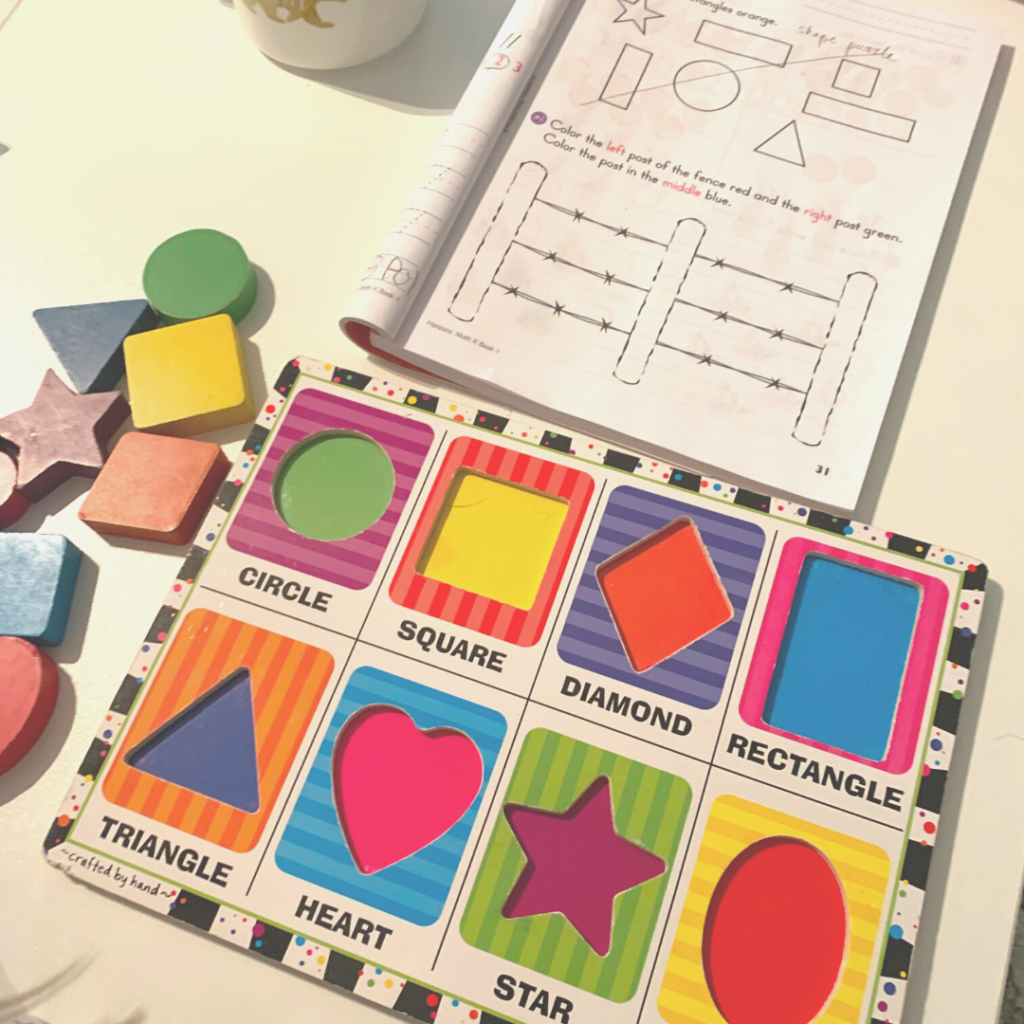
1. The first one may seem obvious, but do a puzzle!
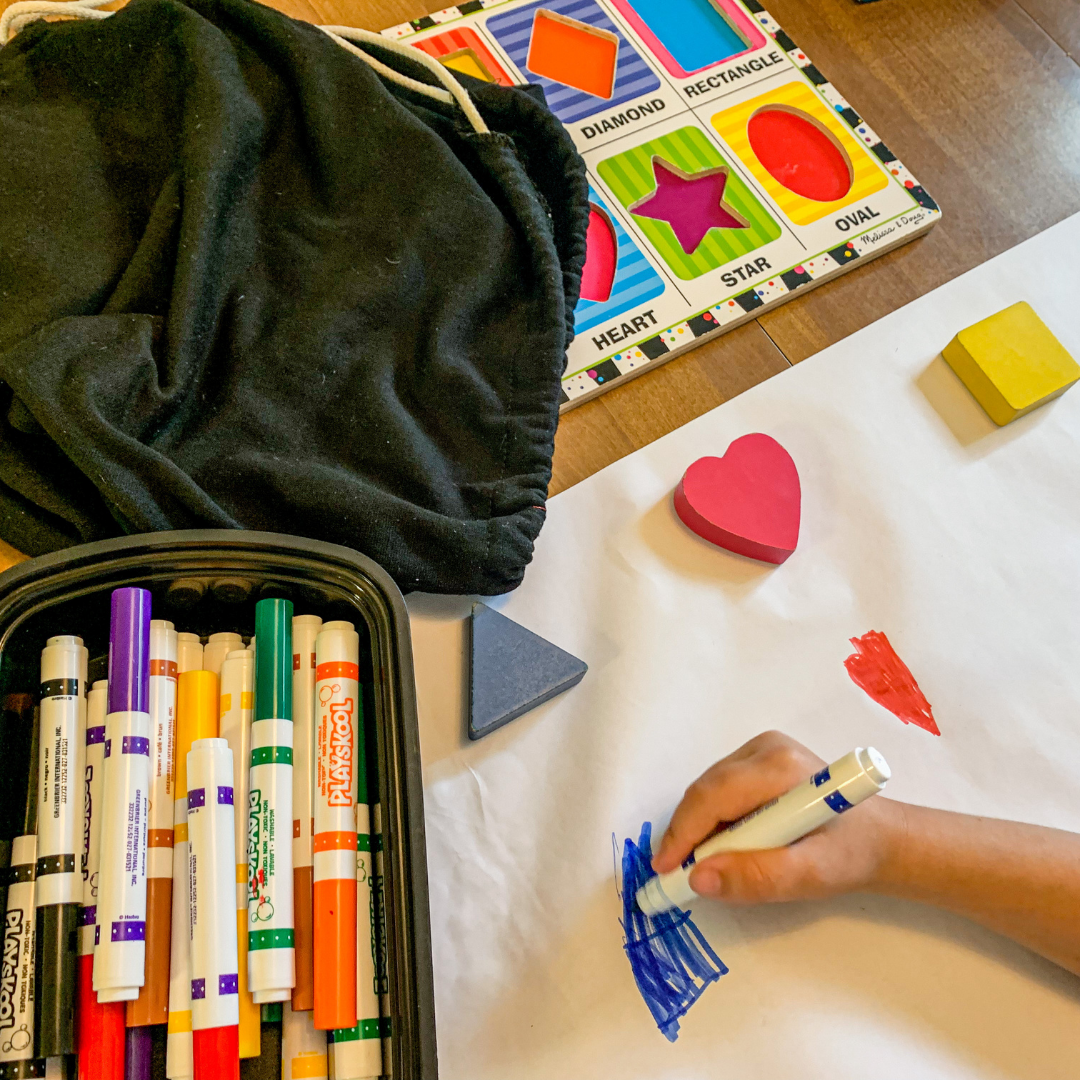
We have a couple shape puzzles at our house, but our favorite is a Melissa and Doug wooden puzzle. These are so great to have for multiple age levels. I also love to use the pieces for a variety of games, which you’ll see as you keep reading.
2. Scavenger Hunt
Use your wooden puzzle to do this next one. Hide the pieces around your house or around the room. (Try not to forget where you hide them!) As your child finds the pieces, place them in the puzzle. Call out the name of the shape. Play this same way OUTSIDE on a beautiful day. The fresh air will really add some goodness to your day.
3. Sidewalk Chalk
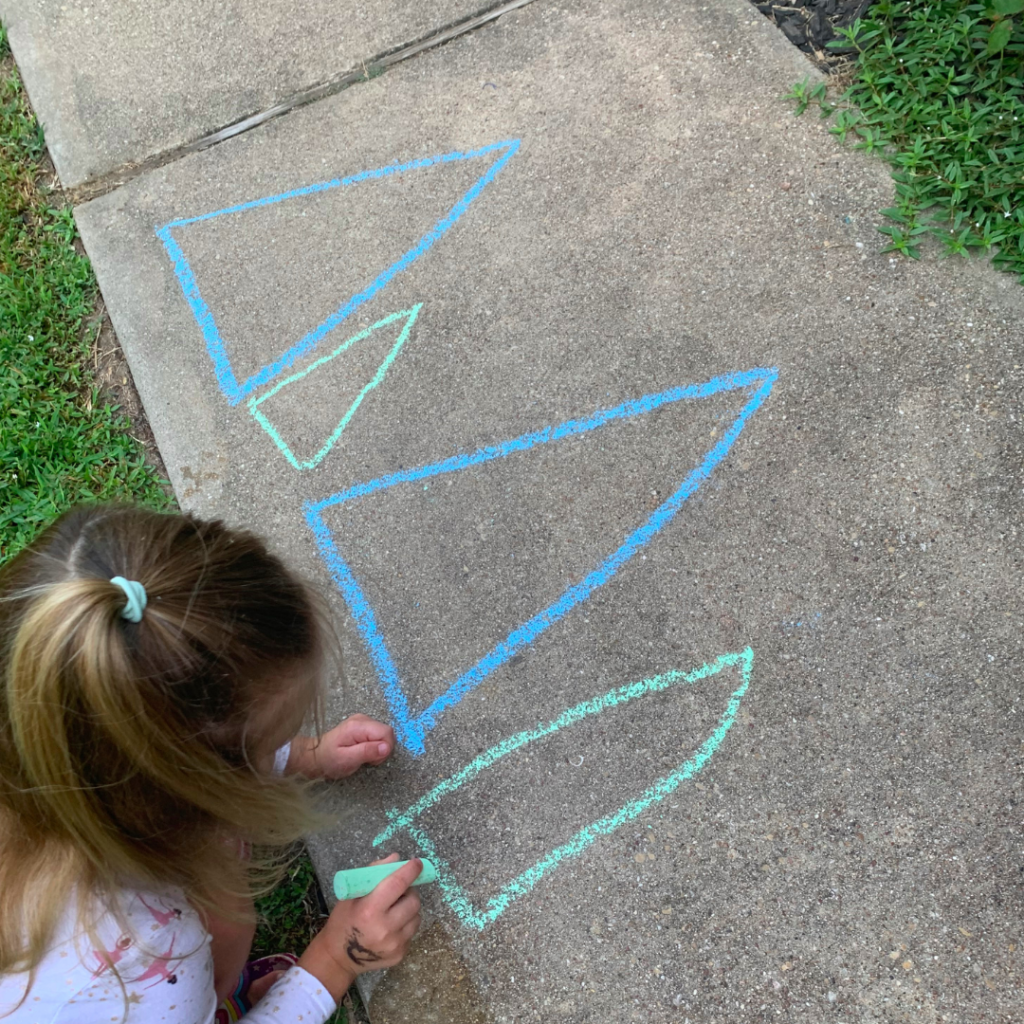
Draw large shapes on your sidewalk with chalk. Depending on your child’s age, he/she can draw them or you can draw them. Call out a shape and have your child jump inside that shape. Keep playing until you’ve called all of the shapes.
4. Spray Bottle
A spray bottle with water in it can be hours of fun! Pick them up at the dollar store for an inexpensive activity! Kids love it, and it’s a great way to play with shapes. Use your sidewalk chalk to draw shapes outside on the concrete. Call out shapes and have your child spray them with the bottle. Want to add a challenge? Add some color to it – Can you spray the BLUE circle?
5. Surprise Shapes in a Bag
Use your puzzle pieces again and place all of them into a bag you can’t see through. Your child will place a hand in the bag without looking, choose a shape, and name it. I actually played this with my five year old and had her skip to the next room each time and draw the shapes onto a piece of paper. It added tons of movement PLUS she got the drawing practice. If your child isn’t drawing yet, just name them. For an added touch of fun, see if your child can feel the shape and name it before they see it!
6. Peek-A-Boo Shapes
This next one came upon us by accident. We originally used magnet tiles to create a tower with a door at the top. My toddler opened the door and peeked through the tower while I held a shape (from the puzzle again) at her eye level. You can get a better idea from the image above. She told me what the shape was. This sounds so simple, but we giggled so much and had a ball!
I eventually tried to come up with something anyone could use. Take a cereal box and cut a square out of the narrow side of the box. On the opposite side, cut a small hole to peek through. As your child looks through that hole, hold up a shape right outside of the square you cut. It’s really just a fun, silly way to look at shapes and name them.
7. Play Doh
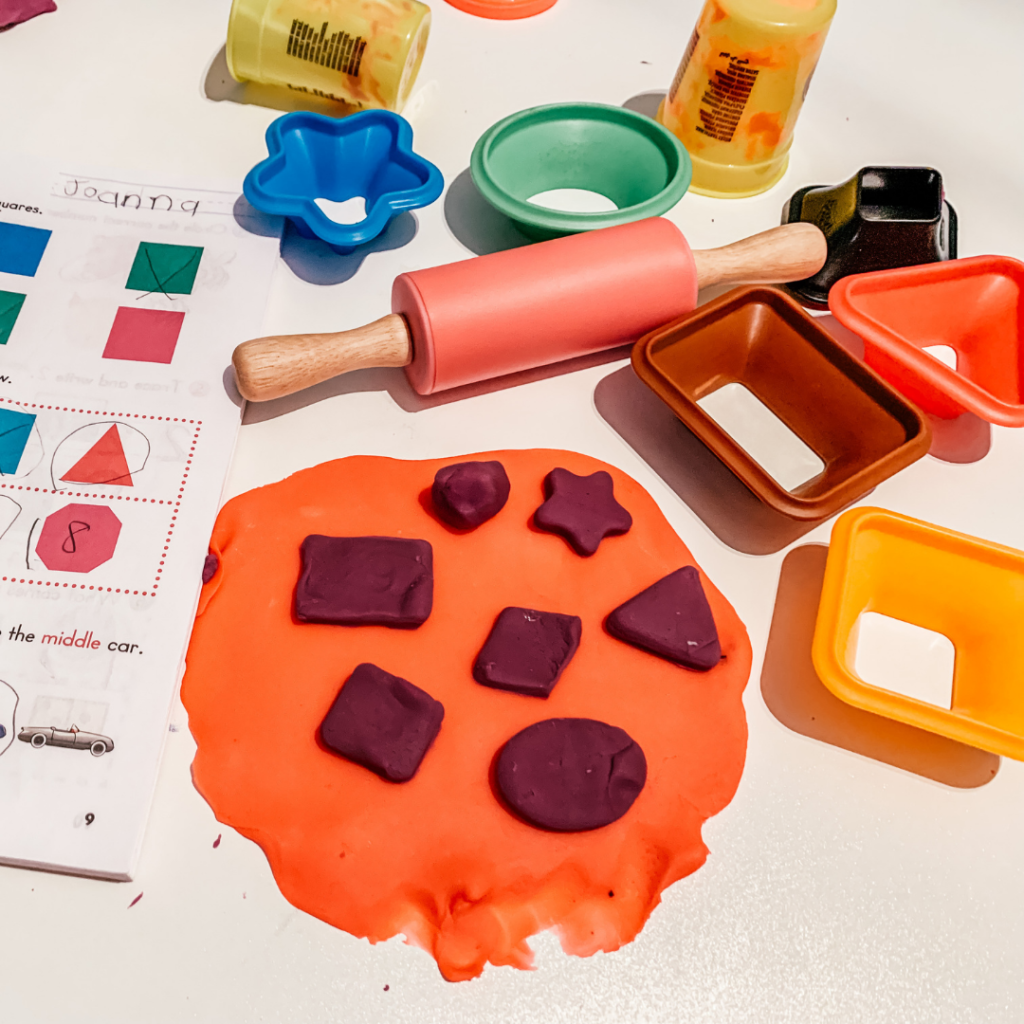
Using Play Doh is especially great if you have shape cutters. We bought a set a long time ago that works awesome, but we also own a giant cookie cutter set that I use ALL. THE. TIME. and it has shapes in there as well. Simply roll out the dough, and cut shapes! I couldn’t find the exact cutters that we have, but here’s a link to a set with a few basic shapes.
8. Play Doh Pizza
We have also made play doh pizza with shapes. Your child is the chef and rolls out the play dough. Place your order with whatever kind of “shape toppings” you want. This can be so fun! All the toppings are cut out of the play dough. Set up a little restaurant and collect orders. Siblings can play too! Challenge your child by ordering half of one topping and half of another. Have fun with it!
9. Play Doh and Dice
Assign 6 different shapes to a number on the die. You could simply write this on a piece of scratch paper or maybe even a mini whiteboard/chalkboard if you have it. This is great for your 4-6 year old who may be practicing to recognize numbers on a die. Roll the die and call out the number. Cut out the correct play doh shape according to the assignments you set when you started.
Find a way to get a “winner”. You can do this by rolling a certain number of times (like 10) and seeing which shape was made the most. Or, you play until one of your shapes gets to 5. Keep it simple, keep it fun, keep it just right for your kiddo.
10. Shaving Cream
Don’t be scared of this one. It’s such a blast! And your kitchen will smell awesome when you’re finished. Spray a little bit of shaving cream on your counter or table. Give your child some time to spread it around and play with it for a little bit. Then, draw shapes with your finger! This can be free choice from your child or you can call out a shape for your child to draw.
There are so many ways to play with shapes while learning. I love these ideas because they all use items around the house. This makes it so easy to throw together last minute and have a good time learning with your little ones.
The Alphabet Workbook is a simple and fun no-prep curriculum with repetitive opportunities to practice letters while also incorporating other early learning skills. It’s the key to our success in learning letters at my house, and this post is to tell you how it came to be…
I started homeschooling when my oldest was in kindergarten and my second daughter was three and a half. I didn’t do much organized curriculum with my three year old. There was a lot of play time, reading, and maybe a letter craft or two.
In our second year of homeschool, I had a goal to teach letters and their sounds to my then four and a half year old. Once again, I didn’t purchase anything super serious. I wanted to keep it low key. We started practicing letters by writing them, playing games, building them, playing with play-doh, reading about them…but they weren’t sticking.
Although we were doing a lot of different things, I was having trouble staying consistent. So, a couple months in, I felt like I needed to adjust some things.
I wanted something that my child could do every day (super short!) that would practice a letter a week.
There were all kinds of printouts online, but I’d have to search around and piece it all together. I also wanted to practice things like shapes and colors and counting…So I thought – why not put all of that into ONE? This inspired me to put together the Alphabet Workbook.
Each week in the workbook we would practice one letter while also practicing other early learning skills such as:
Coloring
Tracing
Shapes
Counting
Graphing
Comparing
Grouping
Numbers
Matching
Patterns
…and more!
This one workbook would allow us to practice multiple skills in just a few minutes a day.
I wanted the lessons to be short and sweet with a lot of variety. Nobody wants to do the same thing over and over. Many times when you download alphabet worksheets, they all look the same, just with a different letter. That would never fly with my daughter. So, I came up with multiple lessons that are incorporated throughout the workbook.
Each letter has 4 different practice pages, and every page for that letter looks different!
This variety was so great because it not only kept our work interesting, it really allowed me to see her practice many different skills. Each day she looked forward to completing her page, because she truly enjoyed doing it.
After a few weeks of using the workbook, I started noticing a difference.
She was writing more letters and remembering them. We would play games or read books about letters and she was participating and doing well. I was so proud of her! Even more important, SHE was so proud of herself. She really felt successful.
I honestly felt a sense of relief knowing every day we were getting consistent practice.
No more scrambling to find activities or practice pages. Everything was right there for us in the workbook. Every morning we could pull it out and get started. Pretty soon it got to the point where I’d catch her sneaking away with it to surprise me with completed pages. I love that she wanted to put in her best effort!
I know how hard it can be to pick a curriculum, which is why I want to send you a sample that you can try out for a couple weeks.
Don’t you just wish when you were picking curriculum, you could try it out for a few days first? I definitely feel that way when I plan for our homeschool year, but I hope to help you when choosing a curriculum for your little one. I’d love to send you the first three weeks of the workbook for FREE.
I want you to try it out at home to see how it works for your family. I want you to see the variety of activities and how fun and easy it can be to add this into your day. See how short and sweet learning can be with your precious babes.
The complete workbook is 109 pages, and you can get it all for just $5.00.
Why so cheap? I just want to help other families feel less overwhelmed by all of the things. This workbook provides consistency while still being fun to do! If you’d like to get the entire workbook, you can download it here.
My ultimate goal in creating this book was to create a simple, regular routine that would bring my daughter success. Looking back on her year, I’m just so proud of how much she grew and learned!
Ready to try it out? Submit your email below and receive your sample of the Alphabet Workbook.
Teaching preschool to my four year old has been such a rewarding experience. The amount of growth that happens between 4 years and 5 years is incredible, and to be able to witness that in our homeschool has been such a privilege and joy.
I’ll admit I was terrified at the beginning. This was my first year to homeschool preschool because my oldest daughter completed pre-k at a school while I was still teaching.
We were basically starting from scratch. When my second daughter was three, we briefly practiced letters, but they didn’t stick. She knew how to write her name and could recognize the letters in it, and that’s about it. I knew the alphabet would need to be a focus of ours, so that was my goal. I would teach her to recognize her letters, write them, and learn their sounds.
This post contains affiliate links. If you follow one of my links, I earn a small commission at no extra cost to you. Thank you for supporting my blog!
My daughter’s personality is not the type to sit at the table for a long period of time to complete something.
As a result, I didn’t want to buy a ton of workbooks. I planned to encourage a lot of play – imaginative and learning based. I also wanted to go at her pace while still challenging her to put an effort into completing a little something on paper each day.
In this post, I’ll be explaining what we started with at the beginning of our preschool (4 years) and how it changed throughout our homeschool year.
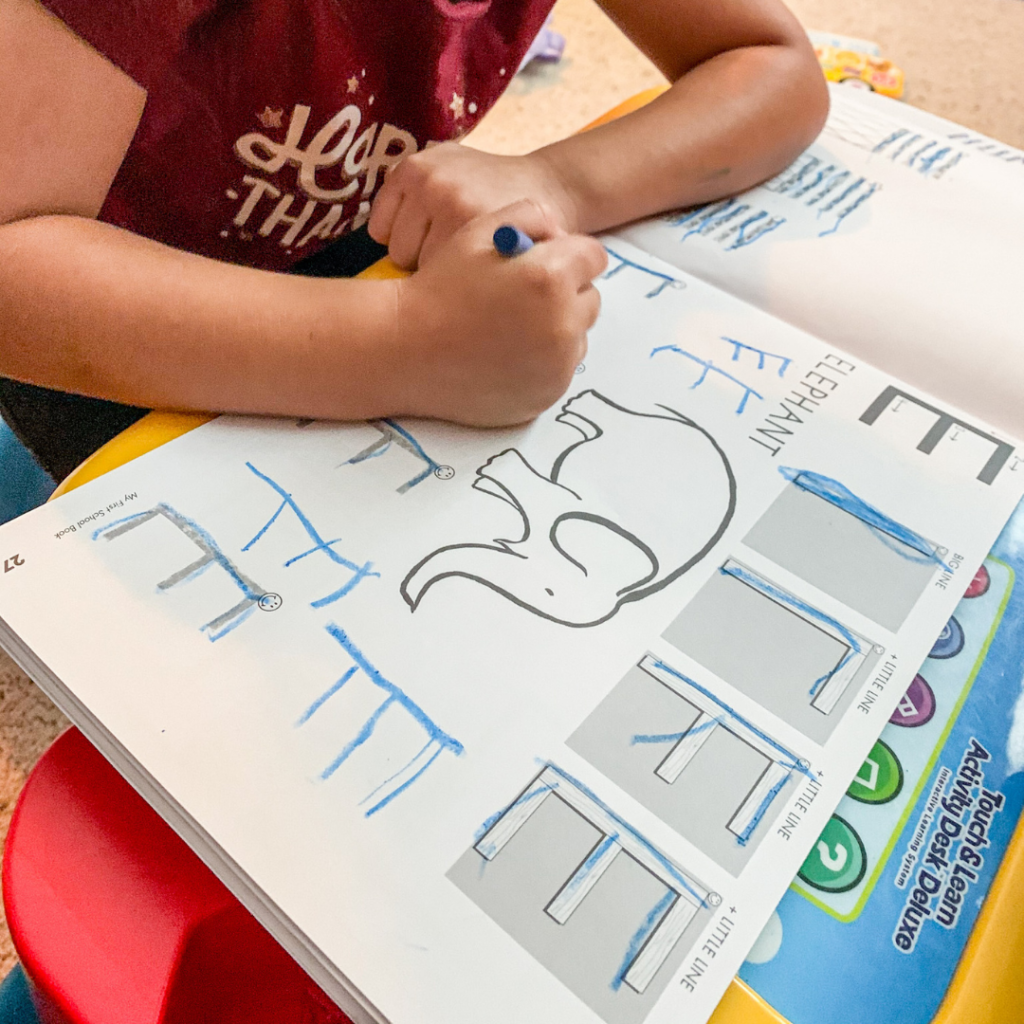
We started with Learning Without Tears for writing.
I felt like this was a great choice for us because it starts off very easy with the first book. The workbook is called My First School Book.
There are no lines or boxes to stay in. It’s simple tracing of a shaded letter. The book begins with color review and then introduces one letter at a time. The letters are not introduced in ABC order. The book also introduces writing numbers. I did not purchase any teachers guide or any of the extra supplies, and we completed one page per day.
Since the lessons were so short, this was the perfect way to start challenging my daughter to complete something in a workbook. It took very little time and she felt successful and confident.
I wish I would’ve bought the set that comes with My First School Book plus My First Lowercase Book.
It’s only a couple dollars more, and you can not buy that specific lowercase book separately. So, when we finished My First School Book we had to move on to the workbook called Kick Start Kindergarten.
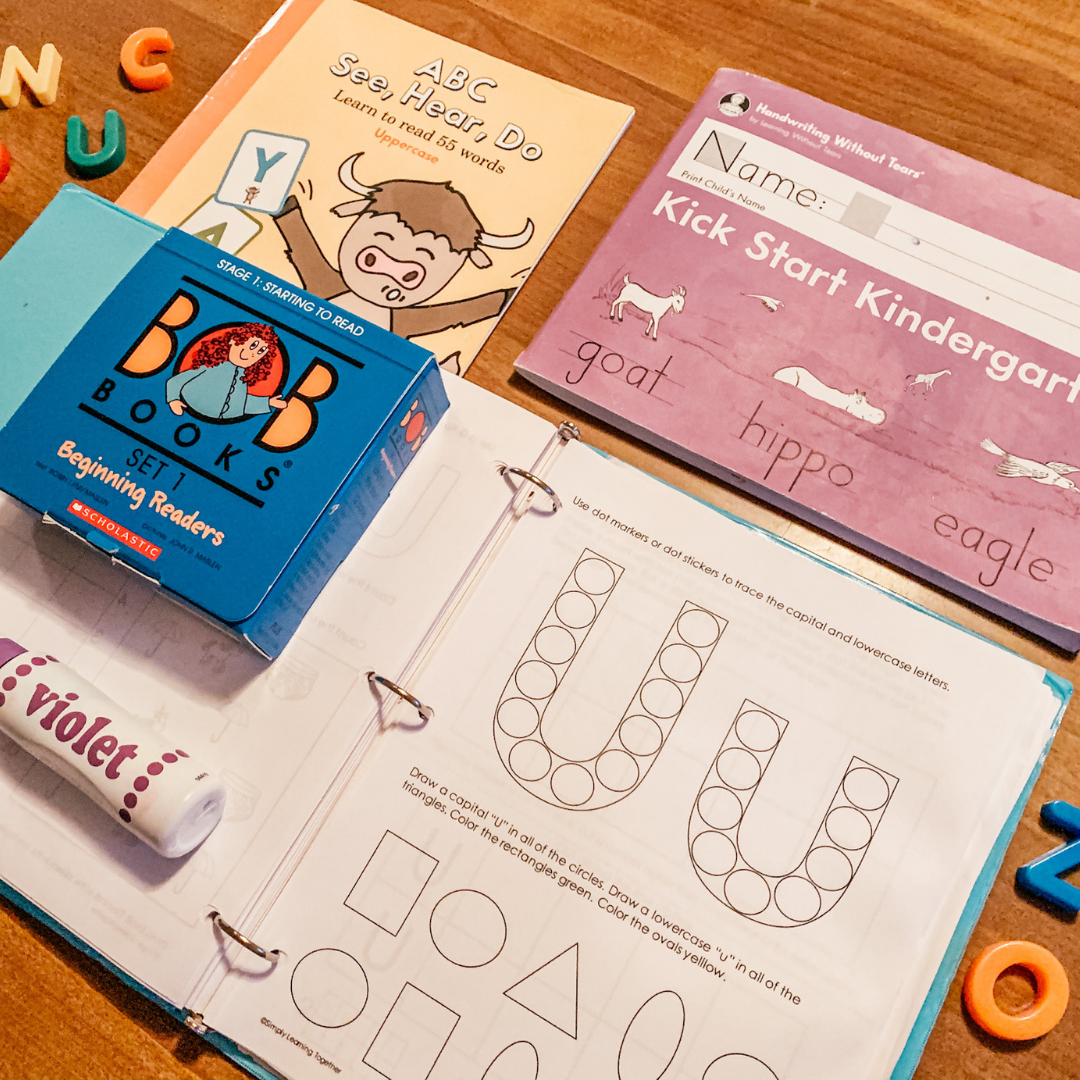
The Kick Start Kindergartenworkbook begins with capital letters. This time the letters must be written inside of a shaded box. This made me nervous at first, because I thought it would be frustrating for my daughter. However, once we practiced a few times, she understood.
Once the capital letters are reviewed, the book moves into writing lowercase letters. These are learned on the two lines that the Learning Without Tears program is known for.
I enjoy that the lessons are short and so does my active daughter. I also like how the lessons in the workbook include pictures and words that start with the letter practiced. This allows me to introduce and practice letter sounds as we learn to write them.
I haven’t decided if I’ll continue with Learning Without Tears for Kindergarten next year. I love their program starting out, but I am definitely a fan of the old fashioned three lines. I’ll always do what’s best for my daughter, so I’ll need to test that style out with her first. I’m also not a fan of the Learning Without Tears cursive style, which I know is a few years from now, but I still like to think ahead as we start the handwriting process.
I purchased one other workbook from Singapore Math for our preschool year.
The book is actually called Essential Math Kindergarten and there are two books in the set. I was able to purchase Book A on its own from our local homeschool store. I’m glad I only bought the first one, because we did not make it very far into this book before stopping.
Although the book states “kindergarten”, it’s actually perfect for Pre-K4. It starts off very simple and moves slowly. I bought it because it came highly recommended by an experienced homeschool mom. She had used it for multiple children at age 4 and loved it. We did not feel the same in our house.
To be frank, the book is boring.
There is no color on the page. My daughter never wanted to sit and color the pictures. Some days it took us 4 seconds to complete a page, and I felt like saying…”That’s it?”
At the bottom of each workbook page, there are activities that you can do with your child to help practice the concept, but we never really looked at that.
I just felt like the book was a waste of time. The focus was on early math skills: shapes, counting, patterns…We can experience so much more learning with a bucket of play dough or a puzzle and have a lot more fun! We made it about half way through Book A and stopped. At this point, I knew I wanted a new plan for practicing math skills consistently.
My goal for the preschool year was to teach the alphabet and the letter sounds.
I’ll be honest, after a couple months into the year, it was not going well. The handwriting pages gave us some review, but I was having a hard time being consistent. My daughter needed repetition and I wasn’t finding it anywhere. Scratch that – I always got lost in the internet world trying to find the perfect solution.
At this point in our year, I knew what I needed: daily, consistent alphabet practice + preschool early math skills.
Enter the Alphabet Workbook…
This is the curriculum that changed our school days. The Alphabet Workbook allowed us to practice the math skills we needed (shapes, numbers, counting, etc…) while also learning the letters each day of the week.
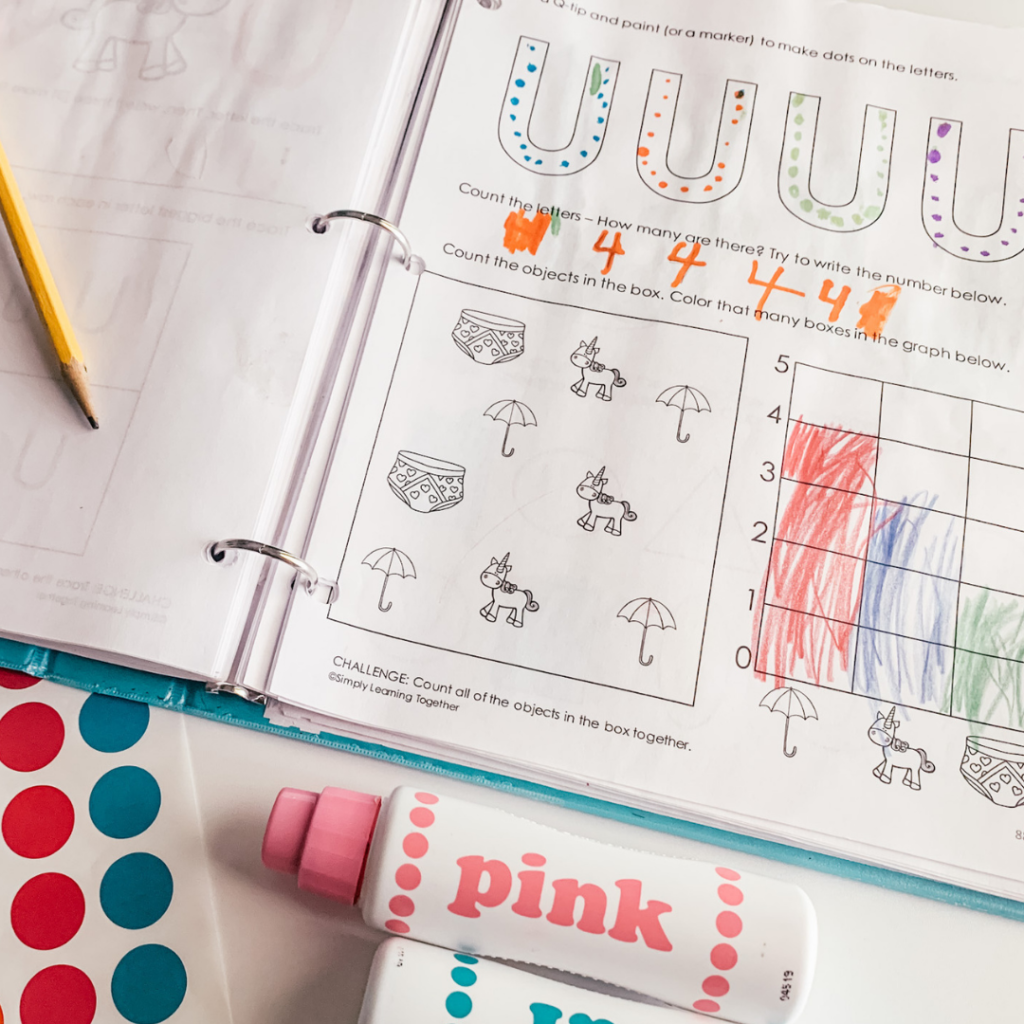
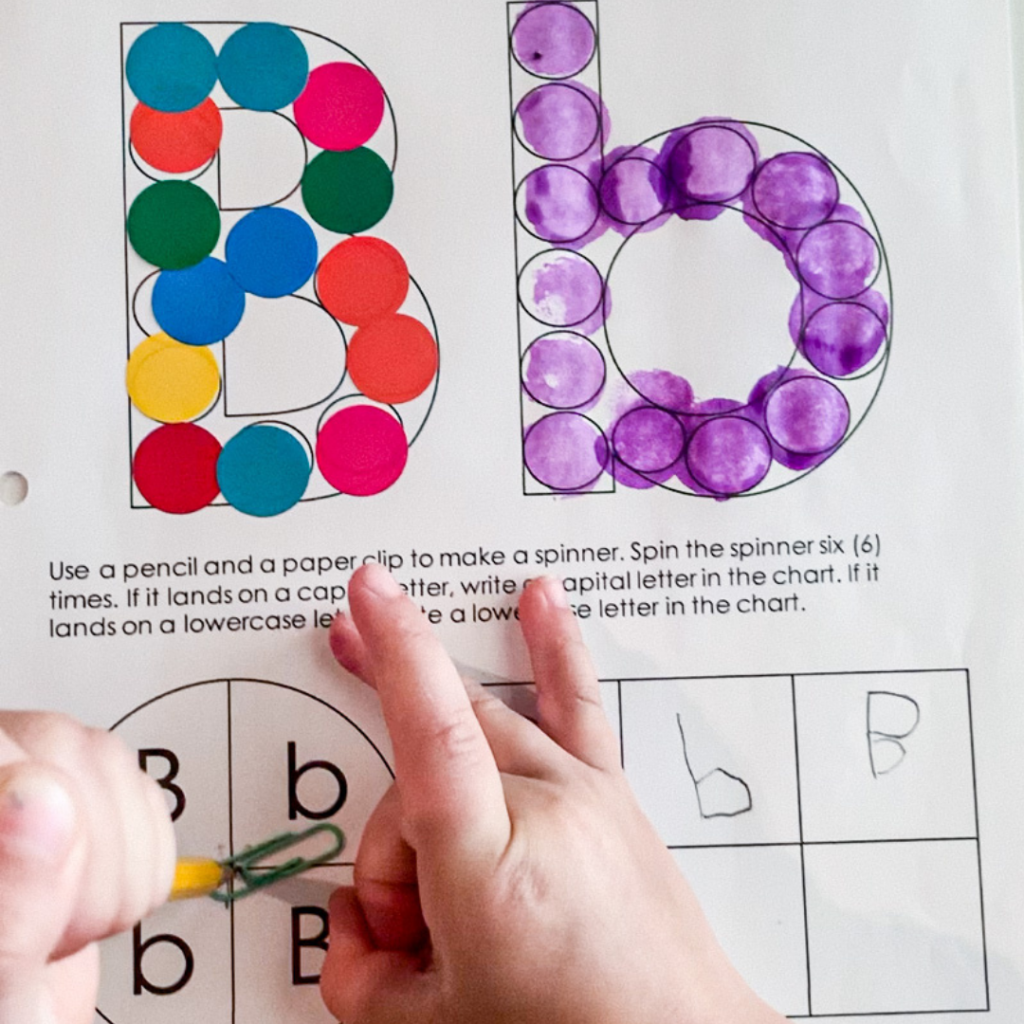
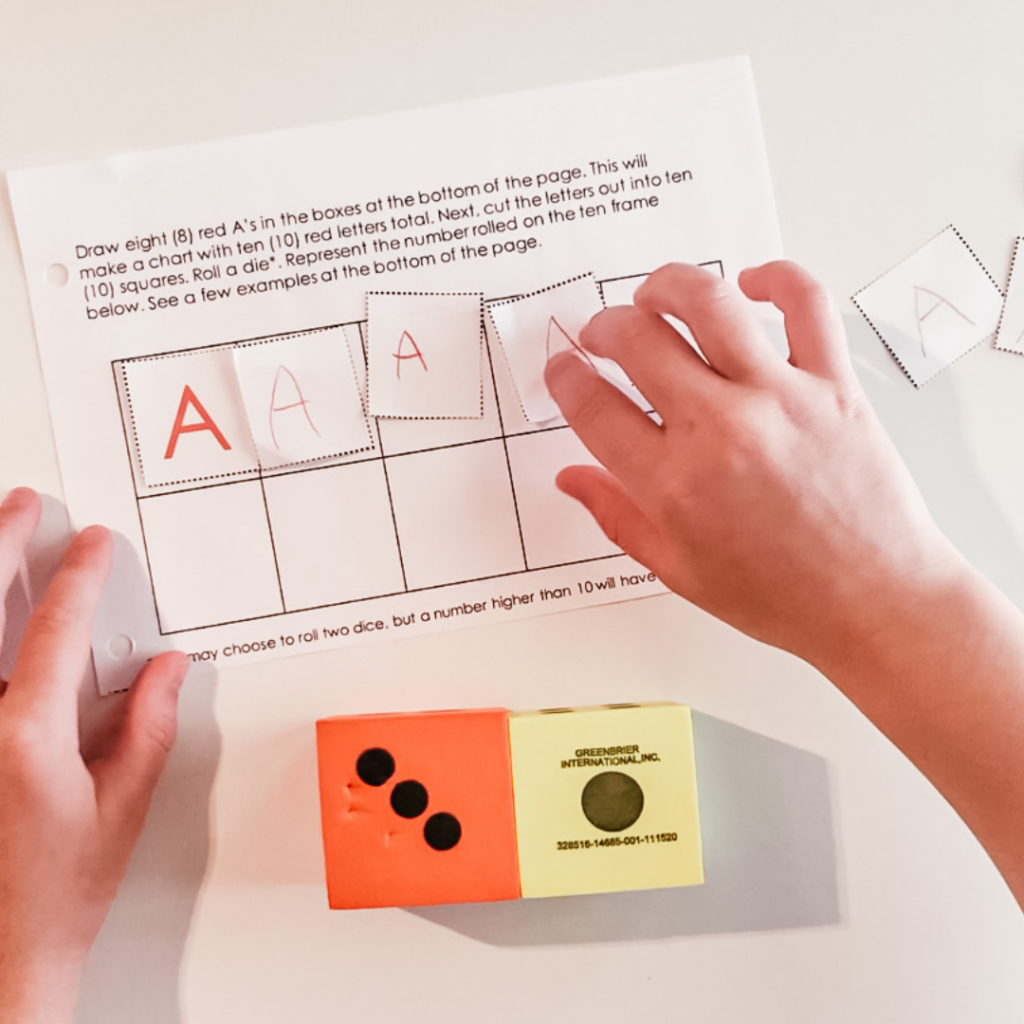
It’s set up to be engaging, fun, and consistent. It’s the perfect resource for learning a letter per week. Every letter has four completely different pages of activities to practice recognizing, tracing, and writing. Coloring, dice games, graphing, cutting, ten frames, dot markers…this is just a glimpse into the variety!
The activities are fun for my daughter and flexible for her learning style.
It can all be completed at my daughter’s pace. If she seems really focused and eager to work, I can encourage her to complete the “challenge” listed at the bottom of many of the pages.
If she’s having a rough day and not willing to focus as much, we can take it slow and complete as much as we can on the page.
When we started using the Alphabet Workbook, my daughter was finally able to recognize and remember her letters.
When our year started, she only knew the letters of her name (most days). Once we had more consistency by using the Alphabet Workbook, my daughter was finally remembering her letters! It was such a relief! She was even recalling the letter sounds thanks to the pictures and words included in the workbook.
We are almost finished with the workbook at the time I write this. Now that it is in our routine, she is even starting to do many pages independently. She recognizes the patterns of the pages and completes some on her own. It’s been amazing and such a joy to watch her grow and mature like this during the year.
The confidence I gained from her success and the consistency of the workbook gave me so much peace in planning our homeschool.
Many people tell you that when you homeschool preschool all you need is PLAY. Ok…I support this thought. Play is so important for young children and we do a lot of it at our house, but hear me out…
As the mother (and teacher!) of my children, I do tend to question if I am doing enough. Maybe you’ve experienced those same feelings.
This is why I love the Alphabet Workbook so much. It is not rigorous. It is fun! It’s engaging and playful and colorful and easy to complete. It helps my brain and my sanity to know that she has completed something. I do a lot less questioning of myself knowing she has done this one small task.
Now that she knows her alphabet and sounds, she has shown an interest in reading!
We purchased ABC, See, Hear, Do and it’s absolutely wonderful! The book is set up to learn the sound of a letter along with a physical action. It’s colorful, adorable, and easy to follow!. The day we got it, she read her first word within minutes. I was shocked! Completing the book means reading 55 words – such a fun accomplishment for a little one!
Once she starting blending sounds together, I knew she was ready to start reading a little more. Honestly, I don’t think I was ready…. (ha!) So, we are going the slow route. I purchased the first set of the Bob Books to start reading with her. We do this VERY slowly. I help her get through a book and we read it over and over throughout the week. She is gaining confidence but also practicing reading skills.
I am not expecting her to learn to read this year, but she shows a ton of interest and is ready to start so we are having fun with it. I try to have her read with me a few times a week. Since she is still so young I do not push it. If she starts to complain, I simply say, “Let’s try this again a different day!”
Everything else that we complete in our school day involves all of my children.
I’ll explain these briefly if you are interested, but I won’t go into too much detail as I only expect my preschooler to really “tag along” for these things.
We are in a Classical Conversations Community.
We attend Community Day once a week for half a day. Each day of the week we spend about 20-30 minutes practicing memory work that covers Math, Science, History, Latin, English, Geography, and the Timeline. We do a lot of singing for this. At age 4, it’s laid back and fun.
You can read more about how we add it to our day HERE. If you are considering joining Classical Conversations and have some questions, check out THIS post.
We love reading novels together and enjoyed completing The Read Aloud Experience this year.
Sitting together with my children and reading a good book is my favorite thing to do. I love it even more when we can do simple activities that relate to that book, even if it’s a small discussion, simple craft, or a recipe to follow!
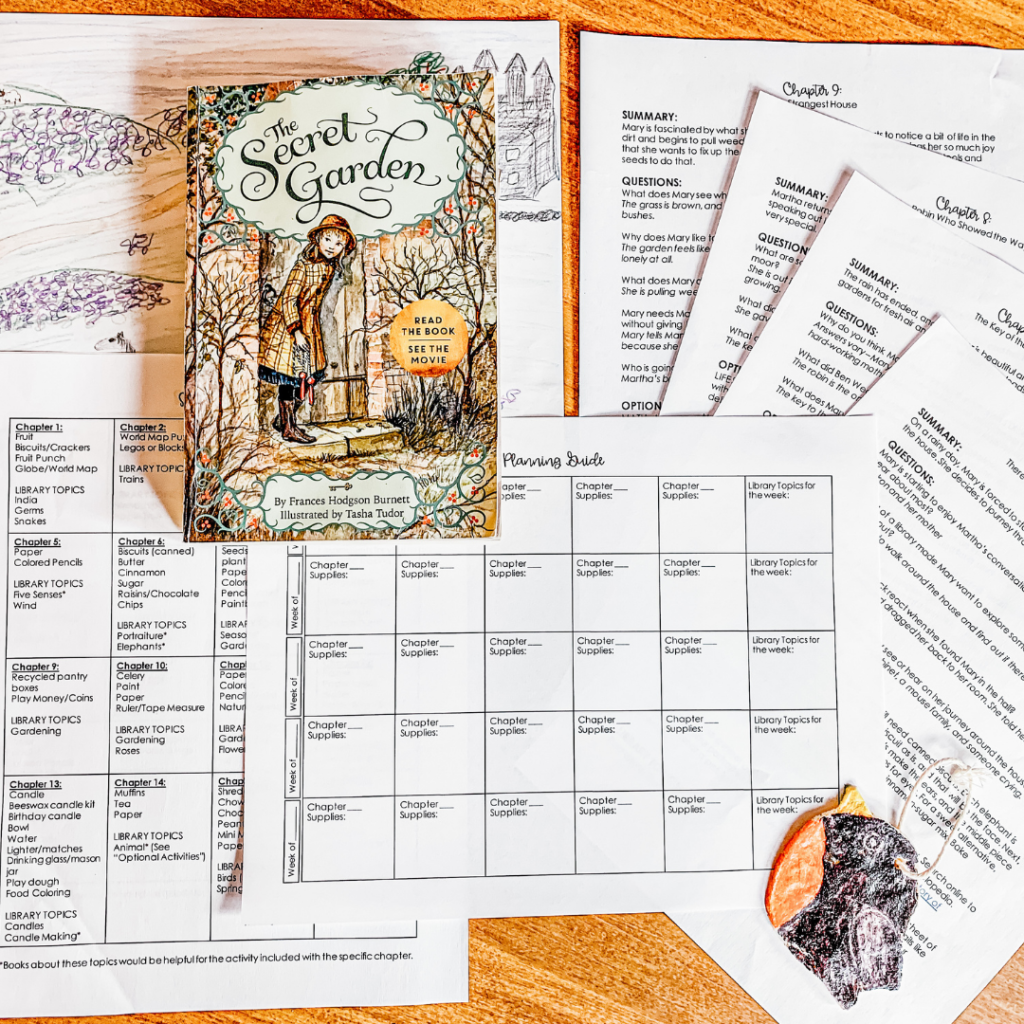
The Read Aloud Experience is a fully planned, FREE novel unit that provides all of the activities that go along with the story. We had so much fun doing these units and it gave us something to look forward to each day! We read The Secret Garden and Mrs. Piggle Wiggle.
The Secret Garden is absolutely wonderful if you have older children as well. Mrs. Piggle Wiggle is hysterical and fun for all ages! Check out the FREE Read Aloud Experience for each book: The Secret Garden and Mrs. Piggle Wiggle.
Our family devotional allowed us to add a little extra science into our day.
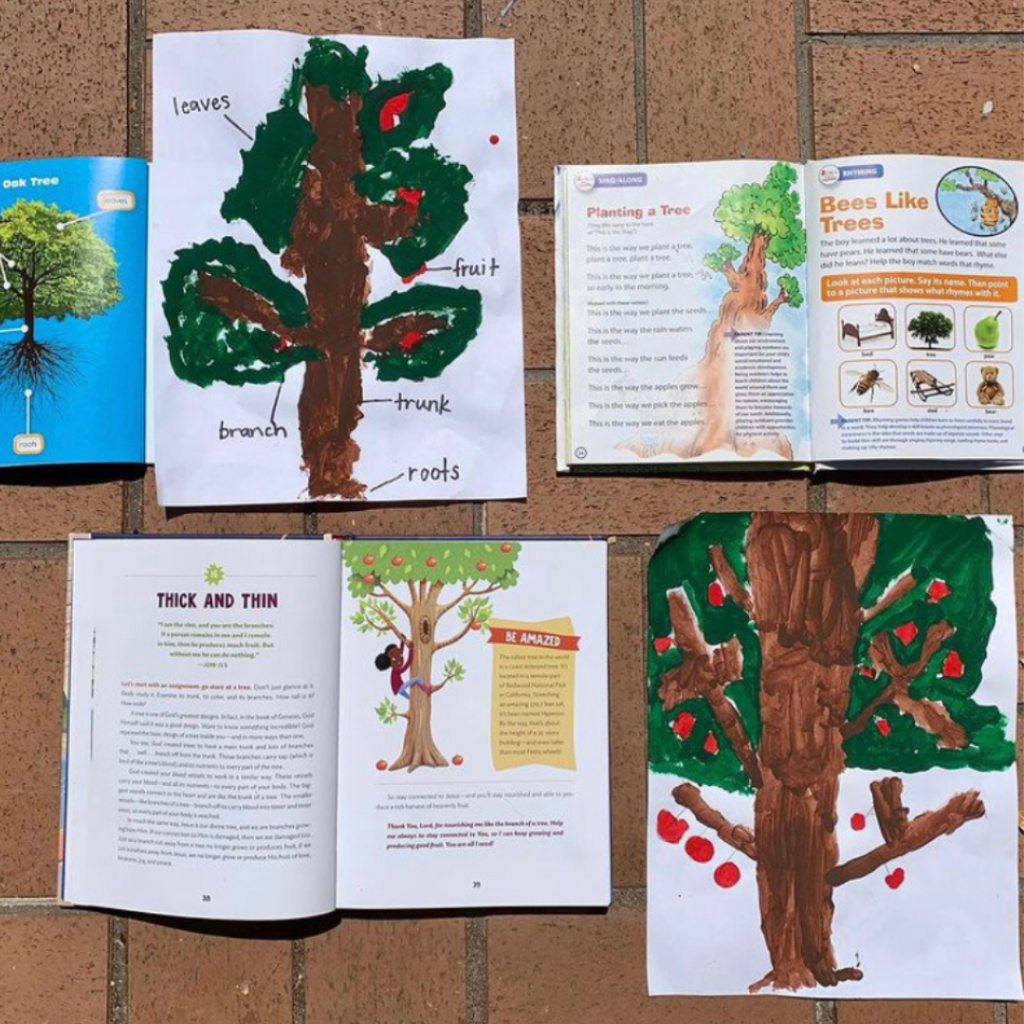
I chose “Indescribable: 100 Devotions About God and Science” for our daily devotion. At the beginning of the year (before I had a baby and before Classical Conversations began) I used our library to gather books related to the science topic in the devotional. It was so fun and such an easy way to add science lessons in at this age.
This devotional is great! It is easy to read and interesting to both my children and me. Every devotion has a scripture verse, a biblical lesson, and a science lesson that relates. With a little planning ahead and a library card, I was easily able to add science into our week.
Some of the other devotionals we completed and enjoyed were seasonal. These included Truth in the Tinsel at Christmas and Resurrection Eggs for Easter.
The last thing I want to share is the digital resources that have been the most helpful for us this year.
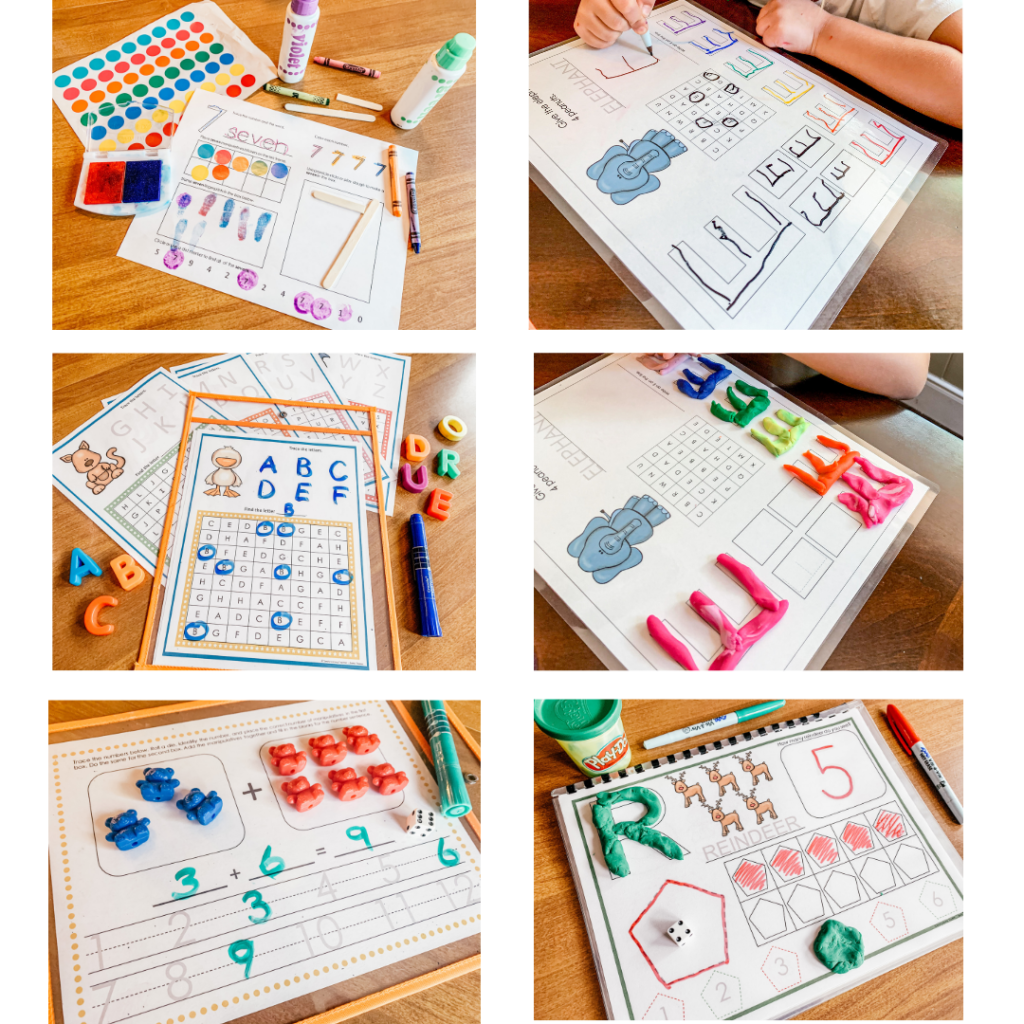
These were specifically created for my four year old to help us practice what we are learning. You can see all of these preschool resources in my shop. Be sure to go ahead download the free ones: Early Addition Math Mat and Capital Letters: Trace and Find.
Our favorite resource that we use every week alongside the Alphabet Workbook is the Alphabet Play Dough Mats. It’s so much more than just making a letter out of play dough. These mats allow my daughter to write, trace, and find the letter in a group. Now, there’s even a set of Lowercase Play Dough Mats that we plan to use for Kindergarten!
Many of the things we complete in our homeschool day involve our whole family.
I love that so much about homeschool. We read together, play together, and learn together. Our big success this year was learning our letters and their sounds. We are excited to take these skills into our Kindergarten year! I can’t believe how fast the time is going with these little ones – cherish every moment!
Have you used any of the curricula mentioned above? Tell me about it in the comments. Or, share something you love for preschool!
When it came time for me to teach the alphabet to my second child, I ran into a few obstacles. I was new to the alphabet game, and I was working with a completely different personality. I really enjoyed trying new things to help her succeed, and I was also learning in the process!
We’ve had our ups and downs as we learn the alphabet together, but I definitely have my list of favorite tools that have worked for us. I hope by sharing them, it may give you some ideas to try at home. After a lot of trial and error, I was even able to create an alphabet curriculum that has worked wonders. I will share that in this post, as well.
I listed these tools in time order. We started at age three with a more playful approach (#1-6). I knew at that time she wasn’t ready for something intense. We gradually added a few different tools at age four that really helped her to succeed.
This post contains affiliate links. If you follow one of my links I earn a small commission at no extra cost to you. Thank you for supporting my blog!
1. Alphabet Spiral Notebook
When Joanna was three, I was pretty laid back for a couple of reasons. One, I didn’t think it was necessary to get super serious at three. Two, she didn’t sit very long! I didn’t want to push it, so we tried something I called the Alphabet Notebook.
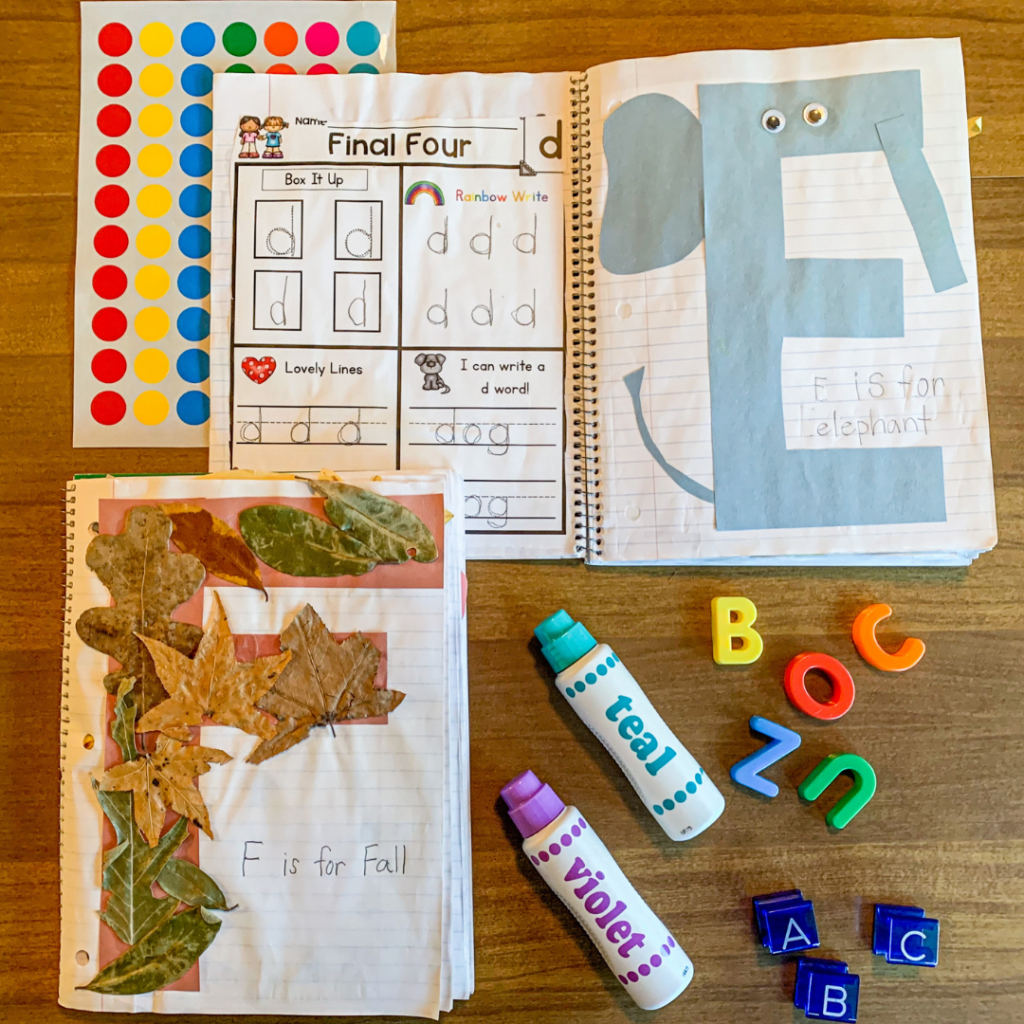
Each week, we went through a letter of the alphabet. The first day, we crafted the letter out of construction paper into a cute animal or object. Next, we glued it into a spiral notebook. The following days of the week, we would use the next page or two in the notebook for writing practice. Sometimes I would glue different letter worksheets in there as well.
The one pictured is handwriting practice pages from Super God Not Super Mom on Teachers Pay Teachers. We didn’t use it all year, but it was a cute resource, and it’s great for early handwriting skills. (It’s a lot more expensive than I remember…I’m wondering if the cost went up.)
This was great for us. We really had the freedom to do whatever we wanted with it. It was low-key, easy to plan, and it’s so cute I can’t get rid of it!
My oldest actually did it with us for Kindergarten, and she really enjoyed it as well! If you follow me on Instagram, I have a whole Alphabet highlight where I show all of these pages. @simply.learning.together.
I hope to one day put together a blog post of my favorite, EASY alphabet crafts. We found almost all of them on Pinterest!
2. Sensory Learning
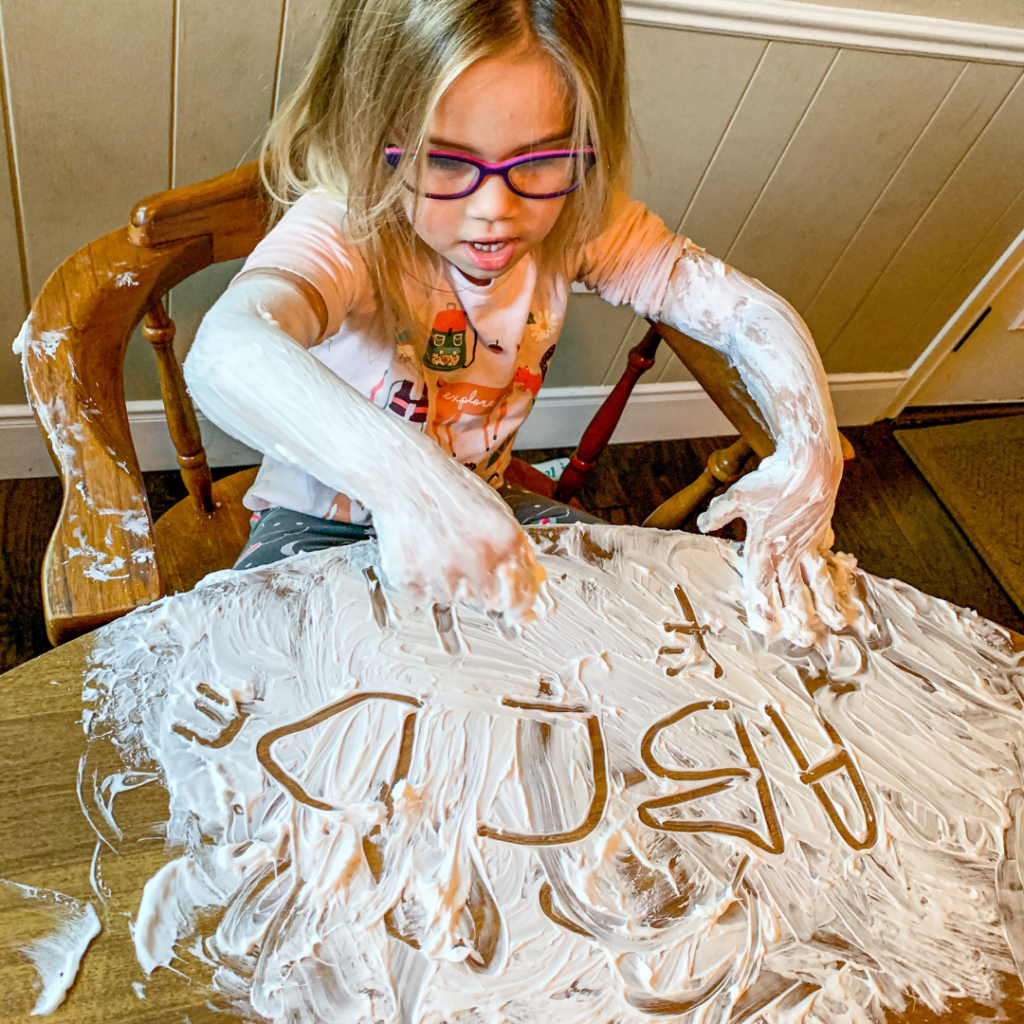
Sensory learning is great as it is, but my Joanna loves it! She wants to touch everything. So, I made sure to add in some sensory play with letters. Play-doh was a huge hit and a tool we used often (I’ll get to that more below). We also love shaving cream. She has so much fun with it. I always let her play in it for a bit and then we practice writing her name and letters.
I did try a salt/sugar tray once for her to make letters, but I spent most of the time trying to get her not to eat it!
Real Life Moment – Try to ignore the actual garbage on the floor in Evelyn’s picture. (ha!)
3. Cardboard Letters
This one sounds odd, but it was a huge success for learning her name. At the beginning of the year, I cut out BIG cardboard letters for the letters of her name. We spent a couple days painting them and decorating them. Then, I would just play games with the letters.
We would lay them out on the floor and trace them with our finger. We practiced calling out the letter as if they were a flash card. Our favorite was a scavenger hunt where I’d hide the letters and she’d find them and spell out her whole name. These were so fun!
This could definitely be a great tool to teach the alphabet at home, as well. I’d suggest cutting as you learn them so you’re not having to cut 26 cardboard letters at once. Don’t forget to make them fun and decorate! You could display them in a play room/homeschool space…they’re really so cute! And the best part – FREE. She loved these and they’re so easy to pull out and play with.
4. Books
Books are always helpful, but I will say that some books don’t work the same for each of my children. My oldest’s favorite was “The Sleepy Little Alphabet”. She was recognizing the letters at a very young age in this book. It has a catchy rhyme to it and a cute story.
We purchased “A is for Apple” this year, and I loved how it encourages the child to touch the letter and trace. I knew that would be so helpful for Joanna.
There are so many alphabet books out there, but my all time favorites are the “A to Z Animal Antics”. There’s one book for every letter. We found most of them at our library, but I know you can find them online as well. The books go beyond just learning a letter. It tells a story using tons of words that start with that letter, so the sound is repeated over and over. At the end of the book there’s even enrichment activities to take learning even further. These books are fun, well written, and helpful when it comes to learning about the alphabet.
5. Magnetic Letters
I love having magnetic letters to teach the alphabet. We’ve practiced finding our name or finding a specific letter. Now that we are working on lowercase, we can match the capital to the lowercase. You really can do so much with these. The set that I’ve linked is just like the one we have, but it must be updated. This version actually comes with an e-book series that has 40 different activities you can do with your child!
I know it’s so fun for my girls to be able to pick up the letters, touch them, and move them around. Their favorite game is to put random letters in a line and ask me to “read” it. The words make absolutely no sense, but they sure do giggle – and I’d say we are getting good practice with letter sounds!
6. Play-Dough Mats
This falls in the sensory category, but we had our own special journey with play-dough that I wanted to share. I love using play dough to learn. It was especially helpful for Joanna because she loves sensory play. I knew play-dough mats existed, but I didn’t really want to pay the price. I also felt like everything I saw was just the letter on a piece of paper, maybe with a cute picture.
I didn’t think it was necessary to have to pay for that, so when she was three I would just write a big bubble letter on a piece of paper and slip it into a sheet protector. That was our play-dough mat, and it was perfect! No printing, no cutting…easy. If you are just starting out learning letters, I highly suggest this easy, free method!
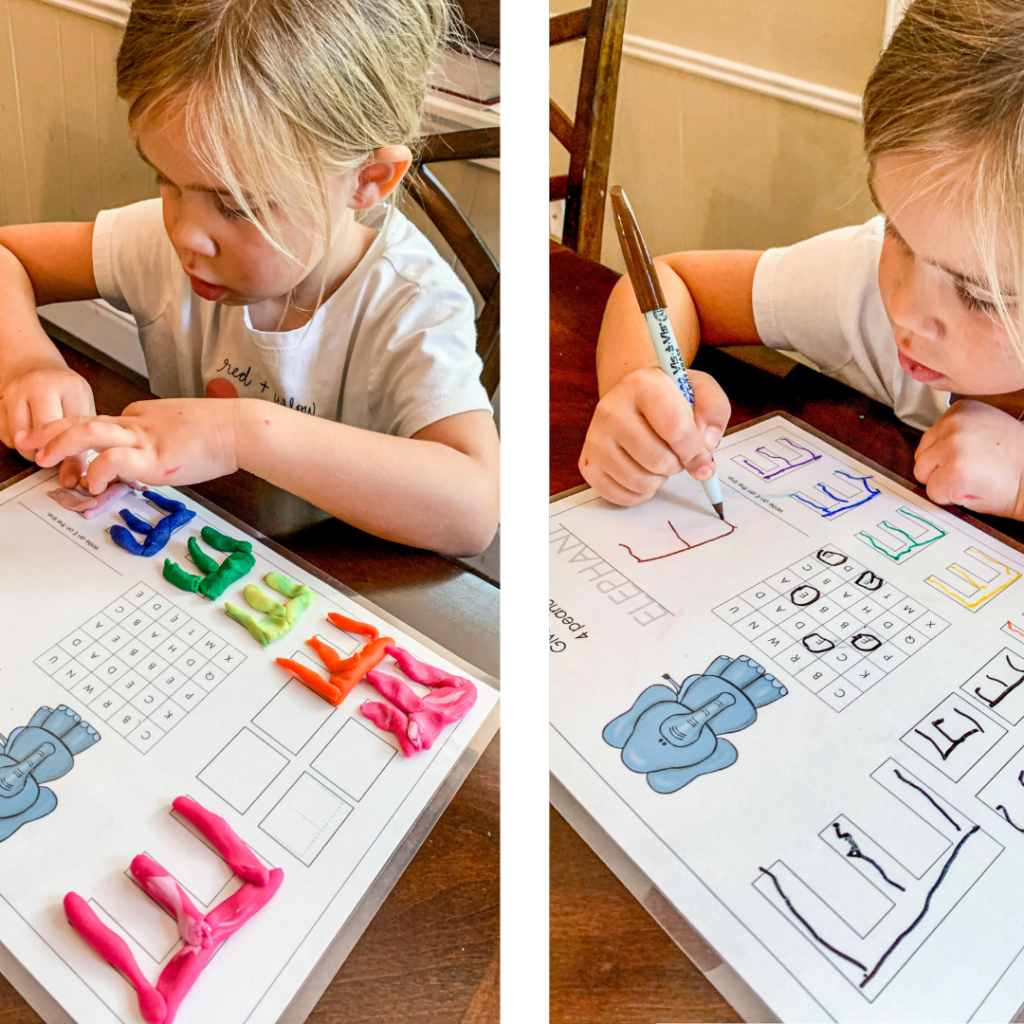
When Joanna turned four, I needed more of a challenge. I started hunting around to find play-dough mats but was unhappy with the result. To me, they weren’t worth the money. Most of them had the letter and maybe a tracing prompt or two. I wanted more practice for her. I wanted something that I could take out and work with her one on one each week. Building one letter on a mat didn’t help me very much. So, I created my very first resource – Write and Play Alphabet Mats.
Joanna LOVED them. She could make the letters, trace them, write them, color them, find them…it was so much exposure to one letter in multiple ways. The best part, they’re designed so that your child can choose to write or play! We switch it up all the time. Sometimes she does a mix of both.
These mats were just what we needed to add a little fun, and it really helped me see where some gaps were. Suddenly, I started realizing she could recognize the letter easily, but she still struggled to write them…so I worked on that more. By having multiple skills on one page, I could easily assess her progress.
The mats are all set up the same, so eventually she was able to complete them independently. We still use these today, and they have been incredibly helpful for my daughter!
After a few weeks of using the alphabet play dough mats, I started noticing that repetition was really helpful, but we obviously couldn’t do the same play dough mat every day!
This led me to create the Alphabet Workbook. I wanted consistent, repetitive letter practice. We were working on a specific letter every week, and I wanted her to have practice with that letter each day. The thing is… I didn’t want to have to go and search for multiple worksheets each week. Plus, most of them looked the same! I wanted variety.
The Alphabet Workbook is set up to do just that. There are four practice pages for every letter. Each page has different activities. There’s dot sticker/dot marker activities, dice games, ten frame practice, an optional painting activity, and color by number. That’s just a few of them listed. The focus is around one letter while so many other preschool skills are being practiced: shapes, counting, numbers, patterns, graphing, and more!
I have seen tremendous improvement with my daughter after using this Alphabet Workbook. She is finally starting to recognize her letters. She is learning the letter sounds. She can write almost the entire alphabet now. Most importantly, she is enjoying it all in the process! She has fun learning and doesn’t complain about completing a page in this book.
8. Puzzles
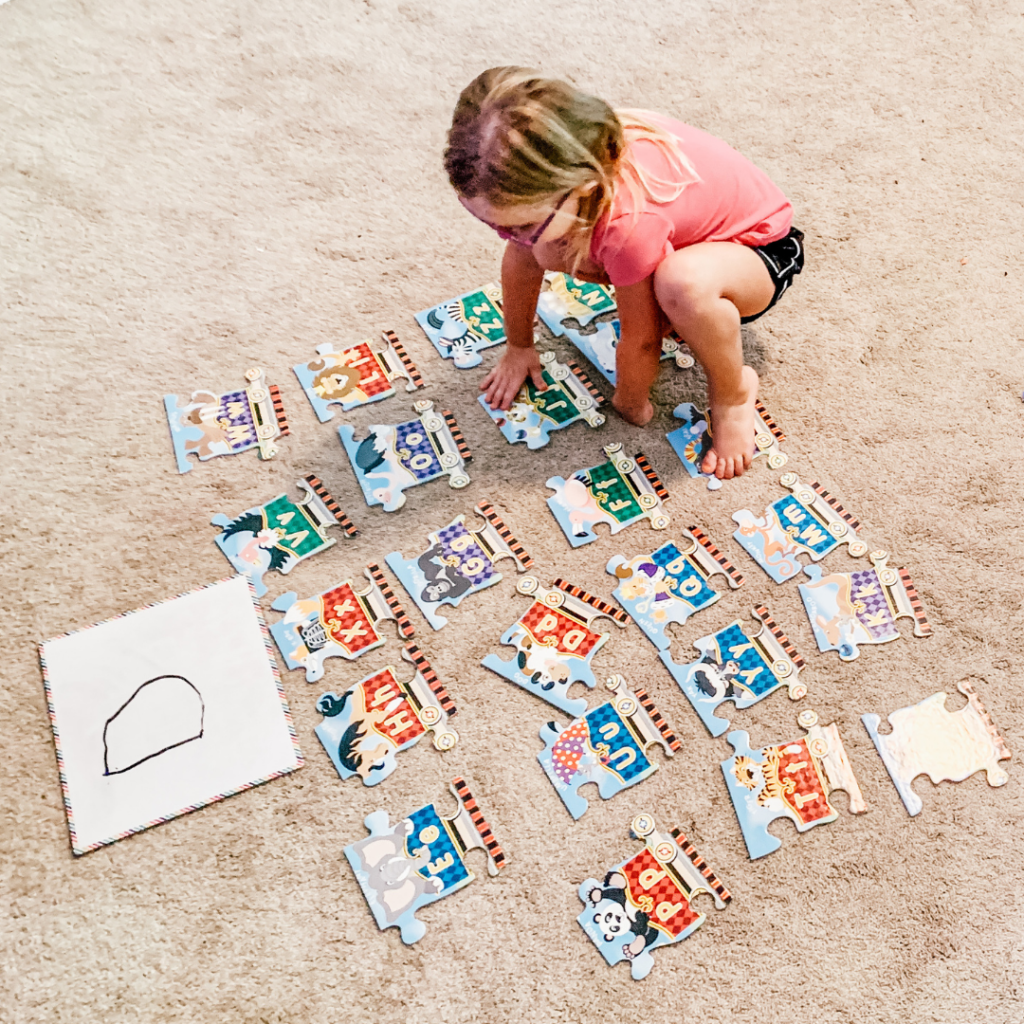
I love educational puzzles. It’s kind of like good books to me. I could buy so many, because I think they’re incredibly useful and so helpful! We have a couple of giant alphabet puzzles – the ones that are about 10 feet long (Click here to see one we have). These are great to practice with and I’ll explain how we’ve done it in the past.
You may have to adjust this depending on your child, but it should give you a good starting point of how to play. I organize about 10-15 letters and line them up nice so they are easy to read. I don’t want them upside down, and I don’t want it to be overwhelming by looking at the whole set of pieces.
Next, I ask her to find the letter, and I give hints as needed. (It’s on this side…it’s at the top) Once she chooses the correct letter, we practice writing it on a mini dry erase board. I make her dotted lines to trace if she needs it.
Then we add the piece to it’s correct place in the puzzle and move to the next letter doing the same thing.
Remember, go at the pace of your child. My oldest would’ve loved to play this game multiple times in a row. The first time I played with my second daughter, she made it through about half the letters, and then I could tell we needed to wrap it up. So, I cut out the writing portion, gave her a few more hints, and we finished. The more we played, the more I could challenge her to go a little bit further. Every child is different.
9. ABC, See Hear Do
I can not say enough good things about these books. We have the “Learn to Read 55 Words” book, and all of my children love it. My oldest already knows how to read and she even thinks it’s fun. My 2 year old can actually turn the pages and “read” the sounds. When my 4 year old opened the book for the first time, I helped her read through the first few sounds. That same sitting, she read her very first word – instantly! The book is incredible. Worth. Every. Penny!
Now, I use it as a supplement as we practice letter sounds. The book actually encourages you to introduce it before you learn letters, but we were past that by the time I found it. As we practice letters, I pull it out to practice the sounds and motions. The movements stick and really help my preschooler to remember the letter sounds!
There is a whole set of books that advance as you work through, including blended beginning sounds, blended ending sounds, sight words, long vowels, and more! We do not own them all yet, but I know many will become part of our collection soon once we master all of the letter sounds. You can learn even more about their program and products by visiting their website.
10. Screens – Movies/Apps
I don’t really like to have the TV on much, but I’ll be completely honest, having it on at certain times during the school day helps me get certain things accomplished easier. While I make lunch or while I work with my oldest, I will try to pick something educational or related to a topic we are studying.
There are some great alphabet shows that we’ve watched and probably more for us to discover. So far we have loved Leap Frog Letter Factory and Alphablocks (on Netflix) as well as Super Why (Free on PBS). Catchy songs and fun characters make learning letters fun and easy to remember.
Leap Frog Letter Factory focuses on the letter and its sound. Alphablocks is all lowercase and the shows are very short (10-15 minutes). Super Why covers letters, sounds, spelling, and early reading skills.
I also downloaded a free alphabet app on my phone. It’s called ABC Alphabet Phonics. The point of the game is to select the letter that is said out loud. It’s very basic and it costs nothing. It was playing this game that I realized my preschooler could identify a letter when it was said out loud, but struggled to call out the name of the letter when asked. So, although it’s not the fanciest game on the planet, it really helped me to easily assess her knowledge of letters. Make sure to play with the settings a bit. You can change it to lowercase, sounds, and add helpful pictures.
Every Child Will Learn At A Unique Pace
As I mentioned before, my first two children learn very differently, and I’m sure when my younger two are ready, I’ll have new ways that work better for them. I don’t believe there is ONE right way to teach the alphabet. What works for me, may not work as well for you. However, I do believe it’s important to try new things to discover that special tool that helps your child grow.
So, what are your favorite tools to teach the alphabet? Have you seen success using something that’s not listed above? I’d love for you to comment and share with me what has worked in your home. I’ll be saving ideas for my next two littles as they get older!
Cookie Consent
We use cookies to improve your experience on our site. By using our site, you consent to cookies.
Cookie Preferences
Manage your cookie preferences below:
Essential cookies enable basic functions and are necessary for the proper function of the website.
Name
Description
Duration
Cookie Preferences
This cookie is used to store the user's cookie consent preferences.
30 days
These cookies are needed for adding comments on this website.
Name
Description
Duration
comment_author
Used to track the user across multiple sessions.
Session
comment_author_email
Used to track the user across multiple sessions.
Session
comment_author_url
Used to track the user across multiple sessions.
Session
WooCommerce is a customizable eCommerce platform for building online stores using WordPress.
Name
Description
Duration
wp_woocommerce_session_
Contains a unique code for each customer so that it knows where to find the cart data in the database for each customer.
2 days
woocommerce_recently_viewed
Powers the Recent Viewed Products widget
session
store_notice
Allows customers to dismiss the Store Notice.
session
woocommerce_snooze_suggestions__
Allows dashboard users to dismiss Marketplace suggestions, if enabled.
2 days
woocommerce_dismissed_suggestions__
Count of suggestion dismissals, if enabled.
1 month
woocommerce_cart_hash
Helps WooCommerce determine when cart contents/data changes.
session
woocommerce_items_in_cart
Helps WooCommerce determine when cart contents/data changes.
session
WPForms is a user-friendly WordPress plugin for creating custom forms with drag-and-drop functionality.
Name
Description
Duration
wpfuuid
Used to track user interactions with forms.
11 years
Statistics cookies collect information anonymously. This information helps us understand how visitors use our website.
SourceBuster is used by WooCommerce for order attribution based on user source.
Name
Description
Duration
sbjs_session
The number of page views in this session and the current page path
30 minutes
sbjs_udata
Information about the visitor’s user agent, such as IP, the browser, and the device type
session
sbjs_first
Traffic origin information for the visitor’s first visit to your store (only applicable if the visitor returns before the session expires)
session
sbjs_current
Traffic origin information for the visitor’s current visit to your store
session
sbjs_first_add
Timestamp, referring URL, and entry page for your visitor’s first visit to your store (only applicable if the visitor returns before the session expires)
session
sbjs_current_add
Timestamp, referring URL, and entry page for your visitor’s current visit to your store
session
sbjs_migrations
Technical data to help with migrations between different versions of the tracking feature