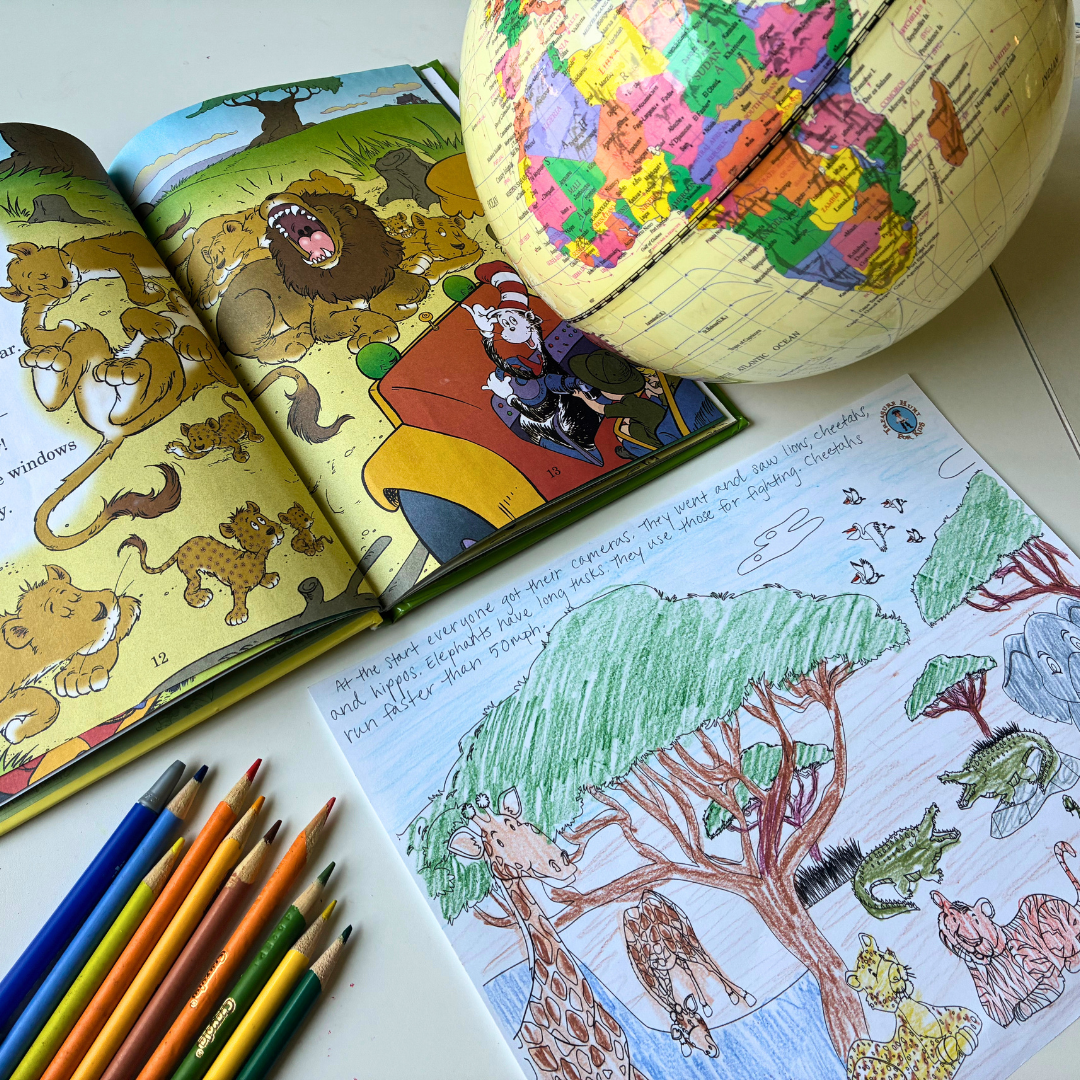
I love to teach science with picture books in our homeschool. The thing about picture books is they’re great for every age. From toddler, to teenager, to me – the adult! We can learn so much through one book.
Over the last couple of years I find myself moving further and further away from textbooks and workbooks in multiple subjects and focusing more on literature-based learning. It has been such an engaging and memorable way to learn.
There’s something about a science textbook where every time I open up to start the lesson, I dread reading it out loud. It’s like I already know it will be hard to keep their attention the whole time. This year I bought a science text for my older girls that they were taking in our co-op and thought we could just use it as a family study since it was made for elementary ages…I couldn’t do it!
The thought of reading it to my youngest ones (ages 5 and 6) was overwhelming. I’ve been thinking a lot about my youngest two and how fun these elementary years can be – so much wonder and curiosity and play through learning. I want to take advantage of these years and enjoy what we are reading. This is what led me to create my newest literature-based curriculum – Science Through Picture Books.
In this blog post I’ll share a little more about what it is and how it works. I’ll let you know my plans as I work on piecing units together over the next couple years to create it for my own family. Picture books have brought so much joy to our homeschool, and I hope it can do the same for you.
This post contains affiliate links. If you follow one of my links I earn a small commission at no extra cost to you. Thank you for supporting my blog!

An Overview of Science Through Picture Books
Science Through Picture Books was created as a family study for your children ages kindergarten through fifth grade. It will be made up of multiple units, and each unit will contain a list of twelve books.
These twelve books can be read at any pace you like. Read one per week and finish the unit in twelve weeks OR two per week and finish the unit in six weeks. Read three per week and finish in four weeks…and so on!
You have the choice to read as many as you’d like throughout your week, making the unit fit into your family schedule as you desire.
Each book is paired with an optional video. These are short videos to enrich the lesson from the stories and can provide more visuals and discussion opportunities with your children.
As you read these books, I will guide you in introducing and discussing the stories with your children. (See example in photo above) For each book, I give you notes on reading it aloud, a script for introducing it to your kids, and optional discussion questions and narration prompts.
Science note booking is also an option. I will teach and encourage you to practice narration as you read this books. The unit will list multiple ways to keep record of your science notebooks in order to differentiate your note booking for different ages and skill levels.
Finally, I provide you with a list of enrichment activities that you have the option to add to your studies. The activities range in prep and difficulty containing super simple ideas or more complex projects that take a little more time.
What is a Lesson Like in Science Through Picture Books?
Picture this: Gather at the table, snuggle up on your couch, or lay out a blanket in the grass. Read a book and have your children narrate to you. It’s that simple. If you’re not familiar with narration, I’ll guide you through all of that in this guide.
Some of you may like to go a little further, and that’s encouraged if it brings you joy! You’ll see in the section above all of the additional videos and activities that are included in this unit. The point is, you can make this as simple or as complex as you’d like.
Unit Topics – Meeting the Standards
As a homeschooling mom, I try not to focus so much on the standards, but at the same time I know that some may feel peace of mind knowing they are following a certain standard as they teach their child. So, in this section, I hope to do my best to meet both sides in the middle.
As I researched science standards while developing this curriculum, I realized that they are not the same across the country. Common Core standards exist, focusing on literacy through science in grades K-5, which is great, because you’ll get plenty of that through these books!
Some states have their own unique science standards while others have adopted the Next Generation Science Standards, released in 2013. (NGSS)
My hope is to provide a variety of science units for families to choose from to help build a foundation of knowledge in the subject. These units will focus on three out of the four disciplinary core ideas listed in the NGSS: physical sciences, life sciences, and earth and space sciences.
These categories will guide me as I choose themes for the different units. The standards will not be stated in these units, because my intention is to make this a family study, which would be an extensive list covering multiple grade levels. However, if you’re curious about what these standards are, I encourage you to do your own research on their website which provides free, downloadable lists of the standards for each grade.
One thing you may notice is the majority of the standards can be met through these books and your discussion. Reading the standards can feel very “official” or possibly overwhelming, but remember that the goal of these elementary years is to build a foundation – the NGSS will tell you the same thing! We aren’t trying to reach a mastery of topics. We are encouraging curiosity and igniting their desire to learn even more!
Look-Through the Curriculum
Want to see inside one of these units? I know sometimes that can help get a better idea of what a specific curriculum is all about. Head to my YouTube channel to learn more about this and see inside the unit guide.
Future Units
These units will be published as I complete them with my own children. I have a goal to complete four this year. We may or may not get to more than that. Here’s what you can expect this year:
- Terrestrial (Land) Habitats – AVAILABLE NOW
- Aquatic Habitats – AVAILABLE NOW
- Weather – AVAILABLE NOW
- Plants
Each unit will follow the same pattern as I mentioned above in the overview.

Choosing Books
I work really hard to research and read tons of books for these units. I enjoy it very much as I get to know authors and illustrators while increasing my knowledge on different topics.
There are hundreds of books on these topics. However, my goal is not to provide you with tons and tons of books. I hope to give you a simplified, streamlined list in order to help you build a foundation of science knowledge with your kids.
A beautiful, informative picture book always engages my children and me. Some people might refer to these as living books. These are the books that draw your attention and make you eager to listen and learn. It never fails when I read a great picture book with my kids, we are wanting to read more! It’s like it can spark a certain curiosity to dig deeper.
That’s exactly what science should be in these elementary years. We want to spark our children’s curiosity to learn more about the world and increase their desire to explore and experiment and even question ideas. All of this will develop their knowledge of science topics as well as their critical thinking skills.
When it comes to collecting these books for your family, the library is such a great way to do that. With the list of books in hand, you can easily put books on hold as you prepare for the unit! It’s such an inexpensive way to learn science with your kids.
How to Use these Units
In my own home, I use these units as our whole science curriculum. I don’t find it necessary to add anything else. Even as I research standards, I am confident that the content and the discussions provide my children with an excellent foundation in science knowledge.
You do have other options to consider:
- As stated above, use this on its own for your homeschool science curriculum. More units coming soon!
- Use the book list as a supplemental resource to enhance a science textbook you plan to work through.
- Let the booklist be your guide as you create your own unit study stretching across multiple subject areas.
However you decide to use it, I can promise you one thing – You’re going to love these books!

Stay in-the-know About Releases
If you’re not on my email list already, you’ll want to join now, because that’s where I will announce new releases. Each time I publish a unit, I’ll send out an announcement with a link. I know joining email lists can be frustrating at times, but it’s the best way to communicate with you all.
Emails are sent to announce product releases, sales, and to share the videos I make on YouTube. I hope you’ll connect with me there!
Interested in more Literature-Based Studies??
American History through Picture Books – Work through the timeline of history, one picture book at a time.
DIY Language Arts Novel Guides – Make LA a family study with these novels! No more workbook.
DIY Language Arts Picture Book Studies (K-2nd) – Practice LA skills through books you know and love.


Leave a Reply