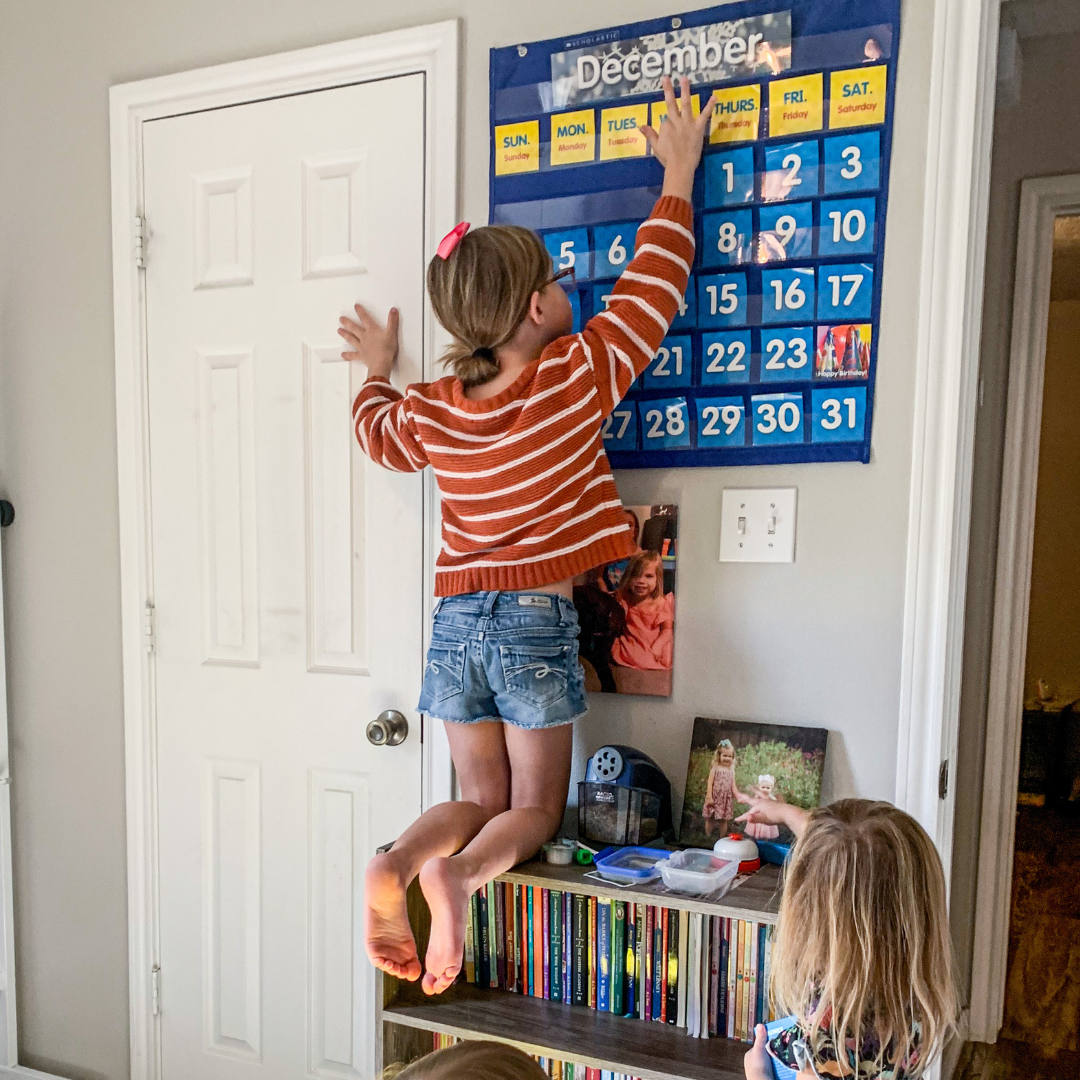
Posted on 1 Comment

Winnie the Pooh Novel Unit – Homeschool Language Arts

winnie the pooh novel unit

This Winnie-the-Pooh novel unit has really brightened up our language arts. The way it is set up has given us a sense of freedom and fun in our homeschool routine.

This method of language arts is new to us, but we love it so much. I actually break down the entire process in another blog post that I will link here. I highly suggest you read through that first as it will help the rest of this post make more sense.

In this post, my goal will be to give you specifics about our studies and schedules for this particular book, Winnie-the-Pooh.

This post contains affiliate links. If you follow one of my links I earn a small commission at no extra cost to you. Thank you for supporting my blog!

Winnie-the-Pooh

When I first heard that this was a great family read aloud, I ignored it. I thought it was going to be baby-ish and that my kids wouldn’t be interested. However, I was gifted the series from my husband’s grandmother and needed a good, living book to try this new method of novel unit out. Since we had it on our shelf, I went for it.

WOW! Was I wrong! This book was one of the most adorable books we’ve read together. We giggled in every chapter and didn’t want it to end. It’s the sweetest, and it made this unit all the more special!

The goal in reading this book was to try to get through a chapter a day. There are 10 chapters total, so we were able to finish the book in two weeks. I didn’t always read a whole chapter in one sitting. Sometimes I broke it up and read some at night and the rest in the morning. I have a couple little ones and longer chapters are harder to sit through. Breaking it up helped some days!

Unit Schedule

The following is a brief outline of what I hope to accomplish each day with my child. For more details on each piece, be sure to read my explanation post.

In this post, I am going to focus on Winnie-the-Pooh and will share the passages we studied and how we broke them down each day in case you’d like to try the same sort of method.

For a VERY brief overview – We read aloud as a family at different times in the day. For daily grammar, my daughter uses Fix it Grammar. I love that it can be done independently and takes about 5 minutes to complete. Copy work is also completed independently (5 minutes). I set a timer for our actual language arts lesson for 20 minutes.

DAY 1

  • Read novel and narrate [whole family]
  • Grammar Workbook [independent work]
  • Copy work – complete 2-3 lines of selected passage from novel [independent work]
  • Study passage – focus on grammar [language arts lesson with parent]

DAY 2

  • Read novel and narrate [whole family]
  • Grammar Workbook [independent work]
  • Copy work – complete 2-3 lines of selected passage from novel [independent work]
  • Study passage – focus on spelling and vocabulary [language arts lesson with parent]

DAY 3

  • Read novel and narrate [whole family]
  • Grammar Workbook [independent work]
  • Copy work – complete 2-3 lines of selected passage from novel [independent work]
  • Written Narration [language arts lesson with parent]
  • **Option – review passage/spelling words if necessary

DAY 4

  • Read novel and narrate [whole family.]
  • Grammar Workbook [independent work]
  • Copy work – complete 2-3 lines of selected passage from novel [independent work]
  • Dictation [language arts lesson with parent]

DAY 5 (OPTION)

  • Read novel and narrate [whole family]
  • Silent Reading (15-20 minutes) [independent work]
  • Narration [language arts lesson with parent, about 5 minutes]

Passage Selection – Week One

I selected two passages to use for our copy work because it took us two weeks to read the book. Each week, we studied one passage during our language arts lesson time. Next, I will share with you how we study these passages throughout the week.

“He was getting rather tired by this time, so that is why he sang a Complaining Song. He was nearly there now, and if he just stood on that branch…Crack!” (Winnie-the-Pooh, A.A.Milne)

On the first day of our schedule, we focus on grammar and punctuation. The following is what we discussed for this passage:

  • Capitalize the first letter in a sentence and choose the correct end mark.
  • A comma and a conjunction can join two sentences together. (Conjunction Junction, what’s your function? — Are you singing yet?)
  • Complaining Song is capitalized by the author – Why? It’s possible he wanted to make it more official or to make it a title of a song. (Poetic License/Author’s Choice)
  • The “…” is called an ellipses. It encourages the reader to pause.
  • “Crack!” is italicized for emphasis, an exclamation point adds volume in this case. For fun, we also discussed what onomatopoeia was.

As we study these topics we might practice different examples on the board or practice them orally, if possible. This might seem brief, but as you discuss each one with your child and provide alternate examples or even just look for more examples in the book, the time will go quickly.

Spelling and Vocabulary

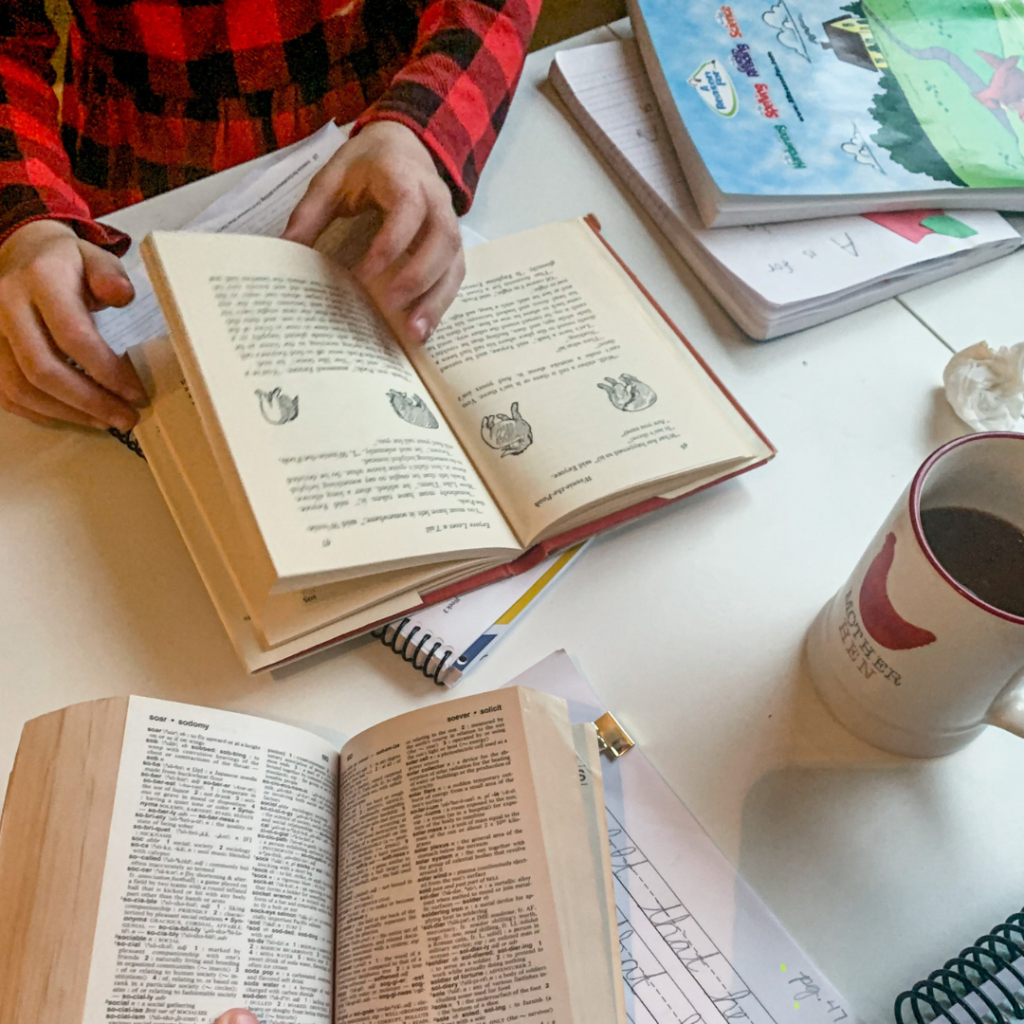
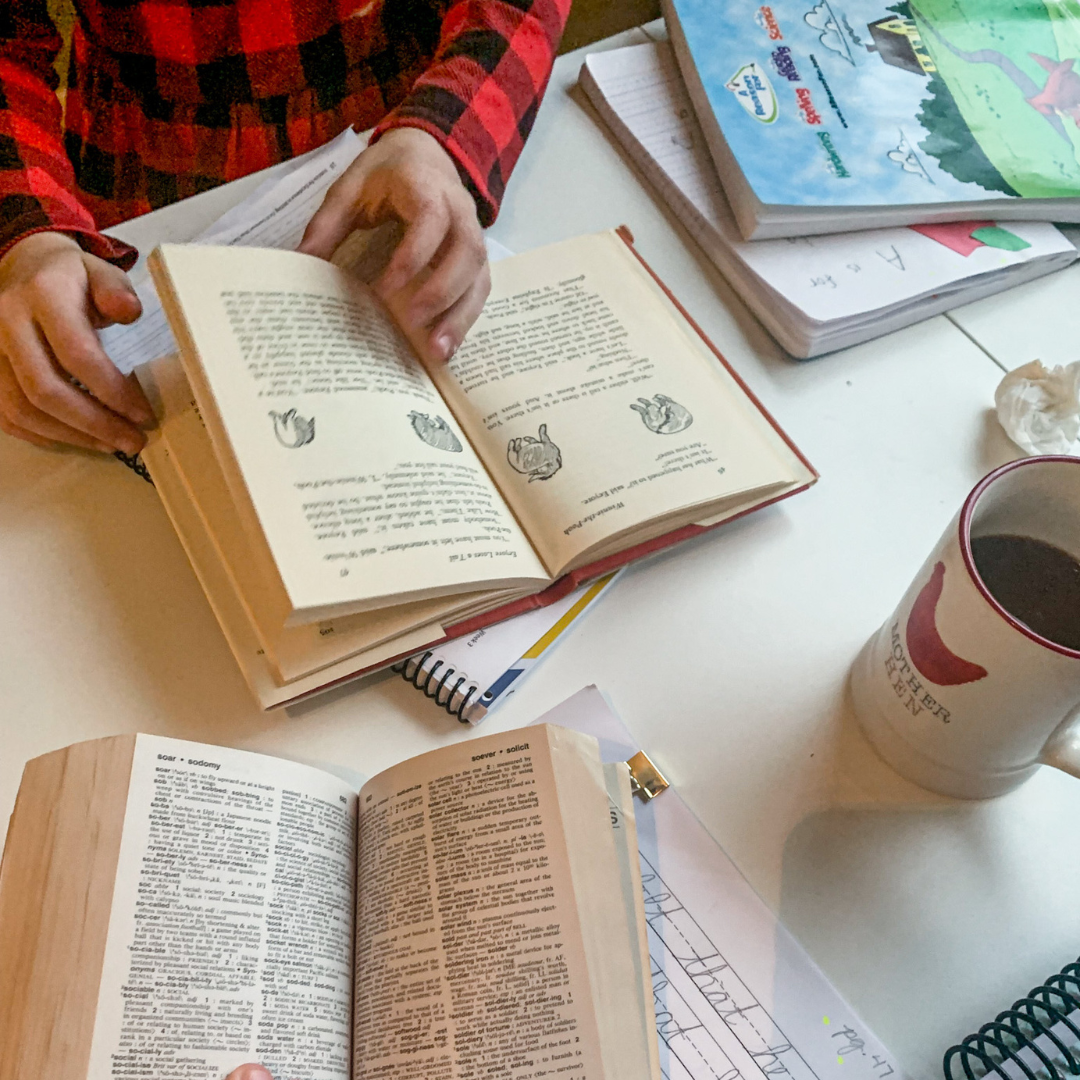
For our second day of lessons, we are still using the same passage. This time we focus on spelling and vocabulary. I first ask my daughter if she knows what certain words mean based on the context. If we need to, we look them up in the dictionary.

The vocabulary words we looked at for this passage: rather, nearly, complaining

For spelling, I quiz her with many of the words from the passage and see which ones are mastered and which ones need practice. I have her write them on a board. You can make this list based on your child’s needs, but our list looked something like this: getting, rather, tired, why, complaining, nearly, there, stood, branch, crack

Any word spelled incorrectly we practice a few times. I will also try to quiz her the following day as well to see if she can remember the word(s) she missed.

Passage Selection – Week 2

Week two follows the exact same schedule, just with a different passage. So for this section, I will list the passage as well as what we studied to go along with it.

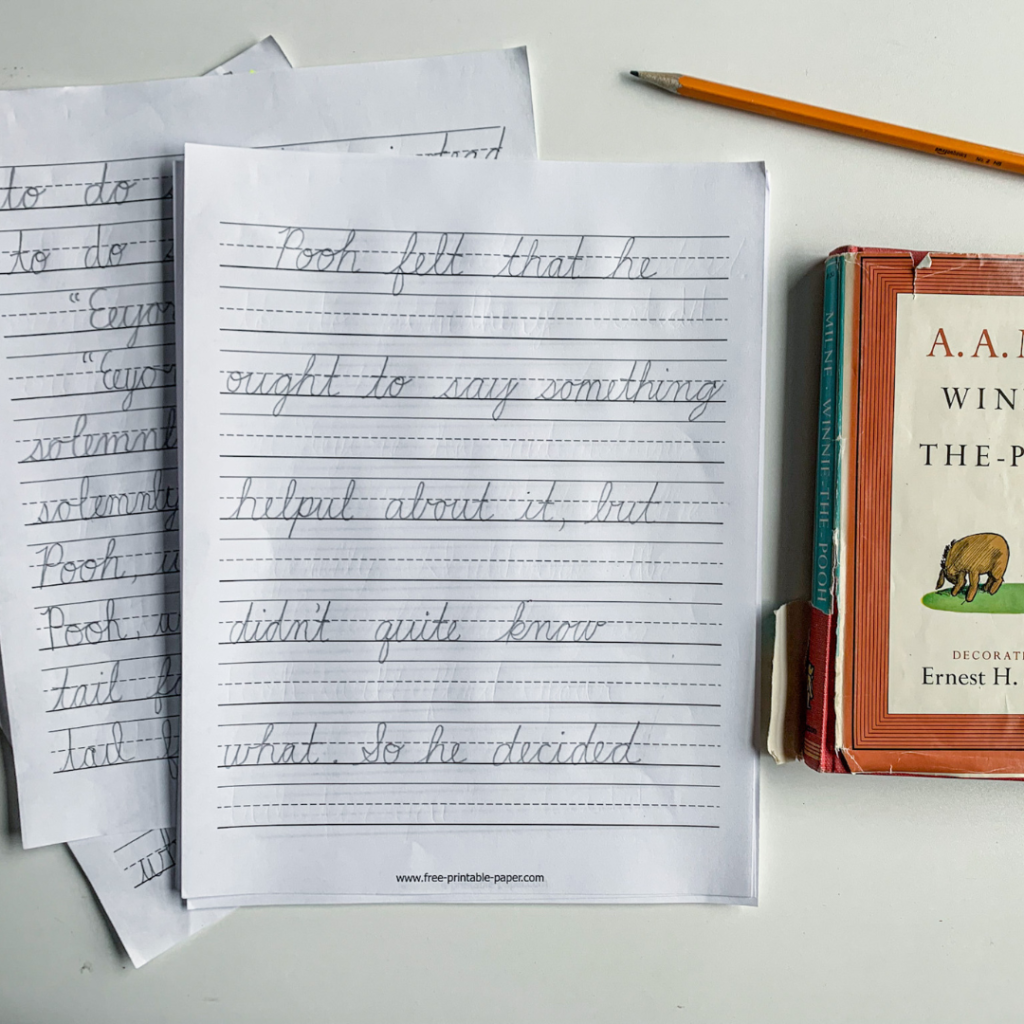
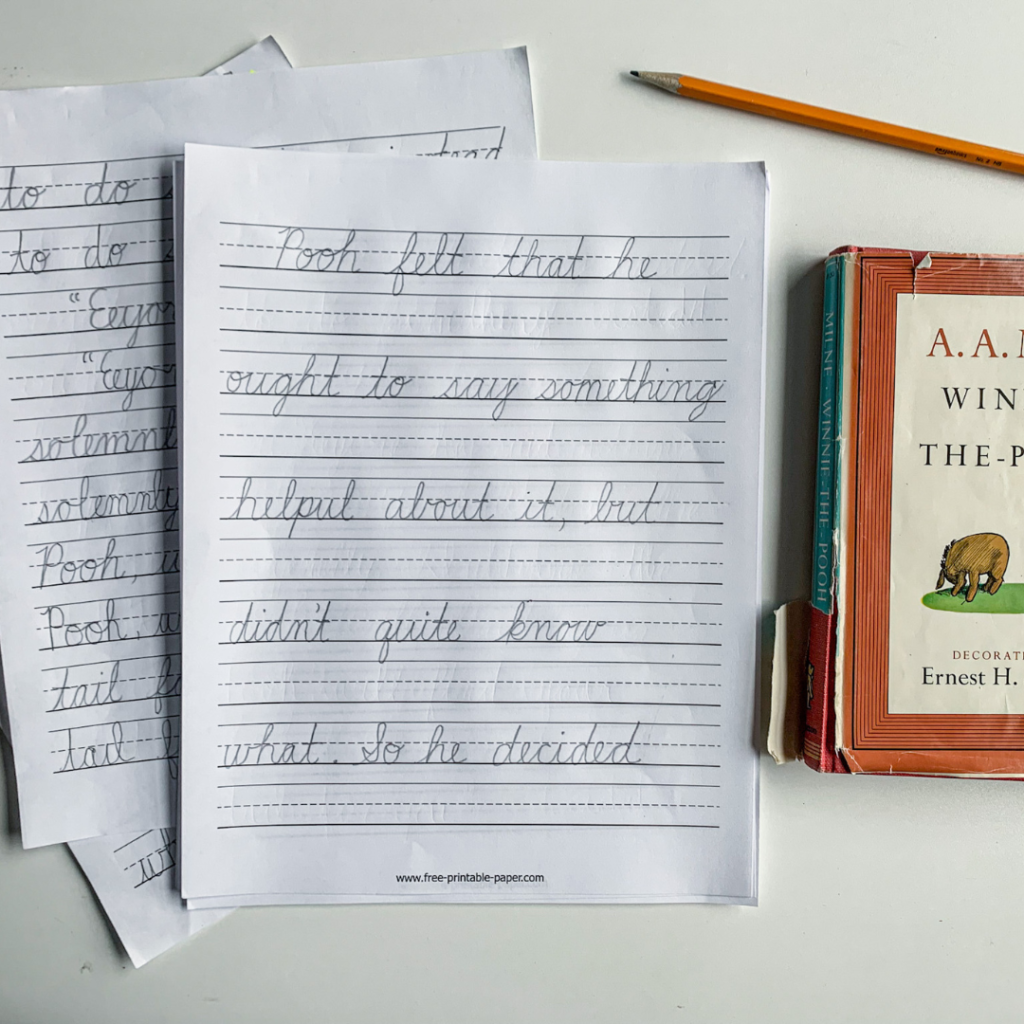
“Pooh felt that he ought to say something helpful about it, but didn’t quite know what. So he decided to do something helpful instead.

“Eeyore,” he said solemnly, “I, Winnie-the-Pooh, will find your tail for you.” (Winnie-the-Pooh, A.A. Milne)

On the first day we discussed the following:

  • Capitalize the first letter in a sentence and choose the correct end mark.
  • Didn’t is a contraction – did not. We practiced writing other contractions.
  • A new speaker starts a new paragraph, indent.
  • A comma is placed after “Eeyore” to separate the quote, but we also discussed direct address.
  • Always capitalize “I”.
  • Winnie-the-Pooh is surrounded by commas because it is information that is not essential to the sentence.
  • Quotes go around what the character is saying.

Now, if you wanted to simplify this even more, you could only focus on what connects to your grammar workbook. Point out what you’ve studied so far, and that’s it. That way it’s consistent between the two. However, I enjoy looking a little deeper than that. There are times when I don’t really know why a comma is there, and I just look it up online right there with her. That’s what it’s all about – learning together!

vocabulary photo

Spelling and Vocabulary

On the second day of our week we look at spelling and vocabulary from the passage. The spelling words we practiced were as follows: ought, something, helpful, about, didn’t, quite, know, decided, instead, solemnly, tail.

The vocabulary words we studied were “ought” and “solemnly”. Don’t forget to use context clues first, and then try the dictionary.

optional grammar activity

Optional Grammar Activity

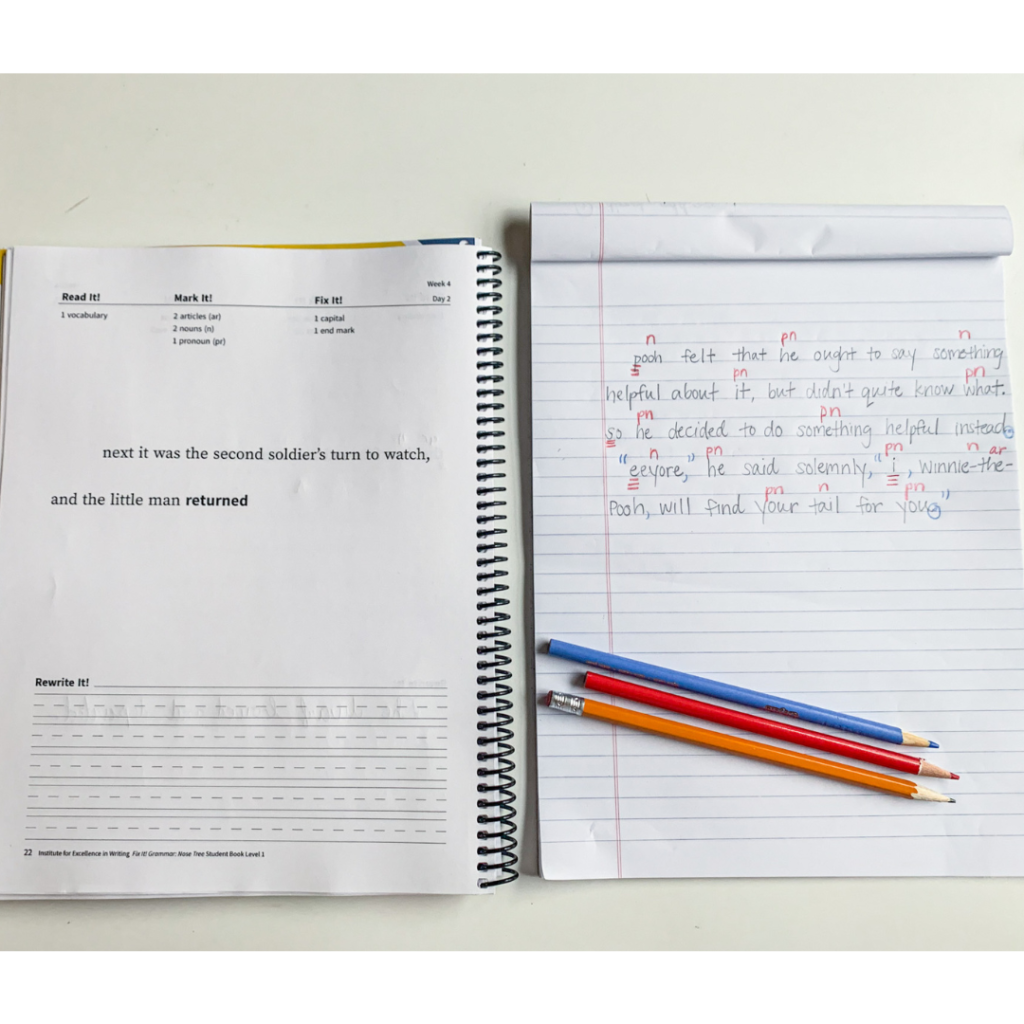
Usually on our spelling and vocabulary day we have extra time. I like to switch out her Fix it Grammar page with a little something different. We use the exact same methods she is practicing in her workbook but we apply it to our passage instead.

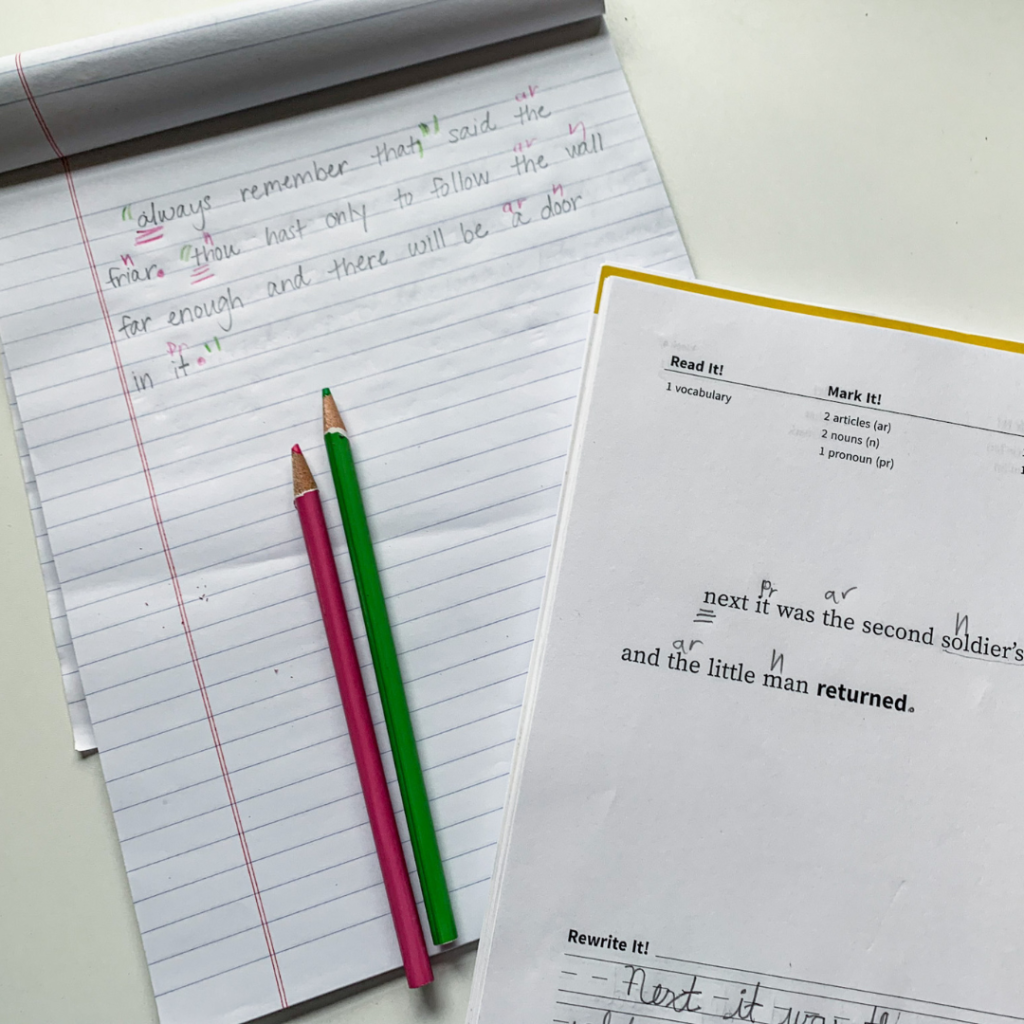
Here’s an example. In her Fix it Grammar book she is currently marking words that need to be capitalized, end marks, nouns, articles, and pronouns. So, I wrote the sentence on the board and had her do the same thing to our passage. It worked out great! I’ve snapped a picture (above) of an example for you to see.

Honestly, you could do this with any grammar workbook. If you are practicing adjectives, find the adjectives. If you’re underlining the subject once and the verb twice, do the same here. See if you can combine your grammar book with your novel one day – It makes the workbook feel relevant!

I’ll admit, there were a couple words I wasn’t sure about (yay for learning together!). The dictionary was very helpful. Find the word that matches the context of what you’re looking for and the dictionary lists the part of speech. So, if you see something off in my photo, blame Webster 😉

Ready to try it?

Does this sound like something you would enjoy? Sometimes it’s hard to explain what goes on in this crazy head of mine, but I hope that this explanation simplified the process for you. Isn’t it freeing to just read and chat about a book with your children? That’s what I love the most about this. Besides our daily grammar practice, there’s no workbooks, no busy work, just beautiful book discussion.

Want to see more novel units like this? We are starting another soon, and if this is helpful, I’m happy to break it down like I did with this one. Let me know in the comments or reach out to me on social media (Instagram: @simply.learning.together)

When I first started learning about the Charlotte Mason method, which is what inspired this study, I was nervous about the no-workbook-factor. Having a consistent plan like this with certain goals has really given me the confidence that a typical curriculum workbook doesn’t have to be necessary if it doesn’t bring you joy! It’s been so freeing to be able to study language arts through the books that we love!

NEW Novel Guide Available

For the last few years, my children and I have used this novel-based language arts program that is family-style and enriched with great literature each week. I’m so excited to share a NEW guide with you on how we do this in our home. If you’re tired of an all-in-one language arts workbook or if you’re itching for a great novel to read aloud to your kids, you’ve got to try this method! Below are two of the newest guides available now:

James and the Giant Peach

The Secret Garden

You can watch multiple videos about this method of Language Arts on my YouTube Channel HERE

Posted on 3 Comments

NEW (Mostly) Workbook Free Language Arts Method

winnie the pooh

(Mostly) Workbook Free! Did that reel you in? 😉 Well, this whole method was inspired by my research but also a desire to get rid of the workbooks! They were making me crazy…and bored! However, I have found it important to continue daily grammar practice. That’s where the workbook comes in. Even still, this new method has been such a breath of fresh air for us! I’m so excited to share. Let me tell you a bit about how we got here.

After Christmas, we kicked off the year with a fantastic history unit on the Vikings. We were having so much fun learning, but it would come time to sit down for language arts, and I dreaded it! I finally said to my husband – I can’t stand language arts workbooks. I’ve tried multiple workbooks over the years, and it never fits our family quite right. I just want to study language arts through what we are already learning in history or science.

Well, it wasn’t long after that, I was led (by prayer I’m sure of it!) to a post or a quote that mentioned Charlotte Mason, which I was pretty unfamiliar with at the time. Well, one thing led to another and suddenly I was listening to every Charlotte Mason podcast I could and reading all the info I could find online. I was fascinated by the methods, but nervous to commit.

Then, I came across a brand new book called “Modern Miss Mason” by Leah Boden, and it inspired me in the most beautiful way – WOW! I can’t recommend it enough. Her book encouraged me to learn the philosophies of Charlotte Mason but then to apply it to our homeschool in a way that suits are family well.

My point in all of this intro is to let you know that this novel unit is inspired by what I learned from studying Charlotte Mason’s methods. (I still have so much to learn!) It may not follow her philosophy exactly, but the whole process has brought my family (especially me) such a sense of joy, and I am certain that is what matters most. This unit has given me a freedom that makes language arts interesting for us again, and I hope if you try it that it may do the same for you.

Now, before I continue, I should mention that you could probably adapt this unit a little bit to use for any grade you’d like. My child (that I created this for) is in third grade, but I planned all of the lessons according to what she has already learned and what she is learning in her grammar book (More on that later). You can do this too, and I hope my breakdown of this method helps you see the simplicity that I see in that. I encourage you to continue reading no matter the grade level.

This post breaks down the actual process of putting this unit together. Definitely look through the detailed descriptions of each piece below first, but if you want to see a unit in action, check out our first novel unit like this, “Winnie the Pooh” (the book is so adorable!)

This post contains affiliate links. If you follow one of my links I earn a small commission at no extra cost to you. Thank you for supporting my blog!

Language Arts

From all of my research, I came up with the following list of what I wanted to include on a regular basis for my daughter’s language arts.

  • Good (living) book
  • Narration
  • Daily Grammar
  • Copy work (to practice Handwriting, Grammar, Spelling, and Vocabulary)
  • Written Narration
  • Dictation

As I go through this unit, you will see these pieces incorporated throughout. If you’re interested on where I’m learning about all this, I’ll leave a couple links for you here. (I listened and read so much! But these two sources stick out to me the most) Simply Charlotte Mason, and the Charlotte Mason Show Podcast.

Novel Unit Schedule

I’m going to outline the schedule of this unit, because I want you to see the simplicity of it – at least, I think it’s simple, and I hope you do too! Think of the lists you see as a checklist for the day. Each day of language arts requires about 5-10 minutes of independent work from your child and a 20 minute lesson with you, the parent. You’ll also be reading aloud at some point in your homeschool day, but I don’t really count that. Reading great books together as a family doesn’t feel like school for us. (We’ve read at bedtime and/or our morning time for the last couple years, and it’s been wonderful)

It probably won’t make any sense at first, but if you read further, I explain each piece of this schedule in my post.

I will put in the schedule to read each day. You can time it as you please. We read every day, whether it’s a school night or not. Our normal homeschool schedule is four days a week, but on the occasion that we are home on Fridays, I will mention my plan for that day as well.

DAY 1

  • Read novel and narrate [whole family]
  • Grammar Workbook [independent work]
  • Copy work – complete 2-3 lines of selected passage from novel [independent work]
  • Study passage – focus on grammar [language arts lesson with parent]

DAY 2

  • Read novel and narrate [whole family]
  • Grammar Workbook [independent work]
  • Copy work – complete 2-3 lines of selected passage from novel [independent work]
  • Study passage – focus on spelling and vocabulary [language arts lesson with parent]

DAY 3

  • Read novel and narrate [whole family]
  • Grammar Workbook [independent work]
  • Copy work – complete 2-3 lines of selected passage from novel [independent work]
  • Written Narration [language arts lesson with parent]
  • **Option – review passage/spelling words if necessary

DAY 4

  • Read novel and narrate [whole family.]
  • Grammar Workbook [independent work]
  • Copy work – finish copying selected passage from novel [independent work]
  • Dictation [language arts lesson with parent]

DAY 5 (OPTION)

  • Read novel and narrate [whole family]
  • Silent Reading (15-20 minutes) [independent work]
  • Narration [language arts lesson with parent, about 5 minutes]

Read Novel – A Good (Living) Book

Give me all the books! I love reading to my kids, and I especially love coming home with a bag full of books devoted to a unit study. This whole year, we have done all of our science and history using books from the library, and it has been the most wonderful time.

I tend to just get what the library has available, which I think is fine! Lately, I’ve been trying to be a little bit better about thinking ahead and finding good, quality literature. I might put a few books on hold or visit my local used bookstore. The effort has been worth it. Having good literature makes our studies come alive and become more enjoyable.

What is a living book? Well, that’s a good question. It’s a hot term in the Charlotte Mason world, and it honestly intimidates me a bit! So, here’s the method I use when choosing a book. Do I enjoy reading it? Is it helpful to our studies? Does it add something positive to what we are learning? Will my kids find it fun/interesting?

These are just a few questions I’m thinking about. This article breaks down the definition of a living book in an easy-to-read list. I find it very helpful, but I’ll be honest, my kids and I enjoy a good Magic Treehouse book here and there…is that “twaddle”? Maybe…but remember…my hope here is to do what’s best for my family, and we like it sometimes! So I encourage you to find books that your family enjoys too!

I mentioned this earlier, but we read our novels at bed time usually. We also have a time to read aloud during our morning time. When we read, it’s with all my kids, and it’s not part of our lesson time. What’s great about this is each child is benefiting from the literature, and my little ones are even practicing narrating as we do it. Whole family learning is my favorite!

Narration

I am new to narration, and I don’t know if I do it the “right” way, but I do it in a way that feels right for my family. (Are you catching a pattern here? Every family is so different, but what a blessing it is to have the freedom to adjust as needed, according to our family interests) Every time we read something we talk about the book together. Sometimes it’s in the middle of a chapter, sometimes it’s at the beginning, sometimes it’s at the end of our reading.

For this new language arts method, I made sure to encourage my children to talk more than we usually do. I wanted to be intentional about our book conversations. If I just say “tell me back what happened”, they look at me confused. So I usually start them off with a question or two to get them going.

So, what happened at the beginning of the chapter? What was your favorite part? What problem did they run into? How did they solve it? How do you feel about that character’s choices? I don’t ask every question every time, but this is just an example of what gets us started talking. Both of my school age girls participate in this daily book discussion.

There’s a lot more to narration than this, so if this is new for you as well, I encourage you to look into it further. (Check out this site)

Daily Grammar

We recently added Fix it Grammar to our homeschool day for my third grader, and I love it. I will link the product for you (not affiliated) if you want to learn more about it. It takes my daughter about 5 minutes a day to do this, and she can complete most of it independently.

She does this work daily, which gives me a boost of confidence knowing she is getting consistent practice. If you are looking into doing a unit like this, any grammar workbook can be used! Earlier this year, we used an Evan-Moor fundamentals workbook, and I feel like that could’ve been used just as well. The point is regular practice and connecting it with what you’re reading.

One of the days of the week, I like to do an alternate grammar activity instead of the grammar workbook. This usually happens on Day 2, because it doesn’t take us the whole 20 minutes to do spelling and vocabulary. We basically apply the rules of her Fix it Grammar sentences to our passage. Let me give you a concrete example.

Currently, in the Fix it Grammar books, she is labeling captalization, end marks, nouns, articles, and pronouns. She knows how to do this because it’s practiced daily. Well, one of the days during the week, we look at the novel passage and label it in the same way. This has been a great way to apply the same steps to a relevant passage from our novel. I love linking the two (grammar and novel) together.

You can see an example of this in our Winnie-the-Pooh unit.

copy work

Copy Work – Handwriting

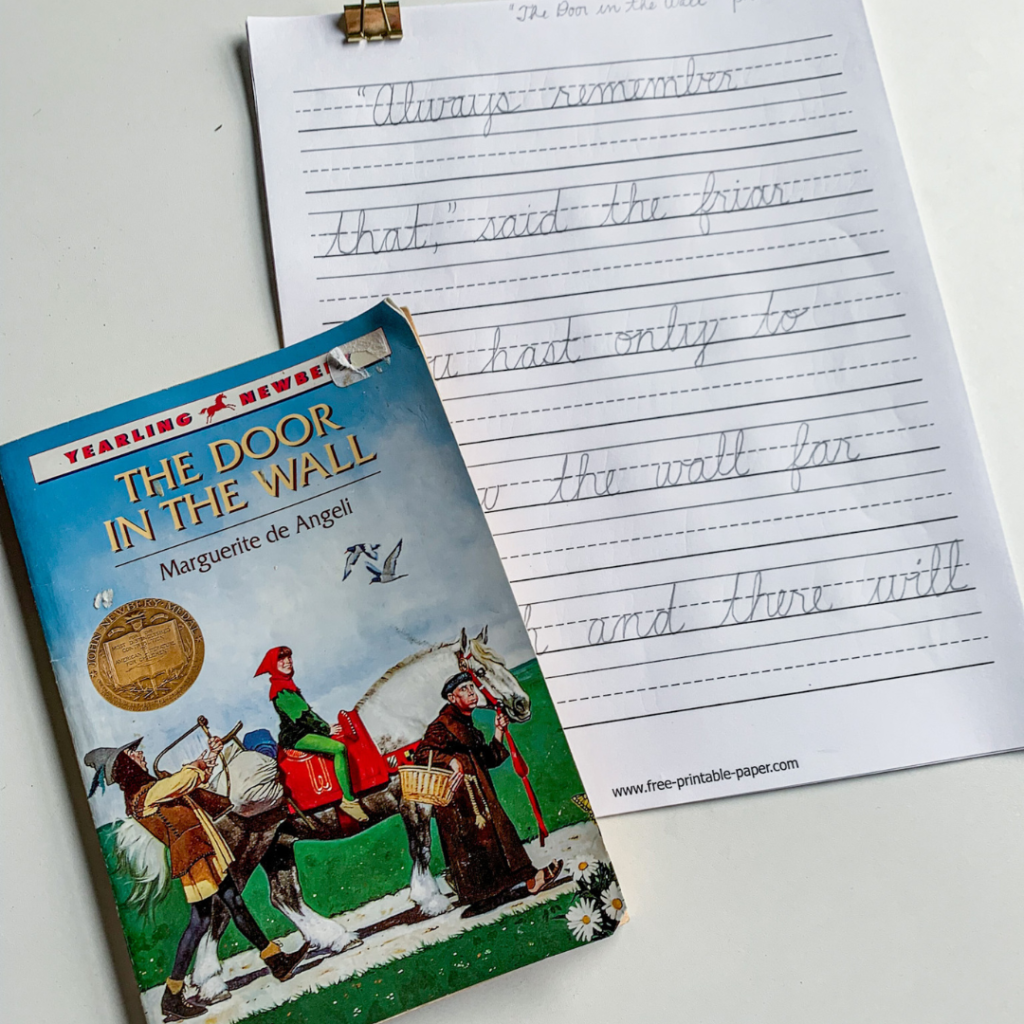
The copy work is chosen by me using passages from our novel. My goal is to study one passage a week. This copy work will allow my child to practice handwriting, but we will also be working together to study grammar, spelling, and vocabulary through this passage.

Each week, I wrote the passage out onto lined paper, skipping every other line. (See photo) This gave her an example to follow. Each morning, during her independent work time, she would copy 2-3 lines. The goal is not to do a ton of copy work in one sitting. What does get finished must be done well, if that makes sense. This is another philosophy I am learning about from the Charlotte Mason method. Shorter lessons, better quality work. I’m finding it to be very true!

Copywork – Grammar, Spelling, and Vocabulary

This part of our lesson will vary depending on the passage, but you can see it in action by checking out one of our units.

On the first day we look at the grammar and punctuation. We go through each sentence and figure out together – Why is something capitalized? What is the punctuation at the end? Why is that comma there? When do we add quotes or indent? And so on…

I am very intentional about the passage I choose for this reason. I’m not going to pick something that has incorrect/odd grammar. I’m choosing passages I know will enhance what she’s already learning in her grammar book.

I also spend a day focusing on spelling and vocabulary. (See outline) If there are any words she is unfamiliar with, I try to have her guess the definition using the context. Then, we look the word up in the dictionary.

Next, for spelling, I quiz her on a variety of words in the passage. If she gets it right, we move on. If it’s wrong, we focus on that word for a bit and I try to remember to quiz her on that word a time or two during the rest of the week. There is no spelling test as she will be writing the words by memory during the dictation portion of our week.

Written Narration

Depending on the child’s age, your lessons may or may not include written narration. Based on my daughter’s abilities, I felt she was ready to start with my help.

One day a week, I require written narration from her. My goal here is for her to write about what we are reading. I like to help her brainstorm and figure out how to write a good narration. Eventually, I hope she will use these brainstorming techniques to write on her own.

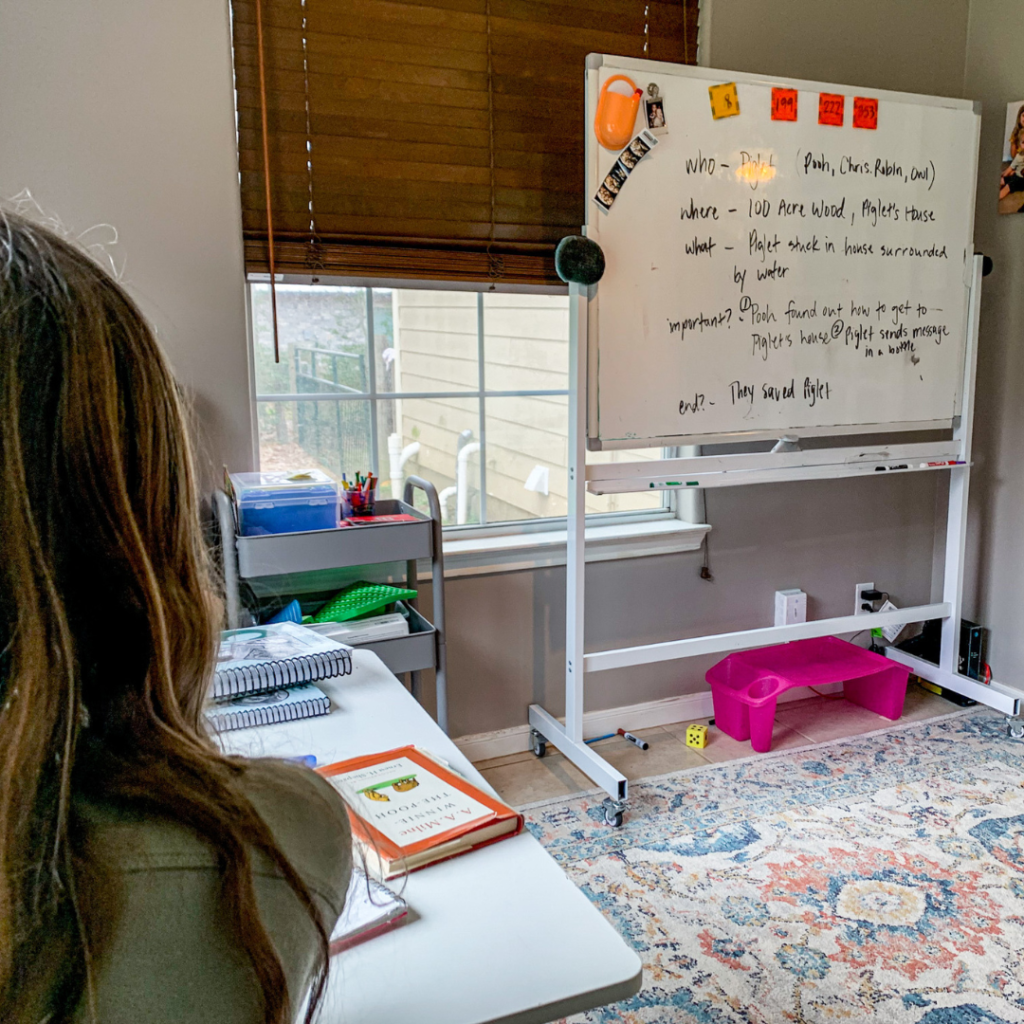
I ask her the following questions and we jot down quick notes as our answers (see photo):

  • Who is involved?
  • Where did it take place?
  • What happened?
  • Any other important pieces to mention?
  • How did it end?

I just made these questions up. This is not an official strategy, but we used it for both passages, and it went really well.

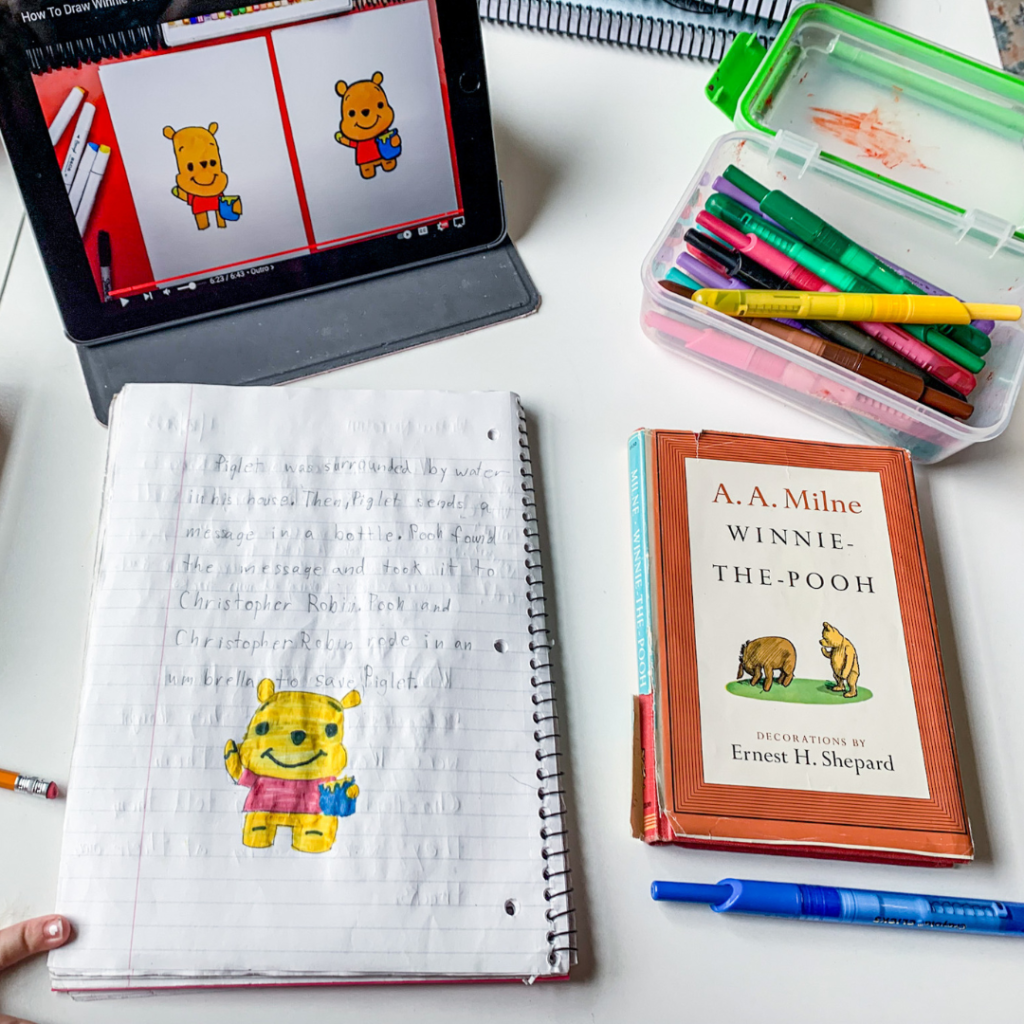
Once she has short notes, she begins making sentences to form a paragraph about what we read that day. The first couple times I asked her to do written narration, it was rough. However, with consistency and my help, she is starting to get the hang of it. I was so proud of the last one she did! She’s made awesome improvement.

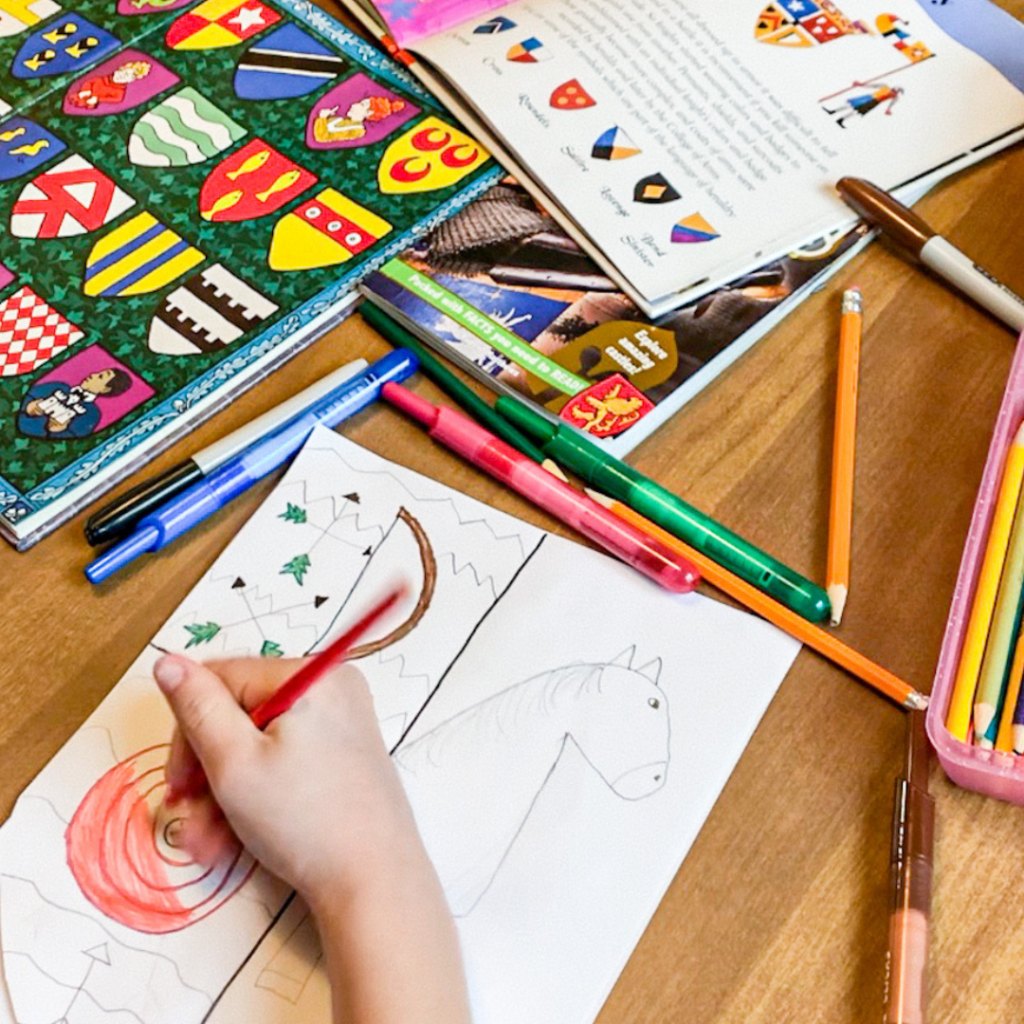
If you check out the picture below, you’ll see something else we add in for fun. As a reward for her hard work in writing, she likes to draw with Art for Kids Hub. We add it to her notebook, and it’s a cute addition to her work. (You’ll also get a peek at how she took my notes from the board in the last picture to her completed paragraph.)

I’ll admit, the hardest part of this lesson in written narration is for me to just be quiet. I always want to say things like, “Wouldn’t it sound better if…” Or, “Well, don’t you want to add…” I have to bite my tongue – a lot! It’s worth it though. I just LOVE hearing her voice in her writing.

written narration

Dictation

We’ve had practice with dictation from a couple different places. I first learned about it when we completed a Dart Guide from Brave Writer. We were also already doing it at the beginning of this year through the language arts program I chose, Learning Language Arts through Literature. I love it because it’s an easy way to assess that doesn’t feel like a test. Plus, it’s meaningful because it comes from what you are reading.

This article gives fantastic instruction, including a video, on how to do dictation. Like some of the other pieces of this unit, dictation gets easier with practice. The way we set all of this up, we study the passage Monday-Wednesday and dictation is on Thursday. By working on the passage a little bit each day, I feel like it’s a great way to set her up for success during dictation.

I was explaining to my daughter today during her dictation what a wonderful skill it was. Being able to write something and know how to add punctuation and edit it is a life skill that will be necessary her whole life – writing emails and letters, for example.

After I finish dictating the passage to her, we correct it together.

Freedom and Fun

I feel like that’s what it really boils down to here. By doing this method in our language arts, we’ve had more freedom to apply books we are already using to learn, making it more fun and interesting to actually work with.

A lot of things have inspired me to get here, as you may have read throughout this post, but I’m so thankful for what I’ve learned and how we can now find a way to do something that works so well for our family.

Have you tried something similar to this? Are you interested in seeing more units like this in the future? Let me know in the comments and be sure to sign up for my email list where I send all our updates, posts, and resources that we are using in our homeschool.

You can also catch me on Instagram @simply.learning.together If you try this out, take a photo and tag me. I love seeing your families enjoy learning together!

NEW Novel Guide Available!

For the last few years, my children and I have used this novel-based language arts program that is family-style and enriched with great literature each week. I’m so excited to share a NEW guide with you on how we do this in our home. If you’re tired of an all-in-one language arts workbook or if you’re itching for a great novel to read aloud to your kids, you’ve got to try this method! Below are two of the newest guides available now:

James and the Giant Peach

The Secret Garden

You can watch multiple videos about this method of Language Arts on my YouTube Channel HERE

Posted on 2 Comments

Homeschool Day in the Life – Timed Lessons

homeshool room

We recently adjusted our homeschool schedule so that we have timed lessons. Prior to this, I began researching a few Charlotte Mason methods and read a book, Modern Miss Mason by Leah Boden. From what I learned, I really loved the reasoning behind doing short, timed lessons. Short is key!

I’ve never been much of a fan of a tight schedule when it comes to our homeschool day, so this was weird for me to start. I always expressed our day as a “rhythm”, starting and finishing as we pleased. I have to remind myself that technically we can still do that, but once the lesson starts we are on a timer.

Want to know what’s crazy – we have LOVED it! This may sound weird, but we actually sit down for a lesson for a shorter amount of time, yet I’m able to get MORE done in our school day than before! Isn’t that crazy?

One day last week, I took some notes about what we did during the day, and I’ll be sharing that with you here. I am going to put start times, but I don’t every feel bound to that. I aim for it, but if I’m early or later than what my plan suggests, I just start when I can. The key is that the lesson is always the same amount of time.

Here’s a link to Charlotte Mason’s timetable, if you’re interested in learning more about the “why” of shorter lessons.

This post contains affiliate links. If you follow one of my links I earn a small commission at no extra cost to you. Thank you for supporting my blog!

morning checklist

Breakfast and Chores

I get up between 6 and 6:30. I like a few minutes to myself to read the bible and drink coffee. Getting up isn’t easy to do, because I still get woken up multiple times during the night by litle ones. My secret is having my coffee pot on a timer! It’s like a Folger’s commercial from the 90s…”The best part of waking up…” (are you singing it?) Seriously though, I can smell it and I love that it’s ready for me. Morning motivation.

I am currently reading the One Year Bible. I also use my study bible alongside it to help me dig deeper into what I’m reading for the day.

My kids start getting up between 6:30 and 7:30. They all wake up at different times, and I’m usually making breakfast by then. If someone isn’t up by 7:30, I’ll let them know breakfast is ready. I like to get our day going, so I do wake someone up if it gets pass a certain time.

After breakfast (8:00ish) my kids immediately start their morning checklist. You can read more about this in my morning routine post, but it’s one of the things in our homeschool that has stuck around through the years. It’s a list to get my kids ready for the day and to do a couple chores around the house before we begin.

Independent Work

Once the checklist is done, my two older girls have independent work. They each do something different, and they don’t always start at the same time together. It’s just whenever they’re done with their checklist.

For First Grade: Handwriting (5 mins). We set a timer when she starts, and I tell her she has to complete two lines. She is using a Reason For Level A right now. if she finishes before, great. If not, she stops and finishes it the next day. I used to have her do a lot more independent work than this – it was not successful. Every since we cut it to just writing for 5 min, it’s been so nice. She works hard and does the work well.

Third Grade: Handwriting (5 mins) Same as my first grader – she completes 2-3 lines in that time. We are not using a program for this. I create her copywork based on the literature we are reading. She also does her math independently. I shorten her math lessons so that she is able to complete it in 20 minutes or less. The last thing she completes is her Fix it Grammar lesson which takes about 5 minutes.

Morning Time and Outside

I aim to start our Morning Time at 9:00. Right now we are using Foundations of the Bible from Driven by Grace. We read poetry from “Poems to Learn by Heart” and we read aloud. Usually the book(s) we read is something we are learning in history/science.

At 9:40 We head outside to play, soak in the sun, and the kids usually have a snack. I also get outside for a minute during this time. It makes such a difference in my mood if I get out throughout the day. In the past we have also used this time to go on a short walk.

christian light education math

Lessons Begin

We start lessons at 10:00, and I do math with my first grader. We set a timer for 20 minutes to get the lesson done. I do my best to pick what is the most important and helpful in her lesson. We do not do every single review problem. At the end of the timer, we stop…even when I don’t want to!

I didn’t mention this, but I have four children. While I have lessons with one of my big girls (8yo and 6yo) the other one is playing with my youngest two (4yo and 2yo).

At 10:20 I switch my big girls and start lessons with my oldest. The first thing we do is like a math meeting. Her lesson is usually complete or almost finished because she does it during independent work time. I help her with anything she couldn’t do on her own and we check her work together. I don’t set a timer for this because it only takes about 5 minutes or less.

Next we immediately start our language arts lesson. I recently wrote a post on what we do for this, but I set a timer for 20 minutes to get it done.

I start my next lesson by 11:00. This is language arts with my first grader. We are using Logic of English Foundations B. For this lesson, I set the timer for 15 minutes. I can usually complete 2-4 sections of a lesson during this time. The lessons in this Foundations B book are very long. Even before I started using a timer, we were not completing a full lesson.

preschool fun

Preschool Fun

At this point we are done with our formal lessons! It’s 11:15, and I have a minute to regroup and think about the afternoon ahead. This is also a great time to play with my little two, and that’s exactly what we did.

My big kids were outside, and my little two came in together looking for some time with mommy. We might read books, do a puzzle, or color. I keep it very simple. On this day we did some counting. It was as simple as rolling a dice and counting math cubes into a cup. They loved it!

After 15-20 minutes of preschool fun, I prep our lunch. I don’t always use this time for preschool. I do try to set aside time to play with my little ones, but it’s more about when it fits best in the day. This just so happened to be the time it worked out on this day.

Movie Lunch

About once a week, I let my kids watch a movie during lunch. The movie has something to do with what we are studying. We are working through Foundations of the Bible from Driven by Grace and she lists certain Superbook shows that match the topic.

At 11:40 we watched an episode while eating a picnic lunch. This is always a fun treat!

Mom’s Chores and Outside Time

Between lunch and my son’s nap (12:00-1:00) is just a free time. My kids played outside which gave me an opportunity to work on my personal checklist. I’ve been doing this for about 3 months now, and it’s amazing.

At the start of every day, I write down three things I want to accomplish. It can be as simple as “sweep the kitchen”. My goal is to get those three things done by the end of the day. I feel more productive and it feels like I’m able to keep up with my house better.

At 1:00, I put my son down for a nap.

Afternoon Activity

At 1:15, I designate something I want to do with my older girls that is a little bit harder to do with a little one around. Now that he’s napping, it’s easier to get it done. This usually has something to do with the current unit study we are in.

Today we studied art during the the time of the Vikings. We sat at the table, researched the information with our library books, and looked at examples. We also read about runes and tried creating some on Play-Doh with a toothpick.

Reverse Planning

We finish up our afternoon activity by 2:00. During this time, I can clean up and fill out my planner. I use the reverse planning method and love it! I simply write down the things we accomplished for the day and shut down the school room for the afternoon.

Quiet Time/ Jog

At 2:30 we started quiet time. My son is still sleeping and my two big girls go into separate rooms to enjoy some quiet. Our days flow much better when we all have this quiet time to ourselves. My girls entertain themselves by reading, drawing, or listening to a book. They have come to really love and appreciate this time.

While they are in quiet time, I go for a jog. I look forward to this every day because I can get outside and I can listen to a book or a podcast that I love. It also gives me an energy boost for the rest of the afternoon/evening. My husband works from home so he is able to be the present adult while I’m gone.

My third daughter comes with me in the stroller. She needs a nap, but a full one is too long, if you know what I mean. So, she rides in the stroller and takes a catnap while I run.

Afternoon Snack

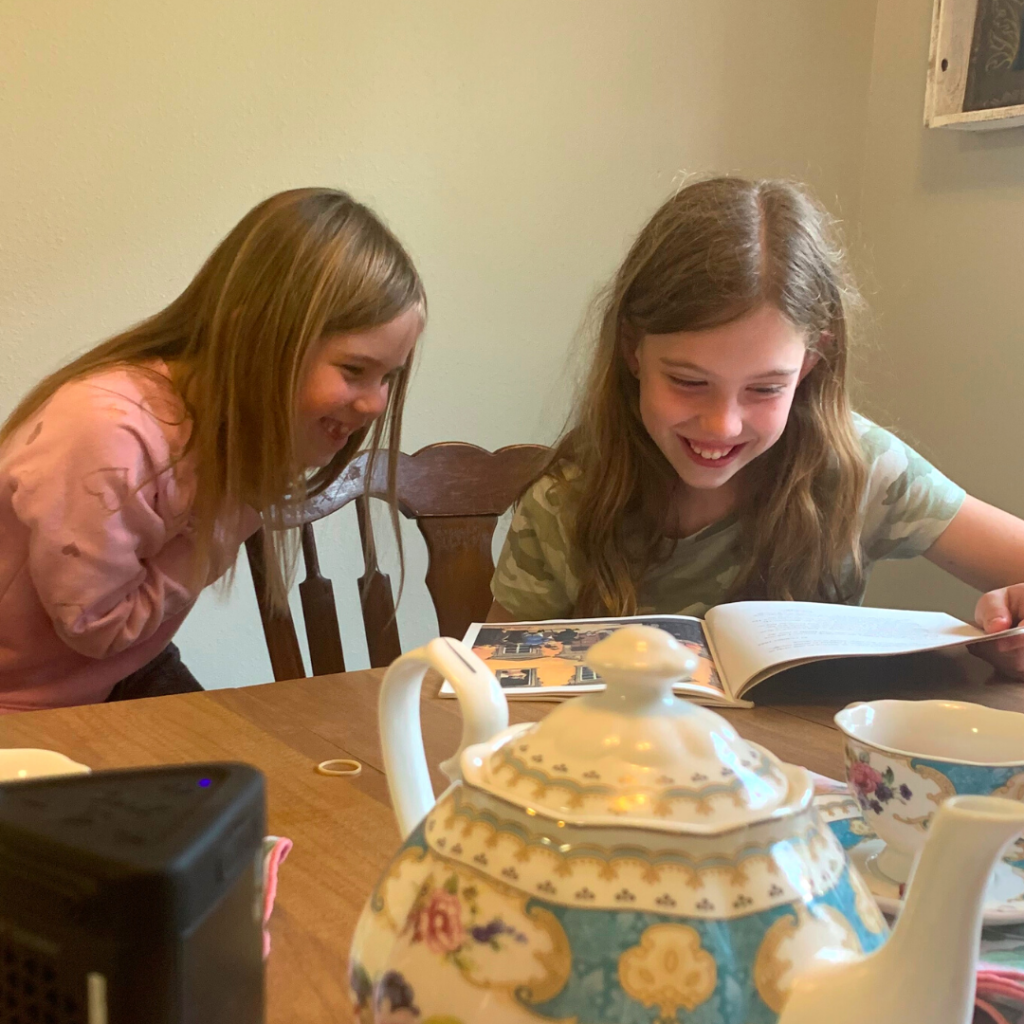
Quiet time is usually an hour. At 3:30 everyone comes out for a snack. I’ve learned to do this snack right away otherwise they get to playing and get hungry too close to dinner, snack late, and ruin their appetite. We’ve been using it as a time to just sit and chat together. Some days we even make tea for fun. I also enjoy an iced coffee while we talk 😉

Once we finish our snack time, my kids head outside for the afternoon. I usually spend this time picking up or prepping for dinner.

Evening Routine

At 6:00 we have dinner. My husband and I clean up at the end while the kids play. Right now it gets dark pretty early. We all look forward to when we can spend some more time outside after dinner.

At 6:45, we visit together in our living room. I wish I could say it was peaceful family time, but the energy level is usually quite high. We are together as a family, but it’s quite loud! Even still, I am grateful.

At 7:00 my kids get ready for bed. They don’t GO to bed. I’ve just learned to start our bedtime routine early. It helps me not to get frazzled in the rush to get to bed. By starting early I have more patience and better self control. Once they are ready for bed, we read aloud together.

It’s just me and the girls that read while my son plays with my husband. We have been reading our novels before bed for a couple years now, and it has been so nice. We read so much together! And it is a time that I cherish with them.

By 8:00 we finish up our reading and I put my son to bed. During this time, my girls read silently in their beds.

By 8:30 it’s lights out and time for bed.

Routine

Routine is so important in our home! Not only does it help our kids, but I’ve realized how much it helps me to follow a routine also. On days where we aren’t in routine, I feel pretty funky!

Our schedule has shifted and adjusted over the years, but this is the first time we’ve tried timing our lessons. It used to be where I’d be teaching all the way to lunch and then I’d have to catch up with someone when my son took a nap.

Now, with timed lessons, I’m able to be more efficient and complete our lessons quicker. This allows me extra time in the afternoon to add in some fun!

Does your routine look similar to this? Have you ever tried timed lessons? I was against it for quite sometime, but I’m glad I finally tried it. We have loved it so far!

Posted on 5 Comments

Vikings – Homeschool Unit Study

It’s time to learn about Vikings in our homeschool! I’m so pumped because I don’t know much about them (HA!) That doesn’t scare me! It makes it all the more exciting doing it with the kids. We will be learning so much together, and I’m thrilled! So, as we go through our unit, I’ll be writing this blog post. I hope to share the books we are reading for our unit study as well as the different activities we do.

This post contains affiliate links. If you follow one of my links I earn a small commission at no extra cost to you. Thank you for supporting my blog!

Library Haul

My first step in any unit study is to collect books from the library. I’ve shared this before, but my main strategy is to just head to the non-fiction section and start putting books in my bag.

This time around I did have a few books I put on hold just in case. So, I grabbed those first and the rest were a surprise.

I’m so excited! For this unit I had some time to make a YouTube video sharing all the books we used. Check that video out here.

Below are just a few of the books that we got and loved for our unit. The first three were great to read front to back as a fun read aloud. The rest are good reference books that we used to research other topics, like geography, art, clothing, and more.

planning a unit

Planning

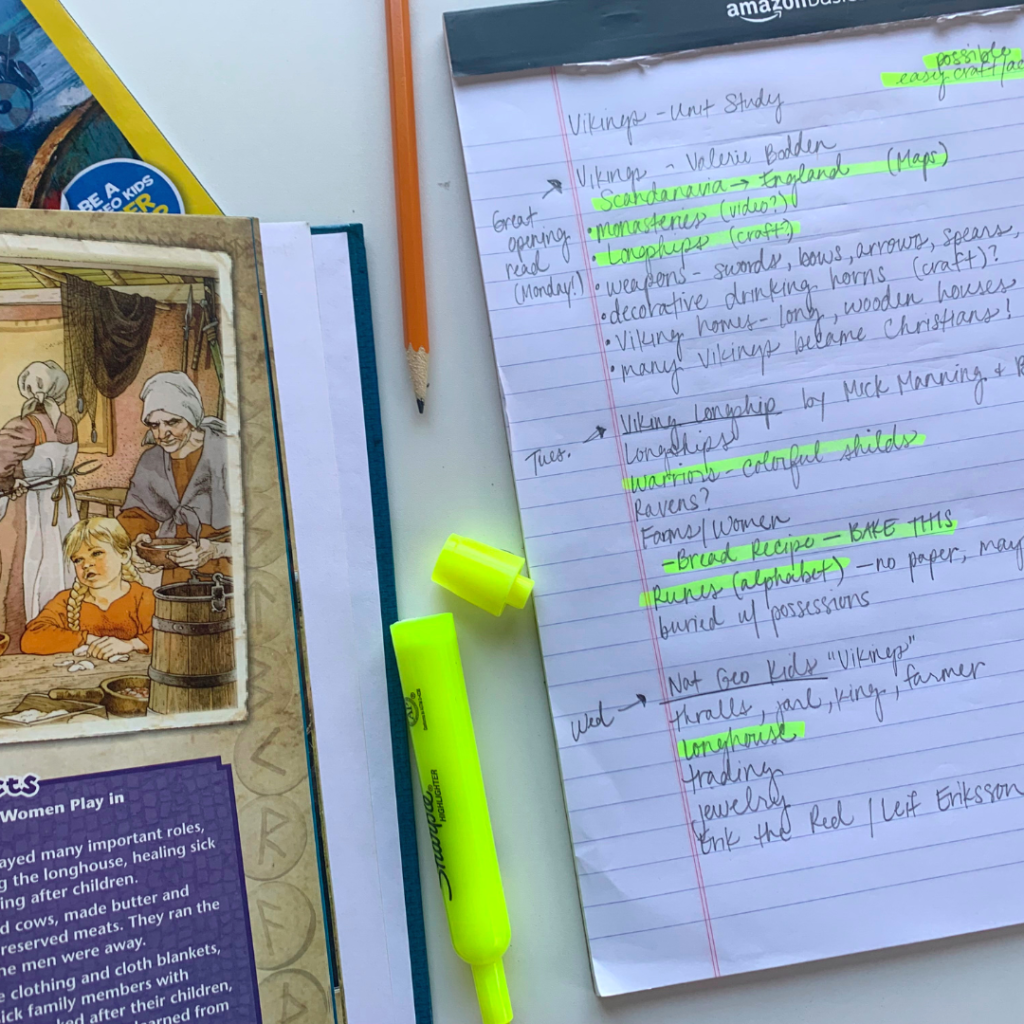
Next, it’s my turn to do the studying. I like to just flip through the library books and skim through the pages. The pictures and text inspire me before I start hunting for different activities on Pinterest. This also helps me know which books will be easy to read to my kids and which ones might just be a good reference book on our shelf.

As I looked through each book, I made a note of some focus topics that the book discussed: ships, food, Viking men and women, recipes, clothing…anything.

Next, I headed to Pinterest and looked for some inspiration of any topics that I knew would interest me or my kids. I’ve saved all of my pins in one board called “Vikings” if you’d like to take a look.

Read Alouds

We always do our read aloud novels before bed time. This has been so great for us. We read so much more, my kids can wind down, and most of the time it’s quieter than our morning time.

For this unit, I’m trying something new and reading TWO books at bedtime. One is nonfiction – “Magic Tree House Fact Tracker: Vikings”. The other is a fictional novel – “Imagination Station: Voyage with the Vikings”

In addition to that, each of my bigger kids (8 yrs and 6 yrs) listened to an audio book separately during their quiet time. Through our library app (Libby) we checked out “Magic Treehouse: Viking Ships at Sunrise” The book is only about 40 minutes long so they were each able to listen to it in one day and had a chance to exchange what their favorite part was.

These three books alone will teach my kids and I so much. Having this as the backbone to our unit will help us learn all sorts of information, but it also gives me confidence that I don’t need a ton of extras. We will be soaking in facts and fun through books!

Extra Activities

Now is the part where I get to share the fun, “extra” things we did for our unit. I personally think reading together is great and the following things aren’t necessary to learn. However, it brings me joy planning them and my children LOVE them. So, we continue to add a few fun things here and there in our units. I hope sharing them with you may inspire your family, as well!

geography activity

Geography

The Vikings lived mostly in Scandinavia, but they sailed to many different countries. I felt like this was a great opportunity to talk about our seven continents.

First, I found a free printable online that was blank, black and white, and would allow us to label the continents. Once we did that we colored each continent a different color.

I also shared a couple of videos online that talked about the different continents and what you may find there. One is shorter, animated, and silly. The other is a little longer, has real pictures, and LOTS of facts. Both were great to watch!

We were also able to use a few of our library books. Almost every book has some sort of map in them, but a few had maps that showed different routes the Vikings traveled.

During our second week of study, I printed out a Viking Map that I found online for free. We were able to mark where the Vikings lived, where they raided, and where they settled. It was super simple and easy to do together. The website where I found this gave an example of the finished product so there was no guessing or researching for me.

baking Birka bread

Baking Bread

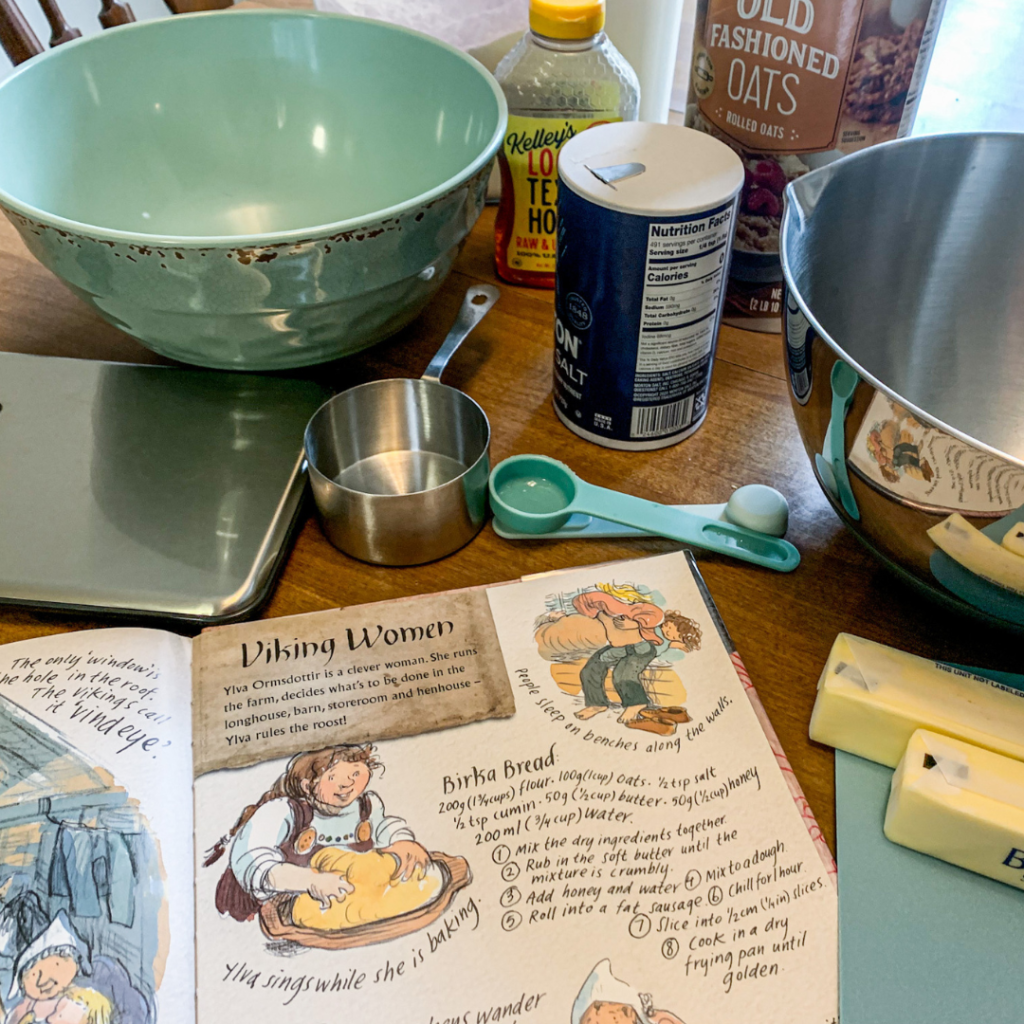
I planned to make a bread recipe that we found in one of our books from the library, “Viking Longships”. The recipe was for something called Birka bread. I’m not sure what happened, but it smelled bad, and it looked like slop. It did not have a dough consistency, so I was unsure how it would turn out.

I quickly found another recipe I saved on Pinterest and threw it together so that we could try both breads. It was really easy, and I happened to have all of the ingredients already in my pantry.

The Birka bread was sort of like a pancake consistency and had a sweet flavor. It definitely tasted better than it smelled. A couple of my kids actually preferred it over the other. The other bread was very dense and pretty dry. It was good with butter and honey.

Either way, it was fun to make and eat what the Vikings may have eaten long ago!

Viking lunch

Viking Lunch

This was probably the easiest themed lunch I’ve ever done. I had everything already at home and decided to throw it together last minute. I found the idea from a blog post that suggested to read “Leif the Lucky” along with it. Unfortunately, I couldn’t find that one at the library OR a good quality read aloud on Youtube. So, we just ate the lunch!

All it took was a PBJ sandwhich, pretzels, raisins and bananas. My kids were so surprised and thought it was so cute. Now, if you see the picture, the bananas act like horns on the helmet. However, from what we’ve been reading, that’s actually a false representation of a Viking helmet. Real viking helmets did NOT have horns. Fun fact of the day!

viking runes

Art/ Runes

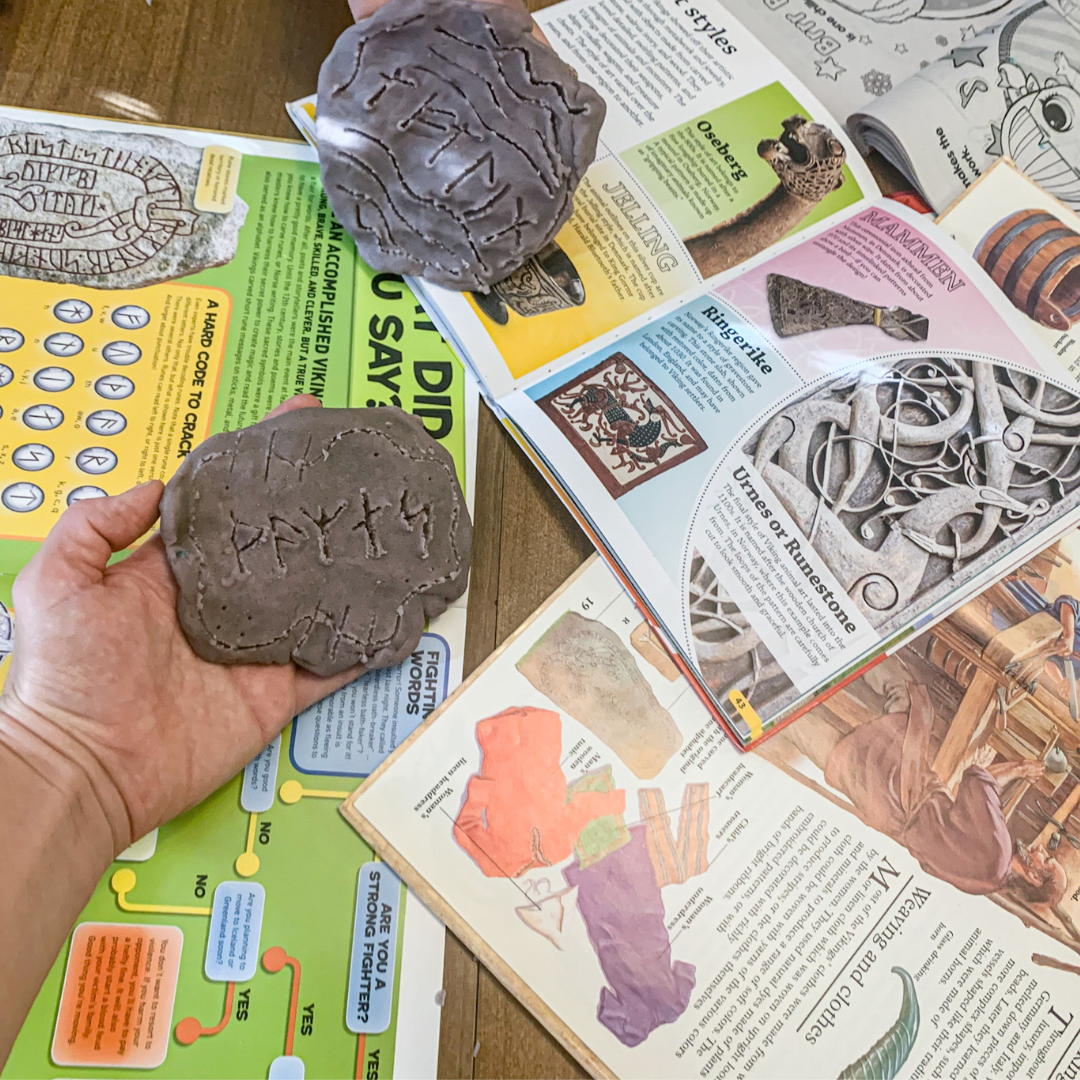
The Vikings art was really in their craftsmanship. The carvings, and weapons, and jewelry were all really neat to see in our library books. We were also able to see runes, which are kind of like a Viking alphabet. We used one of our books that had a chart of all the runes to do a simple and fun activity.

Using a toothpick, we carved words into Play Doh to make it look like runes on stone. It was neat to see our names written that way.

My oldest and I enjoyed cracking the code a little bit. Her and I would come up with a 3-4 letter word and use the chart to try and decode the message. This can get tricky because some symbols represent multiple letters.

drinking horn snack

Snack – Drinking Horns

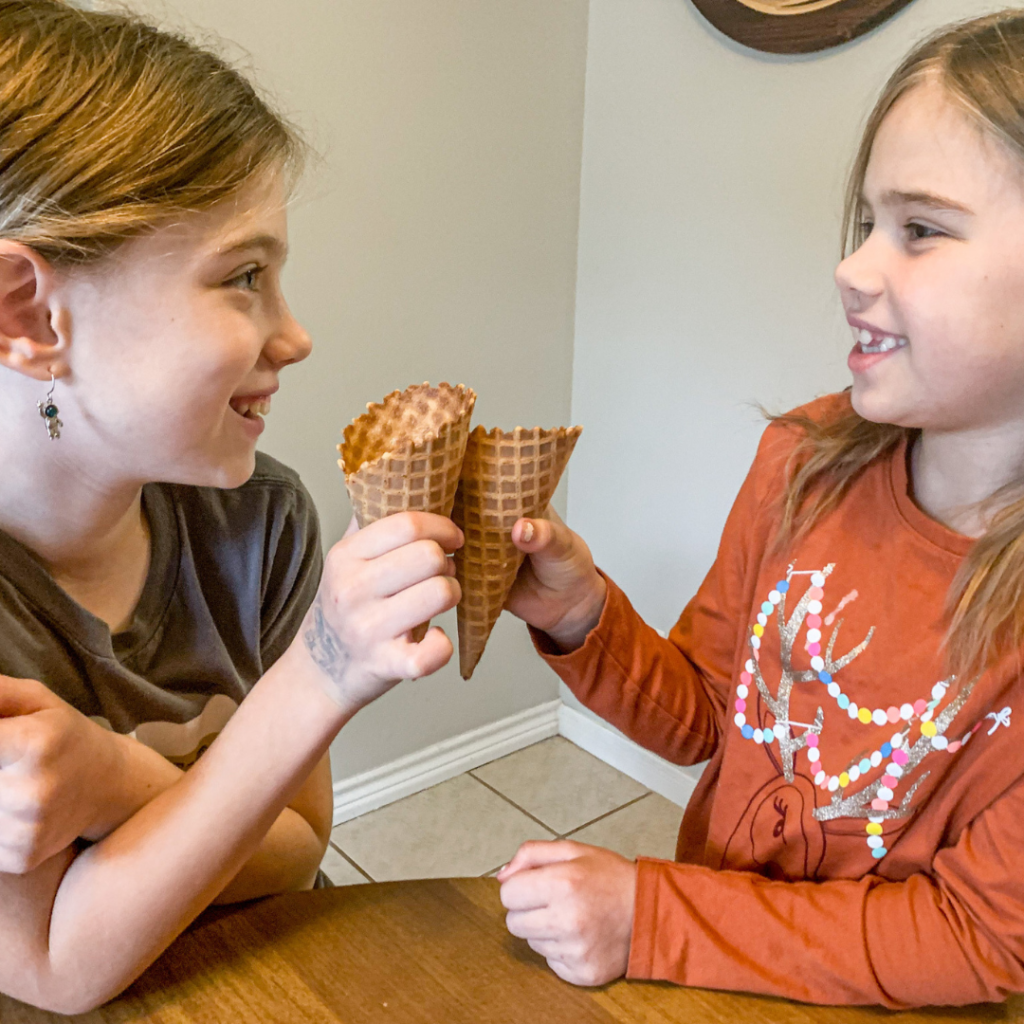
When I saw that the Vikings used drinking horns, I was certain there was a craft for that, but didn’t find anything! So, I came up with my own simple little snack to pretend we were Vikings.

You’ll need the triangular shaped waffle cones to be your horn. We filled ours with yogurt and granola to make a simple parfait, but you could definitely fill it with ice cream or something else.

That’s it! It was so silly and fun, and the kids loved saying “Cheers” before eating it.

Music

The DK find out! series had a page on the music that might have been played during Viking times. Over lunch one day I read through this page as we observed the different types of instruments and read about how they were used.

I found this GREAT selection of videos from YouTube that shared more about the same instruments and the guy hosting the video even played them. It was really neat, and it brought the instruments to life for us. The videos are short and sweet and made the instruments very memorable!

viking language arts

Language Arts

During this unit, I was re-evaluating our language arts program and trying some new things for my oldest daughter. While doing that, we were able to use the history books we read for a few language arts lessons, which was really a lot of fun.

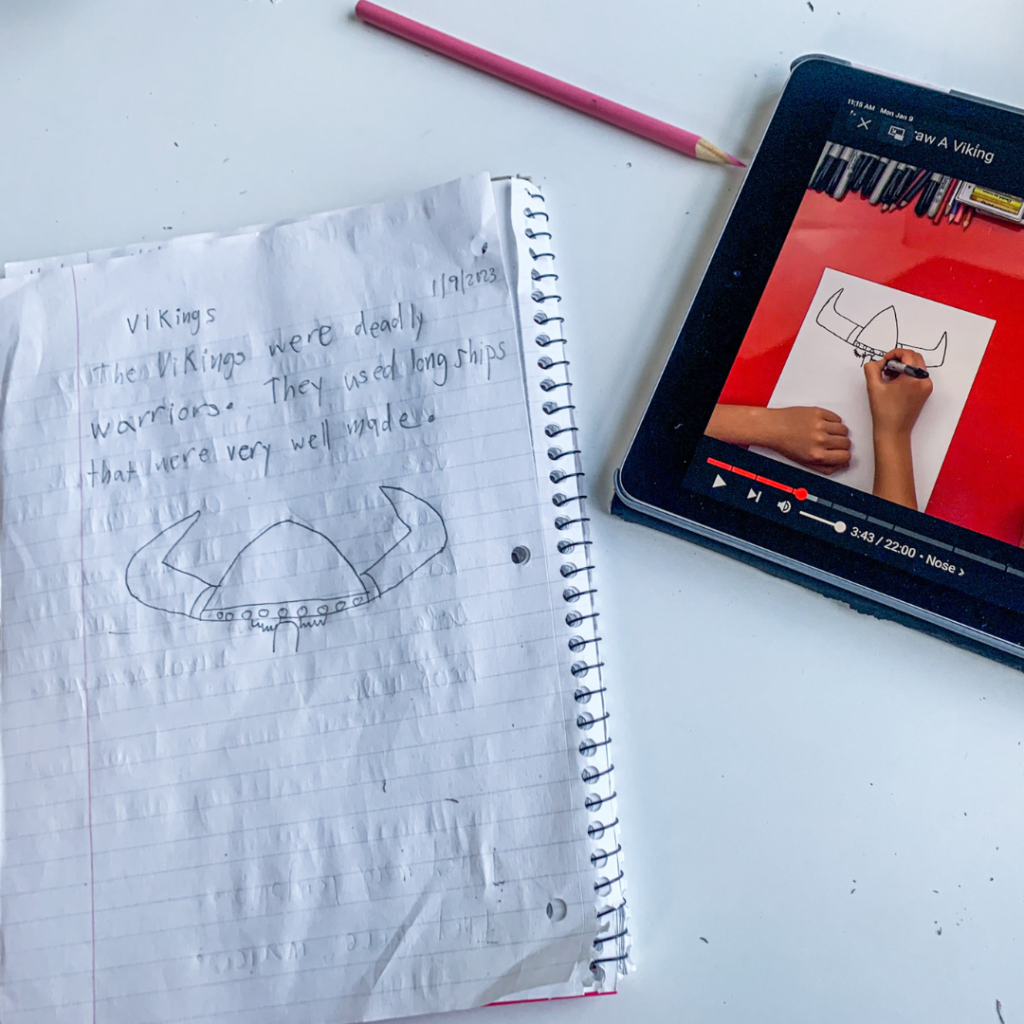
I would read a story about the Vikings from the library. Then, my daughter would write 2-3 sentences about what we read. I’d sit down with her and help her edit her sentences or add to them if we needed to.

As a treat, I’d let her add a picture from an online drawing video. I’ll link the two videos we used below:

This was really a great way for us to incorporate our studies into language arts and it really inspired me to do it more.

Notebook/Portfolio

At the end of each unit we do, I like to have the kids draw a little keepsake for our study. It’s very simple. I have them tell me about something they learned and write it down on the paper (Sometimes my oldest will write it on her own) Next, they draw a picture.

While we did this, we listened to an audio book about vikings, “How to be a Viking” by Cressida Cowell. This book was written by the author of the “How to Train Your Dragon” series. We learned that this picture book was the one that started it all!

We keep all of these drawings in a binder, and it’s so neat to go back and look at all of the things we’ve learned together over the year. This is my first year doing a portfolio like this, and I will definitely continue!

We loved studying the Vikings!

This was such a fun study for us. A couple random things to add in…We did watch How to Train Your Dragon 2 during our study because it’s technically about Vikings. I was actually kind of disappointed with it. The movie itself was fine, but the Vikings didn’t look like what we studied and they didn’t even ride in longships! So, that ended up being kind of a bummer for me. Maybe the first one is better about that? I haven’t seen it in a while.

This next thing is not really kid-friendly…but I’ll share anyway. During our unit study, my husband and I started watching the series called “Vikings”. It was originally produced by the History Channel but eventually it moved to the Prime app. We started it about a week before our unit kicked off, and it got me really pumped up to begin our study. JUST A HEADS UP – this show is very gory, creepy/disturbing at times (I’m talkin’ human sacrifices and such…yikes!), and there are some love scenes as well. Like I said, NOT child friendly at all. However, it was very fun to connect with my husband in a way that related to our homeschool studies! So, watch at your own risk…everyone has their preferences.

Well, that about does it for our history unit! I always hated history as a child, but I am loving it as I study with my children. I feel so blessed to have these days with them. Have you studied the Vikings yet? I’d love to know if you do any of these activities! Comment below or tag me on Instagram @simply.learning.together. I love hearing from you guys!

More Unit Studies

NEW – American History

Ancient Egypt

Ancient China

Space

Weather

Knights and Castles

Novel Units

The Secret Garden

Mrs. Piggle Wiggle

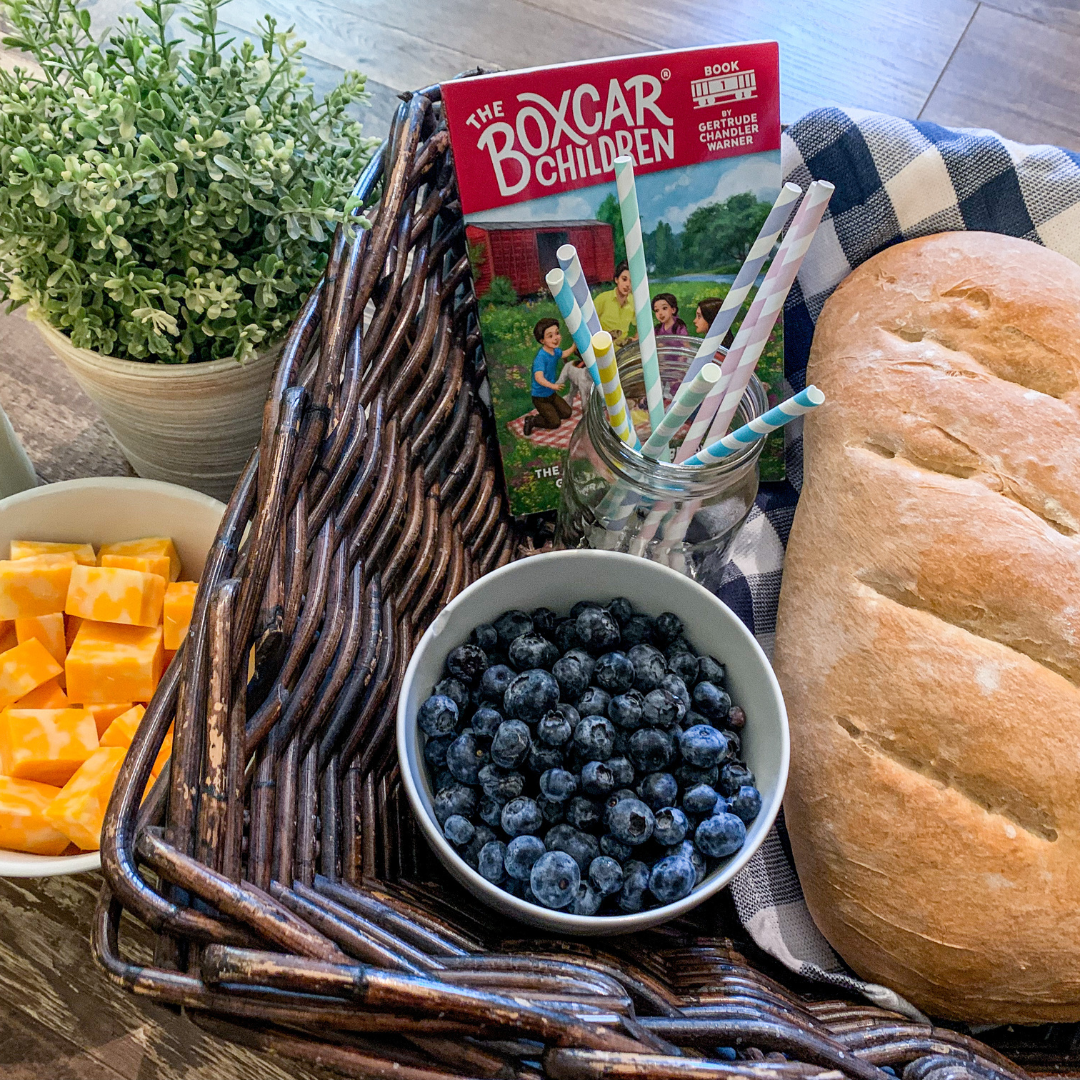
The Boxcar Children

The Courage of Sarah Noble

Posted on Leave a comment

The Boxcar Children – Novel Unit

The Boxcar Children is an adorable, classic novel to add to your homeschool routine. This novel unit will provide you with optional activities, crafts, and library topics to enrich the novel topics and themes.

This post contains affiliate links. If you follow one of my links I earn a small commission at no extra cost to you. Thank you for supporting my blog!

Experience it in the Home

The focus for this unit is “Experience it in the home…” The unit is designed so that you can add simple discussions, recipes, meals, and outdoor play to your day-to-day life while reading this book. These are related to the events in each chapter and provide a way for you to live out the book and experience it as a family…simply and easily.

science experiment

Experience it Across Multiple Subjects

There are also additional activities that you can choose to add on as you please. This would be for you to “Experience it across multiple subjects…” This may include crafts, science experiments, math activities or writing. These are all optional and can be completed at ANY time. (We know deep down the memory of a book never leaves us…save these for when it best suits your family)

Organized by Chapter

The novel unit is broken down by each chapter. Every chapter guide includes the following:

  • Summary
  • Discussion Questions
  • Crafts/Activities/Discussions
  • Library topics to add optional books to your study
tin can bell

Super Flexible

Everything is OPTIONAL! No required book list. No required supplies. This unit is so flexible. Pick and choose what works for your family. Most importantly have fun with it. Learn together from the character experiences. Enjoy digging deeper into a novel.

***DOWNLOAD THE BOXCAR CHILDREN UNIT***

More Read Aloud Experience Units

You can read more about the Read Aloud Experience in this post where I explain our very first one that our family completed for The Secret Garden. To download the free units, click the links below:

secret garden read aloud

More Book Activities

The Courage of Sarah Noble

Adventures of Reddy Fox

Caddie Woodlawn

Posted on Leave a comment

My All-Time-Favorite Laundry Hack

laundry basket

I feel like I’ve tried all the laundry tricks in the book – one load a week, complete it all on the weekend, every other day. Let’s be honest, I’ve even purged clothes throughout my whole house so I would possibly have less to wash! Even still, it feels like it never gets easier.

Well, over the last few months I’ve made one small change that has changed my laundry life for the better, and I’m so excited to share it with you.

This post contains affiliate links. If you follow one of my links I earn a small commission at no extra cost to you. Thank you for supporting my blog!

The Inspiration

My inspiration came from Kristi Clover, author of “M.O.M: Master Organizer of Mayhem“, who suggested that every person in the family have their own basket. I was so overwhelmed by laundry at the time that I couldn’t even think about doing that. Is there even enough space in the bedrooms? I have three girls in one room! Where am I going to get all these laundry baskets? These were all thoughts that were racing around in my head.

As a family of six, the laundry loads were always present, and I felt like it was impossible to keep up. However, I couldn’t stop thinking about what she said – the benefits she listed seemed so wonderful, and I really wanted to find a way to make it work in my own home.

Laundry Baskets

Of course, I immediately searched Amazon to buy cute little narrow baskets so they wouldn’t take up so much space in the house. They were so expensive! I just couldn’t buy new baskets because I didn’t even know if I liked this method yet.

To save money, I started with the baskets I had and made it work. I made the decision that my husband and I would continue to share a basket. Then, I had enough for each of my three girls. That took care of everyone except my two year old son.

The solution – an Amazon box! I’m serious! I used an Amazon box to hold his dirty clothes. I didn’t want to spend the money on baskets because it’s possible this method wasn’t even going to work for me! So, I set the box in a corner in his room and threw his dirty clothes in there each day.

Well, spoiler alert – it worked, and I loved it! Want to know something funny? My son used that Amazon box for about 3 months before I bought him a basket! (ha!)

The basket I bought him was small and only cost $2.50 at Target. So, if you’re not into the box solution, make a quick trip to target for a great deal!

I do keep a basket in my utility room for towels. So, for example, if a towel is in someone’s basket, I’ll pull it out and put it in my towel basket. When that basket gets full, I wash it! That’s really the only separating I do. We wash everything in cold water and I wash all the colors in it. Is it the best for my clothes? Well, possibly not, but I (nor my children) are wearing anything fancy enough for all of that extra laundry care.

Sorting Before You Wash

The trick to all of this is that the sorting takes place BEFORE you actually wash the clothes. To do this, I had to change my picking up habits. Prior to this, anytime I picked up clothes, I just threw them in the nearest basket or just straight into the washer.

Now, I take the clothing item to the specific person’s basket. This may seem like a hassle, but it’s really not that bad. Most of their clothes are in their room anyway. Or they might be in the bathroom next to their room. So, it’s just a few steps here and there to get it done. The fact that I’m keeping up with laundry makes it all worth it!

I also had to teach my kids about putting their clothes in their own basket. I thought this would take time, but they really picked it up quick, even my three and a half year old.

Smaller Loads

I run a load of laundry almost every day. Because of this, when a child is ready to wash their basket, the load is actually not that big. It makes the folding process quick and easy. Everything in the basket belongs to the same person and it can go right to the drawers.

Each of my children get their basket washed about once a week, and so far it’s been great! The only basket that needs washing more than once a week is mine, but it holds clothes for two people.

My Older Children Wash Their Own Clothes

I’ve always wanted to train my kids to do this, but couldn’t quite find the method to keep it consistent. Most of the time I was wanting them to fold, but there would be so many different items in the baskets. I’d spend a ton of time sorting everything in piles before they could even fold.

With the multiple basket method, that whole step is eliminated. Their basket goes in the wash. (I usually switch it to the dryer when it’s ready) and then they fold it on their own and put it away. Back to the smaller load point – it’s really not too bad for them because the loads are small.

My oldest two girls are the ones that can do this. They are 8 and 6. Their folding is not perfection and many times it gets folded inside out, but I’m picking my battles. They are learning such great responsibility, and it’s saving me time to do something else if I need to.

Scheduling

This method might even work great to assign everyone a day, but I’m not very good about that. I try to put a load in every day, and I usually just pick the one that is the fullest. After doing it for so many weeks, a pattern has started to develop, but it’s not super strict.

I Love This Method

Since I’ve started doing this method, I can’t remember the last time I felt overwhelmed by the amount of laundry that had to get done. I think it’s because the folding and putting away just became easier! Plus, I was doing less thanks to the help of my big girls.

I have three girls, and the constant separating of girls underwear, and girls socks, and shirts that are just one size apart was exhausting! It took so much time to look at every. single. tag. Now, that rarely happens!

Give this a Try

So, what do you think? Want to try this out? Or, maybe you already to this too? I’m telling you this was a game changer for maintaining my home and it’s been an active practice in my home for about four months now.

I never thought there would be a day where laundry wouldn’t bother me, but this little hack has really changed my mindset. The loads are smaller and it feels like there’s a whole lot less. I’m so thankful for other moms out there sharing what works for them, because it inspired me to make one small change. I hope that sharing this here with you can be an inspiration as well.

Posted on 2 Comments

Homeschool Morning Routine – Morning Checklist

morning checklist

Our morning checklist is the tried and true practice that has stuck around over the years. As homeschool moms, we are always adjusting routines and curriculum to better fit our needs, and although we have adjusted our checklist at times – the rules of it have stayed the same. It has been such a help for our mornings!

This post contains affiliate links. If you follow one of my links I earn a small commission at no extra cost to you. Thank you for supporting my blog!

How it Started

I first thought of the idea a couple years ago when I was listening to a podcast from Durenda Wilson. Unfortunately, I can’t remember what the episode was, but she talked about how important it was for her main living spaces to be clean and clear before she started her homeschool day. At the time, I could feel the weight of the mess in my own home and new this strategy could be helpful.

She also talked about the fact that the key to doing this is to not take it on alone! Get the kids involved. Set up routines and chores so that the whole family is working together and the pressure is not on mom alone.

The Constant Questions

The other problem I was running into was the questions I had to keep asking every single day. “Did you brush your hair? Did you brush your teeth? Is your room picked up?” Times that by four for each of my children, while I was trying to cook and clean breakfast – I was exhausted doing it!

This really drove me to teach them how to be more responsible about getting ready and how to help me in the house more.

checklist

The Morning Checklist

Enter the morning checklist.

I thought carefully about the things I wanted the kids to do to get ready and added that to the list. I also followed the advice of Durenda Wilson and set a goal to have our main living space clean before we started. This means we would work together to get the kitchen and living room picked up each morning.

It’s tempting to put a large list of things on the checklist, because wouldn’t that be the most helpful? However, I found it best for us to smart very small and eventually work our way towards a good quality list.

Breakfast

One thing I wanted to do was put items on their that will be easy to accomplish. For example, “eat breakfast” is on the list. I plan to feed them every day, so I know for sure they will be able to check that off with ease. I want them to feel successful and not defeated as soon as they start.

At breakfast my kids make a “cup for the day“. This is the cup to be used for the whole day. It stays on the table (or the counter) for them to use as needed. I implemented this cup idea because every time my kids were thirsty, they’d just grab another cup.

Some of the fault was on me too – I’d see a cup and put it in the dishwasher. The cycle of always needing a cup continued. So our “cup of the day” rule helps with that.

Getting Ready for the Day

To avoid all of the questions I was having to ask, I added to the list our daily tasks for getting ready. This includes “get dressed“, “brush your hair“, “brush your teeth“.

Now, this doesn’t mean I never have to question them. I have some kids that are really good about the checklist and others that need reminders. However, it’s better than managing all four by myself. No matter what they’re learning to be more responsible.

Morning Chore

The last piece of the checklist was the chore to help me prepare our home for the day. Remember my focus was the kitchen and the living room. So, I chose two jobs that my older two girls would alternate each week.

One would unload the dishwasher for me and the other would pick up the living room. So, their checklist states, “morning chore: __________________” and I write one of those jobs each week. It’s super easy to manage and they help me remember who’s doing what.

Now, at the time we started this my third daughter was only two. She was just learning about chores, but I wanted her to be a part of our family clean-up team. So, I gave the her job of picking up couch pillows. She’s done that same job every day for the last couple years. She’s almost four now and she’s probably ready to do something more, so I’ll be thinking of that soon I’m sure.

Our First Checklist

Did you catch all of the items on the list? I will list it out for you so you can see how simple and small we started. It was so helpful to do it in this way because the kids could accomplish the list, and I didn’t feel pressure of making them do all kinds of tasks in the morning.

  • Eat Breakfast
  • Cup for the Day
  • Morning Chore: ________________
  • Get Dressed
  • Brush Hair
  • Brush Teeth
checklist with pictures

Adjust the List for Each Child

I do adjust the list for each child as needed. For example, I drew pictures on my preschooler’s list because she can’t read it. They aren’t fancy. I just took my pencil and made a quick drawing.

Some tasks may need to be done by one child but not the others. We started my youngest daughter’s list with “throw away pull-up” on there, and she took care of that on her own every morning.

I’m also able to write things on the list if I want something temporary. For example, if my child has to take medication or if their lips are really chapped, I might add “medicine” or “chapstick” with a wet erase marker. Then we can erase it the next week.

Storing and Displaying

We keep our lists in a dry erase pocket. I’ve learned that the best place for them to be displayed is somewhere near me so I can help make sure everyone is on track. For our home this is the utility room door near where I’m cleaning up in the kitchen in the morning. This makes it easy for me to check on the kids as they finish their items.

The dry erase pocket has been so nice. They erase really well, and if I want to write anything temporary for a few days I just use wet erase markers.

Adding Items When We are Ready

As we have gotten used to our checklists, it’s been easier to add more items to it. For example, The girls’ lists now say “tidy room” and “make bed“. I don’t require a perfectly made bed. I just ask them to pull up their blankets and make it look nice.

This would’ve been great to have from the beginning, but at the time it was overwhelming. Once we had mastered our first list, it felt easier to add more. I also feel like this is a big reason why it’s been so successful – starting small.

Final Thoughts

Things come and go with our homeschool, but this is one thing that has consistently worked for us the last couple years. It makes my mornings easier, and everyone knows what’s expected of them.

When we take breaks from our homeschool routine, we usually skip the checklist and have more relaxed mornings. However, it’s the perfect thing to bring back into our morning a week or two before we start up again to kick everyone back in gear for school.

One new thing I did before we started after Christmas this year was I asked the girls if there was anything they’d like me to add? It wasn’t much, but those one or two items they added really gave them ownership of the list and got them excited for routine again. (If you’re curious what they added, one was “deodorant”, another was “vitamin”, and I think one was “feed cat”…which we don’t really have. It’s a barn cat that all the neighbors feed, but my daughter wanted ownership of that. I gave it to her! She loves it!)

Although we’ve done this for a while, we still have our not-so-good days when it comes to getting it done. We’ve had phases where I had to set timers to motivate them. I also have a couple that need lots and lots of reminders, at times. It’s not a perfect system, but it’s one that has been so beneficial to us.

Last thing – I really try to do the same things for myself to set the example. I used to not make my bed, but once I asked them to, I realized I really needed to do it too! I’ve even said things like, “I’m going to do my checklist” when I get ready. I don’t really have one, but they get it! We all have our responsibilities in the home.

What would you add to the list? Do you use something similar? If you try this out let me know how it works for you! Comment here or find me on Instagram @simply.learning.together

Posted on Leave a comment

Simple Preschool in the Kitchen

preschool in kitchen

Get ready for a list of preschool fun in the kitchen! These simple activities can provide a variety of learning experiences for your little one.

The inspiration for this really started a few weeks back when I could really sense that my almost-four-year old was eager to start learning more. I previously told myself I wasn’t going to start anything formal this year, because I wanted her to just be a kid and PLAY and have fun and pretend with her sisters! However, I was really feeling a push to work with her a bit because I knew she was excited for it.

Of course, I immediately began thinking of what kind of work she could do, but wasn’t sure how I’d fit in the time to sit down with her while also keeping my 2 year old happy. And then it hit me, “Jaimie – stop taking this so seriously, and just PLAY with her!”

So that’s what we did. I was so inspired that I spent all last week coming up with fun things for us to do in the kitchen together, her favorite place to be with me. Some of these activities include the option of different learning manipulatives, but others are just kitchen tools. We had such a blast, and you know what? It was perfect! The best part – when my two year old was with us, he joined in as well! That’s a win-win!

This post contains affiliate links. If you follow one of my links I earn a small commission at no extra cost to you. Thank you for supporting my blog!

Why Kitchen Tools?

I don’t know what it is about my kitchen tools, but my kids are always taking them and playing with them. Is that just in my house? They pretend and do who-knows-what with them, and unfortunately I lose a few.

What is so intriguing about the kitchen stuff? Maybe there’s something about it that makes them feel “big” or just like mom. It’s just the perfect, simple hands-on fun that requires no prep!

Take it from an experienced mother that is missing tools on a regular basis. (ha!) Set some rules and boundaries. We eventually had to do this, and they are pretty good about asking permission and caring for my kitchen stuff now. OR! If you don’t want them using your things, head to the dollar store. Make a kitchen tub full of utensils that you can pull out and play with at any time! (Here’s an inexpensive set from Amazon – but maybe take out the cheese grater and can opener for safety reasons!)

Mixing and Scooping

For this activity we used a mixing bowl, puzzle pieces, a whisk, and a measuring cup. Place all of the puzzle pieces in the bowl. Encourage your child to mix the pieces around with the whisk. Next, scoop a piece (or more!) out of the bowl. Talk about what it is – are you doing letters? numbers? colors? maybe animals? Ask questions about what was chosen. Then, place it in the correct spot in the puzzle.

We used two puzzles. One was shapes and the other was letters. If she drew a shape we talked about the name of the shape and it’s color. If she drew a letter, she identified it and we practiced the sound and gave some examples of words that start with that sound.

This was so fun, and she played until all the pieces were out!

Sorting

One morning I placed three identical bowls on the table and gathered up my magnetic alphabet letters. I picked three colors and set the rest aside. We mixed the three colors of letters in a cooking pot and used a cookie scoop to scoop them out and sort them into a bowl.

A cookie scoop! Something so simple, but it was such a hit. She did it over and over and loved popping the letter out by squeezing the scoop. I placed one letter of each color in the bowl when we started so she would know which color went to which bowl. We would talk about the letters she scooped. Sometimes we’d say the sounds. It was so fun!

My two year old saw the action and wanted in, so I just gave him a bowl of letters and the cookie scoop to explore. The cookie scoop now in his hands, my daughter begged to continue playing, so she settled for an ice cream scoop instead and had just as much fun.

I’m not sure why, but using real tools in the kitchen is a blast to them!

You don’t have to use letters. Craft poms would be great or if you have counting bears, that would work also. You could honestly take a sheet of paper, cut it into squares and crumble the squares in a ball. Don’t make this complicated. Use what you have! Here’s a fun idea! Write a color or shape on that crumbled paper and have your kiddo open it up and then sort it! I may do this again and try that!

Pretend Restaurant

Ok, so this one was a little silly, but we had a ball! You’re going to have to get in there and pretend right along with them. They’ll love it!

So we pretended to be at a restaurant while in our kitchen. My preschooler was the waitress/cook (I was her helper) and she seated her siblings at the kitchen table.

I prepped very quickly. First I had a big pot of colored blocks on the stove with a big spoon. Second, I had a baking sheet with the magnetic letters (A-Z) stuck to the sheet in a random order. I put that baking sheet in the oven – seriously! It makes the pretend play so real!

Do we need to have a safety talk? Please please please make sure your kitchen stove and oven are off. Also, be clear to your children that they can’t be touched or open without your permission in the future. OK, let’s keep going.

I told my big girls they could choose one thing – blocks or letters, and their order could be something like this…

  • “I’d like 4 blue blocks please.”
  • “Yes, I’d like an E and an X”

My preschooler was in heaven. She took one order at a time and then went to “her kitchen” and prepared them on a paper plate.

Once she got the hang of it, I encouraged her siblings to challenge her without frustrating her. So, maybe 2 red blocks and 4 green blocks. Or, an “A” and 1 blue block. We went back and forth ordering, and I’ll tell you what – guess who else wanted to play?! Her big sisters!

Want to know how I changed it for them? I made a quick menu of 6 CVC words for my first grader. She gave the menu to her siblings and they ordered a word. My daughter wrote it down, went to the oven, and made the word from the letters on the baking sheet and sent it to them. So fun!

My third grader (Yes, even she wanted in on it!) is fun to challenge. I gave her a pencil and paper and started ordering lots of things. She quickly wrote it down and then organized it on a plate. We had a good time making her work hard 😉

Sink Play

This is the one thing that will keep my toddler (2yo) busy for a long time, and my almost-four-year old loves it just as much. I have a big, wide sink, and I put two large mixing bowls inside of it. I put soapy water in one and water in the other.

Collect toys around your house that you don’t mind getting wet. Most recently we’ve done cars or dinosaurs. Do you have those floating bath letters? That would be fun, as well!

I place a good, sturdy chair in front of the sink for them to stand on and show my them how to wash the toys and rinse them off. I also make sure to give them a spot to set them to dry.

Their clothes may get a little wet and you might get some extra water around your sink, but the mess is worth it. This is a winner! It’s important to stick around nearby as some of the splashing can get slippery, so a hand towel on-the-ready would be a good practice.

Kitchen Tongs and an Egg Carton

I always have empty egg cartons handy. They’re great for paint because you can just throw them away, but one morning we used them to sort blocks.

I gave my daughter our bucket of colored blocks and a pair of kitchen tongs and showed her how to grab a block and put it in the egg carton. It’s so simple, but once again, so entertaining for little ones. My two year old joined her and they moved blocks from one place to the other while I got ready for the day.

Once she filled the carton we tried filling it with only one color. Then we tried one row red, one row, green, and one row blue. You could also do patterns or finding the same shape.

Just like some of these other activities, the colored blocks isn’t a must. Try unifix cubes or counting bears or Legos. All you need is something small enough to fit in the egg spot.

Flipping Pancakes

I found this idea online a few years ago, and it is the cutest! I did it with my older girls when they were little, and I was so excited to do it again.

First, I used a cup to trace a few circles on a brown colored sheet of paper. Then, I stacked about 3 sheets behind it so I could cut them all together to make lots of circles! Now, you have pancakes.

Write whatever you want on the circles. To be honest, all three of my girls begged to do this when I got it out, so I changed it up for each child.

For my preschooler, I wrote a letter on each brown circle. On the back of a few of them I drew a shape. (This was a little surprise for her) I spread the pancakes out on our griddle and got her all set up with a chair so she could reach. I called out a letter and she flipped the pancake with a spatula. I told her some of them have a surprise shape on the back, and she thought that was the best!

You can change up the surprise – make it a sticker or a stamp. She loved flipping them to find out. I think she played three or four times before I finally had to stop her so her older sisters could try.

Setting it up for the older ones was simple. I just put some of their math problems from the lesson of the day and wrote the answer on the other side. (Then of course we skipped that part in the workbook! The game took it’s place)

Float or Sink

This demonstration is very simple. I use a clear container, but you could also just fill up your sink. Fill the container with water and go around your house finding items to put in the water. Before you put an item in the water, make a prediction. Will the item float or sink?

This has to do with density. If an item is more dense than water, it will sink. If it is less dense it will float. You could talk about what density is, but that may be over their head. Take it as far as you want though. You never know how much they’re soaking in!

Pouring Water

This is one you definitely want to do when you have some space in your day. It can end up quite messy, but it’s only water so it won’t hurt!

I usually lay a couple of towels on the kitchen floor (or outside) and gather a variety of bowls, scoops, spoons, and cups. Next, I’ll fill one or two of the items with water. I show my child how to pour back and forth between bowls and cups, and then let them be!

There will be spills! But it’s just water. There are times when I just let them be on their own to explore and play but you could definitely be more intentional about it as well. For example, pouring 1/4 cup of water into one cup four times to demonstrate what 1/4 means. We like to play a game where I say something like, “How many of this cup do you think it will take to fill that bowl to the top?” We make predictions and test it out.

When you’re done and the towel is soaking wet, just use it to mop your floor up a bit! 😉

Playing is Learning

I had so much fun with my littles (and bigs!) in the kitchen this week. It’s crazy to me how much you can learn just by playing with a few letters or blocks. The best part – basically no prepping! (The pancake one took maybe 3 minutes to get ready) It was so easy to just grab this stuff in my kitchen and go!

Let me know if you try any of these out! Leave a comment or tag me on Instagram @simply.learning.together I love hearing from you guys!

Posted on Leave a comment

Homeschooling after the Holidays

homeschooling

The holidays have come and gone, and I have mixed feelings about starting up our homeschool again. First, I’m anxious to get back into our groove. I’m just craving the routine that provides a peace of mind for me and everyone else in my home. Second, I’m having a hard time letting go of the slow, easy-going days we spent together in December. I’ll miss that, and I’m so thankful for the time we spent doing it.

So, here I am knowing I need to plan and really kick things into gear. The day before we started school my husband and I decided to move our homeschool room (again!), so that was an unexpected but exciting change. Now, it’s a matter of figuring out how I want our days to play out and what my goals are.

This post contains affiliate links. If you follow one of my links I earn a small commission at no extra cost to you. Thank you for supporting my blog!

Morning Time/Morning Basket

We did a Christmas study for or morning time in December, and I loved it so much I purchased another curriculum from the same creator. We had such great conversations, and I learned so much with the kids that I was eager to do more like it.

We are going to try Foundations of the Bible by Driven by Grace. If you aren’t familiar with it, she created the program to go along with the Classical Conversations cycles. Now, we are no longer in CC, but the content is great for anyone! I’m so excited to get started.

I’m curious to see how we will work through it, since we are not bound to a week-by-week schedule through CC. We can move through it as quick or slow as we like, so I can keep you posted on how that goes for us. She lists many other sources to learn from (books, movies, children’s bibles) so I imagine I may look into that as well.

For our other Morning basket items, we will continue with our poetry book. (“Poems to Learn by Heart” by Caroline Kennedy) It’s not my favorite, but we all do really enjoy hearing what our poem of the day is. I really want to find something like we read last year, Sing a Song of Seasons. That book is so beautiful and we loved it! For now, we will stick with what we have.

Most days I throw in something related to our unit studies during our morning time. This is a picture book most of the time, and that has really been a great addition, so we will continue to do that. This is all based on what we find at our library.

christian light education math

Math/ Language Arts Curriculum Changes

I shared all of our curriculum choices for the year in a YouTube video, and we have made some changes here and there throughout the first half of our school year.

My third grader is now using Christian Light Education for math, and we love it! (We stopped Horizons math after 3 years of using it) Read more about that journey in my blog post.

She continues to use Learning Language Arts through Literature, but I’ve also added in a grammar practice workbook to help review different skills. It’s not spectacular, but it’s accomplishing what I want. Every once in a while I take a step away from the workbooks and do something different – like a lesson related to our current unit or something random, like diagramming, because I think it’s fun to spice things up here and there!

My first grader continues to use Christian Light Education for math. She worked hard to complete the Foundations A program from Logic of English, so we will be starting the Foundations B after the holidays (Read about Foundations A here) I’ve also purchased the handwriting book from Logic of English, Rhythm of Handwriting. I don’t think we will do this every day, but I noticed she was ready to start writing more, so we are going to try it.

mummify apples

History/Science

Looking back it’s so interesting to see how my teaching style has changed and adjusted this last year. For a brief background, we were in Classical Conversations for two years prior to this one, so this was my first time in a while to do my own History and Science choices.

I had an idea of what I wanted at the beginning, and we loved it, but as we have done more and more unit studies I am really discovering what I love doing and reading for our units.

If you haven’t seen any of our unit studies, check out a few of the ones below:

I am loving the unit study model for us, so we will kick off the year with a Vikings unit that I’m really looking forward to and I’m thinking the Middle Ages after that. Looking ahead into the spring, I have an idea of a couple more history units I may want to do, but I’m open to making changes as needed.

For science, I’m still deciding. Our first one won’t be until March, and we will be studying CHICKENS! We are planning to add more chicks to our flock, and I’m super pumped to get the kids more involved now that this is my second time around. Last year was our first time raising chicks and it was quite the learning experience.

So, technically I only have a loose plan until the start of April, and as we get closer I’ll plan more. I just don’t like to plan too far ahead because we change! Our interests change, our schedules change, the weather changes. I like to get closer to the Spring before I plan through the end of the year. I have possibilities in my head that I’ll be praying about but my final decision will come later.

Daily Routine

I’m not going to lie, after being out of routine for so long I really have to think about how we ended before break…Our schedule is not based off the time. It’s more of a loose rhythm. However, our routine changes with the seasons we are in whether that’s the ACTUAL season (winter to spring) or a season in our family (birthdays, napping schedules, health). Below is what has worked for us lately.

  • Wake-up
  • Breakfast
  • Morning Checklist/Chores
  • Independent Work
  • Morning Time
  • Outside
  • Math
  • Language Arts
  • Lunch
  • Catch-up/Extra Activity

We school four days a week and meet with a nature/adventure group on Fridays, and we plan to continue with that through the end of the year.

Slow Start

My plan is not to jump into everything at once. Honestly, after Christmas my brain just wasn’t quite ready to get into full swing with a unit study and all the planning that goes with that.

For the last few days I’ve been more strict about my kids’ chores and morning checklist so that we can get that situated before we start. (I’m hoping to get a post soon about our checklist.) Over Christmas break that kind of just washed away – which is fine! – but we know everything runs better when we all work together to take care of our home, and that’s an easy thing for me to work back in before we start.

Then, we will have a slow first week completing only our Morning Time, Math, and Language Arts. This will also be a great opportunity for me to get a feel for how our rhythm is working and if I need to make any changes.

My goal is to make a trip to the library at some point during our first week back so that we can collect the books for our upcoming Vikings unit which we will begin the following week.

Happy New Year!

Have you started planning ahead? Do you have any new goals? I’m not a resolution kind of girl, but I do love setting some new goals!

I have a few, and one of them is to write more blog posts! I have loved sharing more of our homeschool with you guys this last month, and I’m hoping to continue that through the start of this year.

I’m so happy you are following along with us and I wish you a happy new year! May 2023 be filled with beautiful memories with your family!

Posted on Leave a comment

The Christmas Pig – Book Review

book review

We read two novels together as a read aloud for Christmas this year. The first was “The Best Christmas Pageant Ever” (find the review for that one here) and the second was “The Christmas Pig” by J.K. Rowling.

This post contains affiliate links. If you follow one of my links I earn a small commission at no extra cost to you. Thank you for supporting my blog!

Why “The Christmas Pig”?

Well, I’ll be honest. As a Harry Potter fan, the author of this novel was a HUGE reason I wanted to try it. I haven’t read anything else by J.K. Rowling and I was so curious what another novel of hers would be like.

I also wanted a Christmas-themed novel. This book, of course, takes place during Christmas. It’s also a newer novel, published in 2021, so I was eager to check out a new story.

What is the Book About?

The book follows the adventures of a young boy and his toy pig. At the beginning of the story the boy goes through some difficult changes with his family when his parents split up. This leads him to become more and more reliant on the comfort of his toy pig.

Right before Christmas, his toys come alive and take him on an incredible adventure through the Land of the Lost to search for something very special, but he must make it back in time or else be lost forever.

Age Group

I read this out loud to my three girls who are 8, 6, and almost 4. My older two loved it and begged me to read another chapter every night. My four year old enjoyed it as well. I’m not sure how much she caught on, but she looked forward to reading each night.

I also enjoyed this book as an adult. There are some pretty abstract concepts when you get further into the book. I don’t want to give it away, but things like happiness, and hope, and ambition were terms used for some of the characters that really got me thinking deeply. I don’t believe my children could completely grasp what each thing was. However, they understood in a simple way. As an adult, it was just interesting to really wrestle with the different concepts in my mind as they related to the story.

Although this story is about a young boy and his toys, I do feel like middle school children (4th-6th graders) would enjoy this. There is a lot of adventure, and the story keeps you on your toes which I feel like would be something a middle schooler would definitely enjoy.

Warnings/ Concerns

I always like to share concerns about the book if I have any. A lot of times people want to read these out loud to children so it may be helpful to be aware of any red flags. This book really didn’t have many concerns for me so I’m really digging deep here to tell you some things.

The book kind of started a little sad and slow for me. Almost immediately we find out that the boy’s family is splitting up, and it doesn’t really give you that Christmas-spirit-feel. However, get a few chapters in and you’ll be turning pages quickly!

The word “stupid” is used a few times, but that’s about as bad as the language gets. I don’t remember any bad words coming up.

It may also be helpful to know that the Land of the Lost is mostly not a happy place. It could cause some fear in really young children, especially the Loser, which is the bad guy of the Land of the Lost. He is known to kill toys by eating them.

The only other thing I can think of is what I mentioned earlier about the words like “ambition” and “happiness”. It’s nothing bad at all. As an adult it really brought some depth to the story, but it may be harder for young minds to completely grasp.

An Honest Review

As I mentioned in the previous section, I felt like the book started out a little slow. Once we got a few chapters in, I really loved it. It was easy to read and hard to put down.

The chapters are very short, so we were reading 2-3 each night. If it wasn’t bed time, I probably would have read even more.

I love the way J.K. Rowling writes. The way she describes things is so detailed that you can actually picture it in your head. She makes the fantasy worlds seem so real that even I thought twice about what happened to a broken toy after I threw it out. It’s just crazy to me how she can make such an imaginary thing seem so real.

I highly recommend this book if you’re looking for an adventurous read this Christmas!

Listen to the Audio Book

The book was a little long for my taste (reading to little ones). We weren’t able to finish it by Christmas so I had the idea to get the book on Audible and finish it as we drove out of town on Christmas Day.

I am SO glad that we did this because the audio book was amazing! There was a different voice for every character as well as the narrator. There were also background noises which really made it feel like we were in a movie.

I honestly wish we would’ve listened to it from the beginning. It was so wonderful! My kids loved it so much and were so engaged. I need to find other audio books that are made like it, because we really enjoyed listening!

Just as a heads up – the Loser in the audio book is a little bit loud and scary. The shrill voice is quite ear piercing, but it really adds a level of excitement/fear to the story listening to it like that.

Final Thoughts

We loved this book and we loved the audio book even more! The kids were sad when it ended and actually asked to read it again the night after we finished.

I overheard them one day playing and imagining a whole scenario using the details from the book. I feel like that’s when you know it’s a good one. It’s one they still think about even after they’re done reading. It’s a book that expands their imagination and gives them an entire new world to play in.