Posted on Leave a comment

What is Homeschool Kindergarten really like?

kindergarten homeschool

Have you been researching about homeschool kindergarten and reading that it can take as little as 30 minutes? If you’re anything like me, this is possibly blowing your mind. What is homeschool kindergarten really like?

As a former classroom teacher, this was almost impossible for me to grasp. How could 30 minutes to an hour be enough to do all the things needed? I could not understand how it was accomplished.

Well, after a few years experience in our homeschool life, I can see how amazing kindergarten at home really is. This is my second kindergartener, and it is so neat to watch her grow. Every day is different and she does SO MUCH learning naturally through our conversations and her play. In this post, I want to explain how that happens.

Maybe you’re not new to homeschooling, but you’re wondering the question that pokes at a homeschool mom’s mind every so often —

“Am I doing enough?”

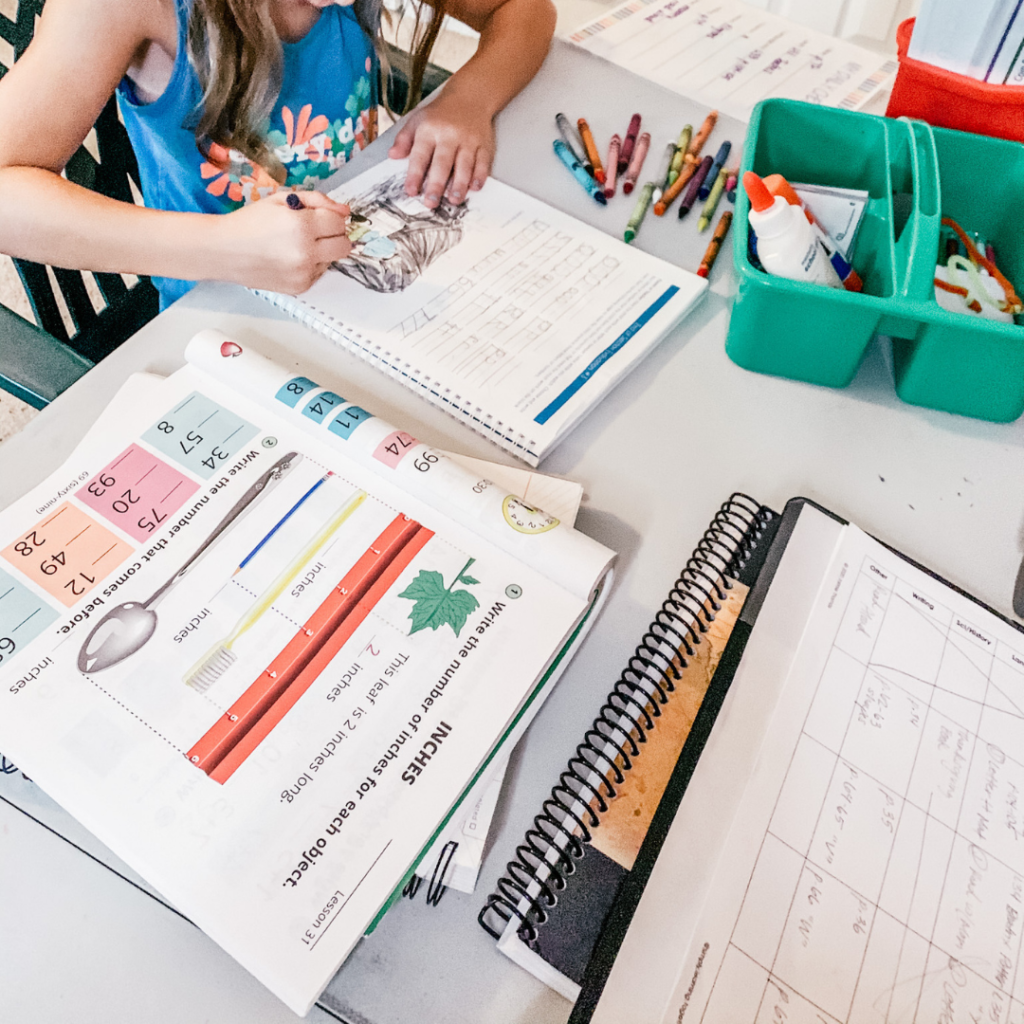
This question stopped me in my tracks today. It was 10:15 AM, and my kindergartener finished all of her school work. (See what we are using for kindergarten in this post.) We started at 9:20 and had a break or two in between! As I paused to warm my coffee up for the umpteenth time, I asked myself, “Am I doing enough?”

You see, what I failed to remember was how much learning takes place beyond our table of books.

The questions in the car, the imaginary play, the quiet time creativity, the chores, the cooking help….all of it is learning! And so much of it!

On this day, I decided to focus on all of the little teachable moments we had beyond our school books. It really made me grateful for all the time we have together to do this, but it also reassured me of how much learning takes place in our day.

I want to share with you what our homeschool looked like on this day that I began to question myself.

Keep in mind none of the discussions or activities that came up the rest of the day were planned! It can be terrifying to think that, but once you see how much can take place naturally, you will understand the beauty of it.

Think of this like a peek into the life of a kindergartener “after school”.

Once our school work is finished we head outside. I usually take care of the garden or anything in the yard that needs it. This time in the sun is so important for our day to go well. It’s important that I soak up the sun a bit too, so I decided to get a few things done while we were outside.

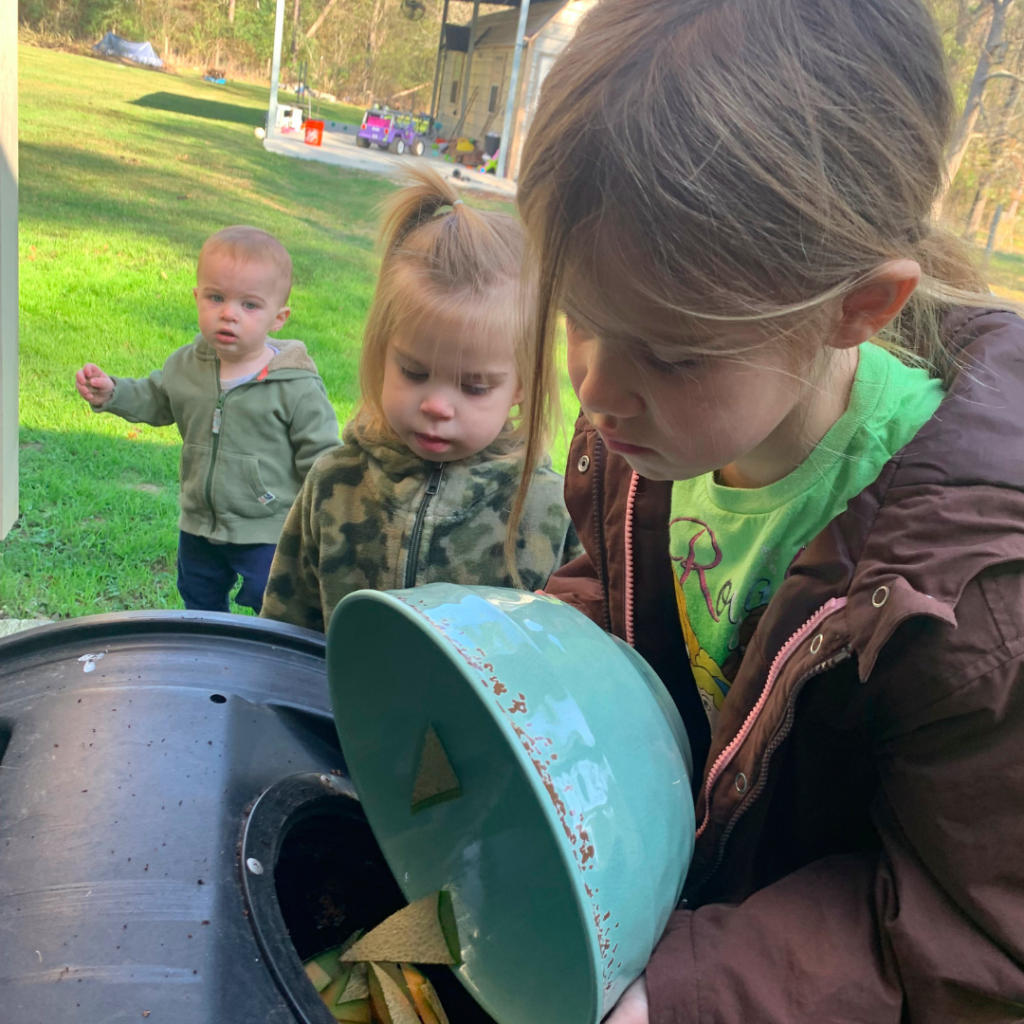
We added to our compost and talked about it’s purpose.

Why do we add this in here? What happens to it? How is it helpful for our home? These are all questions that came up. See the spontaneous science lesson taking place? Next, we mixed the compost around and observed what was inside. We gave examples of where we might use it in our yard.

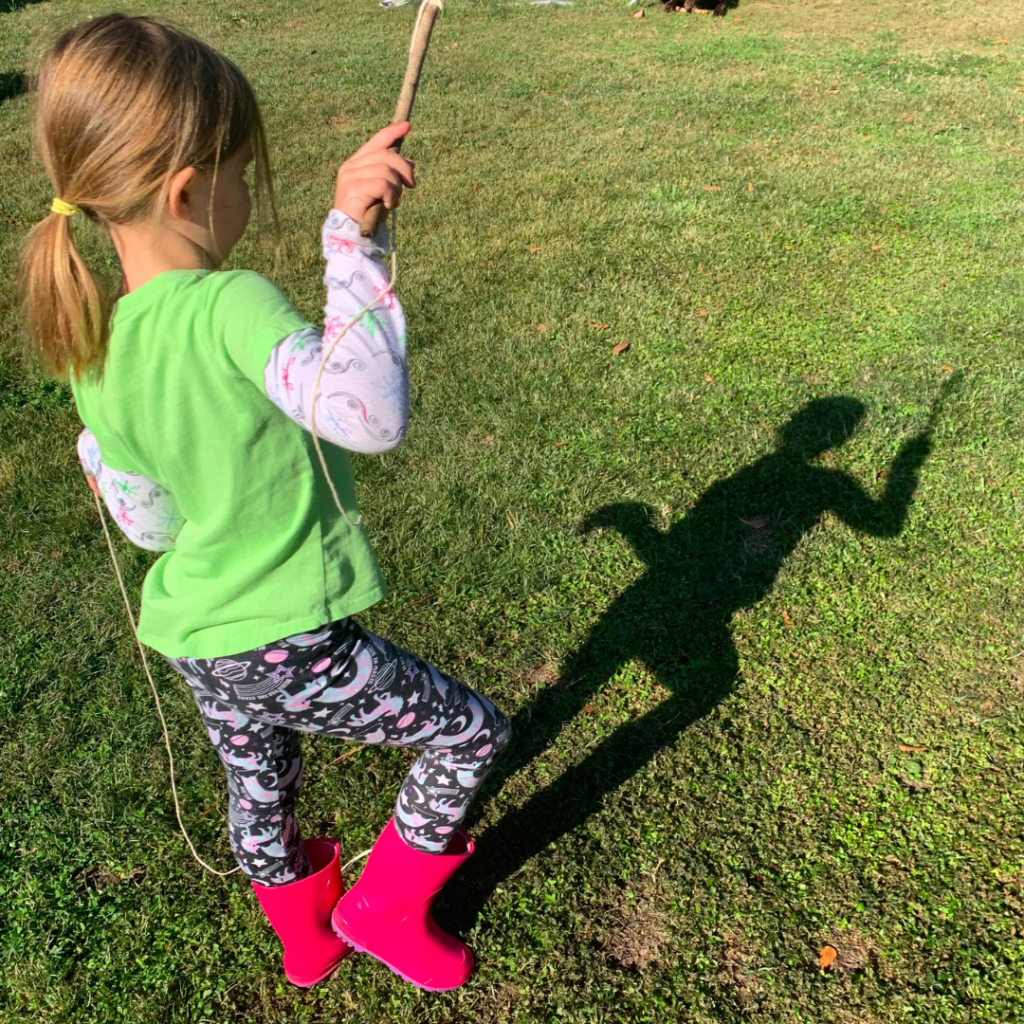
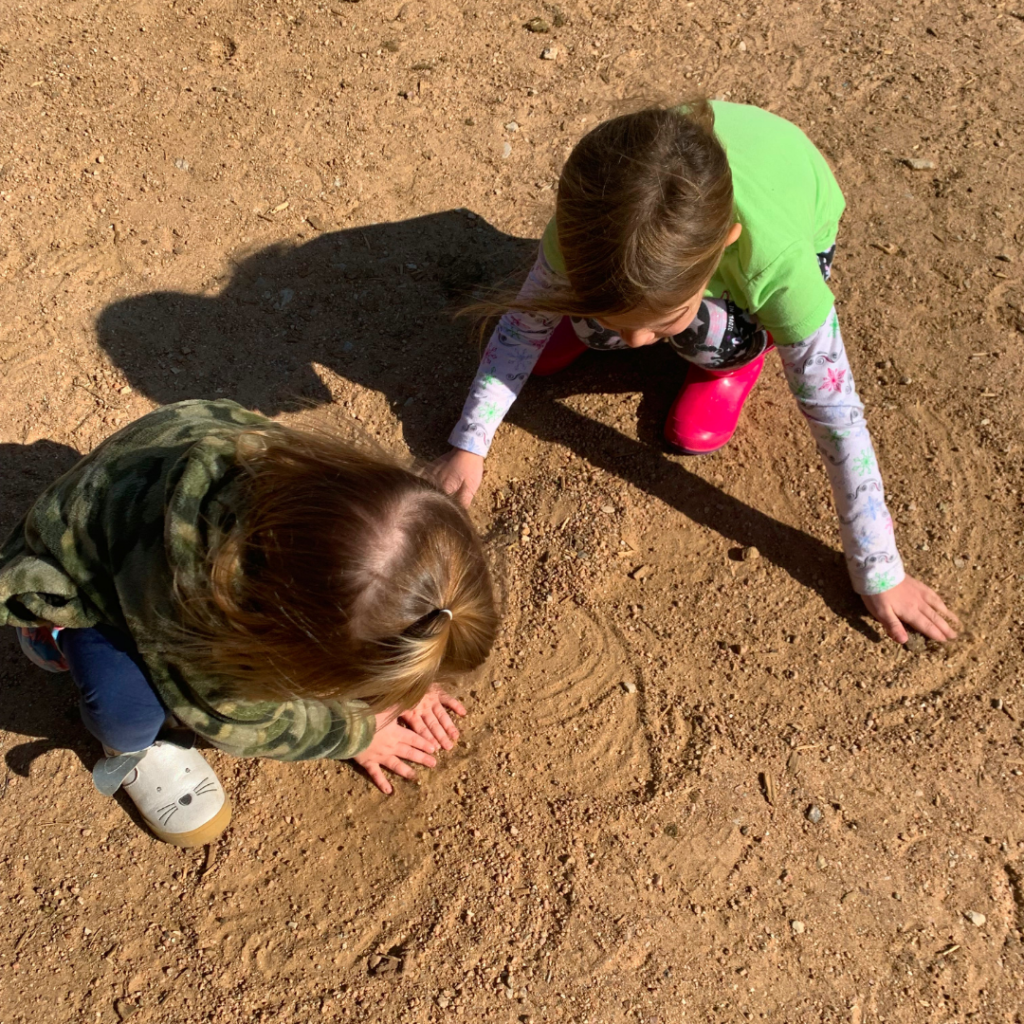
Not long after that, we discussed our shadows.

My daughter started playing with a stick connected to a string and was waving it around, watching the shadow on the porch. So we went out into the yard and looked at our own shadows. We discussed how the sun has to be in a certain place for you to actually see your shadow. We turned around and saw that in action. My 3 year old even participated and loved making poses for her shadow play.

At this point, we’ve been outside for almost an hour.

All the kids were immediately drawn to the lesson Dad was about to lead.

Who knew a car jack could be so mesmerizing? We watched as he slowly lifted the truck off the ground. Next, we watched him check the wheels and listened as he told us what he thought was wrong. It was a total of about 10 minutes, but I’ll tell you this – we talked about car jacks and their job at least 5 more times throughout the day!

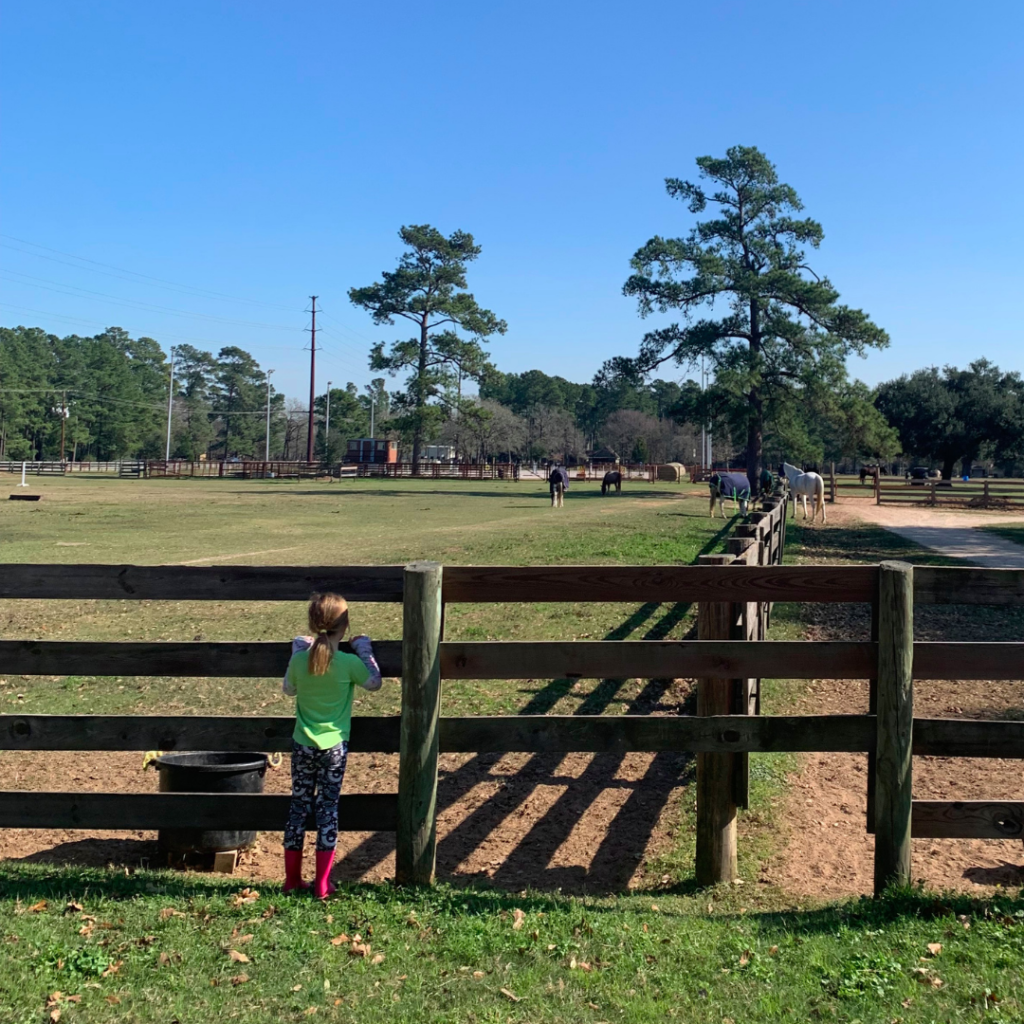
Moving to the next part of our day, my oldest daughter had riding lessons, so we headed to the stables to pick her up. As we waited, we observed the horses in the pasture and noticed that quite a few had blankets on.

This led to a discussion about weather and the needs of animals, specifically horses.

We watched as my oldest daughter helped remove all of the blankets, since the day was warming up. We don’t sit still for long…

A sensory bin from nature at your service!

A mixture of sand and rocks made for a good time while we waited. The rocks were all different and some even shined in the sun. They made sounds when we rubbed them together, and they were all different shapes and sizes.

Time for lunch!

Can you believe that? Scroll back up and adventure into the morning we just had. How cool to experience all of this. I’ll be honest, not every day is like this, but WOW this was just what I needed in the moment. Thank you, God for this wink of encouragement.

It was PBJ day, and I always let the girls make their own. This is an important skill and although her sandwich may not have been pretty, she continues to get better at it, and I have a free hand to help my little ones.

Free play after lunch led to a creative Barbie playground.

I love buying gifts that I know all of my kids will play with. For Christmas this year, I bought Quiet Time

My kids all have a rest/quiet time. I love getting them from their rooms when it’s over because they are so creative with their time. They’ve built something, drawn something, written something…they have the freedom to do whatever and I’m always impressed by the outcome.

A mini-lesson at dinner closed out our day

I had no plans of getting help with dinner from my kids, but my kindergartener had plans of her own. As she saw me measuring ingredients, she begged to help. In that quick 5 minutes of cooking we discussed measuring cups, compared teaspoons to tablespoons, and smelled and tasted multiple spices.

Every day brings its own unique learning experiences

Some days are filled with great conversations and little mini-lessons throughout. Other days are more relaxed, but on THIS day I was filled with joy as I saw all of these experiences play out. Is 30 minutes enough? Yes, yes, 1000% yes!
If you are new to homeschooling and trying to figure out your days, start SMALL and simple. Stick to the basics first, because you can always add more later. If you are interested in what we are doing for kindergarten you can read about it here.

If you’re in the middle of your kindergarten year and feeling overwhelmed with tasks and workbooks, I hope this might inspire you to consider simplifying your day. Just try it for a week! Watch the natural learning explode!

This post contains affiliate links. If you follow one of my links, I earn a small commission at no extra cost to you. Thank you for supporting my blog!

Posted on 4 Comments

The Courage of Sarah Noble – A Homeschool Read Aloud Experience

courage of sarah noble

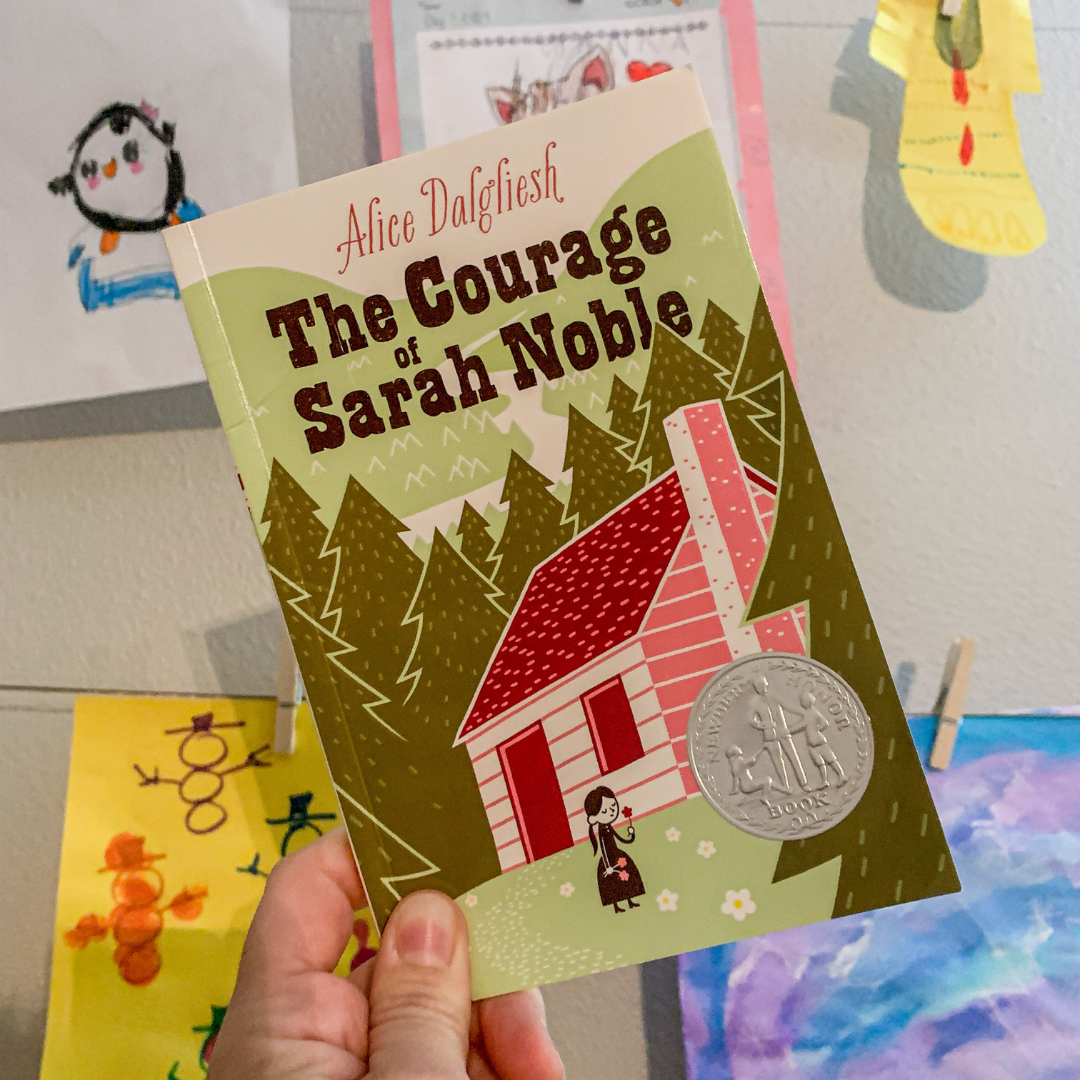
The Courage of Sarah Noble is a super short, sweet story of a girl and her father. Based on a true story, Sarah and her father must travel long distance to begin making a new home for their family.

In this post, I want to share with you a variety of simple activities you can do at home while reading this book. The activities are designed for you and your children to experience the story a little deeper. By making it available to you in this post, I hope you are encouraged to pick and choose the things that fit best for your family.

Everything is optional. Books are wonderful and educational just as they are, but every once in a while I love to dive a little deeper with my kids and see what sort of fun we can have together through the readings of the story. That’s what I’m here to help you do.

Follow along chapter by chapter for different activity suggestions. Complete them as you read or wait until the end. Read four days of the week and save the fifth day for fun! Everything is meant to be flexible for you. Activities include something as simple as a discussion to tasks a little more involved, like a craft.

Chapter 1:

NIGHT TIME SOUNDS: Sarah and her father have to sleep in the woods on their journey. The sounds of the night scare Sarah. Head out to your backyard when it gets dark. Be very still and quiet and listen to the sounds of your neighborhood/home. What animals do you hear? Do you think Sarah heard the same kinds of sounds?

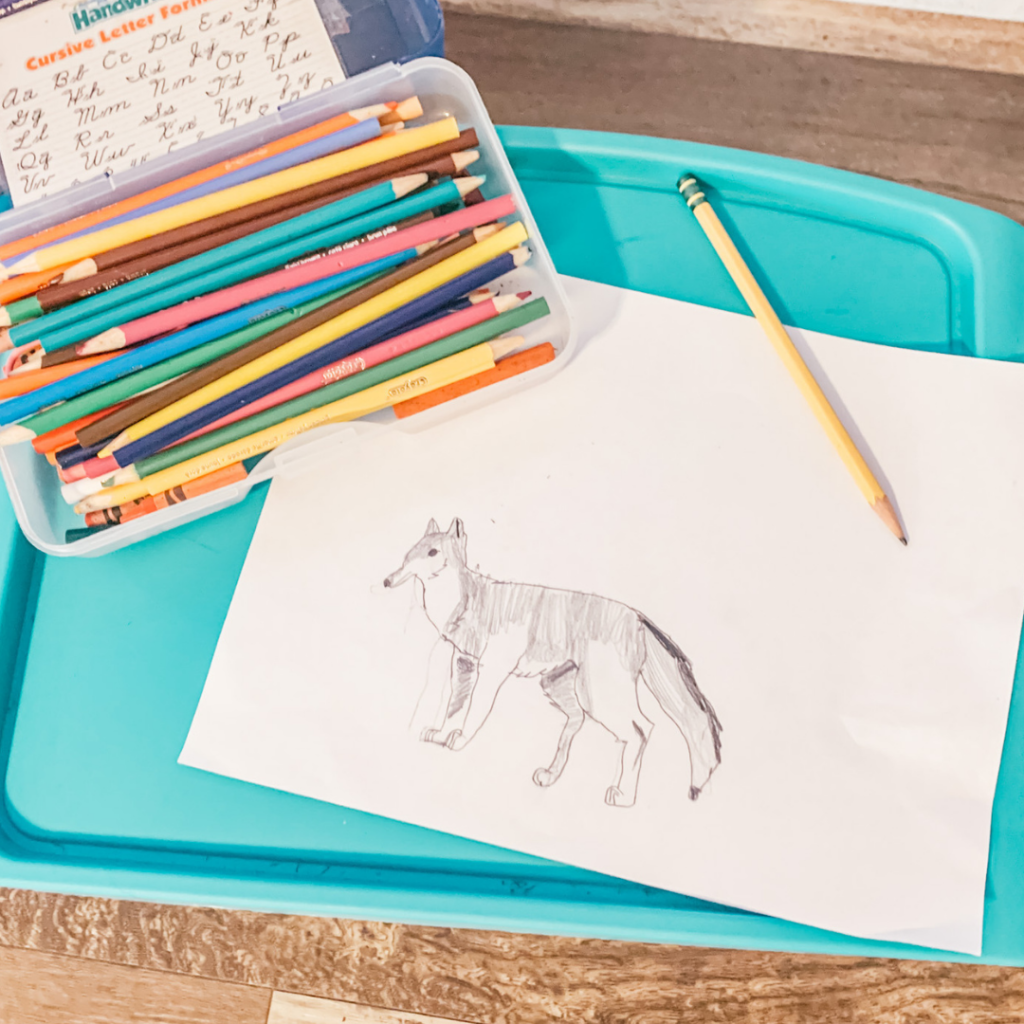
ANIMAL RESEARCH: Sarah’s father lets her know that she hears a fox and a wolf as they are trying to sleep. Learn a little more about one or both of those animals. Watch an educational video on YouTube. Check out books from your library. Draw a picture of one or both. You can copy it from a book you have or check out Art for Kids Hub for an easy drawing tutorial:

Click HERE for a wolf drawing.

Click HERE for a fox drawing.

Chapter 2:

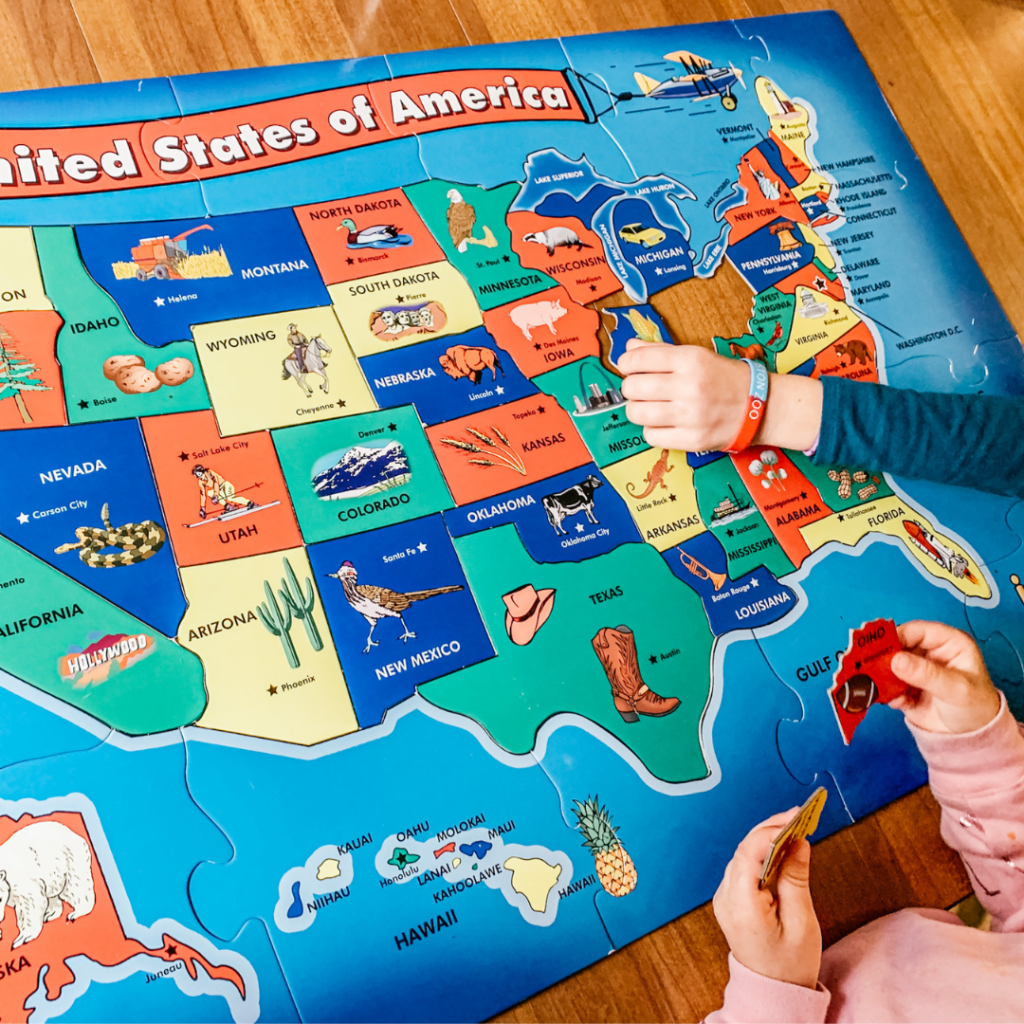
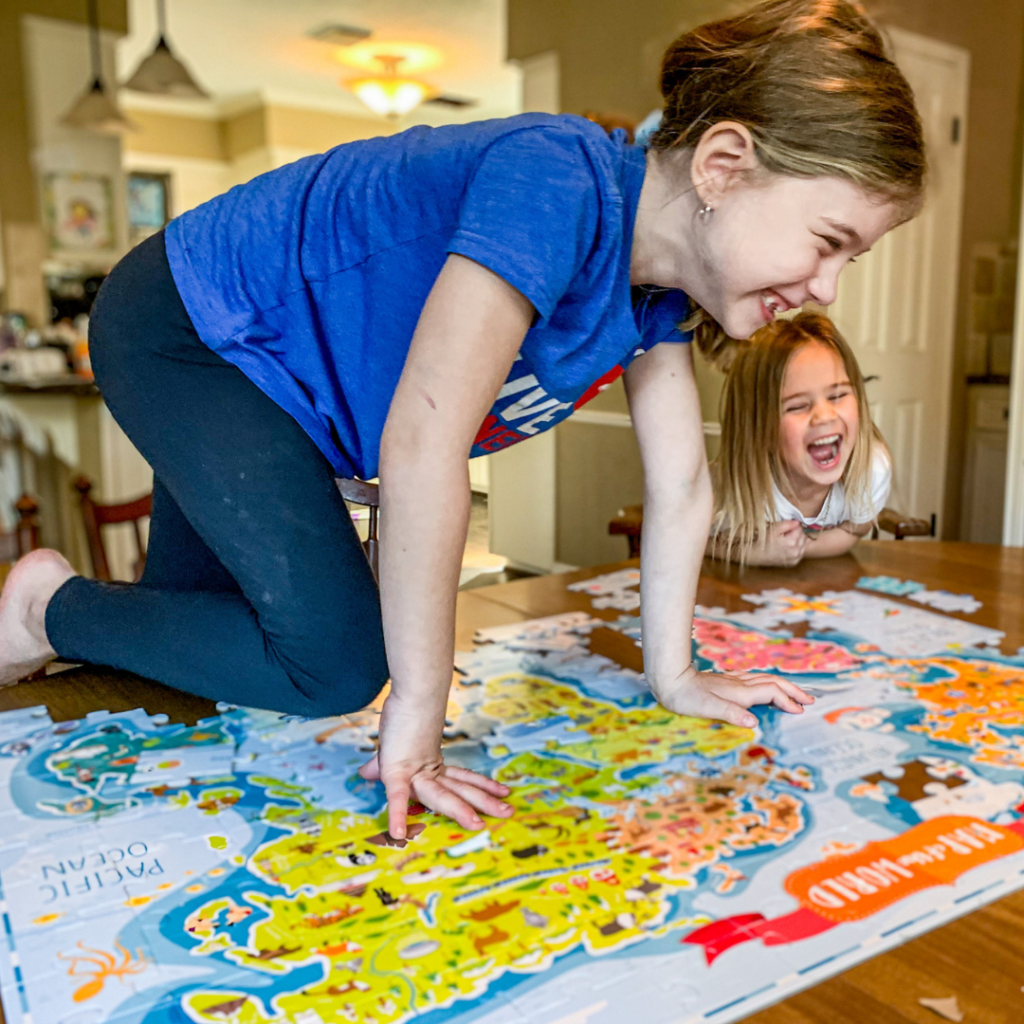
MAPS: In this chapter, we find out that Sarah and her father are traveling from Massachusetts to Connecticut. Complete a US Map puzzle together and point out these states. (This puzzle is our favorite.) Then, point out where you live!

FOREST DREAM: At the end of the chapter, Sarah describes what seems like a dream full of trees. Imagine what this might look like. Draw a picture OR get out paints. Watercolors would be fun and less mess! She mentions men moving in the background. Add it to your drawing/painting. Who might those men be?

Chapter 3:

KINDNESS: Sarah and her father recall the mistreatment they experienced at the settlement. Over and over, Sarah’s father talks about the importance of kindness. Keep this activity simple. How can you show kindness in your home? How about at the park? Or while you are with friends?

Check out this blog post for a list of books about kindness. You may have some at home or visit your library website and see if you can check them out.

Lastly, consider spreading kindness in your home or outside of it:

  • write a letter
  • deliver baked goods
  • offer to complete someone’s chore
  • write a thank you
  • let someone else go first
  • share your toys…the list could go on!

Chapter 4:

JOHNNY CAKE: Sarah is so excited to eat something besides dry johnny cakes! Have you ever tried them? Visit this site to read a little bit of history and for a recipe to make your own. Would you love eating them all the time?

ANIMAL RESEARCH: Animals are always so fun to learn about. Just as you may have done before in chapter one, you can look into skunks, especially if your child(ren) enjoyed the research. Your local library, personal library, or even YouTube may have some great information to look into.

Complete a super simple skunk craft by following this video. Be sure to check it out. It’s more than just a drawing and would be really easy to put together.

Chapter 5

NATIVE AMERICANS: Sarah observes the Indians near her new home. She notices their houses built of bark. Check out the book, “North American Indians.” and learn so much about history and the way different tribes lived. See an example of the different homes they built and learn about their lifestyle. This is a fantastic history book to add to your library.

BIBLE STORY: Read the story of Samuel together with your family. Find it in your Bible in 1 Samuel 3:1-21. Talk about how the Lord spoke to Samuel.

Chapter 6

LANGUAGE: Do you speak more than one? Can you speak a few words in another language? The chapter is titled “Friends”. Did you know that friends in Spanish is “amigos”? Visit www.signingsavvy.com and see how to say friends in American Sign Language. What other languages would be fun to translate the word “friends”?

Chapter 7

MAPLE TREES: Are there maple trees where you live? See them in person if you can. If not, look up pictures or read about them in books. In the fall, the leaves turn beautiful colors.

If you feel up to a painting craft, check out this fun, easy broccoli-print maple tree.

Chapter 8

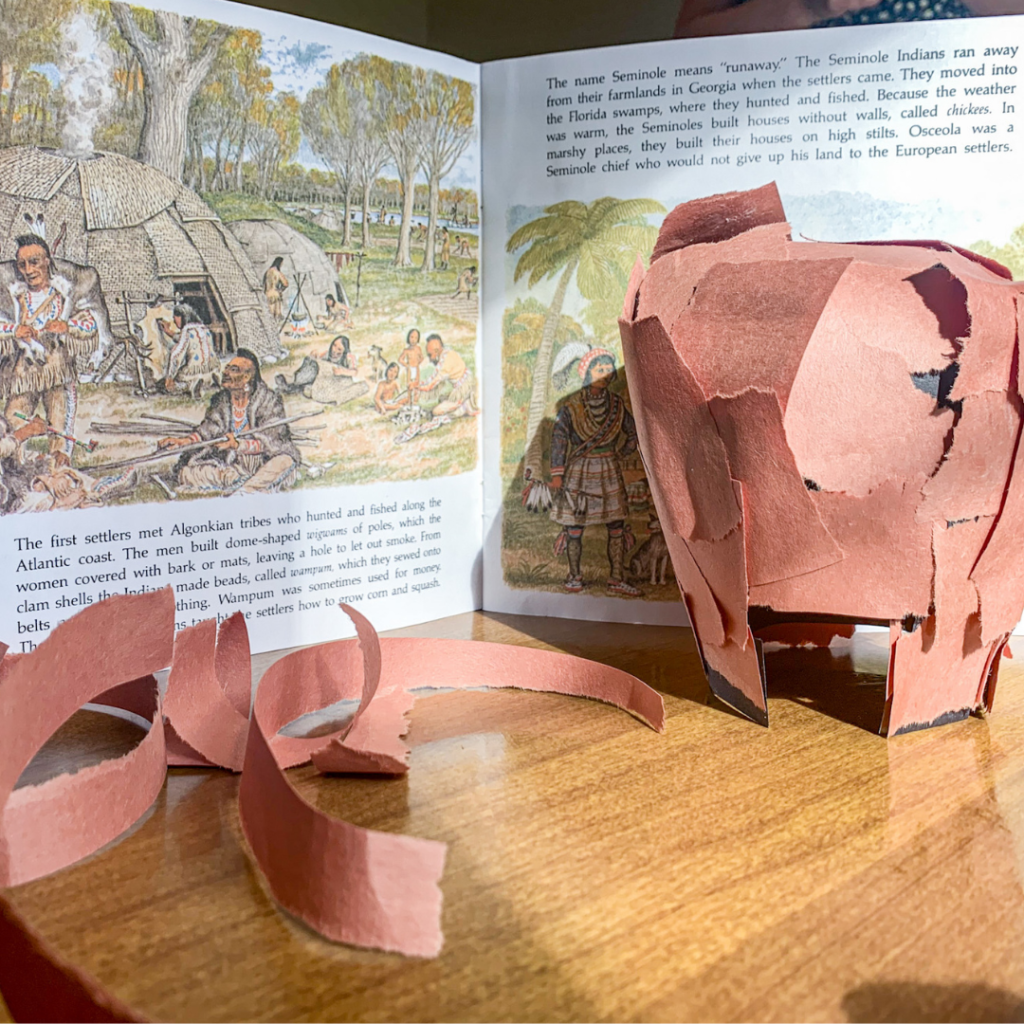
NEW HOME: Sarah finds out she has to live with the Indians temporarily. Based on her description of their homes, the location, and the illustrations in the book, we can assume that the home might have been similar to a wigwam. Construct a wigwam home that is similar to this out of construction paper. See this blog post for full instructions. What might it have been like to live in a home like that?

Chapter 9

BASKET WEAVING: Sarah learned many new things staying with the Indians, including how to weave her own basket. Try making these simple woven bowls with paper plates and yarn.

Chapter 10

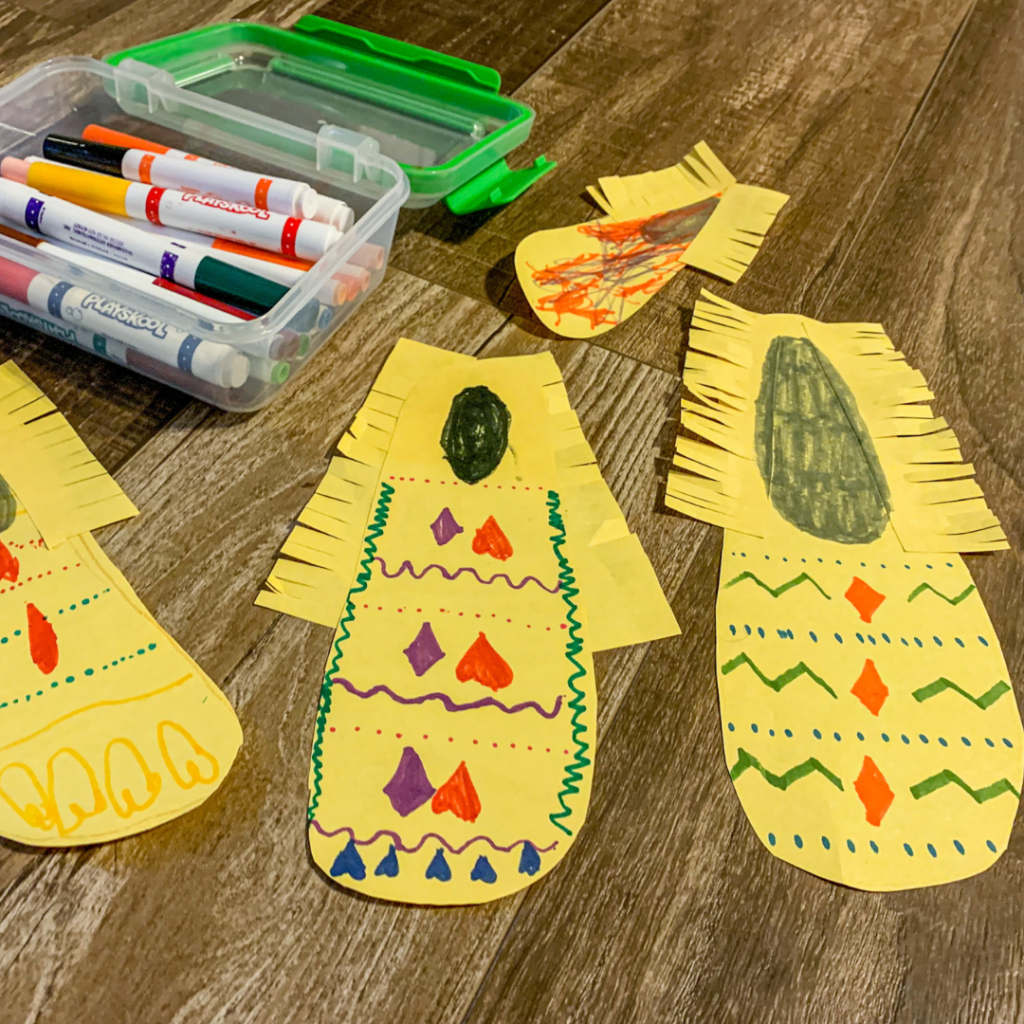
MOCCASINS: Read about moccasins from Brittanica Kids. Do an online search for images of different kinds of moccasins. How were they decorated? What were they made from? Make a simple paper moccasin. Trace your child’s foot onto yellow construction paper. Cut it out and let your child decorate the top. Next cut strips of paper about an inch thick. Cut mini strips to create a frilly look. (See the image above) Use a glue stick to add the frill to the shoes.

Chapter 11

GROWING UP: Sarah thinks she wants to be a teacher when she grows up. Talk with your children about what they want to be when they grow up. What do they hope to accomplish? What did mom/dad want to be when they grew up?

Simple, Flexible, and Fun

That’s what I want this to be for you and your family. Do as little or as much as you’d like, and most importantly enjoy the book with your sweet kiddos.

If this was helpful for you or if you have an interest in more like this, I’d appreciate it so much if you let me know. Leave a comment below. Send me an email jaimie@simplylearningtogether.com. Or, reach me on Instagram @simply.learning.together.

As always, I love seeing all of these activities in action from your families! Please tag and share with me on social media. Seeing you guys enjoy these at home brings me so much joy!

Looking for more novel-based units?

If you like a variety of activities like this, check out my Read Aloud Experiences. These novel units walk you through each chapter and provide multiple ways to experience the book inside your home.

Read Aloud Experience Units

Language Arts Without All-in-One Curriculum

A few years ago, my family ditched the all-in-one workbooks and focused on novels for our language arts study. It’s been the best decision, and we actually have fun learning the subject! After forming a good rhythm in my own home, I now have multiple novel units available for purchase as well. These units take you through a novel with chapter summaries and discussion, provide enrichment activities and literature, AND they will help you hit all the parts of language arts including spelling, grammar, vocabulary, and even some writing! Don’t miss these!

Download a free sample.

See more novel units.

More Literature-Based Curriculum We Love

American History Through Picture Books

Science Through Picture Books

Picture Book Studies (Grades K-2 Language Arts Curriculum)

Posted on Leave a comment

Simple Homeschool Activity: Seasonal Themed Self-Check

christmas self check

It’s just after Christmas, and I have the cutest activity to share with you, but don’t think this is just for Christmas! Scroll down and I’ll show you how you can use this at any time of year.

Somehow, the Christmas season always gets BUSY. It’s hard to fit things in. I usually start my December imagining all of the beautiful Christmas crafts and ornament making that we will do in our homeschool…and then the days fly by and I haven’t done one of those things!

This year I chose to keep it super simple. I didn’t in advance (besides choosing our advent study), and I threw things together as they fit into our day. One of the things we did was add a simple self-check tool to mix up our lesson and add a little festive fun to our day.

This post contains affiliate links. If you follow one of my links, I earn a small commission at no extra cost to you. Thank you for supporting my blog!

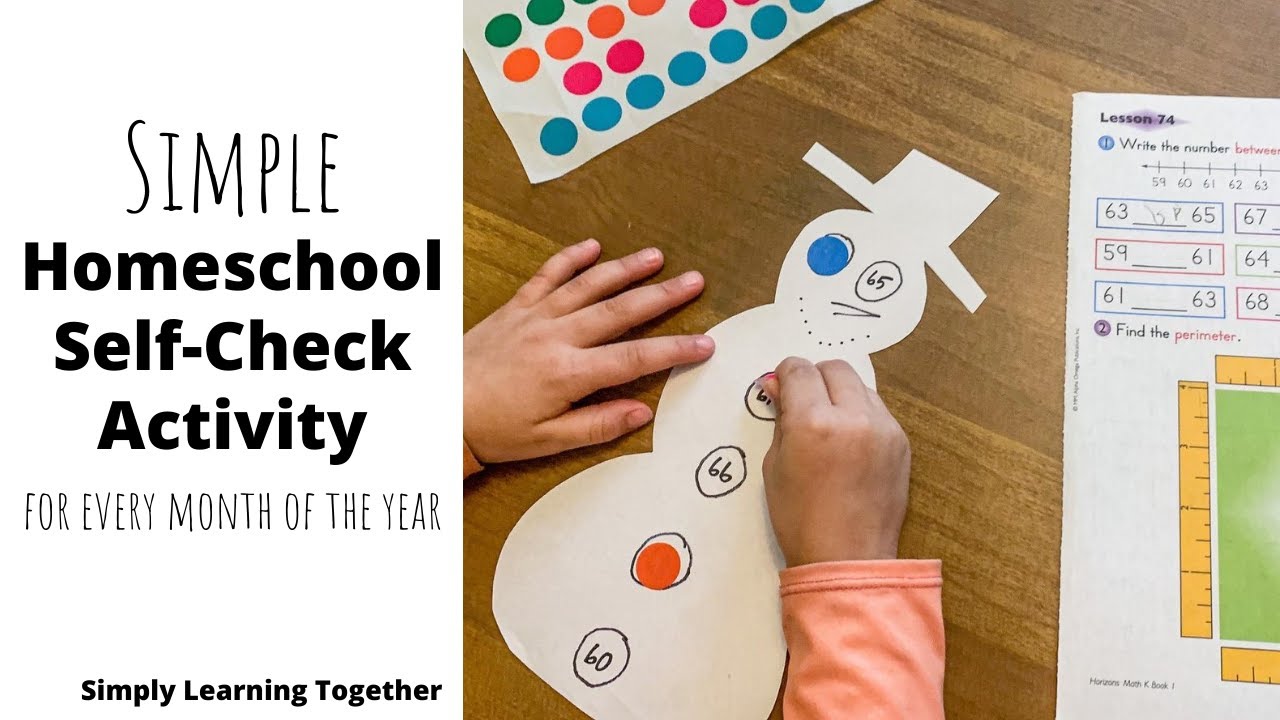
This simple self-check activity can be done with practically ANY subject.

It’s a way for your child to check their own work and correct as needed. I love doing this, because it means I don’t have to check over as much that day (yay!) AND it provides my child with an opportunity to problem solve when they can’t find their answer. Let me explain.

You need just a few things to put this together…and maybe about 2 minutes of prep time.

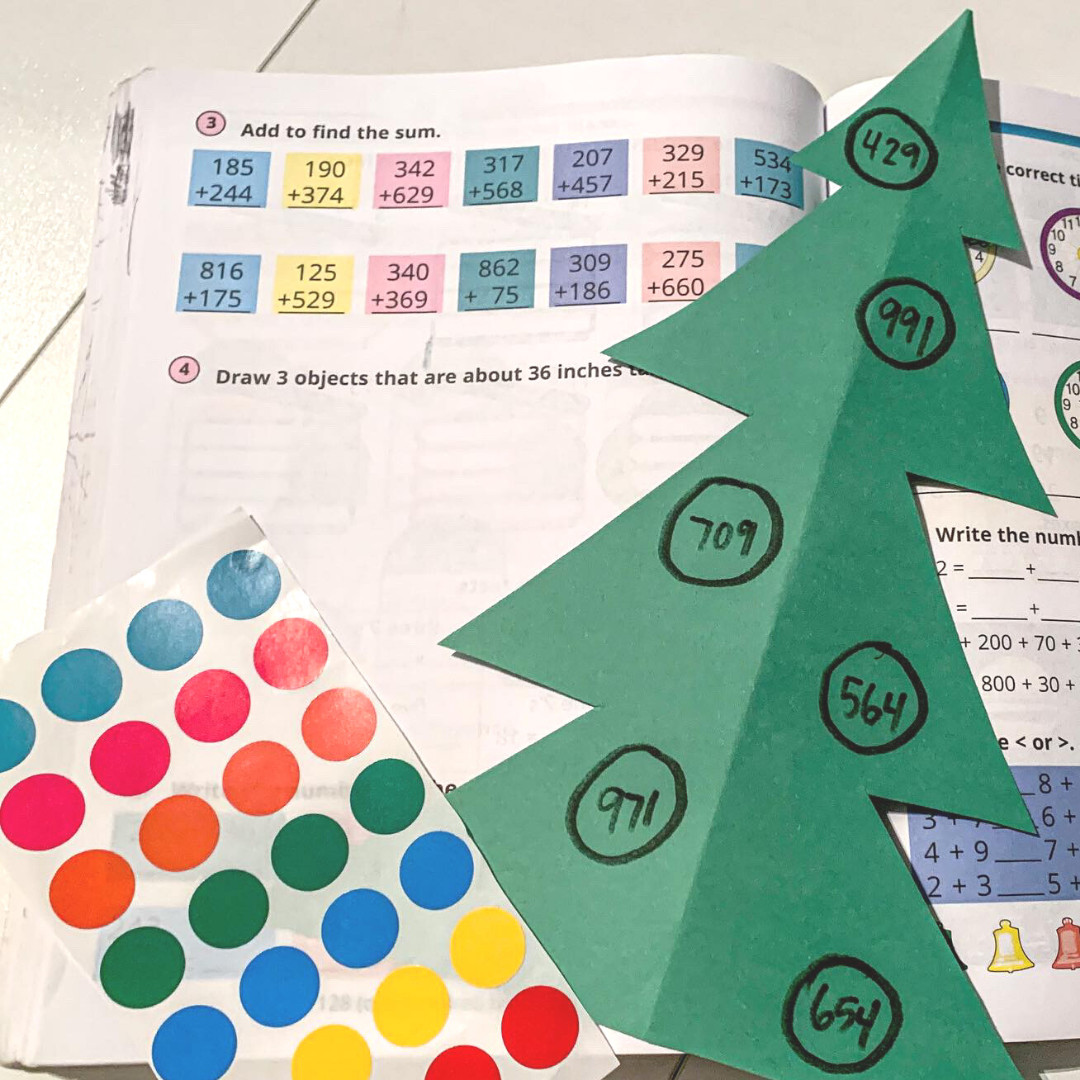
Grab a pencil, scissors, green construction paper (although any color works!), a pen/marker, and dot stickers (dot markers work too! Or, even simpler…just color in the circles. Don’t sweat this!)

Cut out a simple Christmas tree from the construction paper. Choose an activity from one of your workbooks that you want to use and select 8-10 problems. I chose the math lesson for the day and picked about 8 addition problems from a section in the lesson.

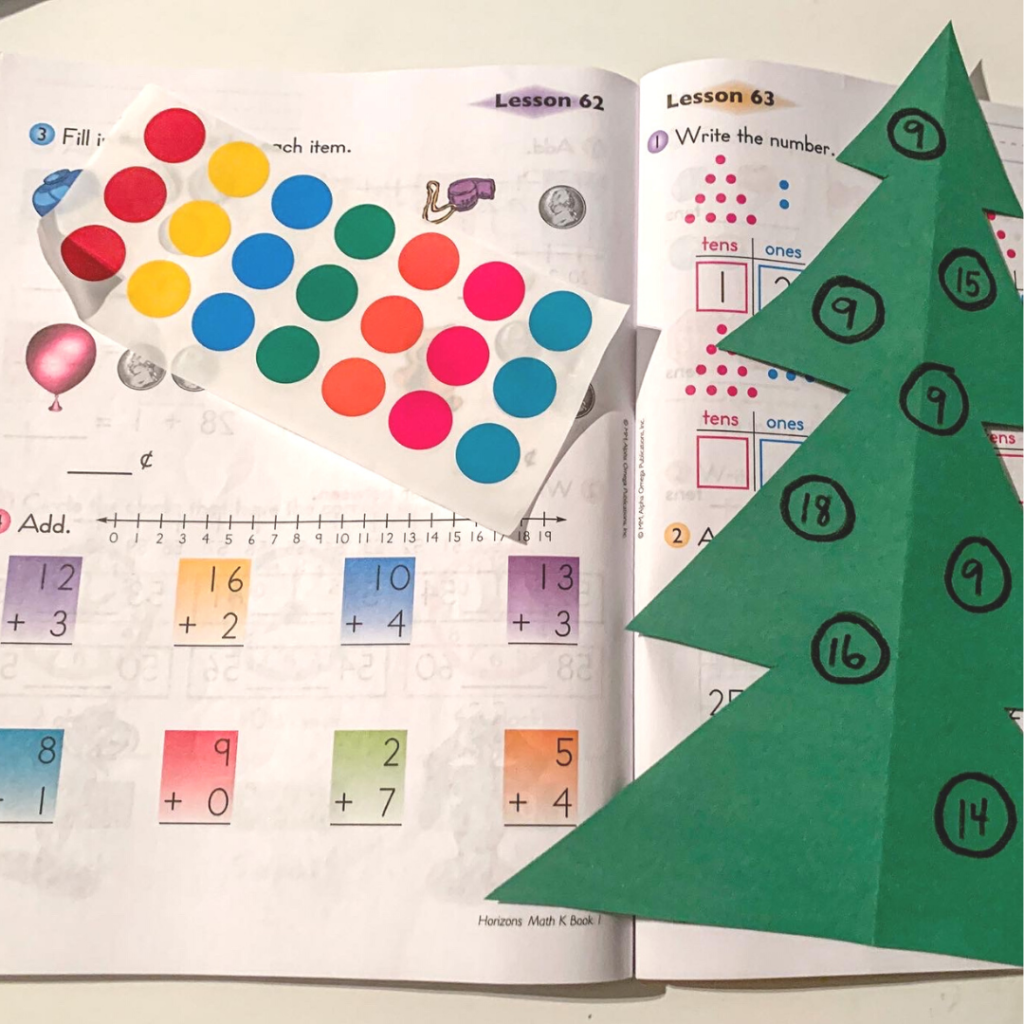
Draw that many circles on the tree and write the answer (Yes, the answer!) inside the circles.

As a problem is completed by your child, he/she will look for the answer on the Christmas tree and cover it with the dot sticker.

Don’t see your answer, time to try the problem again. When all the circles are covered, the problems are solved correctly AND you have a cute Christmas tree with sticker ornaments. I even used mine to decorate the school room!

This is something you can do with all AGES!

Answer math problems, read sight words, match capital and lowercase…the options are endless! I love an activity that can work with something I already have, and that’s exactly what this is. Use it with any subject!

This doesn’t just have to be for the Christmas season. See below for ideas for any month of the year:

Simply sketch one of these images below and cut it out of construction paper. All of these can be quickly drawn and easily cut.

January: Snowman

February: Hearts

March: Clover

April: Flower

May: Sun

June: Beach Ball

July: American Flag (4th of July) – It would be so fun to color code this one with red, white, and blue

August: Big Pencil

September: Apple

October: Pumpkin

November: Turkey (keep it simple here! Think a circle for the head and body and some big feathers surrounding it.)

December: Christmas Tree

Have fun self-checking at any time of year. Share your self-check activities with me on social media. (@simply.learning.together)

Posted on Leave a comment

10 Ways to PLAY with Shapes Using Items Around Your House

play with shapes

My youngest daughter will be three in one month. She loves shapes so we are always playing games with them. My kindergartener is also working on mastering the names of all different kinds of shapes so I wanted to share different ways we have played with shapes to learn them.

This post contains affiliate links. If you follow one of my links, I earn a small commission at no extra cost to you. Thank you for supporting my blog!

1. The first one may seem obvious, but do a puzzle!

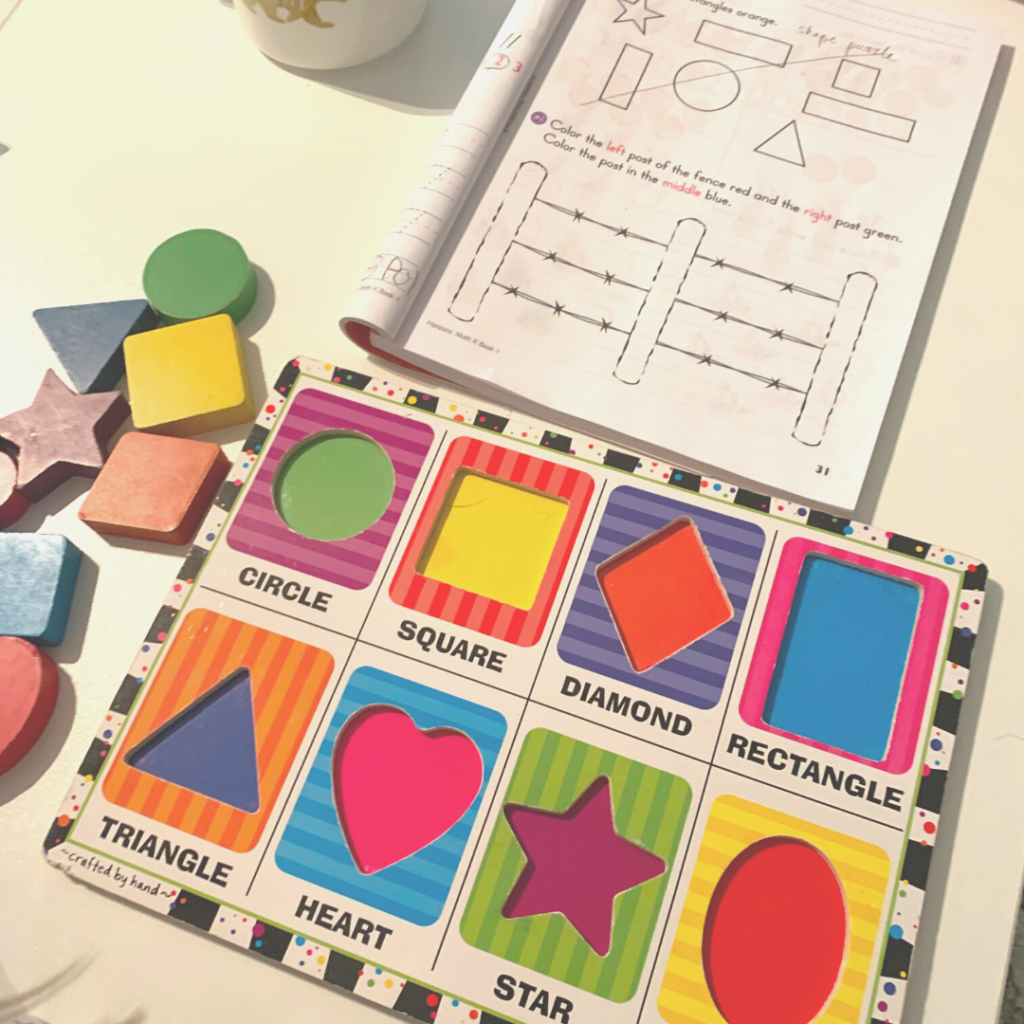
We have a couple shape puzzles at our house, but our favorite is a Melissa and Doug wooden puzzle. These are so great to have for multiple age levels. I also love to use the pieces for a variety of games, which you’ll see as you keep reading.

2. Scavenger Hunt

Use your wooden puzzle to do this next one. Hide the pieces around your house or around the room. (Try not to forget where you hide them!) As your child finds the pieces, place them in the puzzle. Call out the name of the shape. Play this same way OUTSIDE on a beautiful day. The fresh air will really add some goodness to your day.

3. Sidewalk Chalk

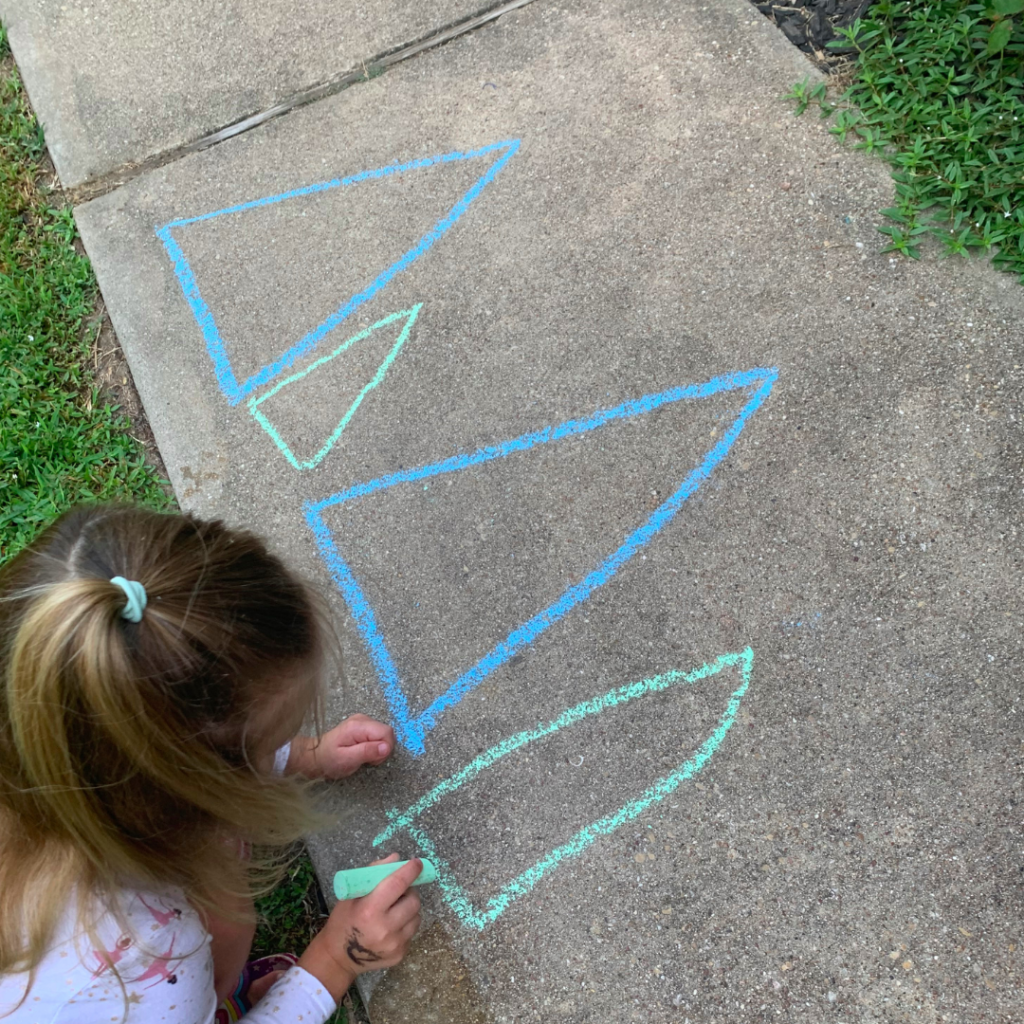
Draw large shapes on your sidewalk with chalk. Depending on your child’s age, he/she can draw them or you can draw them. Call out a shape and have your child jump inside that shape. Keep playing until you’ve called all of the shapes.

4. Spray Bottle

A spray bottle with water in it can be hours of fun! Pick them up at the dollar store for an inexpensive activity! Kids love it, and it’s a great way to play with shapes. Use your sidewalk chalk to draw shapes outside on the concrete. Call out shapes and have your child spray them with the bottle. Want to add a challenge? Add some color to it – Can you spray the BLUE circle?

5. Surprise Shapes in a Bag

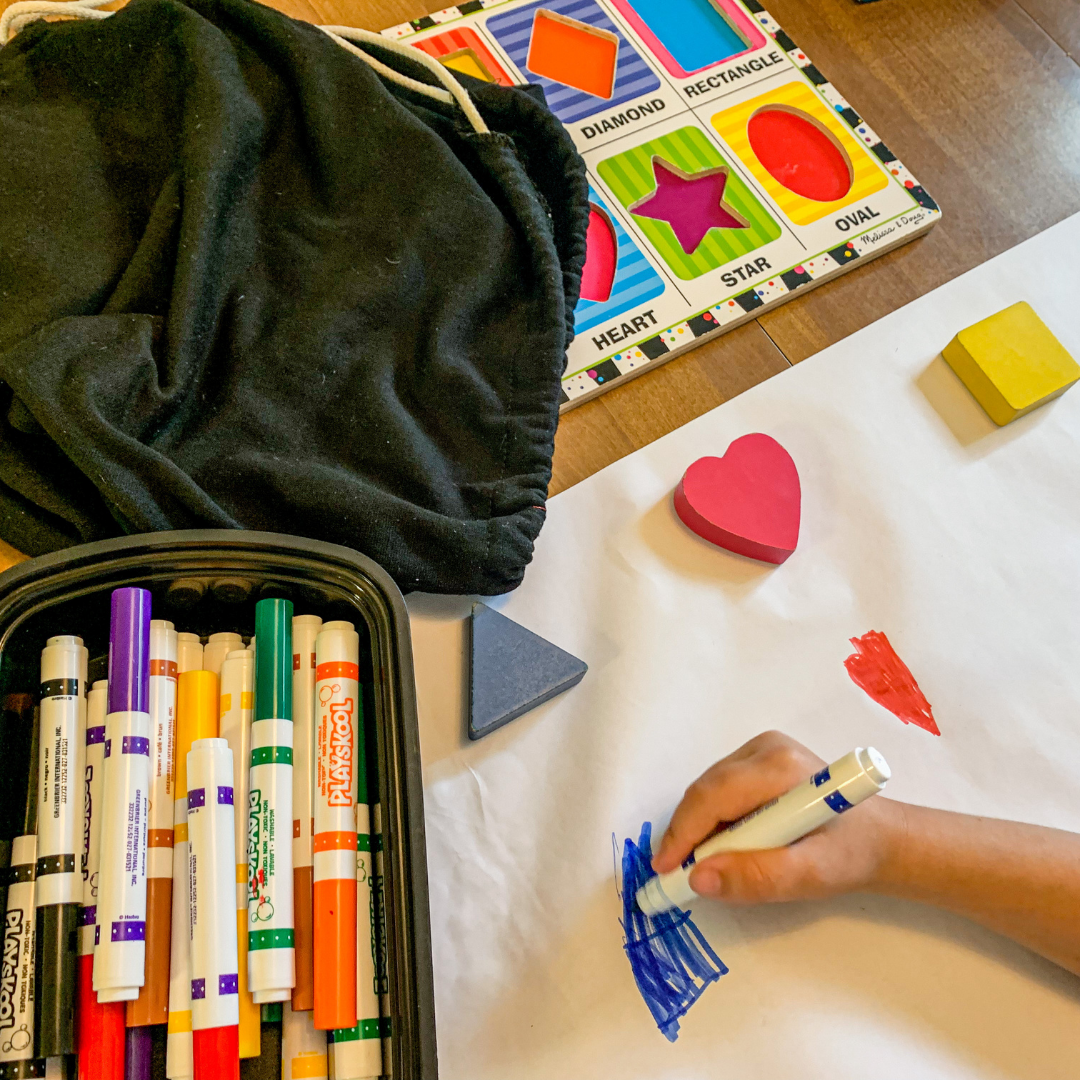
Use your puzzle pieces again and place all of them into a bag you can’t see through. Your child will place a hand in the bag without looking, choose a shape, and name it. I actually played this with my five year old and had her skip to the next room each time and draw the shapes onto a piece of paper. It added tons of movement PLUS she got the drawing practice. If your child isn’t drawing yet, just name them. For an added touch of fun, see if your child can feel the shape and name it before they see it!

6. Peek-A-Boo Shapes

This next one came upon us by accident. We originally used magnet tiles to create a tower with a door at the top. My toddler opened the door and peeked through the tower while I held a shape (from the puzzle again) at her eye level. You can get a better idea from the image above. She told me what the shape was. This sounds so simple, but we giggled so much and had a ball!

I eventually tried to come up with something anyone could use. Take a cereal box and cut a square out of the narrow side of the box. On the opposite side, cut a small hole to peek through. As your child looks through that hole, hold up a shape right outside of the square you cut. It’s really just a fun, silly way to look at shapes and name them.

7. Play Doh

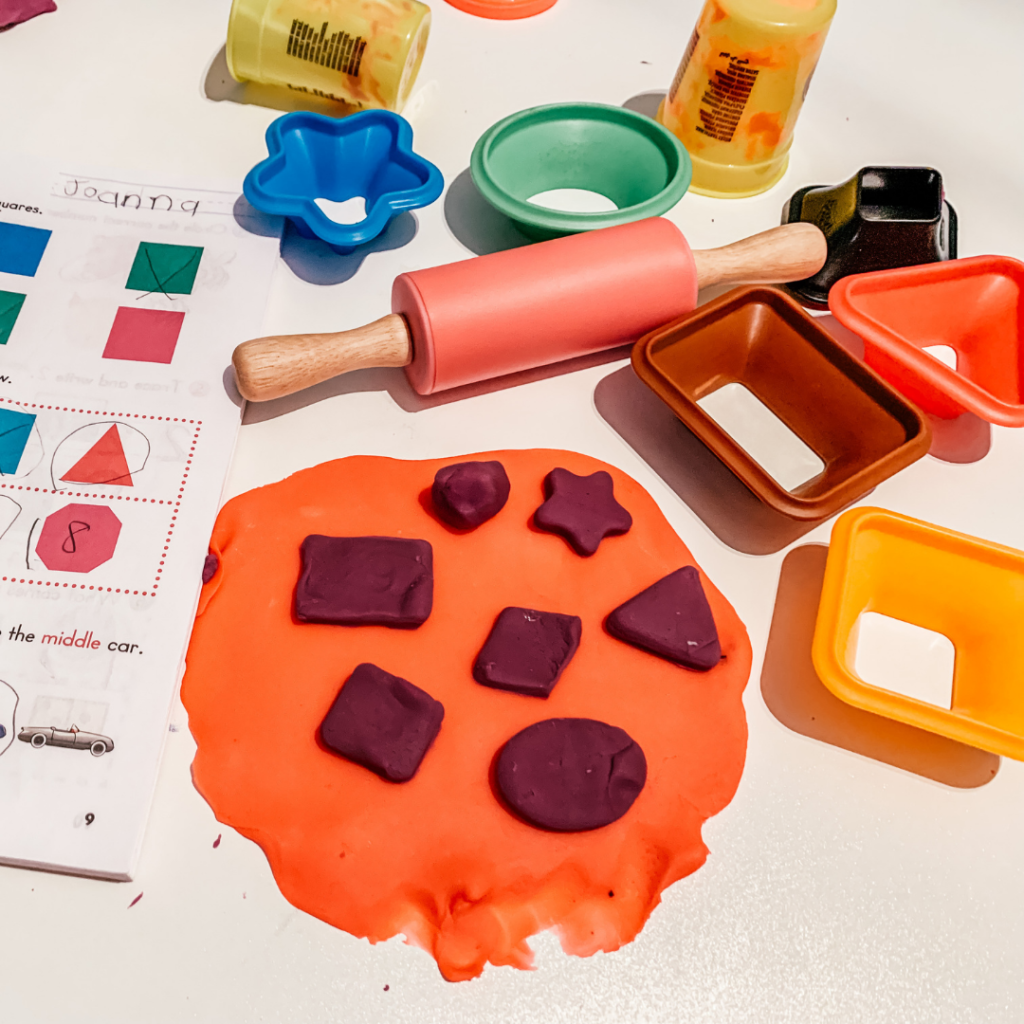
Using Play Doh is especially great if you have shape cutters. We bought a set a long time ago that works awesome, but we also own a giant cookie cutter set that I use ALL. THE. TIME. and it has shapes in there as well. Simply roll out the dough, and cut shapes! I couldn’t find the exact cutters that we have, but here’s a link to a set with a few basic shapes.

8. Play Doh Pizza

We have also made play doh pizza with shapes. Your child is the chef and rolls out the play dough. Place your order with whatever kind of “shape toppings” you want. This can be so fun! All the toppings are cut out of the play dough. Set up a little restaurant and collect orders. Siblings can play too! Challenge your child by ordering half of one topping and half of another. Have fun with it!

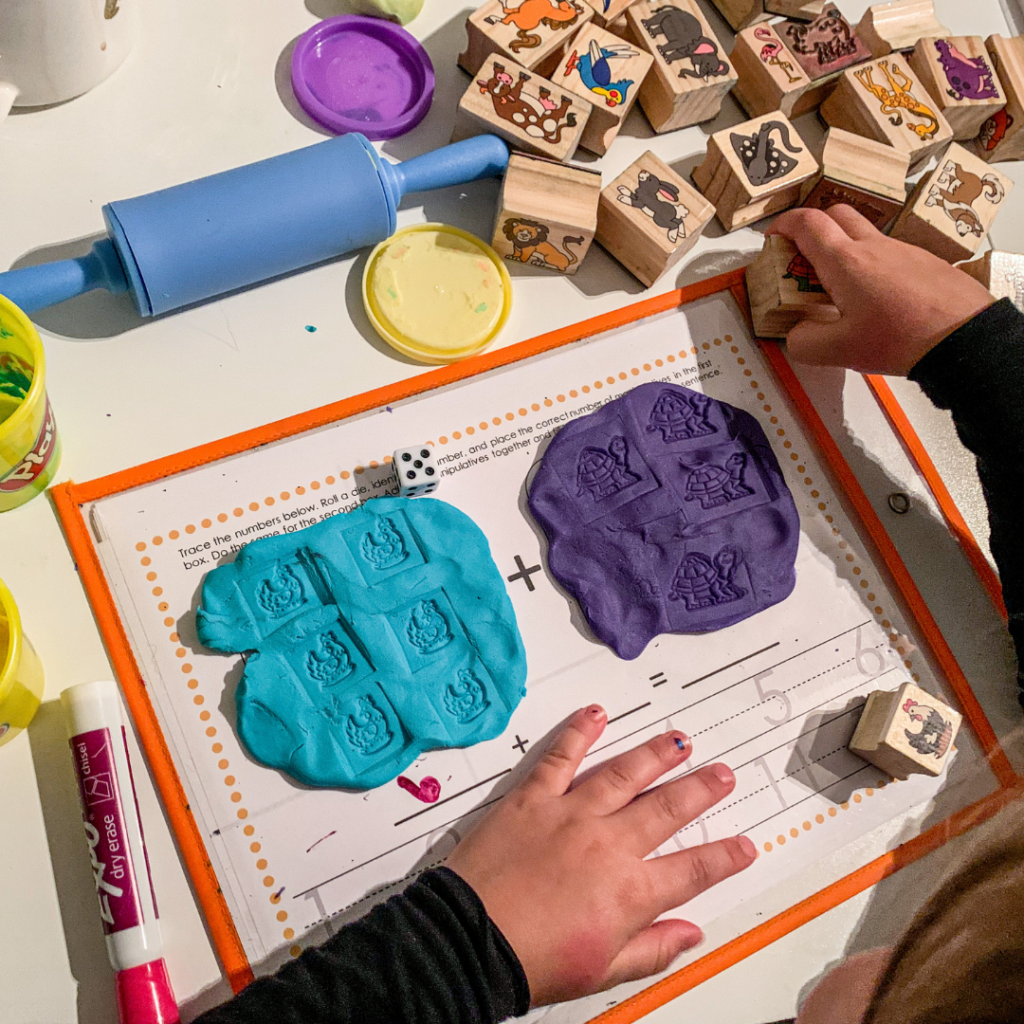
9. Play Doh and Dice

Assign 6 different shapes to a number on the die. You could simply write this on a piece of scratch paper or maybe even a mini whiteboard/chalkboard if you have it. This is great for your 4-6 year old who may be practicing to recognize numbers on a die. Roll the die and call out the number. Cut out the correct play doh shape according to the assignments you set when you started.

Find a way to get a “winner”. You can do this by rolling a certain number of times (like 10) and seeing which shape was made the most. Or, you play until one of your shapes gets to 5. Keep it simple, keep it fun, keep it just right for your kiddo.

10. Shaving Cream

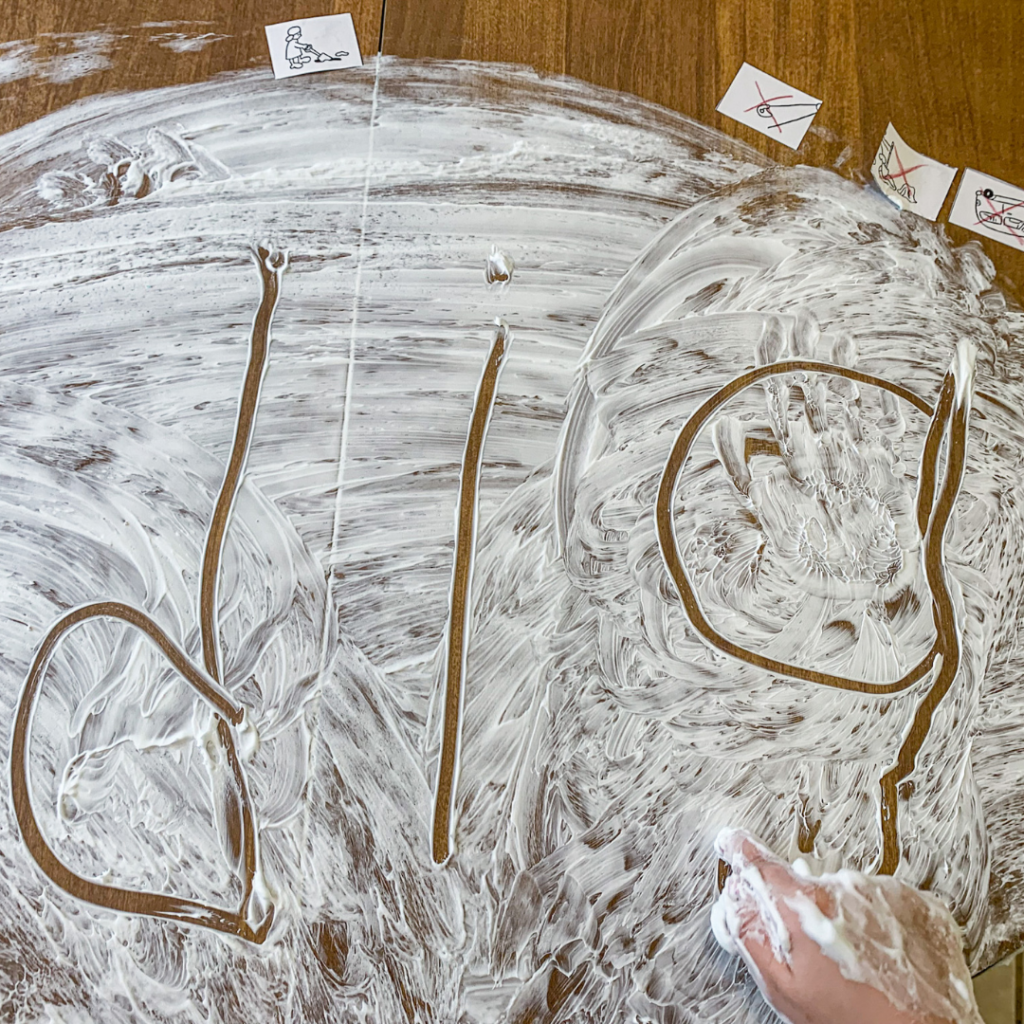
Don’t be scared of this one. It’s such a blast! And your kitchen will smell awesome when you’re finished. Spray a little bit of shaving cream on your counter or table. Give your child some time to spread it around and play with it for a little bit. Then, draw shapes with your finger! This can be free choice from your child or you can call out a shape for your child to draw.

There are so many ways to play with shapes while learning. I love these ideas because they all use items around the house. This makes it so easy to throw together last minute and have a good time learning with your little ones.

Posted on Leave a comment

A Simple and Fun Alphabet Curriculum for your Letter of the Week

alphabet workbook

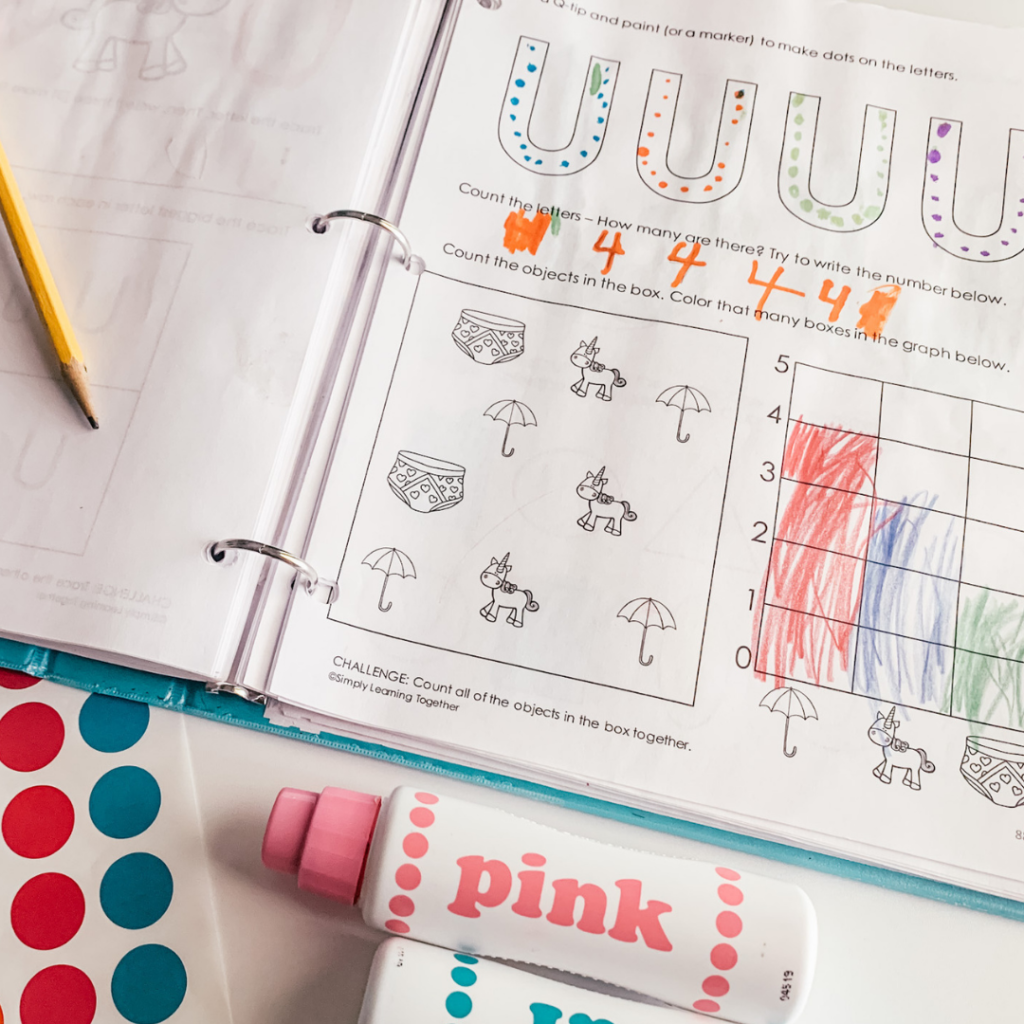
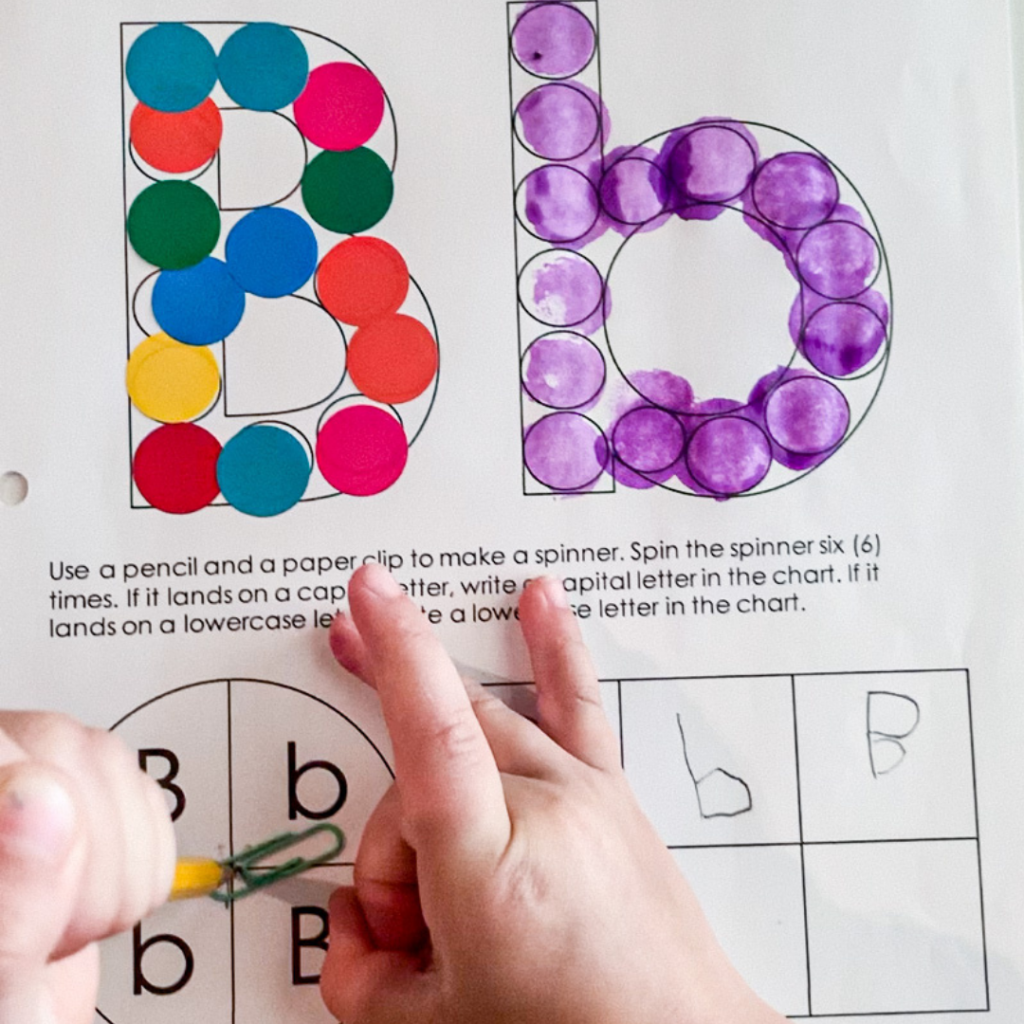
The Alphabet Workbook is a simple and fun no-prep curriculum with repetitive opportunities to practice letters while also incorporating other early learning skills. It’s the key to our success in learning letters at my house, and this post is to tell you how it came to be…

I started homeschooling when my oldest was in kindergarten and my second daughter was three and a half. I didn’t do much organized curriculum with my three year old. There was a lot of play time, reading, and maybe a letter craft or two.

In our second year of homeschool, I had a goal to teach letters and their sounds to my then four and a half year old. Once again, I didn’t purchase anything super serious. I wanted to keep it low key. We started practicing letters by writing them, playing games, building them, playing with play-doh, reading about them…but they weren’t sticking.

Although we were doing a lot of different things, I was having trouble staying consistent. So, a couple months in, I felt like I needed to adjust some things.

I wanted something that my child could do every day (super short!) that would practice a letter a week.

There were all kinds of printouts online, but I’d have to search around and piece it all together. I also wanted to practice things like shapes and colors and counting…So I thought – why not put all of that into ONE? This inspired me to put together the Alphabet Workbook.

Each week in the workbook we would practice one letter while also practicing other early learning skills such as:

  • Coloring
  • Tracing
  • Shapes
  • Counting
  • Graphing
  • Comparing
  • Grouping
  • Numbers
  • Matching
  • Patterns
  • …and more!

This one workbook would allow us to practice multiple skills in just a few minutes a day.

I wanted the lessons to be short and sweet with a lot of variety. Nobody wants to do the same thing over and over. Many times when you download alphabet worksheets, they all look the same, just with a different letter. That would never fly with my daughter. So, I came up with multiple lessons that are incorporated throughout the workbook.

Each letter has 4 different practice pages, and every page for that letter looks different!

This variety was so great because it not only kept our work interesting, it really allowed me to see her practice many different skills. Each day she looked forward to completing her page, because she truly enjoyed doing it.

After a few weeks of using the workbook, I started noticing a difference.

She was writing more letters and remembering them. We would play games or read books about letters and she was participating and doing well. I was so proud of her! Even more important, SHE was so proud of herself. She really felt successful.

I honestly felt a sense of relief knowing every day we were getting consistent practice.

No more scrambling to find activities or practice pages. Everything was right there for us in the workbook. Every morning we could pull it out and get started. Pretty soon it got to the point where I’d catch her sneaking away with it to surprise me with completed pages. I love that she wanted to put in her best effort!

I know how hard it can be to pick a curriculum, which is why I want to send you a sample that you can try out for a couple weeks.

Don’t you just wish when you were picking curriculum, you could try it out for a few days first? I definitely feel that way when I plan for our homeschool year, but I hope to help you when choosing a curriculum for your little one. I’d love to send you the first three weeks of the workbook for FREE.

I want you to try it out at home to see how it works for your family. I want you to see the variety of activities and how fun and easy it can be to add this into your day. See how short and sweet learning can be with your precious babes.

The complete workbook is 109 pages, and you can get it all for just $5.00.

Why so cheap? I just want to help other families feel less overwhelmed by all of the things. This workbook provides consistency while still being fun to do! If you’d like to get the entire workbook, you can download it here.

My ultimate goal in creating this book was to create a simple, regular routine that would bring my daughter success. Looking back on her year, I’m just so proud of how much she grew and learned!

Ready to try it out? Submit your email below and receive your sample of the Alphabet Workbook.

    Posted on 1 Comment

    5 Steps to Start Homeschooling

    science experiment at home

    I never planned to homeschool, so when I started to think about doing it, I was starting from scratch. It was unfamiliar to me, and I didn’t know anyone personally that homeschooled their children. I did a lot of research and a lot of planning. I’ll admit, we definitely hit some bumps along the way, but overall a simple start up was key.

    In this post, I plan to outline how I started homeschooling in hopes of helping someone start their own planning process. I am no expert, and what works for me may not work as well for you. Keep that in mind as you read through. Most importantly, I hope to encourage you as you begin these first exciting steps of planning.

    We are going to start from the VERY beginning stages, because I think they are important. I started thinking about homeschool months in advance to when I actually wanted to start. When I began my own homeschool journey my children were 2 and 4. One would be heading into kindergarten the following year.

    This post contains affiliate links. If you follow one of my links, I earn a small commission at no extra cost to you. Thank you for supporting my blog!

    1. Research and Read

    As you begin thinking about and praying about starting to homeschool, one of the easiest things you can do is research and read about it. You can do this through novels or even different blog posts online.

    I used to just scan Pinterest and read post after post from homeschool families. This allowed me to become familiar with names of curricula, the lifestyle, different terminology, homeschool styles, and the daily routines. I slowly began to gain confidence in what I was doing.

    The following are a few book suggestions. Don’t feel like you need to read them all.

    These are only suggestions. The first one is very short and an easy, quick read. It would be a great start.

    Sometimes you can even scan through them. For example, I’ve read most of “Wild and Free”, but a lot of it I flipped through and read what I was interested in or had questions about.

    “Teaching From Rest: A Homeschooler’s Guide to Unshakeable Peace” by Sarah Mackenzie

    “The Call of the Wild and Free: Reclaiming Wonder in Your Child’s Education” by Ainsley Arment

    “Homeschool Bravely: How to Squash Doubt, Trust God, and Teach Your Child with Confidence” by Jamie Erickson

    There are hundreds of books about homeschooling. These are just a few to get started. As I mentioned before, you can also read through blog posts. Try searching daily routines or different homeschool styles. Look for a day in the life post to get a feel of the rhythm of homeschool.

    Yours will be your own and not like anyone else’s, but I always find it helpful to hear about another experience.

    You don’t need to choose a homeschool style before you begin.

    You will read so much about different styles: classical, Charlotte Mason, eclectic, wild and free….don’t label yourself. How do you know your style if you’ve never even tried it?

    You can definitely experiment with one that you find interesting, but don’t let it stress you out. I’m not even sure I know my own style. It’s probably a mix of everything! Why does everything have to be labeled?

    2. Learn about the laws in your state.

    In the United States, every state has different laws of things that you need to do in order to homeschool your child. I am in Texas, and it is a more relaxed state, giving me a lot of freedom in my homeschool, for which I am very grateful.

    Other states require much more. Some have to take attendance everyday, keep records and grades, record hours, and give yearly assessments. You need to look at your state laws and decide if you can commit to the requirements.

    One place to look is the Home School Legal Defense Association (HSDLA). This website is very informative and allows you to choose your specific state and read about the requirements.

    Be thorough – read as much as you can and watch the videos. Make sure you know what you are getting into, so that it doesn’t become overwhelming in the middle of your year.

    Click here to go directly to the home school laws by state.

    3. Plan a budget

    Not all parts of homeschooling are absolutely free. Decide what kind of budget you have. Don’t get me wrong, you can keep it very inexpensive. However, if you don’t have a plan, the costs will definitely add up.

    Now, a confession: I am not the best budget maker. I did not make any sort of list or chart. If that’s your personality type, go for it. My point in telling you to plan a budget is to just make sure you are aware of the costs that will come up.

    There are many different costs to consider.

    First is obviously curriculum. I’ll talk more about this later in the post, but you need to decide how much you want to spend. Curriculum can be…addicting – seriously! Don’t get carried away. Set a plan and stick to it. I suggest to start small. We will talk more about this in bit.

    You’re going to need school supplies at your house.

    This is as simple as pencils, pens, crayons, construction paper, printer paper, etc… It may seem obvious, but these are all costs! Ordering these can be a bit overwhelming for me each year. Stick to a minimum list at first. Get your basic needs to get through the first few weeks. You can always add more as you plan.

    Do not feel like you need to set up an entire room to homeschool – fully decorated and beautiful. Although it’s nice, it’s not necessary. My suggestion would be to start with a basic cart or tub that carries your supplies. As you begin learning together, you will slowly become comfortable in one area of your home. Then, you can decide to make it into a homeschool space, if you wish.

    Are you planning to sign your child up for any extra curricular activities?

    These activities get expensive. Right now, we only let our children pick one activity each, because that’s what works for our budget. Obviously, you don’t HAVE to do any of these extra activities, but if you are planning to, be prepared to pay.

    The next thing to think about for budgeting is co-ops or groups.

    This can get tricky to explain, because there are so many kinds of homeschool groups/co-ops you can be a part of. I will talk about this more below, but I’m mentioning it here because it does become a part of the cost.

    Don’t forget about field trips or outings.

    I remember dreaming about so many outings with my children, but when it came time to it, I couldn’t always afford it! You have to be careful. Plan free outings! Public parks sometimes have amazing free activities. A trip to a zoo or museum gets very expensive, especially if you have multiple children. Make a plan for field trip costs!

    It’s important to know your budget before you start making purchases and signing up for things. It can easily get exciting and out of control. Set your financial goals FIRST.

    homeschool supplies

    4. Curriculum Choices

    I love learning about curriculum. If I had it my way, I’d order it all, and have my own little curriculum read-through party. That would be super fun and amazing but very unrealistic. There’s a way to break it down a bit to make the decision process a little easier.

    First, decide if you want an all-inclusive curriculum or if you want to pick and choose different texts.

    An all-inclusive curriculum is one that usually comes with plans and all of the subjects wrapped in one big set. This would be great for someone that prefers a lot of guidance.

    If you feel completely lost on what to teach, think about a set like this to help you start. Just because you pick an all-inclusive your first year of homeschool, doesn’t mean you have to do it the next year.

    There are many different options to pick from, but an all-inclusive curriculum is going to be a big ticket item. It costs a lot of money up front – I’m talking hundreds of dollars, sometimes even a thousand. So, that’s something you need to think about if you decide on using it.

    I have never used an all-inclusive program, but I know people that have and enjoy it. I couldn’t tell you the best one based on experience, but I can guide you to a few that I’ve researched or heard of people using in their own home.

    My Father’s World

    Sonlight

    Timberdoodle

    Veritas Press

    The other option is to pick and choose curriculum for each subject.

    This really isn’t a super hard task, but there are just a lot of options to choose from. You can easily fall into a trap of constantly questioning – is this the best one? Do your research.

    Talk to people that have used that specific curriculum before. Read blog posts and visit the websites. Download samples – the samples are always the most helpful to me.

    Look into social media. There are people on Facebook and Instagram (like me!) that will show you the inside of a textbook and tell you how it works for their family. Use a hashtag and search different curriculum titles. Look through highlights.

    Come visit me on Instagram! Send me a DM and say hello! I love connecting with other homeschool families, and I can try to help you find more info.

    Most importantly, once you pick something. Pray for peace and confidence and and go with it. It’s easy to question yourself, but if you’ve done your research, rest in knowing you’re doing what you think is best for your family.

    So, what subjects do you choose?

    First, look at your state laws and see what subjects are required. For your first year, I suggest sticking with just that! Don’t spend a lot of money on a bunch of different things just yet. Give it a couple of months. Start your year with the basic requirements and add to it as you adjust.

    Now, if something is really important to you, like Bible, go ahead and make that a priority. Maybe you are a musician, and it’s important your child studies music – go for it. Just don’t think you need to add on everything right this minute.

    Fine arts, a second language, typing, art study, hymns…these are things that can be added in to your routine in a few months as you are ready, and IF you even want to do them. Don’t overwhelm yourself. I’ve definitely fallen into the trap of buying text I thought would be so great and then never even using it – waste of money!

    If you are interested, check out my blog plosts to see some of our curriculum choices. You can read about my most recent picks for first grade and preschool HERE and HERE.

    5. Homeschool Groups, Co-Ops, and Communities

    You can definitely start without finding a group. So, technically it could be 4 steps to start homeschooling 😉

    However, I do think it’s important to connect with other homeschool families, so I want to add it in here. Having the support and community is encouraging and helpful. I’ll be honest, I struggled with this my first year. Unless you know a giant group of homeschoolers, it can be hard to connect.

    Make an effort to find a group/community/or just a friend if you can. You can really benefit from the relationships and learn so much from others.

    If you are struggling with this, pray about it. It’s OK if you don’t find a group or a friend right when you start your year, but don’t give up.

    A few months into homeschooling, I met a friend at the library of all places. We were sitting together in a preschool music class. She is a huge blessing to me and my family and I cherish our friendship. I feel like as soon as I started questioning what I was doing, God placed her in my life to encourage me and keep me going. I’m forever grateful for that.

    My suggestion would be to find a group in your area through your church or social media and ask around.

    This will give you a better idea of what’s near you. My first year, I joined a few local, free homeschool groups on Facebook. People post all the time about events/activities in the area. There are also park meetups where I can meet other families and learn more from others.

    We also tried a couple groups that required a small fee ($25-$50…I can’t really remember). They didn’t stick. My point in telling you this is don’t be discouraged. Don’t feel like if you can’t find a group, you can’t start. Pray, have patience, and don’t give up.

    Our second year we joined Classical Conversations, and we love it so much. You can read more about that in this post.

    You’re ready to start homeschooling!

    It’s as simple as that! Now, all you have to do is dive in and start. Sometimes, this can be the hardest part. You may be worried about the planning process or your daily schedule, but you will never figure out a good routine until you just jump in.

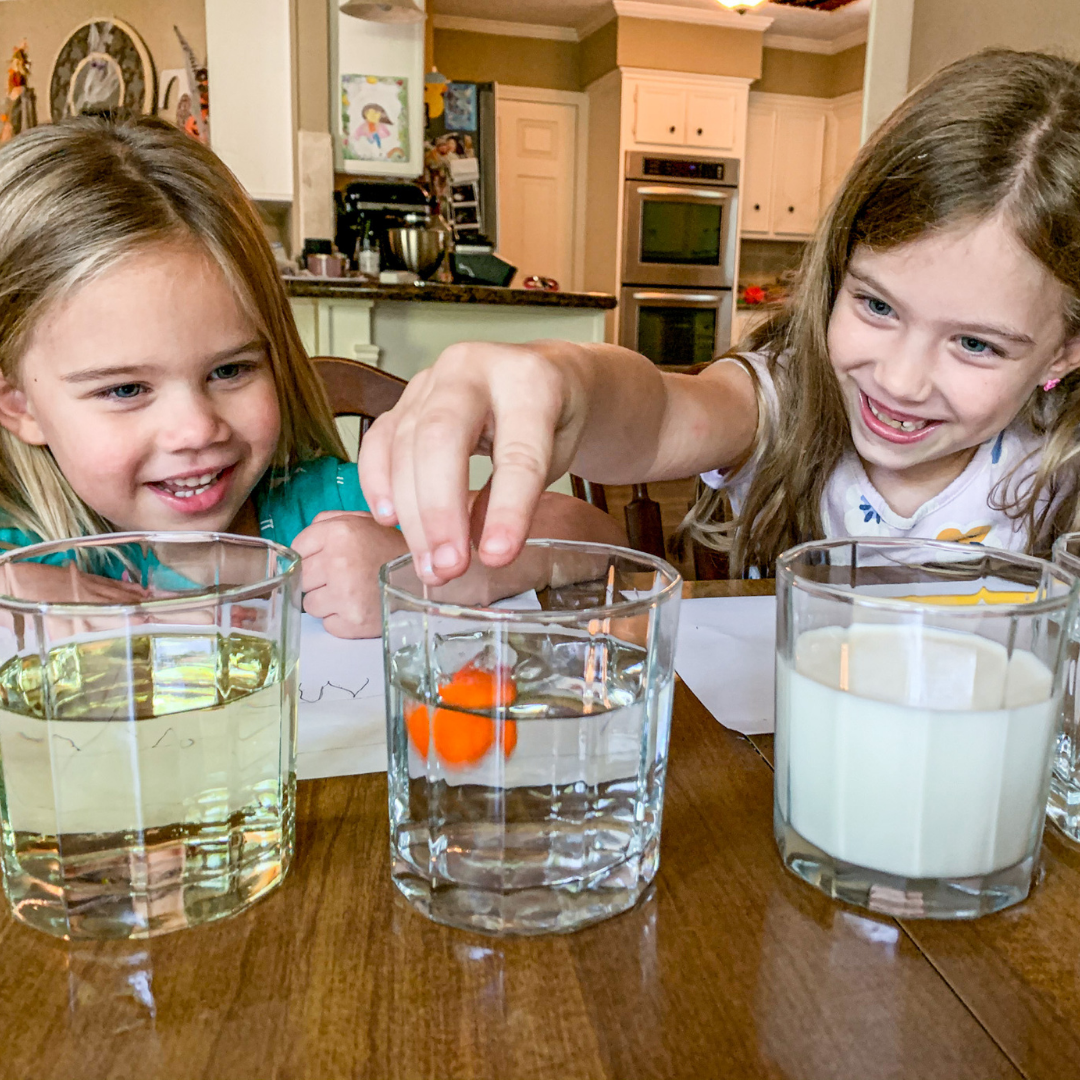
    I will share more in a planning blog post about getting ready for your year. However, one thing that worked for me was to start little mini lessons in the summer. This could be as simple as a craft, board game, puzzle, or reading a few books from the library. Maybe it’s a science experiment.

    I would try little things during our summer day to see when it was easiest to work with my kids. Morning? Afternoon? Where was it easiest to work in my house? How long could they sit there? These are all questions I was trying to answer to better plan my year.

    By doing this, I also realized that the more time my kids spent outside, the better our days went. So, that became a priority – get outdoors!

    You will learn things like this too by just jumping in and trying it! If you have a summer or a break, use that to start experimenting. The last thing I want to say is this…

    Your homeschool will not look like anyone else’s.

    Stay away from comparison. It can be extremely hurtful to your heart and mind. Just because someone is teaching 4 fine arts classes to their children, that doesn’t mean you have to. Just because someone has beautiful wooden toys for every themed lesson doesn’t mean you have to.

    And just because it doesn’t turn out EXACTLY like you pictured it, doesn’t mean it’s wrong. It’s all a trial and error process. You will adjust all the time in a way that best suits your family. Put God first. Put your faith in Him, and pray for wisdom in all that you do. Don’t depend on others to lead you.

    Final words for this … start small. Homeschooling is a building game. Start simple, jump in, and gradually add to it as you wish. It doesn’t have to be complicated. You got this.

    Posted on 3 Comments

    A Faith-Based Read Aloud Unit for Mrs. Piggle Wiggle

    Mrs. Piggle Wiggle

    I chose to read Mrs. Piggle Wiggle with my kiddos because it was light, short, and funny. I also discovered that through each chapter, we could have great discussions about good and bad behavior.

    I developed a Read Aloud Experience to go along with the novel. If you are not familiar with the Read Aloud Experience, check out this post.

    In short, it includes the following: chapter summaries and questions, optional crafts and activities for each chapter, and library topics to guide you in checking out books that go along with the themes.

    This post contains affiliate links. If you follow one of my links, I earn a small commission at no extra cost to you. Thank you for supporting my blog!

    There was something special about this book that made me take it a little further.

    Every chapter follows a child that is making bad decisions or forming bad habits. The parent calls Mrs. Piggle Wiggle to ask for a “cure” for their child. It is all very fictional and humorous but the behaviors are applicable to real life.

    The best part was we could giggle about the silliness, but then have real discussions about good character. We talked about behavior and responsibility in our own home – and most importantly we backed it all up with scripture.

    van gogh painting
    When the characters refused their bedtime, we researched Van Gogh and recreated Starry Night

    Every chapter in this Read Aloud Experience includes a bible verse to use as a devotion with your family.

    I love when a book leaves an impression on you, and to this day we refer back to the characters in the chapters and what we learned from them. We even memorized a few of the verses and can recite them in certain situations.

    There are 8 chapters in Mrs. Piggle Wiggle, and I’ll outline the biblical focus points below:

    1. Obey your parents
    2. Generosity
    3. Use kind words
    4. Greed
    5. Patience
    6. Rest
    7. Thankfulness
    8. Arguing

    Sound like topics you might want to discuss in your family?

    My oldest two children were 6 and 4 when we read this. So, don’t assume your children are too young! I have even thought about doing this again in a few years. It’s great for all ages! All of these topics come up in our home on a regular basis and it was so nice to be able to sit down and discuss them together.

    We homeschool our children and loved using the verses as our devotion, reading a chapter a day, and completing the optional crafts and activities. If you do not homeschool, you could still easily use this book to talk about the character traits listed above.

    STEM Activity
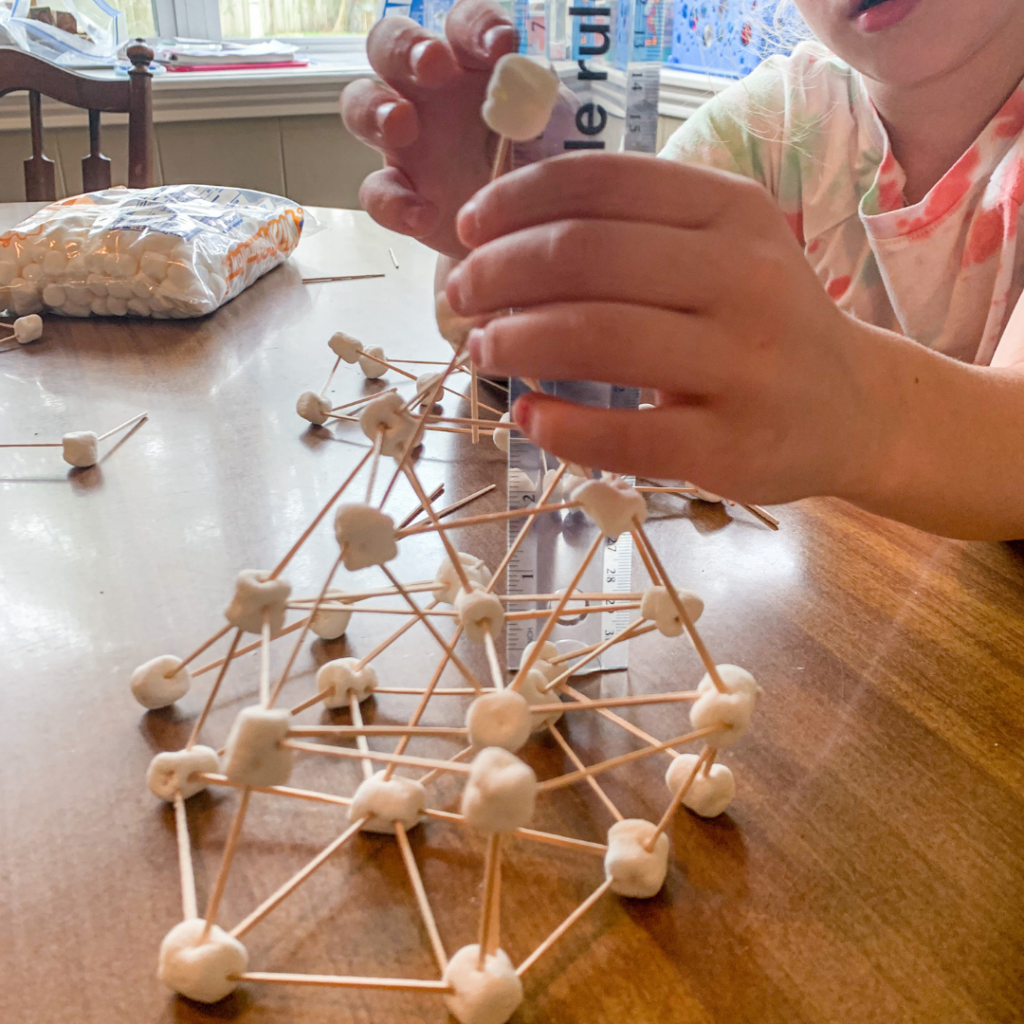
    When a character refuses supper, we got creative with food by completing this marshmallow STEM activity.

    Everything in the Read Aloud Experience is optional and it’s meant to be flexible for all families.

    Think of it as your guide. There are so many ways you could make it work in a way that fits your family. Simply read a bible verse at dinner and a chapter before bed.

    Save it for the weekend! The chapters are short. Read two on Saturday and two on Sunday and you’ll be done in two weekends!

    Download the unit for a spring break or summer activity. It would be the perfect thing to add a small bit of structure/routine to your day.

    If you wanted to use it to its full potential, check your local library for books that go along with the topics listed in the unit. Use the supply list to make sure you have the ingredients for recipes and craft supplies. Since this book is so short, you can get everything you need in one swoop so you’re ready to go!

    In our family, we used the bible verse as our daily morning devotion. I read a chapter a day (usually while the babies were napping). Then, we would complete the activities we had time for. I usually save library books for after dinner/before bed. It’s the easiest way to add them into our day.

    I always randomly select library books based on a specific topic. I love the fun and surprise in this. We did come across some great ones and I will share them below if you’d like to search for them specifically:

    “The Berenstain Bears: Patience, Please” by Mike Berenstain

    “The Berenstain Bears: Get in a Fight” by Stan and Jan Berenstain

    “Dragon Sibling Rivalry” by Steve Herman

    “ABCs of Kindness” by Samantha Berger

    “Bedtime is Canceled” by Cece Meng

    “Topsy-Turvy Bedtime” by Joan Levine

    “Katie and the Starry Night” by James Mayhew

    “Vincent Can’t Sleep” by Barb Rosenstock

    We read many more throughout the unit, but these were our favorites.

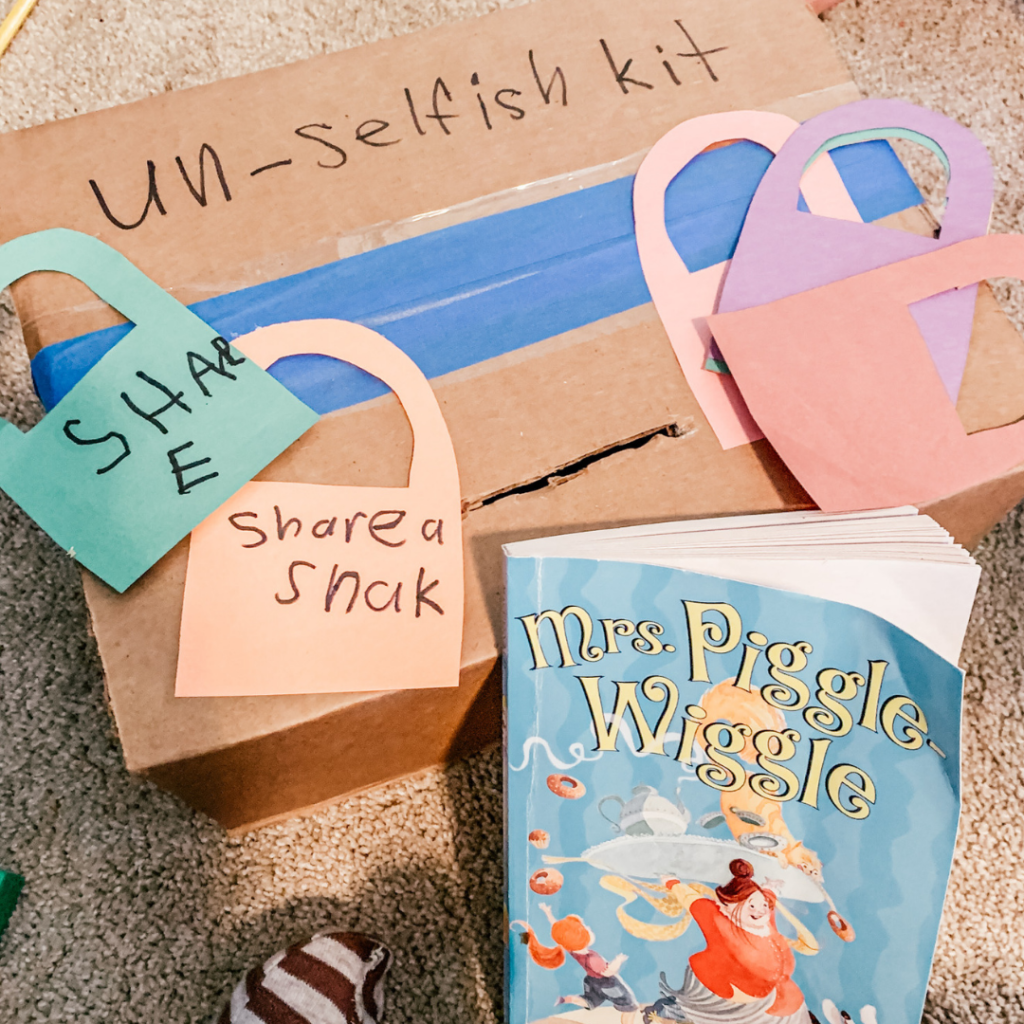
    Our “Un-Selfish Kit” inspired by Mrs. Piggle Wiggle’s kit – We discussed actions that were kind and not selfish.

    If this Read Aloud Experience sounds like something you’d like to look into for your family, you can download the entire unit for FREE in my store.

    Pick and choose how you want it to work for your family and enjoy digging deeper into a book. (Download the unit here.) I love how my children and I really become a part of the book when we do this. We get to know the characters as if they are a friend. We experience new things and get to be creative. You could say it’s almost like we are in the book ourselves!

    You can also check out another free Read Aloud Experience for The Secret Garden.

    If you’ve completed a Read Aloud Experience from me, I’d love to hear about it! Leave a comment below and let me know.

    Posted on 2 Comments

    First Grade Homeschool Curriculum Review

    homeschool curriculum

    Curriculum can sometimes feel overwhelming. As a parent, you want to do what’s best for your child. There are so many wonderful options out there, so what do you choose?

    The answer to that question will always depend on your child. Even within a home, curriculum needs can be different. For example, my two oldest children do not always use the same books.

    In this post, I’ll be sharing what we used for my oldest daughter for first grade and how it worked for us.

    Every family is going to be different, but sometimes it helps to hear how something works for someone else. That’s what I hope to do here.

    Keep in mind, this is all based on my opinion. What works for me may not work for you, and vice versa. I’ll be sharing the good and the bad experiences we have had this year.

    This post contains affiliate links. If you follow one of my links, I earn a small commission at no extra cost to you. Thank you for supporting my blog!

    homeschool math

    Horizons Math

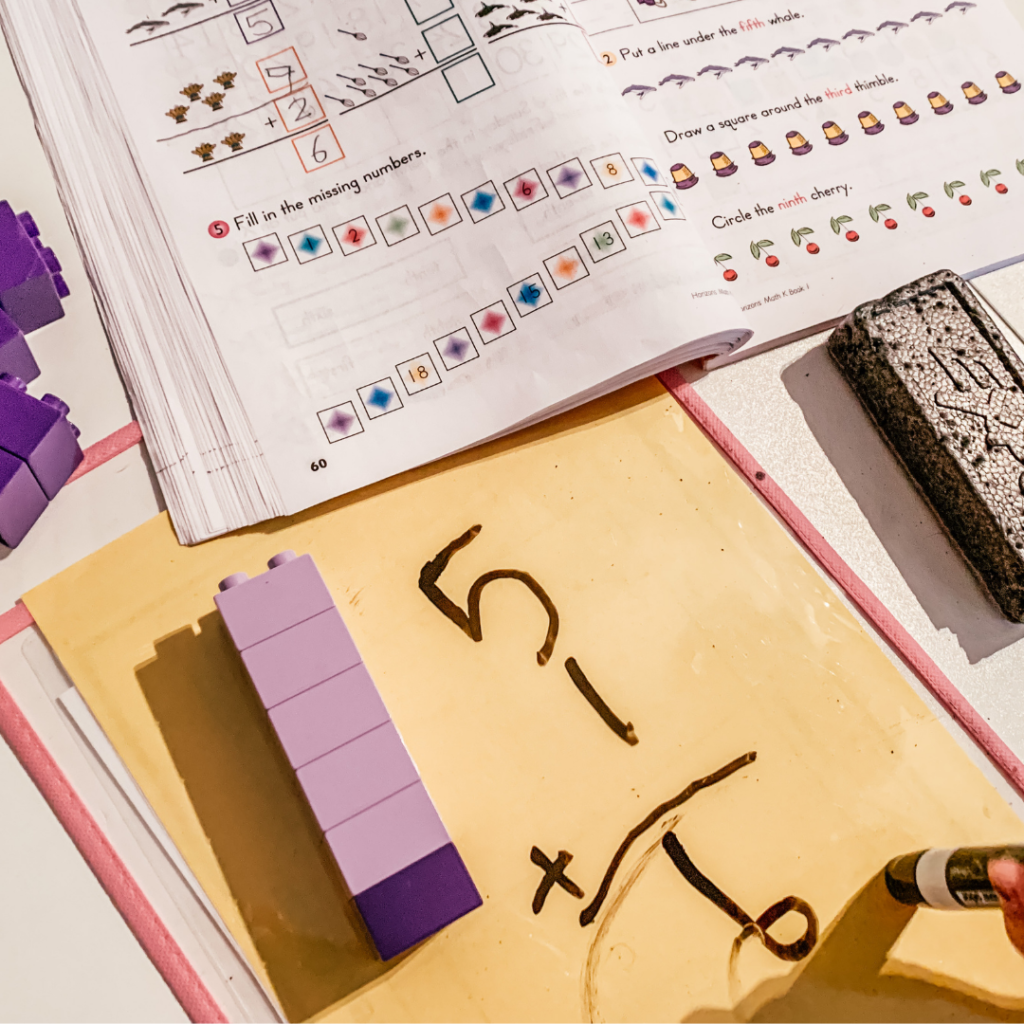
    I chose to stick with Horizons Math for first grade. We used it in Kindergarten, and I really enjoyed it. (Click here for some super fun math activities to go along with Horizons K)

    We purchased Book 1 and Book 2, and that’s it. We did not purchase any sort of curriculum set from the company or the teacher guide this year. (I had the guide for Kindergarten and never used it.)

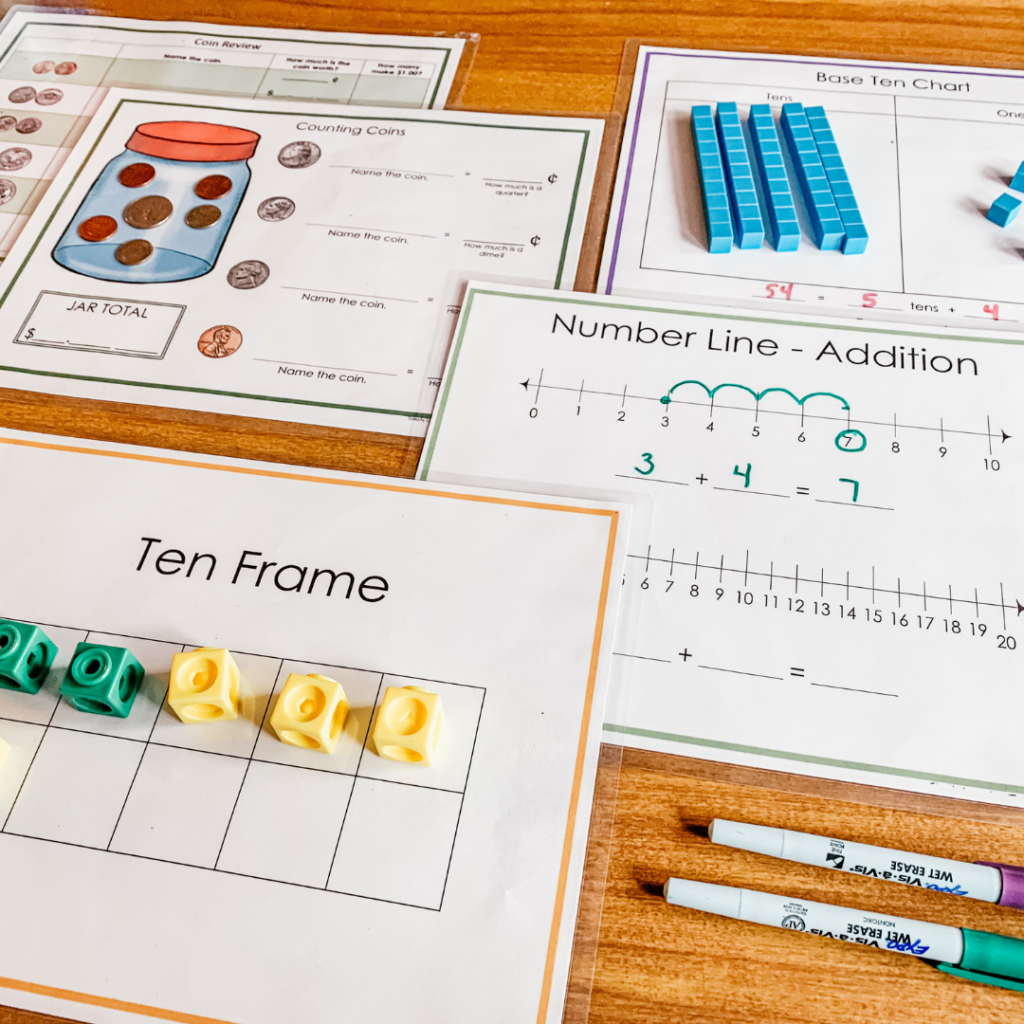
    After my experience with kindergarten, I knew I wanted to have a few manipulatives on hand to use with the lessons. I purchased a small set of base ten blocks and uni-fix cubes. Both are used almost every week. I highly recommend having these to go along with the workbooks.

    Horizons uses a spiral method to teach math skills.

    This means topics are introduced and practiced throughout the entire book. The alternative to that is to introduce a topic, master it, and move on. Horizons is not set up that way. Each lesson reviews multiple concepts – old and new.

    The student workbook is colorful and easy to follow. Lessons are usually front and back, and there are tests throughout. The tests look just like the lessons, so there is nothing surprising there. For the student, it may just feel like another lesson.

    I would not describe Horizons as “open and go”, because at times there is a small bit of prep involved.

    Once you get used to the book, the prep only takes a minute or two. Many curricula include a script for parents. In the Horizons student workbook, there are only directions for the student. You could definitely just have your child complete it, but I’ll tell you right now – that will get really boring really quick.

    I’ve learned a little creativity is necessary, so I created math mats to make the planning and prep super easy! Having a go-to set allows me to just grab and go as I am getting the lesson ready. They are easy to store, easy to use, and fun to do!

    math mats

    Before we begin a lesson, I quickly look through the page and grab a math math that will go with it. I briefly look at the content to see if there’s any new skill to introduce. If so, I introduce that skill and help her practice. The rest of the lesson she completes independently. This works great for us because it puts less pressure on me. It only takes a minute or two for me to get it ready for her.

    The teacher’s guide does include the steps to introducing the lesson and practicing the skill. It also gives an idea or two for an activity to do along with the lesson, but the guide is a separate purchase from the workbooks. Think of it as directions and not a script. (This was my experience with the Kindergarten guide since I did not purchase it for first.)

    I personally love this curriculum because I can get creative at my own pace.

    I can easily add manipulatives (base ten blocks, uni-fix cubes, coins) with simple math mats so that any lesson can be hands on. I can play basic flash card games or math games to practice a skill. This is always fun, because we are not glued to the workbook. We can move around and review. (Check out this flash card blog post.)

    Or, if we want to just stick to the workbook page, we can. Some days it’s nice to just get it done! I don’t ever feel pressure to complete a planned out script.

    I have four children and sometimes following a script gets tricky.

    I love that the Horizons curriculum allows me to do as much or as little as I like, without feeling guilty. I can be creative and add simple activities. On the flip side to that, if I need to tend to other children or we need to work quickly, my daughter can work on her own without much help at all. For now, this is what feels good for our family, so we plan to stick with Horizons next year.

    For More Horizons tips, check out this video on how we shorten a lesson.

    the good and the beautiful

    Language Arts: The Good and the Beautiful

    We started the first grade year with The Good and The Beautiful Level 1. When I first received the curriculum, it was exactly as it says – good and beautiful!

    I loved all of the art and stories. It had activities and games within the workbook that we could play during the lesson. Everything was easy to follow and scripted. I always felt prepared when I taught the lesson, and I thought this would be perfect for us.

    The Good and the Beautiful comes with a few different pieces.

    There is the workbook, phonics cards, and a leveled reader with multiple stories.

    I loved the reader because it was at my daughter’s level and the stories were really cute. The student is expected to read every day, but it’s not always from the reader. The reader was assigned in the lesson 4-5 times a month.

    The included phonics cards are to be practiced a couple times a week. The lesson will specifically say when to practice the cards.  Honestly, I used them maybe 2-3 times and then quit. There is no guidance on which ones to practice or whether or not to practice them in a certain order. There are over 100 cards in the set. It can feel overwhelming to practice them and, to be frank, it’s quite boring.

    We started the curriculum in August and by the time we made it to Christmas, I made the decision to switch to something else. We did not switch because the curriculum was bad. We switched because it wasn’t the right fit for our family.

    The lesson itself takes anywhere from 30-45 minutes to complete.

    Add on phonics cards and shared reading time, and it gets to feel quite time consuming. This is another reason why I skipped the phonics cards. I wish I could sit and do school with my daughter one on one all day. But, let’s be honest, I can’t! With a new baby in tow, it became really hard for me to set aside so much time each day for just one subject.

    Eventually, the lessons felt like too much.

    We both became bored and started skipping things…I just knew we needed something fresh and different. We needed something that could be more flexible.

    We decided to switch to Christian Light Education Language Arts.

    I picked this program because it is sold in small booklets. You can buy an individual booklet or the whole set. I bought one booklet for less than $5.00, and I thought this would be a great way to try it out.

    The Christian Light Education Language Arts is set up very similar to the Horizons math program I mentioned above. This could be why I ended up liking it so much. The program covers phonics, grammar, punctuation, writing, and spelling.

    It introduces new topics and reviews previous skills throughout. It’s easy for me to teach my daughter the new skill, practice it, and then let her work independently. There are no stories to read, no games to play, it is straight to the point.

    Now, this doesn’t mean we can’t have fun with it. I can easily create or search for some sort of practice game or activity If I want to. I do not own the teacher guide, so I am unaware if there are ideas for activities to add along with the lesson.

    When we switched to Christian Light, I decided to use classic novels to read aloud and practice reading skills. I’ll share those later in this post.

    I loved that we finally had time do read alouds because our workbook didn’t take as much time to complete.

    I love reading novels with my kids, and I was having the hardest time fitting it in until we switched to Christian Light. I plan to stick with this program for second grade (See second grade curriculum review here), and I will purchase the guide. There are many days I wish I had it.

    If you look on their website, there are many other helpful resources you can use to enhance your language arts. Phonics cards, information sheets, and a handwriting workbook are all options I can consider next year. Their reading curriculum also correlates with the language arts. (I plan to stick with classic novels.)

    Once again (just like math), I like that I can be as creative as I want with this program. If I want to search for a game to practice, I can. If I want to just let her work, I can do that too. It’s flexible for us.

    I don’t feel stuck to a script, so it works for this phase of our life.

    If you enjoy a script, I would definitely recommend The Good and the Beautiful. It really is well thought out and thorough. When it comes down to it, I just needed more flexibility.

    who was christopher columbus

    Science/History

    We are part of a Classical Conversations Community, so we do not purchase a separate science or history curriculum. However, we have loved reading the “Who Was…?” series this year. We read a couple in the first semester, and I’d like to read more! They are such a fun and easy read.

    Before I had my baby, we were using a devotional book to determine our science lesson. I’ll talk more about this book below, but we had a lot of fun with it. Whatever the devotion was about, I would check out specific books related to that topic from the library. It was easy to read and so easy to do! However, it did require planning in advance (to check out books in time).

    We are not consistent with either of these two science or history supplements, but we do love adding it in when we need something new and fresh in our routine.

    family devotion

    Bible/Devotional

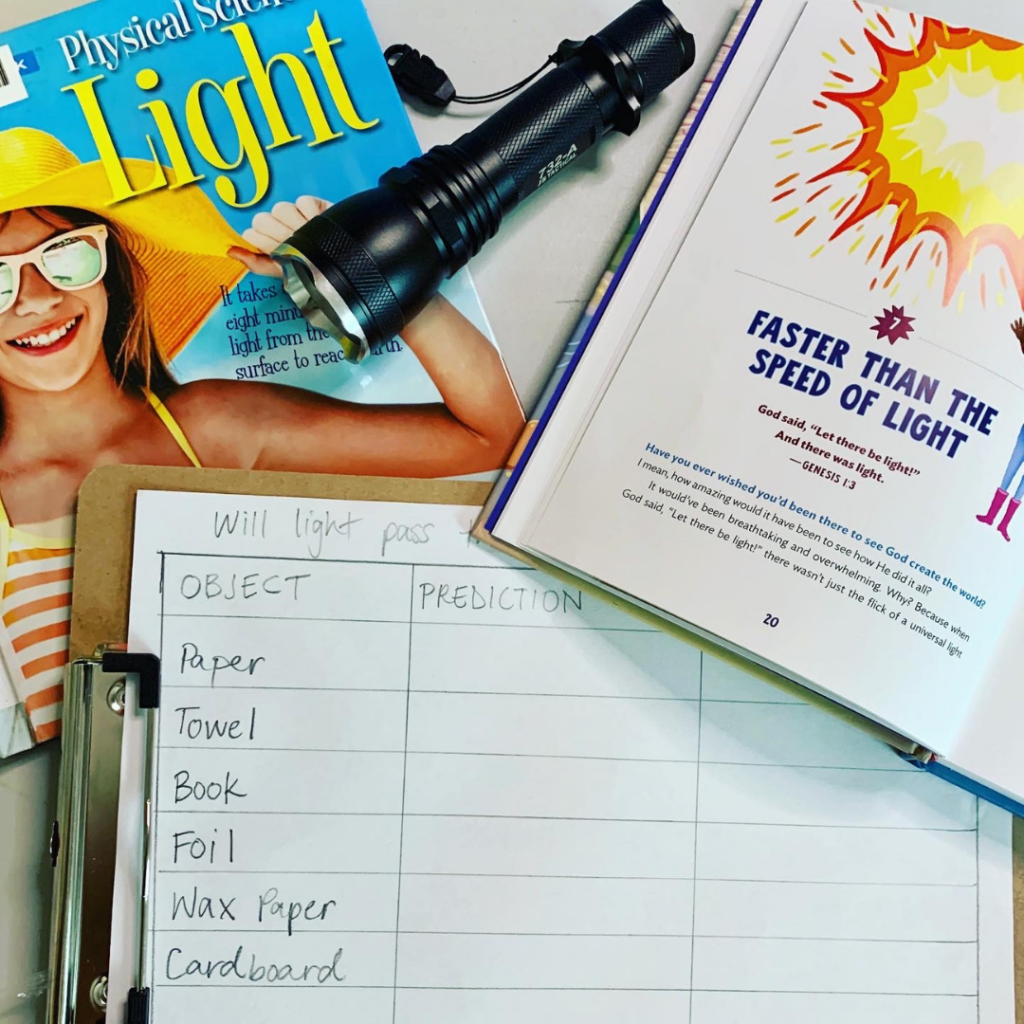
    This year we have been reading “Indescribable: 100 Devotions About God and Science”. This devotional is awesome! They are short and so interesting, even for me as the parent. Every day is a different science lesson related to a bible verse. We never get bored with it.

    This book would be great for all ages. I used to teach 5th grade, and they would have loved this book!

    If you have younger kids, you could definitely get creative and use this to help plan your science.

    As I mentioned earlier, we did this at the beginning of the year, and it was a lot of fun. The only reason we stopped was because I had a hard time planning in time to get books from the library.

    You know, this book would also be great for a summer read! If you take a break from your school books, you could still do mini science lessons along with the devotionals. Simply, look through the devotions for the week and check out library books on those topics.

    Whether you use it to supplement your science or not, this was a great purchase! We will work through the rest of it this year, and I look forward to pulling it out again in a few years.

    first grade curriculum

    Handwriting

    I chose The Good and the Beautiful for handwriting for two reasons. It was inexpensive and my daughter requested a program with three lines (with a dashed mid-line).

    The workbook is put together well and can be completed independently. I love how there are lessons of good character and basic life skills like first and last name, phone number, and home address.

    Each lesson has some sort of drawing or coloring activity at the bottom of the page. Eventually, we started skipping those, because my daughter was not interested. Overall, we were happy with it.

    I think handwriting can be a tricky thing because it does get a little boring and tedious for the child.

    However, I do think it’s good practice. I don’t know if we will purchase this one again only because I feel like it will be a waste to have all of the extra drawing and coloring that won’t get used. Most likely I will look for something without that.

    We did change it up half way through the year. For a while we used the copy work from The Secret Garden Read Aloud Experience. We also use Draw Right Now to add some fun.

    secret garden read aloud

    Read Aloud Novels

    I wish I would’ve read more this year, but with the new baby, this is one of the things that got skipped for a bit. We did read a few great ones that I will share with you.

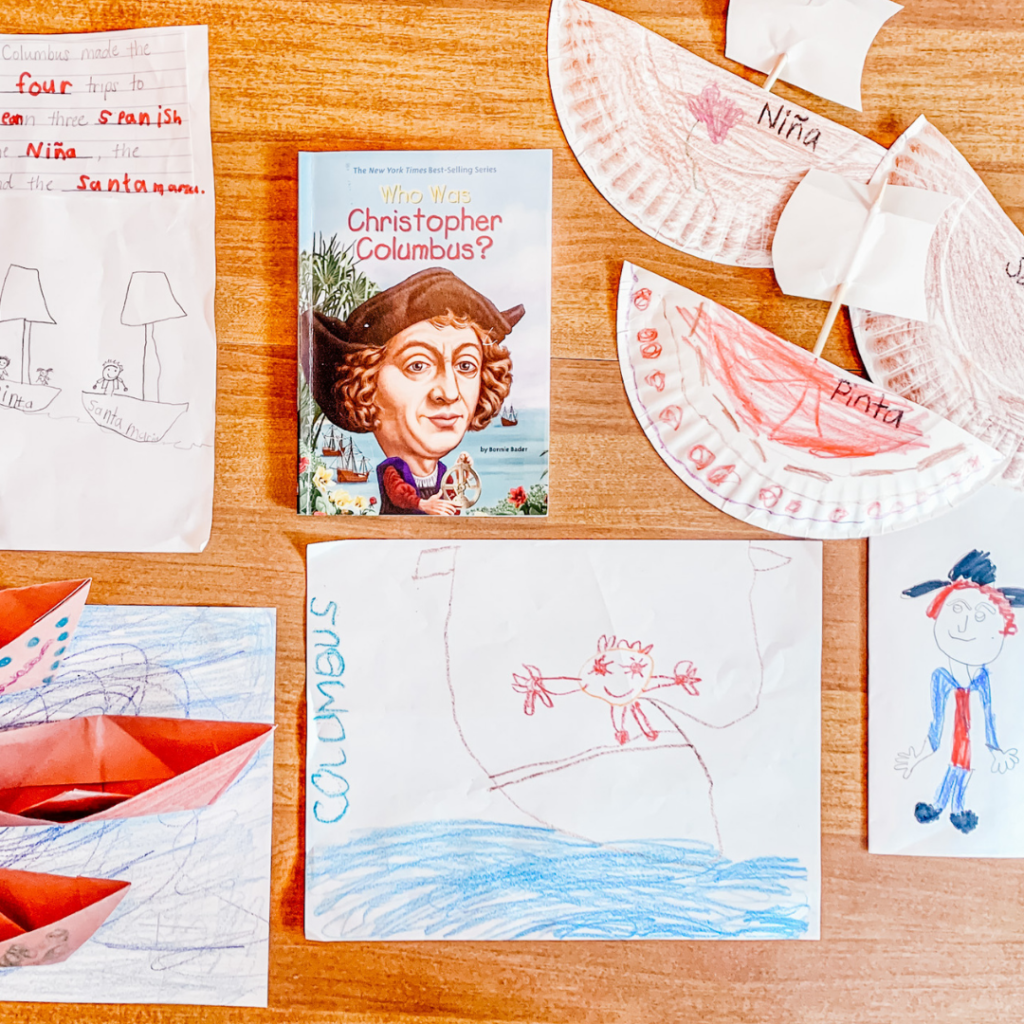
    I mentioned before that we have used the “Who Was…?” series to supplement history. We read “Who Was Christopher Columbus?” and “Who Was Davy Crockett?” I love how these books are short, interesting, and easy to read.

    Once I switched to Christian Light Language Arts, I really wanted to focus on a novel since the workbook did not have any reading portions (it’s a separate curriculum).

    We started with The Secret Garden. We followed the free Read Aloud Experience that allowed us to have new copy work for handwriting and a simple craft/activity to do every day. It was super easy and it gave us something to look forward to every day.

    The Secret Garden has 27 chapters, so it’s a definitely a time commitment. Even still, we thought the book was so wonderful and even enjoyed the movies afterwards.

    I wanted our next book to be much lighter, so we chose Mrs. Piggle Wiggle. Once again we followed the free Read Aloud Experience. There is no copy work with this one, but we did add it into our devotion time, as each chapter is assigned a scripture verse.

    We had a ton of fun with Mrs. Piggle Wiggle. Every chapter brought great discussion, and we continue to refer to the lessons we learned even after finishing. It’s great for all ages and it’s so silly!

    It’s hard to believe we are headed towards the end of our first grade year.

    Maybe you’ve thought about using something in your homeschool that I mentioned above. It’s even possible that you did use something and loved it, even though I didn’t. Whatever the reason is, remember that every child is different. You are the parent. You are obviously doing your research! (That’s why you’re here.) Be confident with what you pick, and jump in. You’ve got this!

    Posted on 2 Comments

    11 Flash Cards Games To Add To Your Math Lesson

    flash card games

    You can get flash cards at the dollar store! They’re an inexpensive tool to practice math facts. Let’s steer away from the old, boring drill method and find ways to add in some fun with these 11 flash card games!

    If your math book has a section to practice basic facts, try replacing it with one of these flash card games. Get out of the textbook and move around! Having go-to activities like this make it easy to add excitement to learning.

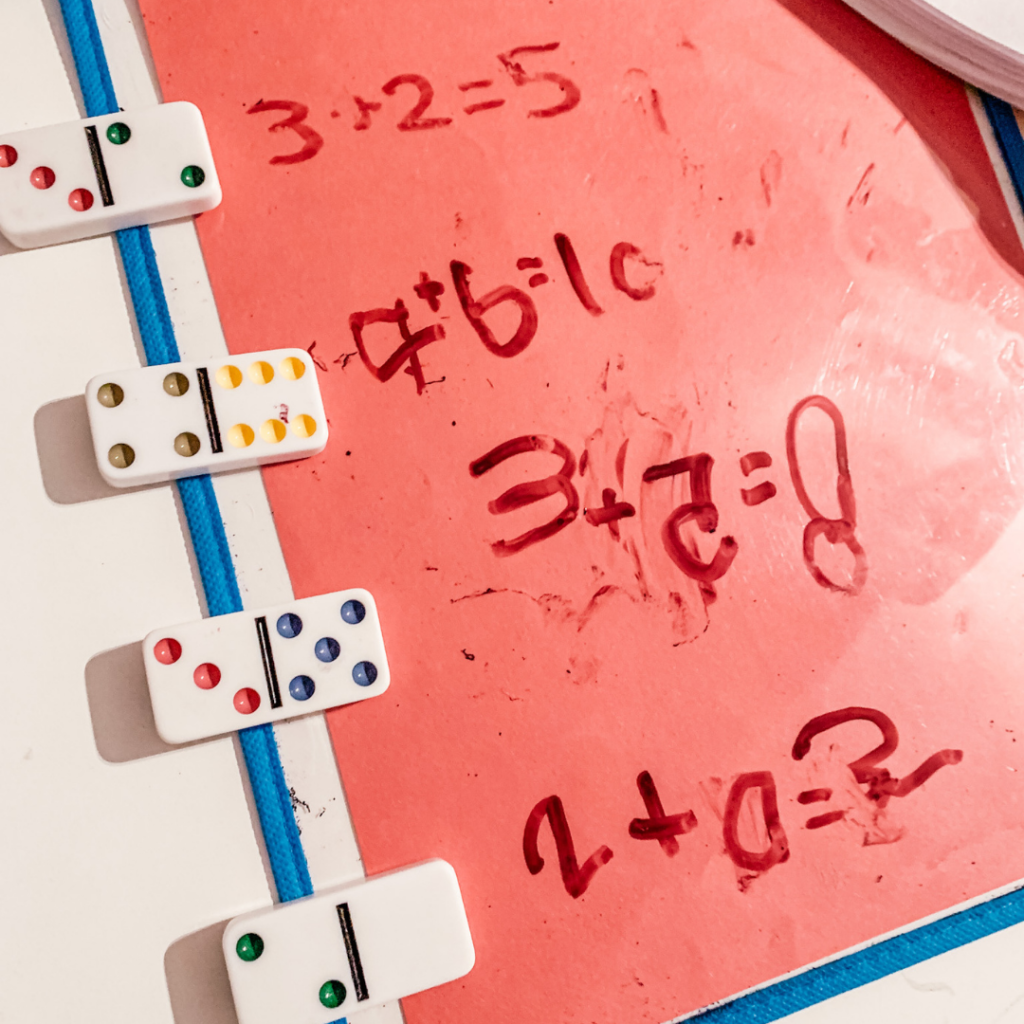
    My first grader is using addition and subtraction flash cards. I can do the same activities for my preschooler with simple number/counting cards. You can purchase them through the links or just make a trip to the dollar store and get them cheaper!

    This post contains affiliate links. If you follow one of my links I earn a small commission at no extra cost to you. Thank you for supporting my blog!

    number line

    1. Giant Number Line

    Create a giant number line. We did this with sidewalk chalk, but you could also tape sheets of paper together. I just love getting outside whenever we can. Number the line based on your flash cards. For example, 1-20 would be good for addition and subtraction for early elementary. If you’re doing multiplication, number it by 2s or 5s…whatever works best.

    Have your child pick a flash card and solve it. Place the card on the number line according to it’s answer. So, 2+3 would go on the 5. Some of your cards will have the same answer, and that’s okay. Just stack them on top of each other or in a straight line.

    flash card game

    2. The Floor is Lava

    Don’t you remember playing this as a kid? Gather as many pillows as you can and place them on the floor. Make sure to spread them out. Place a flash card on every pillow. Your child will jump from pillow to pillow solving math problems. It sounds so simple, but it is SO fun!

    Once he/she gets to the end, jump all the way back to the start – don’t fall in the lava!! Since I introduced this game to my girls, they’re always asking to play!

    flash card game

    3. Shaving Cream

    I’m a huge fan of shaving cream. You’ll probably read about it a lot here, but it’s because you can do so much with it, and it’s a blast. It’s another dollar store treasure! Now, you’ll have to help with this, because you’ll be the only one with clean hands.

    Every time I spray shaving cream on the table, I always allow a minute or two of just free play. It helps!

    Place 2-4 cards in front of your child. He/She can write the answer in the shaving cream. Erase and repeat.

    Change it up: Siblings can challenge each other. Or, have your child write a problem and you solve it. They’re the teacher, so it’s important to check your work. (See what I did there? They’re solving it too!)

    flash card activities

    4. Dry Erase Pocket

    If you don’t have dry erase pockets at home, they are totally worth the cost. Place as many flash cards as you can in the dry erase pocket. Have your child write the answer on the cards. This is great for independent work.

    Use manipulatives alongside the cards. For example, print out a ten frame and solve. (Get a ten frame FREE in my shop.)

    If your flash cards are double sided, flip the pocket over and do the back!

    5. Battle/War Game

    This is just like the traditional card game. Two people go against each other and flip a card. The highest card wins. I even had my girls play against each other with different cards. My preschooler had just a number and my first grader had an addition problem. Adjust it so that it works for your children.

    scavenger hunt

    6. Scavenger Hunt

    Hide the cards around your room/house. Have your child find the cards. Once a card is found, write the problem and answer onto a paper, clipboard, notebook – anything!

    The important thing is don’t forget where you hid them! Been there, done that.

    flash card game

    7. Squirt the Answer

    This will take a minute or two of prep. It’s an outside flash card game using sidewalk chalk and a spray bottle (dollar store! See a pattern?). Write the answers to your flash cards on your driveway/patio. Spread them out to encourage a little movement.

    For Addition/Subtraction, I would write 1-20. This would be great for my preschooler as well learning numbers 1-20.

    For multiplication, you can write the products.

    Now, show a flashcard, and when your child solves it, he/she will spray that number. It doesn’t have to be washed away completely, because it will probably get sprayed again.

    You could also do it backwards. Show a number card (Let’s say 8) and your child can spray all of the addition problems that equal 8! (2+6, 4+4, 3+5…and so on!) It’s a great way to memorize basic facts.

    flash card game

    8. Exercise!

    This is another great activity to get moving. I love exercise activities like these because my children usually forget we are actually learning. They’re having so much fun! You have to be intentional with this one. Pick the right kind of flash cards. I used addition cards and found about 15 cards that had the sum of 1-6. Next, I made a key and gave each number (1-6) an exercise.

    Show the flash card and have your child answer. Whatever the answer is, that is the exercise you complete.

    You could find cards with the sum of 10-20 if you want to make it more challenging. If you wanted you could do 1-20! You would just have to come up with 20 different exercises.

    For multiplication you could set it up to where you give a range. For example, if the product is between 10-20, you do jumping jacks. If the product is between 20-30, you skip around the room, and so on…

    Have fun with this! Join in if you’d like – it’s an easy way to add a little exercise into your day. It would also be a PERFECT rainy day activity.

    9. Sidewalk Solving (or Driveway)

    If you have a sidewalk in front of your house, this could be so fun. We do not, but I was able to set up some giant squares with chalk in our driveway The concept is simple. Give your child some sidewalk chalk and place a flash card in each square. Your child will walk to each square solving the flash cards and writing the answer in the square.

    This would also be great writing practice for your preschooler. Place number cards in the squares to practice writing a number.

    10. Comparing

    This activity compares two flash cards. The supplies needed are flash cards and popsicle sticks. If you don’t have the sticks, use anything with that shape (crayons, sticks, pencils, toothpicks…)

    I set mine up around the table. Each spot had two flashcards and two sticks. My first grader solved each card and wrote her answer on a white board to help her remember. Next, she shaped the sticks into the correct comparison sign: greater than, less than, or equal to.

    flash cards

    11. Building Blocks

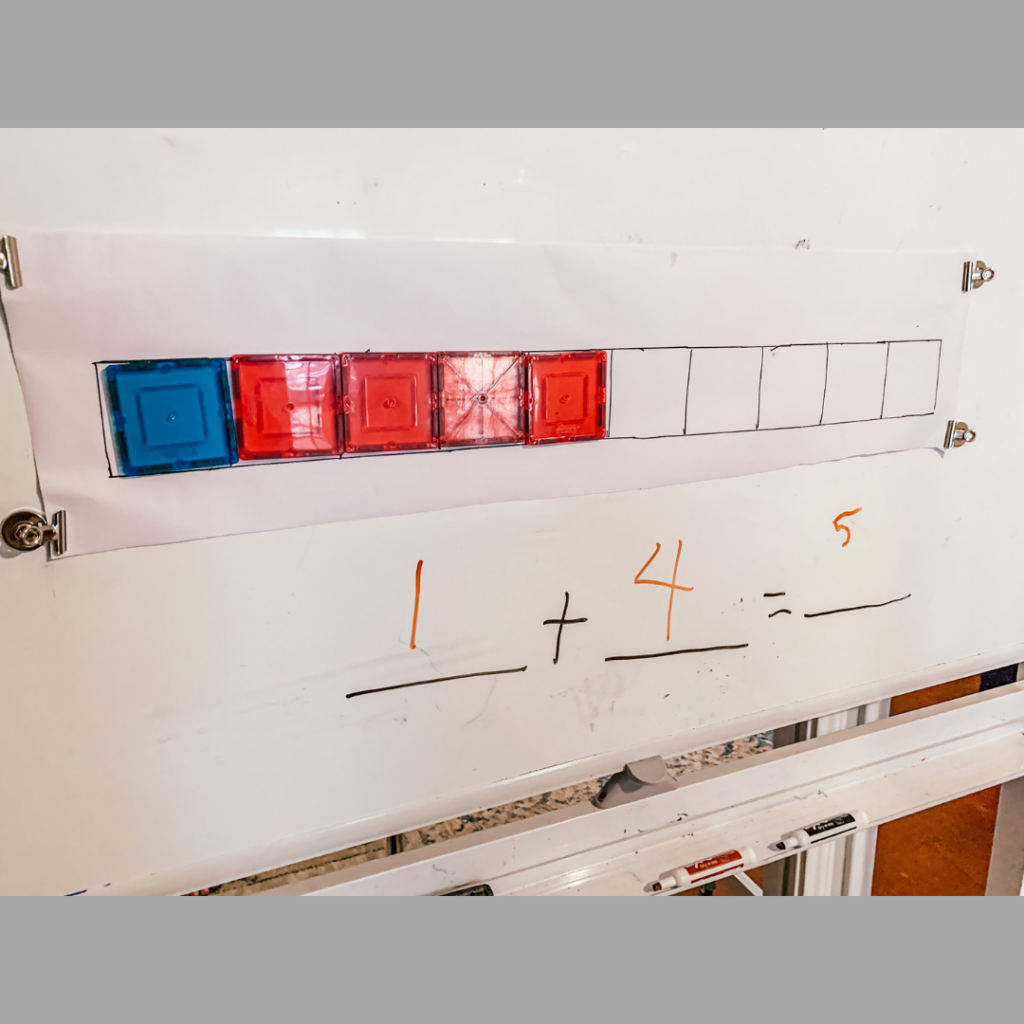
    Pick any type of building blocks: legos, wooden blocks, math cubes, PicassoTiles… This is a great activity for addition flash cards or simple counting. Lay a few cards out on the floor/table. Use the blocks to visualize the problem. Here’s an example – The flashcard says 5+4. Pick 5 blocks in one color and 4 blocks in another. Then, solve.

    Posted on Leave a comment

    Simple DIY Valentine’s Day Activities for Every Subject

    homeschool valentine's day

    Valentine’s Day is almost here, and it’s always fun to prepare something special to celebrate. There have been times when I’ve hunted around for different activities to print and cut and prepare…but I end up searching and searching and wasting time. I want it to be simple and in one place. So, I’m sharing a Valentine’s Day activity that you can do for just about every subject.

    All you need is materials around your house – the prep is easy!

    Some of the activities require a teensy bit of prep from you, but go ahead and look through – decide which are your favorites and how to best plan for them. I’ve recorded a video of myself doing the actual prep. It’s a time lapse video, so I obviously don’t move that fast, but the real time of setting all of these activities up was about 30 minutes. That’s not bad – 30 minutes of planning and you have an entire day’s worth of Valentine’s Day learning! It’s worth it.

    Bible/Devotion – “Love is…”

    Read 1 Corinthians 13:4-7. You are going to be discussing what love is and isn’t. The verse will state just that. Now, get ready to get a little messy. Sit at a table/counter and spray shaving cream on the top. Give your kids a minute to just mix it around and enjoy.

    Talk about each of the words describing love and have your child write the word in the shaving cream. If you have a younger child, you could have him/her write the first letter. For example, love is “patient” (P), love is “kind” (K). If you wanted to speed it along a bit and you have multiple children, you could give each child a different word.

    Here’s the trick – don’t let them erase and play until you discuss an example of each trait. So one might say, “I can be patient when I wait for my turn with the toy.”

    The bible also talks about what love is NOT. While discussing these, put an “X” through the words and discuss their meaning.

    The best way to clean up is with a wet washcloth. Just wipe and rinse a few times, and you’ll be all set. Whatever room you are in will smell quite delightful. To close the lesson, remind your children of our greatest Valentine, Jesus. Just as we erase the words, He wipes our sins clean and forgives us. He loved us so much that he died on the cross to save us. Read John 3:16. “For God so LOVED…”

    Math – Matching Hearts

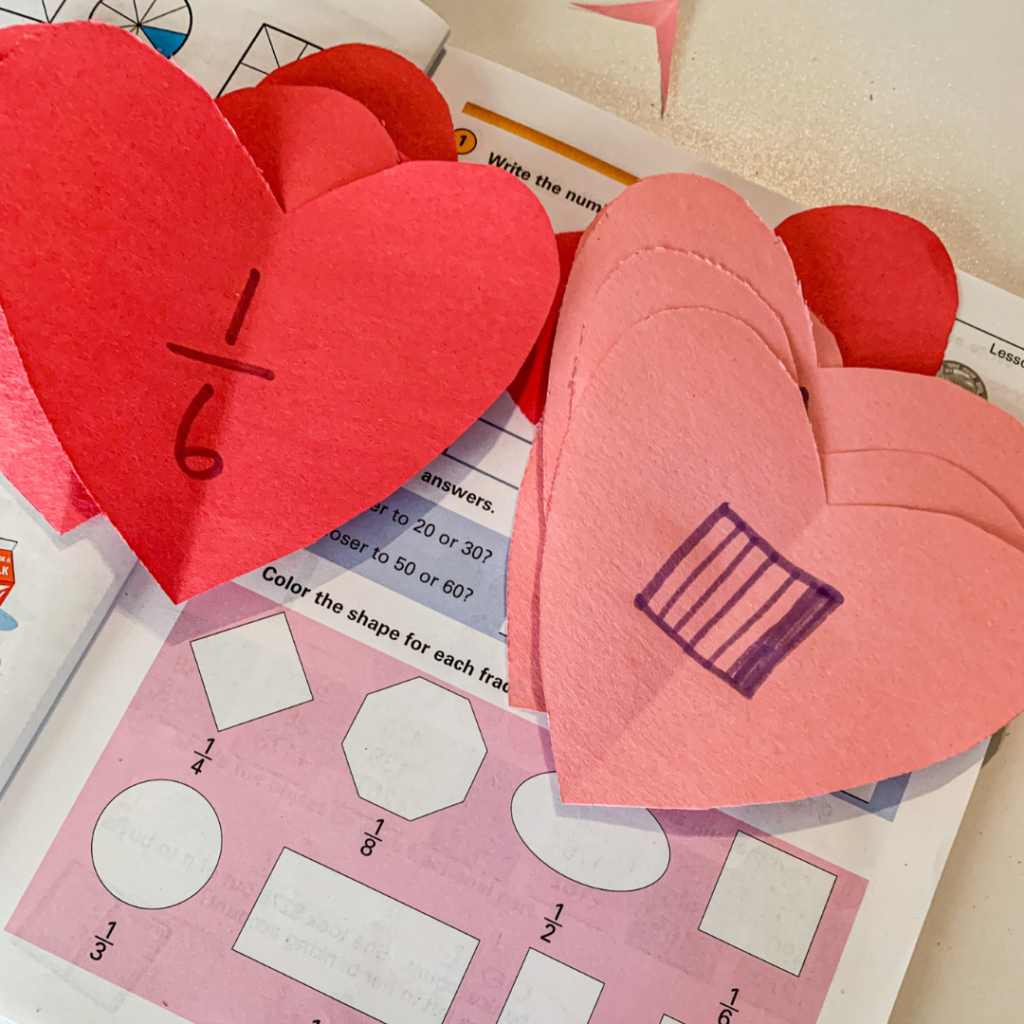
    You need 5-10 minutes to prep for this. (See Video) Grab 4-5 sheets of red/pink paper. Stack them together and fold hot dog style. (That’s the long way.) Cut out four hearts along the crease.

    Think about what your child is practicing in math. Use the hearts to make matching sets. Get the problems straight from the math book. You don’t have to come up with it on your own! Maybe your child is in first grade like mine and you’re practicing basic addition and subtraction, telling time, or fractions. Write the math problem on one heart and the solution on another. That makes a match. Make as many as you please. Ten is a good goal, but more won’t hurt.

    If you have a preschooler, practice numbers and counting. A match could be four circles on one and the number four on another. Or, match shapes. Maybe you’re ready to start some simple addition. Pick an activity that will best benefit your child.

    Language Arts – Write the Room

    You’ll need more paper hearts for this, but you can change the color to mix it up! (See Video) If you’ve never played write the room, I’m so excited for you to try it. It’s a favorite in our house. The way it works is there are words/prompts placed around the room. The child goes around and writes the word or an answer onto a recording sheet. It’s a great way to get moving.

    Once again, use your curriculum to see what you’re child is practicing. Maybe it’s CVC words, consonant digraphs, blends, sight words. Little ones can write letters or draw pictures. Prep your paper hearts with the words and tape them around the room. To help your child stay organized, it’s best if you number the hearts and number the recording sheet. When you’re ready, let them loose!

    Writing/Handwriting – Send a Valentine

    Send someone special a letter for Valentine’s Day. Discuss the components of writing a letter. Challenge your student based on their writing abilities. You can always help as needed. Send it through the mail. This will give you even more teaching moments as you talk about addressing an envelope and putting it in the mailbox. Don’t forget a stamp!

    Snack Time – Cookies or Fruit

    I’ll share a couple options and you can decide what works for you. Or, do both! First, my favorite is always baking cookies to decorate. Make it really simple and buy the package of dough/mix at the store. There is no shame in that. You have an exciting day ahead! (Also, it’s just easier!) If you have cookie cutter hearts, you can use them. Otherwise, just make a regular cookie and you can have your kids decorate with pink/red icing and sprinkles.

    Another option is to cut up bite size pieces of fruit. Give your child a plate and have them create a heart shape with the pieces. Then, of course, eat and enjoy – so simple!

    Art/Craft – Painting Hearts

    This time let’s have the kids cut the hearts! Teach them the process. Fold a piece of paper and talk about symmetry – that’s a good word! Each child will need 2-3 different sized hearts. I found this craft from A Dab of Glue Will Do, and you can see it here. You’ll be taping the hearts to a piece of paper and painting all around it. Be sure to paint the borders of the heart first. When your child finishes painting, remove the hearts for a fancy reveal!

    You can paint thumb prints as the site suggests, or try painting with anything! Cotton balls, q-tips, sponges, paintbrushes…get creative and let your child pick something fun and new.

    History – Valentine’s Day

    Whenever we want to learn more about a topic, I love using YouTube. There’s so much great stuff there, but just make sure to view it before your kids do. Below is a video I plan to show my children. It’s about a minute long. It’s a quick way to get a little history lesson in for the day, and it may bring up some fun discussions!

    Science – Heart Parachutes

    This is a quick experiment you can do at home with stuff around the house. Those are my favorite kind. The question we will be answering is – How does the parachute material affect the flight of the toy? (See Video for prep)

    First, you’ll want to test at least three types of material. Start with an 8.5 x 11 in piece of paper and cut out as big of a heart as you can. Now, use that heart to measure your other materials and make the same shape. (foil, wax paper, cloth, constructions paper, plastic bag…) You should have at least three heart shapes in different materials – all the same size.

    Next, gather string or yarn and cut three pieces for each parachute, all the same size. Tape the string to the top of the parachute. It’s best to spread them out in a triangular pattern. I used masking tape, and it worked just fine. Do your best to keep all the string the same size and taped the same way. These are our controlled variables (another great word! Go ahead – jump into that discussion as you do the experiment. The teaching moments are endless.)

    Normally, you’d want to test these with the exact same object pulling on the parachute, but we are going to break the rules a bit and use an almost-exact-shaped-toy. You need three. We used the little fisher price princesses. They’re basically the same size, just painted differently. You could try army men, hot wheels, small dolls. Make sure it’s not too heavy. Tape the string to the toy.

    Set it up like a winner-moves-on tournament. You can fly them over the railing on your stairs. Or, stand carefully on a chair. Observe which one flies in the air the longest. That’s the better parachute – not the faster one. The “winner” goes against the third parachute, and so on. I would test each flight about three-five times to make sure you have a clear winner. Here’s a quick tip – if your phone has a slow motion recording mode, you can record the flights and see the winner much easier. Plus, who doesn’t love a slo-mo video?

    Once you tested them all, talk about why you think that material was the best!

    It’s a whole day of celebrating and there was so. much. learning!

    So, how fun does that sound? Which one is your favorite? Anyone think they’re up to doing ALL of them? The most important thing to remember is not to stress. If you’re worried about time, split it up into two days. Or, pick just one, and call it good. Don’t let it get you worked up about fitting it in. Whatever you decide to do, I’d love to hear about it. Leave a comment or share it with me on social media. Have a great Valentine’s Day!

    valentine freebie

    BONUS: Valentine’s Day FREEBIE!

    Here’s a fantastic little activity book for your young learners this Valentine’s Day. Use dollar store stamps, stickers, or even manipulatives to add some hands-on fun! This freebie is only available for the month of February so get it while you can! Sign up for my email list and it will get sent right to your inbox today.

    Sign up below for your Valentine’s Day Freebie!