Posted on Leave a comment

A Simple and Fun Alphabet Curriculum for your Letter of the Week

alphabet workbook

The Alphabet Workbook is a simple and fun no-prep curriculum with repetitive opportunities to practice letters while also incorporating other early learning skills. It’s the key to our success in learning letters at my house, and this post is to tell you how it came to be…

I started homeschooling when my oldest was in kindergarten and my second daughter was three and a half. I didn’t do much organized curriculum with my three year old. There was a lot of play time, reading, and maybe a letter craft or two.

In our second year of homeschool, I had a goal to teach letters and their sounds to my then four and a half year old. Once again, I didn’t purchase anything super serious. I wanted to keep it low key. We started practicing letters by writing them, playing games, building them, playing with play-doh, reading about them…but they weren’t sticking.

Although we were doing a lot of different things, I was having trouble staying consistent. So, a couple months in, I felt like I needed to adjust some things.

I wanted something that my child could do every day (super short!) that would practice a letter a week.

There were all kinds of printouts online, but I’d have to search around and piece it all together. I also wanted to practice things like shapes and colors and counting…So I thought – why not put all of that into ONE? This inspired me to put together the Alphabet Workbook.

Each week in the workbook we would practice one letter while also practicing other early learning skills such as:

  • Coloring
  • Tracing
  • Shapes
  • Counting
  • Graphing
  • Comparing
  • Grouping
  • Numbers
  • Matching
  • Patterns
  • …and more!

This one workbook would allow us to practice multiple skills in just a few minutes a day.

I wanted the lessons to be short and sweet with a lot of variety. Nobody wants to do the same thing over and over. Many times when you download alphabet worksheets, they all look the same, just with a different letter. That would never fly with my daughter. So, I came up with multiple lessons that are incorporated throughout the workbook.

Each letter has 4 different practice pages, and every page for that letter looks different!

This variety was so great because it not only kept our work interesting, it really allowed me to see her practice many different skills. Each day she looked forward to completing her page, because she truly enjoyed doing it.

After a few weeks of using the workbook, I started noticing a difference.

She was writing more letters and remembering them. We would play games or read books about letters and she was participating and doing well. I was so proud of her! Even more important, SHE was so proud of herself. She really felt successful.

I honestly felt a sense of relief knowing every day we were getting consistent practice.

No more scrambling to find activities or practice pages. Everything was right there for us in the workbook. Every morning we could pull it out and get started. Pretty soon it got to the point where I’d catch her sneaking away with it to surprise me with completed pages. I love that she wanted to put in her best effort!

I know how hard it can be to pick a curriculum, which is why I want to send you a sample that you can try out for a couple weeks.

Don’t you just wish when you were picking curriculum, you could try it out for a few days first? I definitely feel that way when I plan for our homeschool year, but I hope to help you when choosing a curriculum for your little one. I’d love to send you the first three weeks of the workbook for FREE.

I want you to try it out at home to see how it works for your family. I want you to see the variety of activities and how fun and easy it can be to add this into your day. See how short and sweet learning can be with your precious babes.

The complete workbook is 109 pages, and you can get it all for just $5.00.

Why so cheap? I just want to help other families feel less overwhelmed by all of the things. This workbook provides consistency while still being fun to do! If you’d like to get the entire workbook, you can download it here.

My ultimate goal in creating this book was to create a simple, regular routine that would bring my daughter success. Looking back on her year, I’m just so proud of how much she grew and learned!

Ready to try it out? Submit your email below and receive your sample of the Alphabet Workbook.

    Posted on 1 Comment

    Homeschool Curriculum Picks 2021-2022

    It’s hard to believe this will be our third year homeschooling. What a fun, unexpected journey it has been! This year I will have a second grader and one in kindergarten. In this post I’ll be looking at our curriculum picks for the 2021-2022 school year.

    Some programs we are not changing from last year. Others we are trying something new. Remember that every family is different. What works for me may not be the same for you, but I do love learning about curriculum and I hope to provide that opportunity for you here.

    I will say up front that I also have a 2 year old and a 9 month old. Both will be tagging along and listening while we work, but I have no plans to purchase any sort of curriculum for them.

    This post contains affiliate links. If you follow one of my links, I earn a small commission at no extra cost to you. Thank you for supporting my blog!

    Kindergarten

    This will be my second time homeschooling kindergarten, and I am looking forward to it again. My second daughter has a very different personality then my first, so there are a couple changes I will be making to better fit her needs. I love that so much about homeschool.

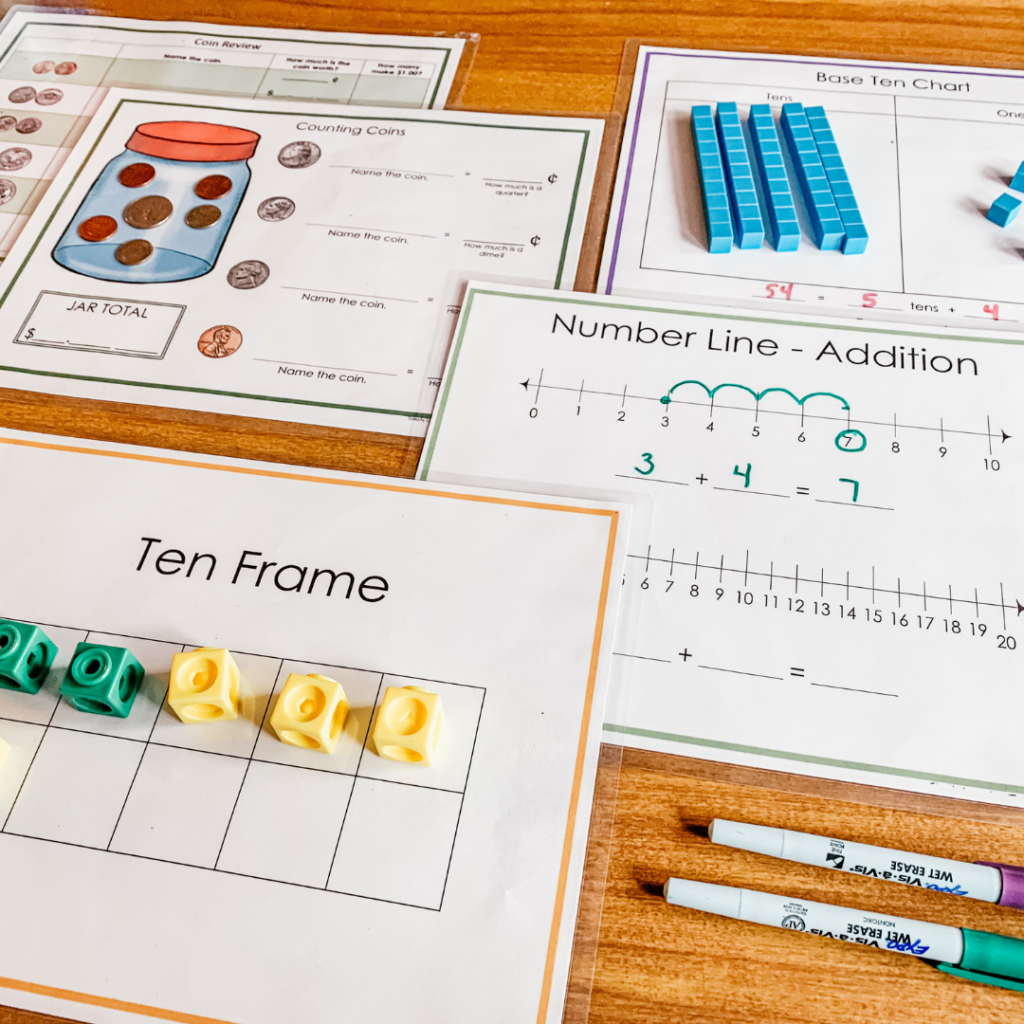
    math mats

    Kinder Math – Horizons K

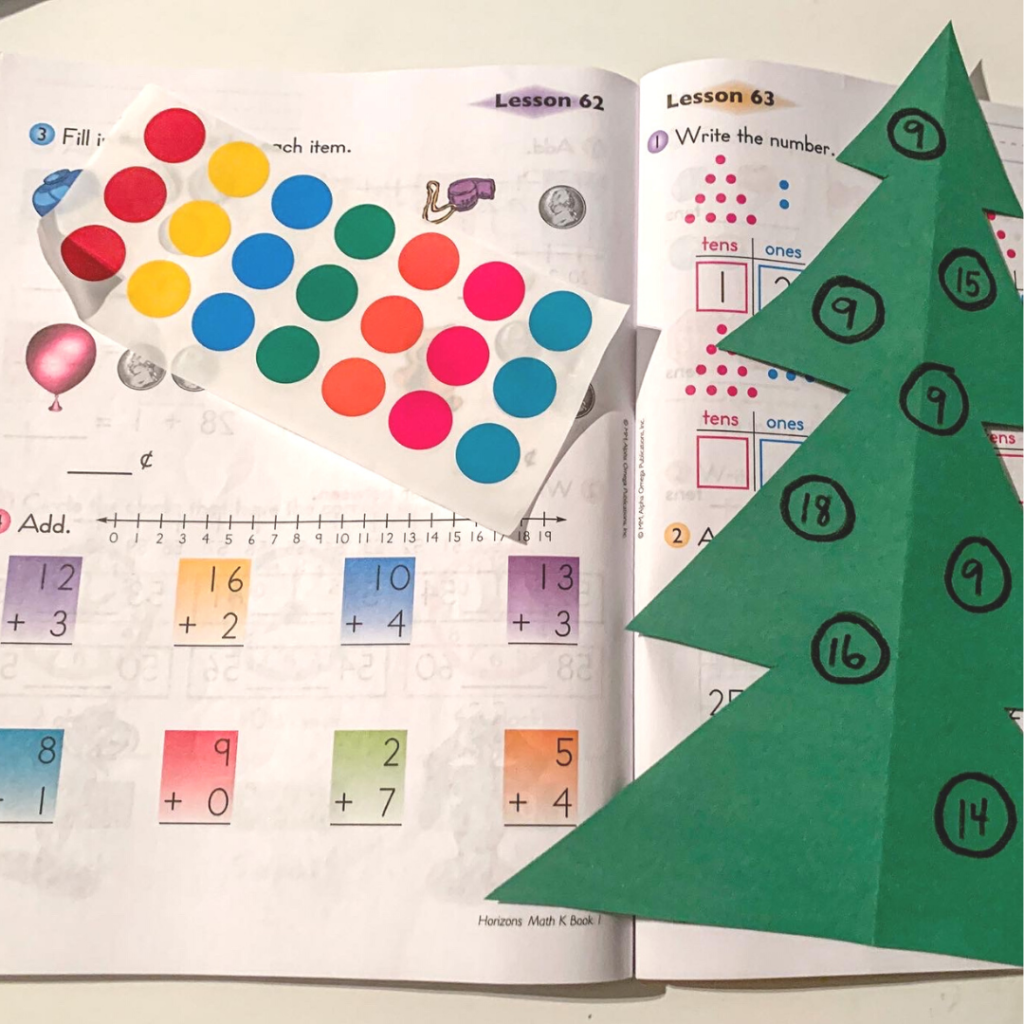
    This will be my third year using Horizons. I love it because it is to the point without any fluff. Along with the workbook I enjoy creating math games and activities to go along with their lessons. This provides us with a lot of hands on learning during our math time.

    Horizons math allows me to be extremely flexible when it comes to planning. Some days I want to have big plans to make an elaborate lesson, but there are also days we want to take it easy and just complete a page together. Horizons is set up in a way that lets me do that whenever I want.

    Kinder Language Arts

    I do NOT plan to use a curriculum set for language arts. You may think I’m crazy, but this is exactly what I did with my first daughter and it was wonderful! Here’s the thing – the fancy reading programs can get SO expensive! I just can’t get myself to spend that much. So, instead, I use a combination of things for our language arts in kindergarten.

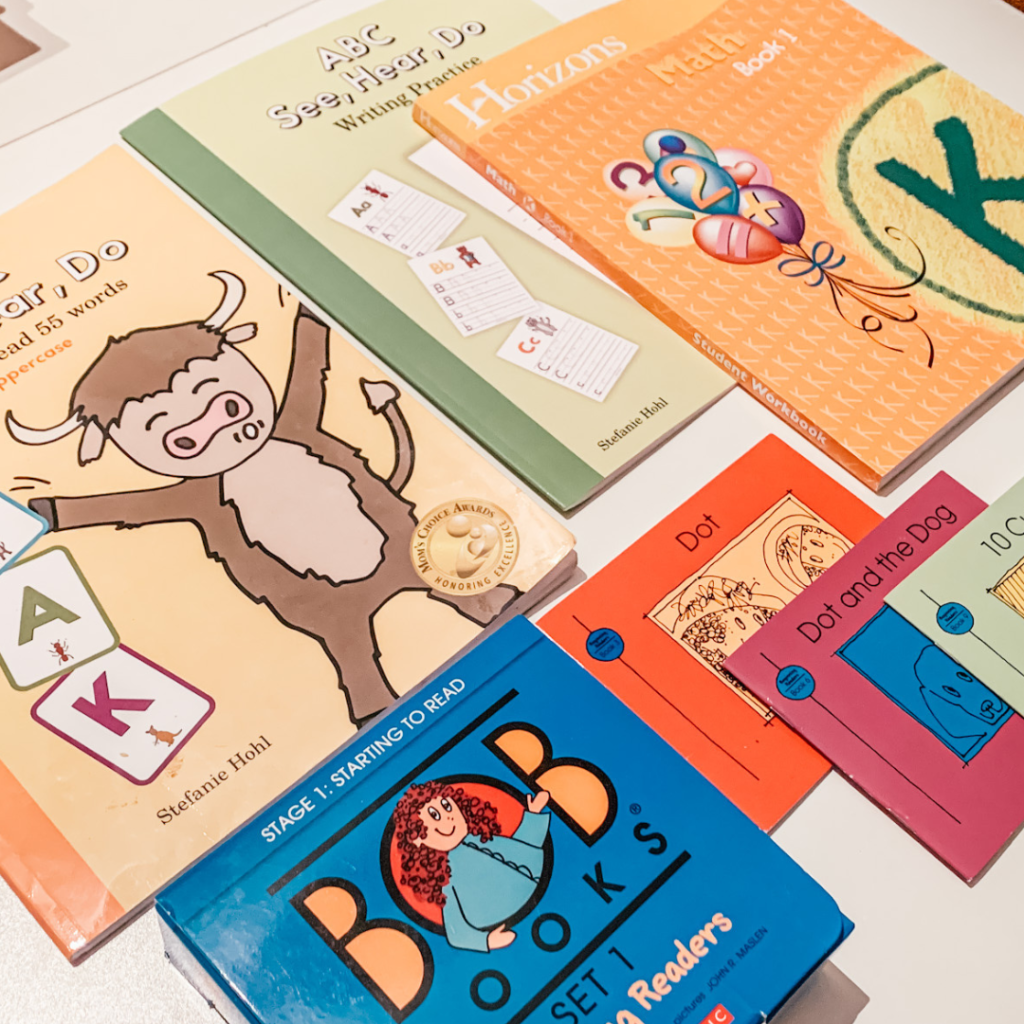
    First, we will review. We had so much success with the Alphabet Workbook at 4 years old. She knows her letters well, but we will spend the first few weeks of kindergarten reviewing and practicing the letters and their sounds. Then we will get into blending sounds, sight words, and using early readers. Here’s my list of sources below:

    Kinder Handwriting

    I actually didn’t use a handwriting curriculum for kinder with my first daughter. We practiced writing within our other lessons. I considered letting it go again this year, but I felt like it would help with routine if both girls had handwriting practice. So, we are going for it. It will also help with alphabet review.

    We are going to start with ABC See, Hear, Do Writing Practice. I actually changed to this last minute. I liked it because it was very basic, simple, and low-key. I also liked that it had the capital letter and lowercase letter on the same page. It will go along perfectly with our practice of letter sounds using the ABC See, Hear, Do workbook. It’s only 26 pages, so once we work through that, we will work through the original program I purchased.

    This year will be my first year to try A Reason For Handwriting in our homeschool. (Level K) I actually used it in the classroom to teach cursive when I was teaching fifth grade. I really loved that it was short, sweet, and scripture focused. I also have a personal preference to the three lines with the dotted middle line.

    That’s it for Kindergarten…sort of.

    It really is a short and sweet plan, and I’m so excited for it. I love how much growth happens in kinder, but there’s also just so much fun and playful learning along with it. I can’t wait to experience that again.

    My kindergartener will participate in the read alouds and bible activities I do with my second grader. Although it’s not necessarily “for her”, she will benefit so much from it, and I love anything that can involve all of my children together. She is also in Foundations with Classical Conversations – more on that later in the post.

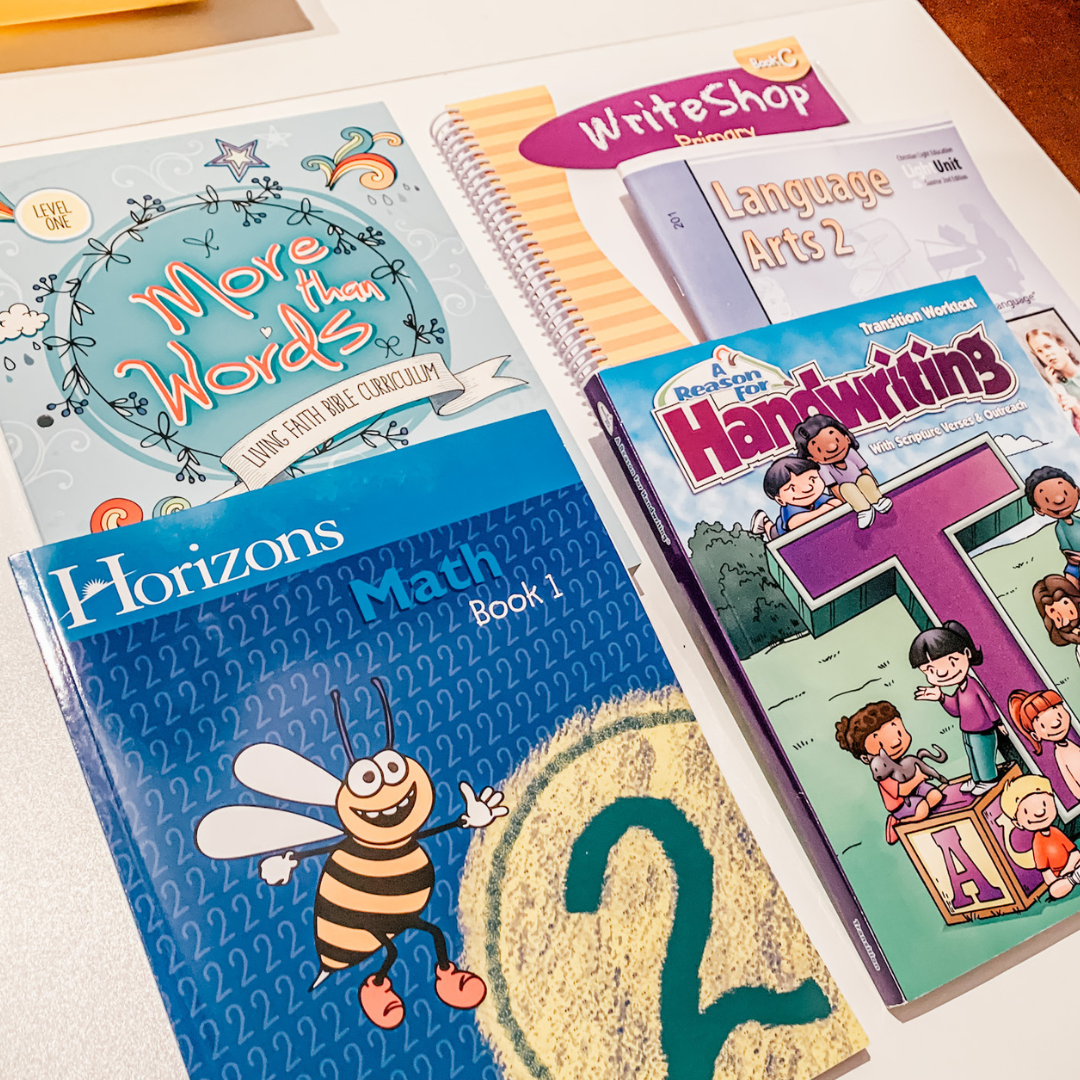
    Second Grade Math – Horizons 2

    This will be our third year working in Horizons. As I mentioned above, we love the simplicity and flexibility of the curriculum. I hope to create new hands on math activities to better help my daughter understand the different math skills. Follow me on Teachers Pay Teachers or, even better, sign up for my email list and be the first to get updates on when I add new math games to the store!

    horizons math

    Second Grade Language Arts – Christian Light Education + Write Shop/Read Aloud Units

    We switched curriculum midway through the year last year and ended on Christian Light Education. You can read more about that in my first grade curriculum review post. I loved the way Christian Light was set up so we decided to continue with it for second grade. I only purchased the unit set and the Teacher’s Guide.

    My goal for language arts this year is to complete one lesson each day from Christian Light, but I also want to add read aloud units and work on writing skills. So my plan is to alternate the two alongside the Christian Light Curriculum. For example, for the first few weeks we will complete a read aloud together. The next few weeks we will focus on a writing project. Then, back to a read aloud book. See the pattern?

    Write Shop

    As I planned Language Arts, I purchased a writing specific curriculum called Write Shop. I did this without knowing that there are actually writing assignments integrated in the Christian Light Program. So, I’m not sure how much we will do of Write Shop. I feel like I may have purchased a level too high anyway, so we will take it slow and see how it works for us. I hope to try one project this year for sure – just to get the feel for it. I feel like it will be a great resource for writing this year and in the future.

    Read Aloud Unit

    For our read alouds, we will complete a Read Aloud Experience which is something I created for the whole family to participate. It’s set up to add simple crafts, activities, and/or (free) books to your read aloud. We will start the year with The Boxcar Children. I’m so excited about it! The book is absolutely adorable, and we will get to experience so many different things through the activities. I really think this will be our favorite read aloud yet!

    For more information about the Read Aloud Experience, check out my post for The Secret Garden and Mrs. Piggle WIggle. You can also download the two units completely FREE in my shop!

    2nd Grade Handwriting – A Reason For Handwriting

    My 2nd grader is begging me to learn cursive, so we will start that using Level T Worktext from A Reason For Handwriting. It starts with manuscript and than gradually works into cursive. I look forward to the challenge for her, because it was getting to the point where handwriting practice was getting a little boring. This will definitely motivate her to continue practicing.

    Bible

    All of my children will be a part of our bible lesson, but I did buy a workbook for my second grader to complete. We have always just done devotionals together, which are great! However, this year I want to be a little more intentional with our bible lessons. I want to ask more questions and study more scripture while applying it to our daily life.

    I chose a program from Masterbooks called “More Than Words: Level 1”. The workbook has places for the student to write things down and interact with the text. I also love that it has character studies, which I’ve been wanting to add to our homeschool. We will have just one workbook that I will use to lead us all in discussion while my oldest uses it as a personal workbook.

    classical conversations

    Foundations – Classical Conversations

    We are a Classical Conversations family. This will be our second year and we absolutely love it. My two oldest children will practice their weekly material which includes Timeline, Science, History, Geography, Latin, English, and Math. If you would like to know more about what is involved with Classical Conversations, check out my blog posts:

    Since we will be covering so much through Classical Conversations, I do not purchase any sort of Science/History/Foreign Language curriculum. However, I do hope to check out library books and dig deeper into our topics as we are interested.

    Science and History

    As I mentioned before, our science and history will come from our Classical Conversations studies. However, this year I want to try to plan ahead a bit and use our library to help expand on our memory work.

    I’ll be checking out books from the library related to the topic we are studying that week. This will provide us with FREE lessons, and we will be able to really dig in to the things we are interested in. I’m using the “Year at a Glance” page from my Foundations Guide and simply writing down topics into my planner.

    Everything will be based on the availability of my library, but that’s OK. This is only for extra reading and fun and just a great way for us to continue to learn together as a whole family.

    Other Resources

    I’d love to add art and maybe some science experiments and field trips. I’d like to even have a designated “morning time” where we do some extra reading together. But – I don’t like to overplan. It’s hard to know what I have time for without getting an idea of what our daily rhythm will be. I don’t want to set myself up for failure. We will be starting with the basics. Once we get in a groove, I’ll think about adding other lessons if time allows.

    If you are feeling overwhelmed with planning, try just starting with the core subjects. Be sure to look into your state laws as well. See my post “5 Simple Steps to Start Homeschooling” for direct links. Put your extras aside until you get going for a couple weeks. Add them in as you can. Having a wish list like this is a great way to jump in to the year without getting too overwhelmed.

    Be flexible and willing to make changes as needed.

    This is one of the greatest perks of homeschool. We get to choose what works best for our family. I’ve given you my whole list of plans for this upcoming school year, but I know one or more things may not work out as I planned. That’s OK! We will make adjustments and push on.

    All I know is I am eager to jump in and get going! As you choose your curriculum for your family, I pray you have peace with whatever choice you make. I pray you have a blessed year as you learn together as a family.

    Posted on Leave a comment

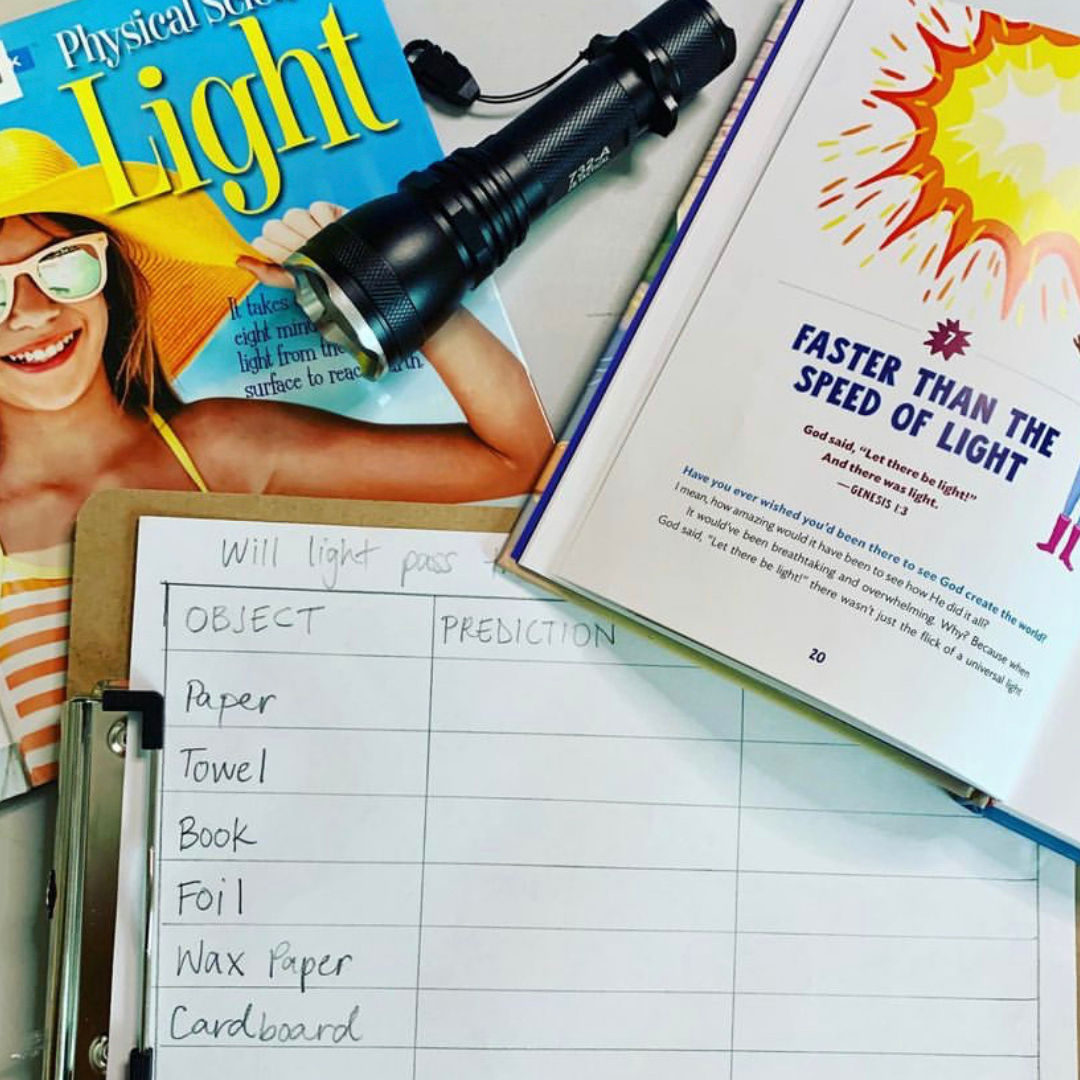
    At Home Science Experiment with Low Prep and Less Mess

    light experiment

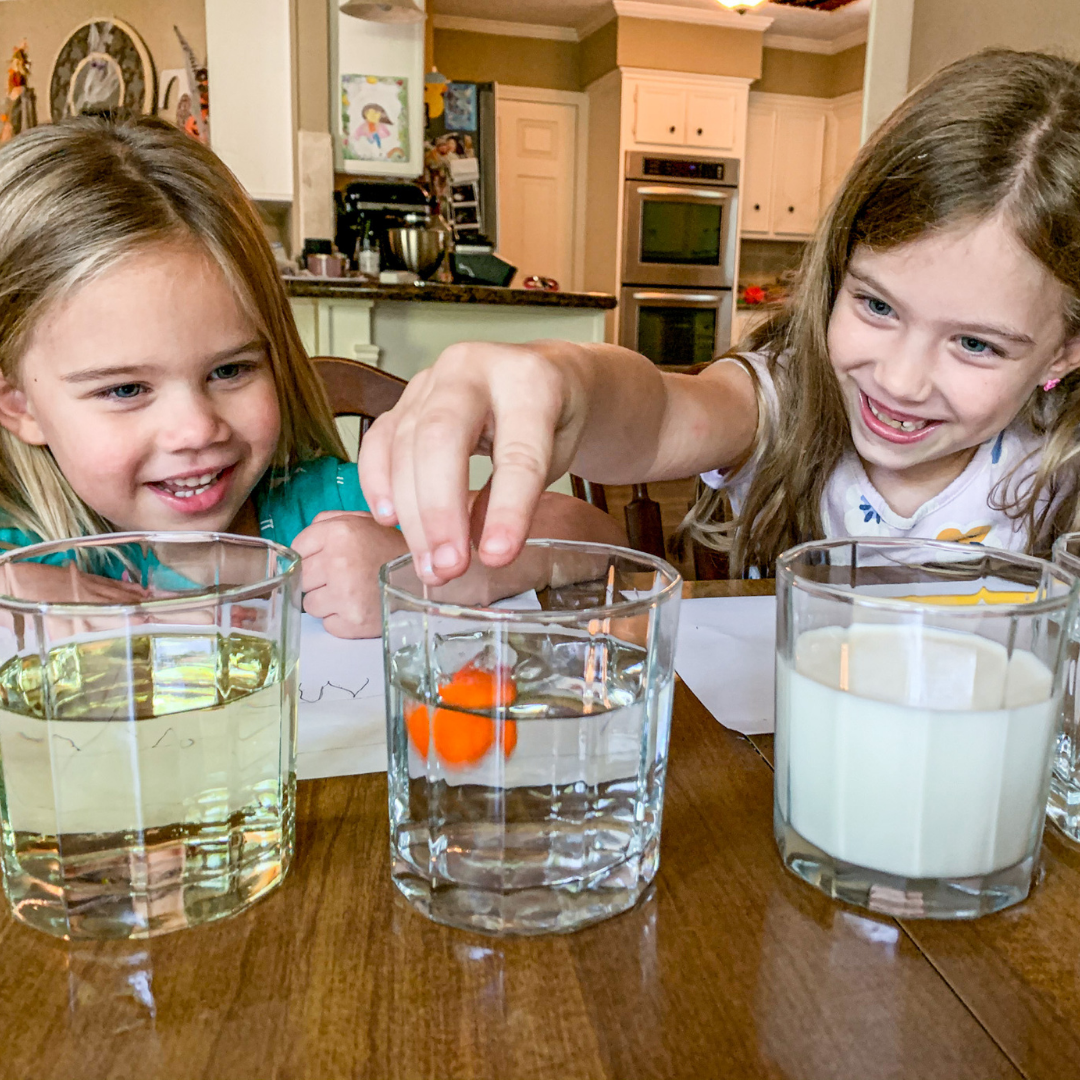
    I love how excited kids get about science experiments. There’s just something about the word “experiment” that gets them all worked up and ready to learn. Something that makes Mom excited is an experiment that can thrown together easily at home – low prep and less mess!

    This post contains affiliate links. If you follow one of my links, I earn a small commission at no extra cost to you. Thank you for supporting my blog!

    The experiment I’m sharing with you today is about light.

    We will be looking at key words like “opaque” and “transparent” as we see how light travels through objects. The question we want to answer is, “Which objects allow light to pass through?”

    light experiment

    Supplies

    You can find everything around your house. First you’ll need a pencil and recording chart. (Get a free recording chart for this experiment at the end of this post.) Next, grab a flashlight. Finally, you’ll need to find a variety of materials in your home. Be sure to find some that you think may let light shine through and others that won’t. For example, I might choose wax paper, foil, cardboard, printer paper, and a t-shirt. Having a good variety makes the results a little more interesting!

    Ask questions and make predictions.

    Get those brain juices flowing. Encourage your kids to wonder. Ask about the different materials. Tell them the question you want to answer and see if they can start sharing what they think may happen.

    Record your predictions in your chart. Your child can examine each item and state whether or not light will shine through it. Talk about the following key words:

    • transparent: able to be seen through
    • opaque: not letting light through
    flashlight activity

    Find a dark space in your home to complete the experiment.

    This makes it really fun! When we completed our experiment we sat in the closet under our stairs. Find a place in your home that works for you. Just make sure there’s enough room for everyone to participate.

    Choose your first item and have your child put the flash light up to it. Can you see the light on the other side? Does the light shine through? Record your results in the chart.

    Test each item and record what happens.

    Analyze the results.

    Now that you’ve tested all of the materials, compare your results to your predictions. Which materials let light pass through? Were your predictions correct? You can also sort your materials into two piles: transparent and opaque.

    Here are some questions to consider. Which objects allowed light to pass through? Which items are opaque? What other items would be fun to test? Can you think of other transparent materials?

    silly experiment photo
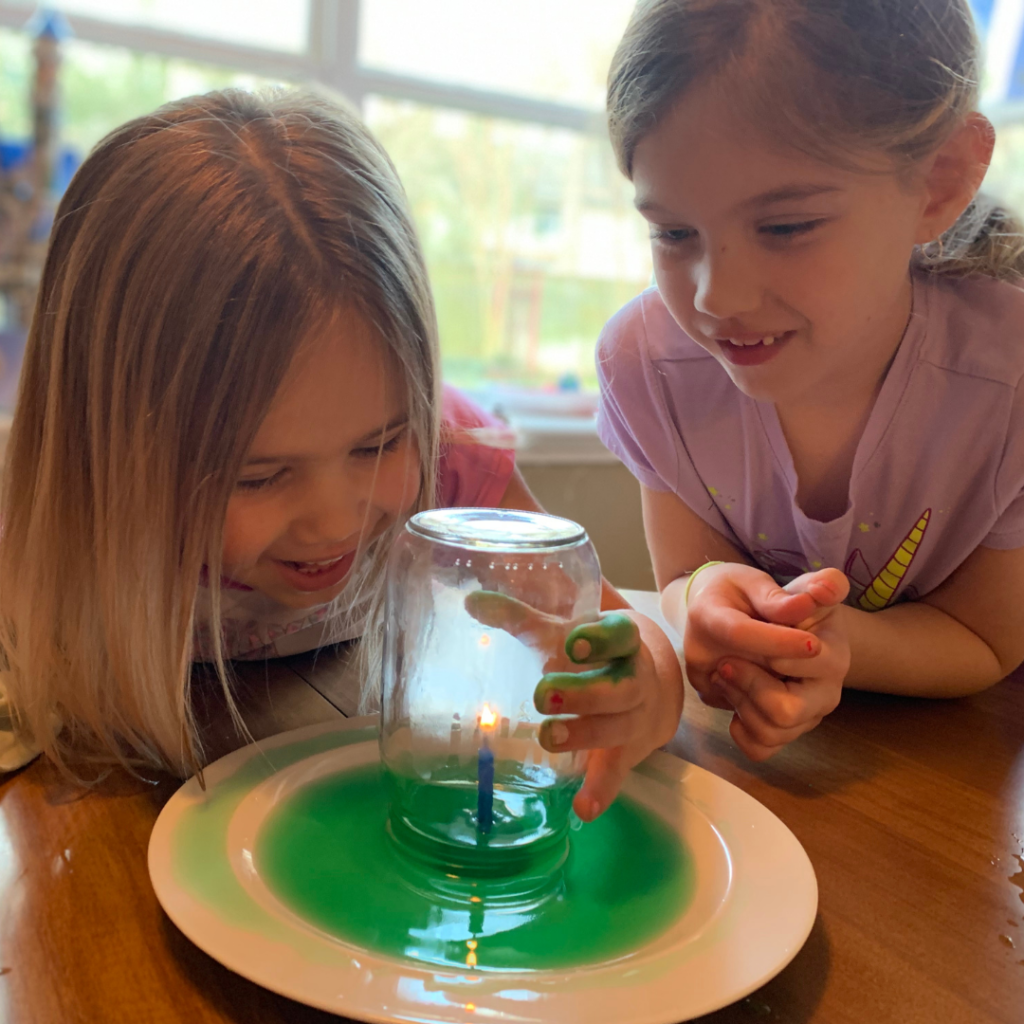
    Can you tell they had fun?? LOL

    Take it further!

    Books, books, and more books! There is so much to learn from reading books. Before you complete the experiment, check out a few books about light from your local library. This will provide even more learning opportunities!

    Remember it doesn’t always have to be nonfiction books. Find a fun story about flashlights or seeing in the dark. Maybe you can even look into other sources of light – lighthouses, candles, etc.

    Add a family devotion to your lesson. There are so many verses about light in the bible. Check out the following link and pick your favorite. (Website – Bible Verses About Light) Talk about it with your kids and pray about what you’ve learned. We paired our lesson with a devotion from Indescribable by Louis Giglio. (See title image)

    Print out directions and recording chart free

    Want a free printout of the instructions and recording chart? Submit your email below and I’ll send it your way!

    Posted on Leave a comment

    How to Potty Train Your Child…the Wrong Way!

    The thought came to me the other day when I checked on my child in the bathroom. She was upset as she was flushing the toilet so I picked her up only to find two little turds on the tile floor at her feet. As I used a wipe to clean out the squished poop between her toes (she had stepped in it), I thought to myself – man, I am doing this all wrong!

    OK…let’s be clear – this post is for giggles! If you’re not the type for a good laugh about parenting, you’re in the wrong place.

    I had a great bible study with some friends recently about image. Social media portrays a certain image of all sorts of things, but I’m specifically thinking of motherhood. So often you see things about doing something the “right way”.

    Well, I’m hear to tell you that everything I’ve done to potty train my 2 year old is the WRONG way. So, I’m laying it all out for you in this post in hopes to help you avoid the error. But, I also just want a good laugh out of you – and I hope you’re able to get it! 🙂

    Are you ready?? Make note – the outlined points are what NOT to do!

    Also, I’ve done all of these.

    1. Be sure to potty train your child at the same age you potty trained all your other children.

    My oldest girls potty trained quickly. No clue what I did, but it was magical. When my third daughter approached the same age, I felt obligated to start! So, I did. After spending the majority of my time on the bathroom floor and getting absolutely nothing done around the house, I was over it.

    Let me just tell you, there is no right age. Your kid is ready when your kid is ready. Unfortunately, we don’t get the memo on when that is!

    I want to also add that I was 7-8 months pregnant while attempting this. I was like a giant cow getting up and down on the tile floor. I huffed and puffed for a few days and called it quits! Potty training attempt #1 failed.

    2. Put them in underwear right away.

    Have you ever heard that? The underwear will teach them what being wet feels like, or so they say. Well, my child would come waddling to me saying “wet, wet”. So, I guess that’s a plus – she knew “wet”! Here’s the thing, I didn’t know where the accident happened.

    I spent many days on all fours rubbing my hands and nose in the carpet trying to figure out where the pee puddle was. As your hand swipes through the carpet and hits that squishy, wet spot, you’re happy to find it but disgusted at the same`time. It wasn’t pleasant.

    Was there a time I didn’t find a wet spot? Yes, yes there was. What did I do to finally find it, you ask? Absolutely nothing. I’m sure it’s dried up by now (gross)….So, maybe wait a bit before trying the underwear trick.

    The same goes for no underwear. There’s no pretty way to say this, but you’ll be picking up a pile of poop on your floor – no doubt.

    3. When the timer goes off to take your child to the bathroom, go ahead and wait a few minutes more.

    I am always in the middle of something when the timer goes off. Surely a couple minutes wouldn’t hurt…wrong. Those minutes do hurt, and you will pay – See #2.

    The timer is your friend. Trust it.

    4. Leave the child alone on the potty so you’re not a distraction.

    This caused multiple issues, as you can imagine. Sometimes the child slides off after going but doesn’t wipe well and a mess gets all over the seat. Next, the child places her hands in said mess to say a sweet “bye bye” as her potty is flushed. Now, we’ve got a full on germ situation.

    Let me also say that you may be picking up poop on the tile NEXT to the toilet. (Did you read the intro? True story.) Your child will not stay on that seat while unsupervised.

    5. Use the pull-up to your advantage.

    When your child wakes up in the morning, after nap, or even before bed, just leave the pull up on. Who cares if it’s on a little longer than it should be? You’ll throw it away and start again. (Guilty.)

    6. Be inconsistent.

    It was a sunny afternoon. My 2 year old was waking up from her nap and started talking in her crib. I decided to leave her in there for a bit so she’d have some time to warm up and be in a chipper mood. (I was also probably watching a really good show or something and it wasn’t quite over!)

    Anyway, she starts talking to herself, but after a minute or two it starts to get much louder. I ignore it at first (mistake) and finally decide it’s time to let her get up. As I walked into her room, it was like I was punched in the face by a giant stink bomb.

    The initial smell was a shock, but the sight I saw next was absolutely nauseating. My child had removed her diaper and pooped in her crib. That’s not all. She then decided to do some sort of painting along the crib rails with her hands and feet, using that pile of poop. There was poop everywhere. She was crying…I was crying….

    There is no stain removing secret for something like this. Throw it AWAY!

    I blame this on my inconsistency. She was thoroughly confused by my laziness and lack of motivation. She figured why not teach me a lesson? Lesson learned.

    7. Give your child a delicious drink to make sure they need to go.

    I did this…once.

    After cleaning about 9 accidents in 45 minutes, I decided that this tip wasn’t for us! We never even made it to the timer going off. It was a constant flow and a big fail.

    Let’s be honest, you have to fully commit to potty training.

    That’s really where I struggle. It’s hard balancing it all, and sometimes I don’t have the energy. However, if you’re not fully invested in it, it won’t go well. I’ve learned this the hard way. I have tried to potty train my child 3-4 times now, and we are still working on it. This time I’m in it to win it – fingers crossed!

    I will say that she can communicate with me better and she is a lot more verbal than when I first tried it. It’s helping! So, if you give it a shot with your own child and it doesn’t work…try again later! I can’t tell you when the “right” time is, but I can tell you that eventually it will all come together.

    So as I continue to wipe up pee and pick up poop on my floors, I hope you have been able to take a breath and know it’s OK if it’s not working right away for you and your child.

    You’re not alone, my friend.

    Now I have to know your funny potty training stories. I know you have them. Leave them in the comments or shoot me an email. Let’s get a good laugh together.

    Posted on Leave a comment

    40 Simple Activities for Every Day this Summer

    summer activities

    We are officially on summer break! I am starting to think about ways to add some simple activities while providing learning experiences on the way. I do not like to plan every day out, because I like our schedule to be a little more free and open in the summer.

    So, how do I pick an activity? I, personally, like to choose spontaneously based on how I feel that day. I’ve got my list of simple activities I enjoy putting together in my head. As the day rolls along, I pick and choose the perfect one for that day.

    The reason I love a good activity list like this is because I love having one small, NEW thing to look forward to each day. It adds some excitement for my children and it makes each day fun in its own way. I’ve been living this “one-new-thing” motto for a while now, and have loved it. It’s easy to plan, and it can be as big or as little of an activity as you want.

    I constantly have ideas running around in my head, but I thought to myself that it might be neat to come up with an idea for every day of the summer. This does not mean that every day needs an activity. There are days when boredom and rest is welcomed and even encouraged! I just wanted to have a list for people to refer to. So, I’m counting the average summer (June and July) with 5 days a week. So, let’s do it: 40 simple activities for your summer!

    Save this post or download the list FREE below, and pick one activity each day. It’s your “one-new-thing” for the day. Some will be super low-key, and some will require some planning. If you have fun with one of the ideas, do it again! You can do multiple activities in one day. There are no rules here.

    This post contains affiliate links. If you follow one of my links, I earn a small commission at no extra cost to you. Thank you for supporting my blog!

    1. Sprinkler and Popsicles

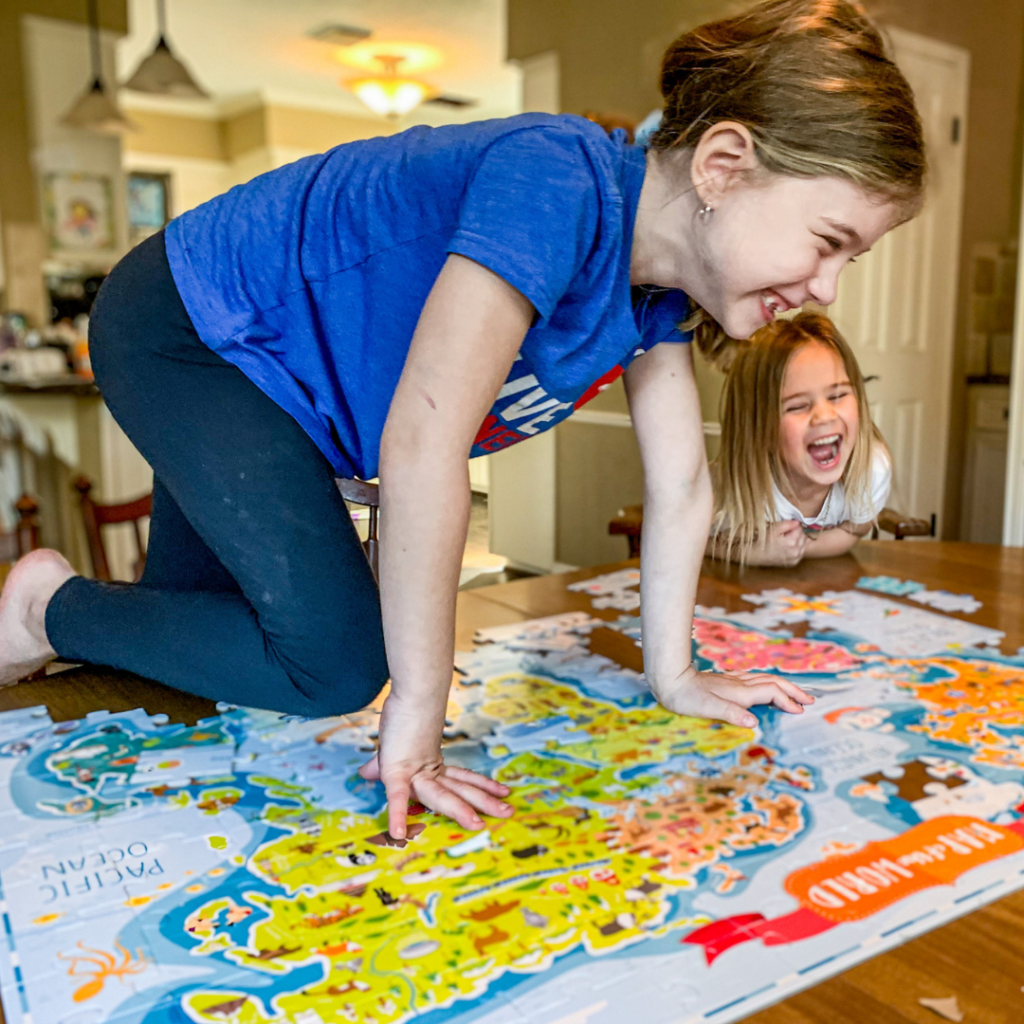
    2. Puzzle

    Complete a big puzzle or do a bunch of little ones. Once, we took all of our wooden puzzle pieces and put them in a pile next to all the empty boards. It was so fun – a scramble to get them all back together! You could also time it for a little racing excitement!

    3. Book Basket

    Pick a selection of books from your shelves that follow a theme: animals, weather, nature, superheros, princesses…it can be anything. Leave that basket in a new spot in your house and read through it that day or even throughout the week. This is a great one to keep going throughout the whole summer.

    You can also use your library.Think of a topic your children are interested in OR just ask them. When they come up with a topic, visit your local library website and choose as many books as you can about that topic. When you pick them up, it’s like Christmas!

    Place the books somewhere they can easily be grabbed and read. I promise you, the learning opportunities will explode. I’ll explain….the other day I checked out a bunch of ocean books. We poured them out on the floor and dove in.

    One of the books came with a song, so we learned a song about a beluga whale. It was so cute! Next, we read tons of crazy facts about interesting animals in the ocean. My oldest couldn’t stop! She was so intrigued.

    I found a couple of sea animal crafts that worked with our supplies. We also found an ocean documentary from Disney that was really good!

    See how one set of books can take you many places? I bet questions will come up as you read. Research! Watch videos…read more books…write about it…find a coloring page…there are so many ways to extend the learning about the topic your children CHOSE to learn about. This process of interest-led learning is exciting!

    4. Start a new Read Aloud

    Simply start a new book together. Don’t think your kids are too little to read chapter books. I’ve been reading out loud to my bigger kids while some of mine were babies. It gets really fun when they are around 3-4 years! If you’re interested in taking it further, check out my free Read Aloud Experience.

    I have two free units. Mrs. Piggle Wiggle is short, funny, and easy to complete. The Secret Garden is a bit longer but it is absolutely beautiful. Each unit comes with discussion questions and simple activities to do along with each chapter. No required book/supply list!

    the secret garden

    Click here to download the Secret Garden Read Aloud Experience.

    Click here to download the Mrs. Piggle Wiggle Read Aloud Experience.

    5. Water Table

    I purchased a water table about 5 years ago, and it’s still going strong. I’m always tempted to get a new one, but they really don’t care about the bells and whistles. All my kids want to do is play and splash in the water. So, if you don’t have a water table, save yourself some money and just purchase a giant plastic container. It will provide hours of fun.

    Change up the water table on a different day to mix it up. Here are some ways we have tried:

    • bubbles (use tear free soap to protect eyes)
    • ice cubes
    • shaving cream
    • water beads
    • toy theme: animals, princesses, superheros, cars – any type of toy you are ok with getting wet.
    • Barbie/Doll bath OR car wash
    • spoons, ladles, measuring cups

    The water table is definitely my favorite because it’s usually an easy clean-up and it entertains all my children, no matter their age.

    6. Watercolors

    If you’ve never tried watercolor paper, it’s a game changer. It turns a sloppy puddle of paint into some really cool art!

    7. Nature Walk

    Walk in your neighborhood or pick a nearby trail.

    8. Scavenger Hunt

    Take it indoors or outdoors. You could also hide flashcards or task cards around your house. (Check out this post for more flashcard games) Hiding puzzle pieces is another fun option – just don’t forget where you put them!

    Check out this neighborhood scavenger hunt.

    Here’s another site with a few different free scavenger hunt printables.

    9. Park Trip

    10. Splash Pad

    11. Paper Plate Craft

    I love having paper plates at my house as a regular craft supply item. There are so many different things you can do with them. You could choose something intentional to make with the paper plate, or just choose something fun and random.

    Click here for some different animal choices.

    You can find more paper plate craft ideas in this post.

    If you go on Pinterest and type in “Paper Plate Craft”, your choices are endless!

    12. Board Games

    Pick one or make a whole day of it! Our favorites right now are Eye Found It, Fairytale, and Hedbanz.

    13. Lego Challenge

    This one is great if you have a variety of legos at home. This link I’m sharing with you is a calendar with a lego challenge a day for 30 days! WOW! Pick one or do them all. Have a lego challenge day! Have fun with it!

    14. Walk a new trail

    van gogh painting

    15. Art Study

    We did this throughout our school year and it’s really a lot of fun. Choose an artist. Look for YouTube videos about that artist. You can even check out books from your library. Then, try to recreate a piece of work created by that artist.

    When we did this at home we studied Van Gogh. I’ll share the link to the video we watched here. I’ll also share the two books we read that were very good and paired well with our study:

    We re-created Starry Night after learning from the videos and books. This was a great activity to do together and I look forward to another art study like this again.

    16. Bake a treat

    17. Bike Ride

    18. Water Balloons

    If you’ve never tried Bunch O’ Balloons, you’re missing out! I remember trying to fill up water balloons as a kid by hand. They were slippery, they popped, and it took forever. Whoever invented these is a genius – it’s practically zero effort and fast! Be sure to teach your kiddos how to clean up all the balloon pieces too 😉

    19. Make a puppet and have a show!

    20. Bake bread

    So, I’m a huge fan of Paul Hollywood and the Great British Baking Show. I have a few of his cookbooks. Paul Hollywood’s Bread is my favorite cookbook of his because it has step by step photos.

    If you don’t know where to start, soda bread is a great one to try because it’s quick. Homemade pizza dough is another fun one and it’s so delicious! Make the dough and add whatever you like to it! If you want to go big and try the whole kneading and rising process, check out the bread loaf recipe. There’s nothing like the smell of homemade bread.

    Soda Bread Recipe

    Pizza Dough Recipe

    Bread Loaf Recipe

    21. Ice Cream Sundaes

    22. Documentary Day

    There are so many great documentaries on streaming channels right now. Disney+ has a Disney Nature series that’s great.

    Planet Earth is another fantastic series that is so interesting to watch!

    23. Card Games

    Play with regular cards or try different games like Uno Attack and Phase 10.

    24. Lemonade Stand

    If you are uncomfortable doing this in your neighborhood, or if you just want to keep it simple, consider hosting a lemonade stand for family and friends. The next time you invite people over for dinner, set up a lemonade stand and have your child sell to family. Add fresh baked cookies or brownies. Let your guests know it’s coming so they can bring change 🙂

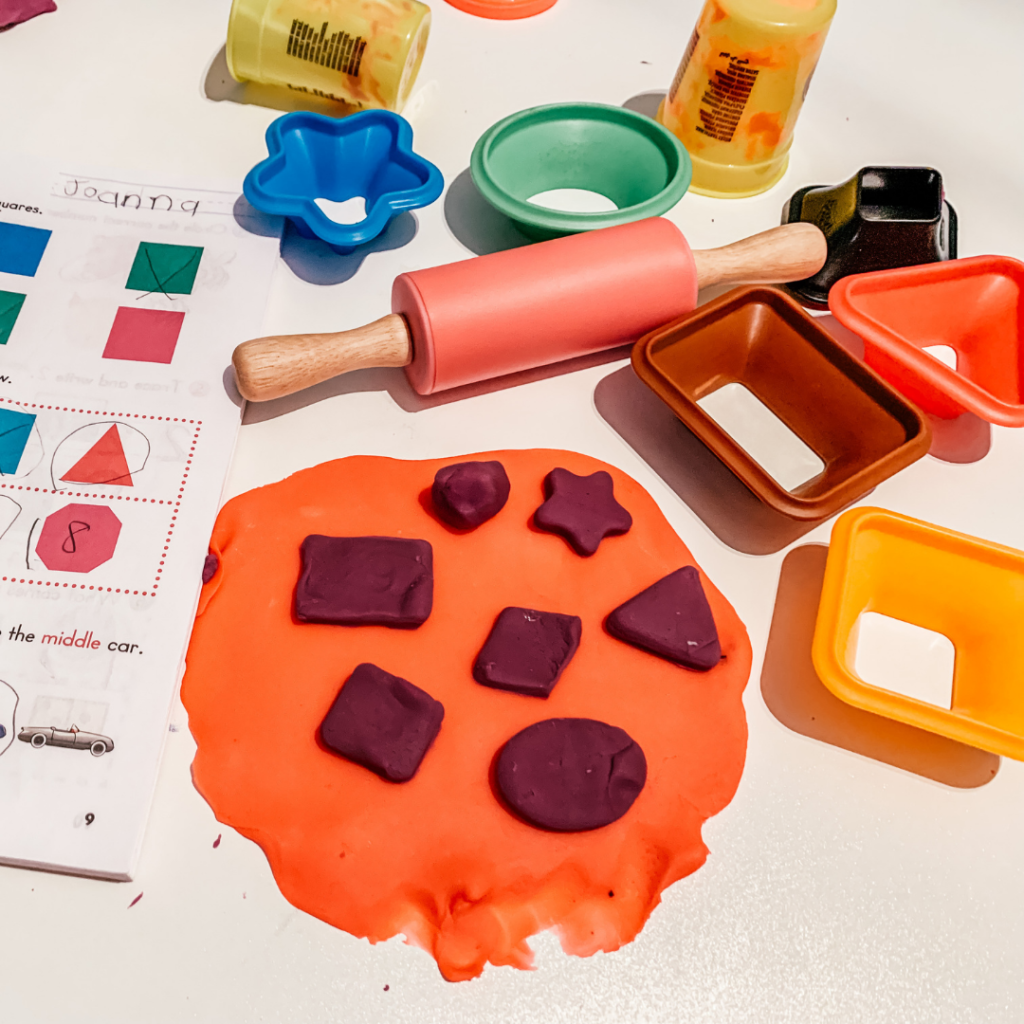
    25. Play Dough

    Play with the store bought kind or make your own! Find a recipe here:

    Homemade Play Dough Recipe

    26. Shaving Cream

    Slap some shaving cream on your table and let your children rub their hands in it. Write words, numbers, pictures…anything you want! Get the shaving cream from the dollar store.

    The best way I found to clean up is to wipe with a wet wash cloth, rinse and repeat. It takes a few times, but it works. Once your finished, the room will smell nice and clean!

    27. Movie and Popcorn

    28. Cookie Decorating

    We have a set of cookie cutters that make cookie decorating so fun. There’s a shape for every holiday! It even comes with letters and numbers. Our set was a gift, so the one linked is not the exact same, but it is very similar!

    29. Field Trip

    30. Minute to Win it

    These are so fun, and you could definitely make a day out of this. It would be perfect if you’re stuck inside because of rain (or sometimes heat!). Check out this blog post that explains what these games are, and it lists 20 games you can put together in your house. Pick and choose what works for you.

    31. Tie Dye

    We recently used a kit just like the one below. I was terrified to do it, but it really wasn’t that bad. My advice would be to get everything ready and do it all in one swoop. Once you mix the dye, you can’t save it. So go big and tie dye all the items you want. Then, clean up and be done! 🙂

    32. Squirt Gun Painting

    Go to the dollar store and get a few squirt guns (you could also just use a squirt bottle, if you prefer). Fill them with some different colored watered down paints. Next, I suggest taping giant paper or cardboard to your fence. You could also hang it on a line. Squirt the paint and create a masterpiece.

    Here’s an article explaining the process using liquid watercolors.

    33. Picnic

    34. Escape Room

    This one might be best for kids that are just a little bit older. However, I did look at Teacher’s Pay Teacher’s for escape rooms and found some great ones for as young as kindergarten. Younger siblings could definitely tag along and participate in the action.

    Check out Teresa Kwant on TPT. She has TONS of escape rooms categorized by age from first grade through sixth. Escape Rooms require quite a bit of prep so keep that in mind as you choose when you want to do this.

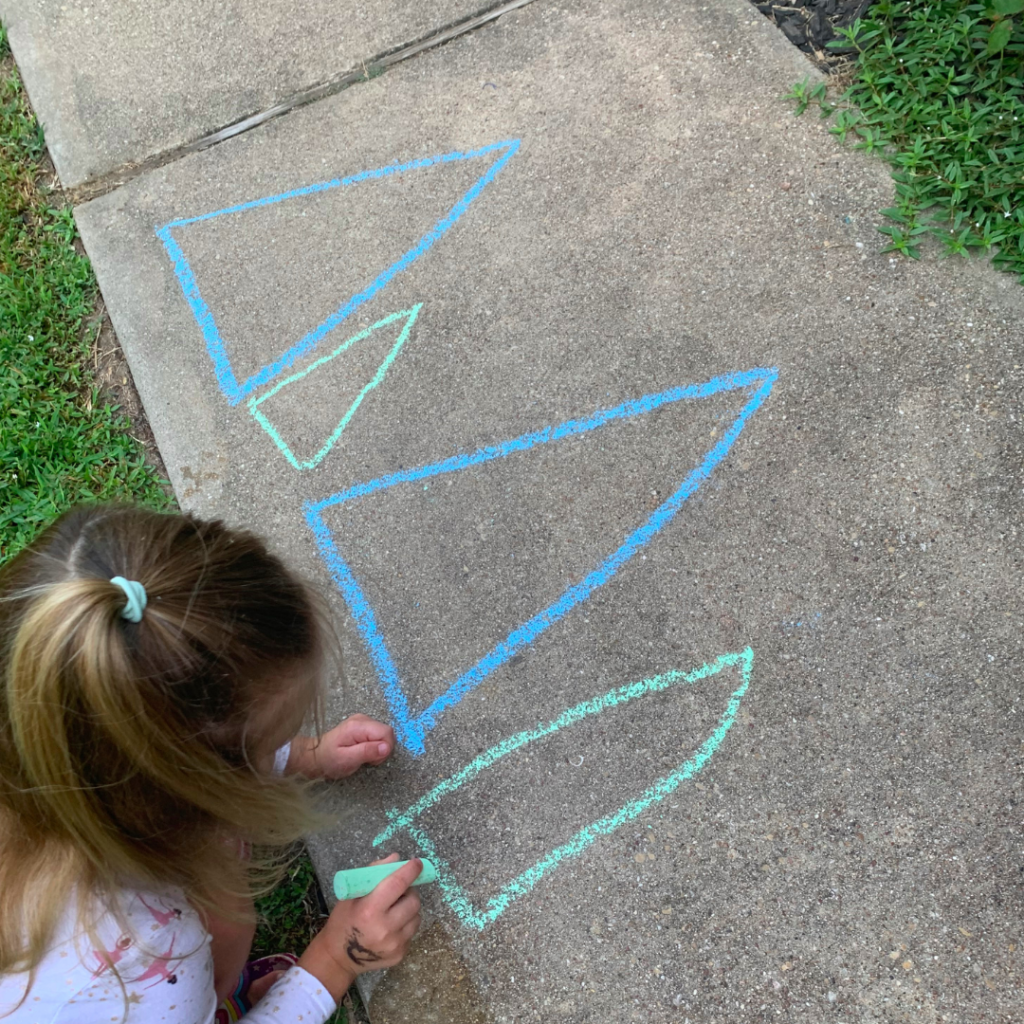
    35. Sidewalk Chalk

    science experiment

    36. Simple Science Experiment

    Simply complete a science experiment, OR you can also practice recording and analyzing data. Make a chart or just grab a pencil and notebook. Have fun with it! Here’s a couple links to some simple experiments you can do at home:

    10 Science Experiments at Home for Kids

    15 Very Simple Science Experiments

    37. Build a fort

    38. Tea Party

    39. Send a letter/picture to a friend

    40. STEM Challenge

    If you are not familiar with STEM, it stands for Science, Technology, Engineering, and Math. STEM challenges provide opportunities for kids to get creative and accomplish a goal set before them. These can get really fun if you like a little competition. You can even participate yourself!

    These challenges can easily be found by searching for “STEM Challenges”, but here’s a link to a blog post that has a few links listed for you.

    Well, there you have it – 40 simple activities for every day this summer!

    I don’t know about you, but I’m pumped. I haven’t decided which ones I’ll do, or even if I’ll do them all. But, it’s nice to have this go-to list to get me started. Keep in mind, these activities are not meant to be “out-of-this-world” or things you’ve never heard of. I only hope for the list to be a simple way for you to enjoy time together with your family!

    Let me know if you try some of these! Comment below or send me an email. Follow me on social media and tag me in a photo! Sign up and receive the FREE list pictured below. Put it on your fridge for an easy checklist to refer to this summer.

    summer activities


    Posted on 1 Comment

    5 Steps to Start Homeschooling

    science experiment at home

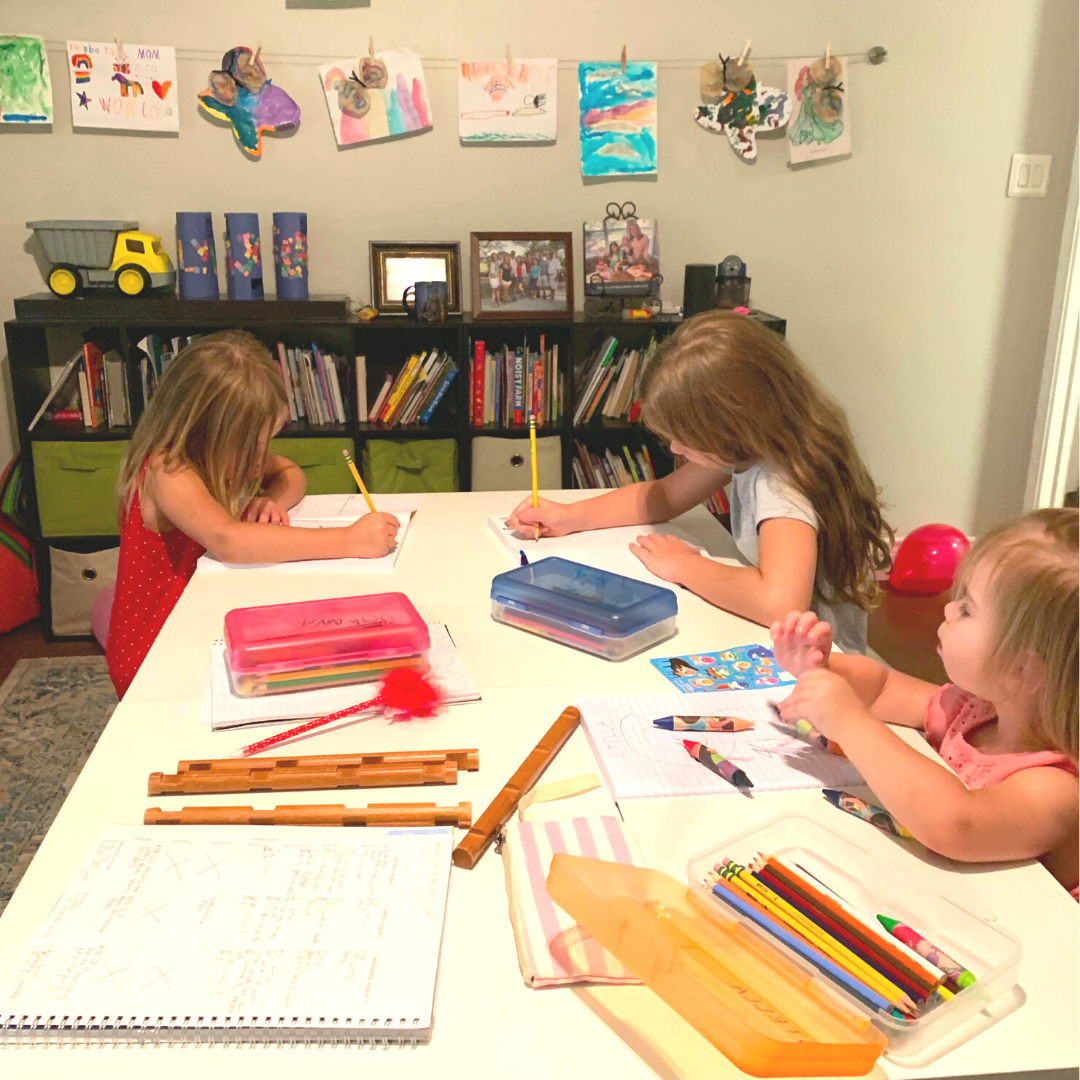
    I never planned to homeschool, so when I started to think about doing it, I was starting from scratch. It was unfamiliar to me, and I didn’t know anyone personally that homeschooled their children. I did a lot of research and a lot of planning. I’ll admit, we definitely hit some bumps along the way, but overall a simple start up was key.

    In this post, I plan to outline how I started homeschooling in hopes of helping someone start their own planning process. I am no expert, and what works for me may not work as well for you. Keep that in mind as you read through. Most importantly, I hope to encourage you as you begin these first exciting steps of planning.

    We are going to start from the VERY beginning stages, because I think they are important. I started thinking about homeschool months in advance to when I actually wanted to start. When I began my own homeschool journey my children were 2 and 4. One would be heading into kindergarten the following year.

    This post contains affiliate links. If you follow one of my links, I earn a small commission at no extra cost to you. Thank you for supporting my blog!

    1. Research and Read

    As you begin thinking about and praying about starting to homeschool, one of the easiest things you can do is research and read about it. You can do this through novels or even different blog posts online.

    I used to just scan Pinterest and read post after post from homeschool families. This allowed me to become familiar with names of curricula, the lifestyle, different terminology, homeschool styles, and the daily routines. I slowly began to gain confidence in what I was doing.

    The following are a few book suggestions. Don’t feel like you need to read them all.

    These are only suggestions. The first one is very short and an easy, quick read. It would be a great start.

    Sometimes you can even scan through them. For example, I’ve read most of “Wild and Free”, but a lot of it I flipped through and read what I was interested in or had questions about.

    “Teaching From Rest: A Homeschooler’s Guide to Unshakeable Peace” by Sarah Mackenzie

    “The Call of the Wild and Free: Reclaiming Wonder in Your Child’s Education” by Ainsley Arment

    “Homeschool Bravely: How to Squash Doubt, Trust God, and Teach Your Child with Confidence” by Jamie Erickson

    There are hundreds of books about homeschooling. These are just a few to get started. As I mentioned before, you can also read through blog posts. Try searching daily routines or different homeschool styles. Look for a day in the life post to get a feel of the rhythm of homeschool.

    Yours will be your own and not like anyone else’s, but I always find it helpful to hear about another experience.

    You don’t need to choose a homeschool style before you begin.

    You will read so much about different styles: classical, Charlotte Mason, eclectic, wild and free….don’t label yourself. How do you know your style if you’ve never even tried it?

    You can definitely experiment with one that you find interesting, but don’t let it stress you out. I’m not even sure I know my own style. It’s probably a mix of everything! Why does everything have to be labeled?

    2. Learn about the laws in your state.

    In the United States, every state has different laws of things that you need to do in order to homeschool your child. I am in Texas, and it is a more relaxed state, giving me a lot of freedom in my homeschool, for which I am very grateful.

    Other states require much more. Some have to take attendance everyday, keep records and grades, record hours, and give yearly assessments. You need to look at your state laws and decide if you can commit to the requirements.

    One place to look is the Home School Legal Defense Association (HSDLA). This website is very informative and allows you to choose your specific state and read about the requirements.

    Be thorough – read as much as you can and watch the videos. Make sure you know what you are getting into, so that it doesn’t become overwhelming in the middle of your year.

    Click here to go directly to the home school laws by state.

    3. Plan a budget

    Not all parts of homeschooling are absolutely free. Decide what kind of budget you have. Don’t get me wrong, you can keep it very inexpensive. However, if you don’t have a plan, the costs will definitely add up.

    Now, a confession: I am not the best budget maker. I did not make any sort of list or chart. If that’s your personality type, go for it. My point in telling you to plan a budget is to just make sure you are aware of the costs that will come up.

    There are many different costs to consider.

    First is obviously curriculum. I’ll talk more about this later in the post, but you need to decide how much you want to spend. Curriculum can be…addicting – seriously! Don’t get carried away. Set a plan and stick to it. I suggest to start small. We will talk more about this in bit.

    You’re going to need school supplies at your house.

    This is as simple as pencils, pens, crayons, construction paper, printer paper, etc… It may seem obvious, but these are all costs! Ordering these can be a bit overwhelming for me each year. Stick to a minimum list at first. Get your basic needs to get through the first few weeks. You can always add more as you plan.

    Do not feel like you need to set up an entire room to homeschool – fully decorated and beautiful. Although it’s nice, it’s not necessary. My suggestion would be to start with a basic cart or tub that carries your supplies. As you begin learning together, you will slowly become comfortable in one area of your home. Then, you can decide to make it into a homeschool space, if you wish.

    Are you planning to sign your child up for any extra curricular activities?

    These activities get expensive. Right now, we only let our children pick one activity each, because that’s what works for our budget. Obviously, you don’t HAVE to do any of these extra activities, but if you are planning to, be prepared to pay.

    The next thing to think about for budgeting is co-ops or groups.

    This can get tricky to explain, because there are so many kinds of homeschool groups/co-ops you can be a part of. I will talk about this more below, but I’m mentioning it here because it does become a part of the cost.

    Don’t forget about field trips or outings.

    I remember dreaming about so many outings with my children, but when it came time to it, I couldn’t always afford it! You have to be careful. Plan free outings! Public parks sometimes have amazing free activities. A trip to a zoo or museum gets very expensive, especially if you have multiple children. Make a plan for field trip costs!

    It’s important to know your budget before you start making purchases and signing up for things. It can easily get exciting and out of control. Set your financial goals FIRST.

    homeschool supplies

    4. Curriculum Choices

    I love learning about curriculum. If I had it my way, I’d order it all, and have my own little curriculum read-through party. That would be super fun and amazing but very unrealistic. There’s a way to break it down a bit to make the decision process a little easier.

    First, decide if you want an all-inclusive curriculum or if you want to pick and choose different texts.

    An all-inclusive curriculum is one that usually comes with plans and all of the subjects wrapped in one big set. This would be great for someone that prefers a lot of guidance.

    If you feel completely lost on what to teach, think about a set like this to help you start. Just because you pick an all-inclusive your first year of homeschool, doesn’t mean you have to do it the next year.

    There are many different options to pick from, but an all-inclusive curriculum is going to be a big ticket item. It costs a lot of money up front – I’m talking hundreds of dollars, sometimes even a thousand. So, that’s something you need to think about if you decide on using it.

    I have never used an all-inclusive program, but I know people that have and enjoy it. I couldn’t tell you the best one based on experience, but I can guide you to a few that I’ve researched or heard of people using in their own home.

    My Father’s World

    Sonlight

    Timberdoodle

    Veritas Press

    The other option is to pick and choose curriculum for each subject.

    This really isn’t a super hard task, but there are just a lot of options to choose from. You can easily fall into a trap of constantly questioning – is this the best one? Do your research.

    Talk to people that have used that specific curriculum before. Read blog posts and visit the websites. Download samples – the samples are always the most helpful to me.

    Look into social media. There are people on Facebook and Instagram (like me!) that will show you the inside of a textbook and tell you how it works for their family. Use a hashtag and search different curriculum titles. Look through highlights.

    Come visit me on Instagram! Send me a DM and say hello! I love connecting with other homeschool families, and I can try to help you find more info.

    Most importantly, once you pick something. Pray for peace and confidence and and go with it. It’s easy to question yourself, but if you’ve done your research, rest in knowing you’re doing what you think is best for your family.

    So, what subjects do you choose?

    First, look at your state laws and see what subjects are required. For your first year, I suggest sticking with just that! Don’t spend a lot of money on a bunch of different things just yet. Give it a couple of months. Start your year with the basic requirements and add to it as you adjust.

    Now, if something is really important to you, like Bible, go ahead and make that a priority. Maybe you are a musician, and it’s important your child studies music – go for it. Just don’t think you need to add on everything right this minute.

    Fine arts, a second language, typing, art study, hymns…these are things that can be added in to your routine in a few months as you are ready, and IF you even want to do them. Don’t overwhelm yourself. I’ve definitely fallen into the trap of buying text I thought would be so great and then never even using it – waste of money!

    If you are interested, check out my blog plosts to see some of our curriculum choices. You can read about my most recent picks for first grade and preschool HERE and HERE.

    5. Homeschool Groups, Co-Ops, and Communities

    You can definitely start without finding a group. So, technically it could be 4 steps to start homeschooling 😉

    However, I do think it’s important to connect with other homeschool families, so I want to add it in here. Having the support and community is encouraging and helpful. I’ll be honest, I struggled with this my first year. Unless you know a giant group of homeschoolers, it can be hard to connect.

    Make an effort to find a group/community/or just a friend if you can. You can really benefit from the relationships and learn so much from others.

    If you are struggling with this, pray about it. It’s OK if you don’t find a group or a friend right when you start your year, but don’t give up.

    A few months into homeschooling, I met a friend at the library of all places. We were sitting together in a preschool music class. She is a huge blessing to me and my family and I cherish our friendship. I feel like as soon as I started questioning what I was doing, God placed her in my life to encourage me and keep me going. I’m forever grateful for that.

    My suggestion would be to find a group in your area through your church or social media and ask around.

    This will give you a better idea of what’s near you. My first year, I joined a few local, free homeschool groups on Facebook. People post all the time about events/activities in the area. There are also park meetups where I can meet other families and learn more from others.

    We also tried a couple groups that required a small fee ($25-$50…I can’t really remember). They didn’t stick. My point in telling you this is don’t be discouraged. Don’t feel like if you can’t find a group, you can’t start. Pray, have patience, and don’t give up.

    Our second year we joined Classical Conversations, and we love it so much. You can read more about that in this post.

    You’re ready to start homeschooling!

    It’s as simple as that! Now, all you have to do is dive in and start. Sometimes, this can be the hardest part. You may be worried about the planning process or your daily schedule, but you will never figure out a good routine until you just jump in.

    I will share more in a planning blog post about getting ready for your year. However, one thing that worked for me was to start little mini lessons in the summer. This could be as simple as a craft, board game, puzzle, or reading a few books from the library. Maybe it’s a science experiment.

    I would try little things during our summer day to see when it was easiest to work with my kids. Morning? Afternoon? Where was it easiest to work in my house? How long could they sit there? These are all questions I was trying to answer to better plan my year.

    By doing this, I also realized that the more time my kids spent outside, the better our days went. So, that became a priority – get outdoors!

    You will learn things like this too by just jumping in and trying it! If you have a summer or a break, use that to start experimenting. The last thing I want to say is this…

    Your homeschool will not look like anyone else’s.

    Stay away from comparison. It can be extremely hurtful to your heart and mind. Just because someone is teaching 4 fine arts classes to their children, that doesn’t mean you have to. Just because someone has beautiful wooden toys for every themed lesson doesn’t mean you have to.

    And just because it doesn’t turn out EXACTLY like you pictured it, doesn’t mean it’s wrong. It’s all a trial and error process. You will adjust all the time in a way that best suits your family. Put God first. Put your faith in Him, and pray for wisdom in all that you do. Don’t depend on others to lead you.

    Final words for this … start small. Homeschooling is a building game. Start simple, jump in, and gradually add to it as you wish. It doesn’t have to be complicated. You got this.

    Posted on 3 Comments

    A Faith-Based Read Aloud Unit for Mrs. Piggle Wiggle

    Mrs. Piggle Wiggle

    I chose to read Mrs. Piggle Wiggle with my kiddos because it was light, short, and funny. I also discovered that through each chapter, we could have great discussions about good and bad behavior.

    I developed a Read Aloud Experience to go along with the novel. If you are not familiar with the Read Aloud Experience, check out this post.

    In short, it includes the following: chapter summaries and questions, optional crafts and activities for each chapter, and library topics to guide you in checking out books that go along with the themes.

    This post contains affiliate links. If you follow one of my links, I earn a small commission at no extra cost to you. Thank you for supporting my blog!

    There was something special about this book that made me take it a little further.

    Every chapter follows a child that is making bad decisions or forming bad habits. The parent calls Mrs. Piggle Wiggle to ask for a “cure” for their child. It is all very fictional and humorous but the behaviors are applicable to real life.

    The best part was we could giggle about the silliness, but then have real discussions about good character. We talked about behavior and responsibility in our own home – and most importantly we backed it all up with scripture.

    van gogh painting
    When the characters refused their bedtime, we researched Van Gogh and recreated Starry Night

    Every chapter in this Read Aloud Experience includes a bible verse to use as a devotion with your family.

    I love when a book leaves an impression on you, and to this day we refer back to the characters in the chapters and what we learned from them. We even memorized a few of the verses and can recite them in certain situations.

    There are 8 chapters in Mrs. Piggle Wiggle, and I’ll outline the biblical focus points below:

    1. Obey your parents
    2. Generosity
    3. Use kind words
    4. Greed
    5. Patience
    6. Rest
    7. Thankfulness
    8. Arguing

    Sound like topics you might want to discuss in your family?

    My oldest two children were 6 and 4 when we read this. So, don’t assume your children are too young! I have even thought about doing this again in a few years. It’s great for all ages! All of these topics come up in our home on a regular basis and it was so nice to be able to sit down and discuss them together.

    We homeschool our children and loved using the verses as our devotion, reading a chapter a day, and completing the optional crafts and activities. If you do not homeschool, you could still easily use this book to talk about the character traits listed above.

    STEM Activity
    When a character refuses supper, we got creative with food by completing this marshmallow STEM activity.

    Everything in the Read Aloud Experience is optional and it’s meant to be flexible for all families.

    Think of it as your guide. There are so many ways you could make it work in a way that fits your family. Simply read a bible verse at dinner and a chapter before bed.

    Save it for the weekend! The chapters are short. Read two on Saturday and two on Sunday and you’ll be done in two weekends!

    Download the unit for a spring break or summer activity. It would be the perfect thing to add a small bit of structure/routine to your day.

    If you wanted to use it to its full potential, check your local library for books that go along with the topics listed in the unit. Use the supply list to make sure you have the ingredients for recipes and craft supplies. Since this book is so short, you can get everything you need in one swoop so you’re ready to go!

    In our family, we used the bible verse as our daily morning devotion. I read a chapter a day (usually while the babies were napping). Then, we would complete the activities we had time for. I usually save library books for after dinner/before bed. It’s the easiest way to add them into our day.

    I always randomly select library books based on a specific topic. I love the fun and surprise in this. We did come across some great ones and I will share them below if you’d like to search for them specifically:

    “The Berenstain Bears: Patience, Please” by Mike Berenstain

    “The Berenstain Bears: Get in a Fight” by Stan and Jan Berenstain

    “Dragon Sibling Rivalry” by Steve Herman

    “ABCs of Kindness” by Samantha Berger

    “Bedtime is Canceled” by Cece Meng

    “Topsy-Turvy Bedtime” by Joan Levine

    “Katie and the Starry Night” by James Mayhew

    “Vincent Can’t Sleep” by Barb Rosenstock

    We read many more throughout the unit, but these were our favorites.

    Our “Un-Selfish Kit” inspired by Mrs. Piggle Wiggle’s kit – We discussed actions that were kind and not selfish.

    If this Read Aloud Experience sounds like something you’d like to look into for your family, you can download the entire unit for FREE in my store.

    Pick and choose how you want it to work for your family and enjoy digging deeper into a book. (Download the unit here.) I love how my children and I really become a part of the book when we do this. We get to know the characters as if they are a friend. We experience new things and get to be creative. You could say it’s almost like we are in the book ourselves!

    You can also check out another free Read Aloud Experience for The Secret Garden.

    If you’ve completed a Read Aloud Experience from me, I’d love to hear about it! Leave a comment below and let me know.

    Posted on 1 Comment

    Homeschool Preschool Curriculum Review

    preschool curriculum review

    Teaching preschool to my four year old has been such a rewarding experience. The amount of growth that happens between 4 years and 5 years is incredible, and to be able to witness that in our homeschool has been such a privilege and joy.

    I’ll admit I was terrified at the beginning. This was my first year to homeschool preschool because my oldest daughter completed pre-k at a school while I was still teaching.

    We were basically starting from scratch. When my second daughter was three, we briefly practiced letters, but they didn’t stick. She knew how to write her name and could recognize the letters in it, and that’s about it. I knew the alphabet would need to be a focus of ours, so that was my goal. I would teach her to recognize her letters, write them, and learn their sounds.

    This post contains affiliate links. If you follow one of my links, I earn a small commission at no extra cost to you. Thank you for supporting my blog!

    My daughter’s personality is not the type to sit at the table for a long period of time to complete something.

    As a result, I didn’t want to buy a ton of workbooks. I planned to encourage a lot of play – imaginative and learning based. I also wanted to go at her pace while still challenging her to put an effort into completing a little something on paper each day.

    In this post, I’ll be explaining what we started with at the beginning of our preschool (4 years) and how it changed throughout our homeschool year.

    preschool handwriting book

    We started with Learning Without Tears for writing.

    I felt like this was a great choice for us because it starts off very easy with the first book. The workbook is called My First School Book.

    There are no lines or boxes to stay in. It’s simple tracing of a shaded letter. The book begins with color review and then introduces one letter at a time. The letters are not introduced in ABC order. The book also introduces writing numbers. I did not purchase any teachers guide or any of the extra supplies, and we completed one page per day.

    Since the lessons were so short, this was the perfect way to start challenging my daughter to complete something in a workbook. It took very little time and she felt successful and confident.

    I wish I would’ve bought the set that comes with My First School Book plus My First Lowercase Book.

    It’s only a couple dollars more, and you can not buy that specific lowercase book separately. So, when we finished My First School Book we had to move on to the workbook called Kick Start Kindergarten.

    The Kick Start Kindergarten workbook begins with capital letters. This time the letters must be written inside of a shaded box. This made me nervous at first, because I thought it would be frustrating for my daughter. However, once we practiced a few times, she understood.

    Once the capital letters are reviewed, the book moves into writing lowercase letters. These are learned on the two lines that the Learning Without Tears program is known for.

    I enjoy that the lessons are short and so does my active daughter. I also like how the lessons in the workbook include pictures and words that start with the letter practiced. This allows me to introduce and practice letter sounds as we learn to write them.

    I haven’t decided if I’ll continue with Learning Without Tears for Kindergarten next year. I love their program starting out, but I am definitely a fan of the old fashioned three lines. I’ll always do what’s best for my daughter, so I’ll need to test that style out with her first. I’m also not a fan of the Learning Without Tears cursive style, which I know is a few years from now, but I still like to think ahead as we start the handwriting process.

    I purchased one other workbook from Singapore Math for our preschool year.

    The book is actually called Essential Math Kindergarten and there are two books in the set. I was able to purchase Book A on its own from our local homeschool store. I’m glad I only bought the first one, because we did not make it very far into this book before stopping.

    Although the book states “kindergarten”, it’s actually perfect for Pre-K4. It starts off very simple and moves slowly. I bought it because it came highly recommended by an experienced homeschool mom. She had used it for multiple children at age 4 and loved it. We did not feel the same in our house.

    To be frank, the book is boring.

    There is no color on the page. My daughter never wanted to sit and color the pictures. Some days it took us 4 seconds to complete a page, and I felt like saying…”That’s it?”

    At the bottom of each workbook page, there are activities that you can do with your child to help practice the concept, but we never really looked at that.

    I just felt like the book was a waste of time. The focus was on early math skills: shapes, counting, patterns…We can experience so much more learning with a bucket of play dough or a puzzle and have a lot more fun! We made it about half way through Book A and stopped. At this point, I knew I wanted a new plan for practicing math skills consistently.

    My goal for the preschool year was to teach the alphabet and the letter sounds.

    I’ll be honest, after a couple months into the year, it was not going well. The handwriting pages gave us some review, but I was having a hard time being consistent. My daughter needed repetition and I wasn’t finding it anywhere. Scratch that – I always got lost in the internet world trying to find the perfect solution.

    At this point in our year, I knew what I needed: daily, consistent alphabet practice + preschool early math skills.

    alphabet workbook preschool curriculum

    Enter the Alphabet Workbook…

    This is the curriculum that changed our school days. The Alphabet Workbook allowed us to practice the math skills we needed (shapes, numbers, counting, etc…) while also learning the letters each day of the week.

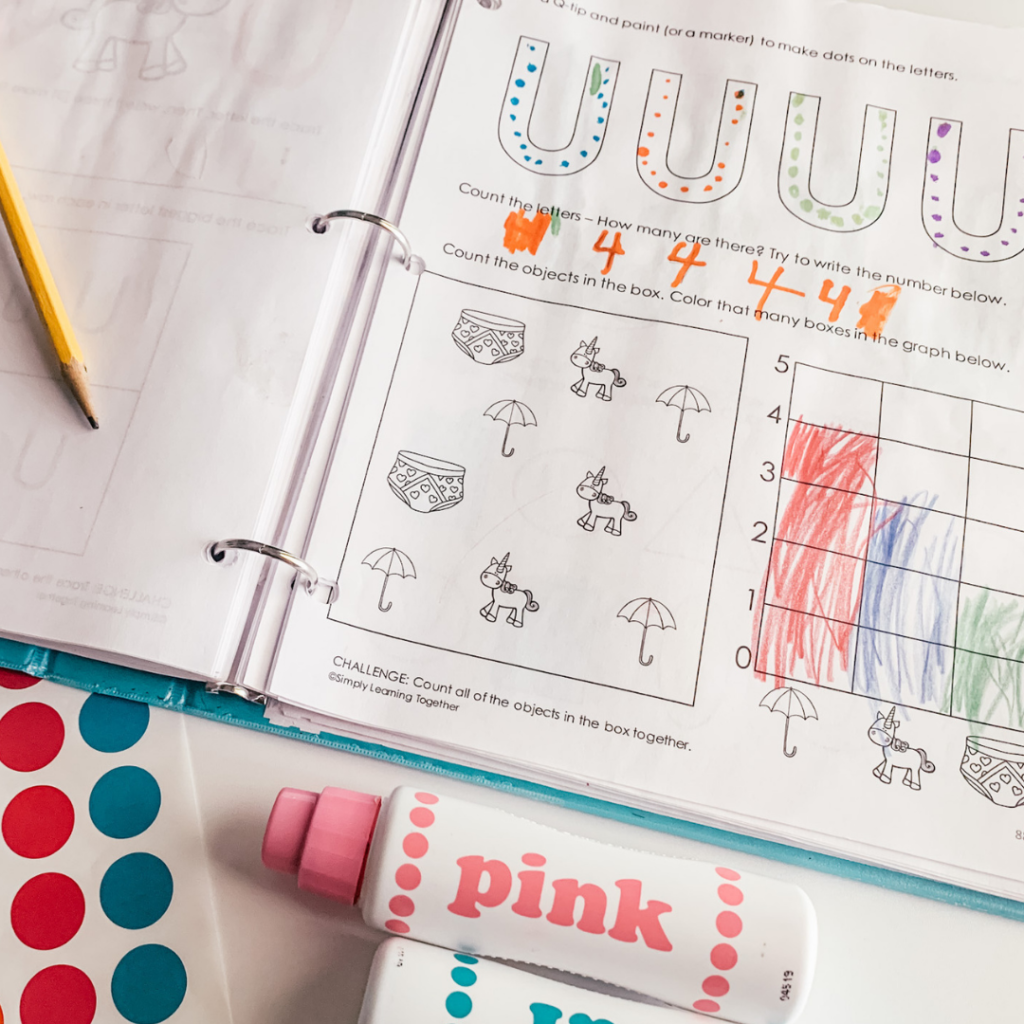
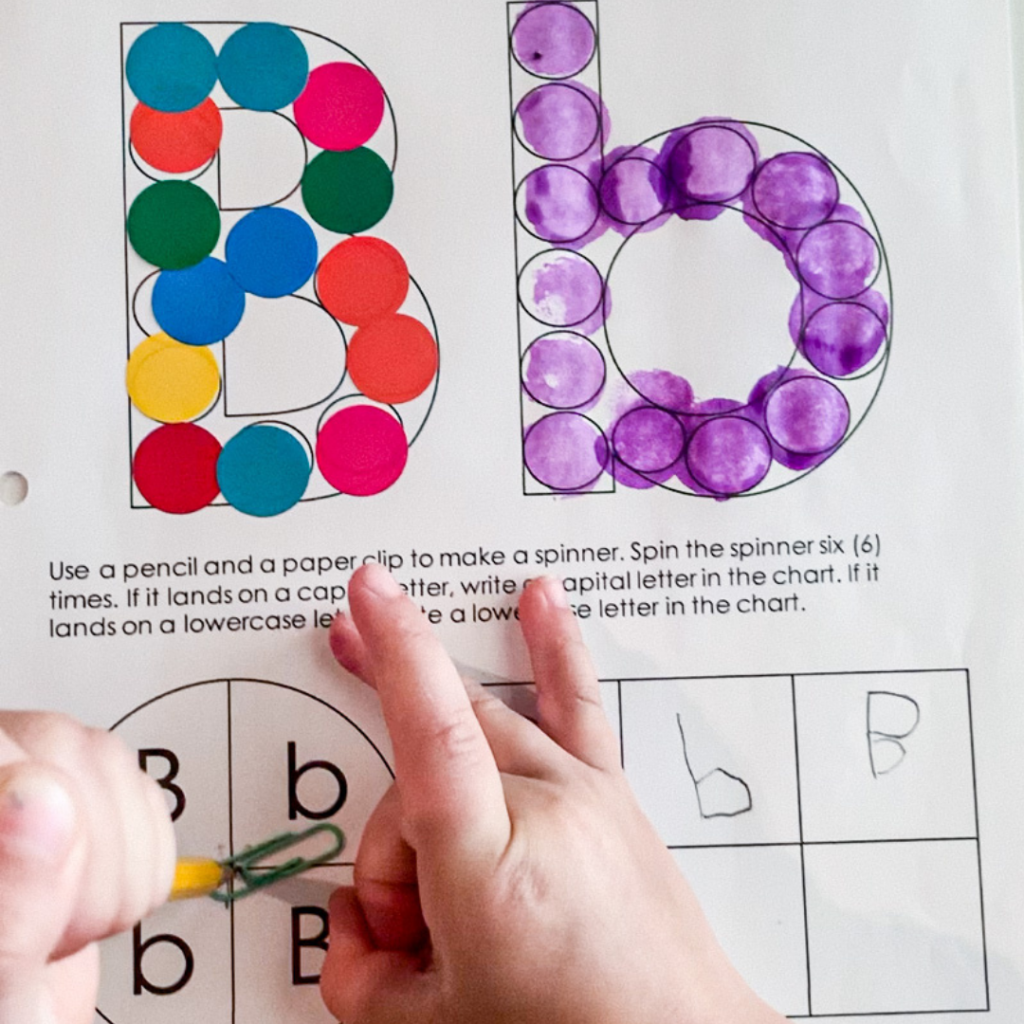
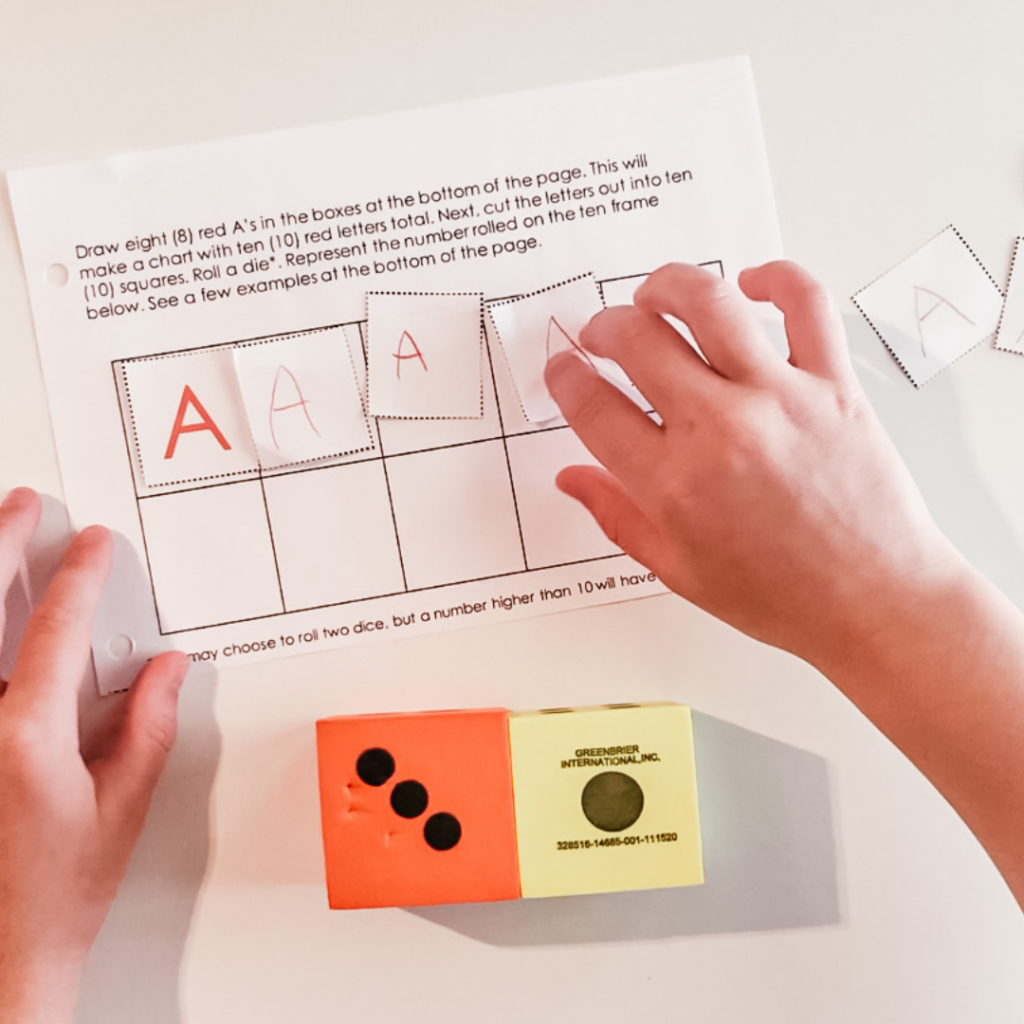
    It’s set up to be engaging, fun, and consistent. It’s the perfect resource for learning a letter per week. Every letter has four completely different pages of activities to practice recognizing, tracing, and writing. Coloring, dice games, graphing, cutting, ten frames, dot markers…this is just a glimpse into the variety!

    The activities are fun for my daughter and flexible for her learning style.

    It can all be completed at my daughter’s pace. If she seems really focused and eager to work, I can encourage her to complete the “challenge” listed at the bottom of many of the pages.

    If she’s having a rough day and not willing to focus as much, we can take it slow and complete as much as we can on the page.

    When we started using the Alphabet Workbook, my daughter was finally able to recognize and remember her letters.

    When our year started, she only knew the letters of her name (most days). Once we had more consistency by using the Alphabet Workbook, my daughter was finally remembering her letters! It was such a relief! She was even recalling the letter sounds thanks to the pictures and words included in the workbook.

    We are almost finished with the workbook at the time I write this. Now that it is in our routine, she is even starting to do many pages independently. She recognizes the patterns of the pages and completes some on her own. It’s been amazing and such a joy to watch her grow and mature like this during the year.

    The confidence I gained from her success and the consistency of the workbook gave me so much peace in planning our homeschool.

    Many people tell you that when you homeschool preschool all you need is PLAY. Ok…I support this thought. Play is so important for young children and we do a lot of it at our house, but hear me out…

    As the mother (and teacher!) of my children, I do tend to question if I am doing enough. Maybe you’ve experienced those same feelings.

    This is why I love the Alphabet Workbook so much. It is not rigorous. It is fun! It’s engaging and playful and colorful and easy to complete. It helps my brain and my sanity to know that she has completed something. I do a lot less questioning of myself knowing she has done this one small task.

    The fact that it actually works helps too!

    So, as a recap the only books I am using solely for my preschooler now are Learning Without Tears Kick Start to Kindergarten and the Alphabet Workbook.

    Now that she knows her alphabet and sounds, she has shown an interest in reading!

    We purchased ABC, See, Hear, Do and it’s absolutely wonderful! The book is set up to learn the sound of a letter along with a physical action. It’s colorful, adorable, and easy to follow!. The day we got it, she read her first word within minutes. I was shocked! Completing the book means reading 55 words – such a fun accomplishment for a little one!

    Once she starting blending sounds together, I knew she was ready to start reading a little more. Honestly, I don’t think I was ready…. (ha!) So, we are going the slow route. I purchased the first set of the Bob Books to start reading with her. We do this VERY slowly. I help her get through a book and we read it over and over throughout the week. She is gaining confidence but also practicing reading skills.

    I am not expecting her to learn to read this year, but she shows a ton of interest and is ready to start so we are having fun with it. I try to have her read with me a few times a week. Since she is still so young I do not push it. If she starts to complain, I simply say, “Let’s try this again a different day!”

    Everything else that we complete in our school day involves all of my children.

    I’ll explain these briefly if you are interested, but I won’t go into too much detail as I only expect my preschooler to really “tag along” for these things.

    We are in a Classical Conversations Community.

    We attend Community Day once a week for half a day. Each day of the week we spend about 20-30 minutes practicing memory work that covers Math, Science, History, Latin, English, Geography, and the Timeline. We do a lot of singing for this. At age 4, it’s laid back and fun.

    You can read more about how we add it to our day HERE. If you are considering joining Classical Conversations and have some questions, check out THIS post.

    the secret garden

    We love reading novels together and enjoyed completing The Read Aloud Experience this year.

    Sitting together with my children and reading a good book is my favorite thing to do. I love it even more when we can do simple activities that relate to that book, even if it’s a small discussion, simple craft, or a recipe to follow!

    The Read Aloud Experience is a fully planned, FREE novel unit that provides all of the activities that go along with the story. We had so much fun doing these units and it gave us something to look forward to each day! We read The Secret Garden and Mrs. Piggle Wiggle.

    The Secret Garden is absolutely wonderful if you have older children as well. Mrs. Piggle Wiggle is hysterical and fun for all ages! Check out the FREE Read Aloud Experience for each book: The Secret Garden and Mrs. Piggle Wiggle.

    preschool science

    Our family devotional allowed us to add a little extra science into our day.

    I chose “Indescribable: 100 Devotions About God and Science” for our daily devotion. At the beginning of the year (before I had a baby and before Classical Conversations began) I used our library to gather books related to the science topic in the devotional. It was so fun and such an easy way to add science lessons in at this age.

    This devotional is great! It is easy to read and interesting to both my children and me. Every devotion has a scripture verse, a biblical lesson, and a science lesson that relates. With a little planning ahead and a library card, I was easily able to add science into our week.

    Some of the other devotionals we completed and enjoyed were seasonal. These included Truth in the Tinsel at Christmas and Resurrection Eggs for Easter.

    The last thing I want to share is the digital resources that have been the most helpful for us this year.

    preschool digitial download

    These were specifically created for my four year old to help us practice what we are learning. You can see all of these preschool resources in my shop. Be sure to go ahead download the free ones: Early Addition Math Mat and Capital Letters: Trace and Find.

    Our favorite resource that we use every week alongside the Alphabet Workbook is the Alphabet Play Dough Mats. It’s so much more than just making a letter out of play dough. These mats allow my daughter to write, trace, and find the letter in a group. Now, there’s even a set of Lowercase Play Dough Mats that we plan to use for Kindergarten!

    Many of the things we complete in our homeschool day involve our whole family.

    I love that so much about homeschool. We read together, play together, and learn together. Our big success this year was learning our letters and their sounds. We are excited to take these skills into our Kindergarten year! I can’t believe how fast the time is going with these little ones – cherish every moment!

    Have you used any of the curricula mentioned above? Tell me about it in the comments. Or, share something you love for preschool!

    Posted on 2 Comments

    First Grade Homeschool Curriculum Review

    homeschool curriculum

    Curriculum can sometimes feel overwhelming. As a parent, you want to do what’s best for your child. There are so many wonderful options out there, so what do you choose?

    The answer to that question will always depend on your child. Even within a home, curriculum needs can be different. For example, my two oldest children do not always use the same books.

    In this post, I’ll be sharing what we used for my oldest daughter for first grade and how it worked for us.

    Every family is going to be different, but sometimes it helps to hear how something works for someone else. That’s what I hope to do here.

    Keep in mind, this is all based on my opinion. What works for me may not work for you, and vice versa. I’ll be sharing the good and the bad experiences we have had this year.

    This post contains affiliate links. If you follow one of my links, I earn a small commission at no extra cost to you. Thank you for supporting my blog!

    homeschool math

    Horizons Math

    I chose to stick with Horizons Math for first grade. We used it in Kindergarten, and I really enjoyed it. (Click here for some super fun math activities to go along with Horizons K)

    We purchased Book 1 and Book 2, and that’s it. We did not purchase any sort of curriculum set from the company or the teacher guide this year. (I had the guide for Kindergarten and never used it.)

    After my experience with kindergarten, I knew I wanted to have a few manipulatives on hand to use with the lessons. I purchased a small set of base ten blocks and uni-fix cubes. Both are used almost every week. I highly recommend having these to go along with the workbooks.

    Horizons uses a spiral method to teach math skills.

    This means topics are introduced and practiced throughout the entire book. The alternative to that is to introduce a topic, master it, and move on. Horizons is not set up that way. Each lesson reviews multiple concepts – old and new.

    The student workbook is colorful and easy to follow. Lessons are usually front and back, and there are tests throughout. The tests look just like the lessons, so there is nothing surprising there. For the student, it may just feel like another lesson.

    I would not describe Horizons as “open and go”, because at times there is a small bit of prep involved.

    Once you get used to the book, the prep only takes a minute or two. Many curricula include a script for parents. In the Horizons student workbook, there are only directions for the student. You could definitely just have your child complete it, but I’ll tell you right now – that will get really boring really quick.

    I’ve learned a little creativity is necessary, so I created math mats to make the planning and prep super easy! Having a go-to set allows me to just grab and go as I am getting the lesson ready. They are easy to store, easy to use, and fun to do!

    math mats

    Before we begin a lesson, I quickly look through the page and grab a math math that will go with it. I briefly look at the content to see if there’s any new skill to introduce. If so, I introduce that skill and help her practice. The rest of the lesson she completes independently. This works great for us because it puts less pressure on me. It only takes a minute or two for me to get it ready for her.

    The teacher’s guide does include the steps to introducing the lesson and practicing the skill. It also gives an idea or two for an activity to do along with the lesson, but the guide is a separate purchase from the workbooks. Think of it as directions and not a script. (This was my experience with the Kindergarten guide since I did not purchase it for first.)

    I personally love this curriculum because I can get creative at my own pace.

    I can easily add manipulatives (base ten blocks, uni-fix cubes, coins) with simple math mats so that any lesson can be hands on. I can play basic flash card games or math games to practice a skill. This is always fun, because we are not glued to the workbook. We can move around and review. (Check out this flash card blog post.)

    Or, if we want to just stick to the workbook page, we can. Some days it’s nice to just get it done! I don’t ever feel pressure to complete a planned out script.

    I have four children and sometimes following a script gets tricky.

    I love that the Horizons curriculum allows me to do as much or as little as I like, without feeling guilty. I can be creative and add simple activities. On the flip side to that, if I need to tend to other children or we need to work quickly, my daughter can work on her own without much help at all. For now, this is what feels good for our family, so we plan to stick with Horizons next year.

    For More Horizons tips, check out this video on how we shorten a lesson.

    the good and the beautiful

    Language Arts: The Good and the Beautiful

    We started the first grade year with The Good and The Beautiful Level 1. When I first received the curriculum, it was exactly as it says – good and beautiful!

    I loved all of the art and stories. It had activities and games within the workbook that we could play during the lesson. Everything was easy to follow and scripted. I always felt prepared when I taught the lesson, and I thought this would be perfect for us.

    The Good and the Beautiful comes with a few different pieces.

    There is the workbook, phonics cards, and a leveled reader with multiple stories.

    I loved the reader because it was at my daughter’s level and the stories were really cute. The student is expected to read every day, but it’s not always from the reader. The reader was assigned in the lesson 4-5 times a month.

    The included phonics cards are to be practiced a couple times a week. The lesson will specifically say when to practice the cards.  Honestly, I used them maybe 2-3 times and then quit. There is no guidance on which ones to practice or whether or not to practice them in a certain order. There are over 100 cards in the set. It can feel overwhelming to practice them and, to be frank, it’s quite boring.

    We started the curriculum in August and by the time we made it to Christmas, I made the decision to switch to something else. We did not switch because the curriculum was bad. We switched because it wasn’t the right fit for our family.

    The lesson itself takes anywhere from 30-45 minutes to complete.

    Add on phonics cards and shared reading time, and it gets to feel quite time consuming. This is another reason why I skipped the phonics cards. I wish I could sit and do school with my daughter one on one all day. But, let’s be honest, I can’t! With a new baby in tow, it became really hard for me to set aside so much time each day for just one subject.

    Eventually, the lessons felt like too much.

    We both became bored and started skipping things…I just knew we needed something fresh and different. We needed something that could be more flexible.

    We decided to switch to Christian Light Education Language Arts.

    I picked this program because it is sold in small booklets. You can buy an individual booklet or the whole set. I bought one booklet for less than $5.00, and I thought this would be a great way to try it out.

    The Christian Light Education Language Arts is set up very similar to the Horizons math program I mentioned above. This could be why I ended up liking it so much. The program covers phonics, grammar, punctuation, writing, and spelling.

    It introduces new topics and reviews previous skills throughout. It’s easy for me to teach my daughter the new skill, practice it, and then let her work independently. There are no stories to read, no games to play, it is straight to the point.

    Now, this doesn’t mean we can’t have fun with it. I can easily create or search for some sort of practice game or activity If I want to. I do not own the teacher guide, so I am unaware if there are ideas for activities to add along with the lesson.

    When we switched to Christian Light, I decided to use classic novels to read aloud and practice reading skills. I’ll share those later in this post.

    I loved that we finally had time do read alouds because our workbook didn’t take as much time to complete.

    I love reading novels with my kids, and I was having the hardest time fitting it in until we switched to Christian Light. I plan to stick with this program for second grade (See second grade curriculum review here), and I will purchase the guide. There are many days I wish I had it.

    If you look on their website, there are many other helpful resources you can use to enhance your language arts. Phonics cards, information sheets, and a handwriting workbook are all options I can consider next year. Their reading curriculum also correlates with the language arts. (I plan to stick with classic novels.)

    Once again (just like math), I like that I can be as creative as I want with this program. If I want to search for a game to practice, I can. If I want to just let her work, I can do that too. It’s flexible for us.

    I don’t feel stuck to a script, so it works for this phase of our life.

    If you enjoy a script, I would definitely recommend The Good and the Beautiful. It really is well thought out and thorough. When it comes down to it, I just needed more flexibility.

    who was christopher columbus

    Science/History

    We are part of a Classical Conversations Community, so we do not purchase a separate science or history curriculum. However, we have loved reading the “Who Was…?” series this year. We read a couple in the first semester, and I’d like to read more! They are such a fun and easy read.

    Before I had my baby, we were using a devotional book to determine our science lesson. I’ll talk more about this book below, but we had a lot of fun with it. Whatever the devotion was about, I would check out specific books related to that topic from the library. It was easy to read and so easy to do! However, it did require planning in advance (to check out books in time).

    We are not consistent with either of these two science or history supplements, but we do love adding it in when we need something new and fresh in our routine.

    family devotion

    Bible/Devotional

    This year we have been reading “Indescribable: 100 Devotions About God and Science”. This devotional is awesome! They are short and so interesting, even for me as the parent. Every day is a different science lesson related to a bible verse. We never get bored with it.

    This book would be great for all ages. I used to teach 5th grade, and they would have loved this book!

    If you have younger kids, you could definitely get creative and use this to help plan your science.

    As I mentioned earlier, we did this at the beginning of the year, and it was a lot of fun. The only reason we stopped was because I had a hard time planning in time to get books from the library.

    You know, this book would also be great for a summer read! If you take a break from your school books, you could still do mini science lessons along with the devotionals. Simply, look through the devotions for the week and check out library books on those topics.

    Whether you use it to supplement your science or not, this was a great purchase! We will work through the rest of it this year, and I look forward to pulling it out again in a few years.

    first grade curriculum

    Handwriting

    I chose The Good and the Beautiful for handwriting for two reasons. It was inexpensive and my daughter requested a program with three lines (with a dashed mid-line).

    The workbook is put together well and can be completed independently. I love how there are lessons of good character and basic life skills like first and last name, phone number, and home address.

    Each lesson has some sort of drawing or coloring activity at the bottom of the page. Eventually, we started skipping those, because my daughter was not interested. Overall, we were happy with it.

    I think handwriting can be a tricky thing because it does get a little boring and tedious for the child.

    However, I do think it’s good practice. I don’t know if we will purchase this one again only because I feel like it will be a waste to have all of the extra drawing and coloring that won’t get used. Most likely I will look for something without that.

    We did change it up half way through the year. For a while we used the copy work from The Secret Garden Read Aloud Experience. We also use Draw Right Now to add some fun.

    secret garden read aloud

    Read Aloud Novels

    I wish I would’ve read more this year, but with the new baby, this is one of the things that got skipped for a bit. We did read a few great ones that I will share with you.

    I mentioned before that we have used the “Who Was…?” series to supplement history. We read “Who Was Christopher Columbus?” and “Who Was Davy Crockett?” I love how these books are short, interesting, and easy to read.

    Once I switched to Christian Light Language Arts, I really wanted to focus on a novel since the workbook did not have any reading portions (it’s a separate curriculum).

    We started with The Secret Garden. We followed the free Read Aloud Experience that allowed us to have new copy work for handwriting and a simple craft/activity to do every day. It was super easy and it gave us something to look forward to every day.

    The Secret Garden has 27 chapters, so it’s a definitely a time commitment. Even still, we thought the book was so wonderful and even enjoyed the movies afterwards.

    I wanted our next book to be much lighter, so we chose Mrs. Piggle Wiggle. Once again we followed the free Read Aloud Experience. There is no copy work with this one, but we did add it into our devotion time, as each chapter is assigned a scripture verse.

    We had a ton of fun with Mrs. Piggle Wiggle. Every chapter brought great discussion, and we continue to refer to the lessons we learned even after finishing. It’s great for all ages and it’s so silly!

    It’s hard to believe we are headed towards the end of our first grade year.

    Maybe you’ve thought about using something in your homeschool that I mentioned above. It’s even possible that you did use something and loved it, even though I didn’t. Whatever the reason is, remember that every child is different. You are the parent. You are obviously doing your research! (That’s why you’re here.) Be confident with what you pick, and jump in. You’ve got this!

    Posted on 5 Comments

    Adding Classical Conversations to our Homeschool

    I think when some people begin to consider adding Classical Conversations to their homeschool, they think it might be too much. It may feel overwhelming and hard to grasp what the planning will be like each day/week.

    I think this because I did it two years ago when I began homeschooling. It wasn’t until my second year that I decided to take the leap and become a part of a Community. You can learn more about that in my previous post.

    I’m so thankful for God’s guidance in choosing Classical Conversations, because we have been so blessed by the Community and the program itself.

    This post contains affiliate links. If you follow one of my links, I earn a small commission at no extra cost to you. Thank you for supporting my blog!

    So, how do we add Classical Conversations to our day?

    Before explaining this, it’s important to know the ages of my children. I have two in Foundations that are 4 years old and 6 years old. I also have a 2 year old and a new baby that is 5 months old. All of these ages play a part in our day to day rhythm.

    The easiest day to plan is Community Day, because it doesn’t change, and we have to be there. We meet once a week for half a day, and we really don’t do any other school work on that day once we are home.

    Sometimes I may read from our read aloud or I might take some time to catch up on a subject, if needed. Most weeks, our Community Day is it. They do a lot of learning just in that half day, and you’ll see that as you continue reading.

    Students in Foundations meet once a week for half a day.

    Every community will have some differences, but the content should be mostly the same. We meet one day a week, and we begin at 9:15 for an opening, family presentation (like an introduction), and prayer.

    At 9:30, students go to their classes and begin working on the new grammar for the week. Each part of the day is broken up into 30 minutes. The segments include new grammar, science, fine arts, presentation and review.

    classical conversations grammar
    Pictured is one week of new grammar. If it seems like a lot, don’t stress! There can be a song for almost everything to make it so easy to remember and practice!

    For new grammar, the tutor goes through each subject demonstrating the new material we will practice throughout the week at home.

    It is repetitive and quick, but it’s easy to catch on and helpful to me as the parent. We memorize material for English, Latin, History, Geography, Math, Science, and Timeline. The topics we memorize will depend on the Cycle we are in. For more information on the way the cycles are set up, visit the website here. The cycles are explained toward the bottom of the web page.

    classical conversations science

    Science consists of experiments and projects that encourage students to ask questions, make predictions, and reflect on an outcome.

    Once again, this will look different for each cycle, but I love that every week is something new. Our tutor does a great job helping the kids get involved with their project and talk about what they are doing or observing. It’s also neat to see a group of 4-5 year olds reciting and singing the scientific method.

    classical conversations art

    The Fine Arts portion is broken up into drawing, music, and great artists.

    The drawing portion definitely challenges my four year old, but it’s in a good way. I’m right there to help her or if I step out, another parent jumps in. I like how it’s all planned out and structured with a goal in mind.

    The music portion is learning how to play the tin whistle. If you don’t know what that is, just think about when you were in elementary school and had to learn the recorder. It looks just like that but smaller. To be clear, my four year old was not able to learn a song, but she was exposed to music notes and an instrument, and I love that. There was no pressure for her to master it.

    Studying great artists has been the most fun for me, probably because I know the least about it. Currently in Cycle 3, we are studying the artists, and the children are practicing their drawing/painting styles. Most weeks, I want to jump in and try it too!

    Presentation is a lot like a Show and Tell

    I think the word “presentation” intimidates people, but that’s exactly why this is so important. By teaching the children to show up and speak in front of others, it is helping them gain confidence in public speaking. Some love it more than others. A few may need help or to be encouraged. The tutors are providing strategies and tips to overcome the fears and learn to be in front of others.

    When I first started, I thought my child was going to have to make this big speech about something they learned. I imagined it super serious. It’s not that way at all from my experience in Foundations. I’m sure as they grow older, the challenge will be there, but for now it’s just about learning to present.

    Everyone in our community is very supportive and encouraging when it comes to helping the kids present. I’ve stood up at the front with one of my children before. Sometimes, I’ve had to jump in and help my child remember what to say.

    My 4 year old loves to look at me during her presentation and say, “What is it…?” I answer, and she’ll repeat. It’s a learning process for these littles. If you’re concerned about it, talk with a director in your local community.

    The last part of Community Day is review (and lunch!).

    During review time, the tutor will lead review games to practice memory work from the weeks before. It’s fun to see what the children still remember! Through songs, motions, and games, the group is led by the tutor to practice. It is not a test or assessment by any means. It is a time to practice together.

    That’s it for Foundations! We have lunch with the Community and our campus even allows us to play outside!

    After lunch, my crew heads home.

    classical conversations foundations

    The rest of the week, my goal is to practice memory work each school day.

    This usually takes us 20-30 minutes. It has looked different as our family changes and babies grow…and nap…or don’t nap. The reason I say this is because you don’t have to fit it in so perfectly and scheduled.

    Sometimes you just have to make it work as best as you can. So, if you are considering CC, know that you can give yourself grace. It’s OK if you don’t know exactly how to do it. There’s time to grow. If you are already in CC, and you feel like you’re not doing enough with your little ones – well here’s me telling you – it’s OK! We have had weeks that we completely flop on practicing, and we still survive.

    We’ve practiced in the car, during lunch, after quiet time, outside, while exercising, on a walk….when I had a new baby, I just had to fit it in as I could.

    Now, the baby is starting to follow somewhat of a sleeping schedule, and we are enjoying some routine and rhythm in our own homeschool schedule.

    Currently, we’ve been practicing our memory work in the mornings after our devotion time.

    Some people call this “morning basket” or “morning meeting”…I don’t call it anything. It’s not quiet, and sometimes it can be a little chaotic. (Real talk!) I take my children into our play area and we listen to the memory work together.

    I choose the play area to keep little hands busy. I allow them to play as long as they’re attempting to participate. I expect my 6 year old to say the memory with me at least once. I encourage my 4 year old to join us. (Note the difference in verb there.) During this time my babies are either playing or in my lap. Most days, my 2 year old sings along with us!

    My role in practicing memory work is important.

    I am the example for my children. My mood sets their mood. If we are all together in a room practicing, I am right there practicing along with them. (And I have learned so much!) I usually just sit on the floor and start reciting along with the app.

    classical conversations grammar
    Here we are practicing the Timeline Song in our messy play room. The quality of this photo isn’t the best, but we sure are having fun!

    We mix it up by how we choose the subjects or how we say the subjects.

    Take turns choosing. Write the subjects on the board and point to one. Roll a dice, choose popsicle sticks, make a spinner…change up how you pick your subjects to practice. It will keep things fresh and interesting. I hope to do a blog post soon compiling all these ideas and more!

    It’s also fun to change HOW you are practicing. For example, sometimes we assign an exercise to a subject and do that exercise each time we recite the memory. (I participate and count it as a workout!)

    We’ve used puppets before, as well. When the subject changes, change the puppet. It’s fun to change your voice for this as well. Get silly and have fun!

    Sometimes just a simple voice level change can help add fun to memory practice. Talk with a deep voice. Say it in a whisper. Squeal like a mouse. Pick an accent.

    These are all just great ways to keep learning fun! If my children want to play with something quietly while we practice, that’s great. Many days they cartwheel back and forth while reciting. I guess gymnastics and memory work is a great combination for them!
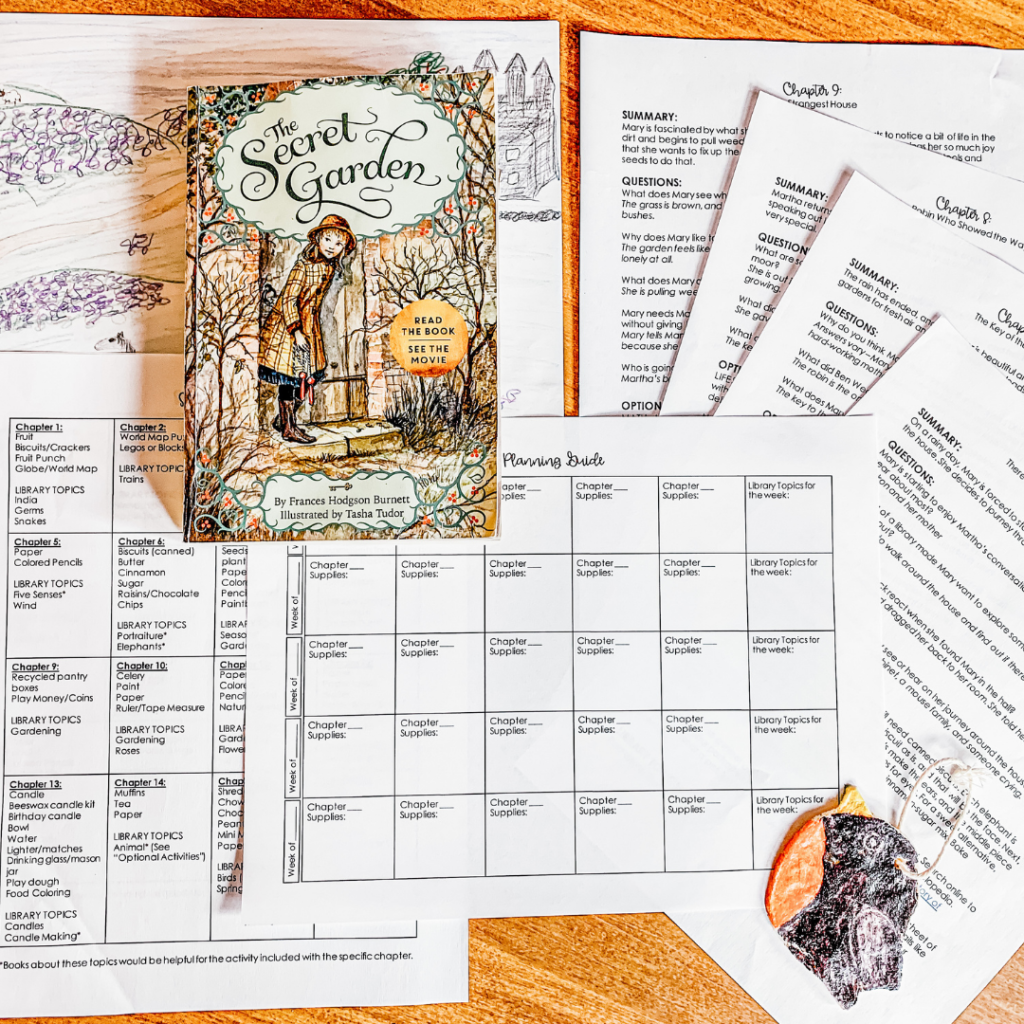
    I tell you all of this to hopefully get out of your head that it doesn’t have to be this sit-at-the-table-and-recite-over-and-over kind of drill. Get crazy and have fun with it. Join in with your little ones. You’ll learn a ton and you’ll be making beautiful memories.

    We practice the memory work. That’s all!

    My goal for the week is to practice memory work each school day. If we’ve done that, we are golden. That’s it, and that’s enough. At these ages, we are just laying a foundation. It doesn’t need to be extreme.

    If my children have an interest in a topic we will surely look into it by watching a video or checking out a book. My girls especially love the history sentences, so usually that’s what we dig into.

    We’ve read a couple of “Who Was….” books. (Literally a couple – two! Don’t get crazy here.) I believe it was one on Columbus and another on Davy Crockett. They were fantastic!! If you have older children, these would be great to add on for personal reading time. I’ll be honest, I’d love to add more of them into our day. For now though, we stick with simplicity.

    I just love how we can follow the lead of what interests our children as we learn about all of these wonderful topics. I am so looking forward to digging a little deeper each year.

    I encourage you to pray about Classical Conversations if you feel interested in it.

    Don’t let fear or worry stand in the way of doing something new. Talk to someone you know that is involved in a Community. Call a director near you just to get a feel for what it’s like. Ask questions. Leave a comment here or email me!

    Planning your homeschool day is important, and it always feels better once a plan is in place. I pray this blog post allows you to feel more comfortable with a decision-whether that means a “yes” or “no”.