Teaching Writing in Our Homeschool Without Curriculum
My first experience teaching writing to my child didn’t go very well.
By the end of it, we were both frustrated. I remember sitting there, trying to help, but constantly jumping in with suggestions like, “What if you said it like this…”
And afterward, I had this uncomfortable realization:
How much of that writing was actually hers?
Around that same time in our homeschool journey, I was also feeling the pull to step away from an all-in-one language arts workbook, which left me with two problems to solve:
- I needed a better approach to teaching writing.
- I needed a consistent way to make sure my child was still progressing—even without a boxed curriculum
What Are We Actually Teaching When We Teach Writing?
One of the biggest questions I had was…
If we’re not using an all-in-one curriculum, how do we even know what to teach?
That question is exactly why I created my free guide, Language Arts: Simplified. It helps break down what language arts actually is and offers simple, natural ways to approach it—especially if you’re trying to move away from an all-in-one workbook or if you just want a more flexible approach.
When you step back and look at writing as part of the bigger picture, it starts to feel a little less overwhelming.
Writing Is Just One Part of Language Arts
Instead of treating language arts as one big subject that has to be done all at once, I’ve found it much more helpful to think of it in parts:
- Reading
- Writing
- Speaking and Listening
- Language
Once I recognized these parts, it suddenly became so much easier to think about piecing the subject together.
What Writing Really Is (and What It Isn’t)
Before we talk about how to teach writing, it helps to understand what writing actually is.
Writing is the expression of ideas through language. This will look different at every stage.
Early stages may include drawing or sharing through play. After a year or two, a sentence (or more) will come into play while the parent is there guiding and supporting. Finally, in the later stages (somewhere around 4th-6th, depending on the child) we start to see our children gaining independence by expressing themselves clearly and organizing their thoughts in a structured way.
It’s not just assignments, prompts, or filling in blanks on a worksheet. This all can grow naturally through hearing good language, reading meaningful stories, and expressing ideas about literature.
This shift in perspective changed everything for me.
What We Do Instead: Written Narration
The approach that completely changed writing in our home is written narration.
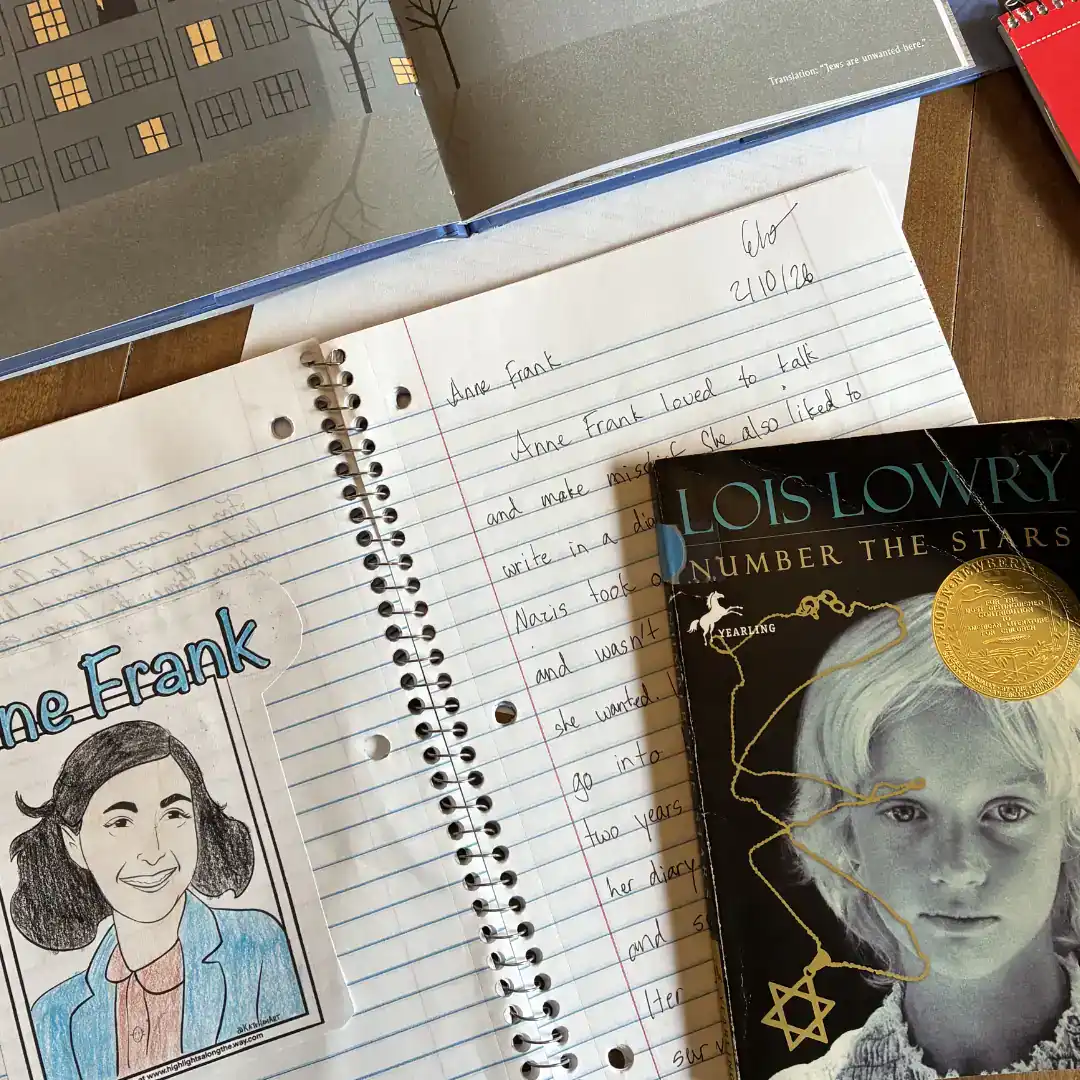
In simple terms, written narration asks a child to take something they’ve read or heard and tell about through their writing.
I highly recommend the book, “Know and Tell: The Art of Narration” by Karen Glass. This book is full of information about this and will walk you through the entire process, step-by-step.
Be sure to get your hands on the hard copy because it includes charts, a scope and sequence for implementing this process, as well as student examples to see it all in action.
As children build written narration skills, they are naturally building fluency in writing. This means they are able to get words onto paper and express themselves clearly without feeling that constant writer’s block.
The biggest plus side to moving to this approach to writing was that it removed the frustration for us.
I’ve seen the difference firsthand. Writing no longer feels like a struggle in our home. My kids are more confident, and they actually enjoy the process.
Developing Written Narration Skills
The book “Know and Tell..” will guide you through this clearly, but I can give you a basic overview.
Oral narration has to be developed first. This can easily be done after reading a great picture book you enjoy. Simply ask your child to tell you about the story.
Once oral narration has developed over time, the goal is to get those same thoughts on to paper. It will be a growing process, starting with just one a week and gradually building into more over time (it can take 2-3 years!)
When your child is fluently writing written narrations (daily), then you move into more of a formal writing approach. This is where you take written narrations and turn them into formal compositions.
I’ve seen this develop first-hand in my own home. It takes trust, time, and patience, but it works.
But What If That Feels Too Uncertain
If you’re reading this and thinking, That sounds nice, but I don’t know if I could do that, I understand.
It can feel uncomfortable to step away from a structured program—especially when you want to make sure you’re covering the “right” things.
If that’s you, there is absolutely nothing wrong with choosing a writing curriculum.
There are many solid options that focus specifically on writing, such as IEW, EIW, Brave Writer, and Write Shop. I’ll be honest and let you know I don’t know much about these, because I don’t use them!
But supportive materials are available if you need it.
The Freedom of Piecing Language Arts Together
This is what I love most about taking a different approach to language arts:
You don’t have to do everything one way.
You’re not locked into a single program.
Instead, you can build something that actually works for your family.
That doesn’t mean you’re “winging it.” It just means you understand the parts, and you’re choosing how to put them together.
For us, written narration has been the best fit. I’ve seen the growth, and I’ve watched the frustration disappear.
But if that’s not the right fit for you, that’s okay.
Choose something that is.
When It Starts to Click
Something shifts when you begin to see language arts in these separate parts.
Instead of searching for one more language arts workbook, you might find yourself thinking:
We’ll read this for literature…
We’ll use this for writing…
We’ll practice language with this resource…
And suddenly, it starts to come together.
If you want to better understand how all of this fits together, you can download my free guide, Language Arts: Simplified. It walks through each part of the subject and gives you a clear, simple framework to follow.
You don’t need to rely on an all-in-one to teach writing well.
You just need a clear understanding of what it is—and the freedom to approach it in a way that works for you.
Previous Post
Next Post
This post contains affiliate links. If you follow one of my links I earn a small commission at no extra cost to you. Thank you for supporting my blog.