2 Simple Ways to Build Vocabulary in Your Homeschool (No Flashcards Required)
When I think about how I learned vocabulary in school, I remember flashcards, quizzes, maybe a crossword puzzle here and there. But mostly what I remember is cramming words into my head the night before a test and then forgetting them almost immediately after. That experience has me asking a really important question: how do we actually help our children build their vocabulary? Not just memorize it for a quiz, but truly grow in it?
Today I want to share two simple practices we've been using in our homeschool that have completely changed the way my kids interact with words. You don't need a curriculum switch. You don't need to buy anything new. These are strategies you can fold right into the lessons you're already doing.
Why I Look Beyond the Word List Mindset
cFor the last few years, I've used these strategies in our homeschool, and now that my kids are getting older, I'm seeing the payoff. My kids are curious about words. They actually want to know what they mean. That, to me, matters so much more than memorizing a definition.
Think back to your own experience learning vocabulary. Quizzes? Crossword activities? For me it was always the same cycle: cram, take the quiz, forget. I may have scored well, but it did nothing for my actual vocabulary skills. I grew up telling people, "My vocabulary isn't that great." Looking back, I understand why. I had no confidence in my own ability to figure out words, so instead of thinking critically, I just slapped a negative label on myself and moved on.
Homeschooling has given me the chance to change that and learn alongside my kids, growing in ways I never expected. I think about what I wish someone had taught me, and then I use that to teach them instead. In the process, I've developed a real love for words and language, and I hope that passion rubs off on my kids too.
None of this means we ignore vocabulary and hope our kids absorb it by magic. We can be intentional about building vocabulary while still helping our kids become curious thinkers and confident readers. Instead of teaching them to memorize a list, we teach them to notice words, think about words, and get curious about language. Here are the two strategies we use almost every day to do exactly that.
Strategy #1: Context Clues
This is something you can practice naturally in the books you're already reading, and the more you do it, the more your kids start doing it on their own. Picture books are perfect for this. You might not expect it, but a good picture book is loaded with fantastic vocabulary.
One of our favorites is Leah's Pony by Elizabeth Friedrich, about a young girl during the Great Depression. There's a line in it: "Leah scratched that special spot under her pony's mane and brushed him till his coat glistened like satin." My older kids might know the word glistened. My younger ones probably don't. So we stop, and I ask one simple question: "What do you think that word means?"
They don't need to get it right away. We just want them to guess. If they're stuck, I read the sentence again, and then we start pulling out clues from the words around it. "What's satin like? Do you know what satin is?" We talk about how satin is smooth and shiny, and suddenly glistened starts to make sense.
Notice what didn't happen there: we never opened a dictionary. We never recited a formal definition. We just had a conversation about a word, and once that conversation was done, we moved on. Those small, simple questions get kids thinking about words and teach them that the rest of the sentence usually holds the clues they need.
Maybe they guess completely wrong, and that's fine too. If I know the word, I'll just tell them. If I don't, we look it up together, often right on my phone. Either way, the goal is the same: use your brain first, then use your resources.
This matters more than it might seem. When kids are reading on their own, they're not going to stop and look up every unfamiliar word, and honestly, we don't want them to. If they keep reading without understanding the words coming at them, it hurts their comprehension. But if we've trained them to pause, guess, and look for clues, that one small habit supports both their vocabulary and their comprehension at the same time. It also teaches them something deeper: it's okay not to know a word. There's no shame in pausing to figure it out.
Side note: if you want a clearer picture of how vocabulary fits into the bigger picture of language arts, I put together a free guide called Language Arts Simplified, where I break down the standards into something much easier to understand.
Strategy #2: Word Study
Word study covers a lot of ground: prefixes, suffixes, root words, even the origin of a word. That can sound like a lot, but once you get familiar with a handful of these pieces, they become such a natural part of conversation during your lessons. I can't list every prefix in the English language off the top of my head, and I don't need to. I just need the tools to support the conversation when a word comes up.
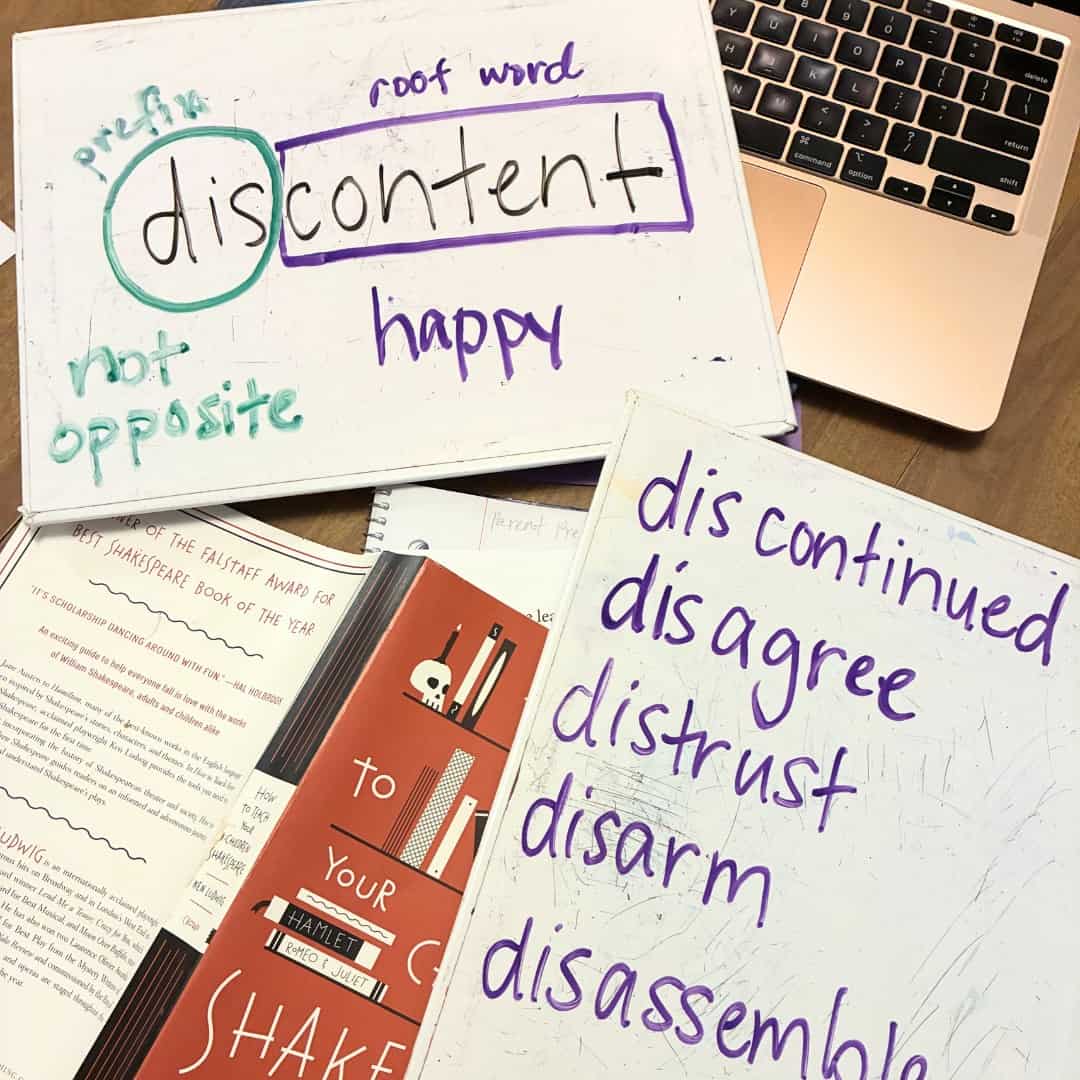
Here's an example...we read a Shakespeare play at the end of the year, and one of my kids stopped mid-sentence and asked, "What does discontent mean?" This happens more and more now. My kids interrupt to ask what words mean, and even though that can throw off a read-aloud, I love that they're curious enough to ask.
I knew discontent had the prefix dis-, so I wrote the word on a board, circled the dis, and explained that it means "not." Then we talked about content as the root word, meaning "happy." Put it together, and suddenly the word makes sense on its own. From there, we brainstormed other words starting with dis- — disarmed, disassemble — and talked about how the prefix shapes each one. All of that came from one question: "What does that word mean?"
Sometimes it's the origin of a word that unlocks it. We're currently listening to the audiobook of The Swiss Family Robinson in the car, and my oldest paused it to ask, "What does vociferously mean?" I was driving, half distracted, and felt that same old "I don't know vocabulary" feeling creep up. My first move is always the same question: how was it used in the sentence? She couldn't remember, so I had to think out loud in front of her. "Vociferously... v-o-c... that reminds me of voice or vocal. Maybe it has something to do with using your voice loudly." Then I handed her my phone and told her to look it up. Sure enough, it meant exactly that: to use your voice in a loud manner.
What excited me most wasn't that I guessed correctly. It was that she watched me work through it, and now I see her doing the same thing when new words come up. That's the whole point.
Final Thoughts
I'm genuinely excited about vocabulary right now, and I've been digging into ways to help you teach these skills naturally through literature too. I know not everyone feels confident knowing which prefixes or suffixes to teach when, so I'm working on resources to help with that, and I'll be sharing more soon.
But here's my real point: vocabulary doesn't have to be a list. It doesn't have to live in one subject or one workbook page. It can be something your whole family uses to understand more about the world around you, almost like its own mini-unit that opens doors into everything else you're studying.
These two strategies are simple. A quick question. A short conversation - done regularly, and that's it. But it's made a real difference in how my kids think about words, and I hope it does the same for yours.
Stay tuned, because I've got more to share on vocabulary soon.
Previous Post
Next Post
This post contains affiliate links. If you follow one of my links I earn a small commission at no extra cost to you. Thank you for supporting my blog.