Mystery of History Volume 1 Activities
I have been teaching a Mystery of History course at our co-op for the last two years. I'll admit I'm not a super-fan of history textbooks. I'd prefer a literature-based method of learning history, but the need was there, and I took my kids along with me to use this as our homeschool curriculum.
It's been a great experience. The best part of the gig is I get to do the fun activities about the lesson every week with the students in my classes.
It's not always easy looking for ideas. The Mystery of History curriculum does provide a digital guide containing multiple activities for a variety of ages. However, I have found that some of them don't translate well to a classroom with a handful of students that need all of the supplies.
So, I thought to myself, there must be other moms in the same shoes - teaching a co-op course and looking for enrichment to add some fun to a lesson. Or maybe you are just looking to add some hands-on learning to your lessons at home! Well, I'm hopeful this post can be just the thing to help inspire you in the process!
Class Set-Up and Schedule
This year, while teaching Volume 1, I'm actually working with two different age groups, and I usually do something different for each one. So I'll be sharing activities for a variety of ages in this post. My goals for my early elementary kiddos (1st-3rd) are to participate in hands-on learning activities and add in literature about the lessons whenever I can. My goals for middle school (6th-8th) is to incorporate a timeline, mapping, develop writing skills, group cooperation, and hands-on learning.
Students are assigned four lessons a week to read at home. When they come to class, we follow a schedule similar to this:
- Elementary: Lesson review (discussion), outside break, hands-on activity, book reading and coloring page (if available)
- Middle School: Lesson review (discussion), timeline, mapping (if time allows), activity
How to Read this Post
As I mentioned before, students are assigned to read four lessons per week. Instead of tracking all of that in this post, I'm going to list the specific lesson in bold that I decided to focus on and let you know the extra activity I planned to go with it. Since the textbook is organized by quarters, I'll organize it that way, as well.
Many times the activity is from the Digital Companion Guide, which is an incredible resource in this curriculum. Other times I have found instructions or activities in other places and will link them below.
My hope is for this to be a helpful resource to you that you can quickly scan for ideas.
If you are here in 2026-2027, this is a growing post! I will add to it as we work through the text. Thanks for being here!
Quarter 1
Elementary and Middle: Creation - Create an animal of your own out of air dry clay. I purchased clay from amazon and let the students pick three colors each from the box. Middle school was challenged to design some sort of adaptation that helped the animal survived. We took a few minutes at the end to present.
Elementary: Sumerians - The Sumerians are known for creating the wheel. So we made a fun paper wheel toy to remind us of this fact. I also brought legos for quick-finishers to build ziggurats. While they worked, I read "Creation" by Cynthia Rylant.
Middle: Teachers pay Teachers is such a helpful source for my middle school kids. You'll notice I use a lot of activities from there. I'm so thankful I have a budget to purchase things like this. Sumerians - Learning Stations from Brain Waves Instruction. We needed more time, but the amount we did was still meaningful and fun.
Elementary: Early Egypt - I was inspired by marshmallow mummies I saw online. A few allergies in my class prevented me from following it exactly so I made some adjustments. I bought a bag of frozen strawberries from Costco and some grapes and bananas and let the kids put fruit on a skewer. Then, we wrapped it in a fruit roll-up snack. They loved it!
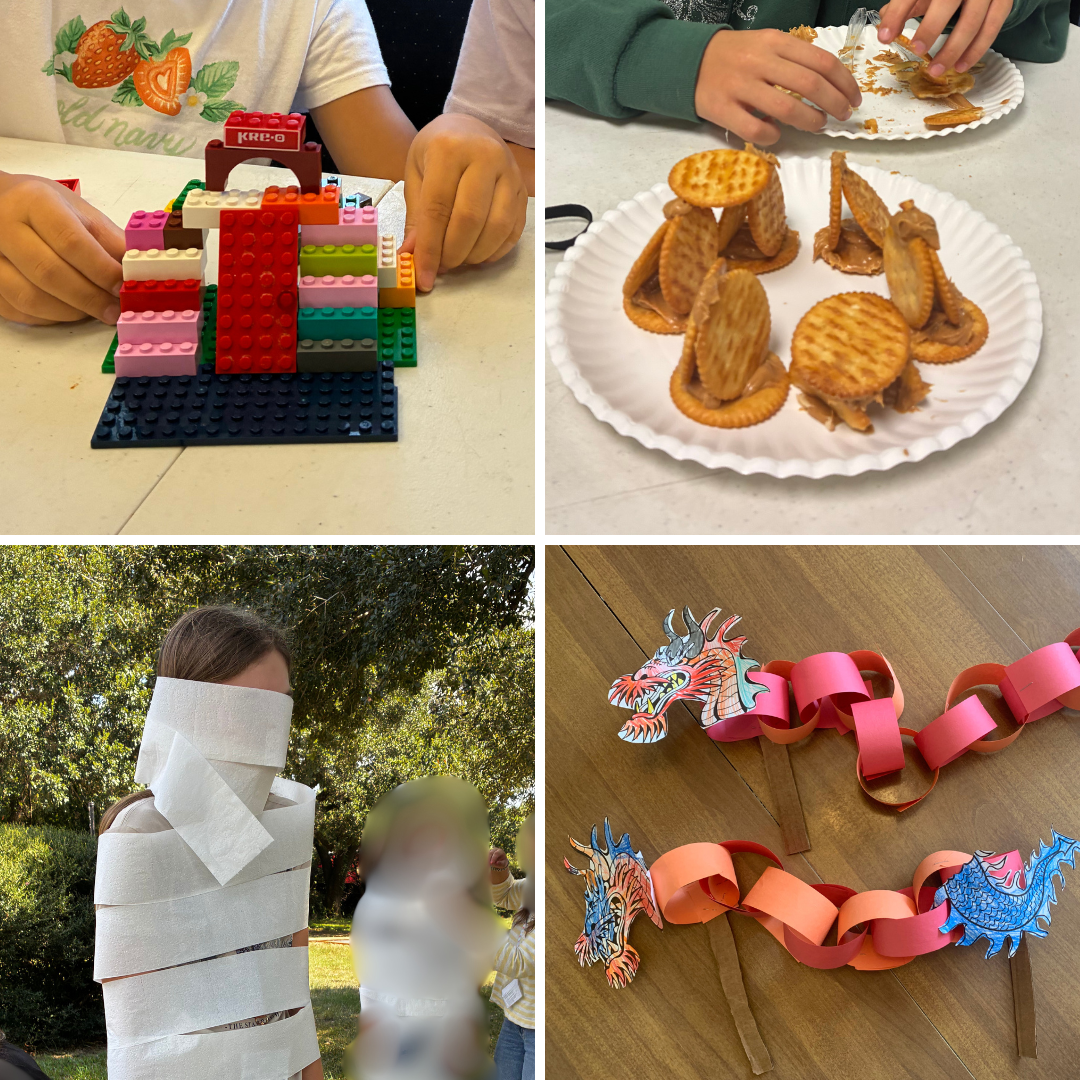
Middle: Stonehenge - create Stonehenge out of food items. This was accomplished with Ritz crackers and peanut butter on paper plates.
Elementary: Joseph - I purchased tissue paper squares and found a simple coat printable. All we needed was a glue stick and the kids had a blast putting these colorful coats together. It was a little something like this from Made to Be a Momma but without the contact paper.
Middle: Hammurabi - I found escape room activities from Think Tank on TPT last year, and I love them. They're minimal prep - no crazy envelopes or pieces to manage. It requires a bit of printing, but I love the way it makes us dig deeper into topics and encourages my students to collaborate with one another as they work to solve the code. We used this one for Hammurabi's code.
Elementary: China and the Shang Dynasty - I went back to one of my old blog posts when my own kids and I studied ancient China. We made paper chain dragons, which turned out so fun! There's a coloring page to print and chains to prep, but the prep isn't bad at all. (See directions in the old post I linked previously.) While the kid's colored I read a fantastic picture book about the Chinese language. This book is incredible. It's called "The Pet Dragon" by Christoph Niemann. As you read the story, the Chinese symbols are woven into the images. I encouraged the kids to put some of the symbols on their chains which was a fun way for them to practice that skill as well. I believe I read a second book this week related to the Moses and the Exodus lesson called "Miriam at the River" by Jane Yolen
Middle: China and the Shang Dynasty - I used an Ancient China Project from TPT. Almost all of the information they needed to fill out the blanks was in the lesson, so I had them get in groups and talk about it while filling it out. Then, I shared a couple videos. One video was about the making of silk and the other was about Chinese writing. Some students colored the activity while watching.
Elementary: Amenhotep IV and Nefertiti, Tutankhamen, and Ramses II - We made hieroglyphic bookmarks, as directed in the Digital Companion guide. I cut strips out of card stock and shared how to write their name. Then, the students decorated it. My laminator is pretty small, so I brought that with some string to tie at the end and fancy it up!
Middle: Amenhotep IV and Nefertiti, Tutankhamen, and Ramses II - The students wrapped each other in toilet paper this week. This was a lot of fun! I partnered kids up and gave them two minutes to wrap their partner as much as possible. The goal was to be the most-wrapped mummy. We did this casually at the end in my elementary class as well on a volunteer basis to fill a few minutes.
Elementary: The Legend of the Trojan Horse - I found a simple, printable activity for my younger class. They colored the horse, cut out the soldiers, and pasted the soldiers inside the horse. They really enjoyed it, and the best part was the printable was free!
Middle - no extra activity for this week. We played games using the questions from the Digital Guide to review what we learned for the quarter. I created a Scoot game using the questions. It's one of my favorites because it's quiet but active. See directions here.
Quarter 2
Elementary: King Saul - To remember that King Saul was the first king of Israel, the students made simple paper plate crowns. My assistant and I had to help with some of the cutting, but, other than that, they loved it!
Middle: Zhou Dynasty - I found an escape room created by Kyle Middleton on Teachers Pay Teachers. This one was set up a bit different than the one I usually prefer. It went really well, and we took it outside on a beautiful day.
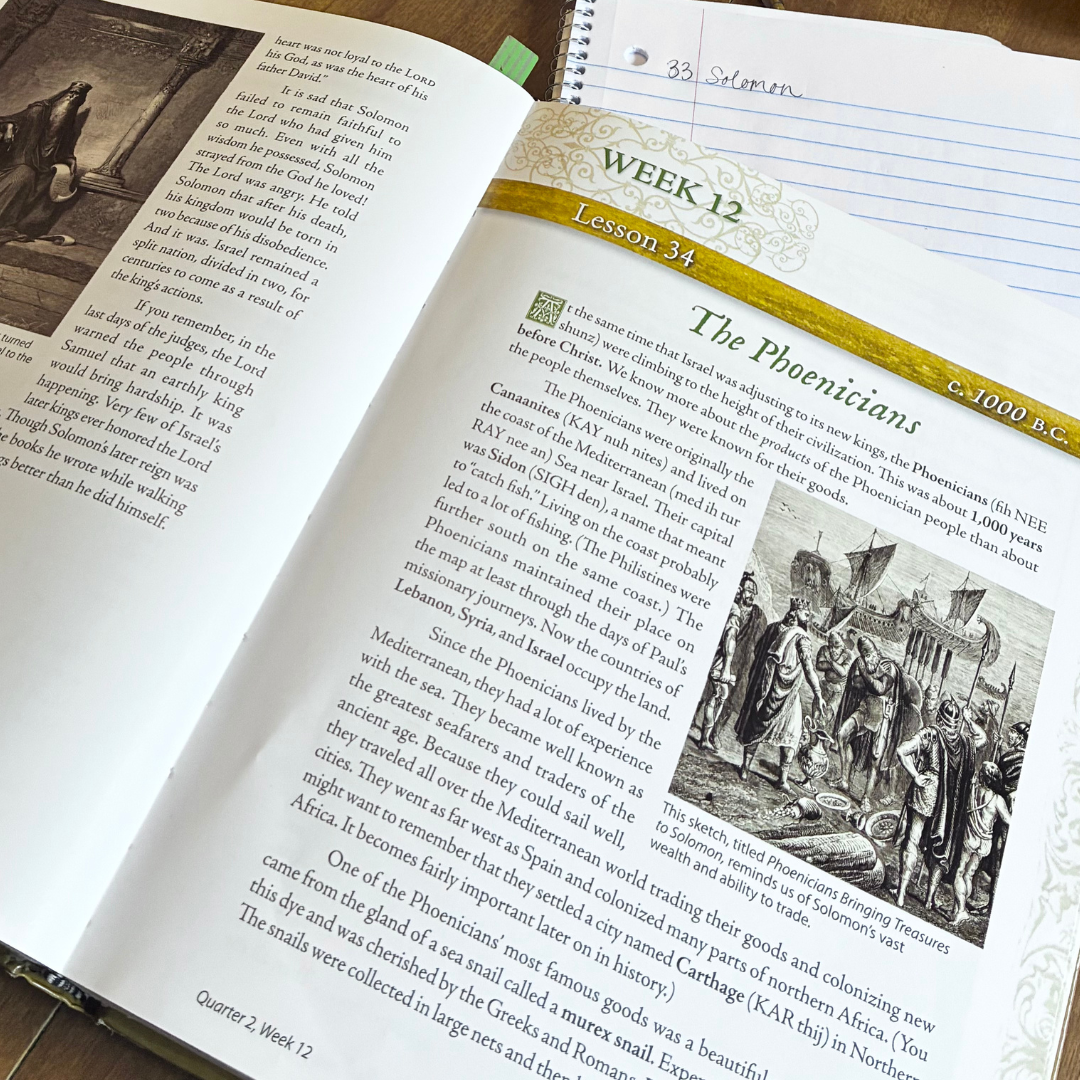
Elementary: Phoenicians - I taught the students how to make a paper boat. We made it together step-by-step. Next, I helped them add a wooden skewer (cut in half) and a square piece of paper for the sail. Finally, I printed clip-art of items that the Phoenicians would have traded. They were about the size of a quarter. The students colored and cut these photos and taped them in the boat as a reminder of the Phoenician trading.
Middle: Phoenicians - Another TPT resource saves the day. This one is called Ancient Phoenician Trade Routes Simulation by Blueberry Collage. Now, it's intimidating to look at when you first see it. Definitely run a practice round on your own so you get the hang of it. Once you do, it's worth it - it's such a blast! All you need is dice and it really does give the students a neat experience with trading.
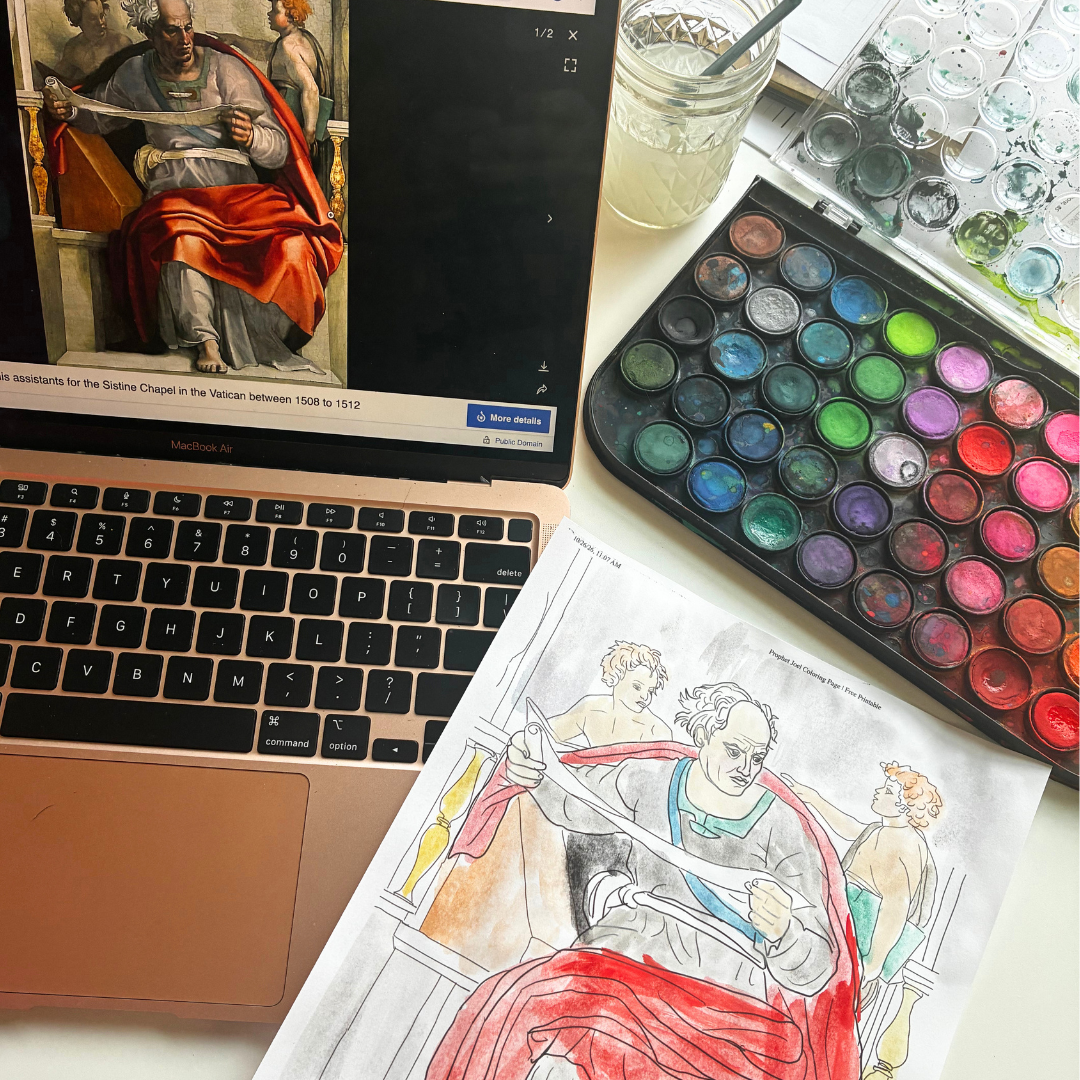
Elementary: Joel - The textbook shares a painting of Michelangelo's Joel from the Sistine Chapel. So, I extended this into a little art lesson. I shared a five-minute video on Michelangelo and his paintings. It was very child-friendly. Next, I printed a free coloring page of Joel onto cardstock and brought water colors for the kids to paint. If you could, it would be fun to tape it to the bottom of a chair and paint upside down like Michaelangelo might have.
Elementary: We studied the Olympic Games this week. Let me just say that a few backyard relay games would be just fine, and maybe I should have, but I was suckered into the cutest little Stuffed Animal Olympics activity from TPT. All of my students brought a stuffed animal to class, and we had a blast playing games with them.
Middle: I'll repeat what I said previously - a few backyard relay games would be just great for this. I was worried we'd run into rain, so I wanted something that could be played inside if needed. I found Cup Olympics from TPT. It turned out great. We did need quite a few cups, and once I downloaded the product I realized ping pong balls and a balloon were also necessary. I went a little over what I wanted to spend for this, and we skipped the balloon activity. We still had a great time doing it!
This is a growing post...come back soon for more!
Previous Post
Next Post
This post contains affiliate links. If you follow one of my links I earn a small commission at no extra cost to you. Thank you for supporting my blog.